During Dennis Linchey’s lifetime in Virginia and North Carolina, his surname morphed into Lindsey. At the end of this posting, I’ve appended links that will enable anyone interested in Dennis Linchey and in his life in the Virginia and North Carolina colonies to read more about him.
As the two postings I link above explain, the Isaac Lindsey whose male descendants’ DNA matches that of other males tracing their ancestry to Dennis Linchey is a bit of a mystery, in that the limited information we have about his life doesn’t seem clearly to connect him to other Lindseys to whom his descendants are a DNA match. Isaac died in April 1833 in St. Helena Parish, Louisiana.
One good clue about where his pre-Louisiana origins may lie, however, is his marriage on 9 July 1816 in St. Helena Parish to Mary Tate, daughter of John and Nancy Tate. As the postings linked at the head of this posting indicate, there’s solid documentation to show that John Tate’s family came to St. Helena Parish, Louisiana, in 1809 from Spartanburg County, South Carolina. It appears that John Tate himself made that move, having sold his land in Spartanburg County, but died either en route to Louisiana or soon after his family settled in St. Helena Parish.
In Spartanburg County, John Tate owned land on the Enoree River that bordered land of a William Lindsey who can fairly confidently be placed as a descendant of Dennis Linchey the immigrant. The August 1762 will of Dennis Lindsey in Granville County, North Carolina — this is the same man, Dennis Linchey, who arrived in Virginia in 1718 as an indentured servant — names a son William. This William is pretty certainly a William Lindsey (abt. 1733 – aft. 1806) who had a survey for land in July 1768 on the north side of the Enoree in what would become Spartanburg County. Spartanburg County records indicate that this William Lindsey had sons Dennis, William, and John. Since there was a period in which the older William and his son William were both of age in Spartanburg County and both lived on the Enoree, it’s not entirely clear whether the William with land joining John Tate’s land on the Enoree in 1809 was William Sr. or Jr. I have not found a clear death date for the older William.
What is clear is that John Tate, whose family moved from Spartanburg County, South Carolina, to St. Helena Parish, Louisiana, in 1809 and whose daughter Mary married Isaac Lindsey, had land joining that of William Lindsey in Spartanburg County, who lived near John Tate. Given the Y-DNA match between Isaac Lindsey’s male descendants and male Lindseys descending from William Lindsey, son of Dennis Linchey/Lindsey, who settled on the Enoree in 1768, and given Isaac’s marriage to John Tate’s daughter, it seems very likely that Isaac Lindsey fits somehow in the Lindsey family of Spartanburg County, South Carolina, descending from William Lindsey.
If that’s the case, the question is how the Isaac Lindsey who died in St. Helena Parish, Louisiana, in April 1833 fits into the Lindsey families in Spartanburg County, South Carolina, descending from Dennis Linchey’s son William (abt. 1733 – aft. 1806). As the two postings linked at the start of this posting indicate, there are very sparse records for any Isaac Lindsey living in Spartanburg County prior to 1809 when the Tate family moved from that county to St. Helena Parish, Louisiana. The two postings linked above note that when Dennis Lindsey, a proven son of William Lindsey (abt. 1733 – aft. 1806) of Spartanburg County, made a deed of trust to George Bruton in Spartanburg County in 1792, an Isaac Lindsey witnessed that deed. Note that Dennis Lindsey’s brother William named a son Isaac, but that Isaac had not yet been born in 1798; so this is an Isaac of a generation before the generation of William’s son Isaac.
As the linked postings also state, Dennis Lindsey’s son Mark Lindsey and his Dinsmore in-laws moved from Spartanburg County to Wayne County, Kentucky, in 1800, where Mark acquired land from George Bruton, who had also gone there from Spartanburg County. And shortly after this, an Isaac Lindsey begins appearing in Wayne County records, and then vanishes in a short period of time.
Was this Isaac Lindsey the same Isaac Lindsey who witnessed Dennis Lindsey’s deed of trust to George Bruton in Spartanburg County, South Carolina, in 1792? I’m strongly inclined to think so. I’m also strongly inclined to think that Isaac was a son of Dennis Lindsey and that he joined his brother Mark in Wayne County, Kentucky, for a brief period of time, and then very likely returned to Spartanburg County and in 1809, moved from there to St. Helena Parish, Louisiana, with the Tate family.
Now what I want to share are a few interesting new documents I’ve found in Wayne County records for this mysterious Isaac Lindsey who arrives there not long after 1800, when Mark Lindsey moved there, and then after a short period of time, disappears from Wayne County records. I’ve found these new records using FamilySearch’s new all-text AI search tool, which I discussed in a previous posting.
These records are all from Wayne County, Kentucky’s Court Order Book A:

In August 1803, court minutes note (p. 58) that an Isaac Lindsey was in Wayne County at this point. The minutes are ambiguous (to me, at least), and may be stating that Isaac Lindsey had made for a certificate for 100 acres of land and this had been denied.[1]
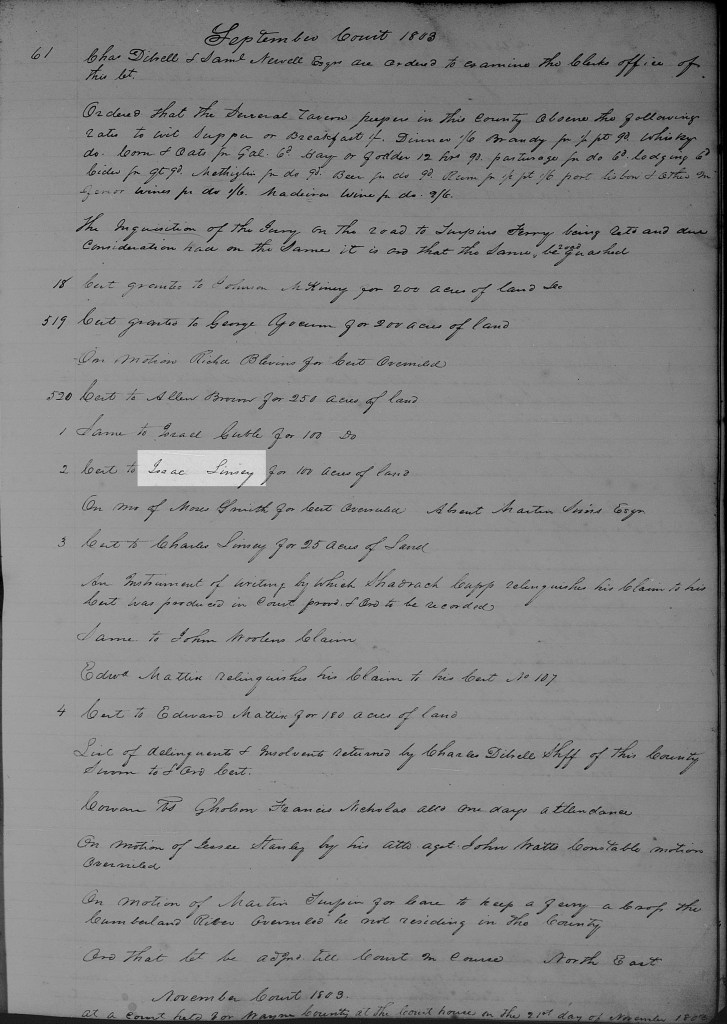
Then at September 1803 court, court minutes say (p. 61) that Isaac Linsey received a certificate for 100 acres of land.[2] The next certificate listed, for 25 acres, is to a Charles Linsey whom I cannot place.

Finally, at a court held on 25 October 1805, court minutes state (pp. 91-2) that Isaac Linsey, labourer, had been charged with having stolen a horse and bridle belonging to Abraham Vanwinkle, but denied that he was guilty of this charge and the court dismissed the charge (see the image at the head of the posting for p. 92).
After this, this mysterious Isaac just vanishes from any Wayne County records, that I have been able to find.
Abraham Vanwinkle was the patriarch of the Vanwinkle family in Wayne County. As a previous posting shows, in November 1801, Mark Lindsey and George Bruton were delegated by the court to lay out a road from the county seat of Monticello to Abraham Vanwinkle’s mill. In 1813 Mark Lindsey’s son Dennis married Jane Brooks, daughter of Thomas Brooks, in Wayne County. Then in September 1823, and Jane’s sister Margaret Brooks married Abraham Vanwinkle’s son Ransom Vanwinkle in Wayne County. The Brooks, Lindsey, and Vanwinkle families lived close to each other and were connected in a kinship network.
I really do think that the Isaac Lindsey who appears briefly in Wayne County records right after Mark Lindsey came there from Spartanburg County, South Carolina, and whose male descendants’ Y-DNA matches that of other Lindsey men with Spartanburg County roots was Mark Lindsey’s brother. I think Isaac is a son of Dennis Lindsey (abt. 1755 – 1795) we might not have discovered without this DNA match.
I think that Isaac went with his brother Mark to Kentucky in 1800 or shortly thereafter, tried to settle in Wayne County, found himself unsuccessful, and then returned to Spartanburg County after 1805, leaving there in 1809 for St. Helena Parish, Louisiana, when John Tate, whose daughter Mary Isaac married in 1816, left Spartanburg County for St. Helena Parish.
Some resources if you want to read more about Dennis Linchey/Lindsey (abt. 1700 – 1762), the progenitor of the Lindseys discussed in this posting:
Dennis Linchey/Lindsey (abt. 1700-1762): The Indentured Servant Years
Dennis Linchey/Lindsey (abt. 1700-1762): Post-Indenture Life in Virginia
Dennis Linchey/Lindsey (abt. 1700-1762): Post-Indenture Life in North Carolina to 1750
Dennis Linchey/Lindsey (abt. 1700-1762): Post-Indenture Life in North Carolina, 1750-1762
Dennis Linchey/Lindsey (abt. 1700-1762): Do DNA Work and Prepare for Surprises
[1] The record is ambiguous and I may be misreading it. It may be saying that John Smith’s application for a certificate for 300 acres had been overruled by the motions of Moses Smith and Isaac Lindsey. In either case, this record shows us that Isaac Lindsey was in Wayne County by August 1803.
[2] Again, this record is ambiguous to me. After stating that Isaac Lindsey (Linsey in the original) had a certificate for 100 acres of land, court minutes say that on the motion of Moses Smith for the certificate was overruled. Does this mean that Smith objected to issuing the certificate for the land to Isaac Lindsey and Isaac did not get the certificate?
 BEGATS AND BEQUEATHALS