I began this project with a focus on my paternal family lines, on my Lindsey family specifically. I did that because DNA findings had recently helped those of us researching our Southern colonial Lindsay/Lindsey families to make some significant breakthroughs: the discovery that male members of my Lindsey family have a genetic signature, Irish Type III, unique to the Dalcassian families related to Brian Boru, the early Irish king of County Clare, paved the way for my recognition that my Lindsey family descends from a young Irish immigrant, Dennis Linchey, who came to Richmond County, Virginia, as an indentured servant in 1718. With his surname spelling morphing into Lindsey during his lifetime: Linchey is a variant spelling of the Irish surname Lynch….
As I keep climbing up interconnected paternal family lines here, I don’t mean to slight my maternal family lines, some of which are quite interesting (and dear to me). The ongoing focus on my paternal family lines is an outgrowth of my initial decision to concentrate on my Lindsey family, since, when I launched this blog, I had begun chairing a research group of those who share my Dennis Linchey ancestral line and who were using DNA findings to help guide our genealogical research.
The family line I’m beginning to focus on with this posting is yet another paternal family line. As I move up my family tree to my father’s grandmother Mary Ann Green (1861-1942), I then go on to connect a number of generations prior to Mollie Green Lindsey to my Kerr ancestral line. The Kerrs link to other family lines I’ve already tracked here in detail in addition to the Green line: Birdwell, Leonard, Lauderdale, James, and Calhoun.
As a subsequent posting will show, this Kerr family line descends from a James Kerr who died prior to 20 March 1770 in Augusta County, Virginia, and who came there from Lancaster County, Pennsylvania, when Augusta was still part of Orange County. James’ origins aren’t clearly known. There are some rather hazy traditions that he was Scottish-born and spent time briefly in Northern Ireland before coming to Pennsylvania. I have not seen real confirmation of those traditions. What is clear is that like the Pickens family with which James Kerr’s family was closely connected from the Pennsylvania years forward, and like the Calhoun and Lauderdale families that tie into this family line in my family tree, the Kerrs were among many families of Scottish descent who arrived in the Middle Colonies primarily from Ireland in the first decades of the 18th century and then made their way down into western Virginia.
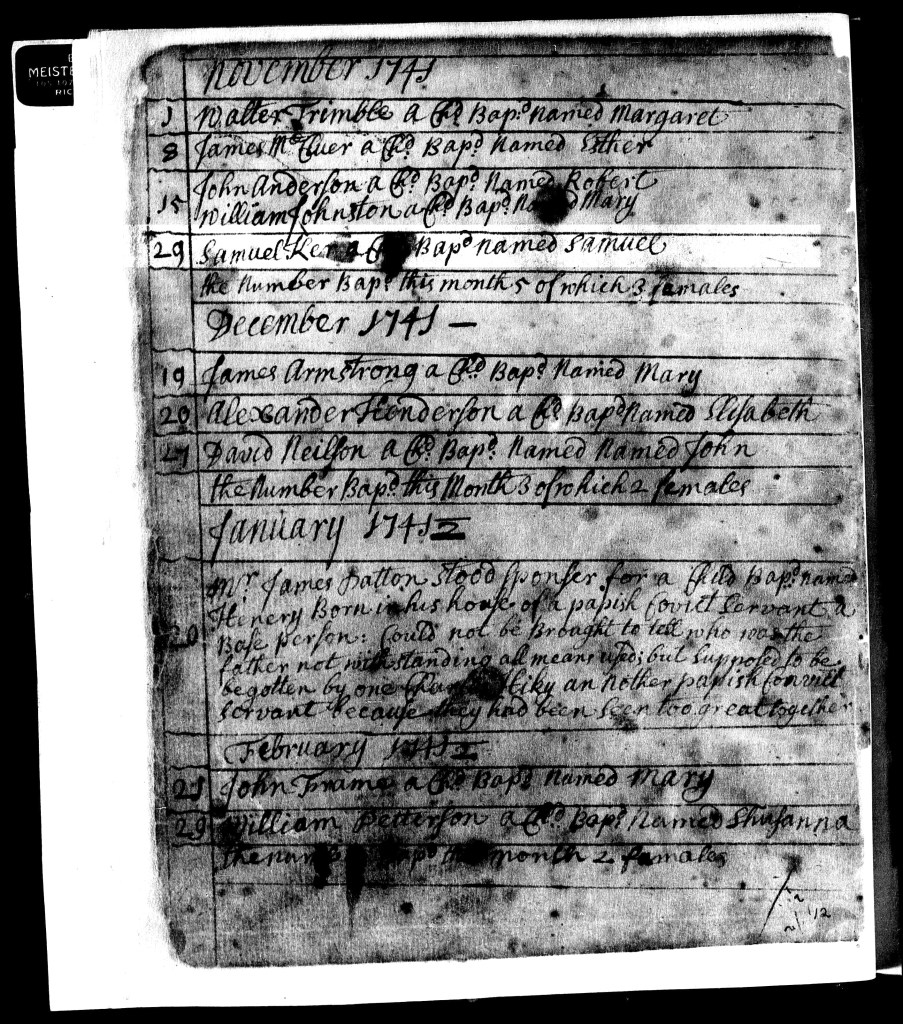
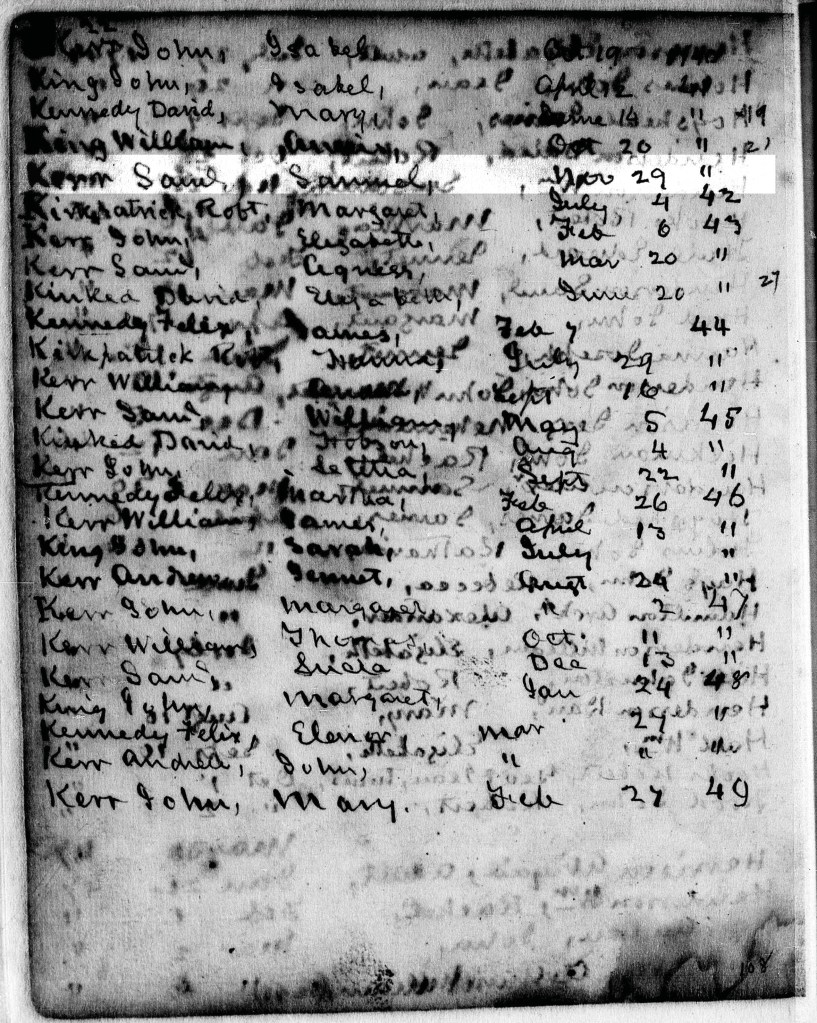
In a previous posting, I provided a brief précis of what I know about Samuel Kerr, who married Mary, daughter of Ezekiel Calhoun and Jane/Jean Ewing, and whose daughter Jane married John Green, great-grandparents of my great-grandmother Mary Ann Green Lindsey. That posting notes that Samuel Kerr was the son of Samuel Kerr and Margaret Pickens and that his baptism on 29 November 1741 at Tinkling Spring Presbyterian church in Augusta County, Virginia, was recorded by Reverend John Craig in a registry he kept as he pastored this church.[1] As a subsequent posting will note, the founder of this Kerr family in Augusta County, James Kerr, played a leading role in the Tinkling Spring church from its inception.
Since the posting I linked at the start of the preceding paragraph points to documentation that provides a solid foundation for what I’ll be sharing in future postings about this Kerr family, it’s worth my replicating in toto here, with a few alterations I’ll explain later, what I said in that posting about Samuel Kerr and his parents Samuel Kerr elder and Margaret Pickens. I stated:
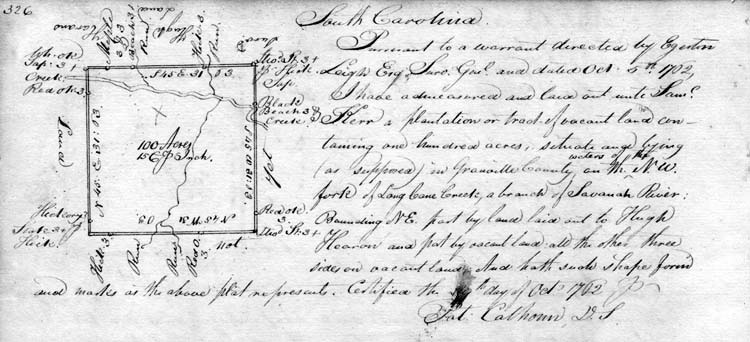
I have not found a record of when Mary Calhoun married Samuel, son of Samuel Kerr and Margaret Pickens. Since Samuel and Mary had a son (John) born by or around 1766, then I think it’s likely they married by or about 1764. It appears that Samuel’s parents arrived in the Long Cane settlement by 5 October 1762, when Samuel had a warrant for a survey in the Long Cane settlement, and on 19 October 1762, Patrick Calhoun surveyed 100 acres on waters of the northwest fork of the Long Cane in Granville (later Abbeville) County, South Carolina, for Samuel Kerr.[2]
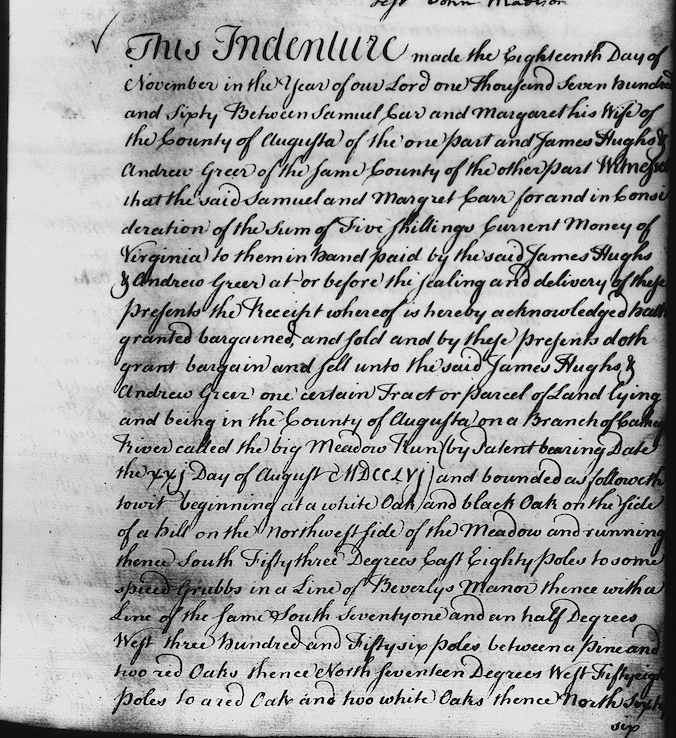
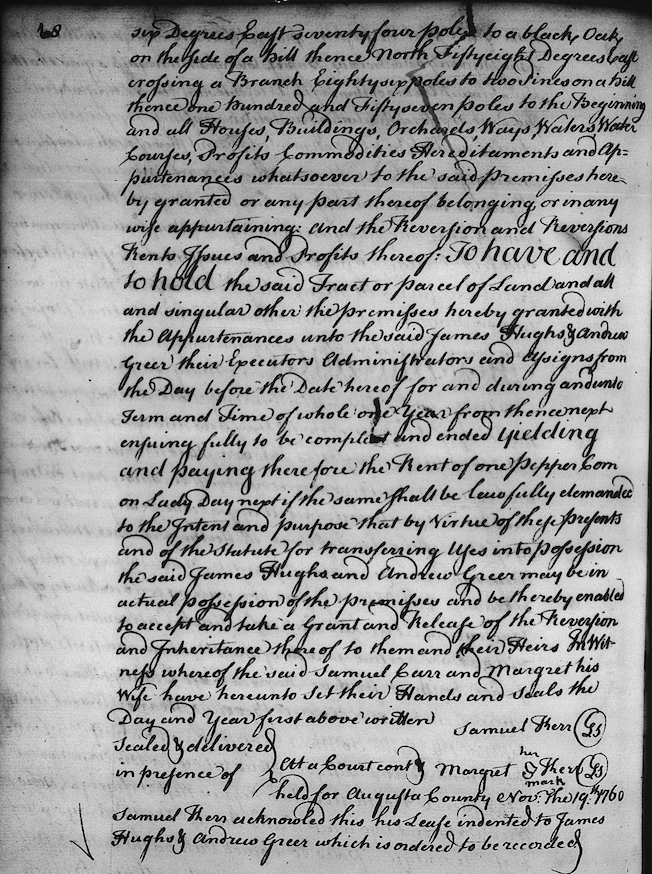
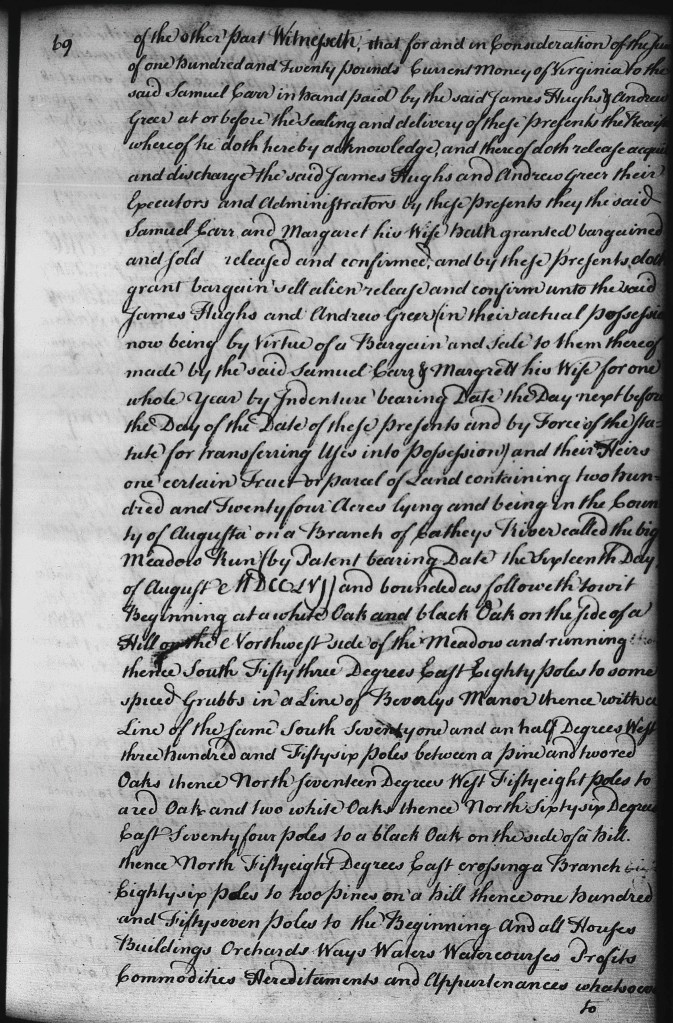
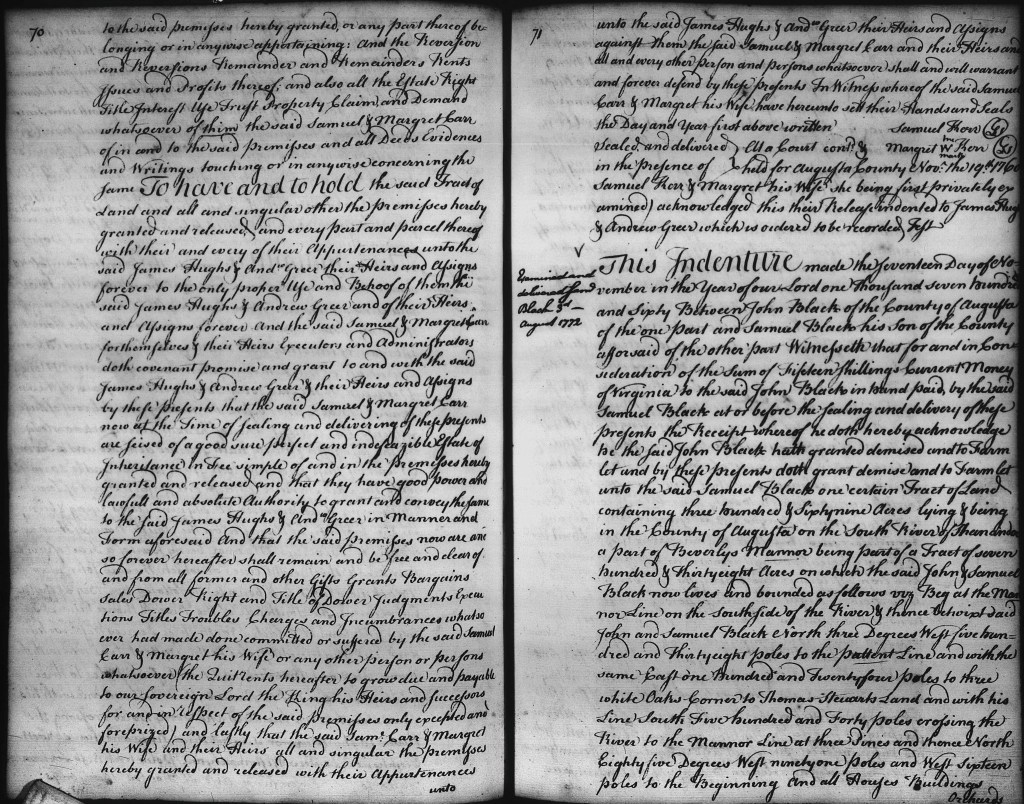
Prior to this, on 18 November 1760, Samuel and wife Margaret had sold their homeplace of 224 acres on Big Meadow Run in Augusta County, Virginia, to James Hughes and Andrew Greer.[3] The deed states that Samuel had acquired this land, which was on Big Meadow Run of Cathey’s River on the Beverly Manor line, by patent dated 21 August 1756, and it speaks of houses and buildings that were being sold with the land. Both Samuel and wife Margaret signed it, Margaret making her mark. It’s evident from the deed that Samuel and Margaret were selling their homeplace to move away from Augusta County. As Howard McKnight Wilson notes in his history of Tinkling Spring church, the Kerr family were among the earliest settlers of Augusta County, settling on “a choice spot of land” at the juncture of Christian’s Creek, Long Meadow Run, and Middle River (i.e., Cathey’s River).[4]
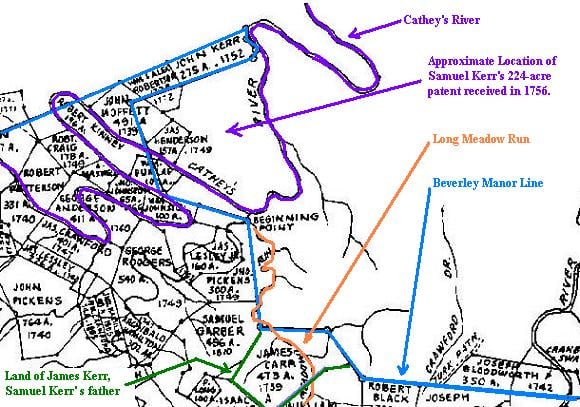
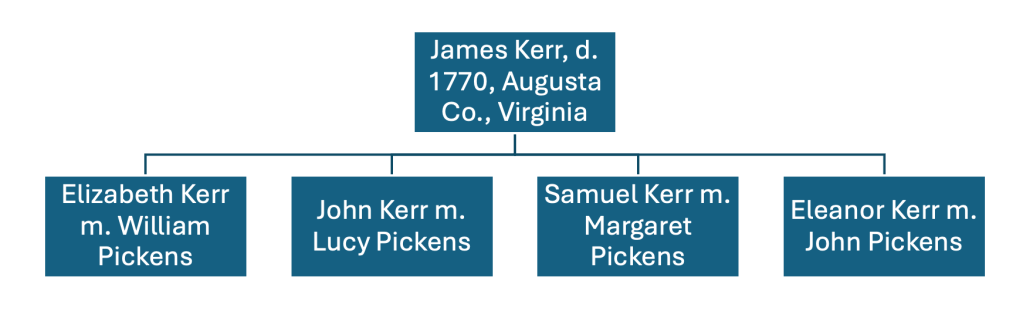
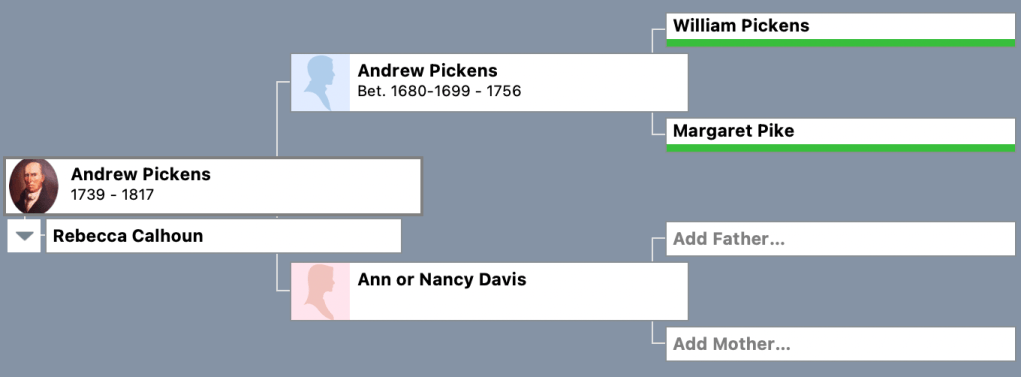
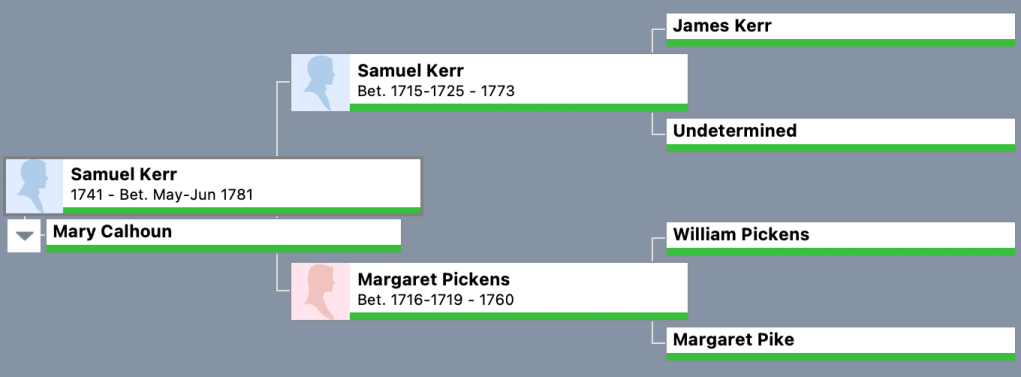
As a map of plats contiguous to Samuel Kerr’s 224-acre tract in Augusta County drawn by J.R. Hillebrand and reproduced on a page for Samuel Kerr in the Early Settlers of Augusta County, Virginia project shows, living just south of and very close to Samuel and Margaret Pickens Kerr in Augusta County was Margaret’s brother John Pickens, who married Samuel’s sister Eleanor Kerr.[5] John and Eleanor Kerr Pickens had left Augusta county by 21 November 1754 after selling their homeplace on 9 October 1754.[6] The Pickens and Kerr families had been closely connected for quite some time, and were thickly intermarried. John Kerr, brother of Samuel who married Margaret Pickens, married Margaret’s sister Lucy Pickens; and Elizabeth Kerr, a sister of John and Samuel Kerr, married Margaret Pickens’s brother William Pickens. Four Kerr siblings (Elizabeth, John, Samuel, and Eleanor) married four Pickens siblings (William, Lucy, Margaret, and John), then. These four Pickens siblings were aunts and uncles of Andrew Pickens who married Rebecca Calhoun, sister of Mary Calhoun Kerr.
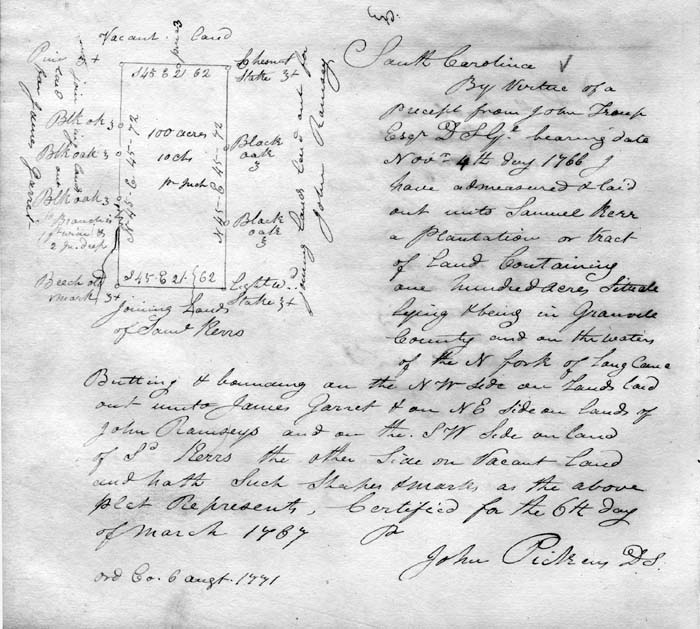
After leaving Augusta County, Virginia, John Pickens (with wife Lucy Kerr) moved to the Long Cane settlement, and when a Samuel Kerr who was either Samuel with wife Margaret Pickens or their son Samuel had a survey on 6 March 1767 for 100 acres adjoining the 100 acres surveyed for Samuel Kerr in October 1762 in Granville (later Abbeville) County, John Pickens was the surveyor of the tract.[7] The precept for Samuel’s survey was dated 4 November 1766. If this land was surveyed for Samuel Kerr younger, I think it’s likely that he and Mary Calhoun had married by the time he received this precept in November 1766 for a 100-acre survey next to his parents. Along with Alexander Noble, both a first cousin of and brother-in-law of Mary Calhoun, a Samuel Kerr who is wither Samuel Kerr with wife Margaret or their son Samuel had witnessed a deed of James and Frances Cain to Alexander McPherson for land on the Savannah above the mouth of Long Cane in Granville County on 27-8 June 1764.[8]
Mary Calhoun’s sister Rebecca married Andrew Pickens in the Long Cane settlement on 19 March 1765. The marriage date is recorded in the journal kept by Rebecca’s uncle William Calhoun, which was discussed in a previous posting.[9] As these marriages show, by the time Samuel Kerr married Rebecca Calhoun’s sister Mary (it seems to me their marriage took place not long before the marriage of Andrew and Rebecca), the family of Ezekiel Calhoun had connected to the Kerr-Pickens kinship network, all of these families coming down to the Long Cane settlement from Augusta County, Virginia.
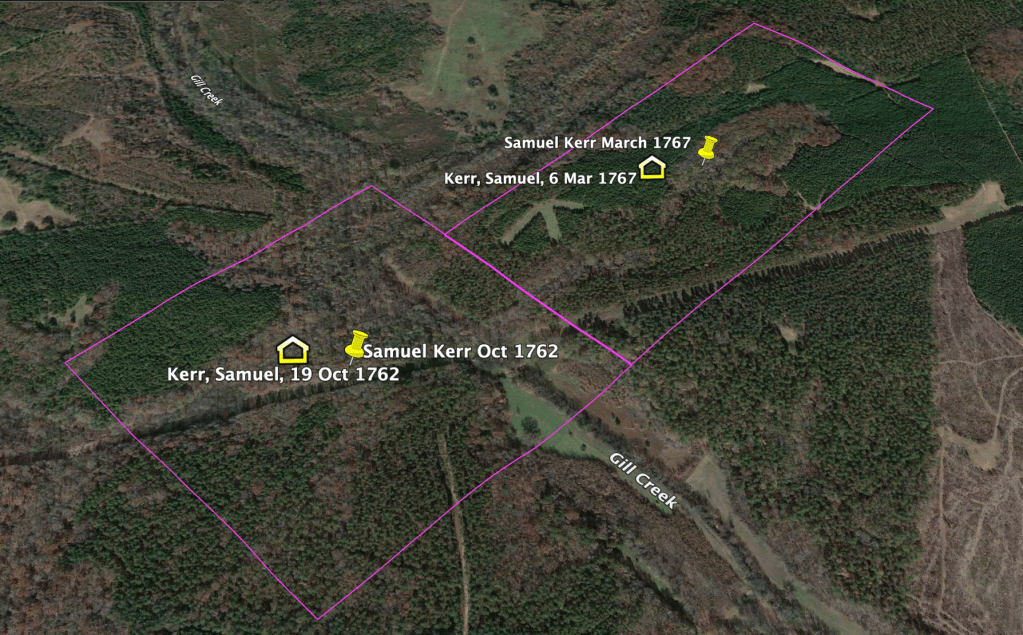
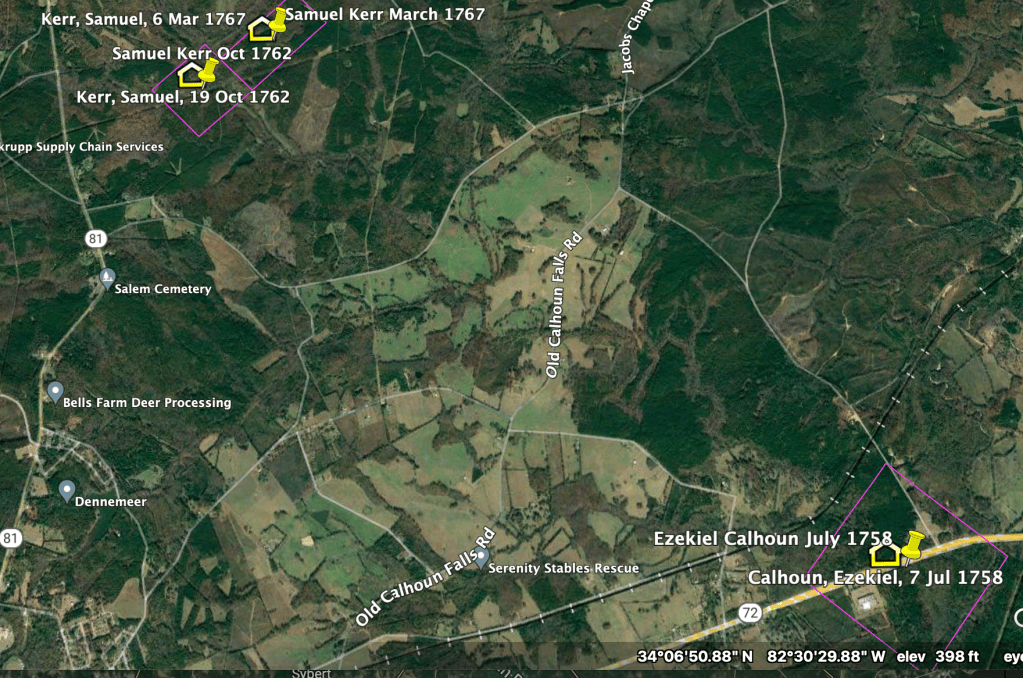
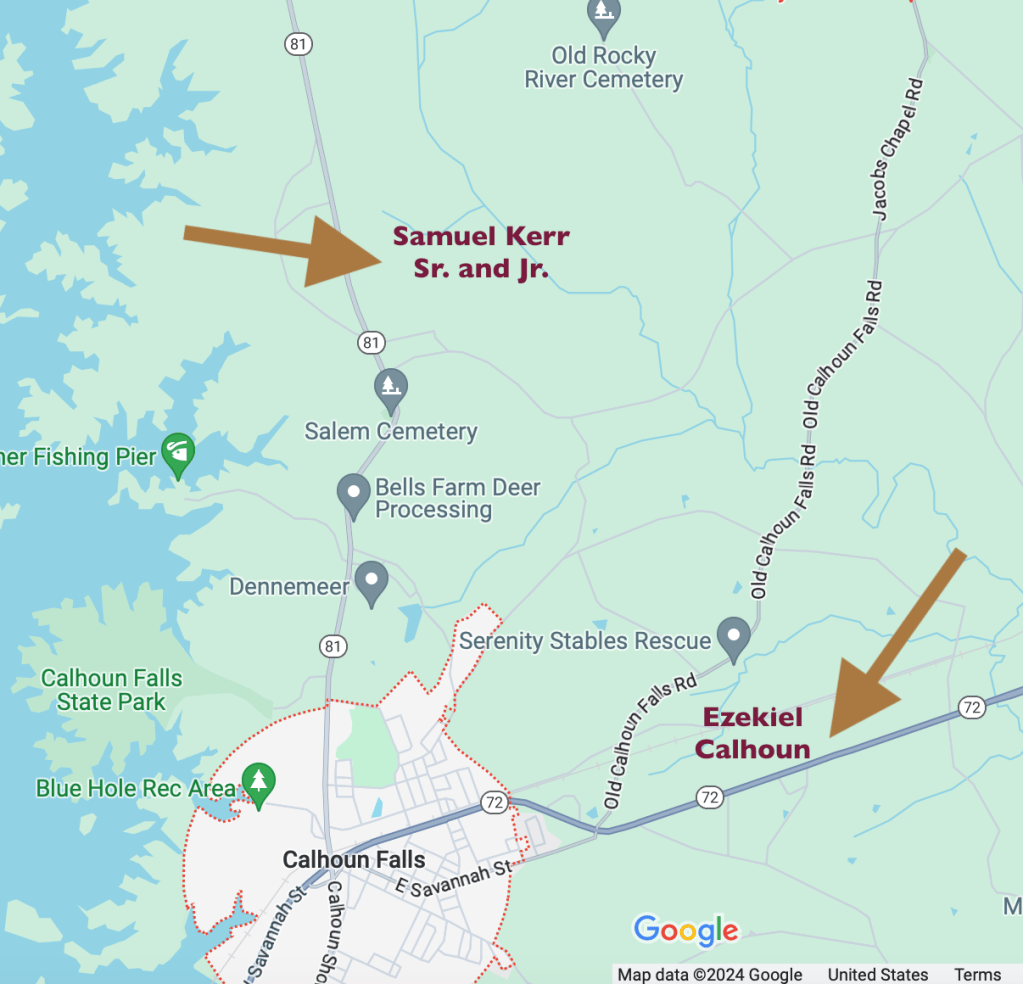
Bob Thompson’s Google Earth plat maps for early Long Cane settlers, discussed previously, show that a survey of 350 acres for Ezekiel Calhoun made by Patrick Calhoun on 7 July 1758 was only some six miles southeast of the two plats for Samuel Kerr elder and younger I’ve just discussed.[10] Ezekiel’s tract was just east of present-day Calhoun Falls, just east of where Old Calhoun Falls Road (outside Calhoun Falls on the east side) joins highway 72. Ezekiel’s land was on both sides of what’s now highway 72. The two Samuel Kerr tracts were northwest of Ezekiel’s land, just east of highway 81 not far north of Salem cemetery and a bit southwest of Old Rocky River cemetery.
Following their marriage, Samuel Kerr and Mary Calhoun raised four children in what would become Abbeville County in 1785: John, who may have been born in or by 1766, as stated above; Jane, born 8 October 1768; Catherine, born in 1774; and Ruth, born in 1779. And then it appears that Samuel Kerr was killed during the Revolution, though the date and place of his death are unclear, with various records providing conflicting information, a point I’ll discuss in a later posting focusing on Samuel and what I know of him. If a payment made to Mary as Samuel’s widow recorded in South Carolina Annuitants Claims has trustworthy information about the date of Samuel’s death, he was killed in 1781: this is stated in a payment of £8 15s made to Mary as the widow on 19 May 1785.[11]
So the preceding paragraphs highlighted with quote bars marking their left-hand sides are what I had posted previously about this Kerr family line as I discussed my ancestor Mary Calhoun, daughter of Jane/Jean Ewing, who married Samuel, son of Samuel Kerr and Margaret Pickens. In my next postings, I’ll track this Kerr line further back in time, noting, as I do so, some problem areas that make this particular family line a challenge to put together:
1. James Kerr, the progenitor of this family of Kerrs, died intestate, and this makes determining the list of James’ children problematic.
2. The Samuel Kerr with wife Margaret who is, Jim Veregge concludes, one of James’ sons, is mentioned less in Augusta County, Virginia, records than are the other fairly well proven sons of James Kerr.[12] In a subsequent posting, I’ll discuss why I think this conclusion of this accomplished researcher of this Kerr family — that Samuel Kerr with wife Margaret is a son of James Kerr — deserves serious attention
3. Information about Margaret Pickens, a proven daughter of William Pickens and Margaret Pike, is sketchy and conflicting. As stated above, William and Margaret Pike Pickens’ children Lucy, William, and John married Kerr siblings, children of James Kerr. It has not been definitively proven that Margaret was yet another child of William and Margaret Pike Pickens who married a child of James Kerr, though I think there are very strong reasons for reaching that conclusion. I’ll explain those in a subsequent posting.
4. It’s not crystal clear what became of Samuel and Margaret Kerr when they sold their homeplace on Big Meadow Run in Augusta County, Virginia, in November 1760. As my précis of Kerr family information above states, I’m confident that Samuel elder and wife Margaret then moved from Virginia to the Long Cane settlement in the South Carolina upcountry and that it was Samuel Kerr with wife Margaret who had a warrant for a survey on waters of the Long Cane in October 1762. If this warrant was for Samuel elder as I think it was, then what became of him and Margaret after they settled on their 100 acres isn’t entirely apparent: did Samuel and Margaret remain in the Long Cane colony, and when did they die?
5. The baptismal register of Reverend John Craig of Tinkling Spring Presbyterian church in Augusta County, Virginia, shows Samuel Kerr (with wife Margaret) having a son Samuel baptized 29 November 1741. Is this the man named Samuel Kerr who, it can be proven, married Mary, daughter of Ezekiel Calhoun and Jane/Jean Ewing of the Long Cane settlement? It’s clear to me that the two Samuels are the same person, but beyond a statement in the will of the younger Samuel’s brother William that Mary Kerr was William’s sister-in-law, absolutely clenching documentation to prove the identity of Mary’s husband Samuel Kerr is elusive.
6. As noted previously, on 19 October 1762, Samuel Kerr had a survey for 100 acres on waters of Long Cane in Granville (later Abbeville) County, South Carolina. Then on 6 March 1767, Samuel Kerr had a survey for another 100 acres on waters of Long Cane adjoining the tract surveyed in October 1762. The second survey and all paperwork connected to it (e.g., the grant and memorial) state that the second tract adjoined “said Kerr’s” first tract. Does this mean that the same Samuel Kerr, presumably Samuel with wife Margaret, obtained grants of two adjoining tracts of 100 acres? Or does it mean that Samuel, son of the elder Samuel, obtained the grant for the second tract of 100 acres? I’ll deal with this confusion in my next posting.
7. Finally, information about when and how Samuel Kerr, husband of Mary Calhoun, died is very muddled, with primary sources offering conflicting information and no source offering an absolutely certain date and place of death. This is another bit of confusion I’ll deal with in a subsequent posting.
[1] See “Book containing baptisms, Oct. 1740-Sept. 1749,” in the collection of the personal papers of Reverend John Craig (held by Union Theological Seminary’s library in Richmond) filmed and digitized by the Family History Library in Salt Lake City and available digitally at FamilySearch. See also Howard McKnight Wilson, The Tinkling Spring, Headwater of Freedom: A Study of the Church and Her People, 1732-1952 (Fishersville, Virginia: Tinkling Spring and Hermitage Presbyterian Churches, 1954), p. 477, extracting the baptisms of Samuel and Margaret Kerr’s four children by Reverend Craig at Tinkling Spring, 1741-7. As William J. Roulston notes, in Presbyterian churches in Scotland and Ireland, “Generally speaking, the baptism of a child took place within a few weeks or months of the date of birth”: see Researching Presbyterian Ancestors in Ireland (Glasgow: Bell & Bain, 2020), p. 70.
[2] South Carolina Colonial Plats Bk. 7, p. 326. The grant was made 8 March 1763: South Carolina Colonial Land Grants Bk. 11, p. 2, and the memorial was recorded 1 April 1763: South Carolina Memorials Bk. 6, p. 65.
[3] Augusta County, Virginia, Deed Bk 9, pp. 67-8. The deed gives the surname as Carr. Samuel and Margaret Kerr’s acknowledgement of their deed is recorded in Augusta County, Virginia, Court Order Bk. 6, p. 431, 19 November 1760.
See also “Samuel Kerr’” in the Early Settlers of Augusta County, Virginia project at WeRelate.org; and Marcia McClure, “The Kerr Family from Augusta Co, VA to Abbeville Co, SC” at the Upcountry South Carolina Green Families website; and Jim Veregge, “Descendants of James Kerr” at Rootsweb.
[4] Howard McKnight Wilson, The Tinkling Spring, Headwater of Freedom, pp. 11-12.
[5] See “Samuel Kerr” in the Early Settlers of Augusta County, Virginia project.
[6] See “John Pickens,” in the Early Settlers of Augusta County, Virginia project at WeRelate.org, citing Lyman Chalkley, Chronicles of the Scotch-Irish Settlement in Virginia, Extracted from the Original Court Records of Augusta County, 1745-1800 (Rosslyn, Virginia: Commonwealth Printing, 1912), vol. 1, p. 312, abstracting Augusta County court judgments, case of Andrew Lewis v. John Pickens, which states that John Pickens had removed himself out of the county by 21 November 1754. See also Veregge, “Descendants of James Kerr.”
[7] South Carolina Colonial Plats Bk. 17, p. 428. The grant for this tract was made 22 August 1771: South Carolina Colonial Land Grants Bk. 24, p. 153. The memorial was made 20 August 1771: South Carolina Memorials Bk. 11, p. 52.
[8] South Carolina Deed Bk. E-3, p. 129.
[9] The journal of William Calhoun is transcribed in A.S. Salley, Jr., “Journal of William Calhoun,” Publications of Southern Historical Association 8,3 (May 1904), pp. 179-195.
[10] South Carolina Colonial Plats Bk. 6, p. 382. The grant for the 350-acre tract describes it as Spring Hill on the northwest fork of Long Cane: South Carolina Grant Bk. 9, pp. 7-8.
[11] See Annuities for Persons Hurt in the Service of the State, 1778-1786 and House of Representative Claims and Pension Reports, 1787-1796, transcribed in South Carolina Magazine of Ancestral Research 1,2 (spring 1973), p. 67, and 1,3 (summer 1973), p. 159. See also Bobby Gilmer Moss, Roster of South Carolina Patriots in the American Revolution (Baltimore: Genealogical Publishing Company, 1983), p. 530. According to Francis B. Heitman, Captain Samuel Carr (as he gives the surname) was “mortally wounded” at the battle on Long Cane on 4 December 1780: see Historical Register of Officers of the Continental Army During the War of the Revolution: April, 1775 to December 1783 (Washington, D.C.: Lowdermilk, 1890), p. 146. However, Samuel Kerr’s South Carolina Account Audited of Claims Growing Out Of The American Revolution (no. 4253, available digitally at the website of South Carolina Archives and history) shows Samuel paid for supplying bacon for the militia in 1780 and then serving as a mounted lieutenant in 1781 and 1782. A receipt in this file shows John Ewing Calhoun signing on behalf of Mary Kerr (John’s sister) on 2 May 1785 in receipt of her payment on indent 677. Samuel Kerr’s stub entry for a South Carolina Revolutionary indent (no. 677, vol O) was issued 2 May 1785, and shows Samuel Kerr paid £67 pounds 10 s 2½d for militia duty as a lieutenant in 1781 and 1782 and for providing bacon for militia use in 1780: see Wylma Anne Wates, Stub Entries to Indents Issued in Payment of Claims against South Carolina Growing out of the Revolution (Columbia: South Carolina Historical Commission, 1915), p. 110.
[12] Veregge, “Descendants of James Kerr.”


So glad that you’ve gotten around to your Kerrs!!
LikeLike
Glad that you’re working on the Kerrs!
LikeLike
So much of the ground-breaking work I’m relying on is your work!
LikeLike