Immediately after David and Margaret’s arrival in South Carolina, he received a South Carolina land grant under the terms of the “Poor Protestants” act on Jamie’s Creek, waters of the Tyger River in what would become Spartanburg County, and he and Margaret settled in that vicinity and began a family: James, Mary, John, Mary Jane, and a daughter whose given name I have not found. When the Revolutionary War broke out, David took the British side as did many recent immigrants from overseas who had settled in the North and South Carolina upcountry. When Charleston fell, David shipped to Nova Scotia and obtained a Loyalist land grant there at Rawdon in Hants County. He sold this grant and bought more land from a Densmore family that had come to Nova Scotia from Ulster and who were surely his relatives, mortgaged that land, and then vanished from all records after January 1787. It appears he did not ever return to Margaret and his children, who had remained in Spartanburg County, South Carolina, where Margaret appears as head of the household on the 1790 federal census.
About 1793, David and Margaret’s daughter Mary Jane married Mark Lindsey, son of Dennis Lindsey of Spartanburg County, and in 1800, Margaret Dinsmore and her son John sold what had been David’s land in that county and moved with Mark and Mary Jane Dinsmore Lindsey from South Carolina to Wayne County, Kentucky. David had a wife Phebe whose given name appears in a deed in Wayne County mentioned below. Phebe may have been a member of the Spartanburg County Woodruff family.
As a previous posting notes, in September 1801 the Wayne County court order book states,[1]
At the motion of Margaret Dinsmore, satisfactory proof being made to the court, the court is of opinion she is entitled to 100 acres of land.
The posting I’ve just linked suggests that Margaret had applied for the 100-acre grant under terms of the Headright Claims act of 21 December 1795, though technically that act restricted patents to men over 21 years of age with families.[2]
As the linked posting also indicates, Wayne County’s court order book notes on 14 July 1801 that Margaret’s son John had claimed a grant of 150 acres on or by that date.[3] John relinquished this claim the following November with no reason for the relinquishment stated in the court record, though court minutes specify that the land he had claimed was warranted by certificate no. 244.[4]
John Dinsmore began to appear on Wayne County tax lists in 1801, when he was taxed on 24 December for two horses.[5] In 1802, John began to be taxed for 200 acres on Otter Creek in Wayne County.[6] John continues to appear on the Wayne County tax list up through 1820, after which he moved to Lawrence County, Alabama, always taxed for the same 200 acres on Otter Creek.[7] On 26 February 1821, John and wife Phebe sold their land in Wayne County in order to move to Alabama.[8]
Up to 1806, Margaret Dinsmore does not appear on the Wayne County tax list. In 1806, she is listed next to her son John and is taxed for 100 acres on Otter Creek with the tax list indicating that Margaret had entered this land. John is taxed for his own 200 acres on the 1806 tax list.[9] In 1807, the tax list shows John taxed for both his 200 acres and 100 acres that had been entered — the tax list states this — by Margaret Dinsmore.[10] In 1808, John is taxed for his 200-acre tract alone. But in 1809, 1810, and 1811, the tax list shows John being taxed for both his own 200 acres and an additional 100 acres entered by the Widow Dinsmore (1809) or, as the 1810 tax list states, by Margt. Dinsmore. The 1811 tax list has the additional 100-acre tract listed as if it were entered by John Dinsmore himself and makes no mention of Margaret or the Widow Dinsmore. From 1813 up to 1820, John is taxed only for his 200-acre entry and no further mention of Margaret’s 100 acres appears on the Wayne County tax list.
My deduction is that Margaret died in 1806 or in 1807 before 22 May. I have found no record of her death. I have also found no grant to Margaret for the 100 acres nor any indication of what happened to this land other than the statement on the 1809-1811 tax list that John was taxed for his own entry of 200 acres and for his mother’s entry of 100 acres.
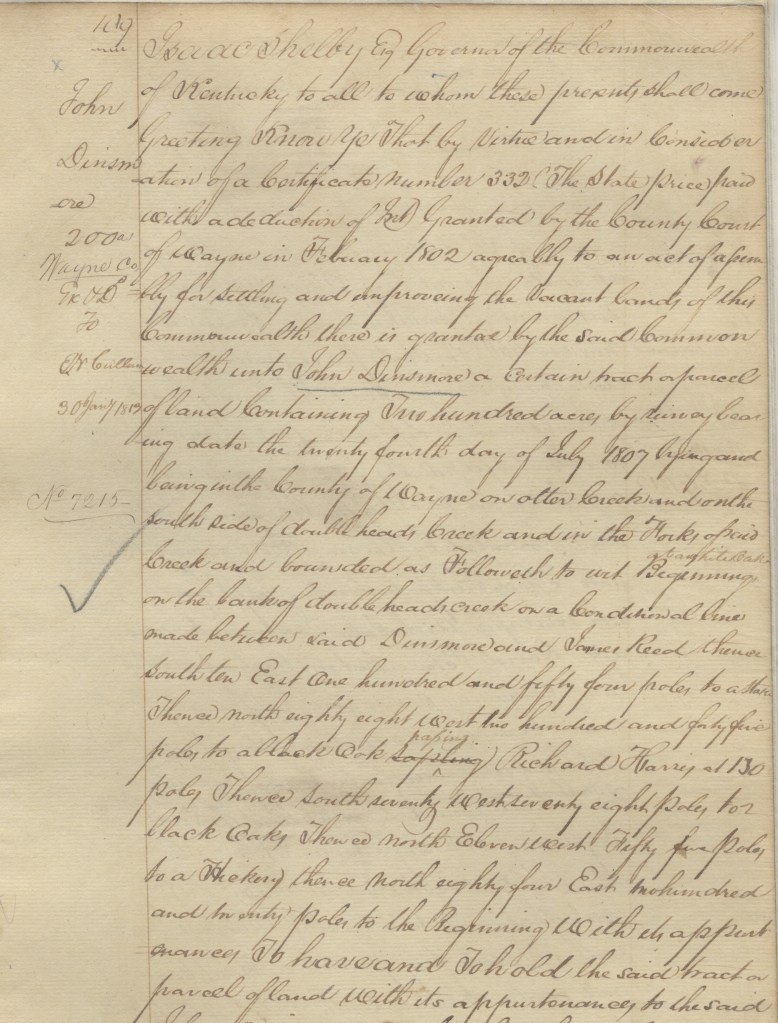
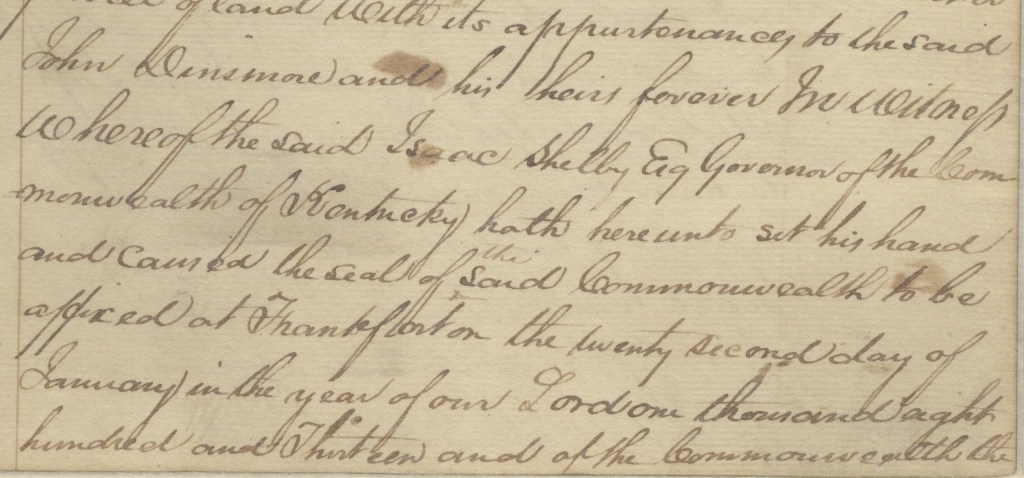
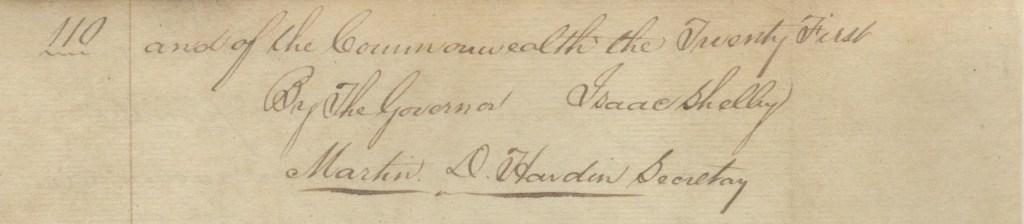
John Dinsmore had a grant from the Commonwealth of Kentucky for 200 acres on Otter Creek on 22 January 1813.[11] The grant document states specifically that the tract was on Otter Creek and on the south side of Doubleheads Creek and in the forks of that creek. It also specifies that Wayne County court had granted this land to John in February 1802 under an act for settling and improving the vacant lands of the Commonwealth. The warrant issued for this land grant in February 1802 is in the collection of documents for the grant held by the Kentucky Land Office.[12] A digital image of the warrant is at the head of this posting.
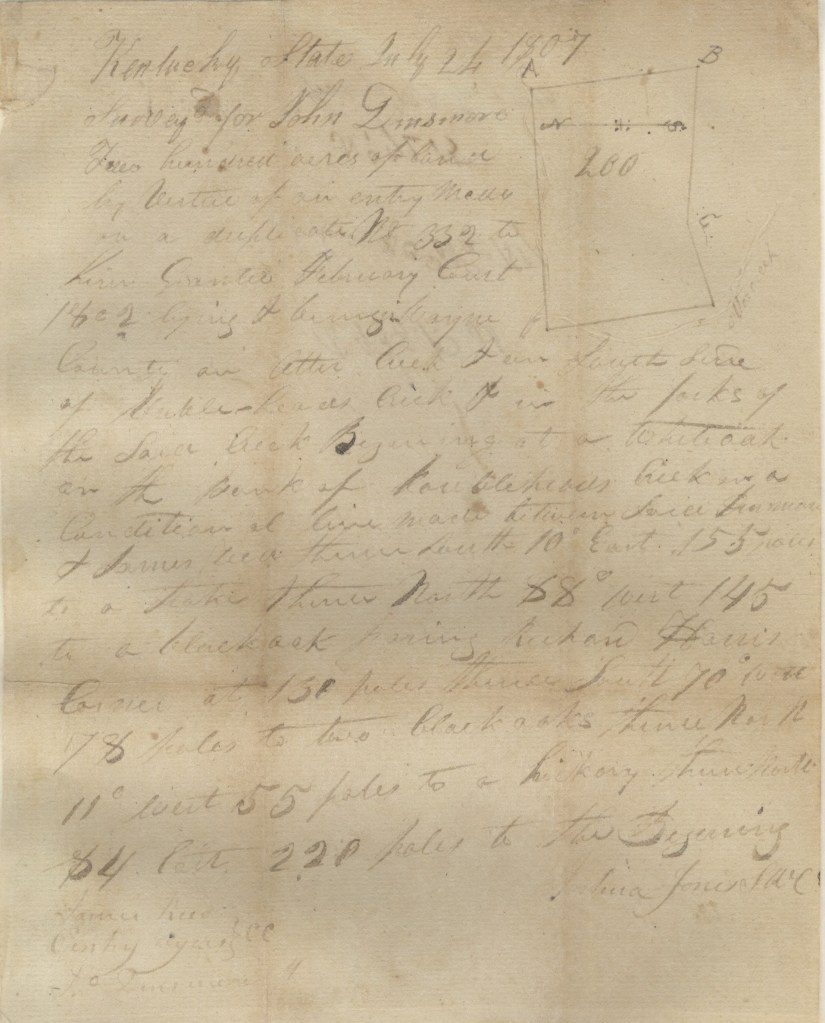
On 24 July 1807, John Dinsmore’s 200 acres were surveyed; the original survey is also in the papers for this land grant at Kentucky Land Office.[13] Joshua Jones made the survey with chain carriers James Reed, (Gentry?) Ayers, and John Dinsmore himself. The survey shows that the land adjoined James Reed and Richard Harris. I think it’s likely that Richard Harris is a man of this name to whom Dennis Lindsey, father of Mark Lindsey who married John Dinsmore’s sister Mary Jane, made a mortgage in Spartanburg County, South Carolina, on 12 February 1794.[14]
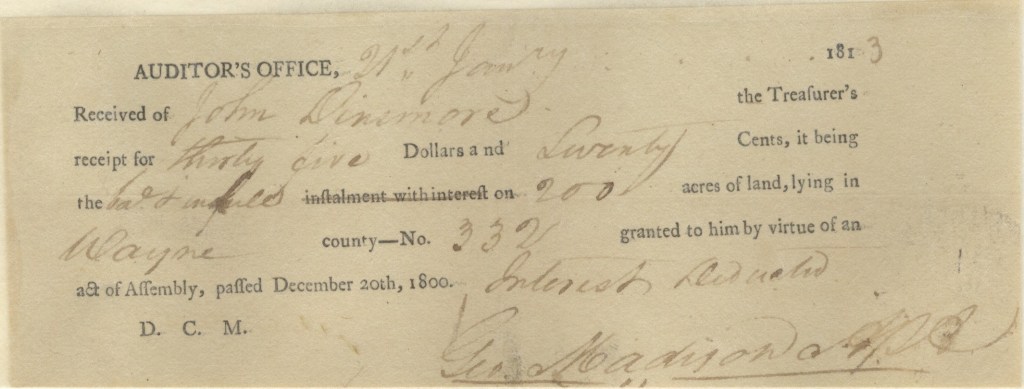
On 21 January 1813, the Kentucky Auditor’s Office issued a receipt to John Dinsmore for his payment of $35.70 for the land. The receipt is in the papers for this land grant held by Kentucky Land Office.[15]
I’m not quite sure how to put together the following pieces of information:
1. John Dinsmore began to be taxed in Wayne County for 200 acres — his own entry — in 1802.
2. After the county court had allotted her 100 acres in 1801, John’s mother Margaret then appears on the tax list in 1806 with 100 acres in addition to John’s 200 acres.
3. In 1807, and from 1809-1811, John was taxed both for his 200 acres and Margaret’s 100 acres.
4. In January 1813, John received a grant for his 200-acre tract for which he had a warrant in 1802.
5. From 1813 until 1820, John’s final appearance on the Wayne County tax list, John was taxed only for the 200 acres on Otter Creek.
I think it’s very likely that, if Margaret did at some point have (or was considered to have) a pending grant of 100 acres, this land was adjacent to John’s, and Margaret likely lived with John and his wife Phebe to the end of his life. It appears to me that John tried to retain possession of the 100-acre tract for a few years after his mother died, but since she had no actual grant for this land, when John received the grant for his own 200 acres, it did not include Margaret’s tract. What became of the 100 acres after this is not clear to me.
[1] Wayne Co., Kentucky, Court Order Bk. A, 1802-1822, p. 19.
[2] On the Headright Claims act, see Willard Rouse Jillson’s introduction to his The Kentucky Land Grants (Louisville: Standard, 1925).
[3] Wayne Co., Kentucky, Court Order Bk. A, p. 17.
[4] Ibid., p. 29.
[5] Wayne County, Kentucky, Taxation List 1801, p. 2.
[6] Ibid., 1802, p. 7, 13 August.
[7] Ibid., 1803, p. 7, 9 August; 1804, p. 11, 1 August; 1806, p. 10, 21 April; 1807, p. 9, 22 May; 1808, p. 7, 10 August; 1809, p. 9; 1810, p. 9, 2 June; 1813, p. 25; 1814, 53rd Regiment of Captain McWhorter; 1815, 53rd Regiment of Captain George McWhorter; 1816, p. 15; 1817, p. 23; 1819, p. 29; 1820, p. 8. The 1812 tax list is too faint for me to read in the digitized copy available at FamilySearch, and the 1818 tax list appears to be missing.
[8] Wayne County, Kentucky, Deed Bk. C, pp. 228-9. A biography of John’s son David Lewis Dinsmore in Thomas B. Owens, Dictionary of Alabama Biography, vol. 3 (Chicago: S.J. Clarke, 1921), states (p. 498) that David was born and raised in Wayne County, Kentucky, and came to Lawrence County, Alabama, in 1823. David Lewis Dinsmore was born in 1803 and was still living unmarried with his parents when they moved to Alabama. I do not find John Dinsmore on the Wayne County tax list after 1820, and I think the family left Wayne County early in 1821 after John and wife Phebe sold their 200 acres to Isaac Huffaker.
[9] Wayne County, Kentucky, Taxation List 1806, p. 10, 21 April.
[10] Ibid., 1807, p. 9, 22 May.
[11] Kentucky Land Grants South of Green River Bk. 12, p. 109, grant 7215, certificate 332.
[12] Ibid.
[13] Ibid.
[14] Spartanburg County, South Carolina, Deed Bk. C, pp. 139-140. See also Deed Bk. E, p. 172.
[15] Ibid.


One thought on “Margaret Dinsmore (1747-1806?) and Son John Dinsmore (1774-1858): Wayne County, Kentucky, Land Grant Records — Additional Information”