The Issue at Stake in Whitlock vs. Whitlock: Did Thomas Whitlock Promise Land to His Son Charles? — William Davies’s Complaint
In September 1799 in Wythe County chancery court, William Davies, guardian of the minor daughters of Charles Whitlock and wife Mary Davies, Agnes and Hannah Whitlock, filed suit against Thomas Whitlock regarding land that William Davies claimed Thomas had promised his son Charles, but had withheld from Charles’s widow and children after Charles’s early death. This case was moved to Augusta County chancery court, and my source for documents about it is the case file generated by the Augusta County chancery case.[1]

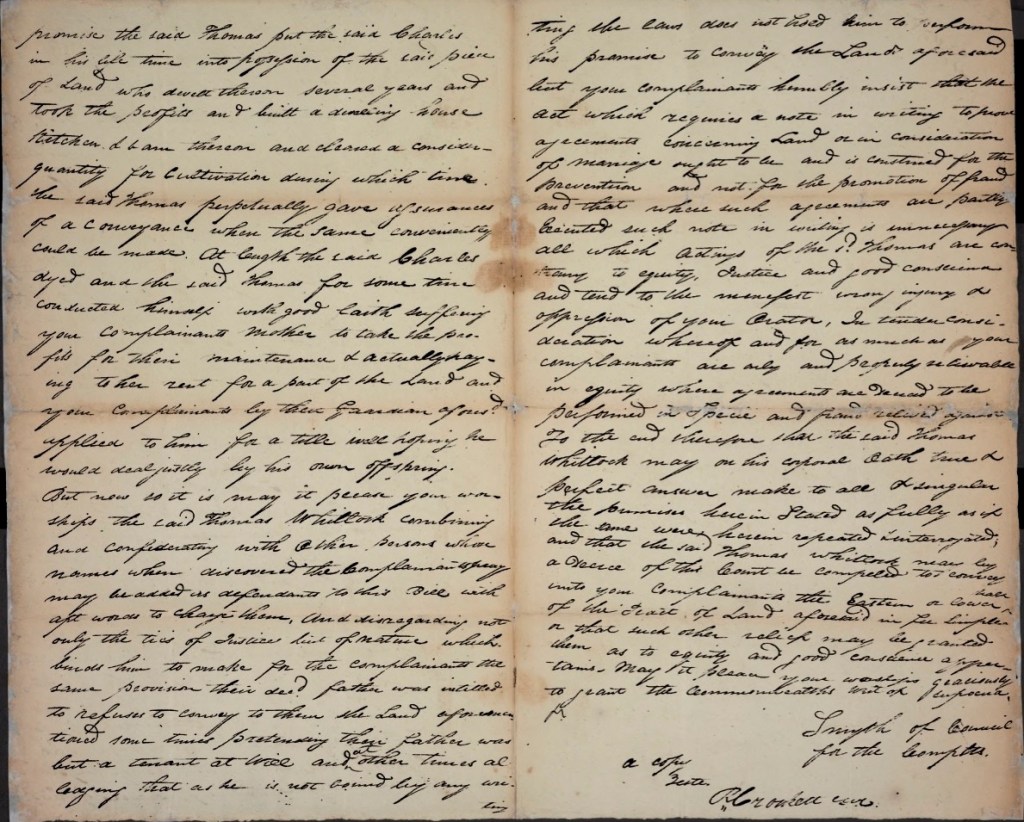
William Davies was an uncle of Mary Davies Whitlock, a brother to Mary’s father Henry Davies. In filing suit on behalf of his great-nieces Agnes and Hannah Whitlock, he was also, of course, filing suit on behalf of his niece Mary, their mother. His petition in the case file, which has no date but was evidently filed in September 1799, states that Thomas had promised to give his son Charles half of his land on Little Reed Island Creek if Charles would marry Mary, daughter of Henry Davies. After marrying Mary Davies (on or about 29 January 1793, we know from Wythe marriage records),[2] Charles settled on half of his father’s land, cleared more of it, cultivated it, and built a house, kitchen, and barn thereon. The petition says that Thomas Whitlock allowed his son Charles the profit of what Charles raised on the land, but did not ever deed the land to him. After Charles was killed by a falling tree in April 1796, Thomas allowed his daughter-in-law Mary and her children to live on the land and raise crops there, even paying them rent for a portion he used, according to the petition.
As we’ll see in a moment, we know of Charles’s death by a falling tree in April 1796 from an affidavit that Thomas Whitlock’s nephew John Whitlock, who was living with his uncle, gave in this case on 7 April 1803. On 9 August 1796, Mary Davies Whitlock and her father Henry Davies gave bond with Joseph Crockett and Henry Davies Jr. in the sum of £1,000 to administer the estate.[3] On this date David Sayers, Charles Calfee, Joseph Stephens, and Robert Carter were ordered to appraise the estate.
The Augusta chancery file contains the response of Thomas Whitlock to William Davies’s petition showing that on 16 September 1799, Thomas Whitlock filed a petition for certiorari to move the case to the high chancery court in Staunton (i.e., from Wythe chancery court to Augusta chancery court), on the grounds that Mary Davies was related to or a friend of a majority of the sitting justices of Wythe County, and had been boasting that she had “friends enough in said court” to secure to her the land in question. As we’ve seen (and here), through her mother Jane, daughter of Samuel Crockett and Esther Thompson, Mary Davies was, in fact, part of a kinship network of influential families in Wythe County that included the Crocketts, Sayers, and Montgomerys.
The case file has a 9 October 1801 writ of attachment for Thomas Whitlock, saying that he had failed to answer the petition of William Davies in Wythe County and was to appear at the next session of chancery court at Richmond. This was executed 28 December by John Sanders acting for James Newell.
On 14 September 1802, at the house of William Hays in Evansham (i.e., Wytheville), in the presence of James McGavock and William Ward, Henry Davies provided an affidavit in this case. It states that some days before Charles married Henry’s daughter Mary, Thomas Whitlock invited Henry to his house, and the following morning walked him around Thomas’s land. Thomas showed Henry the land he intended to give his son if Charles married Mary Davies, indicating that he would give him a cleared field, Bennetsfield, and showing him a fence on the west side of Little Reed Island Creek that was to be the line between Thomas Whitlock and his son Charles. The affidavit notes that Charles had cleared land and built a house, kitchen, and barn on it.
Thomas Whitlock’s Response to William Davies’s Complaint
On 14 December 1802, Thomas Whitlock finally answered the petition of William Davies before Jesse Evans in Wythe County, the answer being filed at Augusta chancery court in Staunton. The reply says that Thomas Whitlock owned 369 acres on Little Reed Island Creek, but had never intended to give his son Charles half of his land, since he had but one tract of land and “a numerous family to support” with no livelihood other than what the land afforded. The petition also notes that Thomas Whitlock had five children besides Charles, and could not be unjust enough to them to give half his land to Charles. (Note that, though Thomas deposed that he owned only one tract of 369 acres, when he disposed of his Wythe County landholdings in 1805, the acreage amounted to 568½).

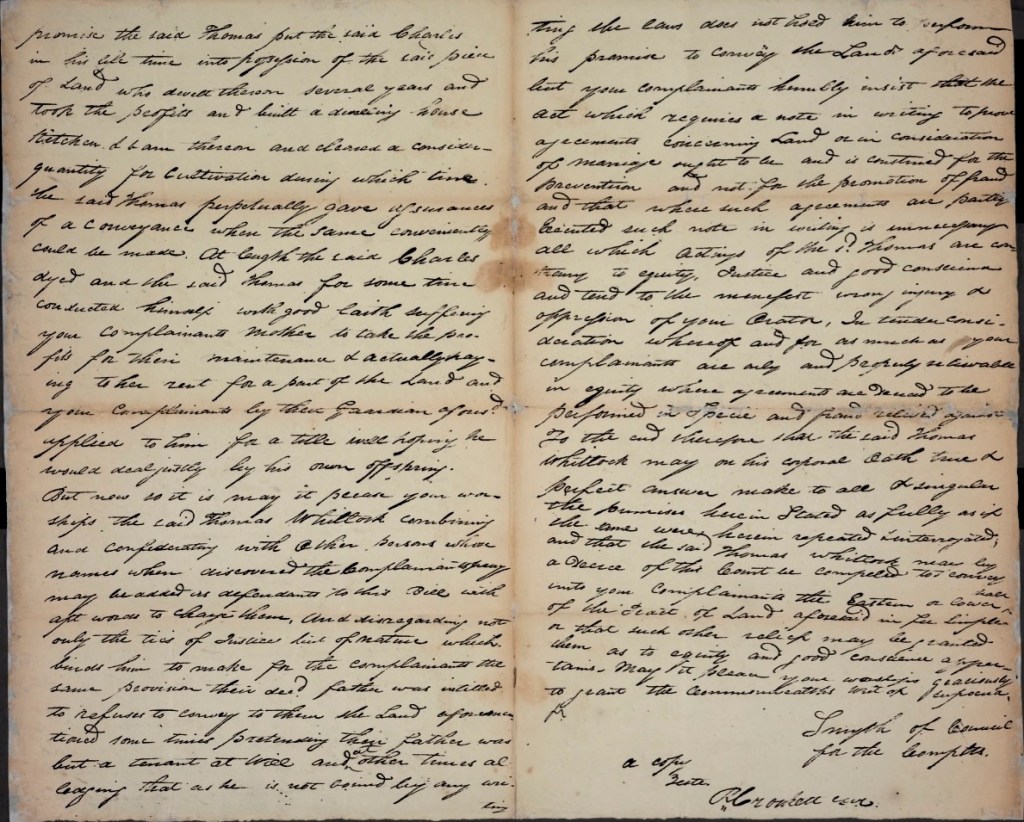
Further, Thomas’s response says that he had been willing to do for Charles what he might, suffering him to live on the land and enjoy its profits until Charles could provide for himself his own tract of land. The petition also addresses a point made in William Davies’s petition, namely that Thomas had paid rent to his daughter-in-law: Thomas states that after Charles’s death, Henry Davies had sent an enslaved woman to assist Mary in making a crop. Thomas also provided a hand to assist Mary during one summer. Not considering it rent, he had allowed Mary to keep all the crop she had made on nine acres, along with a third of the corn made on six acres. Thomas’s response is signed by W. Campbell, his attorney.
Testimony on Thomas Whitlock’s Behalf: John Whitlock, Thomas Whitlock Jr., Thomas Brooks Sr.
On 7 April 1803, Thomas Whitlock’s nephew John Whitlock, son of Thomas’s brother Charles, gave testimony at the house of Jesse Evans in Wythe County, before justices Jesse Evans, with witnesses Nathaniel Frisbee and Robert Sayers. His affidavit notes that he was living with Thomas Whitlock at the time Thomas’s son Charles was killed by a falling tree in the month of April 1796. After Charles’s death, Thomas’s hand and an enslaved woman who had come into the possession of Mary Davies Whitlock’s mother worked in common on the land of Thomas Whitlock as well as on the land claimed by Mary. After the fodder was secured, the enslaved woman and Thomas’s hand ceased to labor in the fields, and Mary D. Whitlock raised a field of corn, nine acres, and part of another six-acre field, which land Mary claimed as her own. John Whitlock noted that he understood from Thomas that he would have given Mary all the corn raised on these fields, had his own croppers not also worked this land. John Whitlock also testified that he had heard Charles Whitlock say he intended to move to the western country, and that if he did so, he would expect something for the improvements he had made to the land his father had shared with him.
John Whitlock also notes that after the death of Charles Whitlock, Mary Whitlock had, at her own choice, moved to the house of Thomas Whitlock, and that Thomas had moved Mary back to her former home in the fall. According to John Whitlock, there was no evidence that Thomas Whitlock had ever intended to give the land in question to his son Charles.
On the same day (7 April 1803), John’s brother Thomas Whitlock Jr. also made a deposition. He said that sometime after Charles Whitlock’s marriage, he (Thomas) was at the house of Charles Whitlock and in conversation, Charles declared that he intended to move to the French Broad in order to purchase a tract of land he had seen there and hoped that his father would help him pay for it. Thomas Jr. told Charles that he was unwise to think of moving, since the land on which he was living, that of his father, was sufficient to sustain him and his family during the lifetime of Thomas Whitlock and, because Charles was his father’s only son, he would no doubt inherit the land. Charles answered that he expected himself and his younger sister (i.e., Mildred) to inherit the whole of their father’s land, with the other children having sums equal to the value of the land. According to Thomas Jr., Charles then said that, however, he expected his father to sell his Virginia land and move west, too.
On the same day (7 April 1803), Thomas Brooks Sr. (father of Thomas Brooks Jr. who married Thomas Whitlock’s daughter Sarah) also gave testimony. He noted that Charles Whitlock had been at his house before his death, and had a few days prior to his death returned from the French Broad, where he had seen land he wanted to buy. A Mr. Carter[4] was present and thought the price too high. Charles Whitlock answered that he had two good horses and his father another two or three that he could spare along with some money, and that he expected his father to help him buy the land.
Testimony on William Davies’s Behalf: James Calfee, Esther Ellis, Ignatius Turman, Randall Fugate, Henry Davies, Wilson Davies
The case file contains a notice from Augusta chancery court dated 19 May 1803, stating that the court was notifying Robert Adams and Joseph Crockett, justices of Wythe County, that it was calling as witnesses Winnie Breeding, Ignatius Turman, Randall Fugate, William Jennings, James Calfee, Wilson Davis, Esther Ellis, and John Sayers to testify on behalf of Charles Whitlock’s heirs. On 23 May 1803, Jesse Evans notified Thomas Whitlock that on 14 June he intended to take depositions from the preceding witnesses at the house of William Hays in Evansham (i.e., now Wytheville). Joseph Evans delivered this notice to Thomas Whitlock.
On 14 June 1803 at the house of William Hays in Evansham/Wytheville, the witnesses called by Augusta chancery court on behalf of Charles Whitlock’s heirs deposed before Robert Adams and Joseph Crockett. The first to depose was James Calfee, who said that two days prior to his marriage, Thomas Whitlock asked James Calfee to accompany him to the clerk’s office to obtain a license for the marriage. James responded by noting that this marriage had been agreed on several times before and had been broken off, and so told Thomas Whitlock that it would not be worth his while to go to the clerk’s office, since it would probably be broken off again.
Thomas replied that he intended to see that this agreement would not be broken again, and that the last time the agreement had been broken, he had gone to Henry Davies and not finding Davies at home, had asked Mary Davies to come to his house. When Henry Davies then came to Thomas’s house seeking his daughter Mary, Thomas showed Henry the land he intended to give son Charles if Charles married Mary. Thomas further mentioned that he could not give his son more clear land than a field which lay over the creek, and that Charles was more able to clear land than was Thomas.
Calfee also said that when Thomas Whitlock asked him to go to the clerk of court, he asked Thomas whether he intended Charles to live on the same side of the creek with his father, or the opposite side, and Thomas replied that he wanted Charles to live on the same side with him, building a house at a place he described. According to Calfee, Thomas also noted that since his son was fond of Henry Davies’s family, Thomas desired this marriage and said he had land enough for himself and his son. The marriage occurred two days later. Calfee notes that he lived two miles from Thomas Whitlock and that he and others had always understood that Charles Whitlock owned the land in question. Jean Calfee verified her husband’s testimony, saying she had heard the conversation between her husband and Thomas Whitlock.
The same day, Esther Ellis also testified, saying that Charles Whitlock had told her the day before his marriage that his father had informed him if he did not marry Mary Davies, Thomas would no longer allow Charles to live with him, and Charles would not have any of his father’s estate. Ellis also noted that a few days before the marriage, Thomas Whitlock had come to Henry Davies’s house and had met a long time with Mary Davies to discuss the marriage, and had seemed so anxious to have the marriage that he had brought the minister himself.
Ignatius Turman then testified. He said that during Charles Whitlock’s lifetime, he (Ignatius) had helped Thomas Whitlock make shingles at a place called the Rich Hill near Thomas’s house. They had come along a field where the fence had been let in on at one point to include a small piece of ground that appeared to have been newly cleared. Thomas Whitlock had told Turman that he would have his son Charles let out that fence, because he wanted a straight line between himself and Charles. He had also told Turman after Charles’s death that if Charles had lived and had had a son and named him Thomas, he would have given Charles a portion of his land. But as Charles had had only daughters, they should not have the land Thomas promised Charles.
Randall Fugate followed. He said that on the day Charles Whitlock married Mary Davies, about a half hour after the marriage he heard Thomas Whitlock say that now that they had married it was fitting that both of their fathers do something for the newly married couple. Fugate also said that he thought he had heard Thomas say he had given Charles half of his land, after which Thomas Whitlock and Henry Davies had walked out of the room.
Henry Davies then deposed. He said that the fall after Charles Whitlock had died, he had been at the house of his daughter Mary to make a cupboard, but unable to do this, he sent for Thomas Whitlock, who was then hauling corn from a field that had belonged to Charles Whitlock. A few days thereafter, Davies came in and saw a quantity of corn in a crib that Mary Whitlock told him had come from the field which Thomas Whitlock had rented from her.
Wilson Davies testified next, saying that after Charles Whitlock’s marriage, he had overhead Thomas Whitlock tell a stranger that a field Wilson Davies was then harvesting along with Thomas Whitlock and others was all the cleared land on the portion of his own land he had given to his son Charles. Davies was present when Charles Whitlock raised his house, on which occasion Thomas Whitlock counseled his son to leave a place on which to build a better house. On that day, Thomas had stated that the land was absolutely his son’s.
Testimony in Wayne County, Kentucky, on Thomas Whitlock’s Behalf: James Ingram, Richard Chrystal, Thomas Brooks Jr., John Hammons
On 14 February 1804, Thomas Whitlock gave notice to William Davies that on 10 March he would take depositions at the house of Charles Cock (i.e., Coke) in Wayne County, Kentucky, from Thomas Brooks, John Hammons, James Ingram, and Richard Cristal (Chrystal in other places) to be read in the chancery case Whitlock vs. Whitlock. On the 17th, Leonard Straw delivered this notice to Davies.
On 10 March 1804, these witnesses gave affidavits in Wayne County, Kentucky. James Ingram deposed that he was intimate with the family of Thomas Whitlock, and at the time of Charles’s marriage up to his death, he never heard Charles or his father say that the land in dispute had belonged to Charles. He had heard Charles say that he would “have to go to the backwoods in quest of land for the plantation his father & himself then lived on was too inconsiderable for them both.” But Charles doubted not that if he continued in Virginia, his father would give him part of the land he then lived on. Ingram also said that Thomas Whitlock had been agreeable to Charles’s marriage, but that Charles had told him prior to the marriage that he would not marry Mary Davies, but would leave the country, instead.
Richard Chrystal then testified, saying that he lived at the house of Thomas Whitlock a year before Charles married and two years after. During this time, he never heard any intimation of Thomas Whitlock giving his son any part of his land. According to Chrystal, sometime after his marriage, Charles displeased his father in some part of his conduct, and Thomas then gave his son a fatherly reprimand. After this, Charles asked his father to give him some property of his own, saying that he would remove to some other country, adding that he wished not to live so near the old man lest he might not please him in his further conduct, to which the old man agreed.
Among the questions put to Chrystal was a question about who sent for the parson to marry Thomas Whitlock’s son Charles. Chrystal responded that it was “old Mr. Whitlock.” Chrystal was then asked whether Thomas Whitlock was not very much dissatisfied at his son’s match before it took place, and Chrystal responded that this was true, and that Thomas had expressed dissatisfaction at the marriage even two days before it took place.
On the same day on which Ingram and Chrystal deposed, Thomas Brooks also gave deposition. This was Thomas Whitlock’s son-in-law Thomas Brooks, who had married Sarah Whitlock — the son of the Thomas Brooks Sr. who gave a deposition in Wythe County on 7 April 1803. Thomas Brooks Jr. stated that seven or eight years earlier, he had been with Charles Whitlock a few hours before his death, and had heard him say that he would have to go to the backwoods in quest of land for himself, alleging that he had none of his own. Charles said that he had some good horses of his own and his father had money and horses and would assist him in buying new land. Thomas Brooks was asked if he himself had an interest in the land under dispute, and he said that he did not. He was then asked whether he was a son-in-law of Thomas Whitlock, and he answered yes.
At the same hearing, John Hammons Jr., also testified, saying that he had lived for some months on the land of Thomas Whitlock. John Hammons was also a son-in-law of Thomas Whitlock, who married a daughter of Thomas and Hannah Phillips Whitlock whose given name I have not discovered. John Hammons deposed that Charles Whitlock had had frequent conversations with him on the subject of the backwoods. Hammons had often heard Charles say that he had a disposition to remove to the Sciota (i.e., Scioto) River, because there was land enough in his father’s tract to support only one man, to wit, his father. Charles Whitlock also alleged that, if he urged, his father might deed him title to the lower end of Thomas’s tract on which Charles lived, but that he would not accept the land if his father did deed it to him. Hammons also said that he had heard Charles Whitlock say that he had property of his own, and with that and what his father would give him, he expected he could purchase a tract in the backwoods equal to the whole of the old man’s land. Hammons said that he had a conversation to that effect with Charles a few days before Charles’ death.
Hammons was asked whether Thomas Whitlock had objected to Mary Davies Whitlock moving into his house after Charles’s death, and replied that there had been no objections, nor had Thomas objected when she moved back to her previous house. When asked whether Thomas had paid rent to Mary, Hammons replied that four people, including an enslaved woman who belonged to Mary, had worked the whole plantation, including the part occupied by Charles Whitlock in his lifetime, and Thomas Whitlock was free at his own discretion to give Mary what he thought fit as reimbursement for the labor of her wench.
Verdict in Whitlock vs. Whitlock
On 13 July 1804, Augusta chancery court handed down a verdict in the case of Whitlock vs. Whitlock. This decreed that Thomas Whitlock’s granddaughters were entitled to a fee simple estate in a moiety of the land of which Thomas Whitlock was seized. The court instructed the Wythe County surveyor to divide the land, giving the children the dwellings their father had erected, along with Bennetsfield.
The court papers have a survey (undated) showing how the land was divided, and indicating the location of Bennetsfield in the lower half of Thomas Whitlock’s land (see the image at the head of this posting). The share of Thomas’s land given to his granddaughters was 199½ acres. The survey shows that Little Reed Island Creek ran through both tracts of land.
Thomas and Sarah Whitlock Dispose of their Wythe County Land and Move to Kentucky
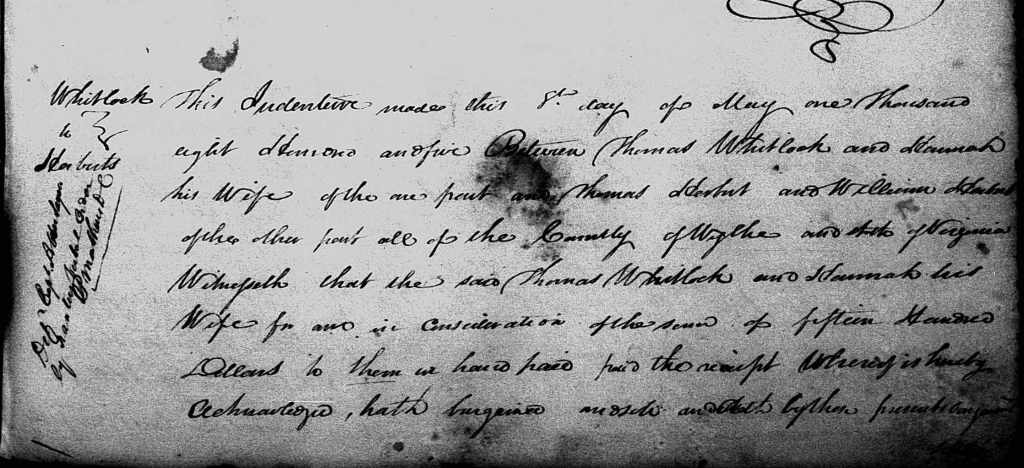
On 8 May 1805, Thomas Whitlock and wife Hannah sold to Thomas and William Herbert, all of Wythe County, for $1,500 their homeplace of 340 acres. The deed describes the land as lying on both sides of Little Reed Island Creek, bounded by the heirs of Charles Whitlock, and by James Calfee and Carter. The deed is signed by both Thomas W and wife Hannah and was witnessed by George Carter, Levi Durnal, Robert Thompson, and Absalom Dunnagan.[5] Carter, Dunnagan, and Thompson proved the deed at October court and it was recorded. Note that though the deed shows Thomas and Hannah signing, when they deeded three days later to their granddaughters Agnes and Hannah Whitlock, they signed by mark.
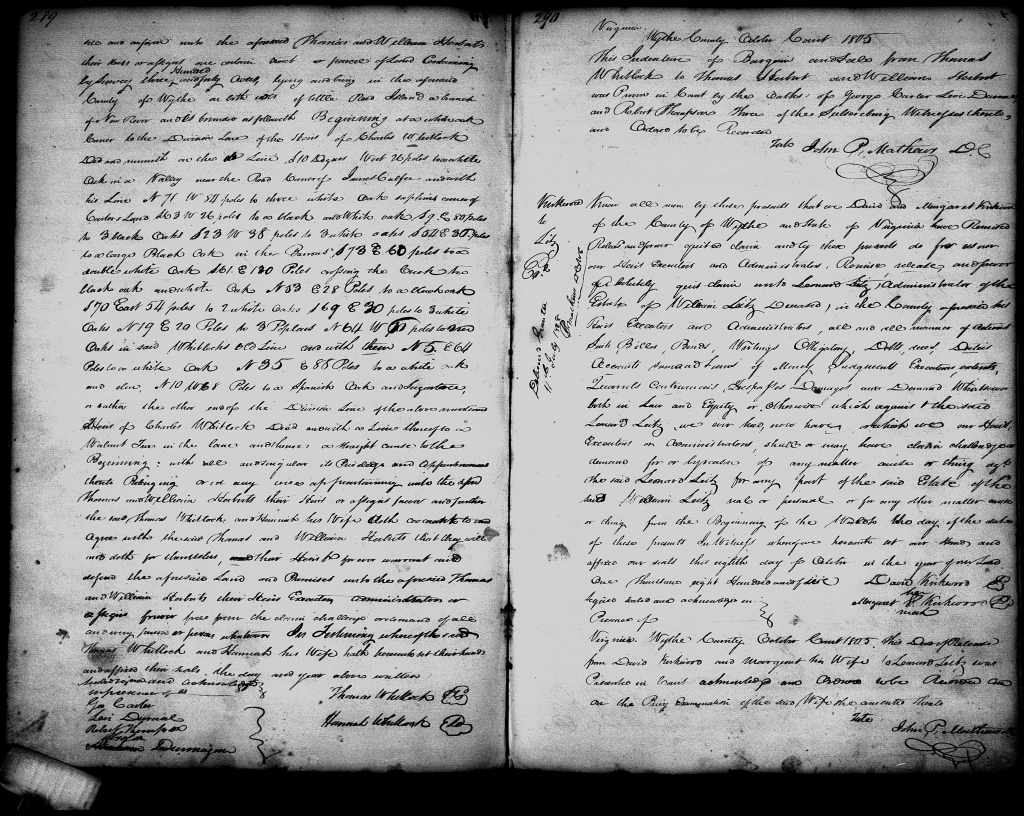
On 11 May 1805, Thomas Whitlock and wife Hannah deeded 199½ acres to their granddaughters Agnes and Hannah Whitlock, daughters of Charles Whitlock, in obedience to a decree of the chancery court of Staunton (Augusta County), Virginia, dated 1 December 1804.[6] The land is described as the lower half of the land on which Thomas Whitlock lately lived, lying both sides of Little Reed Island Creek. This deed was signed by mark by both Thomas and Hannah, and was witnessed by James Davis, Jonathan W. Davis, and Aquiler/Aquila Davis. The deed was proven by James Davis at August court 1805. Further proof was required, and the deed was proven by Aquila Davis on 10 September 1805. Even more proof was required, so the deed was proven by Jonathan Davis on 8 October 1805 and recorded on that date. A marginal note beside the deed says that that the deed was delivered to W. Davis, Esq., guardians of Whitlock’s heirs, on 15 April 1812. The date of delivery may have had something to do when Agnes and Hannah came of age: census data suggest that Agnes was born about 1793 and Hannah about 1795.
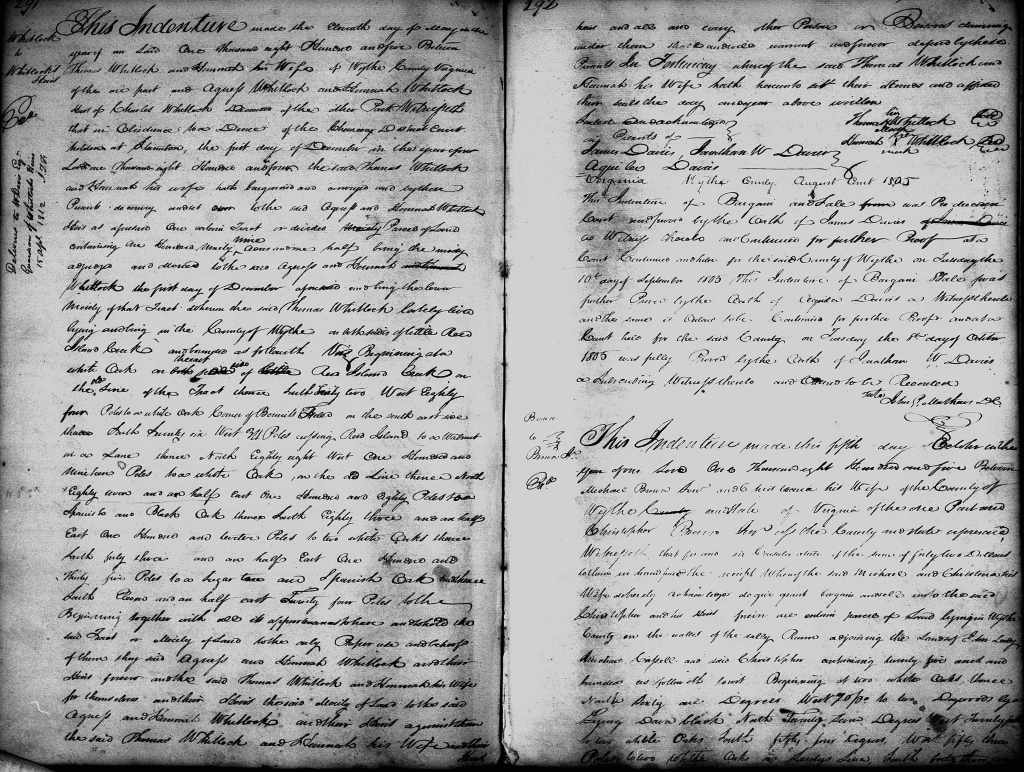
According to researcher Gwen Hurst in a 9 October 1991 letter to me, the portion of Thomas Whitlock’s land deeded to Agnes and Hannah Whitlock was owned by Thomas Whitlock’s daughter Mildred and her husband William Hurst by 1833, they having inherited the land from William Hurst’s father Absalom Hurst.
Since Thomas disappeared from Wythe County’s tax list in 1805, and since the second of the two deeds above notes that Thomas Whitlock lately lived on this land, I suspect that these deeds were made just before Thomas and Hannah moved from Virginia to Kentucky. They may have moved to Kentucky via Surry County, North Carolina, since, according to Gwen Hurst in a 25 November 1993 letter to me, Thomas Whitlock was living in Surry County when his daughter Mildred married William Hurst there on 22 April 1805.
Note, too, that the testimony of Thomas Whitlock’s nephew Thomas in the Whitlock vs. Whitlock case states that Thomas Whitlock had already contemplated moving west prior to the lawsuit between him and his daughter-in-law Mary and her daughters.
As a previous posting has shown, on 13 February 1804, Thomas Brooks bought 300 acres on both sides of Poplar Camp Creek in Wythe County land from Thomas Herbert and wife Sarah.[7] As the posting I’ve just linked also states, Thomas and William Herbert were brothers. According to James Whitman, sometime before 1811, the Herberts built a forge, High Rock Forge, on some of the land they bought from Thomas Whitlock.[8] On 22 October 1811, Thomas Herbert sold 200 acres of the land he had acquired from Thomas Whitlock to John Evans; Evans then sold the land to David Peirce on 10 June 1817; and on 19 March 1842, James Stephens bought the forge from Peirce. The land remained in the Stephens family for many years, and the mineral was sold to Pulaski Iron Company. Whitman says that High Rock Forge was located in the extreme east portion of Wythe County on Little Reed Island Creek, and was quite a business center, dating back to the latter part of the 18th century. Eventually the post office of High Rock became known as Patterson, a community still in existence in southeastern Wythe County near the intersection of highways 100 and 607. As the posting linked at the start of this paragraph also indicates, when Thomas Brooks bought 300 acres from Thomas and Sarah Herbert in February 1804, John Evans witnessed the deed.
In her Early Adventurers on the Western Waters, Mary B. Kegley reproduces a picture of David Peirce’s three log houses at the intersection of present highway 52 and the road to Poplar Camp.[9] Kegley notes that from 1803, Peirce and Thomas Herbert kept an ordinary there.
Further proof that Thomas Whitlock and wife Hannah moved from Wythe County in 1805 is in Wythe County court order book minutes with state that on 11 March 1806, John Dunford was appointed overseer of the road from Thomas Herbert’s to Peirce’s Furnace to replace Thomas Whitlock.[10]
In my next posting, I’ll pick up Thomas Whitlock’s story after his move to Cumberland County, Kentucky, and will share the documents I have for him in that county.
[1] Augusta County, Virginia, Chancery Court case, Whitlock vs. Whitlock, box 10, file 38 (1803-4), available digitally via Library of Virginia’s Virginia Memory chancery records collection.
[2] Wythe County, Virginia, Miscellaneous Marriage Bk. 1790-1905, p. 1. The date is the date on which Reverend Daniel Lockett returned the marriage to court, without stating the date when he married the couple.
[3] Wythe County, Virginia, Court Order Bk. 1795-6, p. 126.
[4] Likely George Carter.
[5] Wythe County, Virginia, Deed Bk. 4, pp. 288-9.
[6] Ibid., pp. 291-2.
[7] Wythe County, Virginia, Deed Bk. 5, pp. 67-9.
[8] James Whitman, “The Iron Industry of Wythe County from 1792,” in Wythe County Chapters, ed. James S. Presgraves (Wytheville: James S. Presgraves, 1972), p. 103.
[9] Mary B. Kegley, Early Adventurers on the Western Waters, vol. 3 (Wytheville: Kegley Books, 1995), p. 325.
[10] Wythe County, Virginia, Court Order Bk. 1805-8, p. 26.
 BEGATS AND BEQUEATHALS
2 thoughts on “Thomas Whitlock (abt. 1745 – 1830) of Louisa and Wythe Counties, Virginia, and Cumberland County, Kentucky: Whitlock vs. Whitlock Chancery Court Case, 1799 – 1805”