As a previous posting has noted, in 1792 Charles Lynch and wife Anne Terrell Lynch sold to James Newell, another of the witnesses to the March 1776 deed, land in Wythe County at which the Austin and Co. ferry operated, along with ferry rights at the lead mines.[1] I note this deed because both Charles Lynch and James Newell appear in the 1 March 1776 deed that is the first document I’ve found for Thomas Whitlock in Montgomery County, Charles as the purchaser of land from Jonathan Jennings, and James as a witness to the deed along with Thomas Whitlock.[2]
In addition, as I’ve stated in a number of previous postings, there are a number of references to Charles Lynch in documents involving Thomas Whitlock, and it appears that there was some connection between the two that, I suspect, went back to Bedford County, where Thomas was living by July 1769 and where Charles moved after marrying Anne Terrell in Albemarle in 1755. In addition, as has been noted, James Newell was a prominent citizen associated with the lead mines in Wythe County and a neighbor of Thomas Whitlock, both living in the vicinity of the lead mines.
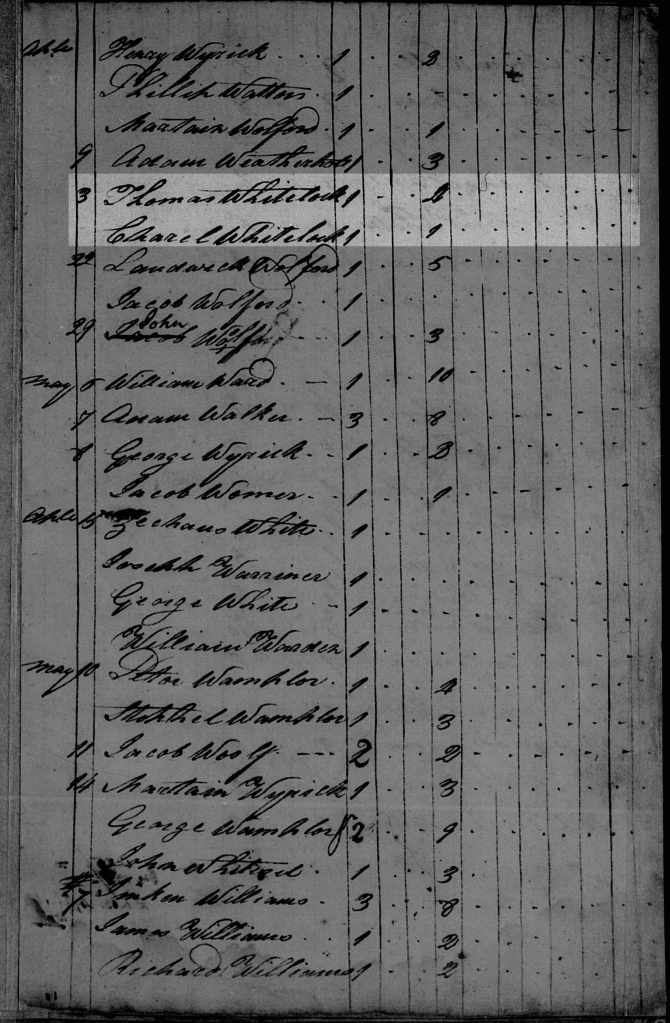
Thomas Whitlock and his son Charles were taxed next to each other on 3 April 1793 in Captain James Davis’s district in Wythe County, with Thomas taxed for a tithable and four horses, and Charles taxed for a tithable and one horse.[3] Charles married on or before 29 January 1793, and we know from the litigation that later ensued between Thomas and Charles’s widow Mary Davies Whitlock — it will be discussed in detail later — that Charles and his family lived on half of Thomas’s 369-acre tract next to Charles’s parents.
Thomas Whitlock also appears on the land tax list of Wythe County in 1793 taxed for taxed for 369 acres valued at £43 9s.[4] Note that this land tax list does not include Charles Whitlock, though we know from his marriage record that he had married Mary Davies early in 1793, and the personal property tax list for Wythe tells us that Charles was now heading his household and evidently living next to his father, since the two are taxed side by side. The lack of an entry for landholdings for Charles underscores that he was living on land his father divided with him, but to which Thomas retained the title, a fact that would be central to the lawsuit Mary Davies Whitlock filed against her father-in-law following Charles’s death.
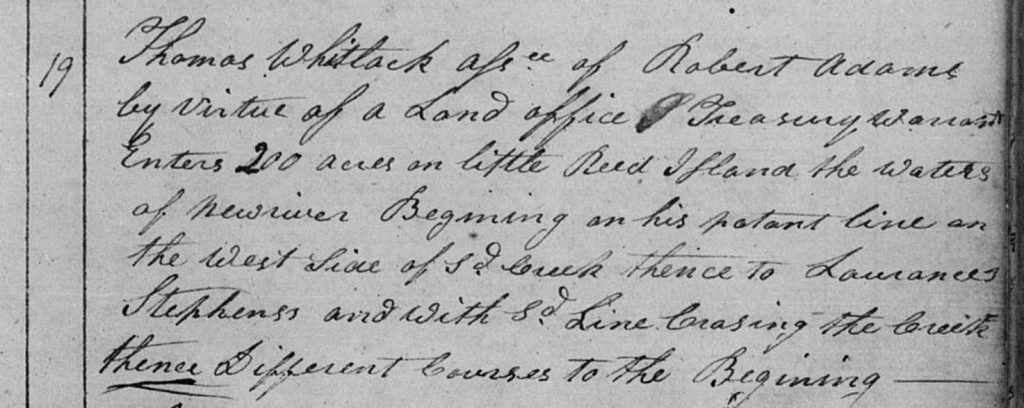
Thomas Enters 200 Acres in Wythe County, June 1793
On 19 June 1793, as the assignee of Robert Adams, who assigned to Thomas a land office treasury warrant, Thomas Whitlock entered 200 acres in Wythe County.[5] The entry record states that the land was on Little Reed Island Creek, waters of New River, starting at Thomas’s patent line and running on the west side of the creek to Lawrence Stephens’s line, with the land being entered crossing the creek.
This piece of land was surveyed for Thomas on 8 October 1795 as 140 acres (see the image at the head of this posting).[6] This states that the entry was made on a land office treasury warrant, #10690, and that the land was on both sides of Little Reed Island Creek, bordering “Larrance Stephys” and at one point following a road leading from Thomas Whitlock’s place to John Craig on New River. The survey contains a plat.
Gwen Hurst thought that this tract of 140 acres was a piece of land, 139 acres, that ended up in the hands of Randal (i.e., Randolph) and Charity Hurst Fugate at some point between the October 1795 survey and October 1797. On 8 October 1797, Randal and Charity sold 139 acres to Winifred (Winnie) Lehue/Lahue Hurst.[7] Gwen Hurst thought that the land description in that deed matched the description of Thomas Whitlock’s 140-acre tract surveyed in October 1795, and noted that the land extended from Thomas Whitlock’s patent. The deed has no information, however, about how Randal and Charity had ended up with this land.
When John Hurst and wife Nancy sold this tract on 29 October 1812 to William Hurst, their deed states that the land bore a survey date of 8 November 1782, which does not match the date on which Thomas Whitlock had the land surveyed.[8] John Hurst had acquired the tract from Brian and Winnie Breeding on 13 September 1808.[9] Brian Breeding married Jean/Jane Hurst, daughter of Henry Hurst and Winifred Lehue/Lahue, and in Gwen Hurst’s view, this deed should state that Brian Breeding and Winnie Hurst were selling this land to William Hurst — Winnie Hurst and her son-in-law were selling the land together, that is to say.
Winifred Lehue/Lahue was, by the way, a sister of John Lahue, who married Sarah, daughter of Thomas Brooks and Margaret Beaumont/Beamon of Wythe County, Virginia. Sarah was a sister of Thomas Brooks who married Sarah Whitlock, daughter of Thomas Whitlock. John Lahue and Sarah Brooks were discussed in a previous posting. As with the Brooks family, both the Fugate and Lehue/Lahue families were in Frederick County, Virginia, before coming to what became Wythe County, Virginia, in 1790.
Note that the 8 November 1782 survey date given in the deed of Brian Breeding and Winnie Hurst is the survey date for Thomas Whitlock’s 369-acre tract, the tract on which he lived and which he apparently divided with his son Charles during Charles’s lifetime.[10] This survey was discussed in the previous posting. It appears that records for that tract of land have somehow gotten mixed up with records for the 140-acre tract Thomas had surveyed in October 1795. But how had that piece of land passed to Randall and Charity Fugate by October 1797? I have not found a deed for that transaction, nor did Gwen Hurst as she worked on these records. There appears to be some mystery here. Did Thomas Whitlock trade some land with Randall/Randolph and Charity Hurst Fugate, with no deed recording the trade? As we’ll see down the road, when Thomas and wife Hannah sold his home tract in May 1805 and then deeded some half of his land to his daughter-in-law Mary Davies Whitlock, the piece they sold to Thomas and William Herbert (their homeplace) was 340 acres, the piece they deeded to Mary was 199½ acres. This yields a total of 539½ acres. The two documented tracts Thomas acquired on the waters Little Reed Island Creek were 369 acres and 140 acres, making a total of 509 acres. The May 1805 deeds suggest that Thomas had held onto land nearing the amount of 140 acres, in addition to his original 369 acres.

Tax Records, 1794-1805
In 1794, Thomas Whitlock and son Charles again appear side by side on the personal property tax list in Wythe County, both taxed on 19 May in Captain James Davis’s district.[11] Thomas is taxed for one tithable, eight horses, and one stud horse and “rates per season” of 12, probably 12d and probably for the services of his stud horse. Charles is taxed for one tithable and four horses. Thomas and Charles continue to be taxed beside each other on the 1795 personal property tax list (again, James Davis’s district);[12] and in 1796, when Thomas’s nephew John Whitlock, son of Thomas’s brother Charles, is listed with Thomas and his son Charles (Samuel Crockett’s district).[13]
In April 1796, Thomas’s son Charles was killed by a falling tree in Wythe County, a fact noted in the lawsuit Charles’s widow Mary Davies Whitlock filed against her father-in-law following Charles’s death, which I’ll discuss in detail later. The 1797 tax list shows Thomas Whitlock taxed in Captain Samuel Crockett’s district, with a Peter Wesley taxed between Thomas and Mary Whitlock.[14] In 1798, Thomas and his daughter-in-law Mary are taxed side by side in Samuel Crockett Jr.’s district, and the tax listing indicates that Mary has an ordinary at her house.[15] I do not find Thomas or Mary Whitlock on the 1799 tax list in Wythe County.
In 1800, Thomas is the only Whitlock on the personal property tax list in Wythe County (James Newell’s district).[16] The chancery case against him filed by his daughter-in-law Mary dates from September 1799. I suspect that litigation created a breach between Thomas and his daughter-in-law, and that she may have moved with her two young daughters to live temporarily with her father until the question of her ownership of the half of Thomas’s land he had promised to his son Charles was settled — though in 1801, Mary is listed again next to Thomas (John Crockett’s district).[17]
In 1802, Thomas Whitlock appears on the county’s personal property tax list next to Turner R. Whitlock (John Crockett’s district).[18] Mary Whitlock is not enumerated. Turner Richardson Whitlock (1774 – 1825) was a cousin of Thomas, the son of David and Martha Whitlock of Hanover County, Virginia, who was admitted as deputy clerk of Wythe County court on 12 January 1802.[19] In 1803, Thomas and his daughter-in-law Mary are again taxed next to each other in John Crockett’s district.[20] Mary is now taxed for two enslaved persons. In 1804, Thomas and daughter-in-law Molly are taxed with John Wisehart between them (John Sanders’s district).[21] In 1805 Thomas drops from the tax list in Wythe County, and Mary remains.[22]
As we’ll see down the road, on 13 July 1804, Augusta County chancery court handed down a ruling in the lawsuit Mary Davies Whitlock had filed against Thomas Whitlock, ruling in favor of her and daughters Agnes and Hannah, and Thomas was instructed to give title to half of his land to Mary and her daughters. On 8 May 1805, Thomas and wife Hannah sold their homeplace to Thomas and William Herbert, and three days later, Thomas deeded some half of his land to his daughter-in-law Mary and her children. Then Thomas and Hannah moved to Cumberland County, Kentucky.
Notes sent to me by researchers Elsie Davis and Gwen Hurst indicate that Thomas Whitlock continued to be taxed from 1793 to 1805 for 369 acres of land that had the same description, in the Wythe County land tax book, as the 369 acres the which he was taxed in 1789 in Montgomery County. That is, the land was bounded by Little Reed Island Creek, Mack’s Branch, Pine Run, the upper end of Persimmon Bottom, Cove, and Reed Creek. Elsie Davis’s notes indicate that a map in Netti Schreiner-Yantis and Florene Speakman Love’s abstract of the 1787 tax lists for Montgomery County shows both Pine Run and Reed Creek entering New River on the west side between Poplar Camp and Little Reed Island Creek.[23]
I have not seen the land tax books for Wythe County. They are available on microfilm at Library of Virginia but are not among the holdings of the Family History Library of Salt Lake available at the FamilySearch site.
Court Records, 1797-1805
Now that I’ve surveyed Thomas Whitlock’s listings on Wythe County tax lists from 1793 to 1805, I’ll return to a chronicle of other records of Thomas in Wythe up to his removal to Kentucky in 1805. I plan to devote a separate posting to discussing the lawsuit filed against Thomas by Mary Davies Whitlock in September 1799 so this chronicle will not include material from that lawsuit.
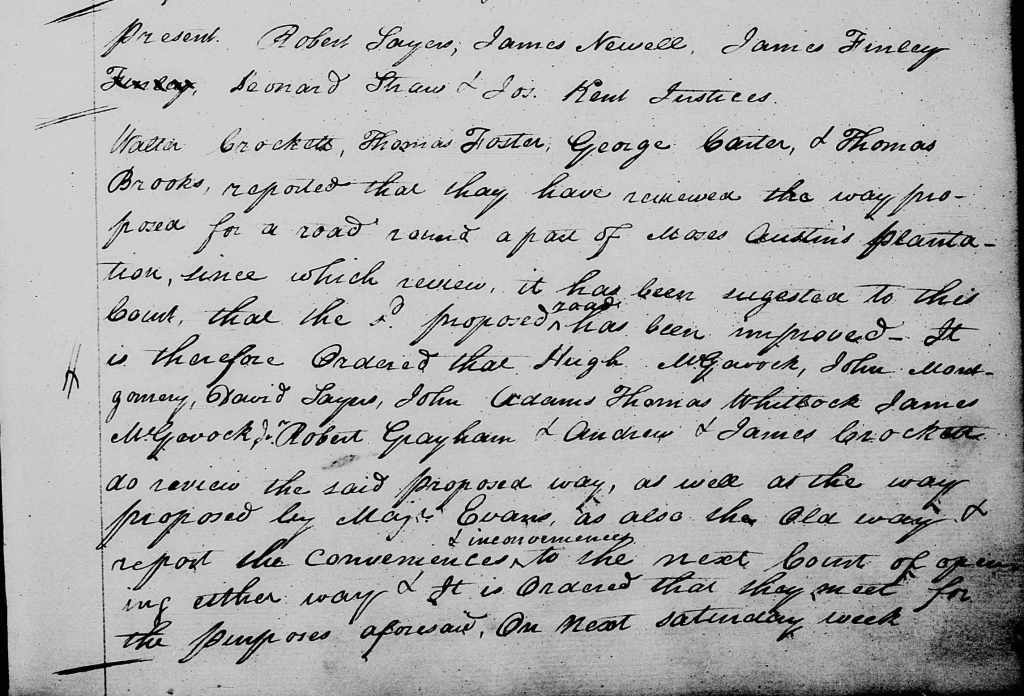
On 8 August 1797, Thomas Whitlock made oath in Wythe Court proving that Abram Price was the heir of Benjamin Price.[24] Thomas appears again in county court minutes on 13 September 1797, when the court notes that Walter Crockett, Thomas Foster, George Carter, and Thomas Brooks had reported that they had viewed a way for a proposed road around Moses Austin’s plantation.[25] It had been suggested to court that this way had been improved, and at this court session, the court ordered Hugh McGavock, John Montgomery, David Sayers, John Adams, Thomas Whitlock, James McGavock, Robert Graham, and Andrew and James Crockett to view the proposed way, as well as a way proposed by Major Evans and also the old way, and make a recommendation to the court. This court record provides a good snapshot of Thomas Whitlock’s neighbors at this point, who included Thomas Brooks whose son Thomas married Thomas Whitlock’s daughter Sarah. We’ve met many of the names found in this court record in previous postings about Thomas Whitlock.


On 14 February 1798, the court appointed Randolph Fugate, Thomas Foster, and Thomas Brooks Sr. to allot hands to work on a county road under Reuben Harrell and Thomas Whitlock.[26] On 15 January 1800, the county court appointed any three of a group of men to view the road from Craig’s Ford past Robert Carter’s plantation, the nearest and best way to Henry Davies’s mill, then down the south side of New River to the Montgomery County line.[27] The list of men appointed included David Sayers, Thomas Foster, and Henry Davies Sr.

On 14 April 1801, Wythe court appointed David Sayers, Thomas Whitlock, Charles Calfee, and John Crockett (son of James), or any three of them, to appraise the estate of Robert Carter.[28] Robert Carter (1769 – 1801) was the son of Thomas Whitlock’s neighbor George Carter, who has been discussed in previous postings. About 1790, Robert married Jane, daughter of Walter Crockett, whose sister Katherine married William Sayers, grandson of Colonel John T. Sayers..[29]
On 11 June 1801, Thomas Whitlock returned to Wythe court an appraisal of Robert Carter’s estate.[30] On 10 June 1802, the county court appointed Thomas Whitlock, Spencer Breeding, and David Sayers appraisers of the estate of Swan, a free Negro.[31] Court minutes for 6 October 1802 show the appraisal returned to court, with Swan’s name given here as Swan Gardner.[32]

Wythe court minutes for 10 May 1803 state that the commissioners the court had appointed to view the way from Randall Fugate’s to Humphrey Ellis’s by Henry Christy’s and William Harrell’s had returned a report that the proposed road was reasonable, and the court then appointed William Harrell Sr. to oversee the road, with David Sayers, Joseph Russell, James Calfee, and Thomas Whitlock or any three of them to appoint and allot hands for the road work.[33]

On 9 August 1803, Wythe court minutes state that William Ross, Henry Davis Jr., and David Sayers were appointed to lay off and divide hands working the road) from Craig’s ford to the Grayson County line under overseers William Harrell (spelled Harrald here), Spencer Breeding, Henry Davis Sr., Thomas Whitlock, James Calfee, and Lawrence Stephens.[34]
On 13 June 1804, Wythe court ordered William Ross, Henry Davies Jr., and David Sayers to lay off and divide hands to work the road under overseers William Harrell, Henry Davies Sr., Thomas Whitlock, and Laurence [sic] Stephens.[35] Court minutes for 12 December 1804 show Thomas Whitlock continuing as a road overseer on that date.[36]
According to Mary B. Kegley, who appears to be citing an act of the Virginia legislature, on 2 January 1805, the state legislature appointed Thomas Whitlock along with Stephen Sanders and James Newell to examine a dam erected on Reed Creek by Andrew and James Crockett at their ironworks. On 15 December 1804, numerous county residents had signed a petition protesting that the dam was obstructing the passage of fish in the creek. Jacob Davis, who had lived in the area about sixteen years, deposed before Leonard Strawn, j.p., on 23 November 1804 that he had caught catfish of up to ten pounds in the creek before the construction of the dam, but that after the dam was built, it was not worth a person’s time to fish in the creek. Sanders, Newell and Whitlock, Gentlemen, were instructed to hear evidence from residents of the area and report to the General Assembly whether the dam should be left alone, or a slope be built leading to the dam.[37] As a previous posting has noted, Stephen Sanders/Saunders operated a ferry on New River with the Herbert family.
In my next posting, I’ll discuss in detail the lawsuit that Thomas Whitlock’s daughter-in-law Mary Davies Whitlock filed against him in September 1799 in Augusta County chancery court, whose outcome appears to be part of what precipitated his and wife Hannah’s move to Kentucky in 1805.
[1] Wythe County, Virginia, Deed Bk. 1, p. 138-140: see Mary B. Kegley, Early Adventurers on the Western Waters, vol. 2 (Orange, Virginia: Green, 1982), pp. 226-7, and Early Adventurers on the Western Waters, vol. 3 (Wytheville: Kegley Books, 1995), p. 221.
[2] Montgomery County, Virginia, Deed Bk. A, pp. 160-1.
[3] Wythe County, Virginia, Personal Property Tax List, 1793, unpaginated; available digitally at FamilySearch.
[4] See Jeffrey C. Weaver’s transcript of Wythe County, Virginia, Land Tax List, 1793, at the New River Notes website.
[5] Wythe County, Virginia, Entry Bk. 1, p. 113.
[6] Wythe County, Virginia, Survey Bk. 1, p. 262.
[7] Wythe County, Virginia, Deed Bk. 2, pp. 108-9.
[8] Ibid., Bk. 5, pp. 538-9.
[9] Ibid., pp. 78-9.
[10] Virginia Land Office Survey Bk. 4, pp. 654-5.
[11] Wythe County, Virginia, Personal Property Tax List, 1794, unpaginated; available digitally at FamilySearch.
[12] Ibid., 1795; available digitally at FamilySearch;
[13] Ibid., 1796; available digitally at FamilySearch.
[14] Ibid., 1797; available digitally at FamilySearch.
[15] Ibid., 1798; available digitally at FamilySearch.
[16] Ibid., 1800; available digitally at FamilySearch.
[17] Ibid., 1801; available digitally at FamilySearch.
[18] Ibid., 1802; available digitally at FamilySearch.
[19] See Mary B. Kegley, Abstracts of Court Orders of Wythe County, Virginia (Wytheville: Kegley Books, 1996), p. 84, citing Wythe County, Virginia, Court Order Bk. Minutes for 12 January 1802.
[20] Wythe County, Virginia, Personal Property Tax List, 1803; available digitally at FamilySearch.
[21] Ibid., 1804; available digitally at FamilySearch.
[22] Ibid., 1805; available digitally at FamilySearch.
[23] See Netti Schreiner-Yantis and Florene Speakman Love, The Personal Property Tax Lists for the Year 1787 [for Virginia], vol. 45: Montgomery County (Springfield, Virginia: Genealogical Books in Print, 1986-1987).
[24] Wythe County, Virginia, Court Order Bk. 1796-9, p. 95.
[25] Ibid., p. 115.
[26] Ibid., p. 165.
[27] Wythe County, Virginia, Court Order Bk. 1799-1801, p. 123.
[28] Ibid., p. 338.
[29] See Early Adventurers on the Western Waters, p. 260, which has a picture of Walter Crockett’s log house at Poplar Camp. See also pp. 598-600 on the Carter family.
[30] Wythe County, Virginia, Will Bk. 1, p. 183; and Wythe County, Virginia, Court Order Bk. 1801-5, unpaginated, 11 June 1801.
[31] Wythe County, Virginia, Court Order Bk. 1801-5, unpaginated, 10 June 1802.
[32] Ibid., 6 October 1802.
[33] Ibid., p. 199 (the order book is paginated sporadically).
[34] Ibid., unpaginated, 9 August 1803.
[35] Ibid., paginated here, p. 357.
[36] Ibid., p. 432.
[37] Kegley, Early Adventurers on the Western Waters, pp. 374-5. See Legislative Petitions of the General Assembly, 1776-1865, accession #36121, box 258, folder 2, held by Virginia State Library, whose website has a digitized copy of the petition file.
 BEGATS AND BEQUEATHALS
One thought on “Thomas Whitlock (abt. 1745 – 1830) of Louisa and Wythe Counties, Virginia, and Cumberland County, Kentucky: Wythe County, Virginia, Records, 1790 – 1805”