Thomas Whitlock Enters Land in Montgomery County, November 1781
The next record I find for Thomas Whitlock in Montgomery County is a 2 November 1781 land entry. On that date, he entered a commissioner’s certificate for 400 acres on both sides of Little Reed Island Creek that had been assigned to him by Charles Lynch, the person to whom Jonathan Jennings sold land in March 1776 with Thomas Whitlock as a witness.[1] The land entry states that Charles Lynch assigned the certificate to Thomas Whitlock, and that Lynch was an assignee of Abraham Price, the assignee of William Crabtree, the assignee of Ezekiel Smith.
According to Mary B. Kegley, this land entry is also recorded in a volume called Records of Certificates of Commissioners of Washington and Montgomery Counties, Virginia, 1767-1788, with a note that the land was settled in 1765. I don’t know if this indicates that Thomas Whitlock settled on this tract of land on that date, or if this is when the tract was first claimed by Ezekiel Smith.[2] I have not seen copies of the original land entry, and cannot locate the books in which it is recorded in the catalogue of the Family History Library in Salt Lake City or of the State Library of Virginia.
As I’ve stated previously, I think that Thomas Whitlock was likely living on this land from the time he arrived in Wythe County before March 1776, and that he had some connection to Charles Lynch, which explains Lynch assigning this land to Whitlock. As you’ll see if you click on this previous posting, an excellent map of Wythe County waterways found in Mary B. Kegley’s Early Adventurers on the Western Waters shows the location of Little Reed Island Creek, one stream upstream (i.e., east) from Poplar Camp Creek, on which Thomas Brooks, whose son Thomas married Thomas Whitlock’s daughter Sara, lived.[3] Both empty into New River, which runs across Wythe County from northeast to southwest. Chiswell’s lead mines were located at the juncture of New River and Poplar Camp Creek.
Next to the 2 November 1781 land entry of Thomas Whitlock is one made by Benjamin Clemons, also for 400 acres on both sides of Little Reed Island Creek, and also with Charles Lynch as the person assigning Clemons this land. Benjamin Clements (as his surname is usually spelled) was a neighbor of Thomas Whitlock per various later documents, with their land adjoining. I have done little research about him, but the little I’ve found indicates he was roughly a contemporary of Thomas Whitlock — perhaps a few years older — and seems to have come to Wythe County from Pittsylvania County, adjacent to Bedford, where Charles Lynch lived.
On the same date on which Thomas Whitlock and Benjamin Clemons/Clements made their entries of land on Little Reed Island Creek, both with certificates assigned to them by Charles Lynch, Josiah Fugate entered three tracts on New River.[4] Josiah was a neighbor of Thomas Whitlock, according to a number of Montgomery-Wythe County documents. The Fugates, who came to Montgomery (later Wythe) County from Frederick County, Virginia, as the family of Thomas Brooks did, had marriage ties to the Hurst family into which Thomas Whitlock’s youngest daughter Mildred married.
The Montgomery County land entry book for 1781 also shows that on 6 March 1781, Henry Davis entered 800 acres at the big falls of Reed Island Creek, then down both sides to where the creek emptied into New River, with the land entry noting that he was the assignee of Charles Lynch.[5] The land entry states that Charles Lynch was the assignee of Jonathan Jennings, the person who sold land to Lynch in March 1776 with Thomas Whitlock witnessing. Jonathan Jennings had claimed it with a preemption warrant.
Henry Davies/Davis is, of course, the father of Mary Davies/Davis, who married Thomas Whitlock’s son Charles Whitlock. On 1 May 1791, Charles Lynch and wife Anne sold Henry Davis 150 acres on an unnamed creek in Wythe County.[6]
Another land entry by Josiah Fugate in 1782 (September?) states that the tract of 200 acres he was entering on Little Reed Island Creek adjoined Benjamin Clements and Thomas Whitlock.[7] On 24 September 1782, Josiah Fugate entered another 88 acres between Carter and Gray on the south side of New River, and 264 acres joining this tract on the north side of Thomas Whitlock and the south side of James Gray.[8]
The Carter mentioned in this land entry is George Carter (1740/6 – 1809), who, as a previous posting states, was a neighbor of Thomas Whitlock. As the posting I’ve just linked also indicates, a 25 October 1784 deed of James and Flower Gray of Montgomery County to Fredegal Adams for land on the south side of New River shows us that one of the three tracts they were selling adjoined Henry Davies, and another joined Thomas Whitlock and George Carter.[9] George Carter was father of Charles Carter, mentioned in the previous posting, who is listed in the 1781 list of members of Jeremiah Pearce/Pierce’s battalion that also includes Sergeant Thomas Whitlock. George Carter appears to have come to Montgomery County from Prince William County, Virginia.
1782 Montgomery County Tax List
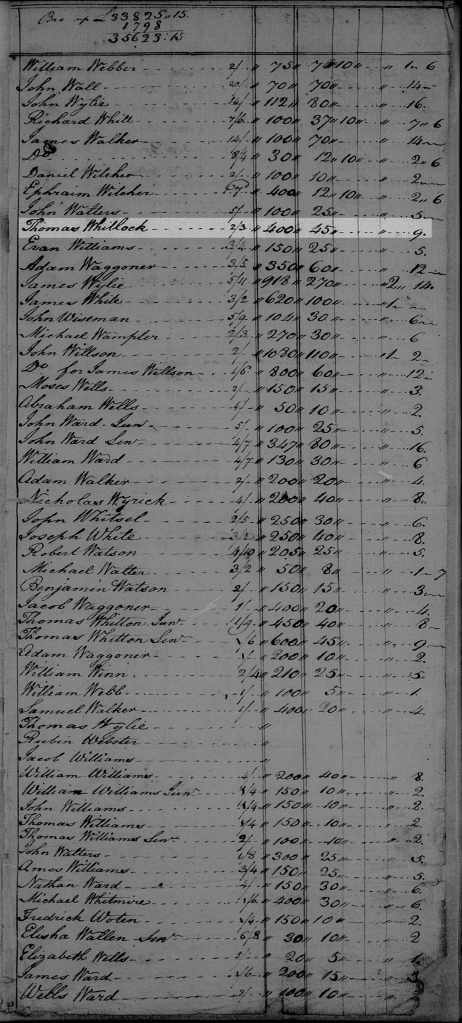
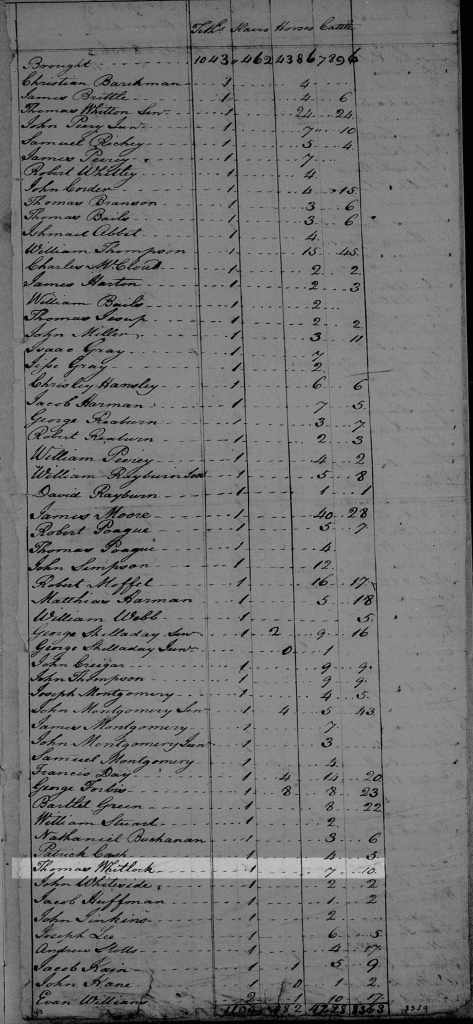
Tax lists for Montgomery County begin in 1782. Thomas Whitlock appears on the 1782 land tax list in Montgomery County taxed for 400 acres, with the land valued at £45.[10] He also appears on the personal property tax list for Montgomery County in the same year with one tithable, seven horses, and ten cattle.[11]
Second Lieutenant Under Captain Stephen Saunders, 1782
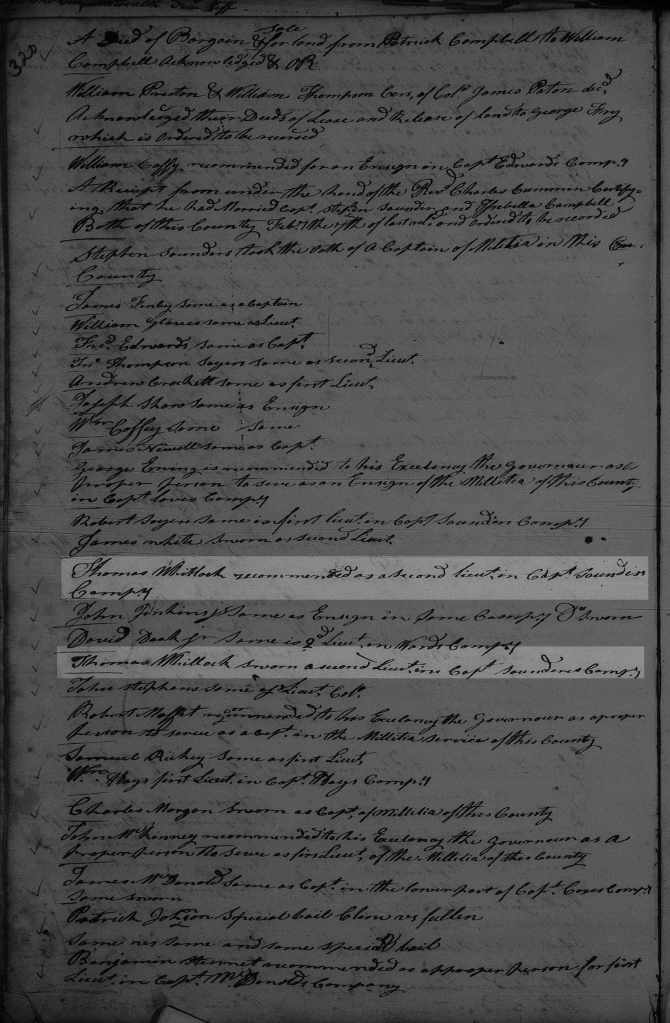
Court minutes for Montgomery County on 6 February 1782 state that Thomas Whitlock was sworn to the rank of second lieutenant in the company of Captain [Stephen] Saunders, a rise in rank from his previous rank as sergeant in Pearce’s company in 1781.[12] The court minutes showing Thomas making oath as second lieutenant on this date also state that Robert Sayers was recommended as first lieutenant. On Robert Sayers, who served with Thomas Whitlock in Jeremiah Pearce’s battalion in 1781, see the previous posting, which notes that he was a son of William Sayers, another witness to the March 1776 deed of Jonathan Jennings to Charles Lynch that Thomas Whitlock also witnessed. Saunders’s militia company also included Francis Day, who, as the previous posting indicates, made the oath of allegiance to the Revolution along with Thomas Whitlock in Montgomery County on 13 September 1777.[13]
Stephen Saunders and his company are mentioned in a number of Revolutionary pension applications. In a Revolutionary pension affidavit he gave in Montgomery County on 2 October 1832, Daniel Howe states that the militia company in which he served in Montgomery County under Captain Patton in 1781 was sent to North Carolina, where the company of Captain Stephen Saunders was also serving.[14] A 26 May 1835 affidavit Henry Byrd/Bird gave at Rogersville in Hawkins County, Tennessee, as he applied for a Revolutionary pension, explains what Saunders’s troops were doing in North Carolina (and in Montgomery County) in 1781: Byrd states,[15]
About the first of the year 1781 there was a call for men again to march in to North carolina. I was drafted in the service of the United States first of February 1781 as a private in Montgomery County State of Virginia under the command of Capt. [Stephen] Saunders Colo. Crocket [sic: Walter Crockett]. There ware part of the men left to guard the lead mines as there ware a great many hands at work then for the publick and Indians and Tories ware troublesome. my Company was left we ware stationed at the mines six months we would go some times for several miles in searching for Indian sign or waylay certain places where they ware expected to pass and then would return to camp again after the six months was out I received a discharge from Capt. Saunders and returned home first of Aug’t. 1781.
As Henry Byrd’s affidavit indicates, the Chiswell lead mines in Montgomery County were of major military importance during the Revolution, and troops raised in that part of Virginia expended a great deal of time and energy to guarding the mines. In his Revolutionary pension affidavit given on 23 January 1833 in Lee County, Virginia, Jacob Crabtree states that in May 1776, he entered a company of rangers under command of Captain James Crabtree, Lieutenant Umberstone [i.e., Humberstone] Lyon, and Ensign Philemon Higgins and served five months guarding the frontiers of Washington County.[16] After being discharged around 1 November 1776, he then joined a militia company in Washington County commanded by Captain James Montgomery, Lieutenant Samuel Newell, and Ensign James Sims and marched against the Tories with those troop to the straw barns and lead mines on New River.
Crabtree describes what the Washington County militia troops were doing at the Chiswell lead mines in 1780:
[We] joined some regular troops at the Lead mines, all commanded by Col. Jeremiah Pearce of the Militia. In this service the declarant was engaged a little over two months; where after having dispersed the Tories and caused several of them to enlist in the Regular Service, and making a large quantity of lead for the protection of the Frontiers, the troops at the Lead mines were permitted to go home.
Note that Jeremiah Pearce is same man we met in the previous posting, in whose Montgomery County battalion Thomas Whitlock is listed as a sergeant on 5 April 1781. This Revolutionary pension affidavit gives us a glimpse of what Thomas Whitlock was likely doing in the time in which he served in Pearce’s battalion.
Listed in Captain Robert Sayers’s Company, 1784
In his history of Montgomery County, Charles W. Crush transcribes a list of tithables in Captain Robert Sayers’s company in 1784, which includes the name Ross Whitlock.[17] I suspect Crush has mistranscribed the name and that this is Thomas Whitlock. I have seen the name Ross Whitlock in no documents at all in Montgomery and Wythe Counties, Virginia. This list is apparently a militia list and not a tax list.
Captain Robert Sayers (1752 – 1847) is not the Robert Sayers discussed in the last posting (1754 – 1826), who was a son of William Sayers and Esther Thompson. Captain Robert was a son of Alexander Sayers, a brother of William Sayers, and Alexander’s wife Elizabeth Prickett. Captain Robert Sayers made a Revolutionary pension affidavit in Pulaski County, Kentucky, on 1 September 1823, in which he states that he enlisted in February 1776 in the Virginia 7th Regiment under Joseph Crockett, whose commander was Colonel Alexander McClanahan:[18]
On this 1st day of September A.D. 1823 personally appeared in Open Court, being a Court of Record Established by the Constitution and laws of the Commonwealth of Kentucky, having power to fine, and Imprison, and proceeding according to the course of the Common Law, Robert Sayers, aged 71 years, a resident in Pulaski County, who being first duly sworn, according to law, doth on his oath declare, that he served in the Revolutionary War as follows, that in the month of February A.D. 1776, he enlisted for the term of two years, in the Regular Service of the United States in the Revolutionary War, in the Company commanded by Joseph Crockett, in the Regiment commanded by Colonel Alexander McClanahan, and in the Brigade of General Andrew Lewis, that the Brigade aforesaid was a part of the Virginia State line, upon the Continental Establishment, he states that he served nine months, and was taken sick, & obtained a permit from said General to go home, when he hired a substitute, during the War, and whom he verily believes served in his stead….
Captain Robert Sayers’s pension file also contains a 21 May 1805 document in which Robert, then living in Wythe County, Virginia, assigned to James Taylor of Campbell County, Kentucky, a 300-acre grant awarded to Robert Sayers for his service as a captain in the 7th Virginia Regiment. James McGavock and Robert Adams approved this assignation of the grant at Wythe Court before Robert Crockett on 3 June 1805.
If mention of the 7th Virginia Regiment and Colonel Alexander McClanahan rings bells to those who have read previous postings about Thomas Whitlock (abt. 1745 – 1830), here’s why: as a previous posting states, a service record of a Thomas Whitlock who I believe is this Thomas Whitlock shows that he enlisted on 10 April 1775 in Captain Joseph Spencer’s company of the 7th Virginia Regiment, under the command of Colonel Alexander McClanahan.[19] I think it’s hardly accidental, then, that Thomas Whitlock of Montgomery County, Virginia, is listed in a 1784 tithables list of Captain Robert Sayers. In my view, this connection in 1784 between the two men tends strongly to prove that the Thomas Whitlock of that Revolutionary service record is the Thomas Whitlock who had settled in Montgomery County by March 1776.
According to Kegley, “it is also said” that Captain Robert Sayers’s cousin Robert, son of William Sayers and Esther Thompson, served in the 7th Virginia Regiment with Joseph Crockett.[20] I think, however, that this tradition is confusing Captain Robert with his first cousin who was son of William Sayers and Esther Thompson. We know from Captain Robert’s September 1823 affidavit for a pension in Pulaski County, Kentucky, that he served in the 7th Virginia Regiment under Captain Joseph Crockett and Colonel Alexander McClanahan.
Captain Robert Sayers’s Revolutionary pension affidavit also notes that the 7th Regiment brigade in which he served was under the command of General Andrew Lewis. According to Mary B. Kegley, on 22 April 1758, Andrew Lewis, then a colonel, recommended Robert Sayers’s father Alexander Sayers as a first lieutenant to Colonel John Buchanan. In recommending Alexander Sayers for this position, Lewis stated that Sayers had served under him as an ensign.[21] In August 1779 in Montgomery County, Robert Sayers received a warrant for 2,000 acres issued to him as son and heir at law of Alexander Sayers, who was an officer in a company incorporated with a detachme of the Virginia Regiment under Major Andrew Lewis on two expeditions (see Lloyd DeWitt Bockstruck, Virginia’s Colonial Soldiers [Baltimore: Genealogical Publishing Company, 1988], p. 273).
Colonel John Buchanan: with that name, we’ve circled back yet again to the March 1776 Montgomery County deed of Jonathan Jennings to Charles Lynch in which we first meet Thomas Whitlock in Montgomery County records. That deed tells us that the land Jennings was selling Lynch at the mouth of Reed Island Creek of New River (the deed uses the older name of Woods River) had come to Jennings from the estate of Colonel John Buchanan, whose executor William Preston sold it to Jennings. John Buchanan, whose wife was Jane Sayers, part of the Sayers family to which Alexander Sayers and his son Captain Robert belonged….
And there’s more: as legal actions in Augusta County, Virginia, in the 1760s show, when Captain Robert Sayers’s father Alexander Sayers drowned in New River in March 1765, leaving his eldest son Robert as his heir, Robert was away in school in Bedford County — the county in which, as we’ve seen, Thomas Whitlock was living by July 1769 before he showed up by 1775 in Montgomery County records, and the county in which Charles Lynch, who seems to have had a connection to Thomas Whitlock, lived. We know that Robert Sayers was in Bedford in the spring of 1765 because, when Archibald Buchanan, heir of Walter Buchanan, a Chesterfield, Virginia, merchant, filed suit against Robert Sayers as heir of Alexander Sayers in Augusta County in May 1765, the court judgment file for this case states, “The boy [i.e., Robert Sayers] is in Bedford at school.”[22]
Augusta County court minutes show that following the death of his father, Robert Sayers chose Robert Breckinridge as his guardian at Augusta court on 18 March 1767.[23] The court record states that Robert Sayers was fifteen years old at this point.
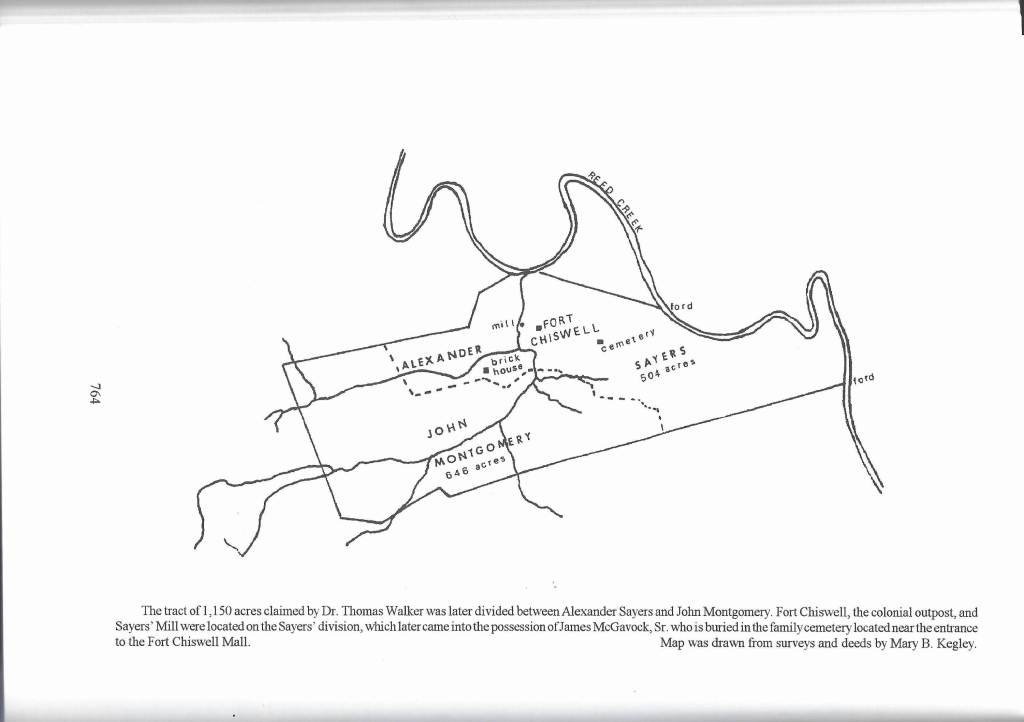
A number of Augusta County chancery court cases provide interesting information about Alexander Sayers’s landholdings in what would become Montgomery County, where his son Robert would settle.[24] As the case files for these cases — Admr. of Walter Buchanan vs. Robert Sayers, John Buchanan vs. Robert Sayers, and Samuel Ewing vs. John Buchanan — show, on 3 July 1755, Alexander Sayers bought from Humberstone Lyon 650 acres on Wood’s (later New) River in what would become Montgomery County. The land was on Reed Creek at Fort Chiswell. Alexander’s brother William Sayers witnessed this deed along with John Buchanan and others.
Humberstone Lyon — we’ve met this name previously, in Jacob Crabtree’s Revolutionary pension affidavit regarding his service in 1776 — was, according to Kegley, an early adventurer of what would become Wythe County, settling in the lead mines community.[25] Kegley says that Lyon was living on the land Alexander Sayers bought from him in 1755, and that Sayers bought some of this land jointly with John Buchanan, the deed being made out solely to Sayers. This arrangement is part of what precipitated the litigation regarding Alexander Sayers’s New River land after he died.[26] Humberstone Lyon’s given name is also often spelled Humberston, and his surname is sometimes spelled Lyons.
The Sayers family had moved to New River, it should be noted, by the time Alexander Sayers bought land there in 1755. Kegley says that the family were among the first settlers of what would eventually become Wythe County, and had apparently settled on a branch of Reed Creek of the New River by December 1745.[27] The county at this point was still Augusta, and would become Botetourt, then Fincastle, Montgomery, and finally, in the area in which the Sayers family had settled, Wythe.
Alexander Sayers mortgaged the land he bought from Humberstone Lyon to Walter Buchanan on 21 January 1764. It was this Montgomery County land about which Archibald Buchanan, brother of Walter Buchanan and Walter’s heir, filed suit against the estate of Alexander Sayers. As a previous posting noted, on 6 May 1760, Colonel John Chiswell claimed 1,000 acres on New River. This land was at Humberston Lyon’s corner, and either adjacent or close to the land Alexander Sayers bought from Lyon.
At the same time that he was living on New River in Augusta, later Montgomery and then Wythe County, Alexander Sayers was also selling land in Bedford County. On 2 July 1764, he made conveyances to Israel Christian of three lots in New London in Bedford, which he had acquired from Benjamin Howard, Richard Callaway, and William Mead (Bedford County, Virginia, Deed Bk. 2, pp. 512-5). Note that James Callaway, one of the witnesses to the March 1776 deed of Jonathan Jennings to Charles Lynch that Thomas Whitlock also witnessed, was treasurer for the town of New London (see Mary Denham Ackerly and Lula Eastman Jeter Parker, Our Kin: The Genealogies of Some of the Early Eamilies Who Made History in the Founding and Development of Bedford County, Virginia [Lynchburg: Bell, 1930], p. 296).
Lots of interesting parallels and connections here: Captain Robert Sayers, son of Alexander Sayers, is in Bedford County for schooling by spring of 1765; his family is living at the time in a part of Augusta County that would later become Montgomery and then Wythe. In February 1776, he enlists (from Montgomery County) in the 7th Virginia Regiment under Colonel Alexander McClahanan, the same regiment and same colonel under whom a Thomas Whitlock that I believe is the man who ended up in Montgomery County served. By 1769, Thomas Whitlock is in Bedford County, and then by March 1776 he’s in Montgomery, settled near the Sayers family. William Sayers, uncle of Captain Robert Sayers, witnesses the Montgomery County deed of Jonathan Jennings to Charles Lynch of Bedford in March 1776 that is the first trace I find of Thomas Whitlock in Montgomery.
And then in 1784, Thomas Whitlock is in Captain Robert Sayers’s tithables (i.e., militia) list in Montgomery County. I may be wrong in thinking that the Robert Sayers who served with Thomas Whitlock in Jeremiah Pearce’s battalion in April 1781 is the son of William Sayers and Esther Thompson, and not his first cousin Captain Robert who was son of Alexander Sayers and Elizabeth Prickett. The two Roberts were close in age and Thomas Whitlock seems to have connected to both, and nothing in Pearce’s list allows one to identify which of these two men is the Robert Sayers in Pearce’s enumeration.
On 6 December 1780, Captain Robert Sayers made a petition to the Virginia legislature requesting pay for himself and men who were serving under him in Montgomery County.[28] The petition states that, at the orders of William Preston, he had formed a troop of mounted light horsemen to guard the frontiers of Virginia, and that “he was on constant Duty in suppreſsing the Insurgents not only in this State but in Carolina.”
It’s also interesting that Captain Robert Sayers moved to Pulaski County, Kentucky, where Thomas Brooks and Sarah Whitlock, daughter of Thomas Whitlock, settled when they first moved to Kentucky in 1798. One final note about Captain Robert Sayers: his wife was a Crockett, Jean/Jane Crockett. I’m not entirely sure where she fits into the Crockett family tree.
Thomas’s Land Entry Is Surveyed, 1782
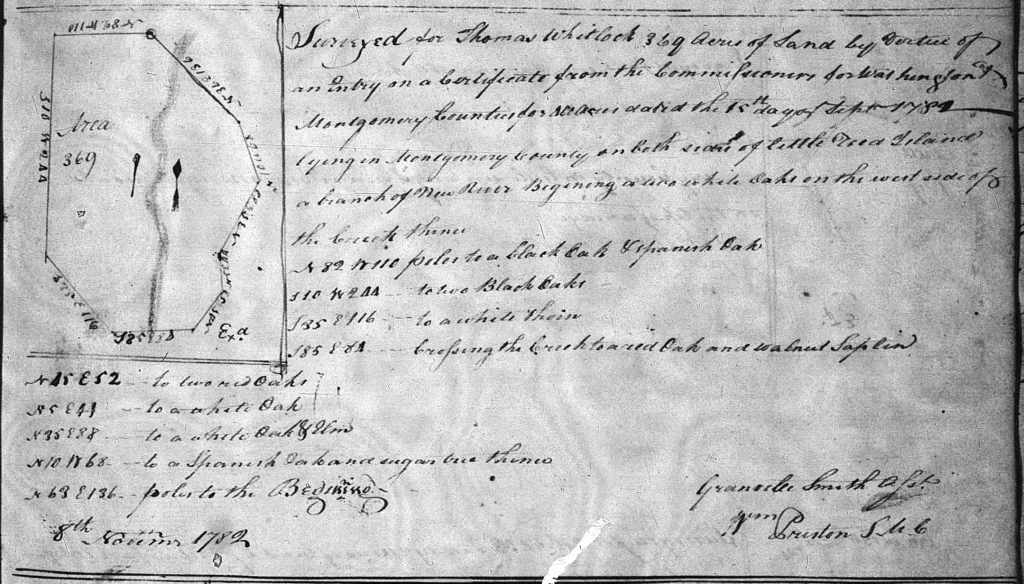
On 8 November 1782, the land Thomas Whitlock had entered in Montgomery County on 2 November 1781 was surveyed (see the image at the head of the posting).[29] The survey gives the entry date as 15 September 1781, and states that the land was entered and surveyed on a certificate from the commissioners of Washington and Montgomery Counties. The plat of the tract in Montgomery County, Virginia, Plat Book A, p. 258, states that the warrant was issued by the commissioners of Montgomery and Washington Counties on 15 September 1782. The 400 acres Thomas Whitlock had entered in 1781 ended up in the survey as 369 acres on both sides of Little Reed Island Creek in Montgomery County. The survey was recorded on 21 August 1783 and certified on 1 May 1784.
Thomas Is Granted (1784) the Land He Entered in 1781
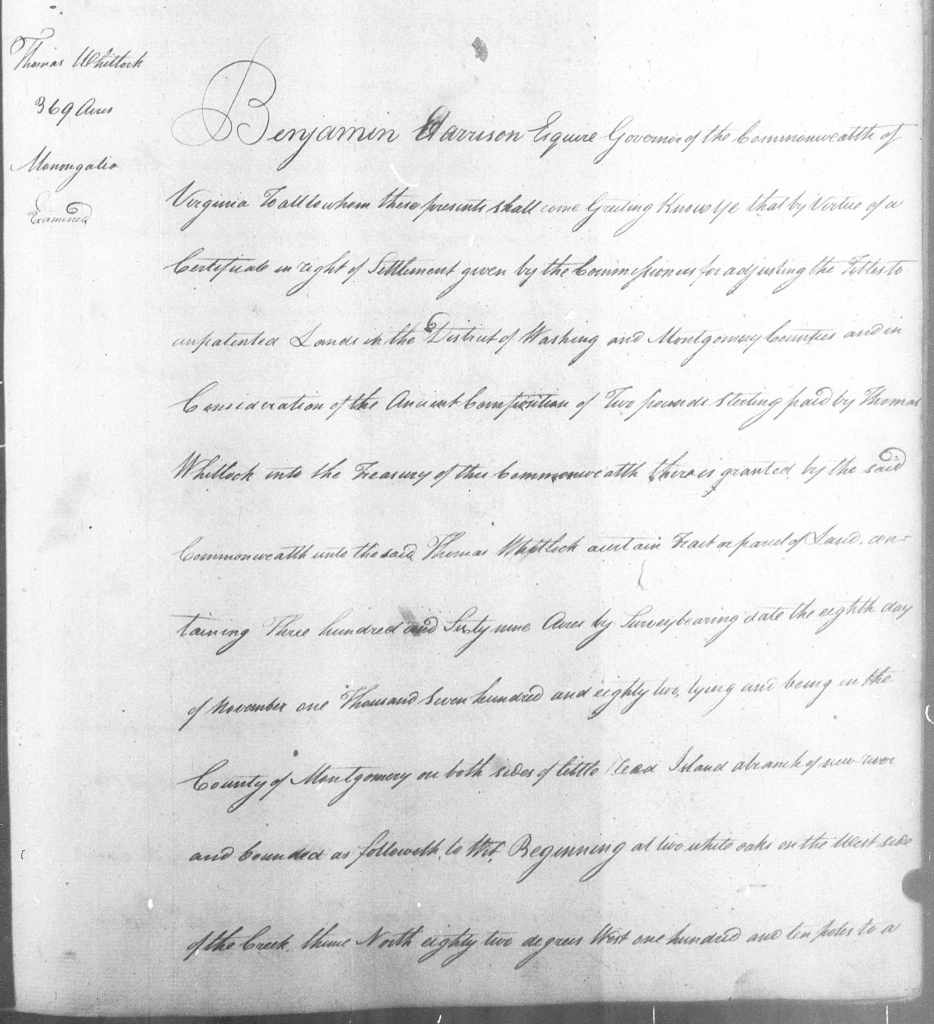
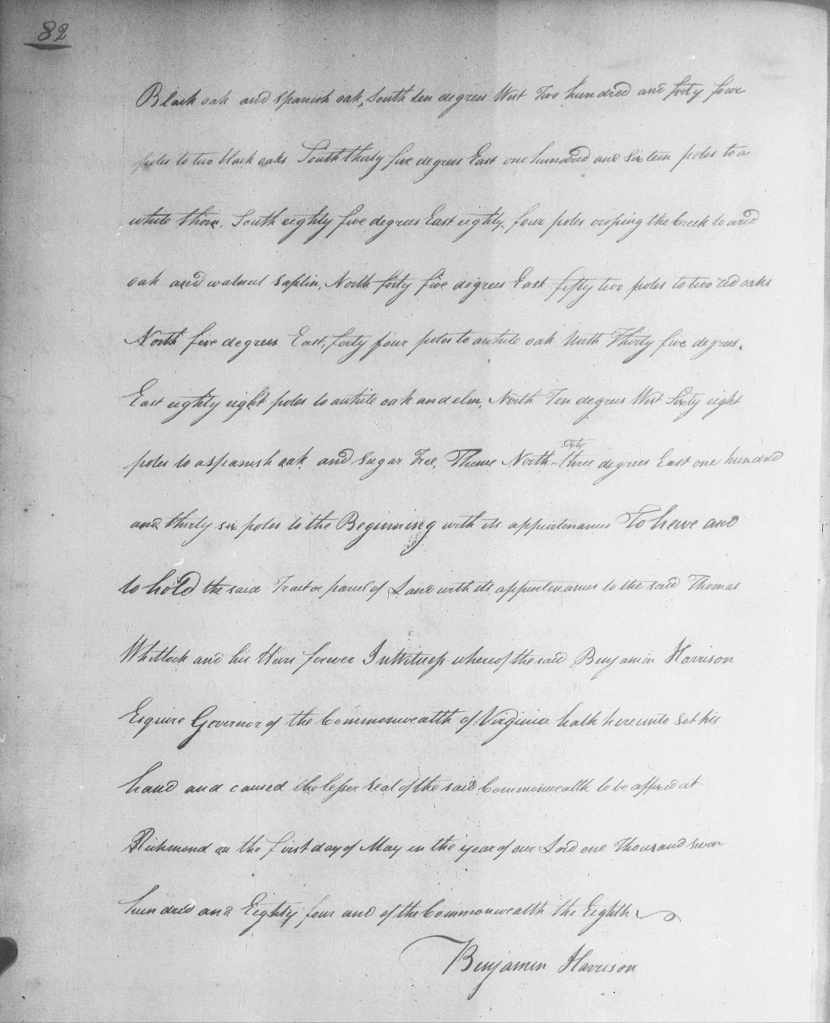
The grant document dated, as I’ve just noted, 1 May 1784 confirms that Thomas Whitlock received a grant of 369 acres on both sides of Little Reed Island Creek in Montgomery County.[30] The grant states that the land was being granted by virtue of a certificate in right of settlement that had been given by the commissioners of Washington and Montgomery Counties for adjusting the titles to unpatented lands in those counties. Thomas Whitlock paid £2 sterling for the land. As this document suggests, those who had already settled on these tracts of land were being awarded clear titles to land on which they were living. Since, as we know from the 1781 land entry, Charles Lynch had assigned the certificate for this land to Thomas Whitlock, it seems to me that Thomas was living on land that Charles Lynch had entered, to which Thomas did not have title until 1784, and that Thomas Whitlock and Charles Lynch had had some kind of arrangement allowing Thomas use and occupation of the land.
Court and Deed Records, 1784-7
As noted previously, a 25 October 1784 Montgomery County deed of James Gray and wife Flower to Fredegal Adams, all of Montgomery County, states that the Grays were selling Adams three tracts of land on the south side of New River, with some of the land adjoining Thomas Whitlock.[31] The first tract was about a mile and a half above the mouth of Reed Island Creek and adjoined Henry Davies and Benjamin Clements. The second tract adjoined Benjamin Clements, George Carter, and Thomas Whitlock, and the third adjoined George Carter. These are all names we’ve met above as neighbors of Thomas Whitlock, and in the case of Henry Davies, father of the wife of Thomas’s son Charles.
On 26 March 1785, Thomas Whitlock was a witness to Benjamin Clements’s sale of 110 acres in Montgomery County to Richard Ellis, both men being residents of Montgomery.[32] The land Clements was selling was on the north side of Little Reed Island Creek. Thomas Whitlock signed by mark, with George Carter and Samuel Conway also witnessing this deed.
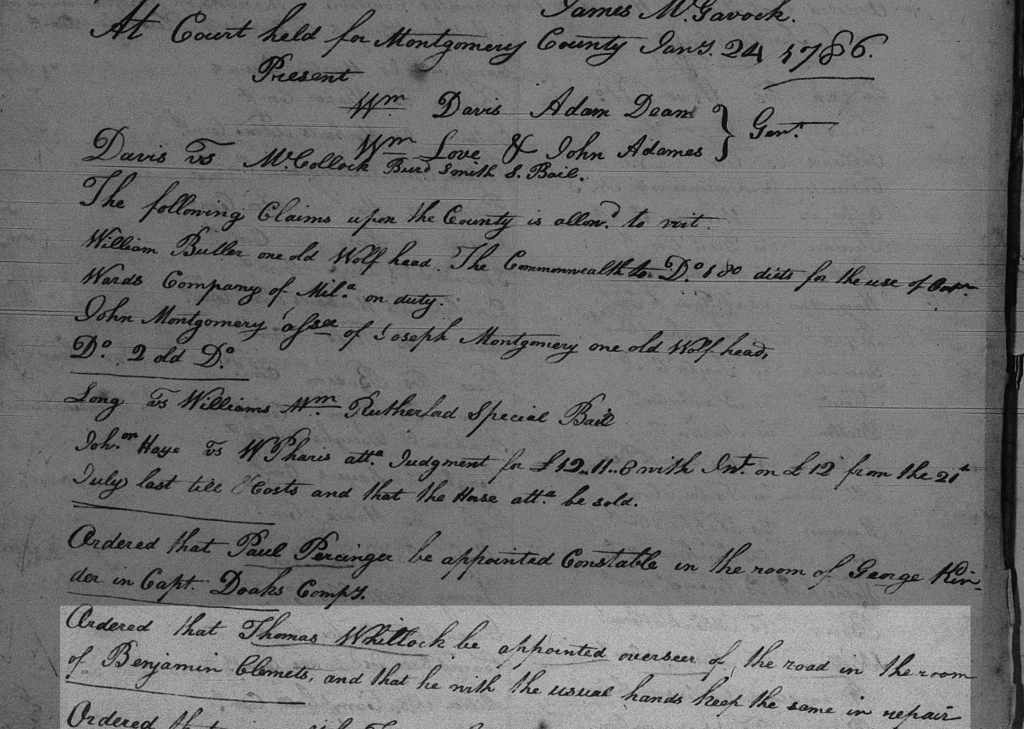
On 26 July 1785, Thomas Whitlock was a juror in Montgomery County in the case of John McClelland vs. Campbell.[33] Thomas appears again in Montgomery court minutes on 24 January 1786, when the court ordered him to oversee the road “in the room of” Benjamin Clements.[34]
A 14 August 1786 Montgomery County deed of John Harding and wife Nancy to Henry Harding, all of Montgomery County, mentions Thomas Whitlock.[35] John and Nancy Harding sold Henry Harding 300 acres, with the deed stating that this was the messuage on which the couple lived. The deed indicates that the land was on a west branch of Little Reed Island Creek, cornering on Richard Ellis, and on the lines of [Josiah] Fugate and [Thomas] Whitlock. This deed was witnessed by George Carter, Richard Ellis, and John Smith.
Thomas Whitlock appears on the 1787 tax list in Montgomery County taxed for 369 acres bounded by Little Reed Island Creek, Mack’s Branch, Pine Run, the upper end of Persimmon Bottom, Cove, and Reed Creek. He is also taxed for five horses, one stud horse, and sixteen cows.[36]
In my next posting, I’ll pick up the chronicle of Thomas Whitlock’s life in Wythe County, which was formed from Montgomery in 1790, insofar as I’ve documented his life.
[1] Mary B. Kegley, Early Adventurers on the Western Waters, vol. 2 (Orange, Virginia: Green, 1982), p. 28, citing Montgomery County, Virginia, Land Entry Bk. 1781, p. 19.
[2] Kegley, Early Adventurers on the Western Waters, vol. 2, p. 104, citing Records of Certificates of Commissioners of Washington and Montgomery Counties, Virginia, 1767-1788, p. 40. Kegley says that State Library of Virginia holds this volume.
[3] See Kegley, Early Adventurers on the Western Waters, vol. 3 (Wytheville: Kegley Books, 1995), p. 216; the map was drawn by Kegley.
[4] Kegley, Early Adventurers on the Western Waters, vol. 2, p. 28, citing Montgomery County, Virginia Land Entry Bk. 1781, p. 17.
[5] Kegley, Early Adventurers on the Western Waters, vol. 2, p. 35, citing Montgomery County, Virginia, Land Entry Bk. 1781, p. 43.
[6] Wythe County, Virginia, Deed Bk 1, p. 40.
[7] Kegley, Early Adventurers on the Western Waters, vol. 2, p. 46, citing Montgomery County, Virginia, Land Entry Bk. 1782, p. 74.
[8] Kegley, Early Adventurers on the Western Waters, vol. 2, p. 68, citing Montgomery County, Virginia, Land Entry Bk. 1782, p. 146.
[9] Montgomery County, Virginia, Deed Bk. A, p. 341.
[10] Montgomery County, Virginia, Land Tax Bk. 1782, unpaginated, available digitally at FamilySearch.
[11] Montgomery County, Virginia, Personal Property Tax Bk. 1782, unpaginated, available digitally at FamilySearch.
[12] Montgomery County, Virginia, Court Order Bk. 2, p. 320. Lewis Preston Summers, Annals of Southwest Virginia, 1769-1800 (Abingdon, Virginia, 1929), p. 759, transcribes the court record, but erroneously dates it 5 March 1782.
[13] Charles W. Crush, Montgomery County, Virginia: The First Hundred Years (Athens, Georgia: Iberian, 1994), pp. 114-5.
[14] NARA, Revolutionary War Pension and Bounty-Land Warrant Application Files, RG 15, application of Daniel Howe, Virginia, S5565, available digitally at Fold3.
[15] NARA, Revolutionary War Pension and Bounty-Land Warrant Application Files, RG 15, application of Henry Byrd, Virginia, S30307, available digitally at Fold3. This transcript is from Will Graves’s and C. Leon Harris’s Southern Campaigns Revolutionary War Pension Statements & Rosters website.
[16] NARA, Revolutionary War Pension and Bounty-Land Warrant Application Files, RG 15, application of Jacob Crabtree, Virginia, R2420, available digitally at Fold3.
[17] Crush, Montgomery County, Virginia, p. 117
[18] NARA, Revolutionary War Pension and Bounty-Land Warrant Application Files, RG 15, application of Robert Sayers, Virginia, B. L. Wt. 351-300 and S35641, available digitally at Fold3. See also NARA, Compiled Service Records of Soldiers Who Served in the American Army During the Revolutionary War, Virginia, 7th Regiment, RG 93, available digitally at Fold3.
[19] NARA, Compiled Service Records of Soldiers Who Served in the American Army During the Revolutionary War, Virginia, 7thRegiment, #2577, RG 93, available digitally at Fold3.
[20] Mary B. Kegley, Early Adventurers on the Western Waters, vol. 3 (Wytheville: Kegley Books, 1995), p. 769.
[21] Ibid., p. 765, citing Preston family papers at State Library of Virginia, and Summers, Annals of Southwest Virginia, pp. 721-737.
[22] See Lyman Chalkley, Chronicles of the Scotch-Irish Settlement in Virginia: Extracted from the Original Court Records of Augusta County, 1754-1800, vol. 1 (Rosslyn, Virginia: Commonwealth, 1912), p. 340, citing an Augusta County court judgments file for Buchanan vs. Sayers, August 1765. Chalkley notes (p. 340) that files of papers marked “Judgments” in the Augusta County court house are the original papers of suits and causes instituted or adjudicated in Augusta court, and that these papers are filed in bundles, wrapped and labeled with the term at which final judgment was entered.
[23] Chalkley, Chronicles of the Scotch-Irish Settlement in Virginia, vol. 1, p. 132, citing Augusta County, Virginia, Court Order Bk. X, p. 472.
[24] Augusta County, Virginia, Chancery Court cases, Admr. of Walter Buchanan vs. Robert Sayers (1767-003, file 417), John Buchanan vs. Robert Sayers (1769-001, file 418), and Samuel Ewing vs. John Buchanan (1774-006, file 426).
[25] Kegley, Early Adventurers on the Western Waters, vol. 3, p. 309. And see supra, n. 16.
[26] Ibid., p. 310.
[27] Ibid., pp. 763-8.
[28] Legislative Petitions of the Virginia General Assembly, 1776-1865, accession number 36121, box 171, folder 8, petition of Robert Sayers, Montgomery County.
[29] Virginia Land Office Survey Bk. 4, pp. 654-5.
[30] Virginia Land Office Grant Bk M, pp. 81-2.
[31] Montgomery County, Virginia, Deed Bk. A, p. 341.
[32] Ibid., p. 353.
[33] Montgomery County, Virginia, Court Order Bk. A, p. 211.
[34] Ibid., p. 243.
[35] Montgomery County, Virginia, Deed Bk. A, pp. 448-9.
[36] Netti Schreiner-Yantis and Florene Speakman Love, The Personal Property Tax Lists for the Year 1787 [for Virginia], vol. 45: Montgomery County (Springfield, Virginia: Genealogical Books in Print, 1986-1987), pp. 27, 93.


5 thoughts on “Thomas Whitlock (abt. 1745 – 1830) of Louisa and Wythe Counties, Virginia, and Cumberland County, Kentucky: Montgomery County, Virginia, Records, 1780s”