• As the postings I’ve just linked note, on 15 December 1878 in Red River Parish, Louisiana, John Wesley Lindsey (1814-1903) married Zachary’s widowed mother Mary Ann Nobles Wester (1827 – after 1910). Mary Ann’s husband Daniel Campbell Wester died before September 1874 in Bienville or Red River Parish. John Wesley Lindsey was the son of Dennis Lindsey and Jane Brooks. Dennis and Jane also had a son Mark Jefferson Lindsey (1820-1878), who moved from Lawrence County, Alabama, in the late 1840s to Louisiana, settling in what would become Red River Parish in 1870. Mark’s sisters Margaret (married William Hunter) and Frances Rebecca (married Samuel Hiram Kellogg) also settled in Red River Parish. Their older brother John joined these siblings in Louisiana late in his life after his wives Margaret Gibson and Mary Louisa, a widow Maupin when he married her, had died. Mark Jefferson Lindsey is my 2-great-grandfather.
• In addition, another 2-great-grandfather of mine, Ezekiel Samuel Green (abt. 1824 – 1900/1910), married Zachary Taylor Wester’s sister Mary Ann Wester in Red River Parish on 13 January 1876. Mary Ann was Ezekiel Green’s third wife. He had previously been married to Camilla Birdwell, by whom he had daughters Rosa and Mary Ann, and after Camilla’s death between 4 December 1865 and 11 December 1867, Ezekiel then married Camilla’s sister Hannah, the widow of Hardin Harville, on 11 December 1867 in Natchitoches Parish, Louisiana. That marriage ended in divorce.
• Ezekiel S. Green’s daughter Mary Ann (1861-1942) married Alexander Cobb Lindsey (1858-1947), a son of Mark Jefferson Lindsey and wife Mary Ann Harrison, in Red River Parish on 2 November 1876. Alec Lindsey and wife Mollie Green are my great-grandparents.
• Finally, Alec Lindsey’s sister Emma (1853-1935) married Daniel Campbell Wester (1852-1901) in Red River Parish on 14 November 1875. Daniel was a nephew of the Daniel Campbell Wester (abt. 1830 – 1870/4) whose wife was Mary Ann Nobles. The younger Daniel Campbell Wester was the son of William Wester and Jane Edna Bryant.
In the two past postings linked at the start of this one, I told the story of Zachary Taylor Wester insofar as I knew it at the time I made those postings. What I’d like to do now is update that story by providing an end to it, citing new information I have now found about the final chapter of Z.T. Wester’s life. The two linked postings tell you that Zachary was born in 1846 in Gadsden County, Florida. When he was two years old, his parents moved their family to Bossier Parish, Louisiana, settling in the Orchard Grove community in which the family of Mark Jefferson Lindsey was living in 1850 when the federal census enumerated both of these families at Orchard Grove post office.
In 1870, the Westers moved to newly formed Red River Parish, where the Lindsey family was also now living. Red River Parish was formed by the Reconstruction government. Because it lies in the fertile Red River valley of northwest Louisiana, it was a parish with large numbers of formerly enslaved people in 1870.
Following abolition, many of the non-Black citizens of the parish claimed to have strong fears that formerly enslaved people would rise up and massacre them. What happened instead was that, in 1874, the White League of the area, an analogue to the Ku Klux Klan, spurred an uprising of white citizens, who shot and killed a number of the Republican leaders of the local Reconstruction government and a larger number of freed African Americans. This event, the so-called Coushatta Massacre, ended Reconstruction in northwest Louisiana. Coushatta is the parish seat of Red River Parish.
Several years before the Coushatta Massacre occurred, Zachary Taylor Wester returned to Louisiana from the Civil War, where he had served as a Confederate soldier who enlisted from his family’s farm in Bossier Parish, and where he lost an arm. These biographical details appear in testimony he gave about the Coushatta events in the fall of 1874, just after the massacre, to a select committee of the U.S. Congress investigating what was occurring in the states of the former Confederacy in response to Reconstruction. Wester’s testimony was published in Report of the Select Committee on That Portion of the President’s Message Relating to the Condition of the South.[1]
In his testimony before the Congressional committee, Wester notes that when he returned to Louisiana after the war, he became a Republican — that is, a supporter and ally of the Reconstruction government of the area. On his return to Louisiana, he was elected the tax-collector and assessor of Bienville Parish, which adjoins Red River on the east. He was a teacher in that parish and was appointed by the parish school directors to teach in a school that had been opened for freed slaves in Sparta, which was then the parish seat of Bienville.
When Wester arrived in Sparta to begin his teaching assignment, no one in the town would board him. He finally found a place to board five miles outside the town. When the school term began, on the second day of term, someone from the town came to him and told him that if he did not leave the parish immediately, he would be assassinated. When he armed himself and continued teaching his pupils, he then received letters informing him that he would be hanged, and within a number of weeks, a group of local men came to him and told him that if he did not leave Bienville Parish and never return, they would kill him. They intended to drive all Republicans out of the state of Louisiana.
Wester refused to be intimidated and continued teaching his pupils until the school term ended. At that point, he left Bienville Parish and went to the adjoining parish of Red River, where his family lived. His father Cam Wester had been a Confederate soldier who deserted during the war, and various records suggest he may not have returned home after the war or perhaps died by 1870, at which point his widow Mary Ann moved her children to Red River Parish to a farm ten miles east of Coushatta — the household to which Wester returned after being threatened in Bienville Parish.
As soon as he arrived in Red River Parish, the White League arrested him and would have killed him, except that several men in the arresting party were former Confederate soldiers who had served with him and pled for his life. At this point, Wester had no choice except to leave the area in order to save his life, and he did so temporarily, or so it seems, returning prior to the Coushatta Massacre. An account in the Shreveport Times newspaper on 6 September 1876 states that the preceding Sunday, Z.T. Wester, clerk of Red River Parish, had been riding from his plantation to that of his brother-in-law when he was waylaid and shot at by someone ambushing him from the roadside. His coat was riddled with bullets, but he was unharmed according to this account though others (see below) state that he was wounded. His horse was killed. The brother-in-law mentioned in this newspaper report was Ezekiel Samuel Green, who, as noted above, had married Wester’s sister Mary Ann several months prior to this incident.
In December 1876, Zachary T. Wester was named by the Returning Board of Red River Parish as the parish sheriff, and in April the following year, he took office. And this is the point at which my account of the life of Zachary Wester ended in the two postings linked at the head of this posting. As they state, when I made those postings, I had been unable to find any record of Zachary’s death. What I had found was a series of notices that several New Orleans papers ran in 1879 stating that a bond he had given with other men for his faithful performance of his duties as sheriff of Red River Parish was being cancelled.
I’ve now found some new information, and I’d like to add it to my previous accounts of Zachary Taylor Wester’s life. On 17 September 1876, the New Orleans Republican carried an announcement by C.C. Antoine, lieutenant governor and acting governor of Louisiana, offering a reward of $1,000 to anyone with information that might lead to the arrest and conviction of an assassin who had shot at and wounded Z.T. Wester, clerk of the Red River Parish court, near Coushatta on the night of 3 September 1876.[2] (See the digital image at the head of his posting.) This announcement refers to the roadside shooting that took place as Zachary rode to the plantation of his brother-in-law Ezekiel S. Green.
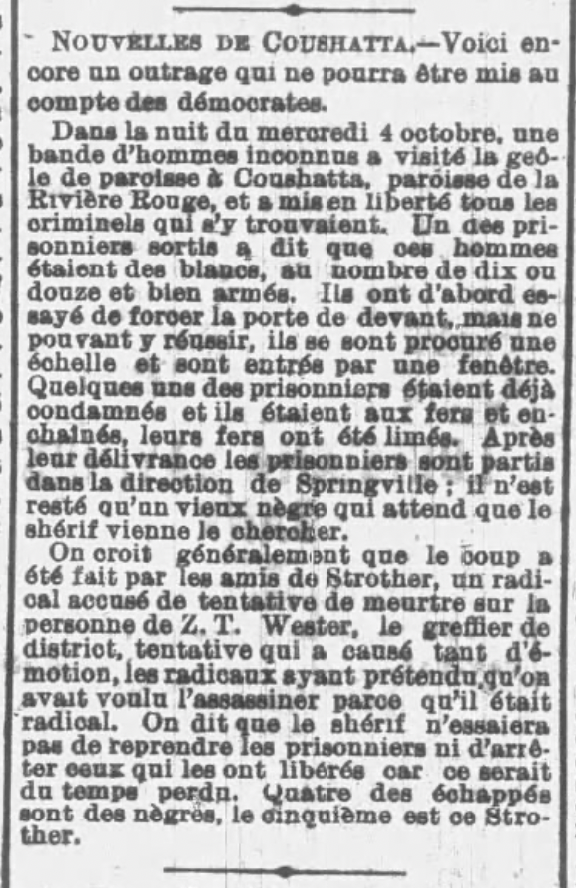
Then not long after this, another act evidently designed to continue the campaign of intimidation aimed at Zachary Wester for collaborating with the Reconstruction government occurred. On 14 October 1876, the L’Abeille de la Nouvelle Orléans reported that on the night of the 4th of October, a band of some ten or twelve armed men had broken into the jail of Red River Parish, freeing all those imprisoned in the jail.[3] This report states that the men were thought to be friends of a man named Strother who was reputed to be the person who had attempted to assassinate Wester in September.
Several months before the attempt was made on Zachary Wester’s life in September 1876, on 2 May 1876, Marshall H. Twitchell, a Vermont native who served in the Louisiana state senate from Bienville, Red River, and De Soto Parishes and was the leader of Reconstruction in that part of Louisiana, had been shot by an assassin as he traveled by boat to Coushatta. Twichell was seriously wounded and lost both arms as a result of the attack. His brother-in-law George A. King, who was traveling with him, was killed by the assassin.[4]
A number of documents in Red River Parish show Zachary T. Wester’s close ties to Marshall Twitchell. On 3 June 1875, Twichell sold Wester land in Red River Parish.[5] On 20 February 1877, Marshall Twitchell again sold property to Zachary T. Wester: in this conveyance, the property was lots in the town of Coushatta.[6]
Previously, on 27 September 1873, when Robert Pior sold Marshall Twitchell land in Red River Parish, Z.T. Wester witnessed the conveyance and proved it on 29 April 1874.[7] Robert Pior is thought to have been a close relative of George W. Pior, who was murdered on 6 February 1870 along with Adolphus E. Jones by an unknown assailant at the store Jones co-owned with his brother-in-law William H. Snead at Ringgold in Bienville Parish.[8] The Congressional committee investigating politically motivated violence in postbellum northwest Louisiana considered these murders an act of political terrorism, though no one was ever charged with them.[9] William H. Snead is yet another ancestor of mine, a 2-g-grandfather whose granddaughter Vallie Snead married Benjamin Dennis Lindsey, son of Alexander Cobb Lindsey and Mary Ann Green. Dennis and Vallie Snead Lindsey are my grandparents.

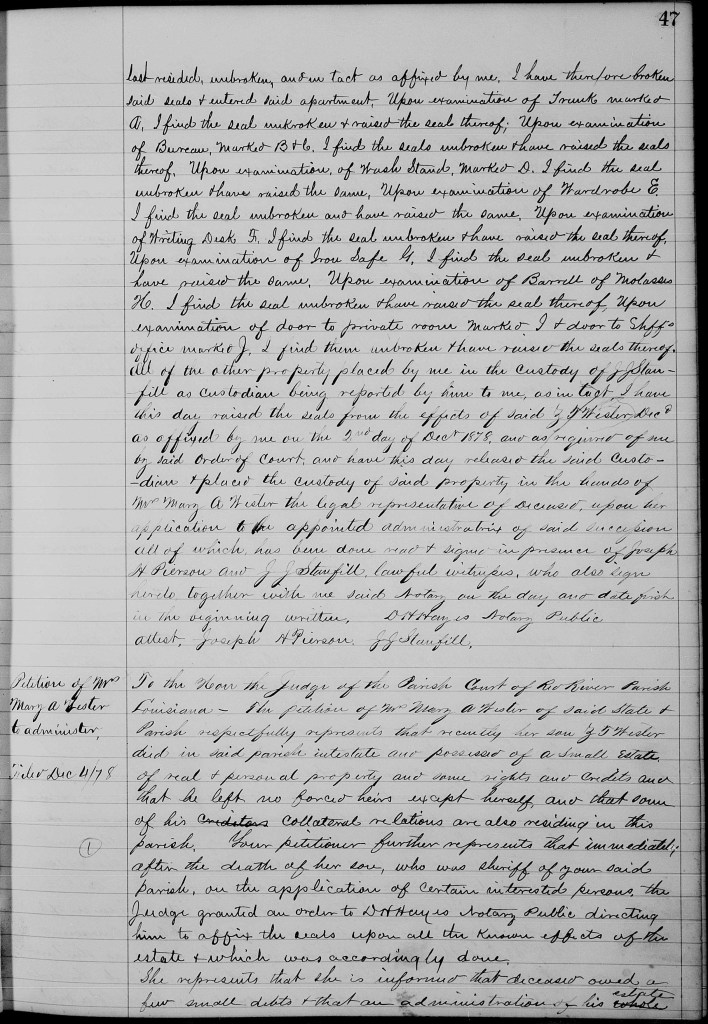
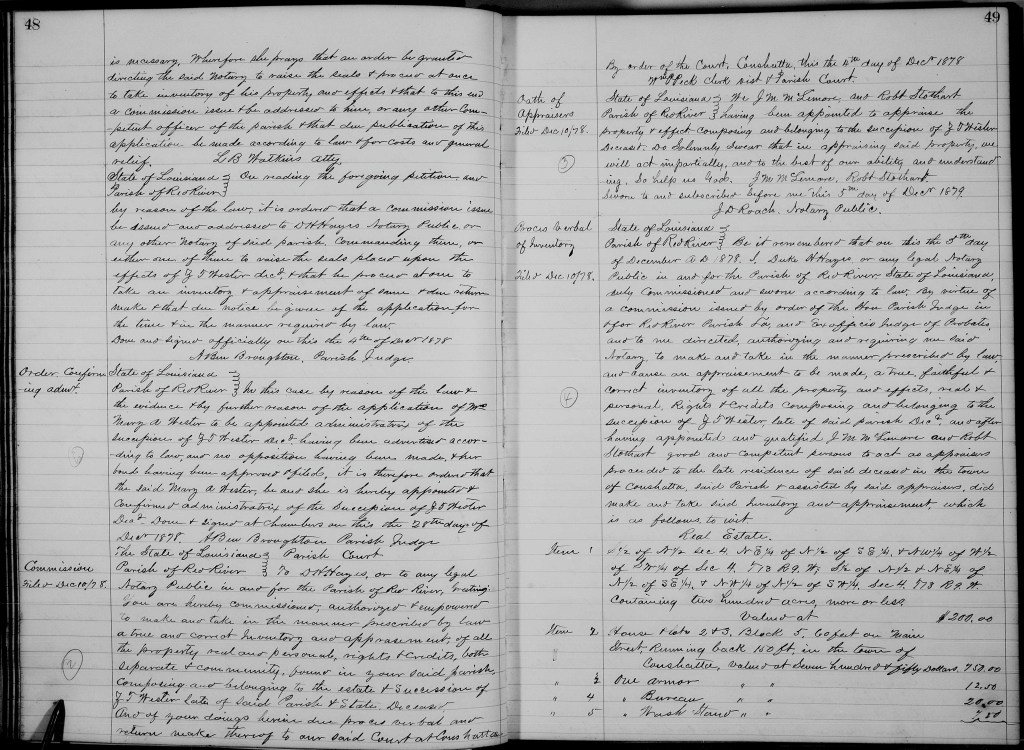
Zachary Taylor Wester died in Red River Parish early in December 1878. On Friday, 13 December 1878, the New Orleans Democrat reported that the previous Sunday morning at Planter’s Hotel in Coushatta, Z.T. Wester, sheriff of Red River Parish, had died of pneumonia.[10] The preceding Sunday to which this announcement refers was evidently 1 December 1878, since Zachary’s mother Mary Ann filed a petition for administration of his estate in Red River Parish on 4 December, stating that he had died intestate in Red River Parish.[11]
Zachary Taylor Wester was a young man of thirty-two years when he died. I have still not been able to find what became of his brother William, who was two years older than Zachary, after William was forced by those targeting Republicans in northwest Louisiana following the war to flee from Red River Parish. That fact is stated in a letter that Marshall Twitchell wrote to General Philip Henry Sheridan on 26 February 1875.[12] Like Zachary, William W. Wester served as a Confederate soldier from Bossier Parish during the Civil War.
[1] Report of the Select Committee on That Portion of the President’s Message Relating to the Condition of the South (Washington, DC: Govt. Printing Office, 1875), pp. 320-1.
[2] New Orleans Republican (17 September 1876), p. 3, col. 5.
[3] “Nouvelles de Coushatta,” L’Abeille de la Nouvelle Orléans (14 October 1876), p. 1, col. 2.
[4] An excellent biographical and historical source for Marshall H. Twichell is Ted Tunnell, Edge of the Sword: The Ordeal of Carpetbagger Marshall H. Twitchell in the Civil War and Reconstruction (Baton Rouge: Louisiana State University Press, 2001).
[5] Red River Parish, Louisiana, Conveyance Bk. A, p. 328.
[6] Red River Parish, Louisiana, Conveyance Bk. A, p. 455.
[7] Ibid., pp. 156-7.
[8] Index of the Executive Documents of the House of Representatives for the Second Session of the Forty-Fourth Congress, 1876-7 (Washington: Govt. Printing Office, 1877), p. 440.
[9] See Executive Documents for the 2nd Session of the 44th Congress (Washington, D.C., 1877), p. 252.
[10] New Orleans Democrat (13 December 1878), p. 8. col. 5.
[11] Red River Parish, Louisiana, Succession Bk. B, pp. 47-9. The entire estate account is in this succession book, pp. 47-57, 94-7.
[12] Index of the Executive Documents of the House of Representatives for the Second Session of the Forty-Fourth Congress, 1876-7, pp. 298-9.

