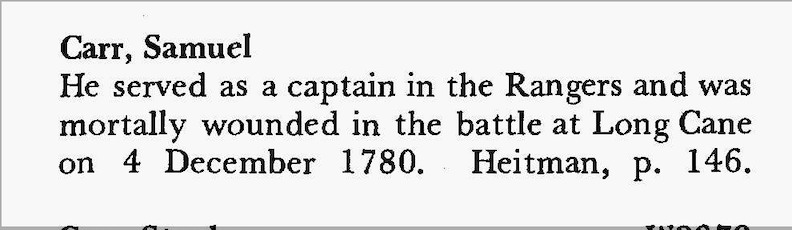

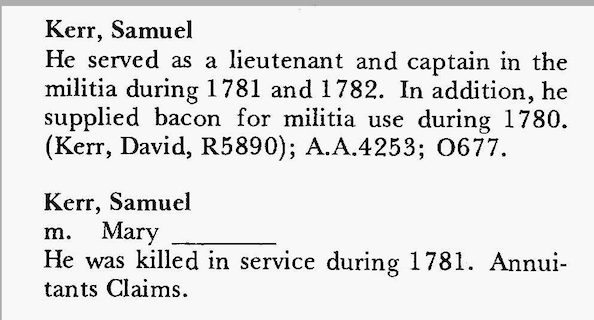
Citing Francis B. Heitman’s Historical Register of Officers of the Continental Army During the War of Revolution, Bobby Gilmer Moss lists Samuel Carr [sic] as a Rangers captain who was mortally wounded at the Battle of Long Cane on 4 December 1780.[1] But Gilmer Moss’s roster of South Carolina patriots in the Revolution also has separate entries for a Samuel Kerr who was a lieutenant and a militia captain in 1781 and 1782, and a Samuel Kerr whose widow was Mary and who was killed in service in 1781.[2] The two Samuel Kerrs and one Samuel Carr who appear in Moss’s roster are, I am fairly confident, all the same man, and they illustrate the confusion about exactly when (and where and how) Samuel Kerr died. In a moment it will become clear why Moss has an entry stating that Samuel Kerr was still alive in 1782.
As a previous posting notes, David Kerr, who appears to have been a son of Samuel Kerr’s cousin Andrew Kerr, gave a Revolutionary pension affidavit on 8 June 1833 in Abbeville County.[3] The affidavit states that after having volunteered in July 1780 (his second round of service) under Captain McCall in Abbeville District, he joined troops of Colonels Shelby and Cleveland at the Battle of Kings Mountain. He then took part in an engagement at Wofford’s ironworks on the Pacolet and went to Thickety Creek on the west of the Broad River and took a fort occupied by the Tories. Following these actions, David Kerr says he then served under Captain Samuel Kerr.
Anderson’s fort on Thickety Creek of the Broad was taken by Revolutionary troops near the end of July 1780 and the battle at Wofford’s ironworks occurred in August 1780. A document in his Revolutionary pension file entitled “A Statement Shewing the Service of David Kerr” indicates that David spent six months in 1780 serving under Captain McCall with Colonels Shelby and Clarke at Kings Mountain, Wofford’s ironworks, and Thickety Creek. This document then goes on to place David Kerr under command of Captain Samuel Kerr and General Pickens for a month in 1781.
On 2 October 1833, David Kerr gave a second affidavit in Abbeville District which says that in July 1780, he was placed under command of Captain Samuel Kerr as a Ranger, and that he and his military unit then marched with Colonel Shelby and his soldiers to Kings Mountain where he was wounded and incapacitated, then having to recover in Rowan County, North Carolina, until May 1781. On 20 May 1781, he again volunteered under Captain Samuel Kerr and was then transferred to Captain Robert Carithers/Caruthers’ infantry company and took part in the Siege of Ninety-Six.
On 4 March 1835, David made an amended declaration in Abbeville District in which he states that he volunteered for service under Captain Samuel Kerr on 15 September 1780 and served with Samuel Kerr at the Battle of Kings Mountain. This amended declaration omits any reference to David’s service with Samuel Kerr in May 1781, but skips from the battle of Kings Mountain on 7 October 1780 to 10 April 1781 when, having recovered from his wounds at Kings Mountain (though they crippled him for life), he volunteered to serve under Robert Carithers.
None of David Kerr’s affidavits makes any reference to Samuel Kerr’s death. The 2 October 1833 affidavit has Samuel living on 20 May 1781, but between that affidavit and the one made on 4 March 1835 there’s confusion about when (and why) David began serving under Robert Carithers.
The confusion about exactly when Samuel Kerr died is built into the documents closest to his date of death, which should be the most reliable sources to pinpoint that date. As we’ve seen previously, Samuel’s widow Mary Calhoun Kerr states in her Abbeville County will dated 21 January 1805 that she was bequeathing her annuity (for Samuel Kerr’s death in military service, though this is not stated explicitly in the will) to her daughter Ruth.[4] Several extant records show Mary receiving both an annuity for her husband Samuel’s death in Revolutionary service and payment for his service, but these provide conflicting information about when Samuel died.
A set of documents entitled “House of Representatives/Annuities, Claims, and Pension Reports,” transmitted by the South Carolina Treasurer to the House of Representatives, shows Mary being paid as Samuel Kerr’s widow £8 15s on 19 May 1785 for his death in service in 1781. Mary was paid again on 5 February 1787, when she received £9 for herself and two children.[5]
All well and good: Samuel Kerr died in service in 1781, evidently of wounds received while he was serving the Revolutionary cause. An official set of South Carolina Revolutionary records provides this information. But on 2 May 1785, Mary Calhoun Kerr’s brother John Ewing Colhoun signed receipt on Mary’s behalf for her payment of £67 pounds 10s shillings 2 ½d for Samuel Kerr’s militia duty as a lieutenant in 1780 and 1782 and for his provision of bacon for militia use in 1780.[6] A digital image of this receipt is at the head of this posting.
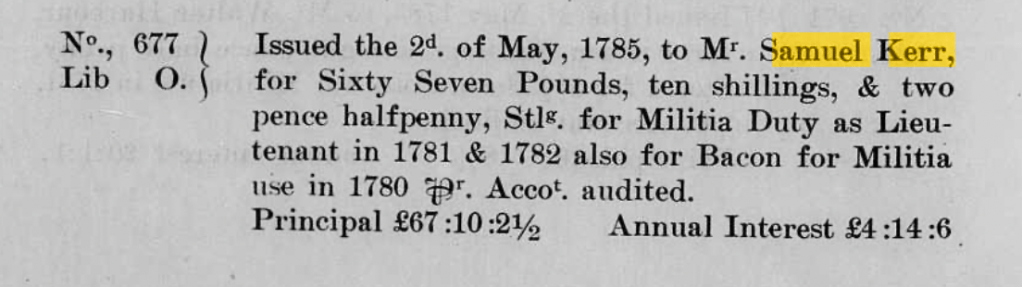
This payment was not an annuity payment to Mary for Samuel’s death while he was in military service. It’s a payment for his militia service as a lieutenant and for what he provided to soldiers as an officer. Above John E. Colhoun’s signature and receipt on this document found in Samuel Kerr’s “Accounts Audited” file is a statement that Samuel served as a lieutenant under Captain Moses Liddell in July 1780 and in 1782, per the return of Colonel (Robert) Anderson. John E. Colhoun’s receipt for Mary’s payment states that the payment was issued per indent 677. The indent shows Mary given payment on 2 May 1785 for Samuel’s service as outlined above.[7] Note that while the receipt signed by John E. Colhoun says that Mary Kerr was being paid for Samuel’s service in 1780 and 1782, the stub indent states that the service was in 1781 and 1782 — another puzzling discrepancy.
Because these audited account records contradict the testimony of the annuity records about when Samuel died — 1781? 1782? 1782-5? — and because the audited account records have him as a lieutenant when others show him serving as a captain, it would be tempting to think we’re dealing with a different Samuel Kerr here, a man other than Samuel who married Mary Calhoun. Yet Mary’s brother John E. Colhoun, who spent most of his time as a lawyer in Charleston where the payment to Mary was issued, received the service payments on Mary’s behalf, and it’s clear that this Mary is Mary Calhoun Kerr. It’s probably not a coincidence that Mary received this payment on 2 May 1785 and her annuity payment for Samuel’s death while in service on 19 May 1785. The state of South Carolina was settling up its accounts for Revolutionary service at this time,[8] and as Samuel Kerr’s widow, Mary was taking advantage of all payments due her for both his service and his death while in service.
Several other Revolutionary pension affidavits in addition to David Kerr’s affidavits also mention Samuel Kerr’s military service. On 25 March 1833 in Rhea County, Tennessee, Thomas Hamilton stated that he was drafted as a horseman in February 1779 in Abbeville District, South Carolina, under Lieutenant Samuel Kerr and was stationed at Brush Island on the Savannah River, whence his unit marched into Georgia and joined troops under Colonels Twiggs and Pickens. After three months, Hamilton received a discharge from Samuel Kerr. Hamilton’s affidavit states that he was born in 1762.[9]
On 6 June 1832 in Hall County, Georgia, Thomas Townsend testified that he served under Captain Samuel Carr at the battles at Kings Mountain in October 1780, Fish Dam Ford and Blackstock’s Plantation in November 1780, as well as at the battle at Reedy Branch, which was the Long Cane battle in December 1780. Townsend’s affidavit says that he was born in 1753 in Augusta County, Virginia.[10]
So what to make of the mélange of conflicting documents about the date of Samuel Kerr’s death, not one of which tells us where he died and what caused his death? Moss and Heitman are furthest removed from the event itself, so their information about Samuel’s death is likely to be least reliable. Mary Calhoun Kerr and her brother John Ewing Colhoun were close to the event and would have known when, where, and how Samuel died. But the conflicting information in Mary’s annuity claim and her receipt for payment for Samuel’s service creates a puzzle: did he die in 1781 as the annuity claim says, or in or after 1782 as the payment receipt suggests?
I think if Samuel Kerr died in battle, there would be clear records of this and it would be stated in those Revolutionary pension applications. My deduction is that he died as a result of wounds received in military action, but died some time after the battle in which he was wounded. I also wonder if the 1782 in the payment receipt for Samuel’s service was a mistake John E. Colhoun made in writing the receipt, since the years of Samuel’s service skip in the receipt from 1780 to 1782.
I’m inclined to think that Samuel Kerr died sometime in 1781, not in a battle but as a result of injuries he received in service. I’m also inclined to think that the 1782 date in the receipt John E. Colhoun signed is a mistake, and that 1781 was the final year in which Samuel Kerr gave military service. I’m inclined, in other words, to accept the 1781 date of death in the annuity records, which was surely supplied by Samuel’s widow Mary. And as I write this, I wonder if the South Carolina Archives might have any original documents in a file for this annuity claim, which might give more specific information about when, where, and how Samuel Kerr died. I’ll do due diligence and check on this possibility.
Noting that David Kerr’s 4 March 1835 Revolutionary pension affidavit states that David was placed under the command of Captain Samuel Kerr in May 1781 and then soon after this placed under command or Robert Carithers, Marcia McClure concludes that Samuel died around May-June 1781, and may well have been mortally wounded during the Siege of Ninety-Six from 11 May to 11 June 1781.
[1] Bobby Gilmer Moss, Roster of South Carolina Patriots in the American Revolution, vol. 1 (Baltimore: Genealogical Publishing Company, 1983), p. 149; and Francis B. Heitman, ed., Historical Register of Officers of the Continental Army During the War of the Revolution: April 1775 to December 1783 (Washington, D.C.: Lowdermilk, 1890), p. 146. The date of the Long Cane skirmish was actually 12 December 1780.
[2] Moss, Roster of South Carolina Patriots in the American Revolution, p. 530.
[3] Revolutionary pension affidavit of David Kerr, Abbeville County, South Carolina, NARA, Case Files of Pension and Bounty-Land Warrant Applications Based on Revolutionary War Service, compiled ca. 1800 – ca. 1912, documenting the period ca. 1775 – ca. 1900, RG 15, file of David Kerr, R 5890, South Carolina, available digitally at Fold3.
[4] Abbeville County, South Carolina, Will Bk. 1, p. 304; Abbeville County, South Carolina, Probate Files, box 52, pack 1231.
[5] These South Carolina annuitant records are transcribed in South Carolina Magazine of Ancestral Research 1,2 (spring 1973), p. 67 and 1,3 (summer 1973), p. 159. See also “Compensation for Revolutionary Service” at the York County, South Carolina, GenWeb site. The original records, entitled “Annuities for Persons Hurt in the Service of the State, 1778-1786” and “House of Representatives/Annuities, Claims, and Pension Reports,” are held by the South Carolina Department of Archives and History.
[6] Accounts Audited of Claims Growing Out Of The American Revolution Bk. 83, p. 110 (file 4253). The original record is held by the South Carolina Department of Archives and History.
[7] See Wylma Anne Stub Entries Wates, Stub Entries to Indents Issued in Payment of Claims Against South Carolina Growing Out of the Revolution (Columbia: South Carolina Historical Commission, 1915), p. 110, transcribing Bk. O, no. 677.
[8] See Helen Craig Carson, “Accounts Audited of Claims Growing out of the Revolution,” South Carolina Historical Magazine 75,3 (July 1974), pp.201-6.
[9] NARA, Case Files of Pension and Bounty-Land Warrant Applications Based on Revolutionary War Service, compiled ca. 1800 – ca. 1912, documenting the period ca. 1775 – ca. 1900, RG 15, file of Thomas Hamilton, South Carolina, S30470, available digitally at Fold3.
[10] Ibid., file of Thomas Townsend, South Carolina, W3889, available digitally at Fold3.


2 thoughts on “Samuel Kerr (1741-1781?): Confusion About When (and Where and How) He Died”