As I’ve now explained repeatedly (see here, here, here, and here), it seems very clear —to me, at least — that after Samuel Kerr and wife Margaret sold their homeplace and home tract of land in Augusta County, Virginia, on 18 November 1760, they relocated to the northwest fork of the Long Cane in then Granville, later Abbeville, County, South Carolina, where a Samuel Kerr had a warrant for land on 5 October 1762.[2] As the last posting tells us, a Revolutionary pension affidavit of David Kerr, a son of Andrew Kerr, states that his family (the affidavit does not name David’s father) moved from Augusta County, Virginia, to South Carolina in 1762.[3] On 4 January 1763, Andrew was issued a warrant for land on the northwest fork of the Long Cane.[4] Augusta County records show Andrew Kerr and wife Rachel selling their land there in February and August 1762.[5] And as the previous posting notes, the 1795 will of William Kerr, son of Samuel and Margaret Kerr, which names Mary Kerr as his sister-in-law, also makes bequests to members of Andrew Kerr’s family, strongly suggesting that these Kerr families were part of a kinship network that, after having migrated from Augusta County, Virginia, to the Long Cane settlement around the same time, settled near each other and maintained strong kinship ties in their new place of residence.
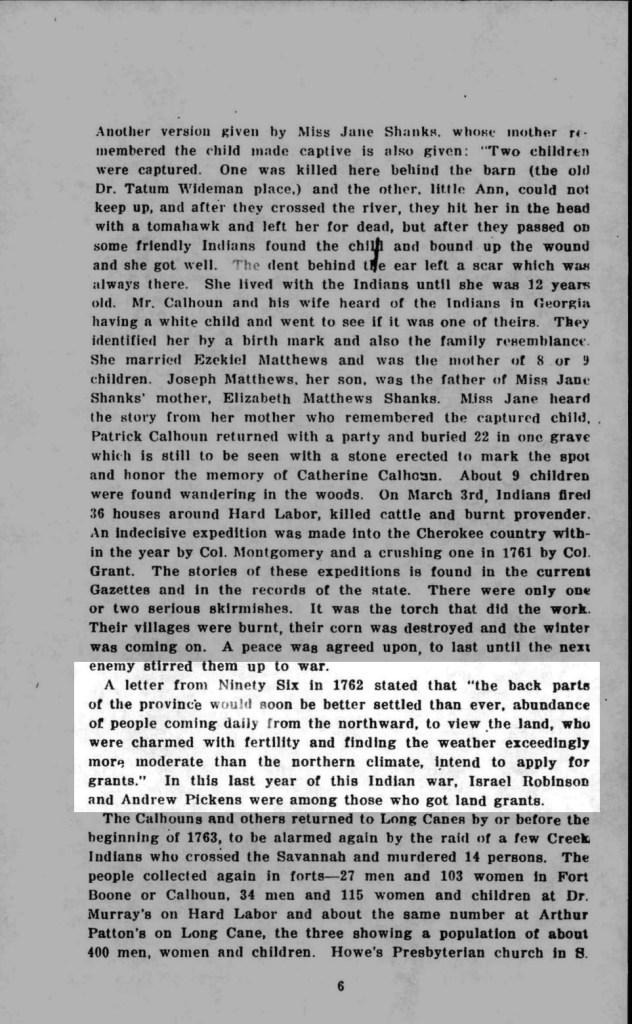
H.T. Cook’s history of The Hard Labor Section notes that as the tensions between the Cherokees and the early Long Cane settlers including the Calhoun family from Augusta County began to diminish after the Long Cane massacre of 1760, settlement of the Long Cane community began to increase.[6] Cook cites a 1762 letter from Ninety-Six predicting that, due to their fertility and clement weather, the back parts of the South Carolina upcountry would soon be more thickly settled than ever, with in-migration from the north.[7] Cook points out that it was in this time frame that Andrew Pickens, who married Mary Calhoun Kerr’s sister Rebecca Calhoun, and whose uncles William and John and aunt Lucy married Kerr siblings, began acquiring land in the Long Cane settlement. I’ll explain in detail later why I think another aunt of Andrew Pickens, his aunt Margaret, should be added to the list of children of William Pickens and Margaret Pike marrying Kerr siblings.
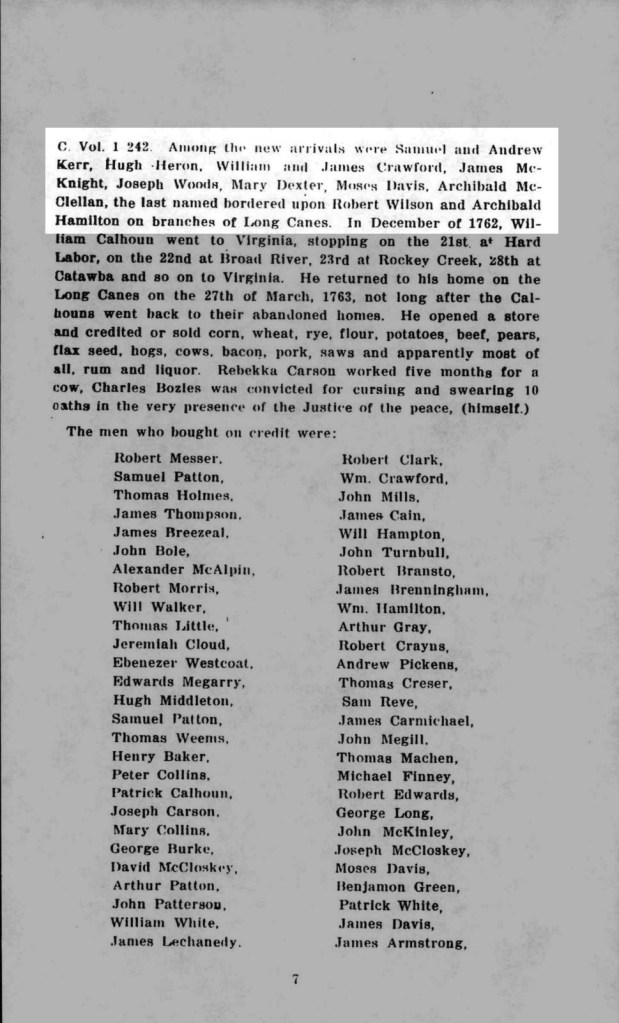
Cook goes on to list newcomers arriving in the Long Cane settlement after the Long Cane massacre of 1760 and by 1763. The list is headed by Samuel and Andrew Kerr.[8] Cook is speaking, of course, of the Samuel Kerr who had a warrant for a survey in the Long Cane settlement on 5 October 1762, and whose 100 acres were surveyed by Patrick Calhoun, uncle of Mary Calhoun Kerr, on 19 October 1762.[9] In the absence of any evidence that, after selling their Virginia land in November 1760, Samuel and Margaret Kerr went someplace other than the Long Cane, I see absolutely no reason not to conclude that the Samuel Kerr of whom Cook is speaking here is Samuel with wife Margaret, formerly of Augusta County, Virginia, and that this is the Samuel Kerr with an October 1762 warrant for a survey on the northwest fork of Long Cane.
It’s from this point forward, from the point of the arrival of this Kerr family on the northwest fork of Long Cane by October 1762, that the challenge of determining what became of Samuel Kerr with wife Margaret after this family moved to South Carolina begins. This challenge is made much more difficult by the loss of almost all early records of Abbeville County, South Carolina, in disastrous courthouse fires in 1872 and 1873. We are simply left with too few records to piece together to form a complete or coherent picture of this Kerr family after it settled in South Carolina.
The task is complicated by the fact that Samuel and Margaret Kerr’s son Samuel was of age by 1762, having been born around 29 November 1741, when Reverend John Craig baptized him at Tinkling Spring Presbyterian church in Augusta County, Virginia.[10] I’ve explained previously my reasons for thinking that Samuel and Margaret’s son Samuel married Mary, daughter of Ezekiel Calhoun and Jane/Jean Ewing, about 1764, not long before Mary’s younger sister Rebecca married Andrew Pickens on 19 March 1765. I’m inclined to think that when Samuel and Margaret Kerr brought their family to the Long Cane, their son Samuel was still unmarried — he certainly met Mary Calhoun after his family came to South Carolina — and the 1762 survey of 100 acres on the northwest fork of the Long Cane was done for the elder Samuel Kerr.
After around 1764, though, for some unknown period of time there may have been two men named Samuel Kerr, father and son, appearing in such sparse records as we have, and those records contain little information to allow us to separate father from son and to know which Samuel Kerr we might be dealing with. I say this is the case “for some unknown period of time” because, insofar as I can discover, no probate or estate records are extant to tell us when the elder Samuel died.
The following three records from the years 1764-6 belong, I suspect, to the elder Samuel Kerr and not his son of the same name, though since both Samuels were of age by this time, the younger Samuel could also be the person appearing in any of these documents:
• 27-8 June 1764: Samuel Kerr witnessed the deed of James and Frances Cain of Granville County, South Carolina, to Alexander McPherson for land on the Savannah above the mouth of Long Cane. The other witness was Alexander Noble.[11] Alexander Noble was a son of John Noble and Mary Calhoun. Alexander was a first cousin of Mary Calhoun who married Samuel Kerr younger. Alexander Noble married his first cousin Catherine Calhoun, a sister of Mary Calhoun Kerr.[12] Alexander Noble was, then, both the brother-in-law of Samuel and Mary Calhoun Kerr and Mary’s first cousin.
Note that this document shows us, if we needed further evidence, that by this date the family of Samuel Kerr had already connected to the Calhoun family into which Samuel Kerr younger married by about 1764. As previous postings have indicated, the family of Ezekiel Calhoun lived only some six miles from the Samuel Kerr family. And with the marriage of Andrew Pickens to Ezekiel Calhoun’s daughter Catherine in March 1765, the bonds between these families would only have grown stronger, if — as I’ve concluded was the case — Samuel Kerr elder’s wife Margaret was Andrew Pickens’ aunt.
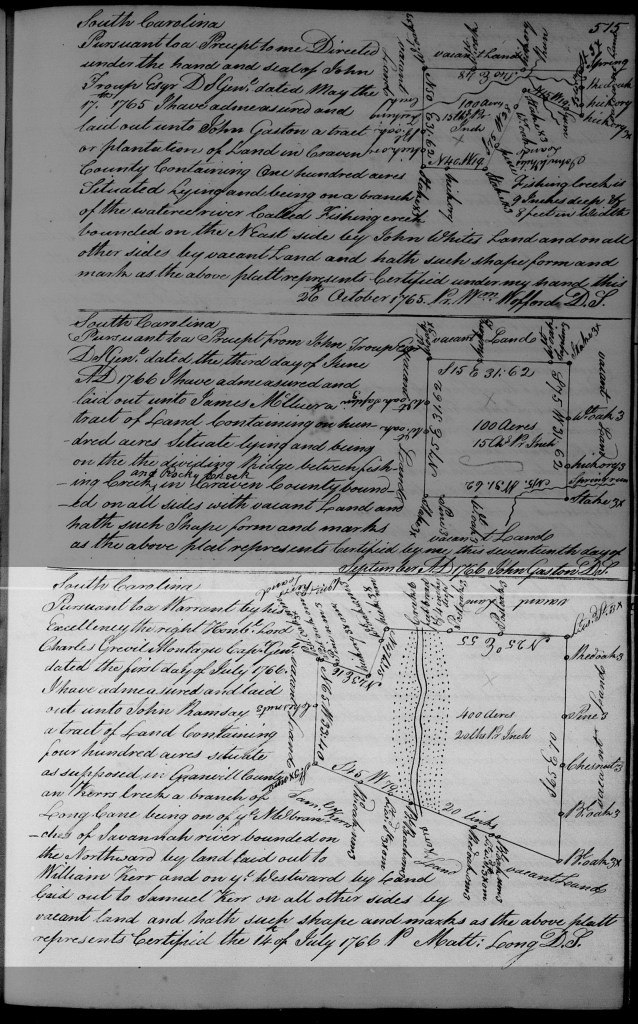
• 14 July 1766: a survey by Matt. Long of 400 acres for John Ramsay per a warrant dated 1 July 1766 shows the land lying on Kerrs Creek in the northwest waters of the Savannah, bordered on the north by William Kerr and on the west by land laid out to Samuel Kerr.[13] This William is not Samuel and Margaret Kerr’s son of that name, but, Marcia McClure concludes and I concur, a nephew of Samuel Kerr, a son of his brother John Kerr and wife Lucy Pickens.[14] As noted previously, this William Kerr had a survey for 100 acres on the northwest fork of Long Cane on 27 December 1758, with a number of documents showing that his land bordered land of his brother Andrew.[15] Other records I’ll discuss in a moment show more connections of the family of Samuel Kerr to the John Ramsay/Ramsey for whom the 400 acres were surveyed in July 1766.
• 17 November 1766: John Pickens’ survey of 300 acres for John Green on waters of the northwest fork of Long Cane shows the land surveyed bounded southeast by John and Walter Trimble, and northeast by Samuel Kerr and Hugh Herron.[16] John Pickens was an uncle of Andrew Pickens who married Ezekiel Calhoun’s daughter Rebecca (again, a sister of Mary Calhoun Kerr). And — again — John Pickens was one of the Pickens siblings who married Kerr siblings; his wife was Lucy Kerr, a sister of Samuel Kerr elder.
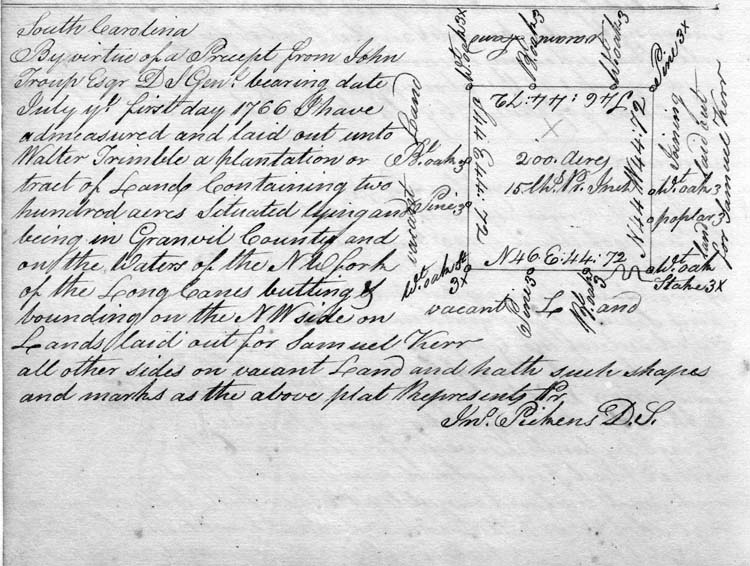
Along with thirteen other heads of families from Northern Ireland, a John Trimble proved his family’s importation on 22 May 1740 in court in Orange County, Virgina, Orange being the parent county of Augusta. Joseph A. Waddell stated in his Annals of Augusta County, Virginia, that among these heads of families was Alexander Breckenridge, who testified that he had arrived in the colonies via the port of Philadelphia prior to moving to western Virginia.[17] According to David B. Trimble, Walter Trimble was in Augusta County by 1741. On 20 May 1765, he and wife Rosanna sold 320 acres on Free Mason’s Run of the North River of the Shenandoah to their son Robert and moved to the Long Cane settlement where he had a certificate for 200 acres on waters of the northwest fork of Long Cane on 1 July 1766.[18] This land bordered Samuel Kerr’s land.[19]
The March 1767 Survey of 100 Acres — For Which Samuel Kerr?
Then there’s the December 1766 precept and March 1767 survey for a Samuel Kerr obtaining land adjoining the tract Samuel Kerr had surveyed in October 1762 and the question of which of the two Samuels was acquiring this second tract of 100 acres:
• 12 December 1766: Samuel Kerr had a precept for a survey of 100 acres on the northwest Fork of Long Cane in Granville County, bordered northwest by James Garrot, northeast by John Ramsey, southwest by Samuel Kerr, and vacant on the other side. The survey of this land was done by John Pickens and certificate issued 6 March 1767.[20] The memorial for this land issued on 20 August 1771 states that James Noble assisted John Pickens in surveying the land.[21] James was a brother of Alexander Noble discussed above, a first cousin of Mary Calhoun Kerr.
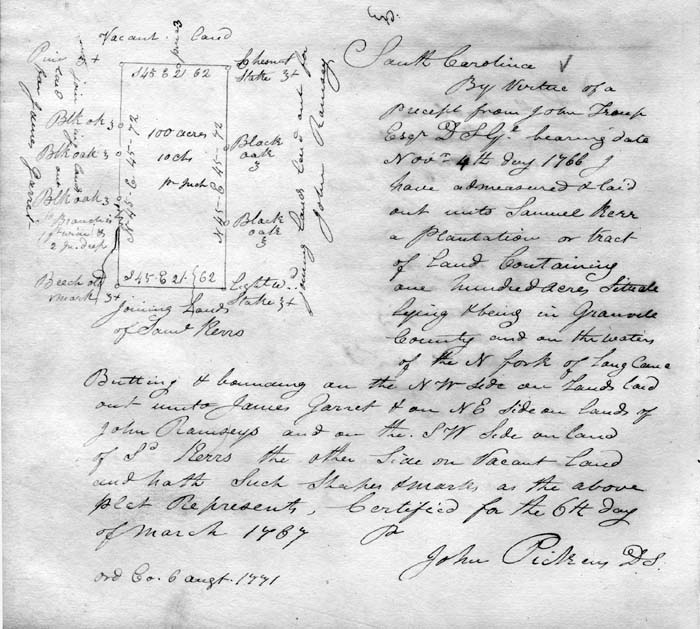
South Carolina Council Journals for 2 June 1767 record the certification of this survey of 100 acres for Samuel Kerr. Patrick Calhoun, uncle of Mary Calhoun Kerr, had a plat certified on the same date, and is listed beside Samuel Kerr. On the same day, James Miller (listed beside Samuel Kerr) and Alexander Noble (listed beside Miller) also had plats certified in Granville, with the Council Journal record noting that Noble’s land was on Long Cane. This is the Alexander Noble discussed above, who married his cousin Catherine Calhoun, a sister of Mary Calhoun, who married Samuel Kerr younger.
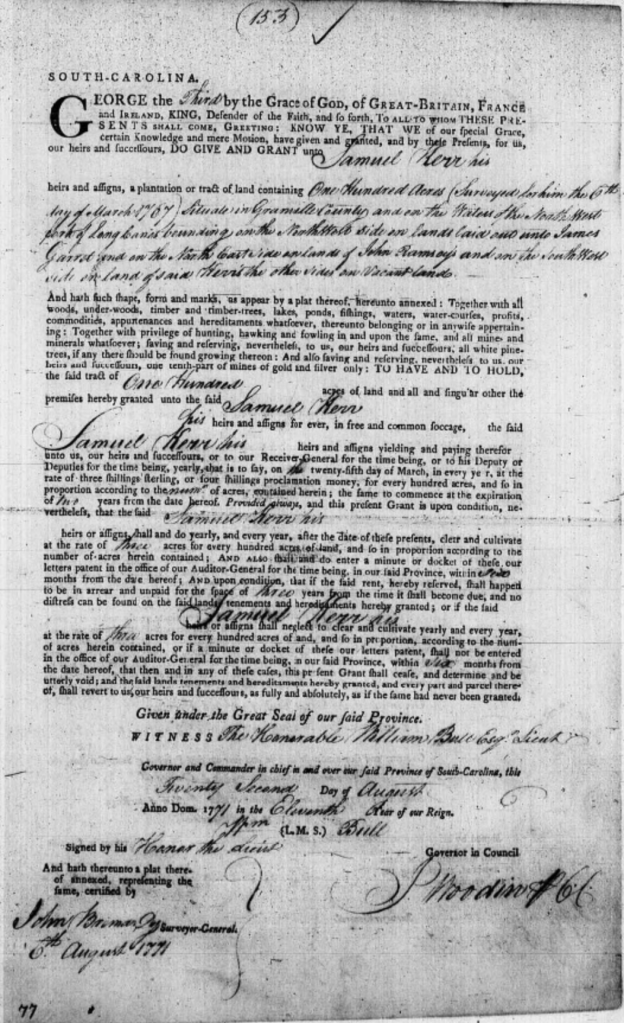
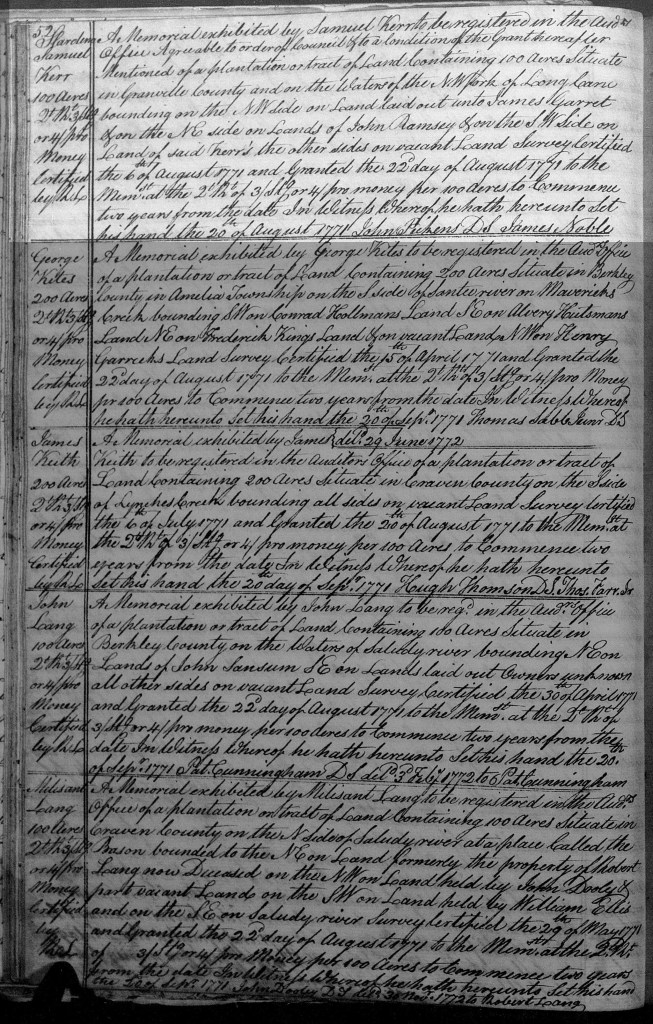
The grant for Samuel Kerr’s 100 acres was made 22 August 1771, and, as I’ve just noted, a memorial was made on 20 August 1771.[22] In a previous posting, I proposed that this survey and land grant were made for the younger Samuel Kerr, who had married not long before one of the two Samuels filed a precept for this 100 acres adjoining the original Samuel Kerr tract of 100 acres on the northwest fork of the Long Cane.
However, a problem confronting this conclusion that this second Kerr grant was issued to Samuel the son and not Samuel the father needs to be noted: All documents pertaining to this tract of land from the survey plat to the grant and the memorial, say that the 100 acres joined “said Kerr’s” land. Unless the elder Samuel Kerr had died by this date and, as the older son, his son Samuel had inherited his father’s land, then these documents might well indicate that it was Samuel elder and not Samuel younger to whom this grant of 100 acres was made.
Because the survey plat, grant, and memorial do not speak of “his own land,” Marcia McClure is inclined to think these records pertain to Samuel younger and not elder, and that the younger Samuel, having married and begun his family, was acquiring land of his own next to his father’s land, and probably farming with him.[23] This is certainly a tempting deduction to make, especially when we can fairly well conclude that Samuel younger married about 1764, but I’m not sure the terminology of the three documents warrants this deduction.
Unless, as I have just stated, the elder Samuel had died after he made his first land claim on the northwest fork of Long Cane…. In the absence of any documentation of when Samuel elder died, I think this is definitely a possibility that needs to be considered. If this were the case, the land of Samuel the father would have passed to his older son Samuel, and in that sense, the land Samuel Kerr was acquiring by his December 1766 precept would have joined “said Kerr’s land.” Unfortunately, the loss of Abbeville County records leaves us with no clear path to track the transmission of these two tracts of land from generation to generation. As previous postings have noted, the 21 January 1805 Abbeville County will of Mary Calhoun Kerr shows Mary bequeathing to her unmarried daughter all Mary’s right of dower to the land she had gotten by Samuel Kerr, and the will then stipulates that after Ruth married, the interest in the land was to be divided equally between Ruth and her two married sisters Catherine McLain/Macklin and Jane Green.[24] Ruth married William Oliver before July 1816 and probably prior to 1815 when Ruth and William’s son James was born. I have found no records showing what became of Samuel Kerr’s land after that date, when Ruth Kerr Oliver, Catherine Kerr Macklin, and Jane Kerr Green shared equal interest in that land.
If the elder Samuel Kerr had died by the time the younger Samuel had a warrant for a 100-acre survey next to the original land grant to his father in 1766, then that would account for the fact that after the younger man married and began living on his own, the sparse Abbeville District and County records left to us make no mention of Samuel Sr. and Jr. Unfortunately, with the almost total loss of Abbeville records prior to 1872, we’re left to speculate and to ask questions for which no extant documents can provide the answers.
Sparse Records from the 1770s
• 7 April 1770: Samuel Kerr appears in a South Carolina Statutes at Large act to establish a road from Long Cane Creek to Great Rocky.[25] The other commissioners named in the act are William Calhoun, John Anderson, Elisha Laurence, John McKinley, William Harris, and John Pickens Jr. This William Calhoun is, I think, probably the son of James Calhoun and Susanna Long, James being an uncle of Mary Calhoun who married Samuel Kerr. John Pickens Jr. is likely the son of John Pickens and Eleanor Kerr, and was a first cousin of Samuel Kerr who married Mary Calhoun.
• 11 December 1772: a Samuel Kerr was issued a warrant for a survey of 150 acres in Craven County, South Carolina, with a survey made on 2 January 1773.[26] The grant for this land was given on 11 February 1773, with a 22 June 1773 memorial stating the date of the grant.[27] The memorial states that this land lay north of Cedar Creek, a branch of the Wateree River, and was bounded on the south by Andrew Nutt, with vacant land on all other sides.
This Samuel Kerr was Samuel Kerr of the Long Cane settlement. Jean Stephenson transcribes a letter of thanks written on 21 October 1772 by members of Reverend William Martin’s Presbyterian congregation newly arrived in South Carolina from County Antrim, Ireland, aboard the James and Mary.[28] The letter was sent to a merchant in Larne in Antrim, James McVicar, to inform him that the passengers had arrived safely in Charleston on the 18th. Samuel Kerr was one of the signatories of this letter. Stephenson notes that this Samuel Kerr is the man who received the grant of 150 acres north of Cedar Creek.[29]
This land Samuel Kerr claimed after his arrival in Charleston was in what eventually became Lancaster County, South Carolina, not far south of Charlotte, North Carolina. The Waxhaws community was located in this region. Andrew Nutt, whose land eventually fell into Lancaster County (and finally Kershaw County), apparently came to this area from Augusta County, Virginia, after having sojourned for a time in Anson County, North Carolina.[30] The fact that Andrew Nutt was in the vicinity of this Samuel Kerr has led some researchers to conclude that this Samuel was also from Augusta County, but the letter to James McVicar (which was printed in Belfast News) proves otherwise.
• 9 September 1775: an inventory of the estate of John Ramsey of Ninety-Six District done by was done by John Cunningham, James Caldwell, and Samuel Kar.[31] This is the John Ramsay of the 14 July 1766 discussed previously, which shows Ramsay’s land bordering both William and Samuel Kerr. James Caldwell died testate in Abbeville County with a will made 15 April 1804 and probated 15 May 1805.[32] The will makes a bequest to an Elizabeth Harris Kerr whose relationship to James Caldwell is not specified (James’ wife was Elizabeth Harris). James’ daughter Rebecca married William Gabriel Pickens, a son of John Pickens and Eleanor Kerr.
• 16 January 1787: a survey for Robert Carithers for 65 acres in Ninety-Six District, Abbeville County, shows this land joining James Gillespie, James Kerr, William Hamilton, Reverend Robert Mecklin, Robert Gerrett, and Samuel Kerr.[33] As a previous posting notes, Robert Mecklin (or Macklin) was a brother of Hugh Macklin who married Catherine Kerr, daughter of Samuel Kerr and Mary Calhoun. The James Kerr mentioned in this survey is, it appears, the son of John Kerr and Lucy Pickens discussed in a previous posting.
Robert Carithers is the Robert Carothers/Carrithers who gave a Revolutionary pension affidavit on 9 February 1833 in Bedford County, Tennessee, stating that he was born 30 March 1744 in Lancaster County, Pennsylvania, and that he enlisted in Ninety-Six District, South Carolina, on 24 December 1780. At the war’s end, he moved to Tennessee, settling first in Davidson and then Williamson County, and finally in Bedford County.[34]
Note that since Samuel Kerr had died prior to January 1787, the reference to Samuel Kerr’s land in the survey for Robert Carithers refers to land now occupied by his widow Mary and their children. The 1787 Carithers survey gives us a snapshot of some of the neighbors of this Kerr family in January 1787.
So to return to the question I posed at the start of this posting: after Samuel Kerr and wife Margaret came to the Long Cane settlement in 1762 and obtained land on the northwest fork of Long Cane, as I’m confident was the case, what became of them? Short answer: I don’t know. I do know that by 1764 or so, their son Samuel had married Ezekiel and Jane/Jean Ewing Calhoun’s daughter Mary. But when Abbeville County records burned almost in toto in the early 1870s, and when no estate records for the elder Samuel appear to be extant, I do not know when Samuel died, and which of the two Samuels we’re encountering in records from the Long Cane region in the 1760s and 1770s.
I have found absolutely no indication that after having obtained land on the Long Cane, Samuel Kerr and wife Margaret moved elsewhere. It’s tempting to think that Samuel the father had died by the time a precept was issued to Samuel Kerr in December 1766 for another 100-acre survey joining the original 100-acre survey for Samuel Kerr. Tempting, because this would tie a number of things together neatly — the date by which it appears Samuel Jr. married and began his family, the reference to “said Kerr’s land” in the documents generated by the second land grant. But this is pure speculation, with no real evidence to back it.
In my next posting, I’ll take a close look at what we know about the younger Samuel’s Revolutionary service, and at the rather thorny question of exactly when and where he died during the Revolution, a question elicited by conflicting evidence in several documents.
[1] Will of William Kerr, 9 September 1795, Abbeville District, South Carolina, Probate Files, box 52, pack 1229; and Abbeville County, South Carolina, Will Bk. 1, p. 201-2.
[2] Augusta County, Virginia, Deed Bk 9, pp. 67-8; and South Carolina Colonial Plats Bk. 7, p. 326.
[3] NARA, Case Files of Pension and Bounty-Land Warrant Applications Based on Revolutionary War Service, compiled ca. 1800 – ca. 1912, documenting the period ca. 1775 – ca. 1900, RG 15, file of David Kerr, R 5890, South Carolina, available digitally at Fold3.
[4] South Carolina Colonial Plats Bk. 7, p. 326.
[5] Augusta County, Virginia, Deed Bk. 10, pp. 149-152, 389-393.
[6] H.T. Cook, The Hard Labor Section (1993), p. 6.
[7] The letter Cook is citing appeared in The London Chronicle or, Universal Evening Post (24-26 March 1763), p. 1, col. 1, in a reported entitled “America.”
[8] Cook, Hard Labor Section, p. 7.
[9] South Carolina Colonial Plats Bk. 7, p. 326. The grant was made 8 March 1763: South Carolina Colonial Land Grants Bk. 11, p. 2, and the memorial was recorded 1 April 1763: South Carolina Memorials Bk. 6, p. 65.
[10] See “Book containing baptisms, Oct. 1740-Sept. 1749,” in the collection of the personal papers of Reverend John Craig (held by Union Theological Seminary’s library in Richmond) filmed and digitized by the Family History Library in Salt Lake City and available digitally at FamilySearch. See also Howard McKnight Wilson, The Tinkling Spring, Headwater of Freedom: A Study of the Church and Her People, 1732-1952 (Fishersville, Virginia: Tinkling Spring and Hermitage Presbyterian Churches, 1954), p. 477, extracting the baptisms of Samuel and Margaret Kerr’s four children by Reverend Craig at Tinkling Spring, 1741-7.
[11] South Carolina Deed Bk. E-3, p. 129.
[12] The estate records of John Huston in Abbeville District feature, inter alia, Alexander Noble and his brother James, along with a William Kerr Sr. and Jr. (Abbeville County, South Carolina, Probate Files, box 46 pkg. 1059). William Calhoun witnessed John Huston’s will on 1 June 1778. On 17 July 1793 order to appraise John Huston’s estate was issued to William Hutton, Alexander Noble, James Noble, Robert Messer, and James Calhoun. An appraisal signed 10 August 1793 by John Green, William Kerr, and James Gillespie. Is in the estate file, with another dated 12 August and signed by a William Kerr whose signature looks different than the signature of William Kerr on the 10 August appraisal. Another appraisal dated 16 August was signed by Alexander Noble, James Noble, and Robert Messer. An additional order of appraisement was issued 11 October 1793 to John Green, William Kerr, James Caldwell, James Gillespie, and Thomas Harris issued order to appraise estate of John Huston Jr. in the hands of Mary and Joseph Lemaster. A 9 December 1793 appraisal was signed by John Green, William Kerr Jr., and James Gillespie.
[13] South Carolina Colonial Plats Bk. 8, p. 515.
[14] See Marcia McClure, “The Kerr Family from Augusta Co, VA to Abbeville Co, SC” at the Upcountry South Carolina Green Families website.
[15] South Carolina Colonial Plats Bk. 6, p. 421.
[16] Ibid., Bk. 10, p. 74.
[17] Joseph A. Waddell, Annals of Augusta County, Virginia, from 1726 to 1871 (Staunton, Virginia: Caldwell, 1902), p. 38.
[18] David B. Trimble, American Beginnings, p. 152.
[19] See Eugene Earl Trimble, Trimble Families, a Partial Listing of Some Colonial Families (Washington, DC, 1986), p. 53.
[20] South Carolina Colonial Plats Bk. 17, p. 428.
[21] South Carolina Memorials Bk. 11, p. 52.
[22] South Carolina Colonial Land Grants Bk. 24, p. 153.
[23] Marcia McClure, “The Kerr Family from Augusta Co, VA to Abbeville Co, SC.
[24] Abbeville County, South Carolina, Will Bk. 1, p. 304; Abbeville County, South Carolina, Probate Files, box 52, pack 1231.
[25] Thomas Cooper and David James McCord ed., The Statutes at Large of South Carolina (Columbia: A.S. Johnston, 1841, p. 233, no. 995.
[26] South Carolina Colonial Plats Bk. 17, p. 438. The warrant for the land appears in South Carolina Council Journals on 6 January 1773.
[27] South Carolina Memorials Bk. 12, p. 259.
[28] Jean Stephenson, Scotch-Irish Migration to South Carolina, 1772 (Washington, D.C.: Clearfield, 1971), pp. 30-1.
[29] Ibid., pp. 84-6.
[30] “Andrew Nutt” in Early Settlers of Augusta County, Virginia at WeRelate.
[31] Charleston County, South Carolina, Inventories 1774-1785, p. 119.
[32] Abbeville County, South Carolina, Probate Files, box 19, package 415.
[33] South Carolina State Plat Bk. 25 (Columbia Series), p. 91.
[34] NARA, Case Files of Pension and Bounty-Land Warrant Applications Based on Revolutionary War Service, compiled ca. 1800 – ca. 1912, documenting the period ca. 1775 – ca. 1900, file of Robert Carothers, North Carolina, S2416, available digitally at Fold3.


2 thoughts on “Sorting Samuel Kerrs in the Long Cane Settlement of the South Carolina Upcountry, 1760s-1770s”