The Confusion Between Two William Kerrs of Augusta County, Virginia
But before I launch my discussion about the difficulty of tracking what became of Samuel and Margaret Kerr after they made their move to the Long Cane settlement — a supremely difficult task when almost all early Abbeville County records burned in 1872 and 1873 — I want to address a related problem. This is the problem caused by the confusion created by researchers who have misidentified Samuel and Margaret’s son William and who, on the basis of that misidentification, want to cast doubt on the identification of Mary Calhoun’s husband Samuel Kerr as the son of Samuel and Margaret Kerr.
In my posting inaugurating this series about a Kerr family of Augusta County, Virginia, and the Long Cane settlement, I said that there are “some problem areas that make this particular family line a challenge to put together.” And in my next posting in the series, I noted that some Kerr researchers’ misidentification of Kerrs in Augusta County, Virginia, and the Long Cane settlement has created confusion (it’s considerable, in fact) about this family. I identified a case in point: some researchers of this family have misidentified the William Kerr who was son of Samuel and Margaret Kerr of Augusta County, Virginia. They have turned him into a William Kerr who was born in Augusta County in the same time frame as Samuel and Margaret’s son William, but is an entirely different person.
This misidentification of Samuel and Margaret Kerr’s son William has led researchers confused about the identity of that son William to miss the significance of the 9 September 1795 Abbeville district will of William Kerr which states unambiguously that he had a sister-in-law named Mary Kerr.[2] Or perhaps researchers who have turned the wrong William Kerr into the son of Samuel and Margaret Kerr have not even bothered to find that 1795 South Carolina will, since they think that Samuel and Margaret’s son William went to Georgia and died in Benton County, Alabama.
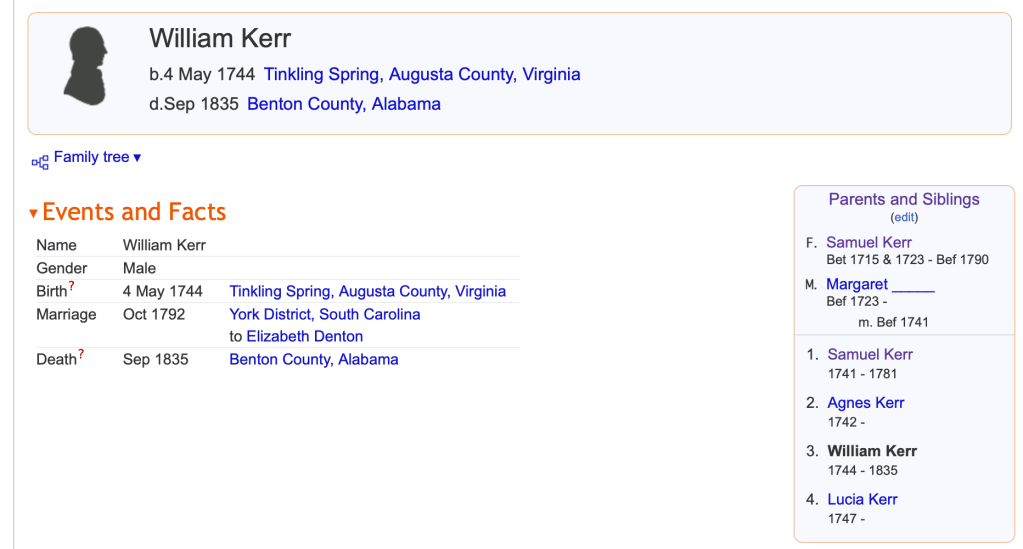
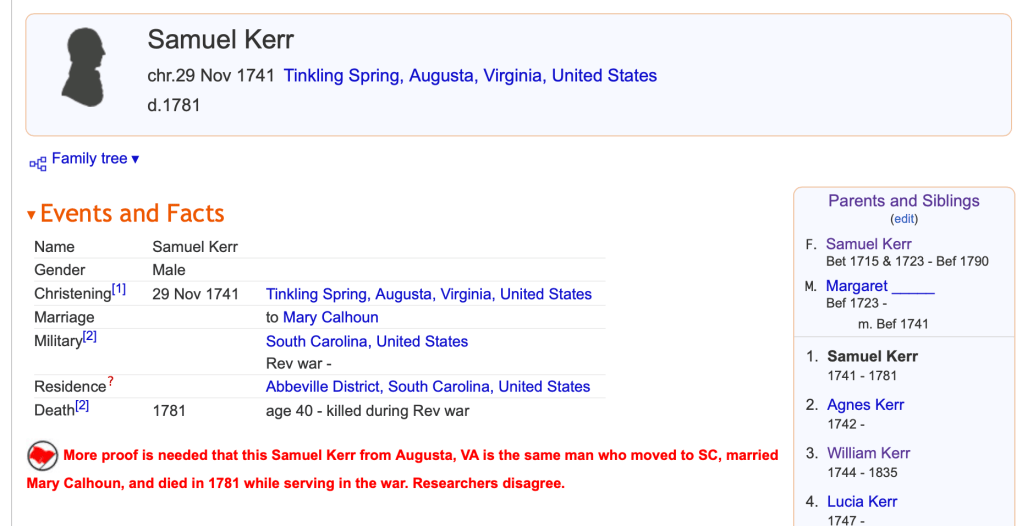
A case study of the incorrect deductions that result from this confusion: in the Early Settlers of Augusta County, Virginia project at the WeRelate site, it’s stated confidently that Samuel and Margaret Kerr’s son William was born 4 May 1744 in Augusta County, Virginia, and died in September 1835 in Benton County, Alabama.[3] Connecting to the page misidentifying Samuel and Margaret Kerr’s son William is a page for William’s brother Samuel.[4] This page is emblazoned with a red-flag warning statement reading, “More proof is needed that this Samuel Kerr from Augusta, VA is the same man who moved to SC, married Mary Calhoun, and died in 1781 while serving in the war. Researchers disagree.”
WeRelate is a free public-service genealogical wiki sponsored by the Foundation for On-Line Genealogy. Anyone can create an account at WeRelate and log in to upload material or add to or edit pages already uploaded. It’s not clear that the same person who uploaded the incorrect information about Samuel and Margaret Kerr’s son William has also flagged the page about William’s brother Samuel. Neither of these pages has any substantial documentation to corroborate the information posted on these pages.
It does seem to me, however, that the misidentification of Samuel and Margaret Kerr’s son William here is directly related to the red flag on the page for William’s brother Samuel. Because the pages for Samuel and Margaret’s family have misidentified their son William, they have also neglected to find valuable information in the very sparse early records of the Long Cane settlement that goes a long way towards proving that Samuel and Margaret Kerr moved to the Long Cane settlement after selling their land in Augusta County, Virginia, with sons Samuel and William accompanying them, and with William dying testate with a will naming his brother Samuel’s wife as his sister-in-law.
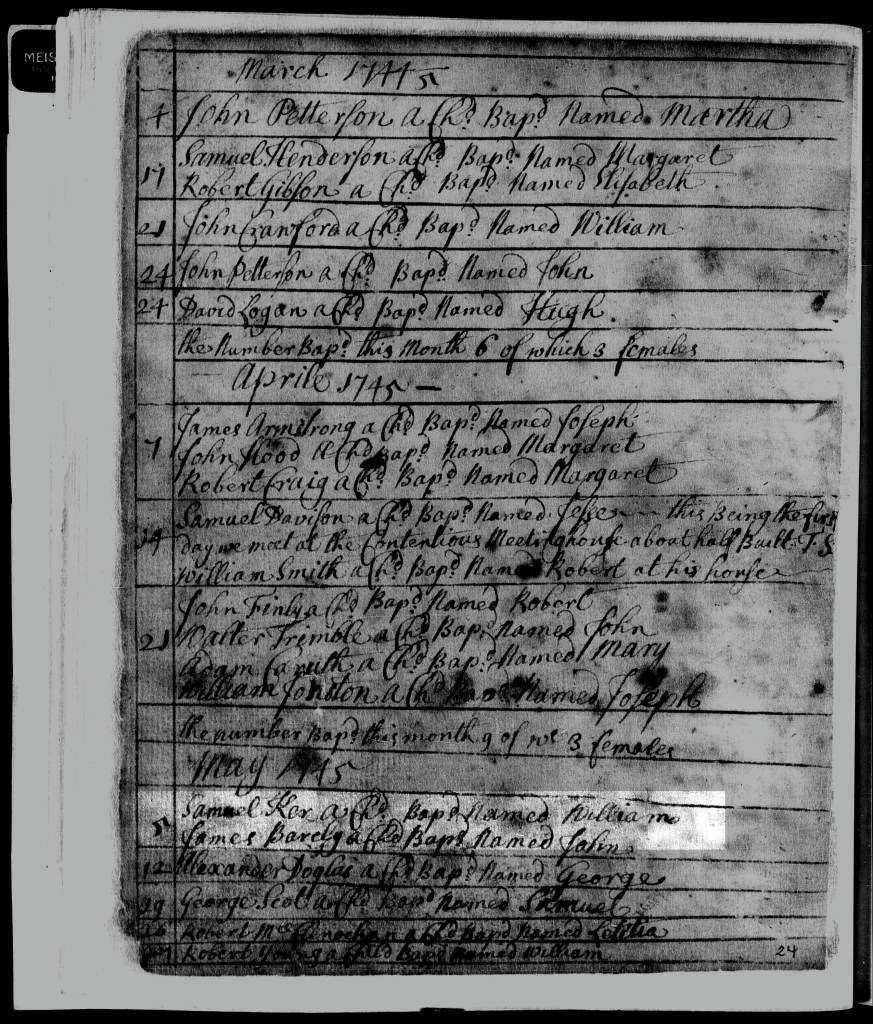
1. When we have an Abbeville District will of a William Kerr stating that Mary Kerr is his sister-in-law who we have every reason to believe is William, son of Samuel, baptized at Tinkling Spring Presbyterian church on 5 May 1745;[5]
2. When we can prove that Mary, daughter of Ezekiel Calhoun and Jane/Jean Ewing, married a man named Samuel Kerr;[6]
3. When the Tinkling Spring baptismal register shows Samuel and Margaret Kerr’s son Samuel baptized there on 29 November 1741;
4. When the William Kerr who died in Benton County, Alabama, in September 1835 states in his Revolutionary pension affidavit in Hall County, Georgia,[7] that he was born in Augusta County, Virginia, on 7 May 1744:
5. How can it be blithely asserted that Samuel Kerr with wife Mary Calhoun was not the son of Samuel and Margaret Kerr of Augusta County, Virginia?
Is the William Kerr dying in Abbeville District, South Carolina, in 1798 some other William than Samuel and Margaret’s son? If so, who is this William Kerr, whose will names other closely related Kerrs who, we can easily prove, also moved from Augusta County, Virginia, to the Long Cane settlement and settled close to the family of Samuel Kerr?
And if the Mary Kerr who is, William Kerr’s will, his sister-in-law, is not Mary Calhoun Kerr, then who is this Mary Kerr? When we have solid proof that Mary Kerr, who was born about 1743 and whose family came to the Long Cane settlement from Augusta County, Virginia, married a Samuel Kerr, why not reach the obvious conclusion that Samuel and Margaret Kerr’s son Samuel (born in 1741) married Mary Calhoun and that the William Kerr who died in Abbeville District, South Carolina, in 1798 and whose will states that Mary Kerr was his sister-in-law is the son of Samuel and Margaret Kerr baptized with that name in Augusta County, Virginia, in 1745?
Here’s Samuel and Margaret’s son William:
Here’s the William Carr who died in 1835 in Benton County, Alabama, and was not the son of Samuel and Margaret:
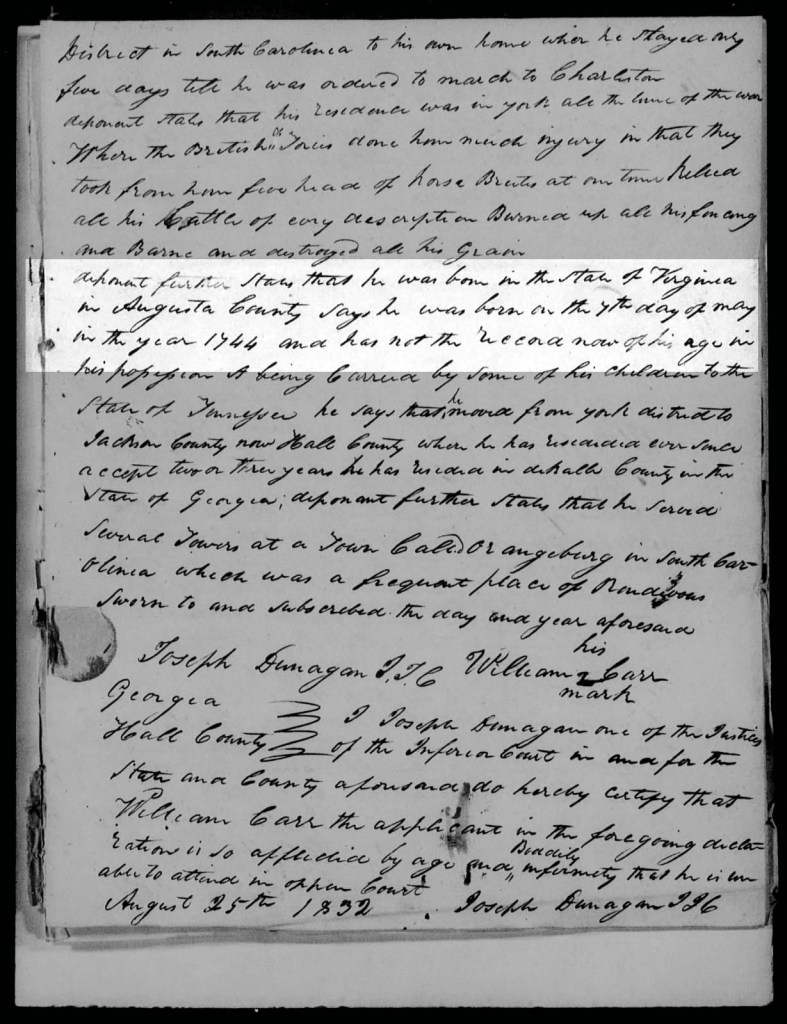
These are not the same man.
Some Basic Methodological Principles to Consider Here
Some basic methodological principles come into play here:
1. When a family sells out its home place of residence, selling the land on which it lives and the house in which it lives, we can usually expect that same family to appear not long down the road, within a year or so, buying new land and establishing a residence in a new place.
2. The deed or deeds showing a family selling out often contain clues that the family is not just selling a piece of land, but preparing to sell out and leave its home place of residence. As this occurs, deeds may mention appurtenances on the land being sold, mills, orchards, etc. Usually, when a couple are selling out, the wife often also signs along with her husband and relinquishes her dower rights, something that doesn’t happen so frequently when the couple are simply selling a piece of land while remaining in their home place. The deed or deeds made as a family sells out and moves away will also often recount the chain of title for the land, noting to whom it was first granted and how the current landholder acquired the land as it passed from hand to hand.
3. If a family is selling out, we can also expect it to vanish from the records of its home county after it sells its home residence and moves away.
4. To find the new place of residence of such a family, we don’t just pick the name of the family’s head at random in places across the map: we look for places to which it’s known that people in their home vicinity are moving. We look for migration patterns and then we seek the family that has recently sold its land in those new places to which people from its home area are moving.
Starting in the 1750s and continuing in the 1760s, there was a strong pattern of migration from Augusta County, Virginia, to places like Rowan County, North Carolina, the Waxhaws settlement on the North and South Carolina border, and the Long Cane settlement in the South Carolina upcountry. Families moving out of Augusta County to those new places of residence frequently moved as kinship units. They often moved with kinfolk or neighbors and also often joined kinfolk and neighbors who had moved ahead of them. They were also frequently followed to their new locations by more kinfolk or neighbors.[8]
As previous postings have shown, on 18 November 1760, Samuel and Margaret Kerr (the deed gives the surname as Carr) sold 224 acres on Big Meadow Run in Augusta County, Virginia, for £120.[9] The deed states that Margaret was Samuel’s wife and shows her selling this tract along with Samuel and signing the deed (by mark). The deed notes when this land was patented and says that along with the land itself, Samuel and Margaret were selling “all Houses Buildings Orchards Ways Waters Watercourses Profits Commodities Hereditaments and Appurtenances whatsoever.” On 19 November 1760, Samuel proved the deed in Augusta County court and Margaret relinquished her dower interest in the land. Digital images of this deed are available at the posting linked at the head of this paragraph.
This is, it seems clear, a deed made by a couple selling their homeplace to move elsewhere. After this land sale, Samuel Kerr disappears from Augusta County records. As has been previously noted, he is mentioned less frequently in Augusta County records than other proven or presumed sons of James Kerr, the progenitor of this particular Kerr family.[10] We can fairly well conclude that references to Samuel Kerr in the county records up to this point and for several years after this all point to the same man, Samuel with wife Margaret and children Samuel, Agnes, William, and Lucia.
As a previous posting states, on 23 March 1773, the Augusta County court order book notes that Samuel Kerr was no longer an inhabitant of the county.[11] I think it’s safe to say that when Samuel and Margaret Kerr sold their homeplace on Big Meadow Run on 18 November 1760, they were selling out in Augusta County and making preparations to move somewhere else. The deed alerts us to the need to begin looking for Samuel Kerr’s family not long after this time in a new location, most likely one to which other families leaving Augusta County in this period of time were moving.
A number of researchers state that, after their 1760 land sale, Samuel Kerr and wife Margaret moved from Augusta County, Virginia, to Rowan County, North Carolina, joining family members who had already gone here. I have seen no proof whatsoever of this claim. I’ve seen no Rowan County documents showing a Samuel Kerr acquiring land in that county within a year or two after Samuel and Margaret Kerr sold out in Augusta County.
However, as we’ve seen previously (and here), on 5 October 1762, a Samuel Kerr had a warrant for a survey in the Long Cane settlement of then Granville and later Abbeville County, South Carolina, and on 19 October 1762, Patrick Calhoun surveyed 100 acres on waters of the northwest fork of the Long Cane for this Samuel Kerr.[12] The Patrick Calhoun (1727-1796) surveying this land was, as it happens, the brother of Ezekiel Calhoun whose daughter Mary married Samuel Kerr and who was for many years a surveyor in the Long Cane settlement.
Other Kerr Families with Augusta County Roots Settling on Northwest Fork of Long Cane When Samuel Kerr Settles There
The 5 October 1762 warrant issued for this survey for Samuel Kerr on the northwest fork of Long Cane suggests that at some point prior to that date, Samuel and his family had likely occupied the land for which he had requested a survey warrant. As my last posting indicates, Samuel Kerr was not the only person with this surname acquiring land in this period on the northwest fork of Long Cane: on 5 September 1758, a James Kerr had a warrant for a survey on the northwest fork of Long Cane, with a survey for 100 acres done by Patrick Calhoun on 20 September 1758.[13] Then on 27 December 1758, a William Kerr had a survey by Patrick Calhoun of 100 acres on the northwest fork of Long Cane.[14]
Following this, on 4 January 1763, a warrant was issued for a survey of 100 acres for Andrew Kerr on the northwest fork of Long Cane, and a survey was made by Patrick Calhoun on 17 January.[15] This plat is listed on the same page and next to the 100-acre survey Patrick Calhoun did for Samuel Kerr on the northwest fork of Long Cane on 19 October 1762.
As my last posting states, Kerr researcher Marcia McClure identifies James, William, and Andrew Kerr as sons of John Kerr and Lucy Pickens, and as nephews of Samuel Kerr with wife Margaret (who was, I’ve concluded, a sister of Lucy Pickens, a matter I’ll discuss in detail later).[16] We might quibble about precisely how James, William, and Andrew fit into the Kerr family tree of Augusta County, Virginia, but there’s incontrovertible proof that at least one of these three Kerr men acquiring land near Samuel Kerr on the northwest fork of Long Cane does very certainly belong to the Augusta County, Virginia, Kerr family and came to the Long Cane settlement from there. And there’s strong evidence that these three Kerr men were closely related to each other.
As previously noted, in the year prior to his survey on Long Cane, in February and on 17 August 1762, Andrew Kerr and wife Rachel sold two tracts of land, evidently their home tracts, on Middle River of the Shenandoah in Augusta County, Virginia, with the second deed stating that the tract lay on William Kerr’s line.[17] When a grant was issued to Andrew Kerr on 20 April 1763 for his 100 acres on the northwest fork of Long Cane, the grant noted that the land was bordered by William Kerr on the west.[18] The memorial for this land dated 20 May 1763 also notes that the land bordered William Kerr.[19] This William Kerr who was, we think, a brother of Andrew and James and a son of John Kerr and Lucy Pickens, is not the William Kerr who died in Abbeville District in 1798, by the way. Marcia thinks that while he acquired land in the Long Cane settlement, this William Kerr did not settle there permanently but by 1779 had gone to the Holston River in Tennessee.[20] It’s not clear to me that either William or James Kerr actually settled for any length of time on the Long Cane, though both acquired land there. It is clear that Andrew Kerr did come to the Long Cane settlement and died there.
A primary reason we can know that the Andrew Kerr warranting land on the northwest fork of Long Cane in January 1763 is the same Andrew Kerr with wife Rachel who sold land in Augusta County, Virginia, in February and August 1762 is that when Andrew Kerr died in by 24 October 1771, his widow and administratrix is named in his estate papers as Rachel: the widow Rachel Kerr and James Kerr received a citation to administer Andrew’s estate on 24 October 1771, and with the citation noting that Andrew was late of Long Cane.[21] On 29 November 1771, an edict was issued to John Pickens, Esq., to qualify Rachel and James as administrators.[22]
If Marcia McClure is correct in identifying this Andrew Kerr and the James and William Kerr obtaining land on the northwest fork of Long Cane by 1758 as sons of John Kerr and Lucy Pickens — and I think she is correct — then John Pickens was an uncle of Andrew Kerr. He married Eleanor Kerr, a sister of the John Kerr who married John Pickens’ sister Lucy. Not long before their sons James, William, and Andrew obtained land in the Long Cane settlement, John and Lucy Pickens Kerr sold their land on Middle River of the Shenandoah in Augusta County, Virginia, in May 1761, with the deeds for their land sale showing among other witnesses their sons James and William Kerr.[23]
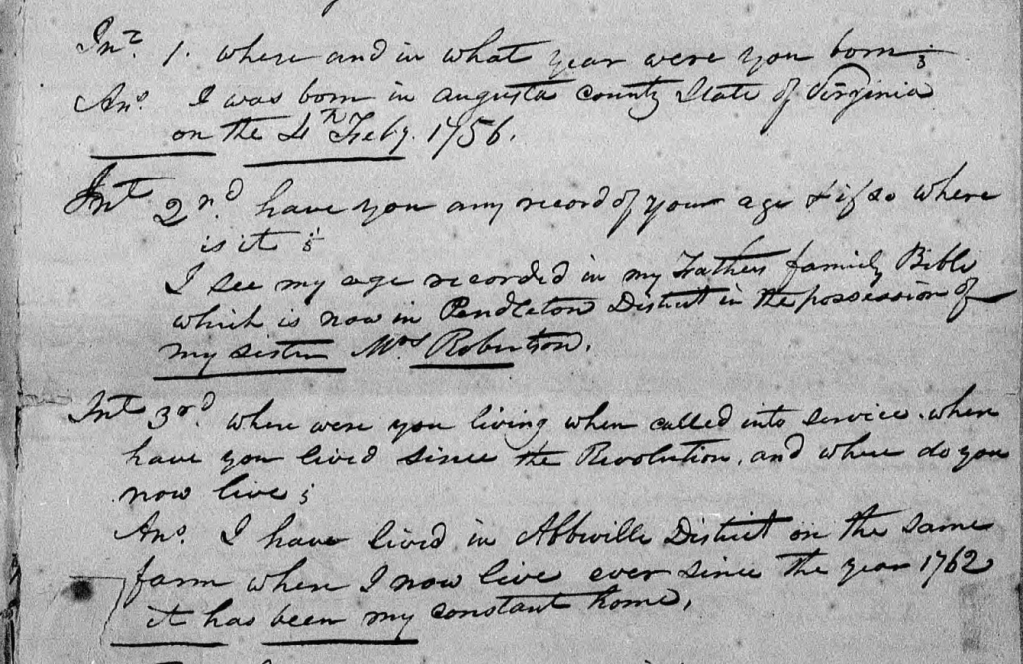
One more significant piece of evidence about the movement of Kerr families out of Augusta County, Virginia, to the Long Cane settlement in the late 1750s and early 1760s needs to be noted here: on 8 June 1833, a David Kerr who, as we’ll see later, served under Captain Samuel Kerr during the Revolution, gave a pension affidavit in Abbeville District, South Carolina.[24] The affidavit contains David Kerr’s answers to the interrogatories put to him as he made his pension claim. In response to a question about when and where he was born, he states that he was born in Augusta County, Virginia, on 4 February 1756. He does not state the name of his parents, but other documents indicate that David was a son of Andrew and Rachel Kerr. When asked where he was living when called into Revolutionary service and where he now lives, David replies:
I have lived in Abbeville District on the same farm where I now live ever since the year 1762 it has been my constant home.
If the Abbeville District land on which David Kerr was living in 1833 was land on which he had lived continuously since 1762, and if David was six years old in 1762, then it was his parents who occupied this farmland in 1762. This affidavit tells us that Andrew and Rachel Kerr moved their family to the Long Cane settlement in 1762 after having sold their Augusta County, Virginia, land in February and August 1762. They then applied for a warrant in January 1763, had the land surveyed later that month, and received a grant in April 1763, with the grant noting that the land bordered William Kerr’s land.
And by October 1762, a Samuel Kerr had also settled on the northwest fork of the Long Cane. It seems very clear that this Samuel Kerr is the same Samuel Kerr who, with wife Margaret, sold his Augusta County, Virginia, land in November 1760. Two closely related Kerr families both arriving at the same spot in the South Carolina upcountry not long after having sold their home tracts of land and residences in Augusta County, Virginia….
The 1795 Abbeville District Will of William Kerr Again
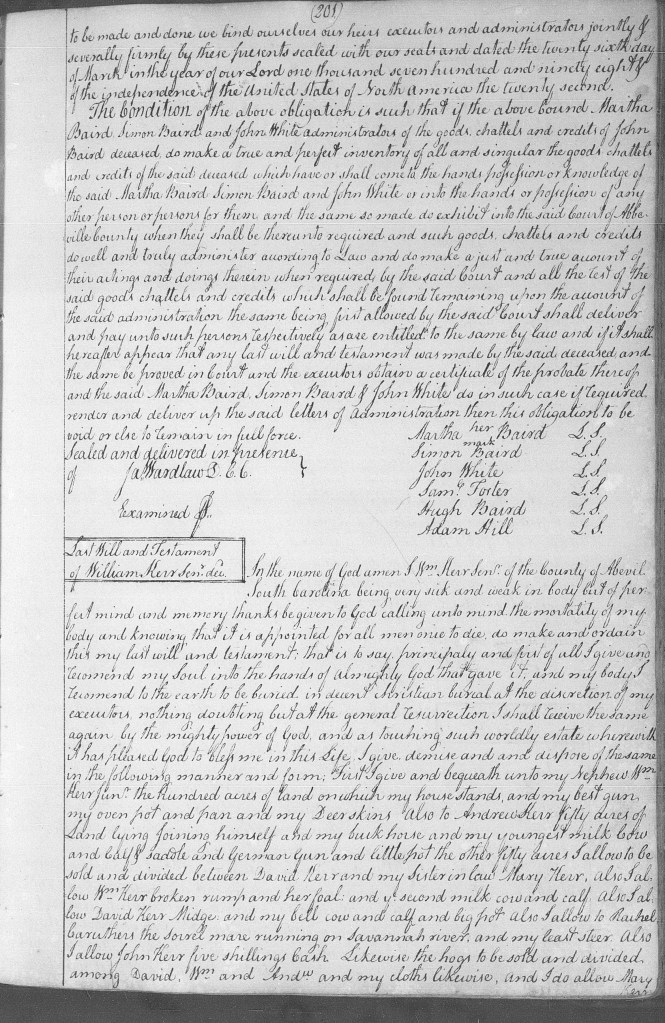
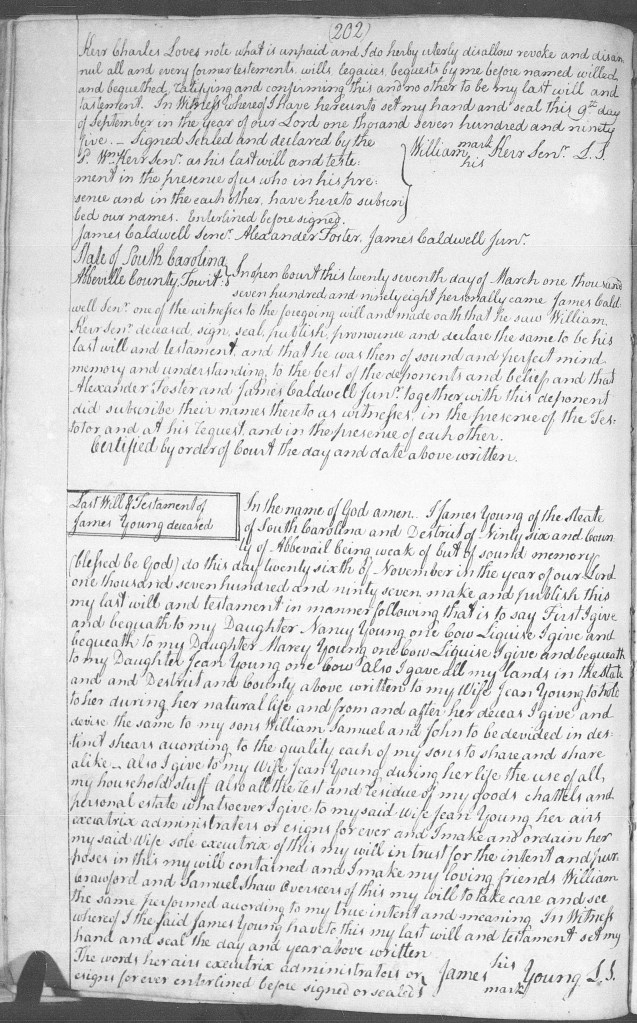
And finally to return to the 9 September 1795 Abbeville District, South Carolina, will of William Kerr in which William names Mary Kerr as his sister-in-law: in a previous posting, I provided a digital image of the original will from William Kerr’s loose-papers probate file in Abbeville County.[25] The image above is the somewhat more legible copy of this will recorded in Abbeville County’s Will Book 1.[26]
Mary Kerr, William’s sister-in-law, is not the only Kerr named in this will. The will identifies the testator as William Kerr Sr. and it makes bequests to William Kerr Jr., naming him as a nephew of William Sr. as well as to Andrew, David, and John Kerr. Not only does the will of William Kerr go a long way toward proving that the Samuel Kerr who married Mary Calhoun was William’s brothers and that these are the two sons of Samuel and Margaret Kerr named in the baptismal register of Reverend John Craig of Tinkling Spring Presbyterian church in Augusta County, Virginia. But it also shows us the strong interconnections between Samuel and William Kerr and the other Kerrs who had acquired land on the northwest fork of Long Cane in the late 1750s and early 1760s.
The will names William Kerr Jr. as a nephew of William Sr. It does not specify William Sr.’s relationship to Andrew, David, and John Kerr. William Jr., Andrew, and David were not nephews of William Sr. but cousins. All were sons of William Sr.’s first cousin Andrew Kerr with wife Rachel. The will suggests that William was an unmarried and childless man, possibly a widower.[27] He’d have been forty when he made his will. The 1790 federal census for Abbeville District shows William elder and his “nephew” the younger William living side-by-side, with Andrew living close to the two Williams.[28] The bequests William makes to the younger William, Andrew, and David — the will leaves William Jr. 100 acres of land on which William Sr.’s house stands, it leaves Andrew 50 adjoining acres, and it stipulates that another 50 acres are to be sold and the money from the sale divided between David and William’s sister-in-law Mary Kerr — suggest that as an unmarried man in perhaps not robust health, William Kerr relied on the sons of Andrew and Rachel Kerr, who lived near him, to assist him in various ways, and William elder wanted, with his bequests, to show gratitude to these close relatives for their support of him.
The John Kerr to whom the will makes a bequest of five shillings is not identified. I suspect this is John, son of Samuel and Mary Calhoun Kerr. The will also makes a bequest of a horse and steer to Rachel Carruthers, whose relationship to William Kerr is not identified. According to Marcia McClure, Rachel was the daughter of Samuel Carruthers and Hannah Kerr.[29] Hannah was, Marcia concludes, a sister of William Jr., Andrew, and David — children of Andrew Kerr and wife Rachel.
The will of William Kerr reinforces, then, the conclusion that the various Kerr families moving to or acquiring land on the northwest fork of Long Cane in the 1750s and 1760s, all with roots in Augusta County, Virginia, were closely related to each other. And it helps to reinforce the deduction that after selling their Augusta County home place in 1760, Samuel Kerr and wife Margaret moved to the northwest fork of Long Cane and settled there by 1762. The following posting will take up the question of what became of Samuel and Margaret from this point forward.
[1] Augusta County, Virginia, Court Order Bk. 15, p. 56.
[2] Will of William Kerr, 9 September 1795, Abbeville District, South Carolina, Probate Files, box 52, pack 1229; and Abbeville County, South Carolina, Will Bk. 1, p. 201-2. The will was probated James Caldwell Sr., one of its witnesses, on 27 March 1798.
[3] “Samuel Kerr’” in the Early Settlers of Augusta County, Virginia project at WeRelate.org.
[4] “William Kerr” and “Samuel Kerr” in the Early Settlers of Augusta County, Virginia project at WeRelate.org.
[5] See “Book containing baptisms, Oct. 1740-Sept. 1749,” in the collection of the personal papers of Reverend John Craig (held by Union Theological Seminary’s library in Richmond) filmed and digitized by the Family History Library in Salt Lake City and available digitally at FamilySearch. See also Howard McKnight Wilson, The Tinkling Spring, Headwater of Freedom: A Study of the Church and Her People, 1732-1952 (Fishersville, Virginia: Tinkling Spring and Hermitage Presbyterian Churches, 1954), p. 477, extracting the baptisms of Samuel and Margaret Kerr’s four children by Reverend Craig at Tinkling Spring, 1741-7.
[6] See will of Mary Kerr, Abbeville County, South Carolina, bequeathing land she has received from Samuel Kerr by right of dower: Will Bk. 1, p. 304; Abbeville County, South Carolina, Probate Files, box 52, pack 1231. See also James Wooley, A Collection of Upper South Carolina Genealogical and Family Records, vol. 2 (Easley, South Carolina: Southern Historical Press, 1981), p. 170; and Willie Pauline Young, Abstracts of Old Ninety-Six and Abbeville District Wills and Bonds (Greenville, South Carolina: Greenville Printing Company, 1950), p. 171. And see documents showing Mary Kerr receiving an annuity as the widow of Samuel Kerr: Annuities for Persons Hurt in the Service of the State, 1778-1786 and House of Representative Claims and Pension Reports, 1787-1796, transcribed in South Carolina Magazine of Ancestral Research 1,2 (spring 1973), p. 67, and 1,3 (summer 1973), p. 159.
[7] NARA, Case Files of Pension and Bounty-Land Warrant Applications Based on Revolutionary War Service, compiled ca. 1800 – ca. 1912, documenting the period ca. 1775 – ca. 1900, RG 15, file of William Carr, R 1719, South Carolina, available digitally at Fold3.
[8] Carolyn Earle Billingsley’s classic study Communities of Kinship: Antebellum Families and the Cotton Frontier (Athens: University of Georgia Press, 2004) is an indispensable resource in understand these patterns of kinship migration.
[9] Augusta County, Virginia, Deed Bk. 9, pp. 67-71.
[10] See Jim Veregge, “Descendants of James Kerr” at Rootsweb.
[11] Augusta County, Virginia, Court Order Bk. 15, p. 56.
[12] South Carolina Colonial Plats Bk. 7, p. 326. The grant for this land was made 8 March 1763: South Carolina Colonial Land Grants Bk. 11, p. 2, and the memorial was recorded 1 April 1763: South Carolina Memorials Bk. 6, p. 65.
[13] South Carolina Colonial Plats Bk. 7, p. 25.
[14] Ibid., Bk. 6, p. 421. The survey gives William’s surname as Ker.
[15] Ibid., Bk. 7, p. 326. The surname is spelled Ker here.
[16] See Marcia McClure, “The Kerr Family from Augusta Co, VA to Abbeville Co, SC” at the Upcountry South Carolina Green Families website. On 19 May 1761, John and Lucie Kerr sold Hugh Botkin 174 acres on a draft of the North Shenandoah in Augusta County, with witnesses John Botkin, William Kerr, William Mathers, and John Reburn (Augusta County, Virginia, Deed Bk. 9, pp. 267-9. On the same day, John and Lucy Kerr sold William Mathers 112 acres from a survey of 275 acres for John Kerr in Beverly Manor on a branch of Middle River with William and James Kerr witnessing along with John Hind (ibid., pp. 269-270). The following day, John and Lucie Kerr sold John Allison ten acres on the east side of the Shenandoah between John Kerr and John Allison, part of 400 acres on Andrew Kerr’s line (ibid., pp. 353-5). Andrew Russell, Edward Rutledge, and William Kerr were witnesses. Lyman Chalkley abstracts material from a May 1795 Augusta County case, Commonwealth vs. John Dixon, in which Dixon was charged with cutting down trees on the corner of James Kerr on 31 May 1794. Chalkley’s abstract states that the case documents give John Kerr’s date of death as 1794 and state that John Allison was John Kerr’s grandson: see Lyman Chalkley, Chronicles of the Scotch-Irish in Virginia, vol. 1 (Rosslyn, Virginia: Commonwealth, 1912), p. 406, abstracting a case in a set of cases Chalkley labels “Office Judgment.”
[17] Augusta County, Virginia, Deed Bk. 10, pp. 149-152, 389-393. The first deed is dated only February 1762; the day may have been the 17th, when Andrew and Rachel proved the deed.
[18] South Carolina Colonial Land Grants Bk. 11, p. 37.
[19] South Carolina Memorials Bk. 6, p. 81.
[20] Marcia McClure, “The Kerr Family from Augusta Co, VA to Abbeville Co, SC.”
[21] South Carolina Journal of Court of Ordinary, 24 October 1771, p. 8: see Brent Holcomb, Probate Records of South Carolina, vol. 2 (Easley, South Carolina: Southern Historical Press, 1978), p. 7. See also the inventory of Andrew’s estate naming his widow Rachel in in Charleston County, South Carolina, Inventories Bk. Z 1771-1774, pp. 288-9.
[22] South Carolina Journal of Court of Ordinary, 29 November 1771, p. 17; see Holcomb, Probate Records of South Carolina, vol. 2, p. 14.
[23] Augusta County, Virginia, Deed Bk. 9, pp. 266-272, 352-5. See supra, n. 16.
[24] NARA, Case Files of Pension and Bounty-Land Warrant Applications Based on Revolutionary War Service, compiled ca. 1800 – ca. 1912, documenting the period ca. 1775 – ca. 1900, RG 15, file of David Kerr, R 5890, South Carolina, available digitally at Fold3.
[25] Abbeville County, South Carolina, Probate Files, box 52, pack 1229.
[26] Abbeville County, South Carolina, Will Bk. 1, pp. 201-2.
[27] As Marcia McClure has pointed out to me, if William married a wife who had died by 1790 and if that wife happened to be a sister of Andrew Kerr’s wife Rachel, then William Kerr would, indeed, have been an uncle of William Jr., Andrew, and David Kerr, as well as their cousin.
[28] 1790 federal census, Abbeville District, South Carolina, p. 61.
[29] Marcia McClure shared this information with me in a 27 February 2001 email citing the Revolutionary pension file of Samuel Carruthers and testimony of Archibald Hamilton in an Abbeville District assault case of the 1790s involving Samuel Carruthers.
 BEGATS AND BEQUEATHALS