As the preceding posting states,
The baptismal register of Reverend John Craig of Tinkling Spring Presbyterian church in Augusta County, Virginia, shows Samuel Kerr (with wife Margaret) having a son Samuel baptized 29 November 1741.[1] Is this the man named Samuel Kerr who, it can be proven, married Mary, daughter of Ezekiel Calhoun and Jane/Jean Ewing of the Long Cane settlement? It’s clear to me that the two Samuels are the same person, but beyond a statement in the will of the younger Samuel’s brother William that Mary Kerr was William’s sister-in-law, absolutely clenching documentation to prove this is elusive.
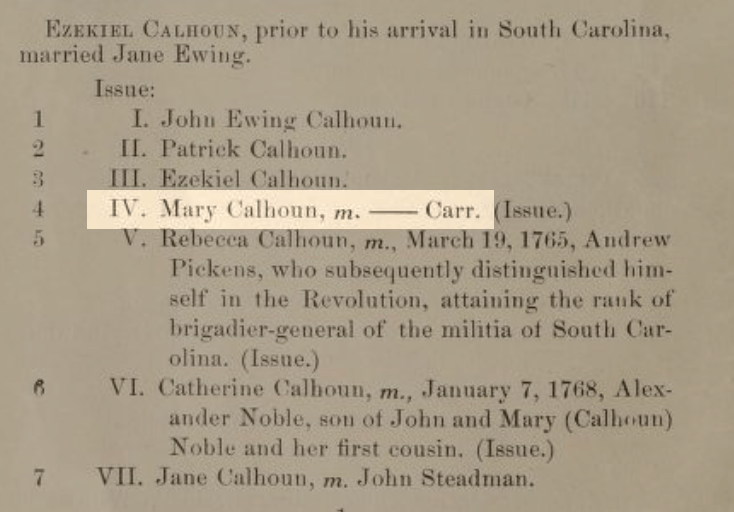
Many published histories of the Long Cane Calhoun family have long noted that Ezekiel Calhoun and Jane/Jean Ewing’s daughter Mary married a Kerr, but some of the most widely circulated of these histories including A.S. Salley’s articles entitled “The Calhoun Family of South Carolina” in South Carolina Historical and Genealogical Magazine do not even state the name of Mary’s husband.[2] Salley says that Mary married — Carr. (The surname Kerr was commonly pronounced in the 18th century as “car” and was often transcribed phonetically as Car, Carr, or Karr in various records.)
As we’ve seen previously, the will that Mary Calhoun Kerr made in Abbeville County, South Carolina, on 21 January 1805 explicitly names her deceased spouse as Samuel Kerr.[3] Mary states (my emphasis added),
I bequeath to Ruth Kerr all my right of dower to the land I got by Samuel Kerr untill her marriage after which I wish the Value of the same to be divided Equally between her the sd. Ruth Kerr and my daughters Catherine McLain and Jane Green….
Digital images of Mary Calhoun Kerr’s will in its entirety are at this previous posting. A close-up image of the section I’ve highlighted is at the head of this posting.
As the posting I’ve just linked also notes, on 19 May 1785, Mary received an annuity payment of £8 15s from the state of South Carolina as the widow of Samuel Kerr. She received an additional annuity payment for Samuel’s Revolutionary service on 5 February 1787 for herself and her children, and her will bequeaths this annuity to her daughter Ruth.[4]

So it’s well-documented that the Kerr husband whom Mary Calhoun married and whose given name escaped A.S. Salley was named Samuel. Furthermore, as noted above, the 9 September 1795 will of William Kerr of Abbeville District, South Carolina, named Mary Kerr as his sister-in-law.[5] For a digital image of William Kerr’s entire will, see this previous posting.
As a previous posting notes, the William Kerr making this will was William, the son of Samuel Kerr elder and wife Margaret, who was baptized at Tinkling Spring Presbyterian church in Augusta County, Virginia, on 5 May 1745.[6] The posting I’ve just linked explains that the William Kerr who was son of Samuel and Margaret Kerr of Tinkling Spring church has been confused with a William Kerr who was, according to his Revolutionary pension affidavit, born 7 May 1744 in Augusta County, Virginia. This William died in Benton County, Alabama, in 1835. Marcia McClure’s excellent research has cleared up the confusion between these two Williams and helped to identify the William who died testate in Abbeville County, South Carolina, before 27 March 1798 as the son of Samuel Kerr and wife Margaret who was baptized at Tinkling Spring church on 5 May 1745.[7]
If the William Kerr naming Mary Kerr as his sister-in-law in his 9 September 1795 Abbeville District, South Carolina, will, was — and I’m persuaded this was the case —William Kerr, son of Samuel and Margaret Kerr, who was baptized at Tinkling Spring Presbyterian church in Augusta County, Virginia, on 5 May 1745, then we can conclude that the Samuel Kerr whom Mary Calhoun married was Samuel, son of Samuel and Margaret Kerr, who was baptized at Tinkling Spring church on 29 November 1741. It appears that both of the sons of Samuel and Margaret Pickens Kerr found in Reverend John Craig’s baptismal register for Tinkling Spring Presbyterian church migrated from Augusta County, Virginia, to the Long Cane settlement in what became Abbeville County, South Carolina.
And if both of Samuel and Margaret Pickens Kerr’s sons moved from Augusta County, Virginia, to the Long Cane settlement, then it seems very likely that the Samuel Kerr who had a warrant for a survey in the Long Cane settlement in Granville County, South Carolina, on 5 October 1762 and a survey of 100 acres on the northwest fork of the Long Cane on 19 October 1762 is the Samuel Kerr with wife Margaret who sold his homeplace in Augusta County, Virginia, on 18 November 1760.[8] In making this move, Samuel and Margaret would have been following a migration path other Kerr family members also followed. On 5 September 1758, a James Kerr had a warrant for a survey on the northwest fork of Long Cane in Granville County, South Carolina, with a survey for 100 acres done by Patrick Calhoun on 20 September 1758.[9] James’s survey was followed by another survey by Patrick Calhoun of 100 acres on the northwest fork of Long Cane for William Kerr on 27 December 1758.[10]
On 4 January 1763, a warrant was issued for a survey of 100 acres for Andrew Kerr on the northwest fork of Long Cane, and a survey was made by Patrick Calhoun on 17 January.[11] This plat is listed on the same page and next to the 100-acre survey Patrick Calhoun did for Samuel Kerr on the northwest fork of Long Cane on 19 October 1762. In the year prior to his survey on Long Cane, in February and on 17 August 1762, Andrew Kerr and wife Rachel had sold two tracts of land, evidently their home tracts, on Middle River of the Shenandoah in Augusta County, Virginia, with the second deed stating that the tract lay on William Kerr’s line.[12]
When a grant was issued to Andrew Kerr on 20 April 1763 for his 100 acres on the northwest fork of Long Cane, the grant noted that the land was bordered by William Kerr’s land on the west.[13] The memorial for this land dated 20 May 1763 also notes that the land bordered William Kerr.[14]
Andrew Kerr died in the Long Cane settlement by 24 October 1771, when his widow Rachel and James Kerr received a citation to administer his estate, and with the citation noting that Andrew was late of Long Cane.[15] On 29 November 1771, an edict was issued to John Pickens, Esq., to qualify Rachel and James as administrators.[16]
As Marcia McClure, to whom I’m heavily indebted here, notes, the James, William, and Andrew Kerr who came to the Long Cane settlement just before (James and William) and just after (Andrew) Samuel Kerr and wife Margaret came there were nephews of Samuel Kerr with wife Margaret.[17] James, William, and Andrew were sons of Samuel Kerr’s brother John Kerr and wife Lucy Pickens, Lucy being a sister to the John Pickens who appears in the 1771 probate records of Andrew Kerr cited above. John Pickens married Samuel and John Kerr’s sister Eleanor Kerr. Not long before their sons James, William, and Andrew obtained land in the Long Cane settlement, John and Lucy Pickens Kerr sold their land on Middle River of the Shenandoah in Augusta County, Virginia, in May 1761, with the deeds for their land sale showing among other witnesses their sons James and William Kerr.[18]
In moving from Augusta County, Virginia, to the Long Cane settlement in the early 1760s, Samuel and Margaret Pickens Kerr and their sons Samuel and William were taking part in a migration process that involved not a few of their Kerr and Pickens relatives, as well as the Calhoun family into which Samuel and Margaret’s son Samuel married when he married Mary Calhoun about 1764. As previous postings show (and see here), Mary’s father Ezekiel Calhoun moved his family from Augusta (later Wythe) County, Virginia, to the Long Cane settlement in South Carolina in 1755-6. The Calhoun family left Virginia in 1755 after Braddock’s defeat on 9 July and arrived on the Long Cane in February 1756. Ezekiel’s widowed mother Catherine Montgomery Calhoun and Ezekiel’s siblings Mary (Noble), James, William, and Patrick moved together from Virginia to South Carolina and were founders of the Long Cane settlement.
As we’ve also seen, when Samuel and Margaret Kerr arrived in the Long Cane settlement by October 1762, they settled some six miles northwest of Ezekiel Calhoun and his family. And this helps to explain how Samuel, who was baptized on 29 November 1741, met and married Ezekiel Calhoun’s oldest child Mary, who seems, as a previous posting explains, to have been born in or around 1743.
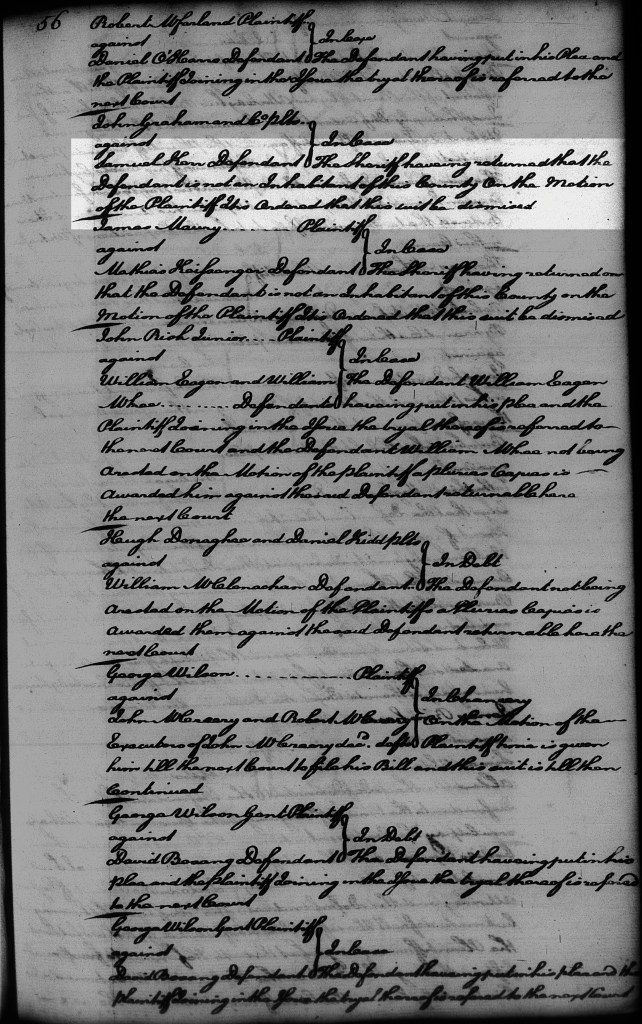
In my next posting, I’ll discuss the problem of determining what became of Samuel Kerr elder and wife Margaret Pickens after they acquired land on the northwest fork of Long Cane by October 1762 — as I have concluded was the case — and after they apparently settled on that land. From the point at which Samuel and Margaret sold their Augusta County, Virginia, land in November 1760, they disappear from Augusta County records, and on 23 March 1773, a court record in Augusta County noting a case of debt filed against him by John Graham & Co. states that Samuel Kerr was no longer an inhabitant of the county.[19] If Samuel remained in Augusta County after selling his land in 1760 and died there, I’d expect some statements to that effect in court records and possibly a probate file. No such documents exist. With the 1773 court record stating that Samuel was no longer an inhabitant of Augusta County, I conclude that he left the county after 1760 and went elsewhere.
As the next posting will note, with no estate record extant in South Carolina for the older Samuel Kerr, with the Abbeville courthouse having burnt in both November 1872 and January 1873 and with virtually all of the county records prior to those dates having been lost, and with two men named Samuel Kerr, both of age and both living in the Long Cane settlement at the same time, as it seems, it is not very clear what became of Samuel elder and his wife Margaret after they made their move to South Carolina.
[1] See “Book containing baptisms, Oct. 1740-Sept. 1749,” in the collection of the personal papers of Reverend John Craig (held by Union Theological Seminary’s library in Richmond) filmed and digitized by the Family History Library in Salt Lake City and available digitally at FamilySearch. See also Howard McKnight Wilson, The Tinkling Spring, Headwater of Freedom: A Study of the Church and Her People, 1732-1952 (Fishersville, Virginia: Tinkling Spring and Hermitage Presbyterian Churches, 1954), p. 477, extracting the baptisms of Samuel and Margaret Kerr’s four children by Reverend Craig at Tinkling Spring, 1741-7. A preface to the digitized film of John Craig’s baptismal register linked above notes that Craig was born in the parish of Dunagor, County Antrim, Ireland, on 17 August 1709, and came to America on 17 August 1734, dying in Augusta County, Virginia, on 21 April 1774. Craig had an M.A. degree from Edinburgh and studied theology at Chestnut Level in Pennsylvania under Rev. John Thomson. More biographical information is in Lillian Kennerly Craig, Reverend John Craig, 1709-1774: His Descendants and Allied Families (New Orleans: Accurate Letter Co., 1963), which includes a transcribed autobiography of John Craig transcribed (pp. 40f. See also Katharine L. Brown, “John Craig (1709–1774),” Dictionary of Virginia Biography at the Library of Virginia website, noting that John Craig was for several years the only Presbyterian minister in the area of Augusta County in which he resided, and that his record of 883 baptisms performed during the 1740s is the earliest surviving document of its kind from the region. Note that Chestnut Level in Lancaster County, Pennsylvania, where John Craig studied theology with John Thomson, is said by traditions in the Calhoun and Montgomery families who came from Pennsylvania to Augusta County, Virginia, to have been those families’ place of residence before they went to Virginia — see here and here.
[2] A. S. Salley, Jr., “The Calhoun Family of South Carolina (Continued),” South Carolina Historical and Genealogical Magazine 7,3 (July 1906), p. 153. Salley is not listing Ezekiel Calhoun’s children by order of birth. Mary was the first child of Ezekiel and Jane/Jean Ewing Calhoun.
[3] Abbeville County, South Carolina, Will Bk. 1, p. 304; Abbeville County, South Carolina, Probate Files, box 52, pack 1231. See also James Wooley, A Collection of Upper South Carolina Genealogical and Family Records, vol. 2 (Easley, South Carolina: Southern Historical Press, 1981), p. 170; and Willie Pauline Young, Abstracts of Old Ninety-Six and Abbeville District Wills and Bonds (Greenville, South Carolina: Greenville Printing Company, 1950), p. 171.
[4] See Annuities for Persons Hurt in the Service of the State, 1778-1786 and House of Representative Claims and Pension Reports, 1787-1796, transcribed in South Carolina Magazine of Ancestral Research 1,2 (spring 1973), p. 67, and 1,3 (summer 1973), p. 159.
[5] Abbeville District, South Carolina, Probate Files, box 52, pack 1229.
[6] On this document, see supra, n. 1.
[7] See Marcia McClure, “The Kerr Family from Augusta Co, VA to Abbeville Co, SC” at the Upcountry South Carolina Green Families website.
[8] South Carolina Colonial Plats Bk. 7, p. 326; South Carolina Colonial Land Grants Bk. 11, p. 2; South Carolina Memorials Bk. 6, p. 65; and Augusta County, Virginia, Deed Bk 9, pp. 67-8.
[9] South Carolina Colonial Plats Bk. 7, p. 25.
[10] Ibid., Bk. 6, p. 421. The survey gives William’s surname as Ker.
[11] Ibid., Bk. 7, p. 326. The surname is spelled Ker here.
[12] Augusta County, Virginia, Deed Bk. 10, pp. 149-152, 389-393. The first deed is dated only February 1762; the day may have been the 17th, when Andrew and Rachel proved the deed.
[13] South Carolina Colonial Land Grants Bk. 11, p. 37.
[14] South Carolina Memorials Bk. 6, p. 81.
[15] South Carolina Journal of Court of Ordinary, 24 October 1771, p. 8: see Brent Holcomb, Probate Records of South Carolina, vol. 2 (Easley, South Carolina: Southern Historical Press, 1978), p. 7.
[16] South Carolina Journal of Court of Ordinary, 29 November 1771, p. 17; see Holcomb, Probate Records of South Carolina, vol. 2, p. 14.
[17] Marcia McClure, “The Kerr Family from Augusta Co, VA to Abbeville Co, SC.”
[18] Augusta County, Virginia, Deed Bk. 9, pp. 266-272, 352-5.
[19] Augusta County, Virginia, Court Order Bk. 15, p. 56.


2 thoughts on “Nailing Down the Identity of the Samuel Kerr Who Married Mary, Daughter of Ezekiel Calhoun and Jane/Jean Ewing”