I’ve obtained permission from the Tuscaloosa Genealogical Society to republish this article here on my blog. Before I share the text of the article (below), I want to say a word of strong recommendation for this first-rate genealogical society. In my view, it’s one of the best local genealogical societies to be found anywhere. It has lots of active, skilled researchers who share information freely; it’s engaged in an ongoing basis in digitizing and transcribing records; it publishes a quarterly newsletter and offers access through links on its website to several valuable collections of digitized Tuscaloosa County records. If you have roots in Tuscaloosa County, I encourage you to consider joining this society (see the link above). And now for my article:
Artificial Intelligence and Genealogical Research: Some Notes on the New FamilySearch AI All-Text Search Tool
The application of artificial intelligence (AI) technology to genealogical research is attracting attention with good reason. AI promises to revolutionize how we conduct online searches. As with DNA analysis, it’s not an instant or magic-bullet solution to all our genealogical problems, of course. To yield the best results, It has to be used judiciously and with human intelligence factoring into how we search.
In what follows, I’d like to offer some tips about using one particular AI search tool, the new full-text search feature at the FamilySearch site. This new feature is still in the experimental stage. It scans some but not all of the vast caches of digitized documents accessible at FamilySearch. It hasn’t yet been configured to scan each and every document in that site’s collection. But new material is being added regularly to what this tool can access. If you use this AI search tool, it’s advisable to keep going back and reusing it in the hope that it may pick up new material that it didn’t access the last time you used it.
To find FamilySearch’s new AI search tool:
- Go to the FamilySearch home page and sign in to your account.
- In the lower right corner of the page, find “FamilySearch Labs,” and click “VIEW EXPERIMENTS.”

- On the new page that opens after you click, find “Expand your search with Full Text,” and click “Go to Experiment.”

- This will bring you to the search page for the AI search tool, which allows you to search by keywords, name, place, range of years, or image group number in the FamilySearch collection of documents.
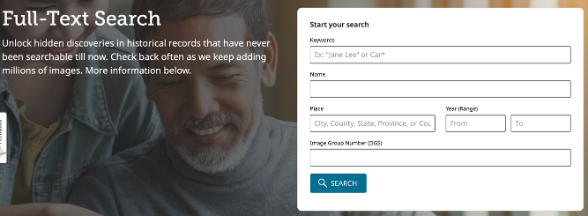
N.B. Keep in mind that the set-up of FamilySearch’s website and its page for its new all-text search tool can change. I’m giving you tips on how to use this tool as it’s presently configured.
Some tips for using the new FamilySearch AI search tool:
- In the name box on the search page, enter a name. I advise using quotation marks (Boolean search) so that the engine searches for that specific name.
- Don’t forget variant spellings of both the given name and surname. Remember to search for those variant spellings as well — e.g., after searching for “Wilson Batchelor,” search for “Wilson Bachelor.” If your person often used a middle initial — e.g., “Wilson R. Batchelor” or “Wilson R. Bachelor” — the search engine will find names that have your given name and surname with initials in between.
- Remember that people can appear in documents with their first names given as initials, so in addition to searching for (e.g.) “Zachariah Sims Simpson,” also look for “Z.S. Simpson.”
- In the place box, you may want to limit your search to a specific location — e.g., Tuscaloosa County, Alabama — and then you may want to do another search and zoom out and search for Alabama in general. It’s possible the ancestor you’re searching for appears in documents in more than one county including counties you don’t even know about.
- The year range feature allows you to limit and organize your results, though the search tool will return hits outside your year range.
- Note that when your results show up, you can limit them further by filters listed above your list of results — collection, year, place, and record type.
One of the things that makes this new AI search feature so valuable: it scans material that has never been transcribed and indexed and is inaccessible in published form. Going through this unpublished, untranscribed, unindexed material on your own, digital frame by digital frame, would be onerous, indeed. This untranscribed material includes, e.g., loose-papers probate or estate files (estate inventories, accounts of sales of estates, notes owning to estates, etc.), and land survey files. The AI search tool accesses material in places you wouldn’t have known to search for information about an ancestral figure, places that are difficult to search in the absence of indexed transcriptions of documents.
Using the AI search tool, I’ve been able to find the following:
- A 2 November 1779 court record in Frederick County, Virginia’s, Chancery Court Order Books stating that on that date, Mary and Thomas Brooks brought the will of James Brooks to court for probate. I’ve spent years searching for the name of Mary’s husband, father of her son Thomas. The court record indicates that this will was never definitively proven and recorded — but now, due to the AI search tool, I know the long-sought name of Mary Brooks’ husband.
- A 31 July 1867 deed in Pulaski County, Arkansas, confirming stories I was told growing up for which I had not previously found proof. I was told that when her sister Margaret died on 9 August 1862, Catherine Ryan, my great-grandmother, married Margaret’s widowed husband Robert A. Sumrall so that Margaret’s infant daughter would have a mother. The July 1867 deed states that Robert and Catherine Sumrall were living in Little Rock and selling land in Jefferson County, Arkansas, where the Ryans and Sumralls settled south of Little Rock. Robert and Catherine then divorced and both remarried other spouses. This deed is the first proof I’ve found confirming my family’s story about Catherine’s marriage to her sister’s widower. I had never thought to search Pulaski County records because I had no idea that Robert and Catherine lived at some point in Little Rock.
- A transcribed bible record in a Louisiana DAR collection giving the dates of birth and death of Elizabeth J. Birdwell and stating that her parents were Moses and Hannah Birdwell and that Elizabeth married Craven Sullivan. Before I found this bible record with the AI search tool, Elizabeth was a mystery daughter of Moses and Hannah Folkinson/Fulkerson Birdwell of Madison, Limestone, and Marshall Counties, Alabama, mentioned in family letters but otherwise unidentified — until the AI search tool pointed me to this transcribed bible record.
- Information in loose-papers estate files in Nash County, North Carolina, helping me pinpoint when my ancestors Wilson Richard Batchelor and wife Alcie Odom Batchelor of that county moved from North Carolina to Tennessee, where they appear on the 1820 federal census in Maury County. On 9 September 1817, Wilson Batchelor bought property at the estate sale of William Lindsey in Nash County. Alcie Odom’s mother Dinah married William Lindsey’s brother John Lindsey and following his death, she married Theophilus Odom. The estate sale record tells me that the Batchelor family left North Carolina between September 1817 and 1820. (The Lindsey family in these records is different from my own Lindsey family, by the way.)
- Tax lists in Lyon County, Kentucky, in 1864-5 showing that Wilson Richard Bachelor (son of Wilson R. Batchelor above) was taxed in that county during those years. An autobiography that Wilson Bachelor wrote in 1890 for Goodspeed for Northwest Arkansas says that he took his family from Hardin County, Tennessee, to Kentucky in 1863 and then returned to Hardin County in 1866, where the federal government made him physician in charge of building a national cemetery at Pittsburg Landing (later, Shiloh). Those of us researching this family had not known where the Bachelors went in Kentucky during the Civil War.
- A 13 February 1838 indenture document in Talladega County, Alabama, showing Green B. Harrison bound out to Robert K. Hampson to be clothed, boarded, lodged, schooled, and to learn the art of brick masonry. The record states that Green B. was a son of Benjamin Harrison, deceased, and was ten years old. The indenture was witnessed by Richard Johnson Harrison, Green’s uncle. I have not been able to find a clear record of the children of my ancestor Benjamin Harrison, who died in Talladega County before 10 January 1835, and prior to finding this record, I did not know of a son Green.
- A listing of my immigrant ancestor John Brazelton as an insolvent debtor in a 19 September 1749 inventory of the estate of Joel Cloud of Chester County, Pennsylvania, by Joel’s widow Esther. As far as I know, this record has eluded Braselton/Brazelton researchers. It’s interesting because it connects John Brazelton to Chester County, Pennsylvania, when every other record found for him to date shows him in Prince George’s and Frederick Counties, Maryland, the latter formed from the former in 1748.
- A January 1839 sale record in Greene County, Georgia, showing my ancestor William Henry Snead purchasing from Joseph Wright’s estate enslaved persons Shadrack and Fanny. William H. Snead appears on the federal census in Russell County, Alabama, with four enslaved persons, two of whose names the estate sale record (in Greene County, Georgia, loose-papers probate files) now tells me.
- The AI search feature has also turned up records showing some of my Georgia ancestors buying and selling land in counties in which they did not live, and where I did not know they owned land. It also shows some of these ancestors witnessing deeds in counties in which they did not live. I would not have known to search for records of my ancestors in those counties if the AI search feature had not pointed me to these records.
- The AI search tool has led me to seventeen records I did not have showing Patrick Ryan, a brother of my ancestor Catherine Ryan Batchelor of Jefferson and Grant Counties, Arkansas, giving security for bonds of neighbors, family members, and friends as they administered estates or assumed guardianship of orphans. These records helped me understand how the estate of Patrick and Catherine’s father Valentine Ryan was settled in Grant County, when Patrick and Catherine’s sister Margaret had a daughter Mary Margaret living in Mississippi.
As you use FamilySearch’s AI search tool, keep in mind that it’s not infallible. It can misread words, including names. I’ve found multiple cases in which AI returns hits for a man named Benjamin Greer as it searches for my ancestor Benjamin Green in Abbeville County, South Carolina.
When you open the hits the AI tool shows you as you search, you’ll see to the right of the digitized original document a transcription of that document. And when you compare that transcription with what you read in the original, you’ll see that it often misreads words and names. Even so, the transcription is a valuable tool to use, since it can sometimes clarify for you words you might not be able to read in the original document. My point in mentioning that this transcription often misreads words and names is to encourage you to read the original for yourself and not rely on the transcription as a faithful rendition of the original document.
In conclusion, AI tools have the potential to help genealogists find information we might well never have found without the assistance of this new technology. But the usefulness of AI is not automatic or magical: it depends on the intelligence human users apply as they use this technology for genealogical research.
I’ve offered a few suggestions for ways readers might use one particular AI tool, FamilySearch’s new experimental all-text search feature. Please don’t regard my suggestions as exhaustive. I encourage readers to experiment with various ways to use FamilySearch’s tool to pursue genealogical searches. For instance, in addition to searching for complete names (given name + surname) as I’ve suggested, you might consider searching for a surname in a specific place. This kind of search works especially well if the surname for which you’re searching is not too common in that place.
By searching, for instance, for “Pryor” or “Prior” in Tuscaloosa County, Alabama, you may find documents mentioning other people with that surname than your own ancestor in the county. You may also find documents that your search for “Joseph Pryor” in Tuscaloosa County did not discover, if the surname Joseph has been misread by the AI search tool or if some idiosyncratic spelling of the surname was used in the document.
My concluding suggestion: Have a bit of fun using this new FamilySearch tool. Experiment with different ways to conduct your searches. And as you do so, be prepared to turn up material you might never have found otherwise — and don’t forget to keep returning to FamilySearch to do more searches with the all-text AI tool, since new documents are being added regularly to the collection it searches.
William D. Lindsey is a family historian living in Little Rock, Arkansas, with many years of experience in the field of genealogy. With a grandfather born in Tuscaloosa County, he has long roots in the county: his surnames there include Braselton, Clements, Pryor, Simpson, and Winn. He maintains a blog at which he’s publishing his 50-some years of family history research. The blog is Begats and Bequeathals, a Southern U.S. Family Documented.
 BEGATS AND BEQUEATHALS
2 thoughts on “Some Notes on the New FamilySearch AI All-Text Search Tool”