Settling in Virginia
The Kerr family’s move from Pennsylvania to the Shenandoah region of Virginia between 1730-4 is mentioned in Robert Ramsey’s Carolina Cradle, which notes that the Kerr and Lewis families led the migration of the Scotch-Irish from the Cumberland and upper Potomac valleys into the Shenandoah region.[2] Ramsey notes the role played by William Beverley in the process of settling the Ulster Scots settlers who began pouring into the area in the 1730s, as Beverly reaped great economic benefits by selling tracts in his Beverley Manor to many of these settlers.
B.F. Kegley indicates that, with a grant for 473 acres, James Kerr was among the first settlers of Beverley Manor whose title deeds are recorded in Orange County deed books before Augusta began to function as a separate county.[3] Kegley notes that many of the first settlers were actually in Orange (later Augusta) County by 1732, but no deeds were recorded for their land before February 1738. Maps of the northeastern section of Beverley’s Manor show James Kerr’s tract on Meadows Run, a stream that empties into Cathey’s River. The land is south of the bend in Cathey’s River on which James’s son John settled.
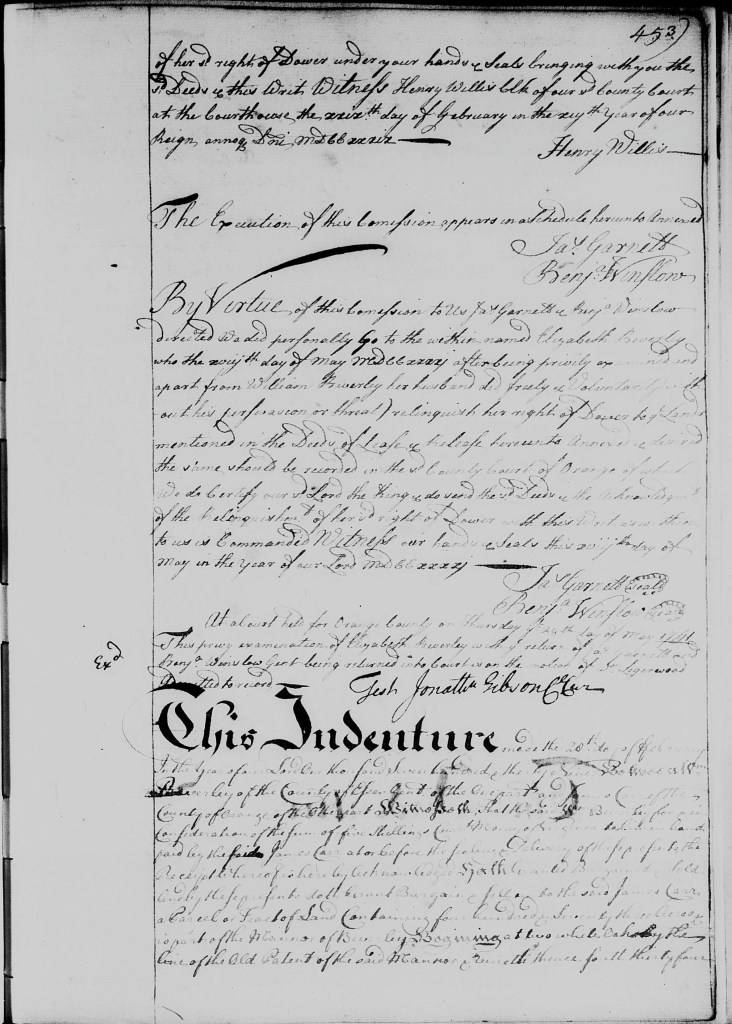
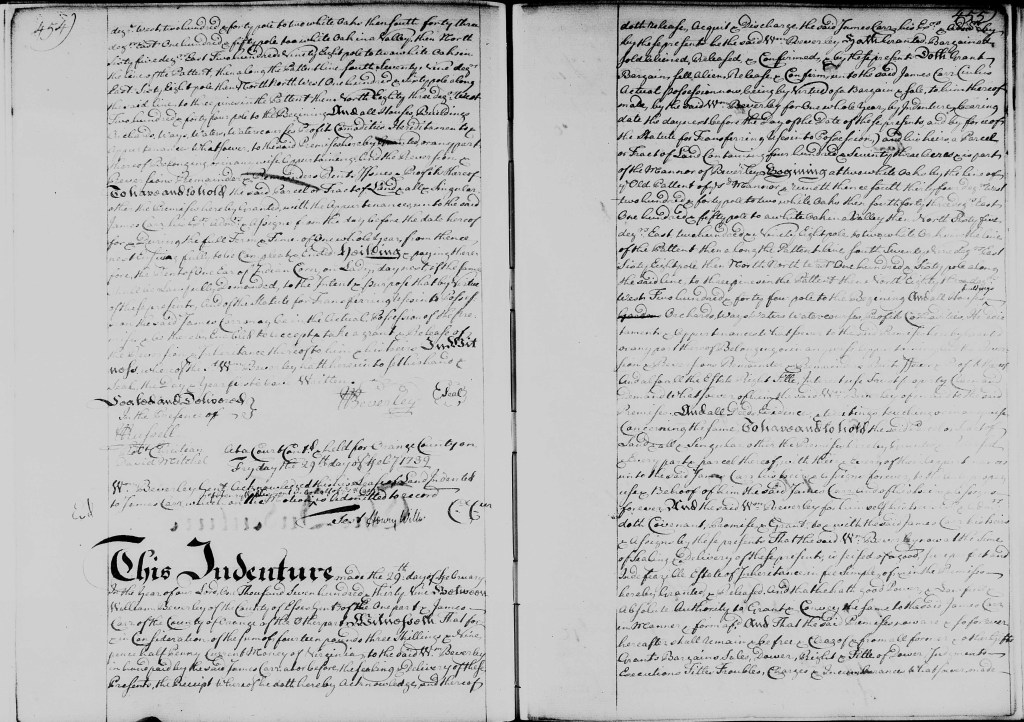
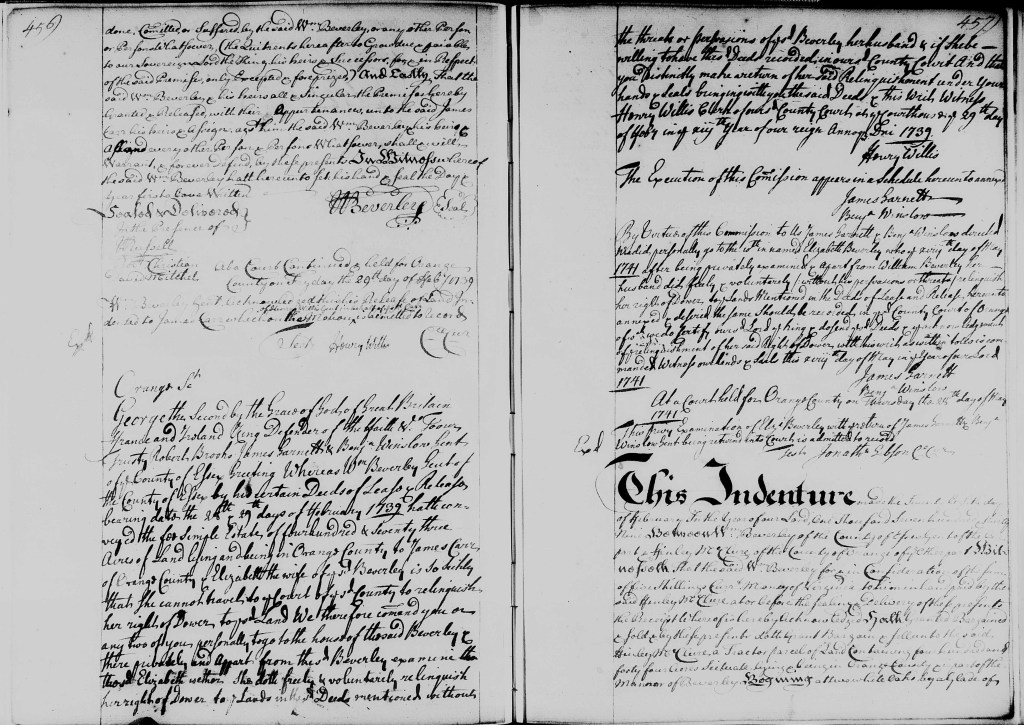
On 29 February 1739, William Beverley of Essex County, Virginia, deeded to James Carr of Orange County for ₤14 3s 9½p current money 473 acres, part of “the Mannor of Beverley.”[4] The deed notes that the land was at the beginning point of the line of the original 1736 survey made for Beverley Manor. Citing Vincent Brown Kerr, who says (as a previous posting has noted) that a strong tradition in the Kerr family of Augusta County insists that James Kerr preceded John Lewis to this region, Howard McKnight Wilson thinks that James had settled on this land at the juncture of Christian’s Creek, Long Meadow Run, and Middle River “around 1730.”[5]
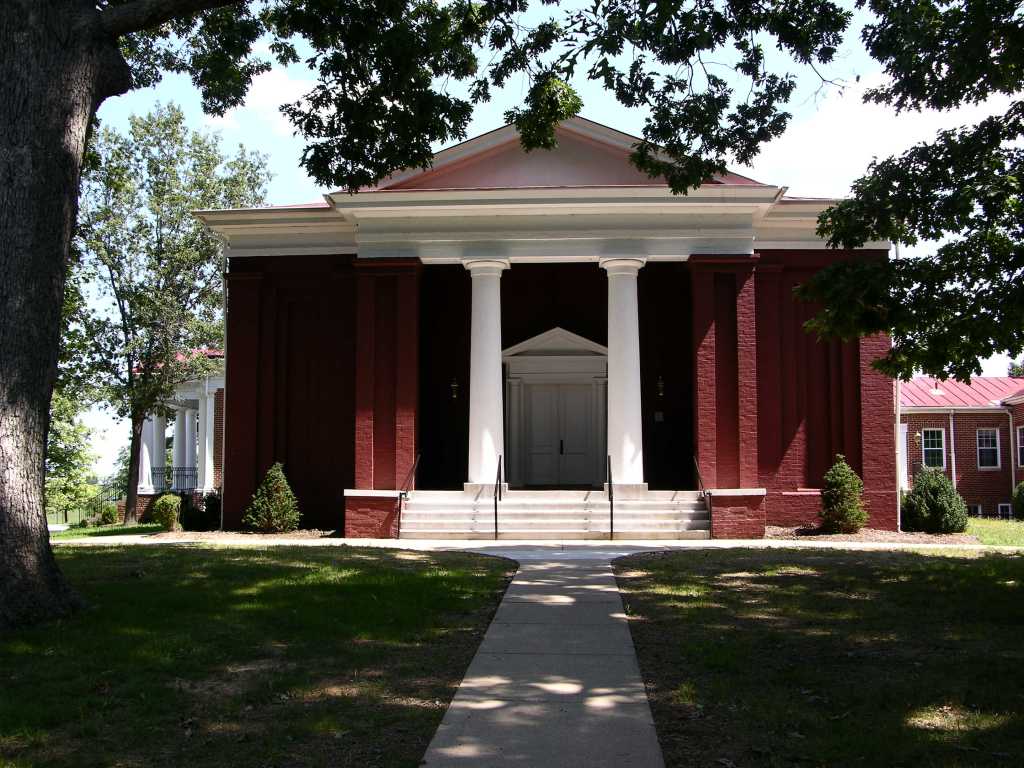
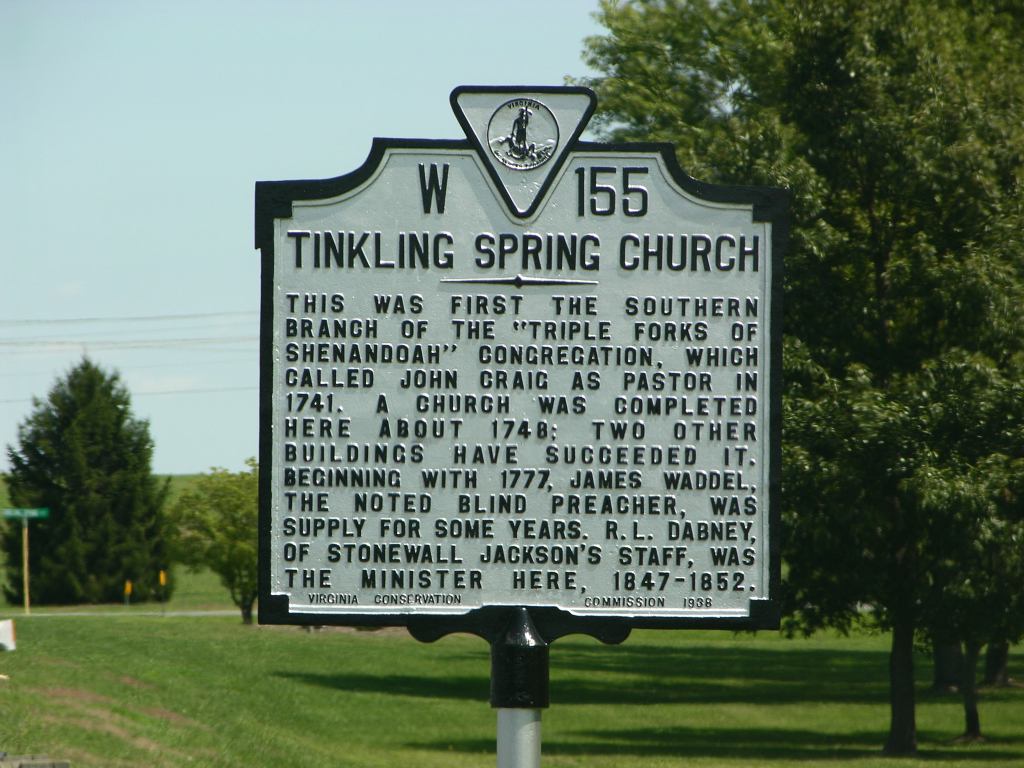
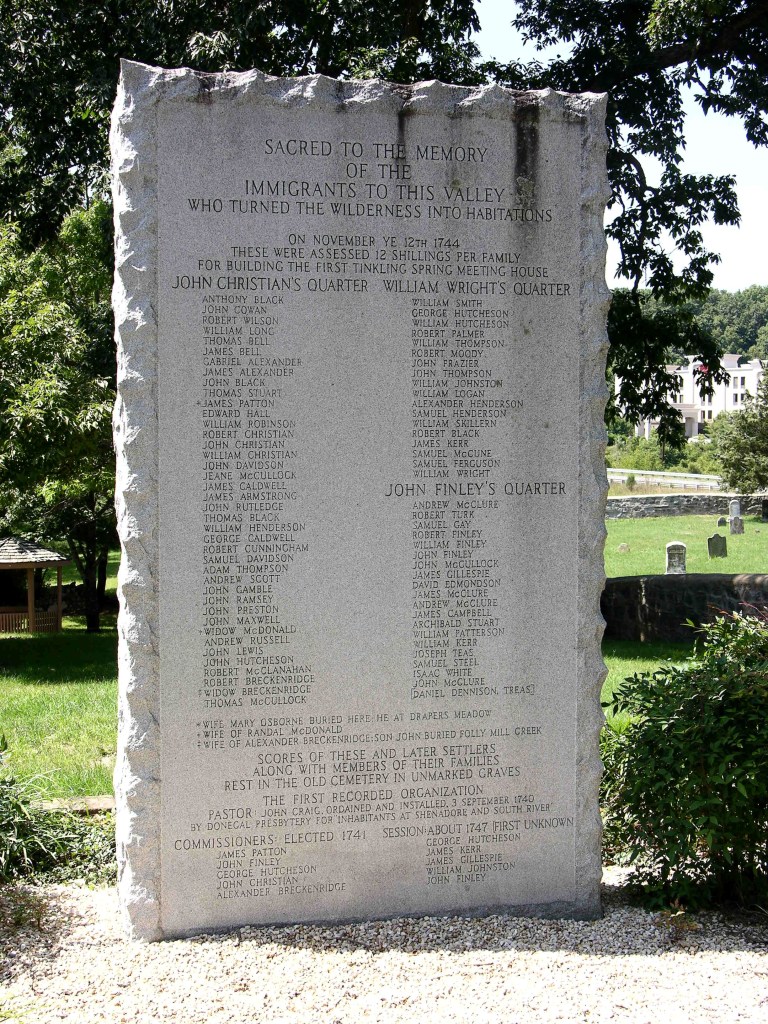
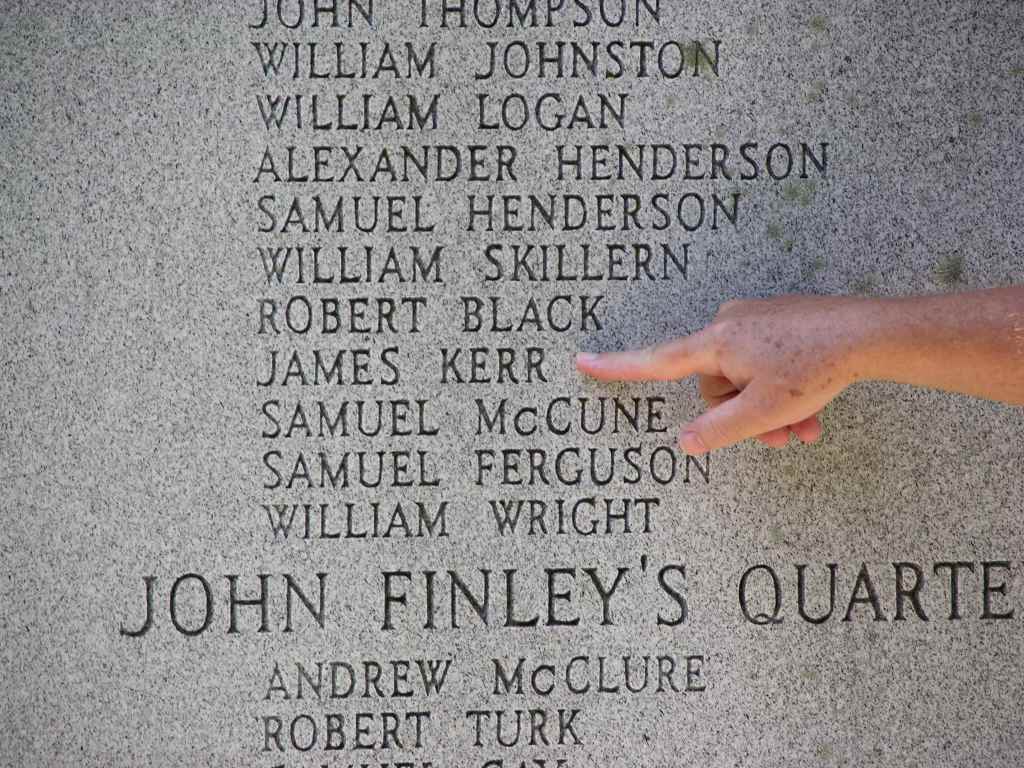
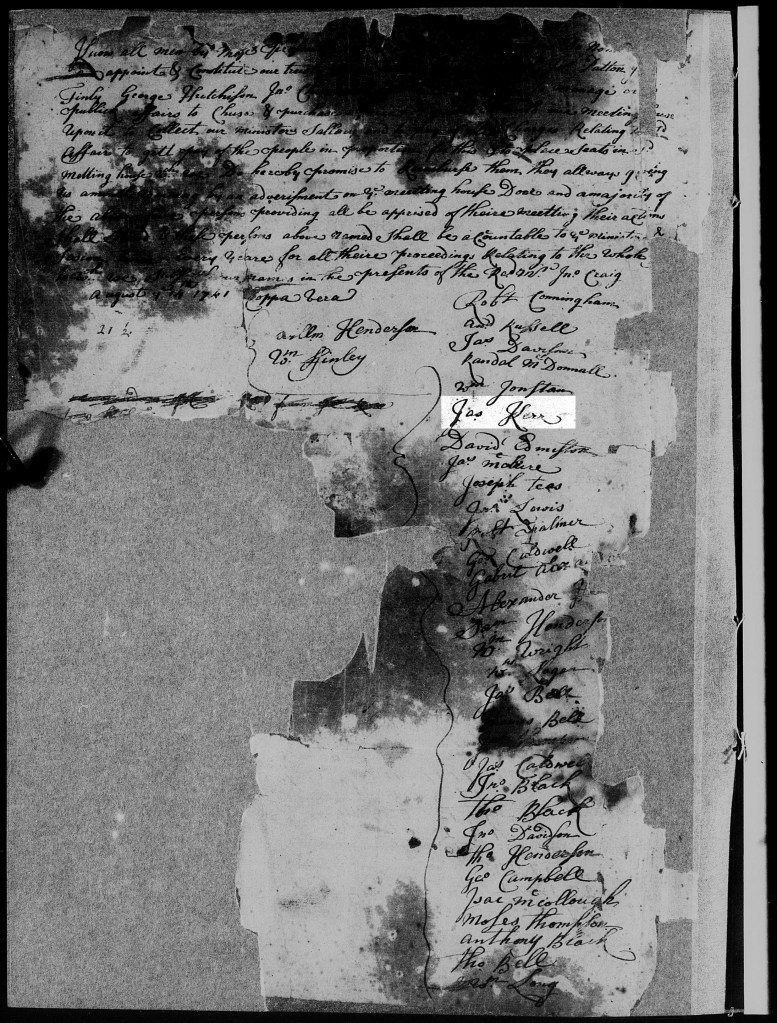
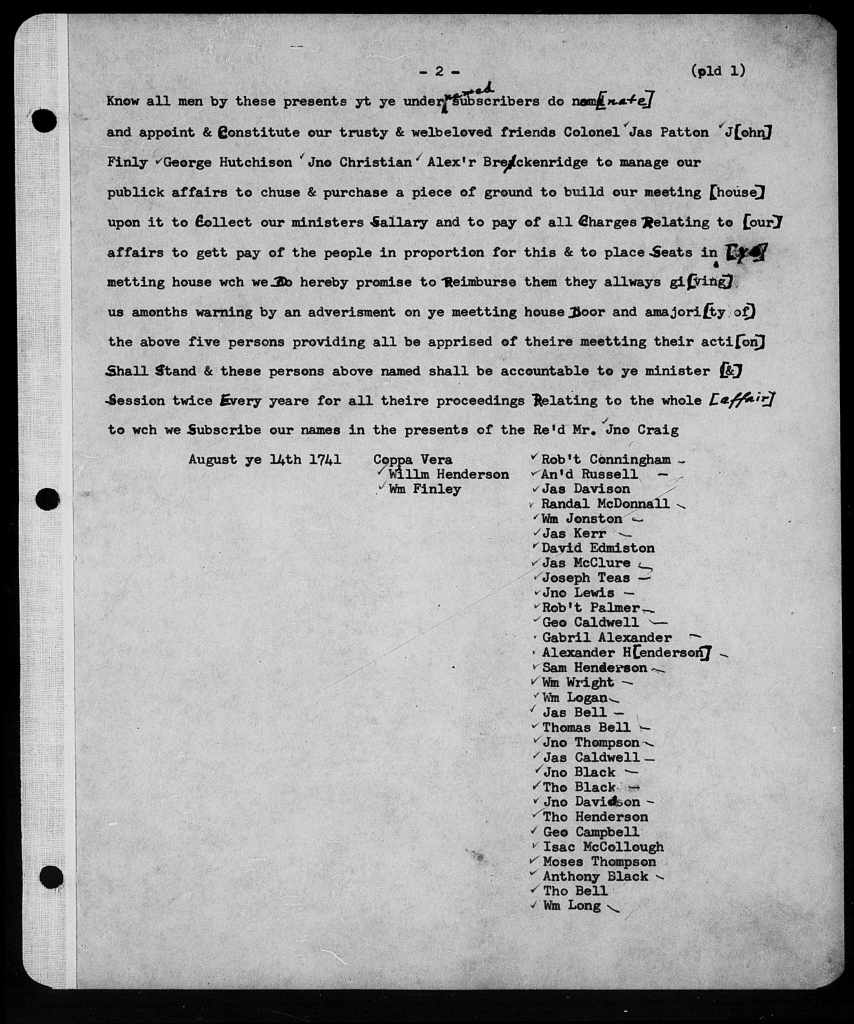
E.M. Sharp notes that members of the Pickens family had arrived in Orange (later Augusta) County, Virginia, prior to 1740.[6] By 1741, this family appears in the records of the Stone Presbyterian church eight miles north of Staunton, which was founded in 1740 at present-day Fort Defiance. Both the Stone and Tinkling Spring churches were established by the congregation of the Triple Forks of the Shenandoah in 1740, both being served by Reverend John Craig. The Triple Forks of the Shenandoah congregation was formed in 1738 at the home of John Lewis. On 2 September 1740 at Donegal, Pennsylvania, the Donegal Presbytery by imposition of hands sent Reverend John Craig to “ye work of ye holy ministry in ye Congreg’n on ye South part of Beverly Mannor in Virginia.” A log meeting house was built in 1744 and a stone church in 1792.[7] James Kerr was among the subscribers to the 14 August 1741 authorization of James Patton and others to build a Presbyterian meeting house at Tinkling Spring in Augusta County, Virginia.[8]
John Lewis was born 1 February 1678 in County Donegal, Ireland, son of Andrew Lewis and Mary Colquhoun.[9] John Lewis married Margaret Lynn (the maternal aunt of James Patton) in 1715 in County Donegal. She was born on 3 July 1693 in County Donegal and was the daughter of William Lynn and Margaret Patton.[10] Lewis arrived in Philadelphia by 1729, having killed his landlord in Ireland, and after spending brief time in Lancaster County, Pennsylvania, by 1732 he settled near what became Staunton in Augusta County, the county seat, which he founded.[11]
As was his uncle John Lewis, James Patton (1692-1755) was a native of County Donegal, Ireland. For some years, he was master of a merchant vessel bringing immigrants from Ireland to the colonies. Under Lewis’s influence, Patton became interested in land speculation in Virginia and formed close ties to William Beverley. In February 1738, he acquired from Beverley 474 acres in Beverley Manor. Patton eventually ended up with the 100,000 acres originally surveyed in Orange (later Augusta) County by John Smith, Zachary Lewis, William Waller, Robert Green, and Benjamin Waller. After settling in Augusta County, Patton became county lieutenant, sheriff, collector of revenues, and burgess. He was a trustee of Tinkling Spring church. In July 1755, Patton was killed by Native Americans in Draper’s Meadows.[12]
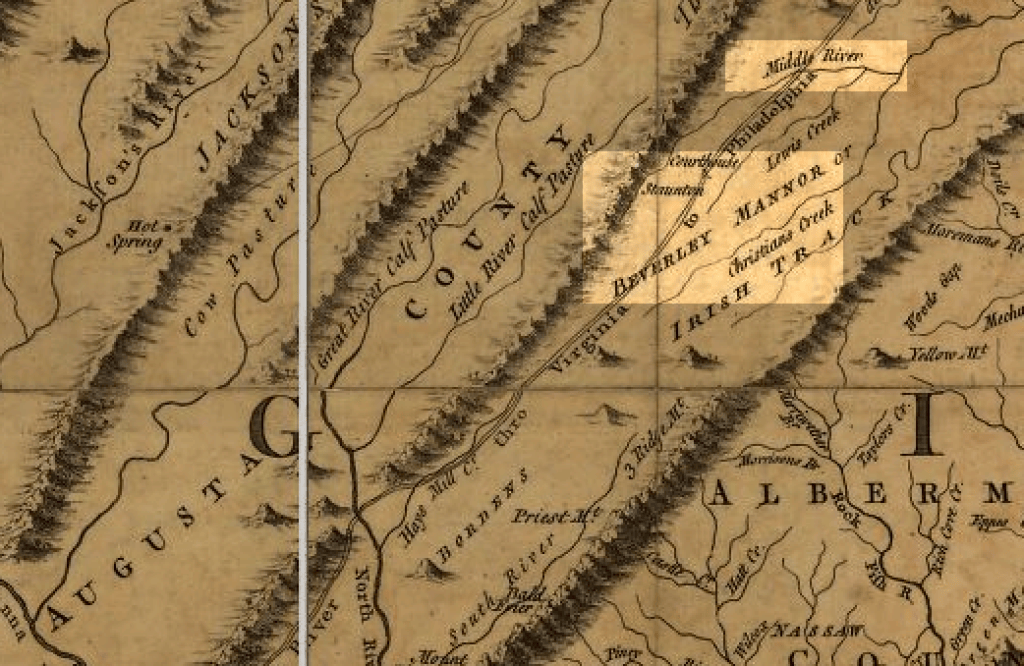
As I’ve noted previously, citing a strong family tradition that James Kerr arrived in Orange (later Augusta) County before John Lewis, Tinkling Spring historian Howard McKnight Wilson says that around 1730, the family settled at a choice spot at the juncture of Christians Creek, Long Meadow Run, and Middle River.[13] A log home built by the Kerrs that was still standing into the early 1970s was at the beginning point of the initial 1736 survey made for the Beverley Manor lands out of which all settlers of the area obtained their titles. Wilson also notes that James Kerr took a leadership role in the earliest records of the Tinkling Spring church and county organizations.[14]
In August 1936, the Staunton News-Leader reported that what was believed to be the first cornerstone setting the boundaries of Beverly Manor had been discovered by W.L. Kerr at the old Kerr home property near Laurel Hill.[15] The article states that James Kerr preceded John Lewis to this area by several years. It says,
James Kerr with his wife and possibly one son and some livestock arrived here in 1730 and built a cabin in the low ground, a dam, and mill in 1731 (presumably), and the log semi-blockhouse in 1732 (George Washington’s natal year.) The log house with its large stone chimney and stone cellar steps is still standing and occupied today. …
The Kerrs of this section of Augusta are all descended from the first settler here, James Kerr….
Vincent Brown Kerr notes that after initially acquiring 473 acres from William Beverley in 1739, James Kerr then bought tracts of 350 acres and 280 acres in 1764, all on Long Meadow Run.[16] As we’ll see with more detail later on, not long before his death, James Kerr sold the entire 1,103 acres in 1764 to his son-in-law, husband of James’s daughter Letitita/Lettice, William Robertson. Vincent Brown Kerr also notes that James Kerr entered 400 acres in 1748 adjoining his son William, and he later entered tracts of 230, 130, and 127 acres near Middle River and New Hope.[17] In 1747, he had 250 acres surveyed at Flag Spring, New Hope.
The Kerr House
The house that James Kerr built between 1730 and 1740 on the corner of his Beverley Manor survey was a log house with a wide rock chimney, a fireplace large enough to accommodate logs eight feet long, and a double-thick door. According to Vincent Brown Kerr, it was still lived in by members of the Kerr family in 1930.[18] In her history of the house written in 1972, Gladys B. Clem states that it was sold out of the Kerr family in 1953, and had been lived in continuously by family members up to that date.[19] The house was on the south bank of Middle River of the Shenandoah, overlooking Middle River 150 yards from where Christians Creek, Long Meadow Run, and Middle River join at the start of the Beverley Manor survey.[20] Just south of the house on Christians Creek was a mill belonging to James Kerr.
Vincent Brown Kerr reproduces a photo of the Kerr House taken about 1880, and a 1909 photo of the house by J.R. Hildebrand is online at the website of the O. Winston Link Museum, the History Museum of Western Virginia.[21] Gladys Clem’s article about the house also contains photos by David Bushman that appear to date from the early 1970s, along with a sketch of the house done by Joe Nutt in 1952.[22] (See the head of the posting for a digital image of Joe Nutt’s drawing.) The Kerr house is no longer standing.
Augusta County Records
What follows is a chronological survey of records for James Kerr in first Orange, the parent county of Augusta, and then Augusta County, Virginia. Augusta was formed in 1738, but court records were still maintained in Orange up to the mid-1740s as the new county got organized and on its feet. This survey of records for James Kerr is not exhaustive, but gathers what seem to me among the most important records for him in Augusta (and Orange) Counties.
• “Around 1730”: as stated previously, a number of historians including Howard McKnight Wilson and researchers including Vincent Brown Kerr think this is when James Kerr arrived in Orange (later Augusta) County, settling at the juncture of Christians Creek, Long Meadow Run, and Middle River, which was previously called Cathey’s River.
• 11-12 August 1736: as stated above, on 14 August 1936, the Staunton News-Leader reported that what was believed to be the first cornerstone setting the boundaries of Beverly Manor had been discovered by W.L. Kerr at the old Kerr home property near Laurel Hill.[23] This article states,
Sir William Beverley came from Essex County by way of Williamsburgh, the then capital of Virginia, to survey a domain and to apply to King George II for a patent. Tradition and history show that he spent two nights with Justice James Kerr in the new log house (then only four years old), presumably the nights of Aug. 11 and 12, 1736. The planting of the first corner-stone of Beverley’s Manor bears date of Aug. 1, 1736, “lying and being in the county of Orange, beyond the great mountains, on the River Sherando, containing 118,491 acres.”
• 29 February 1739: as noted previously, on this date, William Beverley deeded to James Kerr the tract of 473 acres in Beverley Manor that were James’s home tract in the years in which he lived in Augusta (previously Orange) County, evidently from 1730 forward.[24]
• 27 March and 24 July 1740: James’s son John Kerr (who married Lucy Pickens [Gillespie]) and John Pickens (who married John Kerr’s sister Eleanor Kerr) made Orange County headright claims.[25] John Pickens settled just above James Kerr on Meadow Run on the east side of Cathey’s River (i.e., Middle River) in Beverley Manor. John Kerr settled above John Pickens west of Cathey’s River in Beverley Manor. Both were evidently already living in this location near James Kerr prior to filing their headright claims.
• 14 August 1741: as noted previously, James Kerr was among subscribers to a petition on this date for the authorization of James Patton and others to build a Presbyterian meeting house at Tinkling Spring in Augusta County.[26]
• 13 April 1742: a list of charter members of Tinkling Spring Presbyterian church includes James Kerr. John Cear is listed on this document as one of the commissioners of the church along with James Patton. An undated list of church members that seems perhaps to date from the 1740s shows James Carr at the top of the list with George Hutchinson, and also Andrew and William Carr. Another undated list from the same period “entitled Money for the Meeting House” shows Andrew and William Kerr listed, both for £1 4s.[27]
• 30 July 1742: John Carr had a grant of 400 acres in “Orange County designed to be called Augusta” on both sides of Cathey’s River adjoining the Beverly Manor line, with this 400-acre tract adjoining James Carr.[28]
• 1743: an April 1808 deposition of Benjamin Stuart in the Augusta County case of Beverley vs. Hutchison states that the land about which the litigation was contending had been lived on by William and Andrew Carr 65 years ago (i.e., 1743). Benjamin Stuart was 72 in 1808. Alexander Stuart testified that about 1742, when he was a small boy, his father came into the neighborhood and settled there. The two Carrs, both sons of James Kerr, it appears, were living on the land at the time.[29]
• 7 July 1743: a list of deeds recorded in Orange County’s district court and abstracted by Lyman Chalkley includes a deed bearing this date executed by Benjamin Borden to John Carr.[30]
• 16 January 1744: the Orange County will of William Skillern bequeaths to his son William 300 acres adjoining land of James Carr, land on which William Skillern was living.[31]
• 10 February 1745/6: Daniel Griffiths, committed by James Kerr for stealing a horse from Edward Franklin of Orange County, was acquitted in Augusta County.[32]
• 18 April 1745: Jacob Ker of Augusta County made a will recorded in Orange County.[33] The will was probated 22 August 1745. The will makes bequests to Reverend John Craig, Charles Lewis, son of Col. John Lewis, William Hutchison, son of John Hutchison, George Hutchison, Eleanor Hutchison, wife of George Hutchison, Margaret Spear, Margaret Pickens, William Henderson, Gabriel Home, Daniel Craig, and Jacob Ker’s brothers David and Hugh Ker. George Hutchison and William Henderson were executors, and witnesses were Andrew Russell and William Lewis.
On 24 July 1740 in Orange County court, George Hutchison made oath that he had imported from Ireland himself, wife Eleanor, Jennot, Francis, John, and William Hutchison and Jacob Carr to Philadelphia and then to Virginia.[34] (Jennot seems to be listed twice).
A deed made by George Rodgers and wife Elisabeth to Robert Rodgers of Augusta County and Robert Wallace, of Lancaster County, Pennsylvania, on 22 April 1763 for two tracts in Beverley Manor notes that the first tract of 540 acres conveyed by Beverley to George Rodgers on 28 February 1749 bordered Cathey’s River, Christians Creek, and Jacob Carr’s corner. The second tract of 135 acres bordered Christians Creek and George Hutchison.[35]
Note that the preceding deed places Jacob Kerr’s land close to James Kerr and members of James Kerr’s family. It seems likely, I think, that there was some kinship connection between Jacob Ker(r) and James Kerr. The Margaret Pickens to whom Jacob made a bequest was almost certainly Margaret Pike Pickens, widow of William Pickens, several of whose children married children of James Kerr. The 24 July 1740 headright claim that John Pickens made in Orange County (the same date on which George Hutchison made his headright claim) shows that John brought his mother Margaret to Virginia. Margaret was evidently living with her son John Pickens in 1740.
On 13 June 1746, John Kerr witnessed deeds of George Hutchison/Hutchinson and Eleanor his wife to Samuel and Alexander Henderson for Beverley Manor land on Long Meadow Run.[36] George Hutchison’s Beverley Manor land was just down Long Meadow from James Kerr’s home tract of 473 acres.
As noted above, an undated list of church members in the Tinkling Spring that seems to date from the 1740s shows George Hutchinson’s name at the top of the list along with James Carr’s name.[37] The previously cited 14 July 1741 petition for a meeting house to be built for the Tinkling Spring congregation commissioned George Hutchinson among others including James Patton and John Christian to manage the gathering of funds and church construction.[38] The role played by George Hutchison, who brought Jacob Kerr from Ireland to Pennsylvania and then Virginia, in the Tinkling Spring congregation helps explain why Reverend John Craig was a legatee of Jacob’s will. I’m inclined to think that there was a kinship connection between George Hutchison and Jacob (and James) Kerr, and that George’s wife Eleanor may have been a Kerr.[39]
Andrew Russell, another legatee of Jacob Ker, witnessed the 29 February 1739 deed of William Beverley to deed James Kerr for land in Beverley Manor.[40] When John Kerr and wife Lucy sold land to John Allison in Augusta County on 21 May 1761, Andrew Russell witnessed the deed along with William Kerr and Edward Rutledge. The deed states that the land bordered Andrew Kerr.
• 24 May 1745: James Carr was made an overseer of the road between the mountains above Thompson’s ford and Tinkling Spring in Orange (later Augusta) County.[41] Court minutes state “that James Cathey and James Carr be Overseers of that Part and that all the Inhabitants between the mountains above Thompson’s Ford & Tinkling Spring do clear the Same and that the said Road continue from Tinkling Spring to Beverley Manor line.”
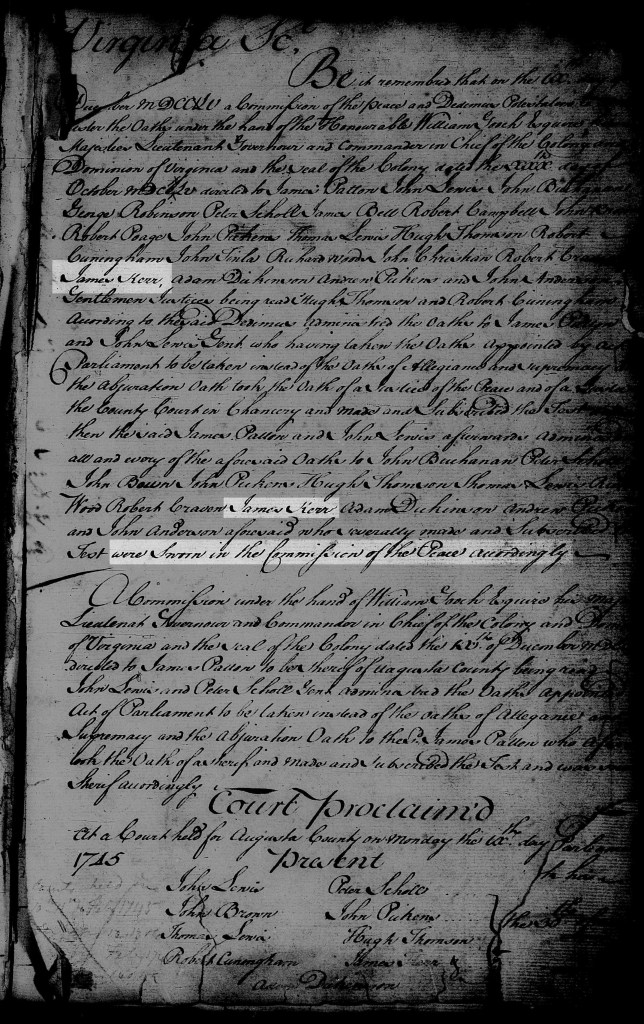
• 30 October 1745: James Kerr was on the list of the first magistrates in Augusta County, along with his son Andrew and son-in-law John Pickens.[42]
• 23 March 1746: a court judgment by Peter Scholl and James Montgomery in the commissioners’ book of Tinkling Spring church shows a judgment ordering Andrew Kerr to pay £1 7½p due for John Craig’s stipend and William Kerr to pay the same for the balance due for building the meeting house.[43]
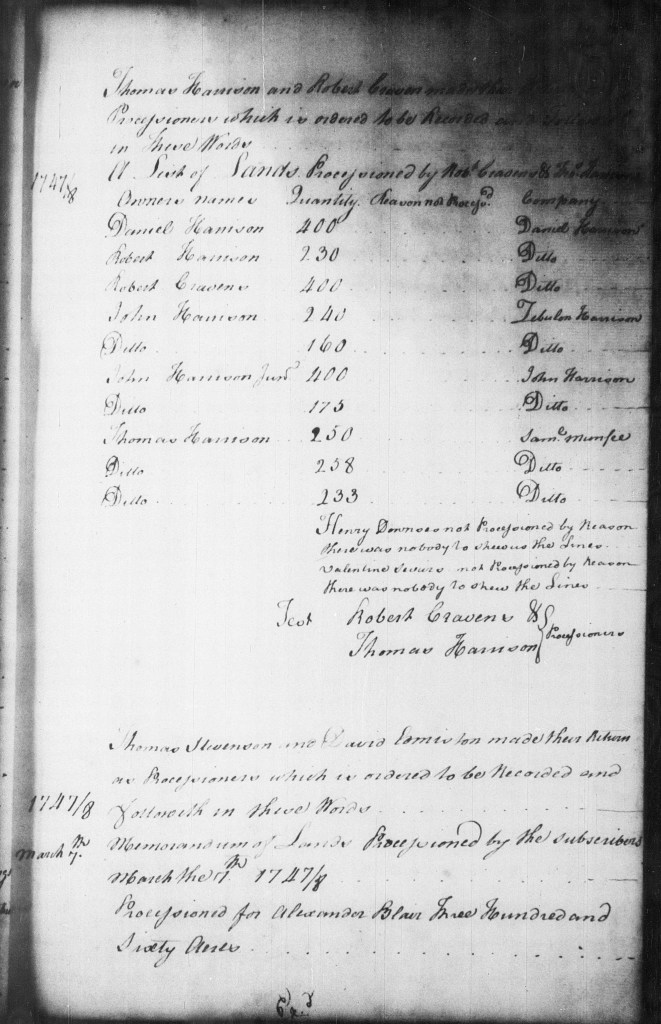
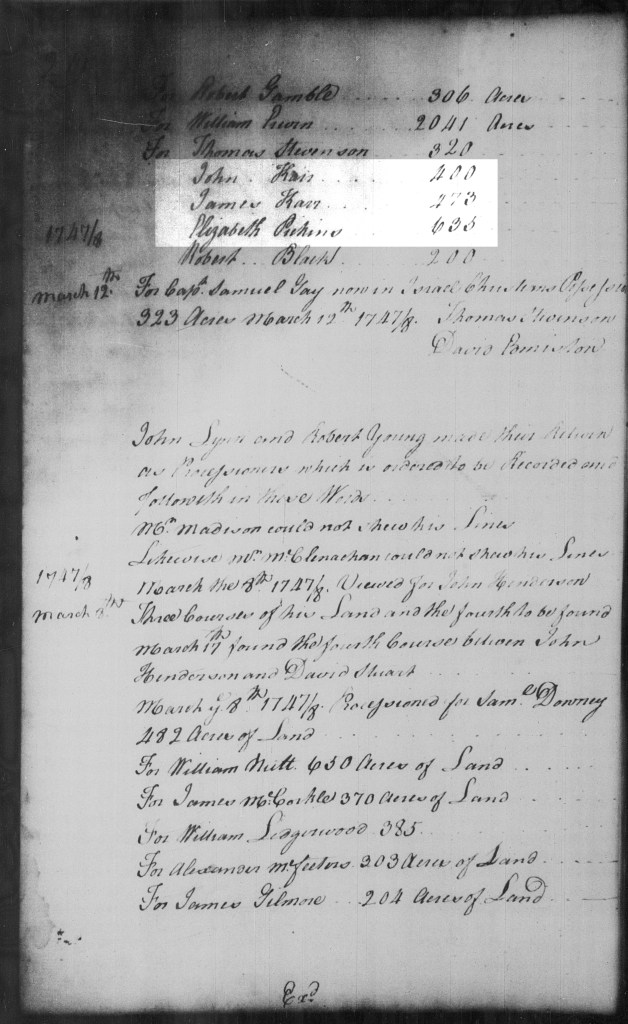
• 7 March 1747: the Augusta Parish vestry book shows Thomas Stevenson and David Edmiston reporting that they had processioned the land of John Karr, James Karr, and Elizabeth Pickens.[44]
• 21 May 1747: James Kerr was presented to the Augusta County grand jury on word of Samuel Norwood, James Young, and John Peter Norwood for being a “Disturber of the Common Peace of the Neighbors by carrying Lies and as a comon Lyer.”[45]
• 19 June 1747: James Kerr was presented to the Augusta County grand jury on information of James Young for being a Sabbath breaker.[46] There appears to have been contention between members of the Young family and James Kerr. Court minutes for 18(?) September 1747 show a case, Robert Young vs. James Kerr, for slander, being continued.[47] On 30 November 1747, James pled not guilty to the charge and the case was continued for next court.[48] Later court minutes in show this case being continued on 2 March 1748 and 31 August 1750.[49]
• 10 March 1748: James Kerr is listed in the commissioners’ book of Tinkling Spring church as an elder of the church in minutes about the activities of some people in the vicinity to set up a separate meeting house in addition to the Tinkling Spring church, to which the elders objected.[50]
• 23 June 1748: as noted previously, the first Augusta County land entry book shows James Kerr entering 400 acres of land on this date, between his son William’s land and Beverly Manor.[51] This land was patented on 20 June 1749, with a grant of 325 acres on Broad Creek, a branch of the Buffalo, in December 1749.[52] He sold this land in February 1751 to John Beatty.[53]
• 17 May 1750: James Patton sold James Carre, late of the province of Pennsylvania, county of Lancaster, 474 acres in Beverley Manor.[54] I discussed this deed in the previous posting, noting that James Kerr (Care is the spelling used in the deed) sold this land on 17 August 1762, with the deed stating that he was living in Rowan (Roan in the original deed) County, North Carolina.[55] Since James Kerr, progenitor of the Augusta County Kerr family, did not live in Rowan County, North Carolina, at any point in his life, insofar as I’ve discovered, I think the James Kerr of these land transactions was the grandson of James the progenitor, a son of John Kerr and Lucy Pickens, who did settle in Rowan County, North Carolina.
• 20 May 1752: Elizabeth Perkins and sons George and William Skillern were bound to peace towards James Carr by Augusta County court.[56] Note that the 16 January 1744 will of William Skillern cited above states that William’s son William was living on land adjoining the land of James Kerr.[57] J.R. Hildebrand’s map of the original grantees in Beverley Manor shows William Skillern (elder) with 635 acres he acquired in 1741 on Long Meadow Run adjoining James Kerr’s 473-acre tract on the south.[58] On the Skillern family, see this previous posting.
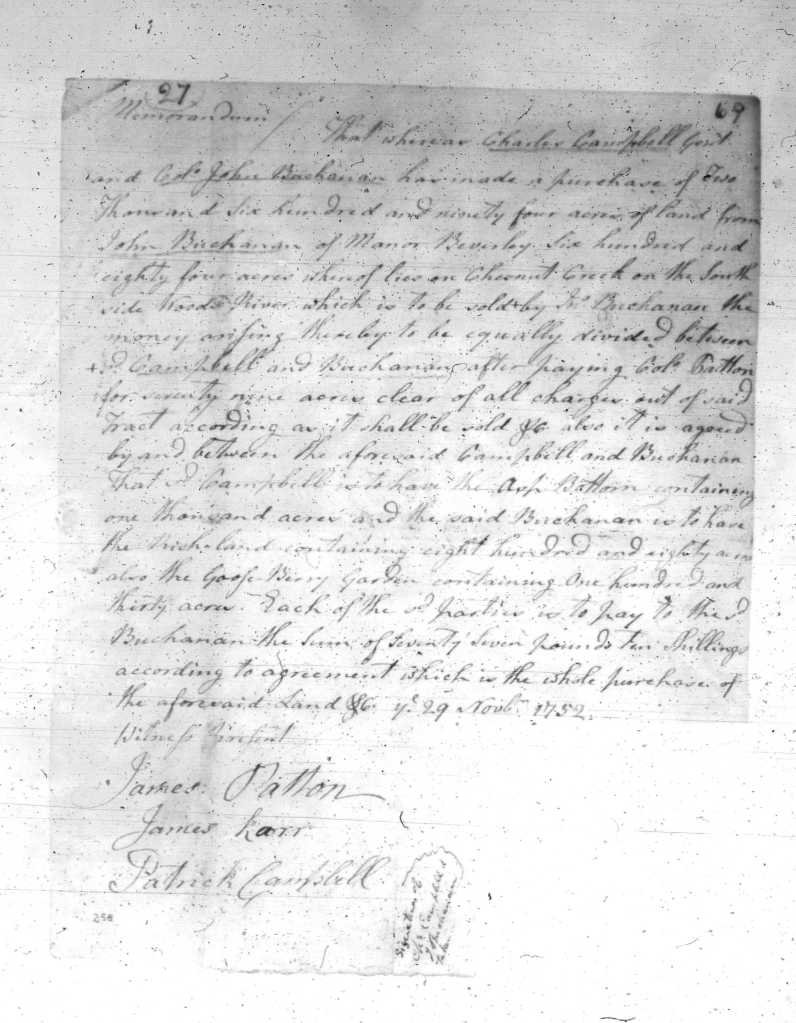
• 29 November 1752: James Kerr witnessed an agreement of Charles Campbell and Colonel John Buchanan about 2,694 acres in Beverley Manor purchased by them from John Buchanan of Beverley Manor. Colonel James Patton was to receive payment for 79 acres. Other witnesses were James Patton and Patrick Campbell.[59]
• October 1753: in an appraisal compiled 17 February 1758 by Thomas Stewart, John Ramsay, and Edward Hall, a list of debts to the estate of James Patton contains a debt of James Kerr to Patton dated October 1753.[60]
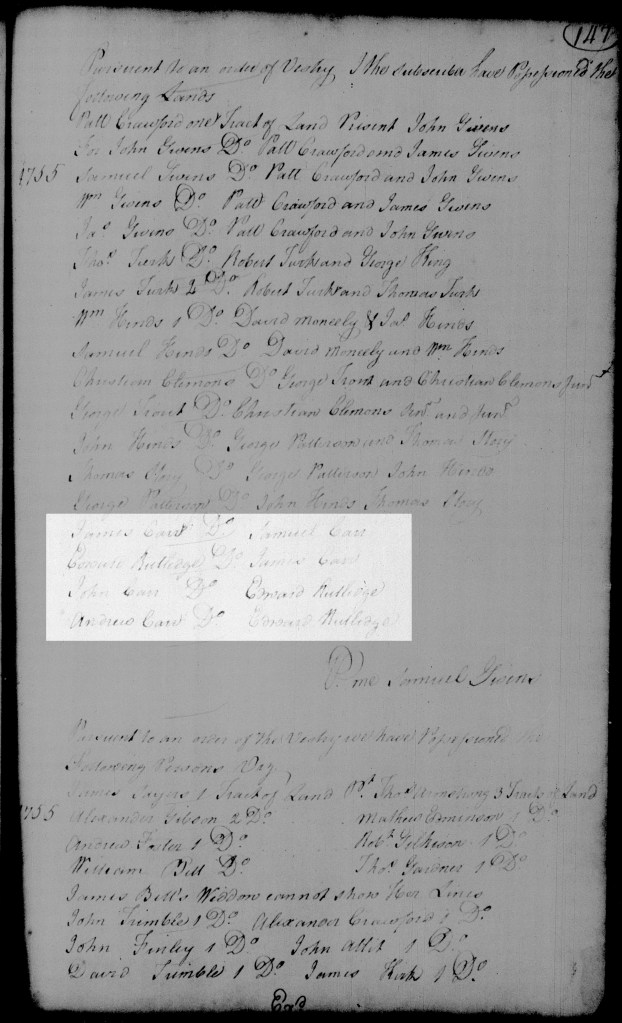
• 1755: Samuel Givens processioned the Augusta County land of James Carr, Samuel Carr, John Carr, and Andrew Carr.[61] This processioning record indicates that these Carr men all lived and/or held land in proximity to each other at this time.
• 1755: James Kerr appears in an Augusta County delinquent tax list of Robert Breckinbridge along with John Keer, Samuel Carr, and Andrew Carr.[62]
• 26 April 1760: bond was given by defendants in the suit of Samuel Bell vs. James Kerr of Cumberland County, Pennsylvania. The bondsmen were evidently John Hind and Edward Rutledge.[63] Since this is a record abstracted by Chalkley in his Chronicles of the Scotch-Irish Settlement in Virginia and the original record is not accessible via filmed and digitized images at FamilySearch, I’m not totally clear as to whether Chalkley means that it was Samuel Bell and not James Kerr who was of Cumberland County, Pennsylvania.
A debt case of James Kerr vs. Samuel Bell and James Hamilton appears in Augusta County court records in the 1760s. On 23 February 1761, court minutes say that Bell had been arrested (or an order for his arrest was issued), with an alias capias granted to Kerr.[64] On 21 August 1762, this suit was continued in court and it was continued again on 23 September 1763.[65] On 22 August 1764, judgment was rendered against Bell and Hamilton, with the court ordering them to pay 621 pounds of tobacco and James Kerr’s court costs.[66] Chalkley abstracts the loose-papers file for the court judgment, stating that the judgment was conditioned on the obligation of Bell and Hamilton to sell land on Christians Creek to James Kerr.[67]
• 16 February 1761: Samuel Bell and wife Margaret sold to James Kerr, blacksmith, all of Augusta County, 300 Acres in Beverley Manor at the mouth of Christians Creek on the southeast side of Middle River bordering the fork of Long Meadow Run.[68] The deed says that the land was already in possession of James Kerr by an agreement he and Samuel had previously made, and that the land bordered James Hamilton. If I’m reading the deed correctly, the deed was not delivered to James Kerr (or his estate?) until 10 June 1771. So James Kerr’s litigation with Bell and Hamilton appears to have something to do with this land sale.
Previously, 18 August 1759, James’s son John Kerr of Rowan County, North Carolina, had sold land to James Hamilton, on Middle River at the mouth of Christians Creek between Long Meadow Run and Christians Creek, with a James Kerr who was either John’s father or son of the same name witnessing.[69] See the 17 March 1764 deed below noting that John Kerr sold James Hamilton 180 acres, which he then conveyed to George Skillern, with George selling James Kerr an acre and a bit more of this land in March 1764.
John Hind, who gave bond with James Kerr in April 1760, was John Kerr’s son-in-law. He married Jean/Jane Kerr, daughter of John Kerr and Lucy Pickens. The other bondsman, Edward Rutledge, appears in many records of this Kerr family in Augusta County.
• 17 February 1761: James Kerr’s hog and cow mark and horse brand were recorded in Augusta County court.[70]
• 19 May 1761: a James Kerr who is either this James or the son of John Kerr witnessed the deed of John Kerr to William Mathers in Augusta County.[71]
• 23 February 1762: a survey was made of 127 acres for James Carr between Pickens? (the survey is smudged) and Edward Rutledge.[72]
• 17 March 1764: George Skillern and wife Elizabeth sold James Kerr, all of Augusta County, an acre of land plus three roods and ten poles in the forks of Christians Creek and Middle River, part of 180 acres granted to John Kerr by patent dated 5 September 1748 and conveyed by him to James Hamilton, who sold to Skillern.[73] John Anderson, Robert Wilson, and William Kerr witnessed this deed, which was acknowledged 20 June 1764 and recorded.
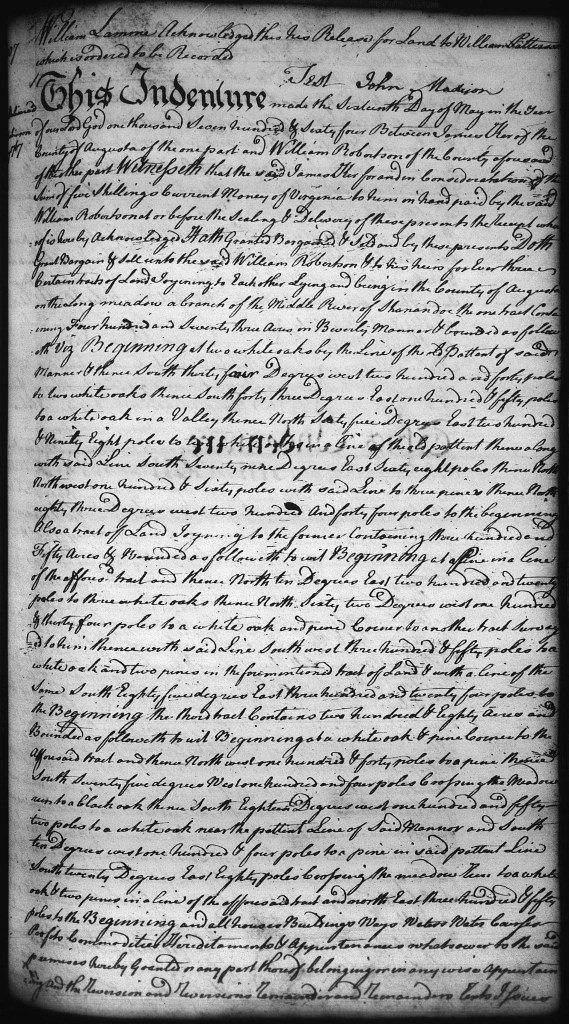
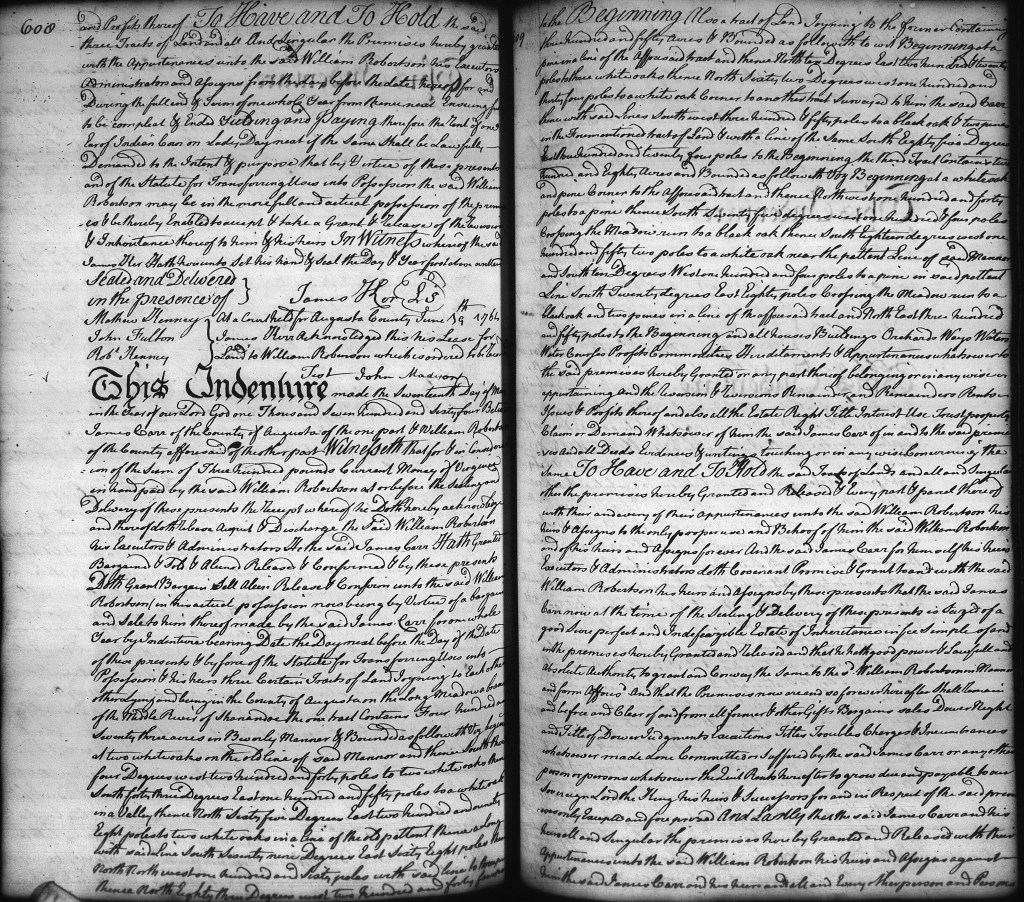
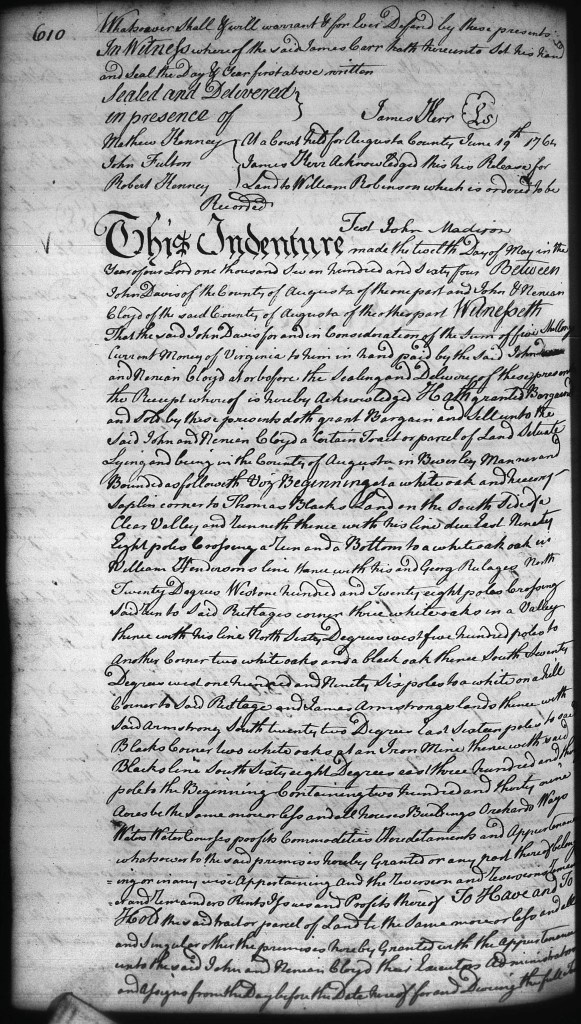
• 16 May 1764: James Kerr sold William Robertson, both of Augusta, 473 acres on Long Meadow, a branch of Middle River on the line of old patent of Beverly Manor, 350 acres adjoining it, and 250 more acres.[74] James Kerr signed. The deed spells the surname as Carr. Witnesses were Matthew Kenney, John Fulton, and Robert Kenney. James acknowledged the deed on 19 June 1764 and it was recorded.
William Robertson was the husband of James’s daughter Letitia/Lettice.[75] Not long before his death, then, James Kerr sold his homeplace and land to his daughter and son-in-law. Letitia was the youngest of James’s daughters, and she was, as far as I can determine, the only child remaining in Augusta County at this point. James would have been up in years and possibly growing infirm, and it appears to me he was relying on Letitia and her husband to provide care for him in his final years.
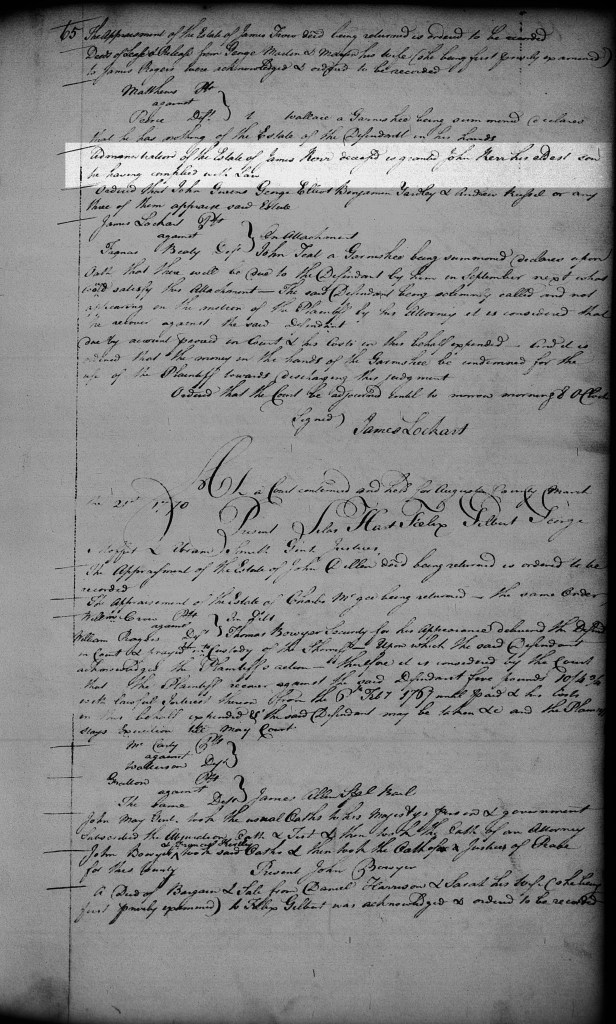
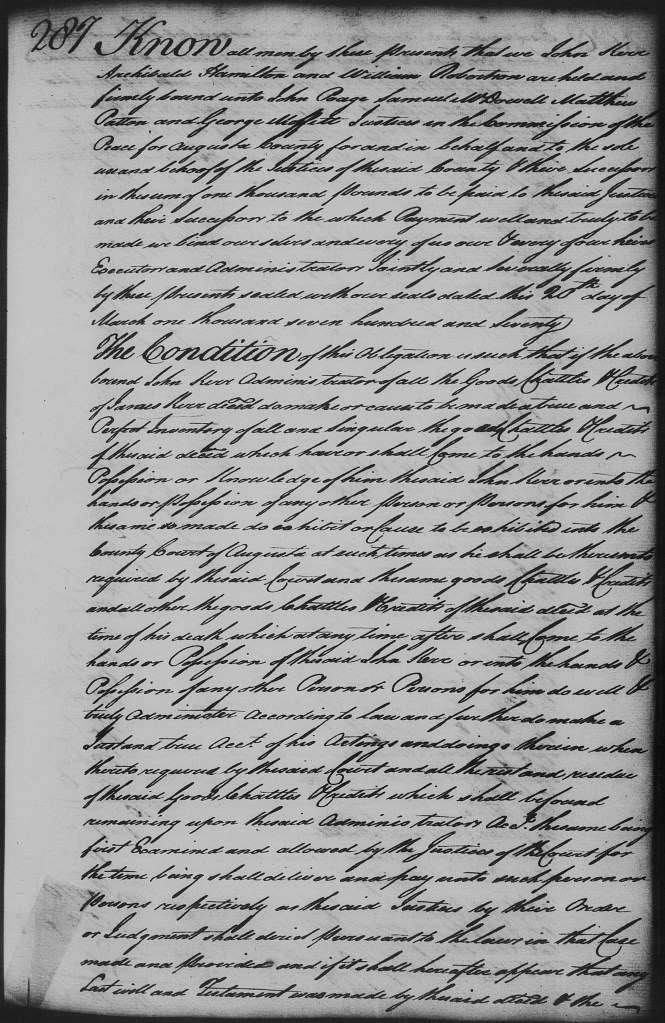
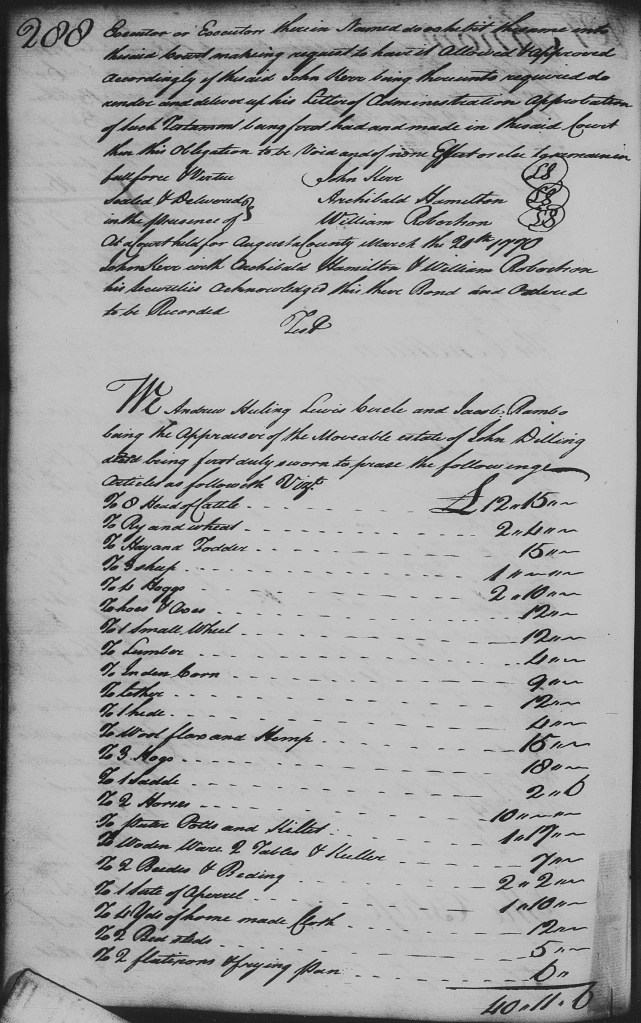
• 20 March 1770: John Kerr appealed for administration of James Kerr’s estate in Augusta County.[76] The court minutes state that John was James’s eldest son and was granted administration. On 23 March 1770, John Kerr gave in the amount of £1,000 bond with securities Archibald Hamilton and William Robertson.[77]
As a previous posting notes, Archibald Hamilton (1704-1794) married Frances Calhoun, who is apparently of the same Calhoun family into which James Kerr’s grandson Samuel Kerr married.[78] Noting that both Archibald and wife Frances were born in Ireland about 1705, Brian Anton states, “Frances’s ancestry is not documented, but based on religion, migration patterns, and proximity, researchers have suggested that she was a close relative of Patrick Calhoun Sr. (ca. 1683-1741), the grandfather of US Vice President John C. Calhoun.”[79]
• 1772: Augusta County Fee Book shows a James Kerr either with land in Pennsylvania or residing in Pennsylvania and holding land in Augusta County.[80] Note that the date seems to indicate that this is another James, unless this is an estate record in the year following JK’s death.
Noting that James Kerr was one of the original panel of magistrates in Augusta County, Donnell MacClure Owings refers to him as “the Civilizer of the Border.”[81] The designation “Civilizer of the Border” perhaps fits James Kerr due to his role in pioneering settlement of Augusta County and setting up the Tinkling Spring church, but it was actually given to Colonel William Lewis, son of James’s contemporary and fellow pioneer settler John Lewis.[82]
[1] Vincent Brown Kerr, Brief History of Kerrs and Kin, 1730 to 1930 (Staunton, Virginia, 1930), p. 8.
[2] Robert Ramsey, Carolina Cradle (Chapel Hill: University of North Carolina Press, 1964), pp. 142-3, citing also Howard McKnight Wilson, The Tinkling Spring, Headwater of Freedom: A Study of the Church and Her People, 1732-1952 (Fishersville, Virginia: Tinkling Spring and Hermitage Presbyterian Churches, 1954), pp. 7-14.
[3] B.F. Kegley, Kegley’s Virginia Frontier: The Beginning of the Southwest; the Roanoke of Colonial Days, 1740-1783 (Roanoke: Southwest Virginia Historical Society, 1938), p. 41. Kegley gives the surname as Carr.
[4] Orange County Deed Book 3, pp. 453-7.
[5] Wilson, Tinkling Spring, p. 12, citing Vincent Brown Kerr, Brief History of Kerrs and Kin, p. 3
[6] E.M. Sharp, Pickens Families of the South (Memphis, 1963), p. 3.
[7] See “Tinkling Spring Presbyterian Church,” Records of Lexington Presbytery, Synod of Virginia, in the microfilmed and digitized copy of the Commissioners’ Book, South Side of Triple Forks of Shenando Congregation, 1741-1767. This document is available at FamilySearch and consists of both images of the original commissioners’ book and a typescript transcription of the book. The original is held by the library of Union Theological Seminary in Richmond, Virginia.
[8] The original list of subscribers is in ibid. Lillian Kennerly Craig notes that the richest members of Reverend John Craig’s flock, who controlled the affairs of the settlement, were in the Tinkling Spring congregation rather than Stone Church: Reverend John Craig, 1709-1774: His Descendants and Allied Families (New Orleans: Accurate Letter Co., 1963), p. 25. This biography includes John Craig’s autobiography, which mentions this difference between the two Presbyterian congregations (p. 55).
[9] Henry Howe, Historical Collections of Virginia (Charleston, South Carolina: Babcock & Co. 1845).
[10] Irvin Frazier and Mark W. Cowell Jr., The Family of John Lewis, Pioneer (San Antonio: Fisher Publications, 1985).
[11] “John Lewis (Virginia colonist),” Wikipedia.
[12] Kegley, Kegley’s Virginia Frontier, pp. 41, 62.
[13] Wilson, Tinkling Spring, pp. 11-12. The 1755 map made by Joshua Fry and Peter Jefferson, entitled “A map of the most inhabited part of Virginia containing the whole province of Maryland with part of Pensilvania, New Jersey and North Carolina” (London: Thos. Jeffreys, 1755), shows the location of Beverley Manor along with Middle River, Christians Creek, and Lewis Creek. A digital image of this map is available at the website of Library of Congress.
[14] Ibid.
[15] “Beverly Manor Survey Stone Was Laid 200 Years Ago,” Staunton News-Leader (14 August 1936), p. 7, col. 1-2.
[16] Vincent Brown Kerr, Brief History of Kerrs and Kin, p. 4.
[17] Ibid.
[18] Ibid., p. 5.
[19] Gladys B. Clem, “Old Homes of Augusta County, The Pioneer Home of the Kerr Family,” Augusta Historical Bulletin 8,2 (Fall 1972), pp. 53-6.
[20] Ibid., and Vincent Brown Kerr, Brief History of Kerrs and Kin, p. 23.
[21] Vincent Brown Kerr, Brief History of Kerrs and Kin, p. 24.
[22] Clem, “Old Homes of Augusta County, The Pioneer Home of the Kerr Family.”
[23] See supra, n. 15.
[24] See supra, n. 4.
[25] Orange County, Virginia, Court Order Bk. 2, pp. 138, 218.
[26] See supra, n. 7.
[27] See supra, n. 7.
[28] Virginia Patents Bk. 20, pp. 354-5.
[29] Augusta County Judgments, April 1808, as abstracted by Lyman Chalkley, Chronicles of the Scotch-Irish Settlement in Virginia, Extracted from the Original Court Records of Augusta County, 1745-1800, vol. 2 (Rosslyn, Virginia: Commonwealth Printing Company, 1912-3), p. 39.
[30] Chalkley, Chronicles of the Scotch-Irish Settlement in Virginia, vol. 1, p. 525. The deed is in Orange County, Virginia, Deed Bk. 7, pp. 383-5.
[31] Orange County, Virginia, Will Bk. 2, pp. 63-4.
[32] Augusta County, Virginia, Court Order Bk. 1, p. 5.
[33] Orange County, Virginia, Will Bk. 2, pp. 66-7.
[34] Orange County, Virginia, Court Order Bk. 2, p. 225 (minutes for 25 July 1740).
[35] Augusta County, Virginia, Deed Bk. 11, p. 55.
[36] Ibid., Bk. 1, pp. 79, 81.
[37] See supra, n. 7.
[38] See supra, n. 7.
[39] Mike Marshall’s “Early Colonial Settlers of Southern Maryland and Virginia’s Northern Neck Counties” has Jacob Kerr as a son of James Kerr and a brother to John and James Kerr along with David Kerr. This is clearly not correct.
[40] See supra, n. 4.
[41] Orange County, Virginia, Court Order Bk. 4, p. 331; and see Kegley, Kegley’s Virginia Frontier, p. 143.
[42] Augusta County, Virginia, Court Order Bk. 1, p. 1 (9 December 1745); and see Joseph A. Waddell, Annals of Augusta County, Virginia, from 1726 to 1871 (Bridgewater, Virginia: C.J. Carrier, 1958), p. 52.
[43] See supra, n. 7.
[44] Augusta County, Virginia, Parish Vestry Bk., pp. 23-4.
[45] Augusta County, Virginia, Court Order Bk. 1, p. 199.
[46] Ibid., p. 235.
[47] Ibid., p. 305.
[48] Ibid., p. 330
[49] Ibid., Bk. 2, pp. 334 and 454.
[50] See supra, n. 7.
[51] Augusta County, Virginia, Land Entry Bk. 1. This book appears not to have been filmed and digitized by FamilySearch. This record is abstracted in Chalkley, Chronicles of the Scotch-Irish Settlement in Virginia, vol. 2, p. 380.
[52] Virginia Land Patents Bk. 28, pp. 604-5.
[53] Augusta County, Virginia, Deed Bk. 3, p. 325.
[54] Augusta County, Virginia, Deed Bk. 2, pp. 737-740.
[55] Ibid., Bk. 10, pp. 431-5.
[56] Augusta County, Virginia, Court Order Bk. 3, p. 249.
[57] See supra, n. 31.
[58] J.R. Hildebrand, The Beverley Patent, 1736: Including Original Grantees, 1738-1815 in Orange & Augusta counties, Va.
[59] This document is in the William Preston Papers of the Draper Manuscript collection: Draper mss. 1QQ69.
[60] Augusta County, Virginia, Will Bk. 3, 206.
[61] Augusta County, Virginia, Parish Vestry Bk., p. 147.
[62] List of Delinquents as abstracted by Chalkley, Chronicles of the Scotch-Irish Settlement in Virginia, vol. 2, p. 416. Chalkley says he’s abstracting only the names listed, not the reasons given for the tax delinquency.
[63] Chalkley, Chronicles of the Scotch-Irish Settlement in Virginia, vol. 1, p. 328. Chalkley is abstracting County Court Judgments for February 1762, which were, he states, in files of loose papers marked “Judgments” stored in the Augusta County courthouse at Staunton. These were the original court papers filed in wrapped bundles.
[64] Augusta County, Virginia, Court Order Bk. 7, p. 184.
[65] Ibid., Bk. 8, p. 244.
[66] Ibid., Bk. 9, p. 79.
[67] Chalkley, Chronicles of the Scotch-Irish Settlement in Virginia, vol. 1, p. 339, Kerr vs. Bell & Hamilton, abstracting the original judgment record for August 1764 found in loose-papers court files in the Augusta County courthouse.
[68] Augusta County, Virginia, Deed Bk. 9, pp. 139-143.
[69] Ibid., Bk. 8, pp. 202-4.
[70] Augusta County, Virginia, Court Order Bk. 6, p. 462.
[71] Augusta County, Virginia, Deed Bk. 9, pp. 267-273, 352-5.
[72] Augusta County, Virginia, Survey Bk. 1, p. 93.
[73] Augusta County, Virginia, Deed Bk. 11, pp. 637-9.
[74] Ibid., pp. 607-610.
[75] See “William Robertson, of Beverley Manor, Augusta, VA” in the Early Settlers of Early Augusta County, Virginia project at WeRelate. See also the Find a Grave memorial page for William Robertson, Augusta Stone Presbyterian Church Cemetery, Fort Defiance, Augusta County, Virginia, created by Ky White.
[76] Augusta County, Virginia, Court Order Bk. 14, p. 65.
[77] Augusta County, Virginia, Will Bk. 4, p. 287.
[78] See “Archibald Hamilton” in the Early Settlers of Old Augusta project at WeRelate.
[79] Brian Anton, “The ‘Big Four’ Sources in Calhoun History and Genealogy,” Genealogy of the Calhoun Family.
[80] Augusta County, Virginia, Fee Bk. for 1772, p. 109, as abstracted by Chalkley, Chronicles of the Scotch-Irish in Virginia, vol. 2, p. 407. Chalkley states that the fee book recorded charges for services rendered by the court. These fee books do not appear to be filmed and digitized by FamilySearch.
[81] Donnell MacClure Owings, “Ancestry of the Children of Andrew McClure of Montgomery Co., KY,” Register of Kentucky State Historical Society 36, 117 (October 1938), pp. 345-352.
[82] Thomas Marshall Green, Historic Kentucky Families (Cincinnati: R. Clarke, 1889), p. 27; and J. Lewis Peyton, History of Augusta County, Virginia (Staunton: Samuel M. Yost & Sons, 1882), pp. 287, 341. See also this previous posting.

