But as the posting I linked in the previous paragraph explains, there’s a major problem with Thomas D. Leonard’s list of the children of Robert Leonard and Honor Pritchard: We know from an 8 February 1755 Frederick County, Maryland, indenture document that Robert Leonard had a son named William who was old enough to be indentured in 1755.[2] The indenture document states that Robert Leonard was William’s father. Yet Thomas D. Leonard does not even mention William, and, compounding the problem, speaks of a son Samuel for whom no records exist, who appears to be the same person as William!
In what follows, I’ll do my best to try to piece together such information as we have about the names and birth order of Robert Leonard’s children, with a prefatory warning that my conclusions about these children differ in some key respects from what has come to be “received” wisdom about these children, based on Thomas Dunlap Leonard’s manuscript:

1. William Leonard was born prior to 1755, almost certainly before 1750, and died between 12 February and 29 March 1811 in Pendleton District, South Carolina. As I’ve previously noted, it seems clear to me that the William Leonard who shows up in Pendleton District records by 9 February 1786 with land surveyed near that of Thomas Leonard is the William Leonard named as Robert Leonard’s son in the February 1755 Frederick County, Maryland, indenture record.[3]
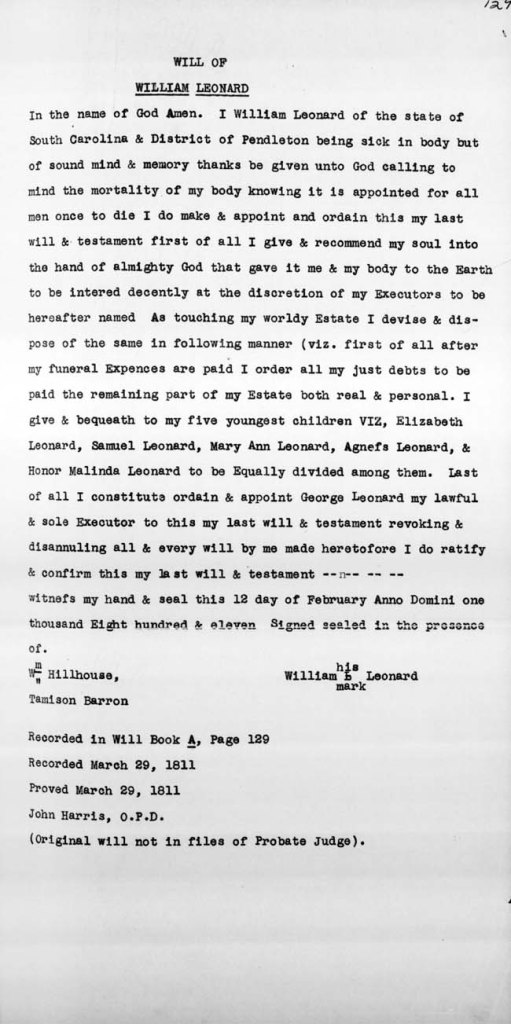
This William Leonard is also clearly the man of that name who died in Pendleton District with a will dated 12 February 1811 and probated 29 March 1811.[4] That will names children George, Elizabeth, Samuel, Mary Ann, Agnes, and Honor Malinda. About the son of Robert Leonard who remained in Pendleton District, South Carolina, while the widow Honor Pritchard and her children Robert, Thomas, and Mary (Campbell) moved to Tennessee in the early 1800s — a son Thomas D. Leonard calls Samuel — Thomas D. states that Samuel married a Miss Lawan, remained in South Carolina, and had children George, Samuel, Elizabeth, and Belinda.
Notice how closely Thomas D. Leonard’s list of Samuel’s children matches the list of children named in William Leonard’s will: both the will and Thomas D. Leonard’s list show sons George and Samuel and a daughter Elizabeth. The Belinda of Thomas D. Leonard’s list appears to me to be the Honor Malinda named as a daughter in William Leonard’s will.
Why Thomas D. Leonard would have turned a son of Robert Leonard named William into Samuel is not easy for me to understand, when his Leonard family history is in many other ways extraordinarily reliable. As I’ve proposed, because Thomas D. grew up knowing his grandparents Thomas Leonard and Hannah James and his great-uncle Robert and great-aunt Mary (Campbell) in Tennessee, while his great-uncle William died in South Carolina a year after Thomas was born, I suspect he knew much more about the Tennessee relatives than about his great-uncle William in South Carolina. Even so, turning a man named William into one named Samuel is quite a stretch, isn’t it?
About the probability that William was Robert Leonard’s oldest child: as I’ve said previously, the February 1755 contract for Robert Leonard’s indenture of his son William does not state William’s age, unfortunately. But to be apprenticed in 1755, he has to have been more than a mere infant. Children as young as seven or eight years of age could be and sometimes were indentured in this period. It seems very likely, then, that William was born prior to 1750 and was probably Robert Leonard’s oldest child.
The posting linked in the previous paragraph also proposes the following possibility for a calculation of William Leonard’s date of birth: The indenture document specifically states that Robert was indenturing his son for fourteen years and seven months. When minors were indentured in Maryland at this period, the limit of indenture was usually up to their 21st birthday. If the indenture period is an indicator of William’s age at the time Robert indentured him, he would have been six years and five months old in February 1755, and therefore born in September 1748.
That date of birth would sync well with a possible 1747 marriage date for Robert Leonard and Honor Pritchard discussed in a previous posting about a water-damaged bible printed in 1766 that appears originally to have belonged to Robert and Honor. The bible apparently records a date of 14 February 1747 for some event that now seems to be illegible due to the damage the bible has sustained.
One other point I’d like to offer for your consideration here: When Honor Pritchard Leonard and her sons Robert and Thomas and son-in-law Colin Campbell gave power of attorney in Pendleton District, South Carolina, on 12 September 1800 for James Irwin to recover pay that might be due to Robert Sr. for military service, William Leonard did not sign this power of attorney document. He’s mentioned nowhere in the document, though we know from other records that William was living in Pendleton District along with the Leonard family members who signed this power of attorney in 1800.
The family members giving this power of attorney then moved to Tennessee some eight or nine years later to Tennessee, leaving William behind in South Carolina. A question that arises as I think about that power of attorney and then the move of the widow Honor with her sons Robert and Thomas and son-in-law Colin Campbell to Tennessee is this: Was William Leonard perhaps a son of Robert Leonard born prior to his marriage to Honor Pritchard? If so, that might explain Robert’s decision to indenture this son out as a boy. A step-mother is not always eager to raise a child of a previous mother. It might also explain why William is excluded from the power of attorney document and why his relatives moved as a group from South Carolina to Tennessee, leaving William behind in South Carolina.
And it would help explain why Thomas D. Leonard was hazy about this one Leonard great-uncle, though he does state that “Samuel” was a son of Robert Leonard and Honor Pritchard and that Robert and Honor raised him along with their other children.
2. Thomas Leonard was born 15 October 1752, very likely in Frederick County, Maryland, and died 8 April 1832 in Lincoln (later Marshall) County, Tennessee. About 1775 in Frederick (later Washington) County, Maryland, he married Hannah, daughter of Griffith and Mary James of Sharpsburg. I’ve documented Thomas’ life in detail in these previous postings:
Thomas Leonard (1752-1832), Son of Robert Leonard and Honor Pritchard: Maryland Beginnings

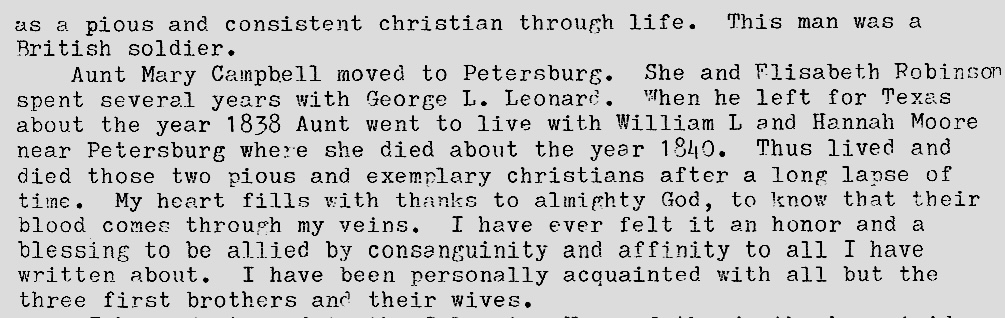
3. Mary Ann Leonard was born 5 May 1754 and died 8 September 1844 at the home of her niece Hannah Leonard and husband William Depriest Moore near Petersburg, Marshall County, Tennessee. As far as I can determine, these dates of birth and death were recorded on a gravestone in the Leonard family cemetery near Petersburg that is no longer legible but appears in cemetery transcriptions undertaken in the past.[5] I think it’s very likely that Mary Ann was born in Frederick County, Maryland, since it seems that her father Robert Leonard had probably begun doing military service under John Dagworthy there by 1754.
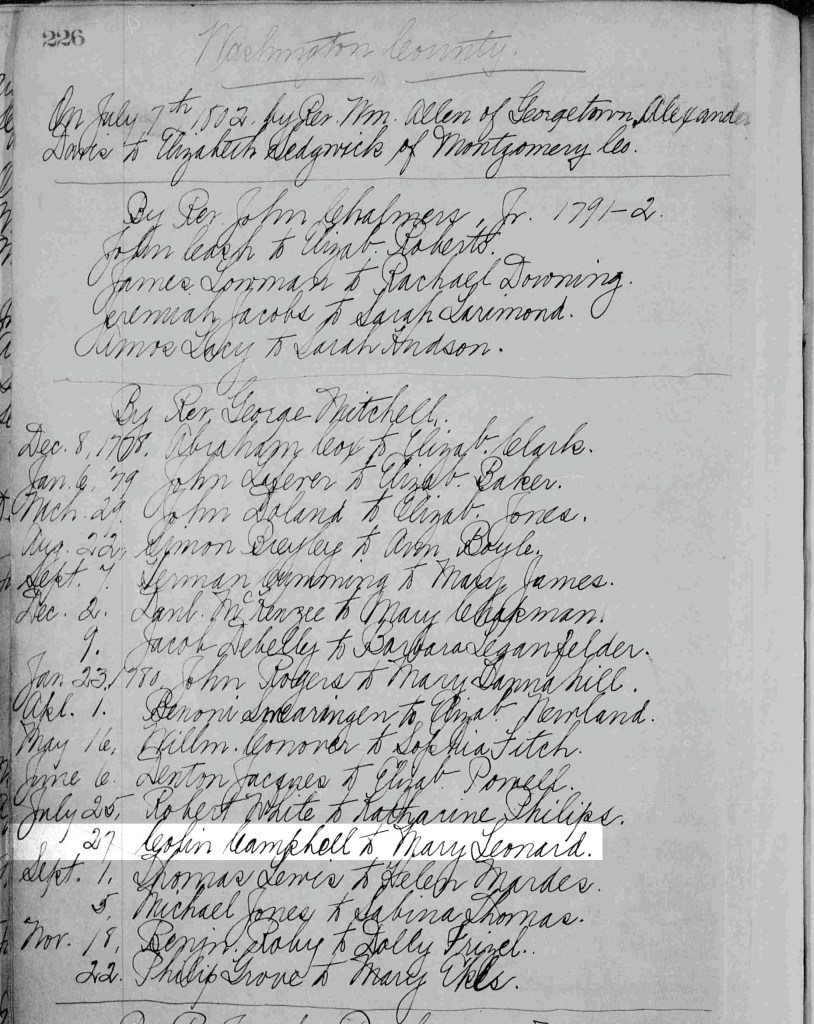
On 27 July 1780 at Hagerstown in Washington County, Maryland, Mary Ann married Colin Campbell, a Scotsman who was a British soldier, according to Thomas Dunlap Leonard in his “Biography of the Leonards.”[6] Colin’s grave marker in the Leonard family cemetery, also transcribed in the past but not now legible, shows him born 1 August 1745 and dying 27 May 1832. As a previous posting notes, Colin and Mary Ann were married by Reverend George Mitchell, a Reformed minister of Hagerstown, who also married Mary James, a sister of Hannah James, wife of Thomas Leonard, to Harmon Cummings on 7 September 1779 at Hagerstown.[7]
As Thomas D. Leonard notes, Colin Campbell and wife Mary Ann moved to Tennessee with family members who went there from Pendleton District, South Carolina, in the first part of the 1800s, having moved to South Carolina by 1785 from Washington County, Maryland, along with the same family members. If Colin Campbell was the man of this name found in a list of Frederick County, Maryland, debtors to John Orme in May 1773, Colin was in that county by that date.[8] Orme’s second wife Lucy Beall was a member of the Beall family to which Robert Leonard connected through his years of service under Dagworthy and Alexander Beall at Fort Frederick near Hagerstown.
According to Thomas D. Leonard, who grew up knowing his great-uncle and great-aunt Colin and Mary Ann Campbell, Mary Ann never had children. Both Colin and Mary Ann lived to old age, Thomas D. Leonard states, with Colin dying after a horse threw him. This appears to have happened at Robertson’s Fork in what’s now southern Marshall County, Tennessee.
The widowed Mary Ann then went to live at Petersburg with her nephew George Lawan Leonard, son of William Leonard. George had moved from South Carolina to Tennessee about 1815 to join his relatives there.[9] When George moved to Dallas County, Texas, about 1838, Mary Ann then went to live with her niece Hannah and husband William Depriest Moore, remaining with them until her death, which Thomas D. Leonard places as “about 1840.”
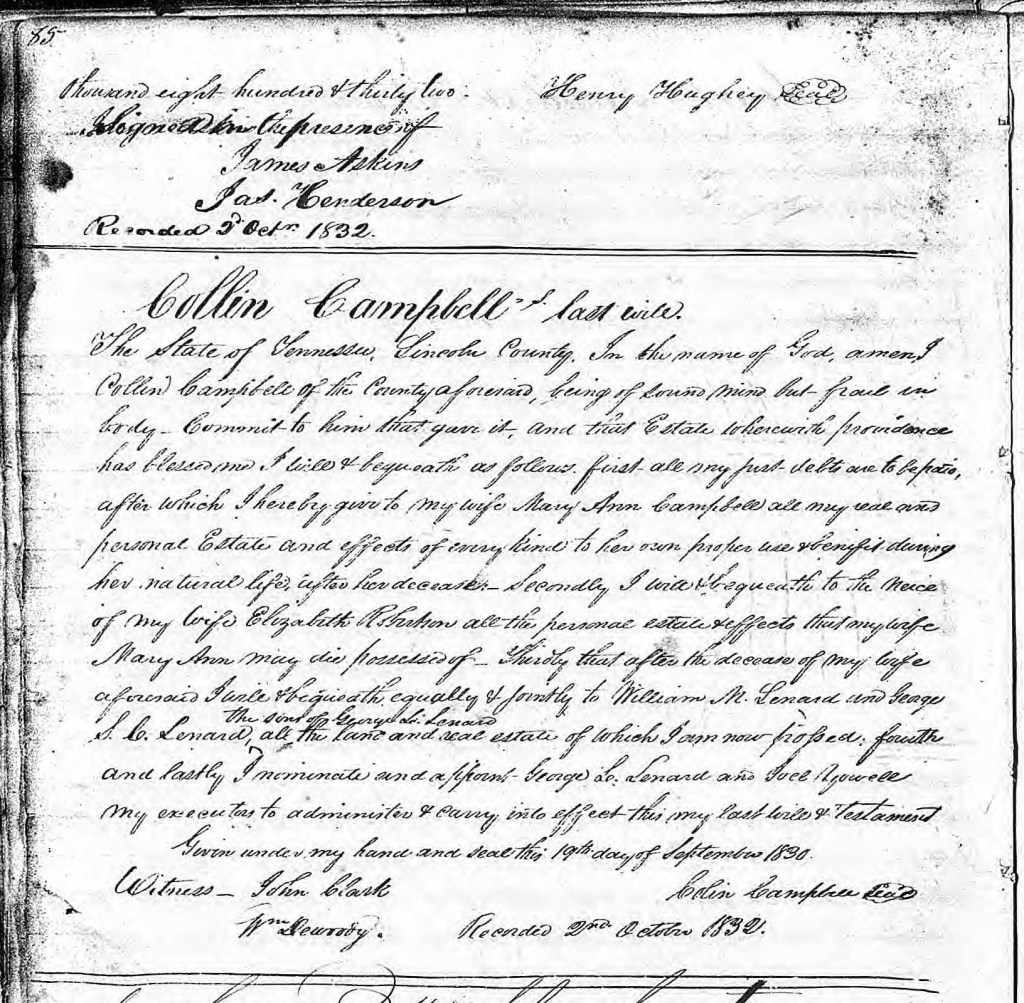
Colin Campbell died testate in Lincoln County with a will dated 19 September 1830, probated 2 October 1832.[10] The will leaves Colin’s entire estate to his widow, naming her as Mary Ann. The will specifies that following Mary Ann’s death, her personal effects were to go to her niece Elizabeth Robertson/Robinson, a daughter of Mary Ann’s brother William. Thomas D. Leonard states that when Mary Ann went to live with her nephew George after Colin died, Elizabeth Robinson accompanied her. Colin Campbell’s will appointed George L. Leonard and Joel Yowell executors, and stipulated that following Mary Ann’s death, all the land and real estate owned by Colin was to be shared equally by George’s sons William M. and George S.C. Leonard.
4. Robert Leonard was born, federal census data suggest to me, between 1760 and 1769. If federal censuses from 1790 through 1830 report correct information about his age, then he was not, it appears to me, the oldest child of Robert and Honor Pritchard Leonard, but perhaps their youngest.
As I’ve previously indicated (with these censuses documented in the linked posting), the 1790 federal census enumerates Robert in Pendleton District, South Carolina, showing him aged above 16 years. In 1800, also in Pendleton District, he’s aged 26-44. In 1810, still in Pendleton District, Robert’s age category is again 26-44. The 1820 federal census has him, now in Lincoln County, Tennessee, aged over 45. And the 1830 federal census, also enumerating him in Lincoln County and the last federal census on which he appears, shows him aged 60-69. If that census has a correct age listing for Robert, he was born between 1760 and 1769 and was younger than his brothers William and Thomas.
In my discussion of the bible that originally belonged to Robert Leonard and Honor Pritchard, I noted that this bible apparently lists a birthdate of 10 October 1760 for a Robert Leonard. As the posting I’ve just linked states, if the bible transcriptions providing this information are reading the original bible record correctly, I’m tempted to think that this may be a record of the birthdate of Robert and Honor Leonard’s son Robert. If it is Robert’s birthdate, he’d have been born in Frederick (later Washington) County, Maryland, since numerous records place this Leonard family there in 1760, with Robert stationed at Fort Frederick and, I suspect, his wife and children living in nearby Hagerstown.
Thomas Dunlap Leonard states that Robert Leonard married a Miss Kate York of Maryland and then moved with her to Lincoln County, Tennessee, about 1806. Robert and wife Katherine went, of course, first from Frederick County, Maryland, to Pendleton District, South Carolina, around 1786. A number of Pendleton District records confirm that Robert’s wife was named Kate. These records also suggest to me that Robert moved his family to Tennessee just after his mother and siblings moved there in 1808 or 1809.
I have not found a record of Robert Leonard’s death. As noted above, the 1830 federal census shows him in Lincoln County, Tennessee, and by 1840, he seems to have disappeared from the federal census, so it appears he died between 1830 and 1840, very likely in Lincoln County. On 28 December 1835 in Lincoln County, a Robert Leonard witnessed a deed from Thomas Bounds to Peter Cole.[11] Robert’s nephew Robert Leonard, son of Thomas Leonard, was of age by this time, but had moved to Alabama around 1818. Robert and Kate York Leonard had a son Robert, also of age by 1835, but this Robert Leonard was living in Sumner County, Tennessee, at that time. So it appears to me the Robert Leonard witnessing this December 1835 deed is Robert, son of Robert and Honor Pritchard Leonard. This document places Robert’s death between the December 1835 date and 1840.
Robert’s wife Kate may have predeceased him. The 1830 federal census shows the oldest female in the household as aged 40-50, while the 1820 federal census shows the household’s oldest female as 45+. If these censuses have accurate information on this point, then it seems to me the female aged 40-50 in Robert’s household in 1830 is not Kate.
According to Thomas Dunlap Leonard, Robert Leonard and wife Kate had the following children: William, John, Robert, Riley, Campbell, Thomas, Samuel, Honor, Polly, and Anna.
[1] On Thomas Dunlap Leonard’s “Biography of the Leonards,” see this previous posting.
[2] Frederick County, Maryland, Land Record Bk. E, pp. 659-660.
[3] South Carolina Plat Books (Charleston Series), vol. 15, p. 127; and Ninety-Six District, South Side of Saluda, Commissioner of Locations Plat Bk. B, p. 113.
[4] Anderson County, South Carolina, Will Bk. A, pp. 129-130.
[5] See Elizabeth Lucie Leonard Baxter, “Leonard Family,” Marshall County, Tennessee, Historical Quarterly 6,2 (summer 1975), and “Thomas Leonard Family Graveyard,” Marshall County, Tennessee, Historical Quarterly 10,1 (spring 1979), both reporting a transcription of the cemetery headstones made by Baxter on 28 January 1968.
[6] I have found no information about Colin’s service as a British soldier. In the period of the American Revolution, the British 35th Regiment of Foot in which Robert Leonard served in the late 1750s and early 1760s had two men named Colin Campbell: see “35th Regiment of Foot, Grenadier Company, American Revolution 1775-1783,” at the Royal Sussex Society – 35th Regiment of Foot website. I have found no reason to think that either of these is the Colin Campbell who married Mary Ann Leonard. If so, then this Colin Campbell would have served on the British side during the Revolution while Mary Ann’s father was a Revolutionary soldier.
[7] See Maryland Historical Society, Maryland Marriages 1777-1804 (1949), p. 226; and Gaius Marcus Brumbaugh, Maryland Records, vol. 2 (Lancaster, Pennsylvania, 1928; repr. Baltimore: Genealogical Publishing Company, 1967), p. 522.
[8] Frederick County, Maryland, Inventory Bk. C-3, p. 119.
[9] History of Tennessee, from the Earliest Time to the Present; Together with an Historical and a Biographical Sketch of Giles, Lincoln, Franklin and Moore Counties (Nashville: Goodspeed, 1886) p. 780.
[10] Lincoln County, Tennessee, Will Bk. 2, p. 85.
[11] Lincoln County, Tennessee, Deed Bk. J, p. 547.

