Then he joined the British Army’s 35th Regiment of Foot — his discharge from that military group preserved by his descendants tells us this — and according to his great-grandson Thomas Dunlap Leonard, while serving in that regiment, Robert was at the battle of the Plains of Abraham (the battle of Québec, Thomas D. Leonard calls it) in September 1759. The discharge paper tells us Robert was discharged from the 35th on 24 July of an unnamed year, and states that the discharge occurred at Havana. This tells us he had gone with the 35th to the Caribbean after Québec and Montréal fell and was participating in the British military campaign there. The 35th was in Havana in the summer of 1762, so the 24 July date with the missing year is 24 July 1762.
From July 1762 up to 19 August 1779, when Robert Leonard enlisted in the 7th Maryland Regiment during the Revolutionary war, I find no records at all to document his life. I assume that after his discharge in Havana in July 1762, he returned to Frederick County, Maryland, to rejoin his wife Honor and their children. But I’ve been unable to find documentary proof of that, other than the fact that he had a payment, probably a final one, in March 1763 for his service under Dagworthy. And that payment does not necessarily indicate that he was in Frederick County at the time it was issued.
I never find any land or deed records suggesting to me that Robert owned property in Frederick County. There’s every indication that he was a professional soldier throughout his adult life, and this no doubt meant that he spent his years in Frederick County living in a military garrison, with wife Honor and their children probably living in a rented house nearby. Hagerstown is some eighteen miles east of Fort Frederick, and as I’ve noted previously (here and here), there’s substantial reason to conclude that Robert’s family was probably living in Hagerstown while he was stationed at Fort Frederick.
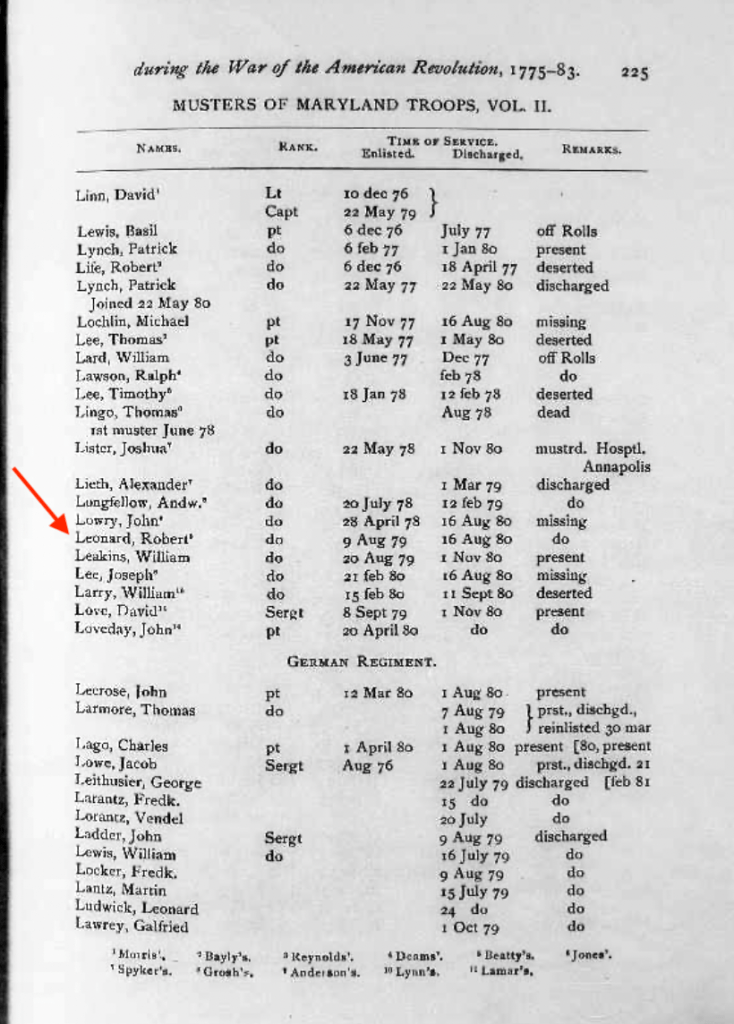
The first clear record I find indicating that Robert Leonard returned to Frederick County after his discharge from the 35th Regiment of Foot in Havana in July 1762 is his enlistment in the 5th Maryland Regiment under Captain Richard Anderson on 19 August 1779.[1] Robert appears in the DAR’s Patriot Index as a proven Revolutionary ancestor (no. A069340) who served in the 7th Maryland Regiment under Captain Richard Anderson and who died at Camden, Camden District, South Carolina on 16 August 1780 — that is, he died at the battle of Camden.
The information that Robert died at the battle of Camden appears in a power of attorney that his widow Honor, sons Thomas and Robert, and son-in-law Colin Campbell gave to James Irwin of Cumberland County, Pennsylvania, on 12 September 1800 while the Leonard family was living in Pendleton District, South Carolina. This power of attorney, which passed down in the family of Robert’s son Thomas along with Robert’s discharge from the 35th Regiment of Foot, was discussed in a previous posting. The linked posting provides a digital image and transcription of this document.
As the linked posting notes, Robert’s heirs gave Irwin power of attorney as he sought to claim any pay that might still be due for Robert’s service in both the French and Indian and Revolutionary Wars. The power of attorney states that Robert served in the “war of 1753” and also “in the Late American war with Britain in the Maryland Ridgiment as Sergeant till killd. in Genl. Gatises Defiat.” As the linked posting states, the statement about “Genl. Gatises Defiat” refers to the battle of Camden, South Carolina, on 16 August 1780 at which American troops led by General Horatio Gates were decisively defeated by the British, with many casualties on the American side.
With this power of attorney, his widow Honor, sons Thomas and Robert, and son-in-law Colin Campbell tell us that Robert Leonard was killed at the battle of Camden on 16 August 1780. The muster roll of Maryland’s 7th Regiment states that he was declared “missing” from 16 August 1780 forward.[2] The muster roll gives Robert the rank of private. The September 1800 power of attorney devised by his heirs says that he served in the Maryland regiment as a sergeant, his rank under Dagworthy and Beall and also in the 35th Regiment of Foot.
The 7th Maryland Regiment was authorized on 16 September 1776 for service with the Continental Army. It was comprised of eight companies of volunteers drawn for the most part from Frederick and Baltimore Counties.[3] In April 1780, as the British made advances in Georgia and the Carolinas, the 1st American Brigade, which included the 7th Regiment, was reassigned from the Continental Army to the Southern Department under Major General Johann de Kalb.
Prior to this reassignment, the Maryland line had been sent south under General Lincoln as British generals Clinton and Cornwallis headed for Charleston. The troops marched through New Jersey and Pennsylvania, embarking from the mouth of the Elk River on 3 May 1780 on vessels headed to Petersburg. From there, they began their advance towards Camden.[4]
As this advance took place, leaders of the Continental Army appeared indecisive about how to defend South Carolina against the British. As a result, the Maryland troops were badly provided for during the spring and summer months of 1780, experiencing hunger. On 3 August a small group of Virginia troops joined them, followed on 7 August by some North Carolina troops. On the 13th, 700 militiamen under General Stevens also joined the troops advancing to Camden.[5] When the battle began on the morning of the 16th, the Maryland troops fought valiantly against great odds, but were decisively defeated by British forces.
The battle of Camden was the first major engagement of the 7th Regiment in the South. Due to strategic blunders Gates made confronting Cornwallis’ forces, it was a rout for American soldiers, with the Maryland Continentals including the 7th Regiment suffering devastating losses: over 300 Maryland Continentals were killed in the battle of Camden with many more captured.[6] In all, the Continentals from various colonies taking part in this battle had 1,900 killed, wounded, or captured.[7] A biography of Richard Heron Anderson, grandson of Robert Leonard’s captain Richard Anderson, states that those wounded at Camden included Richard Anderson.[8] But I suspect the biographer is confusing the battle of Camden with the battle of Guilford courthouse in March 1781 at which Anderson suffered a crippling wound, according to his Revolutionary pension application.[9]
A project sponsored by the South Carolina Battleground Preservation Trust and USC-SCIAA Archaeological Research Trust is currently underway to determine the identity of some of the soldiers buried at the Camden battlefield site. Family History Forensics is managing the DNA analysis for this project, seeking to match DNA recovered from the remains of the exhumed soldiers with DNA of descendants of those killed at the battle of Camden.
I assume that Robert Leonard is buried in an unmarked grave at the site of the battle of Camden. A memorial page has been created for him at Find a Grave’s pages for the Camden Revolutionary War cemetery, which for reasons unknown to me gives him a middle initial, G.[10] I’ve seen no documents anywhere giving Robert Leonard a middle name or middle initial.
In my next and final posting about Robert Leonard, I’ll provide a brief overview of information about his four children William, Thomas, Robert, and Mary.
[1] Archives of Maryland, vol. 18: Muster Rolls and Other Records of Service of Maryland Troops in the American Revolution, ed. Bernard Christian Steiner (Baltimore: Lord Baltimore Press, 1899), p. 225.
[2] Ibid. See also Jane Wallace Alford, Revolutionary War Patriots of Marshall County, Tennessee (Lewisburg, Tennessee: Webb, 1976), p. 117.
[3] See “American Revolutionary War Continental Regiments, 7th Maryland Regiment,” at the American Revolutionary War website; Valley Forge Park Alliance, “7th Maryland Regiment,” at the Valley Forge Legacy site; and “7th Maryland Regiment,” Grokipedia.
[4] Esther Mohr Dole, Maryland During the American Revolution (Fort Wayne: Allen County Public Library, 1980), p. 153.
[5] Ibid., pp. 154-5.
[6] Jim Piecuch, The Battle of Camden: A Documentary History (Charleston: The History Press, 2006); and “Battle of Camden,” Wikipedia.
[7] “Camden | Aug 16, 1780,” at the American Battlefield Trust website.
[8] Walker C. Irvine, The Life of Lieutenant General Richard Heron Anderson of the Confederate States Army (Charleston: Art Publishing, 1917), pp. 11-12.
[9] NARA, Case Files of Pension and Bounty-Land Warrant Applications Based on Revolutionary War Service, compiled ca. 1800 – ca. 1912, documenting the period ca. 1775 – ca. 1900, RG 15, file of Richard Anderson, Maryland, S10059, available digitally at Fold3.
[10] See Find a Grave memorial page for Robert G. Leonard, Camden Revolutionary War cemetery, Camden, Kershaw County, South Carolina, created by Linda Neilson.
 BEGATS AND BEQUEATHALS
One thought on “Robert Leonard (bef. 1730 – 1780): Revolutionary Service in 7th Maryland Regiment and Death at Battle of Camden, South Carolina”