Joseph Pryor of Tuscaloosa County, Alabama: Pre-Alabama Records Gap and Importance of Church Minutes
You’ve been there no doubt. I’ve been there myself more times than I like to remember, trying to find traces of an ancestor who seems just to vanish as I follow her or his migrations from place to place. My early Tuscaloosa County, Alabama, ancestors had a penchant for doing that. Their families had moved from Virginia to Tennessee, or Virginia to South Carolina and then Tennessee, before they settled in Tuscaloosa County. And their Tennessee sojourn was, I discover as I research them, full of mysteries. I could determine when they arrived in Tuscaloosa County, find lots of information on them in their pre-Tennessee period, but for some reason, as they trekked across Tennessee, they seemed to fall into an information abyss.
As it turns out, a primary reason for this inability to track those Tennessee-to-Alabama ancestors is that as they migrated through Tennessee, they settled in counties whose records are now lost. In what follows, I’m going to talk about one of those early Tuscaloosa County settlers in my family tree, Joseph Pryor (1767-1851), who came to Tuscaloosa County before the county was even formed. I can fairly confidently track Joseph in his growing-up years in East Tennessee up to about 1800, and I know where he was in Tennessee from around 1810 to 1816, when he left for Alabama.
But there’s a gap period from about 1800 to 1810 when I lose sight of him. I’ve now determined this gap exists because the Middle Tennessee County in which he lived from 1802 to 1810, Jackson County, is a burnt-records county. And one valuable record, a set of church minutes from that county, is my primary way of pinpointing him and his family in Jackson County in his “lost” years and determining where his family lived in the county.
This article continues a discussion of Joseph Pryor that I began with a previous article in Roots & Branches in August 2025.[1] In that article, I explained that there has been confusion about the background of the Joseph Pryor who died in Tuscaloosa County prior to 15 December 1851, when Joseph’s will was probated by his executors, his son John Pryor and son-in-law Zachariah Sims Simpson.[2]
As my August 2025 article explains, a number of researchers of this Pryor family have misidentified the Joseph Pryor who died in 1851 in Tuscaloosa County as a Joseph Pryor who died before 2 December 1833 in Bourbon County, Kentucky, and whose father Joseph Pryor Sr. died in the same county between 13 December 1812, when he made his will, and February 1813, when the will was probated.[3] The confusion has been exacerbated by the fact that in the past, both DAR and SAR accepted descendants of Joseph Pryor of Tuscaloosa County on the basis of the claim that he was the Joseph Pryor Jr. named in the December 1812 will of Joseph Pryor Sr. of Bourbon County, Kentucky.
My previous Roots & Branches article also tells you that a family bible belonging to Joseph Pryor of Tuscaloosa County and his wife Sarah was once extant, with photocopies of its bible register still available, and this bible record shows Joseph and Sarah having children born from 1793 to 1816. Census data and biographies of those children show all of them born in Tennessee. The last child born to Joseph and Sarah Pryor, a daughter Rebecca who was born 29 April 1817, was born in Alabama. The sister prior to her, Margaret, was born 10 February 1816 in Tennessee. So the family of Joseph Pryor moved from Tennessee to Alabama between the February 1816 date and the April 1817 date.
Joseph Pryor: Greene County, Tennessee, Years (1783-abt. 1800)
My August 2025 article also told readers that an 18 December 1815 deed in Warren County, Tennessee, shows Mourning White of Logan County, Kentucky, deeding to Joseph Pryor of Warren County, Tennessee, an enslaved girl named Hannah.[4] Mourning (who was the daughter of Thomas Thomson [abt. 1718-1774] of Louisa County, Virginia) was the widow of a Richard Pryor who is found in the records of Greene County, Tennessee, from 1783-1795, and before 1783, in the records of Washington County, North Carolina (later Tennessee). This Pryor family came to Tennessee from Louisa or Amherst County, Virginia.
Greene County records show Richard Pryor making preparations in the years before 1796 to move out of that county. In February 1794, Richard’s wife Mourning Pryor received a letter of dismission from Big Pigeon Baptist church in Greene County (later Cocke County), of which she had been a founding member on 6 December 1787.[5] On 20 September 1795, Richard Pryor sold the last of his land in Greene County and on 20 March 1796, he purchased from Joseph Pryor of Greene County 2,565 acres of land on Caney Fork of the Cumberland River in Sumner County, Tennessee, with the deed stating that Richard Pryor was now living in Logan County, Kentucky, which is in southern Kentucky on the Tennessee border.[6]
Richard Pryor died in Logan County by 8 August 1797, when his widow Mourning appealed for administration of his estate.[7] By 1800, Mourning had married a second husband, Thomas White. On 29 November 1811, the heirs of Richard Pryor made a deed in Logan County selling their shares of a tract of Richard’s land in Logan County to one of the heirs, Jonathan Pryor.[8] All of Richard’s heirs (i.e., his sons and sons-in-law) signed this deed, stating that they were heirs of Richard Pryor. One of the heirs signing this deed was Joseph Pryor.
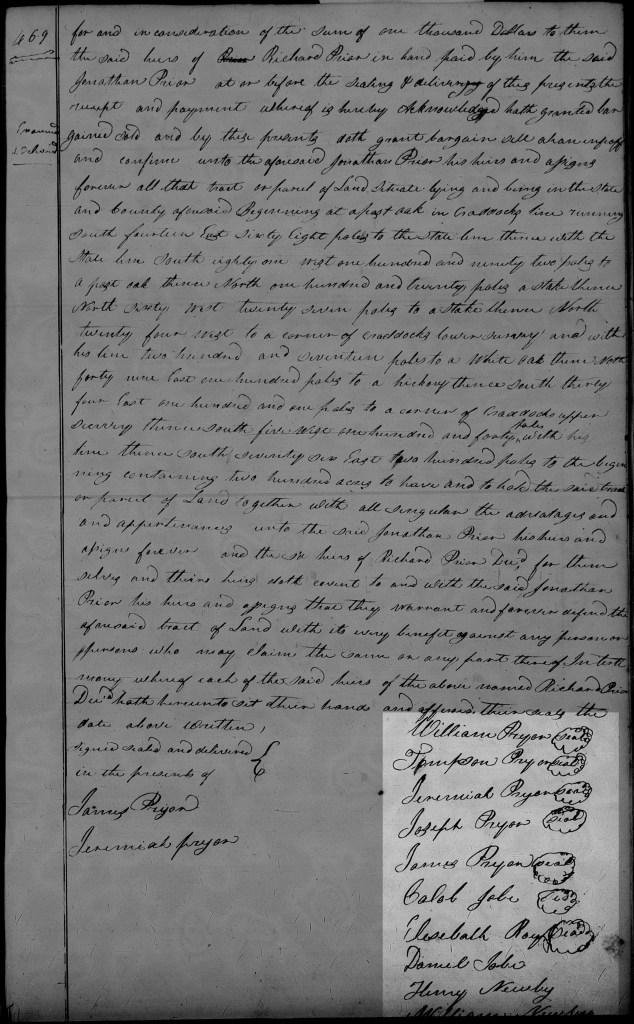
As my previous article indicates, I’ve concluded that the Joseph Pryor to whom Richard Pryor’s widow Mourning White sold an enslaved girl in Warren County, Tennessee, in December 1815 is the son of Richard and Mourning Thomson Pryor (later White) who signed the 1811 deed of Richard Pryor’s heirs, and is the Joseph Pryor who then moved to what would soon be Tuscaloosa County, Alabama, between the February 1816 date and the April 1817 date.
The Joseph Pryor who disappears from Warren County, Tennessee, records after 1816 shows up in the records of that county by 11 June 1811, when he bought from Richard Cantrell for $700 a 100-acre tract on Charles Creek of Collins River on which Cantrell was then living.[9] As I’ll explain below, I think it’s likely that Joseph and wife Sarah moved to Warren County in 1810 from Jackson County, Tennessee. If this Joseph was the son of Richard and Mourning Pryor (and I’m confident he was), he would have spent the first part of his life in Tennessee in Greene County, and would have come of age and married there: Joseph’s family bible states that he was born 1 December 1767. The family bible states that Joseph’s wife was named Sarah — no maiden name is stated — and that she was born 25 November 1776. The couple’s first child, a daughter Mary, was born 25 May 1793, according to the bible register. These pieces of information suggest that Joseph Pryor likely married wife Sarah about 1791, when his parents Richard and Mourning can be placed by a number of documents in Greene County, Tennessee. In 1791, Joseph would have been 24 and Sarah 15.
Numerous pieces of information that would take me down a sidetrack if I discussed them here tell me that Joseph Pryor’s wife Sarah was the daughter of Samuel Odle and Elizabeth Job of Greene County, Tennessee, who came to Tennessee from Shenandoah County, Virginia. Samuel Odle died in Greene County with a will dated 5 July 1788.[10] The will, which was filed in Jefferson County, Tennessee, and probated in Washington County though it identifies Samuel Odle as a resident of Greene County, names a daughter Sarah, who was not married by 1788.[11]
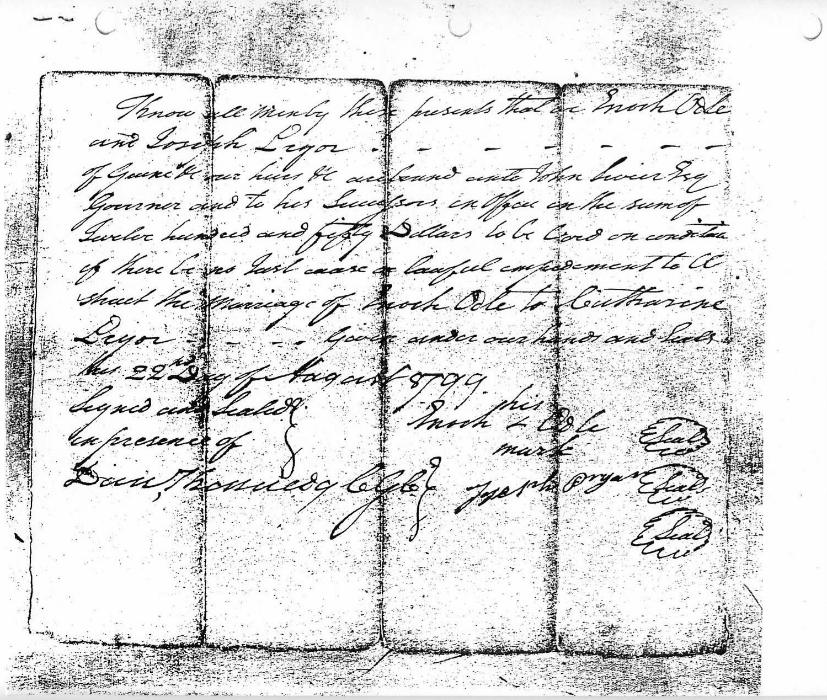
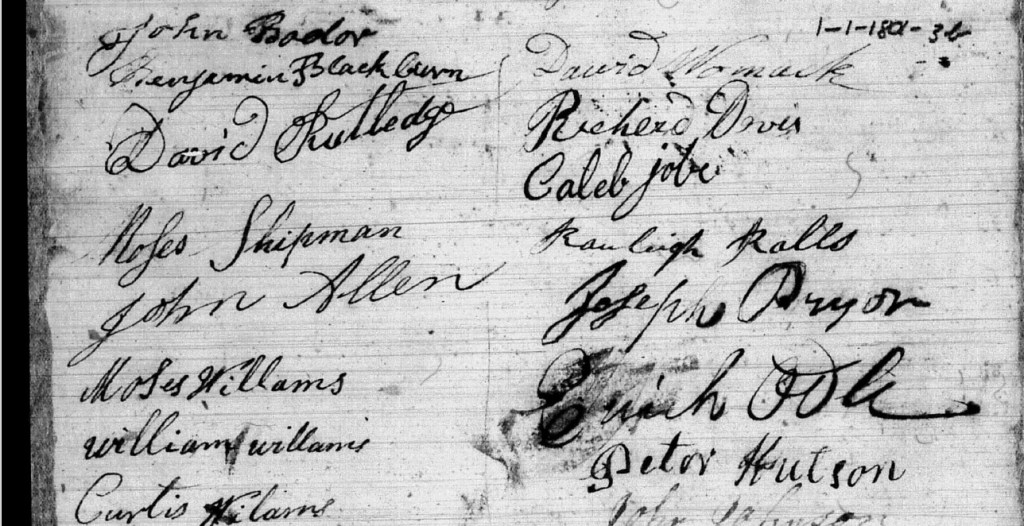
Joseph Pryor and wife Sarah appear to have remained in Greene County several years after his parents Richard and Mourning Pryor left that county for Logan County, Kentucky. Joseph was in Greene County up to 22 August 1799 when Sarah’s brother Enoch Odle (who is also named in Samuel Odle’s will) married Catherine Pryor in that county and Joseph signed as bondsman for Enoch Odle as Enoch made bond for this marriage.[12] Soon after this date, it appears that Joseph and Sarah left Greene County for Smith County, Tennessee, where Joseph Pryor and Enoch Odle signed a petition to the Tennessee legislature on 1 January 1801.[13] Their signatures are next to each other, one after the other, with Caleb Jobe signing several names above theirs.
Before moving from Greene County, Joseph also signed a petition in November or December 1789 in which those living south of the French Broad in Greene County asked the North Carolina General Assembly for relief from predations of the Cherokees.[14] Among the signatories to this petition were William and Joseph Pryor (both signing their surnames as Pryar).[15]
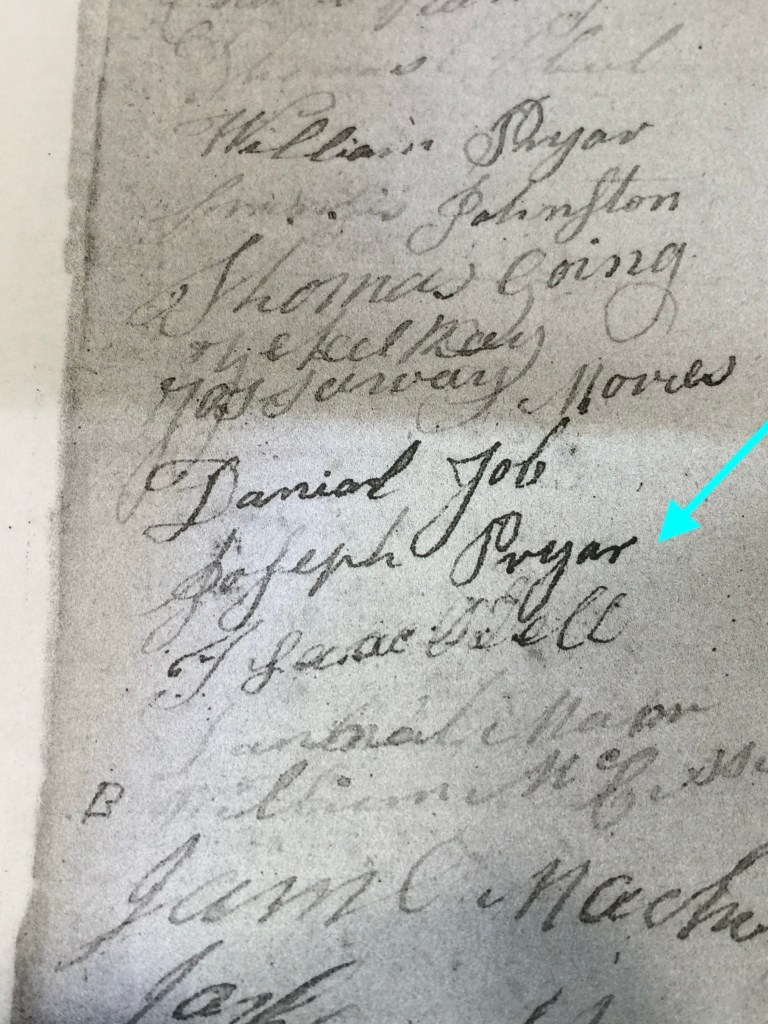
The William Pryor signing this petition was another son of Richard and Mourning Thomson Pryor, who is among the heirs signing the 1811 Logan County, Kentucky, deed of Richard’s heirs. His signature appears several signatures ahead of the signature of Joseph Pryor. Joseph Pryor signed — and this is a significant and noteworthy point — between Daniel Job (1758/1760 – abt. 1864) and Isaac O’Dell (1750-1834). Both men were relatives of Sarah Odle, Joseph Pryor’s wife. Daniel Job was a son of Samuel Job (1735-1819) and Dorcas McKay (abt. 1735-1819), who show up by 1802 in an important set of church minutes in Jackson County, Tennessee, which prove that Joseph Pryor and wife Sarah were living in that county by 1802. Daniel Job was a brother-in-law of Joseph and William Pryor; he married Richard and Mourning Pryor’s daughter Mourning Pryor.
Isaac O’Dell/Odle witnessed and probated the will of Samuel Odle, father of Sarah Odle Pryor, and was a nephew of Samuel Odle, a son of Samuel’s brother Caleb Odle, and thus a first cousin of Sarah Odle Pryor. So to sum up: we can place Joseph Pryor, son of Richard Pryor and Mourning Thomson, in Greene County, Tennessee, records up to 1799, at which point it appears this family left Greene County about 1800, and from 1811 to 1816, when the Pryor family moved from Tennessee to Tuscaloosa County, Alabama, we can place these folks in records of Warren County, Tennessee.
Joseph Pryor: The “Lost” Years in Middle Tennessee (abt. 1800 – abt. 1810)
But there’s a gap between 1801, when we know Joseph had moved to Smith County in Middle Tennessee, and 1811, when he begins appearing in Warren County records. Where was Joseph Pryor during the years 1801-1811, when we know from census data and other information that he and wife Sarah were living in Tennessee, as the first ten of their eleven children were born from 1793 to 1816? Filling that gap is made more difficult by the fact that several men named Joseph Pryor are found in the records of Greene County and in Middle Tennessee counties from the 1780s up to 1820. As I stated above, just after Richard and Mourning Pryor moved from Greene County to Kentucky late in 1795 or early in 1796, a man named Joseph Pryor of Greene County sold Richard a large tract of land in Middle Tennessee in Sumner County.
Greene County records show that, in addition to Joseph Pryor son of Richard, there were also a Joseph Pryor Sr. and Jr. who were evidently father and son, with the younger of these two Josephs of age by 1796.[16] Three Joseph Pryors were living in Greene County in the 1790s, all of age by 1796. Many researchers, I included, have thought that these two Joseph Pryors Sr. and Jr. are the Joseph Pryor Sr. and Jr. who are in Bourbon County, Kentucky, records by 1808. I’m beginning to ask myself if this is a correct deduction, however. I have begun to think that the two Josephs in Bourbon County records never lived in Tennessee, but moved to Kentucky directly from Botetourt County, Virginia. As I try to disentangle Joseph Pryors in Middle Tennessee records in the first decades of the 1800s, I’ve begun to conclude that the Joseph Pryor Sr. and Jr. (who appear to be closely related to the family of Richard Pryor) moved, as did most of Richard Pryor’s children, to Middle Tennessee from Greene County, and remained in Tennessee.
When Richard Pryor acquired 2,565 acres in Sumner County in 1796, several of his children, including his son William, who may have been his first-born son with Joseph next among Richard’s sons, settled in Sumner County and lived on Richard’s land there. In 1799, Smith County was formed from Sumner, and Richard’s tract fell into that county, with William and his son Joseph Pryor then showing up for a short period of time in Smith County. In 1801, another county, Jackson County, was formed from Smith.
In its early period, Jackson County is something of a black hole for genealogical researchers, since its early records burned in 1872. Tax lists from 1802 and 1803 have survived, and the 1803 tax list shows both Joseph and William Pryor taxed in Jackson County in that year.[17] In 1802, the tax list shows only William.[18]
For those researching early settlers of Jackson County, Tennessee, state-level land records also help fill in the gap caused by the destruction of Jackson County records in 1872. And for those searching for the whereabouts of Joseph and Sarah Pryor after they left Greene County about 1799 or 1800 and before Joseph shows up in Warren County records by 1811, there’s one other extremely valuable record. This is the minutes of Spring Creek Baptist church of Jackson County.
Spring Creek Baptist Church Minutes, Jackson County, Tennessee
When Spring Creek Baptist church was constituted in Jackson County on 7 July 1802, Joseph’s wife Sarah shows up as a constituting member of the church (see the digital image at the head of this posting).[19] Spring Creek church is near Cookeville in Jackson County at the intersection of Dodson Branch highway (state highway 135) and South Smith Chapel road.[20] This is in southeast Jackson County not far from the Putnam County line. The original church was located about a mile north from the present location of the church at the intersection of highway 135 and South Smith Chapel road.
Several months after Sarah Odle Pryor helped establish Spring Creek Baptist church in July 1802, on 13 November 1802 Sarah’s cousin Dorcas McKay Job, wife of Sarah’s cousin Samuel Job and mother of Daniel Job who married Richard and Mourning Thomson Pryor’s daughter Mourning, joined Spring Creek church. These are the Samuel and Daniel Job and Dorcas McKay Job discussed above. Spring Creek church minutes note that Dorcas joined that church by letter.
Along with Mourning Thomson Pryor, mother-in-law of Sarah Odle Pryor, Dorcas had been a constituting member of Big Pigeon Baptist church in Greene County on 6 December 1787.[21] The first meeting place for the Big Pigeon church was, according to minutes of that church, at the house of Samuel and Dorcas McKay Job. Researcher Ann Jobe Brown thinks that the letter of membership Dorcas Job brought to Spring Creek church in November 1802 was her dismission letter from Big Pigeon Baptist church.[22]
Both Samuel Job and wife Dorcas McKay were cousins of Joseph Pryor’s wife Sarah Odle Pryor. Sarah’s mother Elizabeth Job Odle was a cousin of Samuel Job on the Job line, but through her grandmother Margaret McKay Job, Elizabeth was also related to Dorcas McKay Job, whose father Zachariah McKay was a brother of Margaret McKay Job. Both the Job and McKay families were Quaker families that had moved down from the middle colonies to Virginia in the first half of the 1700s, with the progenitor of the McKay family, Robert McKay, organizing and financing (and profiting from) a large exodus of Quaker families from New Jersey, Pennsylvania, Delaware, and Maryland to Virginia.
According to C.P Cawthorn and N.L. Warnell in their history of pioneer Baptist churches of south-central Kentucky and the upper Cumberland region of Tennessee, a number of members of the Big Pigeon church moved as a group to the upper Cumberland area, with many members of the group settling in Kentucky, where they founded Old Mulkey Baptist church (also known as Mill Creek church), which preserved the constitution of the Big Pigeon church. Cawthorn and Warnell note that one wave of this migration took place in 1787 with John and Philip Mulkey of the Big Pigeon church moving from Greene County to present Monroe County, Kentucky, with the members of the Job family accompanying them.[23]
Philip Mulkey spent time living in Jackson County, Tennessee, however. As Lewis Kerry Smith, who owned the original minutes of Spring Creek Baptist church after they passed to him from his grandfather Daniel Morgan Morgan, notes in an undated article entitled “Gainesboro Sketches, Sketch No. 1,” Philip Mulkey was one of the commissioners appointed to lay off Jackson County’s seat at Gainesboro in 1817.[24] Smith says that Mulkey was a preacher whom he heard spoken of at the house of his grandfather Morgan when he was a boy.
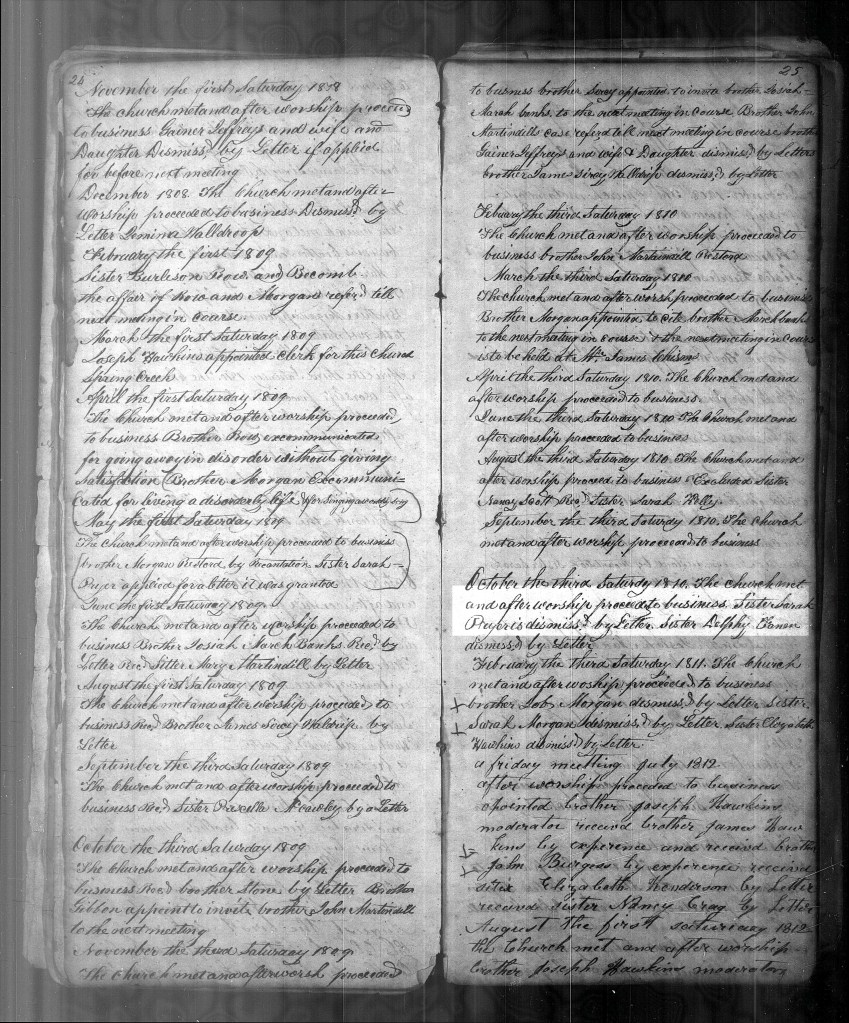
Sarah Odle Pryor continues appearing in the minutes of Spring Creek Baptist church in Jackson County from its formation in July 1802 up to the 3rd Saturday in October 1810, when church minutes show her receiving a letter of dismission. A list of members made on the 3rd Saturday in 1804 and another made in 1805 show her continuing as a church member in those years, and on 1 January 1808, church minutes state that she had been paid 12 cents for supplying wine for the Lord’s Supper celebration. The fact that Sarah is in Spring Creek Baptist minutes from July 1802 through October 1810 is a very good indicator that Joseph and Sarah Odle Pryor were living in Jackson County during that time frame.[25] The October 1810 dismission letter for Sarah at Spring Creek church suggests to me that at this point, the family was making plans to move to Warren County, where, as noted previously, Joseph acquired 100 acres on Charles Creek of Collins River on 11 June 1811 with the deed stating that Joseph lived in Warren County.
To sum up: when you encounter a puzzling gap in records as you research the migrations of an ancestral family, if you determine that gap was due to the loss of records in a place in which your family lived, don’t overlook church records as a way to address that gap. Tennessee state-level land records add further confirmation that Joseph Pryor lived in Jackson County in his “lost” period from 1802-8. They show, in fact, that he and his wife Sarah’s brother Enoch Odle lived on adjoining tracts of land.
But it’s the Spring Creek church minutes that provide the essential piece of information we need to place this family in Jackson County in this time frame, since, by naming Joseph’s wife Sarah, the church minutes allow us to sort this particular Joseph Pryor from other Josephs who seem also to have been living in Middle Tennessee counties at this time.
If you’re lucky enough to find surviving church minutes for ancestors who trekked across the states of the old southwest in the first half of the 1800s, those minutes can fill in important pieces of your gap. Comb published histories of your problem counties, books and journal articles discussing the formative years of those counties, to see if you can spot mention of extant church minutes. As you do a locality church for a particular county in the FamilySearch catalogue, don’t forget to click on the categories “church history” and “church records.”
When you find that the church records you need do exist, then look to see both what transcriptions of those records are available and whether there are digital or microfilmed copies of the originals. Transcriptions are invaluable and very helpful, but it’s important always to read the original minutes with your own eyes, when you have a chance to do so, since transcribers sometimes miss or misread things.
Look at the holdings of state archives and state libraries, too, to see what church minutes may have ended up there, or at archival holdings of colleges and universities that may specialize in collecting church minutes — e.g., the special collections and holdings of Furman University Library in Greenville, South Carolina, which has a rich repository of Baptist church records. Also search for regional or localized archival holdings: after years of searching to find the original minutes of Bethel Baptist church in Tuscaloosa County, Alabama, which Sarah Odle Pryor joined by letter in November 1819, I finally found those minutes at the Western Alabama Heritage Learning Center in Northport, whose staff graciously let me read and copy portions of those minutes.
The information you’re seeking and not finding may well be out there, if you only look in the right place….
[1] “Joseph Pryor of Tuscaloosa County, Alabama,” Roots & Branches 50,3 (August 2025), pp. 12-21.
[2] Joseph Pryor made his will in Tuscaloosa County on 22 September 1851 (Tuscaloosa County, Alabama, Will Bk. 1, p. 286). On 15 December 1851, John Pryor and Zachariah S. Simpson gave bond in the amount of $32,000 as executors of the will (Tuscaloosa County, Alabama, Orphans Court Minutes, 1850-4, p. 380; and Probate Court Bond Book 1850-1853, p. 75).
[3] Bourbon County, Kentucky, Court Order Bk. K, p. 292; Bourbon County, Kentucky, Will Bk. B, p. 330.
[4] Warren County, Tennessee, Deed Bk. B, p. 228. The bill of sale was entered 11 June 1816 and recorded 11 July 1816.
[5] C.P Cawthorn and N.L. Warnell, Pioneer Baptist Church Records of South-Central Kentucky and the Upper Cumberland of Tennessee (n.p., 1985), pp. 421f; W.J. McSween, Early Recollections of Newport and Cocke County, (Newport Times, 1903); Ruth Webb O’Dell, Over the Misty Blue Hills: The Story of Cocke County, Tennessee, p. 150, transcribing the original minutes of the Big Pigeon church; Elizabeth Pryor Harper, Twenty-One Southern Families: Notes and Genealogies (Albuquerque, 1985), p. 149. See also Katherine Reynolds, Index to the Minutes of the Big Pigeon Baptist Church, 1787- 1874, prepared in 1968 for the Samuel Sorrell chapter of DAR, Houston, Texas.
Baptist churches in the South were strongly influenced by the Calvinist theology and practices of the Presbyterian churches to which not a few Baptist families had belonged prior to moving onto the frontier in the late 1700s and early 1800s. It was a common practice in Presbyterian churches to issue letters of dismission or disjunction as people moved from one place to another. Those letters allowed a church member to join another church of the same affiliation when she/he arrived at a new place of residence. As William J. Roulston states in Researching Presbyterian Ancestors in Ireland (Glasgow: Bell & Bain, 2020),
“A member of one congregation who wished to move to another could apply to the Session for a transfer certificate testifying to his or her good standing in the church. This was a handwritten document, signed by the minister and at least some of the elders. They are also known as testimonials and certificates of disjunction” (p. 95).
[6] Greene County, Tennessee, Deed Bk. 6, pp. 432-3, and Sumner County, Tennessee, Deed Bk. 1, p. 229.
[7] Logan County, Kentucky, Court Order Bk. A-1, p. 67.
[8] Logan County, Kentucky, Deed Bk. C, pp. 467-470.
[9] See Warren County, Tennessee, Deed Bk. A, p. 317. The deed is erroneously listed in the index to the original deed book as Richard Cantrell to Joseph Priest; the deed itself gives the surname as Pryor and states that both parties lived in Warren County. On 25 May 1813, Joseph Pryor then purchased a second tract of 100 acres on Charles Creek, this land purchase being from Charles Sullivan (ibid., p. 388). Warren County’s seat, McMinnville, is directly south of the junction of Charles Creek and the Collins River.
[10] Jefferson County, Tennessee, Will Bk. 1, p. 45.
[11] Ibid., and Washington County, Tennessee, Court Order Bk. 1, pp. 361-2.
[12] The original marriage bond is on file in the loose-papers marriage files of Greene County, Tennessee. I have never been able to figure out to which Greene County Pryor family Catherine belongs. She can’t have been the daughter of Richard Pryor and Mourning Thomson, since she and Enoch Odle do not appear among the estate heirs in 1811 when the heirs signed a deed selling their portion of Richard Pryor’s land to Jonathan Pryor. Her tombstone in O’Dell cemetery in Wright County, Missouri, says that she was born in 1780 in Tennessee: Find a Grave memorial page of Catherine Pryor Odle, O’Dell cemetery, Wright County, Missouri, created by D.R. O’Dell, maintained by Stacey Muldering, with a tombstone photo by D.R. O’Dell. Note that Tennessee did not become a state until 1796.
[13] Tennessee State Library and Archives, Tennessee Legislative Petitions, Legislative Petition Smith County Residents, 1 January 1801. I’m grateful to TSLA for providing me with a digital copy of the original petition.
[14] Petition Sundry Inhabitants South of French Broad, North Carolina General Assembly Session Records, box 4, folder 81 at the North Carolina Archives — see Roberta Estes, “Petition Sundry Inhabitants South of French Broad,” at the Native Heritage Project website. See also Vanessa Wood, “Signature William Pryor and Joseph Pryor on French Broad Petition,” at her former Tennessee Pryors website. This posting has a digital image of the signatures of William and Joseph Pryor.
[15] The signature of Joseph Pryor on the 1789 Greene County petition and on the 1799 Greene County bond for Enoch Odle’s marriage to Catherine Pryor is not a perfect match — the initial J in the two signatures is somewhat different — but the two signatures are close enough that it seems clear to me they are the signature of the same man. Both signatures slant noticeably to the right; both use the old-fashioned medial S that looks in some renditions like an F; both have the same shape for the letter P in the surname; and both sign the surname Pryor as Pryar.
[16] On 8 October 1796 in Greene County, Joseph Pryor Sr. sold 200 acres south of the Nolichucky in Greene County to Joseph Pryor Jr., with the deed specifying the Sr. and Jr. designations and stating that both lived in Greene County: see Greene County, Tennessee, Deed Bk. 2, p. 61.
[17] A microfilmed copy of the tax list is in “Early Tax Lists of Tennessee” at the Tennessee State Library and Archives. Digital copies are available in Ancestry’s collection Tennessee, U.S., Early Tax List Records, 1783-1895. A transcription of the 1803 Jackson County tax list is at Jame Paessler, “Jackson County 1803 Tax List,” Ansearchin’ News 42,3 (fall 1995), pp. 113-115. See also Vanessa Wood’s commentary at “Tennessee Counties — J,” Tennessee Pryors website.
[18] A microfilmed copy of the tax list is in “Early Tax Lists of Tennessee” at the Tennessee State Library and Archives. Digital copies are available in Ancestry’s collection Tennessee, U.S., Early Tax List Records, 1783-1895.
[19] The original church minutes covering the years 1802-1868 but excluding the Civil War years are available digitally via FamilySearch. A transcription by J. Hobart Bartlett and Jane K. Wall entitled Minutes of the Spring Creek Baptist Church of Jackson and Overton Counties, Tennessee, 1802-1868 (Excluding the Civil War Years) (n.p., n.d., perhaps 1970s), is also available digitally at FamilySearch. Bartlett and Wall state that when they transcribed these church minutes, the original minutes were in the hands of Sanford Byrom Smith of Hockessin, Delaware. They had passed to his mother Leonore Byrom Smith when her husband Lewis Kerry Smith died. Prior to that, they appear to have been in possession of Lewis Kerry Smith’s grandfather Daniel Morgan Morgan.
[20] “Spring Creek Baptist Church,” Historical Markers Database site, a page originally created by Duane and Tracy Marsteller.
[21] See supra, n. 5.
[22] “Samuel Job — Dorcas McKay,” My Jobe Ancestors. When people moved away from a Baptist church, they received letters stating that they were members in good standing, and when they arrived at a new place and joined another Baptist church, they would then be accepted by the new church on the basis of that letter: they “moved their letter” to the new church.
[23] C.P Cawthorn and N.L. Warnell, Pioneer Baptist Church Records of South-Central Kentucky and the Upper Cumberland of Tennessee, p. 514.
[24] Lewis Kerry Smith’s article has been clipped and preserved in Garland Draper’s Historical Scrapbook of Jackson County, Tennessee, available digitally at FamilySearch.
[25] The minutes of Spring Creek Baptist church show “Darcas” Job dismissed by letter on the 6 April 1805 and the church’s 1805 membership list confirms that she had a dismission letter in that year. From 1805-8, the family of Samuel and Dorcas McKay Job appears in Jackson County and White County, Tennessee, records.


Thank you for taking the time to research this and write about it. I am a descendant of Zachariah Simpson and thus, the Sarah Pryor and family you are writing about. Much of this I did not know but will try and incorporate it into my ancestry.
You also provided me with a key piece of information, for which I have been looking for a year or so. Some of my other Clements and McGee relatives had an intertwined history with Bethel Baptist Church from its earliest days. I have tried to contact the current church through calls and emails, but I haven’t received any return call. I currently live in Tuscaloosa and just returned from a Tuscaloosa Genealogical Society Meeting when I found your article. I am looking forward to reading your “prior” article on Joseph Pryor and Zachariah Simpson. I sincerely appreciate your time, research, effort and scholarship which are invested in producing a piece like this.
LikeLike
Thanks so much for letting me know my postings and articles about our shared ancestor Joseph Pryor are worthwhile. I am now planning one about Zachariah S. Simpson, which I’ll send to the Tuscaloosa County genealogical group for publication. You probably know that Jacob Clements and Frances Sims Simpson joined Bethel Baptist church in 1823 — and that Frances was Zachariah S. Simpson’s mother by her unidentified Simpson husband. I had known that the McGees connect to the Clements kinship network through the marriage of Gabriel Clements and Barsheba McGee, whose son Thomas married Z.S. Simpson’s daughter Elizabeth. Bethel Baptist church is no longer in existence, as far as I know. The original church organized in 1818 was at the falls of the Black Warrior River. The church now called Bethel is about 5 miles northeast of Tuscaloosa on Watermelon Road and is a Presbyterian church. The original Bethel Baptist church minutes are at the West Alabama Heritage Learning center in Northport. In 2024, the staff there kindly let me read through the original minutes on a visit there. I hope this is helpful information and am glad to hear from you.
LikeLike
I actually live about a quarter mile from the current iteration of the Bethel Presbyterian church on Watermelon Rd. Gabriel Clements and Barsheba McGee Clements are my 4xGGParents, but I am not certain of where they are buried. Barsheba died in Missouri, evidently leaving Tuscaloosa after Gabriel’s death. Gabriel filed a claim with the Southern Claims Commission after the Civil War and was paid by the Government for 2 horses taken by Croxton’s Raiders on their way through this area to burn the University of Alabama. His estate was paid, as his son, Thomas (my 3xGGF) pursued the claim after his father’s death. Evidently, Gabriel was a Union loyalist and the Confederates jailed him until his 3 fighting age sons volunteered to sign up for the CSA military. Barsheba’s father, David McGee was a Rev. War Veteran, so I don’t think the family wanted any part of the war.
All of that was a roundabout way of getting back to my interest in the Bethel Church records. I know some of Barsheba’s brothers were involved with the church, so I was hoping she might be mentioned in the documents. Barsheba and Gabriel’s Grandson through Thomas Clements and Elizabeth Simpson, Alonzo Berkley Clements and his wife Frances Elzadia Dunn Clements (my paternal grandmother’s maternal grandparents) are interred at Bethel Cemetery very close to the flagpole, so I drive by them a lot. LOL! I did not know that Jacob and Frances Clements were members of Bethel. That is even better for me.
I was aware of Zachariah Simpson’s mother marrying Jacob Clements but I get a little confused because somehow Zachariah is the uncle to his half-brother’s children who then they marry sisters of Elizabeth Pryor, which makes him their children’s uncle through the Pryor side? So, he is their uncle on both sides? I haven’t really studied it lately.
I am from a family tree with several instances of having double cousins due to several sets of siblings marrying another family’s set of siblings. One would think I would understand it better, but I think it’s analogous to not looking too directly into the sun or it might blind me. My brain goes blue screen at that point. It is either too complicated or too close for me to handle. Haha!
I can’t wait to see what you have in the article about Zachariah. Thanks again for everything.
LikeLike
There was a strong, thickly interconnected kinship network of Unionist families in northern Tuscaloosa County during the Civil War. As you say, a claim was filed on Gabriel Clements’ behalf with the Southern Claims Commission, attesting to Gabriel’s loyalty to the Union. His son Thomas Clements who married Elizabeth Simpson filed the claim. Thomas Clements filed a similar claim on behalf of the estate of Zachariah S. Simpson. In his claim on behalf of his father Gabriel, Thomas Clements stated that in May 1864, his father was arrested and placed in jail in New Lexington, and those arresting him tried to force him to place his sons in the Confederate Army. He was released only when sons Mannen, Solomon James, and David surrendered themselves at New Lexington and were forced into the CSA. Thomas also testified that those doing all of this threatened to burn Gabriel Clements’ place down in March 1864 if his son Thomas did not enlist in the CSA. Thomas Clements testified that Gabriel said he’d rather die than take an oath of loyalty to the Confederacy.
John Hamner also gave testimony on behalf of Thomas Clements’ claim, saying he had known Gabriel Clements for 40 years and that Gabriel “was arrested and put in Jail and his property was threatened to be burned, all because he was a loyal man to the government of the United States.” Hamner says that there was “not a more determined [Union] man in the whole South than Gabriel Clements” up to his death, which occurred in September 1867.
C.H. Lunceford corroborated what Thomas Clements and John Hamner had said.
After the war, Gabriel left Tuscaloosa County due to the harassment he and his family had experienced. He made a will in Laclede County, Missouri, on 25 July 1867, and it was filed there on 10 December 1867, so it’s clear he died there between those two dates.
Among those filing Unionist claims and living in that part of Tuscaloosa County was also my g-g-grandmother Elizabeth Ann Winn Braselton, who testified that she had kept her son Walter out of the Confederate Army and had fed men hiding in the woods to avoid conscription into the CSA. Her son Jackson ended up joining the CSA under duress. Elizabeth’s cousin Judge Richard D. Winn voted against secession at the Secession Convention in Georgia and after the other representative from Gwinnett County changed his vote when it became clear the state would secede, Richard D. Winn refused to do so. Elizabeth’s first cousin Thomas Posey McConnell, who represented Fayette County in the Alabama legislature, also voted against secession.
Some years ago, Gene Armistead, who was descended from a number of families in the northern part of Tuscaloosa County, was preparing to write a published study of all the Unionist families in that part of the county and their connections to each other. The connections were thick and as you say, definitely confusing. You’re exactly right that Zachariah Simpson was a “double uncle” to the children of Joseph Pryor who married children of Jacob Clements and Frances Simms. My great-grandfather Mannen Clements Simpson, son of Zachariah S. Simpson and Elizabeth Pryor, was named for his uncle Mannen Clements, who was an uncle both as the half-brother of Z.S. Simpson and as the husband of Elizabeth Pryor’s sister Nancy! Very confusing. Z.S. and Elizabeth Pryor Simpson also named a son James Clements Simpson, for another half-brother of Z.S. Simpson and for James L. Clements who married Elizabeth Pryor’s sister Sarah. My family tree is full of double cousins, too. Just today, I’ve been texting several cousins whose grandparents were both first cousins of my mother, on both sides of my mother’s family.
LikeLiked by 1 person
That is awesome history to know. My 86-year-old father and his 86-year-old double second cousin grew up together in Alberta, as they shared the same four grandparents, they are very close. I will send your story to them so they can enjoy it, as well. I have been transcribing as a volunteer with the National Archives and Records Administration and worked on some of the records about Gabriel’s Estate Claim with the Southern Claims Commission, so I am familiar with the story.
Also, I transcribed some records on General Croxton about a horse rustling and fraud ring being run by some of Croxton’s underlings during the Civil War. So, as it turns out, the horses taken from Gabriel, may have been involved in that scheme. The Commission looking into it, deposed several of the soldiers involved and they were trying to implicate Croxton. But, as I was transcribing the situation, there is a point where the file goes missing and it seems to just get dropped. I had never hear nor read anything about that before and don’t think it was searchable before I transcribed it last year. I was not surprised they didn’t charge anyone. as that is the way the fog of war works, but I thought it interesting.
I remember reading the story about your g-g-grandmother Braselton hiding her son from the Confederates. It has changed my view of my ancestors and their war leanings. Seems I had relatives with quite disparate feelings about it but only one side was spoken of. The strange thing about Croxton and my family is that he took horses from my father’s mother’s Clements family and then marched his men to Pickens County and camped out at the store, The King’s Store in Pleasant Grove, of some of my dad’s paternal ancestors, Williamson Riley King (who had died before the war) but was run by his wife, Martha Bonner King and their children. Croxton reallly got around. The next day, they had the “Skirmish at King’s Bridge or Pleasant Ridge” and that may have been one of the last engagements of the Civil War, if I remember correctly.
It’s a pleasure messaging you. I will look forward to your continued research and scholarship!
LikeLike
You’re very fortunate to have those elders in your family, to share stories they may have heard and information passed down to them. Yes, I had noticed some conflicting strands of information provided in the testimony of those supporting Thomas Clements’ Southern Claims Commission filing on behalf of his father Gabriel. Some testimony seems to suggest that it was Union soldiers who jailed Gabriel in New Lexington. Others report that it was Confederates who placed him in jail. Since he was being threatened because he had kept his sons from conscription in the Confederate Army, it wouldn’t seem to make sense to have Union soldiers placing him in jail, though. Much of the testimony given in these claims filed in northern Tuscaloosa County does have to do with horses taken from farms by Croxton’s raiders. I think that’s understandable since the commission was set up to reimburse families who were Unionists and lost property to the Union Army during the war. People were trying to establish that their horses had been taken by Croxton’s men, and lots of testimony states where the horses ended up. My Elizabeth Ann Winn Braselton, who filed a claim (which was honored, by the way), us buried at New Lexington in Campground Methodist cemetery with her her parents John Alexander Winn and Laodicea/Dicey Horton Winn. I suspect that, because there was contention among neighbors who had conflicting loyalties during the war, people tended to stop talking about who took what side in the years after the war ended, and that resulted in many of us raised in the Southern states assuming that our ancestors were uniformly Confederate. I was very surprised to discover quite a few Unionists in my family. My grandmother had an Irish-born uncle who had been in the war and lost an eye, I knew from family stories I heard as a child. For years, I thought he must have been a Confederate soldier since he lived south of Little Rock in the part of Arkansas that was most Confederate-leaning. Then I found that he had gone as a boy, really, and joined the Union Army in Little Rock, and that he and his wife had filed a pension claim on his behalf, with a file full of fascinating and valuable genealogical information. In northwest Louisiana, where my father’s family lived, there was horrible violence for years after the war, with people whose families had supported the Union or who were collaborating with Reconstruction leaders being murdered and driven out of the state. In western Arkansas, where a brother of my g-g-grandfather moved from West Tennessee following the war, there was similar violence, with people using the excuse of political differences to settle old scores by killing folks. That brother of my g-g-grandfather had been a Unionist in Hardin County, Tennessee, and he wrote in his diary after he moved to Arkansas that in all his years growing up in Tennessee, he had not seen the kind of violence, shootings and stabbings, that he saw in only one year in Arkansas. Much of his medical practice was sewing men up who had been stabbed, shot, or clobbered, often following a dance at which lots of whiskey was flowing.
LikeLike
I think that was Laudanum that they drank before they danced. Hahaha! One of my Dunn relations grew poppies at his place, or so it was told, to make laudunum and supply his opium habit. All of that is allegedly, of course.
I knew there was an odd county that did not vote to secede in Alabama during the secession times, but I just assumed everything was calm and back to the business of living after the war. This morning, I was looking through the old Tuscaloosa newspapers from not long after the war and it mentioned that the town administrators elected by the newly expanded electorate had not established good order yet in the county. I found a couple of articles which confirmed an old story told to us about some of the Dunn’s in Dunn’s Beat near Windham Springs. I am sure you have heard it before. The first part has not been mentioned in any paper article, but it was told that Jap Dunn killed one of his nephews for stealing an onion out of Jap’s garden. The rest was in the paper where, Ozze (Osse) Dunn and another brother John went to avenge their brother’s murder. Apparently, Ozze shot his Uncle Jap and Jap shot Ozze at close range killing him. As Jap was trying to get away from there, John walked over and ended Jap’s time on Earth with a shot to the head. I see where John fled and the law captures him in Memphis a little while later. I haven’t gotten to the trial yet, but he was in custody in Montgomery from the last I found.
It sounds like your ancestor was not exaggerating about the violence and lawlessness in the Reconstruction South. And you’re probably right that people likely didn’t talk about sides after the South lost the war. Even after 160 years, some families are still in pain or less than ideal circumstances after the losses incurred during the war. I know one of my family lines from Perry County lost one 18-year-old son in an accident the year before the Civil War and then the last 3 sons died during Civil War battles. The only ones left after the war were the oldest men and the women. Their paternal line died on the fields of smoke and steel during the war.
Another tidbit I ran across in the papers was when the Feds arrested several of the scions of Tuscaloosa Pioneer families for counterfeiting. It seems one of them was one of my 3xGGF, ES Dunn. Supposedly, they found stacks of counterfeit greenbacks at his home when they went to arrest him. They had court in Huntsville but I don’t think ES Dunn showed up or he was let out on bond. Whatever the case, he ran from justice. The last I found was a blurb saying that the US Marshalls caught him in Arkansas and returned him to jail in Montgomery.
Now, I have to find those cases and find out what happened. Have a great weekend!
LikeLike
Laudanum was definitely the go-to remedy for all sorts of ailments in the diary Dr. Wilson Bachelor kept from 1870, when he left Tennessee for Arkansas, up to not long before his death in 1903. I’m always surprised when I read his diary how freely he gave laudanum to his patients (and also used it himself). You’re exactly right that it’s an extract of poppy seeds.
Your Dunn stories are fascinating. I do see lots of references to Dunn’s Beat near Windham Springs as I work on my (and your) families in Tuscaloosa County. Unless I’m mistaken, Alonzo Berkley Clements, a son of Thomas Clements and Elizabeth Simpson, lived at Windham Springs, and married Frances Elzadia Dunn. Their son William Houston Clements then married Martha Ann Christian, whose grandmother was a Dunn, and William and Martha had a son Herman Wiley Clements who married Lela Belle Dunn!
The violence and threats of violence stemming from the Civil War did continue in Tuscaloosa County after the war. My g-g-grandmother Elizabeth Ann Winn Braselton had an uncle Abner Winn, who was a Methodist minister in Northport and who represented the county in the state legislature. In his will, Abner stipulates that he wanted his widow Nancy Adaline Cook to allow an enslaved man Jerry to buy his freedom. Jerry was Jeremiah Abner Winn, son of a Jack Winn on whose behalf Jeremiah filed a Southern Claims Commission claim. This Winn family had a blacksmith business in Northport, and Jack Winn and his wife Lucy belonged to Abner Winn’s father Abner Winn Sr. and wife Lucretia/Lucy Posey Winn. At Abner Sr.’s estate sale, Abner Jr. bought Jack and Lucy and at some point prior to 1860 had freed them or allowed them to buy their freedom.
One of the people testifying on behalf of Jeremiah Winn’s Southern Claims Commission claim was James Wiley Shepherd, who also served in the Alabama legislature. James’ sisters Elizabeth and Barsheba married sons of Zachariah Simms Simpson and Elizabeth Pryor — Richard A. Simpson and Joseph Pryor Simpson. In his testimony, James W. Shepherd states that he had been threatened for supporting the Union and had to buy a gun to protect himself. The threats evidently continued after the end of the war. I also find several newspaper articles in Tuscaloosa papers after the war, when Jack Winn’s family members were assisting freed formerly enslaved people to register to vote, calling for violence against the Winns, calling for their blacksmith shop to be burned down — and I think it did get set on fire at least once.
We’ve forgotten much of this history, because it complicates simplistic black-white narratives. There were also strong kinship networks of Unionists in Franklin and Colbert Counties, Alabama, I’ve found. A branch of my Lindsey family from Spartanburg County, South Carolina, settled in Franklin County and were all of them Unionists during the war — though it infuriates some of their descendants that I have publicized information from the Southern Claims Commission files showing this. My approach to history is that history is what happened, not what we imagine happened or want to have happened. I’d much rather know what actually happened than pretend and make things up. Very much enjoy your comments here, too!
LikeLike
My little puddle of knowledge doesn’t deserve to be in the same room with the deep reservoir of history which you have flowing through your brain, but I am always ready to learn. I appreciate your responses and the info that comes with it.
The Christian and the Clement Families with a Double or Triple Portion of Dunn should be the title of a book. LOL! I was not aware of William Houston Clements marrying Martha Ann Christian. Not sure how to start, but I will see if I can make sense of it.
Frances Elzadia Dunn (wife of Alonzo Bekley Clements) and Peggy Jane “Sis” Dunn (wife of Samuel Cecil “Sam” Christian) were 2nd cousins, as their grandfathers, Daniel Dunn and Winton William “Wint” Dunn respectively were brothers. The Clements family had 11 children, and the Christian family had 12 children. 3 of the Clements siblings, Lula (my great grandmother), Corrie Lee and John Preston Clements married 3 of the Christian siblings, Marion Jackson “Jack” (my great grandfather). Thomas Edward “Tom” and Mary Frances Christian. So, their children were 3rd cousins to the other children through their Dunn mothers, and it follows that the progeny of that generation of 23 siblings were all 4th cousins to each other, 1st cousins to each other and the issue from the 3 sets of C&C marriages would be double 1st cousins.
From what I understand about William Houston Clements marrying Martha Ann Christian, William Houston Clements was a sibling of Lula, Corrie Lee and John Preston Clements. And Martha’s grandmother, Martha Jane Emeline Dunn (Banks) would have been Houston’s Dunn grandfather, Edley S Dunn’s 1st cousin. I think I have that right.
Additionally, Martha’s father Edward David “Ned” Christian was one of my 3xGGF Jesse Francis Christian’s brother. Ned was a Captain in Freemean’s Tuscaloosa Prison Guards during the civil war. Jesse Francia and two of my Clements kin were part of their regiment, too.
One of Edward David “Ned” Christian’s grandsons lives in Seattle around Puget sound and is 90 y/o. I met his son Kris Christian through one of the DNA sites and he, Lige and I got on a Zoon call one sunday afternoon. It is so fascinating to me that Lige is a living grandson of a Civil War Vet. talked for almost 3 hours. At 90, Lige Christian is as sharp as a tack and quite the card. Lige said he graduated from HS and went to University of Washington when he was 19 y/o. He said he fell in love with a midwestern farm girl while at school and never returned home.
Have a great week!
LikeLike
You’re kind to say I have some knowledge. I suspect I’m very much a dilettante. My notes about William Houston Clements and wife Martha Ann Christian cite an article entitled “History of the Historic Clements House” by an unidentified author, which is found in the Clements Surname File at the West Alabama Heritage Learning Center in Northport. I did some research there in May 2024 and found that article at that time. Just as you say, Martha was the daughter of Edward David Christian and Mary Ann Banks. You probably know that William taught school at Windham Springs and operated a resort hotel, general store, and farm there. And that he was a U.S. marshal and j.p.
The thick kinship web and intermarriages of these families in the upper part of Tuscaloosa County make my head spin — cousins marrying cousins. James Clements Simpson, son of Zachariah Simms Simpson and Elizabeth Pryor, went from Tuscaloosa County to Slate Spring in Calhoun County, Mississippi, as a young man. In moving there, he was following Elizabeth’s brother Samuel Odle Pryor and wife Unity Fox. The Fox family also moved from Tuscaloosa County to that area of Mississippi.
James Clements Simpson then married Samuel and Unity’s daughter Phebe Ann Pryor — James’s first cousin. You probably know that the Freemans are part of this kinship network, too: Boswell M. Freeman married Sarah Alexander, daughter of Thomas Alexander and Rachel Pryor. Thomas and Rachel’s son John Alexander married Editha Russell Freeman, a daughter of Boswell Freeman by his first wife Anna Maddox. And Martha Alexander, sister of Sarah and John, married Editha’s brother Boswell M. Freeman (Jr.). But I may be misreading what you wrote, since it refers to Freeeman! Wouldn’t be the first time I’ve gone off on a tangent.
The Christians and I think the Freemans also came from Laurens County, South Carolina, to Tuscaloosa County, Alabama, as did Jacob and Fannie Simms Clements and her son Zachariah Simms Simpson. You have distinguished Tuscaloosa County ancestors, with the Christians of the Shirley-Christian house in Northport, and William Houston Clements of the Clements house. Lige Christian sounds like a very interesting and admirable cousin to have.
LikeLiked by 1 person
Your knowledge is definitely broader than mine. I respect that. I am still learning a lot. This endeavor has renewed my sense of pride in my country and humility from understanding what sacrifices and pain accompanied our forebearers on their journeys. Dilettante or not, gaining the level of knowledge you have is laudable.
I do not know a ton about any individual family members other than my direct line ancestors. I am working on filling out details, but even with rampant endogamy, one’s family of two joined surnames explodes into myriad threads in the tapestry of our kinship stories.
I had a question or two about some things into which you might have insight or knowledge. If it is alright, I will email the contact email here, as I don’t want to embarrass myself or my kinfolk. LOL! If that doesn’t work, I will come back here and ask you.
LikeLike
I’ll be happy to have you email me! Will look forward to reading your email.
LikeLike
I sent one and located what I was trying to find. The second email I typed part of an article listing the people arrested in the counterfeiting ring. Its network went from St Louis to Tennessee to North and South Alabama. And they insinuated that the people involved were from well-known or prominent families in these towns. I wanted to send you the names to see if you recognized any of them. There might be a Lorens County Cosa Nostra or Cecil Maryland Mafia or something. I figured you might recognize them if they were interrelated. One thing I forgot to mention. Frances Elzadia Sunn’s mother was Sarah A Simpson (1838-1908) but I do not think she is related to her husband’s, Alonzo Berkley Clements, mother Eizabeth Simpson (1830-1870). My tree has errors in it though, so I wouldn’t be completely shocked to find out they were cousins.
LikeLike
The counterfeiting ring is new to me, and fascinating. I think you’re right about Frances Elzadia Dunn’s mother Sarah Simpson: she belonged to a Simpson family in Tuscaloosa County with Kentucky roots, not the South Carolina roots of Zachariah Simms Simpson. I had just emailed you something about that very matter before reading this comment.
LikeLike