Established Factual Information about Milbury Mauldin
1. The 27 September 1962 DAR affidavit of Mattie Conwill Murphy discussed previously, which reports information given to Mattie Murphy by two other descendants of John Lauderdale and wife Milbury in the 1940s, states that John Lauderdale’s wife was Milberry Maulden [sic], and that John and Milbury were the parents of Sarah M. (married Thomas Leonard), James Henry, Josiah Mauldin, and John Gammel Lauderdale.[1]
2. An 1891 Goodspeed biography of John and Milbury’s grandson Abner Driver Lauderdale also discussed previously states that Abner’s father John Gammel Lauderdale was son of John and Millie Maudlin [sic] Lauderdale.[2]
3. As we’ve seen, John Lauderdale’s wife Milberry (as her name is spelled in this document) signed a deed on 23 March 1791 in Pendleton County, South Carolina, when she and John sold the land on which they had previously lived in Wilkes County, Georgia.[3]
4. As we’ve also seen, on 7 November 1796 in Pendleton County, South Carolina, John Lauderdale and wife Milbury (the spelling used in this document) sold land in Pendleton County, with Milbury again signing, this time by mark, and with the deed stating that she was John’s wife.[4]
5. The DAR affidavit of Mattie Conwill Murphy cited above states that the family of John Gammel Lauderdale moved to Tennessee from Pendleton District, South Carolina, in 1806 and from Tennessee to Limestone County, Alabama. “The family of John G. Lauderdale” means, of course, his parents John and Milbury Mauldin Lauderdale, since John G. Lauderdale was only eight years old in 1806.
6. The minutes of Round Island Baptist church in Limestone County, Alabama, show Milbury Lauderdale taking the position of church clerk in 1836. If the fact that Milbury signed a deed in November 1796 by mark means that she was illiterate then (though she apparently signed her name to a March 1791 deed), she would have been literate by 1836 in order to serve as clerk of Round Island Baptist church.
7. John and Milbury Lauderdale are said by tradition passed down among their descendants to have moved from Lincoln County, Tennessee, to Limestone County, Alabama, in 1819, though John remains on the federal census in Lincoln County in 1820.
8. John and Milbury made the move to Limestone County with three of their four children — Sarah, Josiah, and John G. Their son James moved in the same year with his Henry in-laws from Tennessee to Tuscaloosa County, Alabama.
9. John Lauderdale and wife Milbury are, it seems clear, an elderly man (aged 80-89) and woman (aged 60-69) found in the household of their son John Gammel Lauderdale in Limestone County on the 1830 federal census.[5] In 1840, this elderly couple are no longer in John G. Lauderdale’s household. Both seem to have died in Limestone County between 1830 and 1840, Milbury after assuming position of the Round Island Baptist church clerk in 1836.
In addition to this good stream of facts pinning down Milbury’s whereabouts from the early 1790s up to the 1830s, from Pendleton County, South Carolina, to Limestone County, Alabama, there are also the two deeds John Lauderdale made in January 1795 in Pendleton District to his children Sarah and James (see here and here), stating that he had wasted £100 given to them by their grandfather and was deeding each of them half of his land to pay for what he had squandered.[6] The deeds do not mention Milbury, but her father John Mauldin and brother Harris Mauldin witnessed these deeds.
The Mauldin connection to this deed make it obvious, I think, that the grandfather whose bequest to his children John had wasted was their grandfather John Mauldin, who had given £100 to Sarah and James Lauderdale while he was still living. And it also seems plain to me that Milbury’s Mauldin relatives forced her husband to take this step of placing his land in the hands of his small children since he had wasted money given to his children by their Mauldin grandfather.
Bizarre Counterfactual Information about Milbury Mauldin Published Online
With all this clear, documented information about Milbury, it’s astonishing to find the following when one googles “Milbury Mauldin” or “Millbury Mauldin”:
1. A Find a Grave memorial page for her saying she was born in Scotland in 1722 and died in Botetourt County, Virginia, apparently before 1790, with a linked page for her husband John Lauderdale stating that he was born in Ireland in 1713 and died in 1790 in Blount County, Tennessee. Connected to these two Find a Grave pages is a list of children the REAL John and Milbury Mauldin never had. Milbury never set foot in Scotland or in Virginia. She was born in Granville County, North Carolina, between 1760 and 1770. As we’ve seen, John Lauderdale was born in Virginia in 1745 — not in 1713. Nor did John die in 1790 As the deeds cited above and other documents tell us, John was alive and well in Pendleton District, South Carolina, up to 1806, then he went to Tennessee and finally to Alabama, dying there after 1830.
2. A WikiTree page with the same ludicrously wrong information as given in the Find a Grave page I’ve just discussed. This page states that Milbury died 11 February 1747 in Augusta County, Virginia!
3. A FamilySearch Family Tree page with this very same astonishingly wrong information giving Milbury another name found in no document anywhere — Margaret Millbury Mauldin.
4. Family trees at Tim Dowling’s Geanet site and WeRelate that repeat this totally wrong information, including the incorrect February 1747 death date for Milbury.
And so it goes, page after page of preposterous information about Milbury, information easily disproven by the documents I’ve discussed above….
Milbury’s Birth, 1760-1770, in Granville County, North Carolina and Marriage abt. 1785 to John Lauderdale in Wilkes County, Georgia, or Pendleton County, South Carolina
How on earth could John Lauderdale’s wife Milbury have died in 1747 in Virginia and John have died in 1790 in Tennessee when he and wife Milbury were alive and well in South Carolina in the 1790s deeding land together and both signing their deeds? And when every piece of information about Milbury shows her in South Carolina, then Tennessee, and finally in Limestone County, Alabama, how could she possibly have been connected to Botetourt County, Virginia, when there’s no record anywhere ever showing her in that county or in its parent county of Augusta?
I have not found documented evidence of exactly when Milbury Mauldin was born. In an FGS chart compiled in April 1997, Lauderdale researcher Nancy Breidenthal of Sandpoint, Idaho, who provided me a copy of this chart, gives Milbury a birthdate of 13 March 1760. The chart does not cite a clear source for this evidence, but states that the information came to her from Penelope Culver of West Helena, Arkansas, who was citing information from Ruth Porter Maxfield, a niece of Mattie Conwill Murphy, whose September 1962 affidavit about John Lauderdale and his family was discussed above.
Nancy Breidenthal’s FGS chart also indicates that her information about Milbury Mauldin came from a lineage chart compiled by Mattie Conwill Murphy’s daughter Christine Murphy Land, published in a collection of lineage charts compiled by the South Carolina Genealogical Society. As a previous posting notes, the family bible that passed down from John Lauderdale among his descendants went from Mattie Murphy to her daughter Christine and in 1992, belonged to Christine Land’s daughter Nancy Baldwin Land. The bible register as transcribed by Mattie Murphy for her September 1962 affidavit does not have information about Milbury Mauldin Lauderdale.
The collection of lineage charts compiled by South Carolina Genealogical Society that includes Christine Land’s chart was published in 1977.[7] I find no information about Milbury Mauldin in the chart other than the statement that John Lauderdale married a Mauldin whose given name is not stated.
Nancy Breidenthal’s FGS chart notes that since it seems evident that the elderly couple found in the household of John Gammel Lauderdale on the 1830 federal census in Limestone County, Alabama, are John Lauderdale and wife Milbury, and that Milbury would have been born between 1760-1770, per this census. John and Milbury’s first child, Sarah, appears to have been born about 1785/6. As the posting I’ve just linked notes, the 1790 federal census shows the household of John Lauderdale in Pendleton County, South Carolina, comprised of a white male 16+ and two white females, who would have been Milbury and John and Milbury’s daughter Sarah.[8] Both the 1850 and 1860 federal census place Sarah M. Lauderdale’s birth in Georgia. It appears to me that John Lauderdale married Milbury Mauldin not long before 1785 while he was living in Wilkes County, Georgia, with Milbury’s family living across the Savannah River in Pendleton County, South Carolina, and with John and Milbury moving from Georgia to South Carolina to join Milbury’s family just before 1790.
As noted previously, that John Lauderdale had a foot in both Georgia and South Carolina in the years in which he was living in Wilkes County is evident from a South Carolina land grant to him in 1787. John had a survey for 456 acres in Ninety-Six District (later Pendleton County), South Carolina, on 1 November 1786, with the grant made for this land on 3 December 1787.[9]
We have factual evidence, then, that John Lauderdale of Wilkes County, Georgia, and Pendleton County, South Carolina, had a wife Milbury by the early 1790s, a wife we learn from the 1830 federal census was born between 1760 and 1770. And we have substantial testimony from their descendants identifying Milbury as a Mauldin. It’s clear that John met and married Milbury in either Wilkes County, Georgia, or Pendleton County, South Carolina, likely just prior to or around 1785, if the birth of their first child Sarah in 1785/6 is an indicator of when the couple married.
Milbury’s Likely Father: John Mauldin (abt. 1737-1796) of Granville County, North Carolina, and Pendleton County, South Carolina
We know from John Lauderdale’s January 1795 deeds to his children Sarah and James, which were witnessed by Harris and John Mauldin, that John had some connection to a Mauldin family found in Pendleton County records in the 1780s and 1790s. The progenitor of that Mauldin family was a John Mauldin who was, it seems clear, the father of Harris Mauldin and other children found in Pendleton County records, and who appears in Granville County, North Carolina, records from the 1750s into the first part of the 1780s, with a wife Sarah/Sally showing up in records from the 1760s forward.
As I’ve noted previously, John Mauldin was still living in Pendleton County in 1796, the year in which his son Harris died in the same county. No estate record is extant for John Mauldin Sr. naming his children, but there are compelling reasons to conclude that Milbury Mauldin Lauderdale was a daughter of this John Mauldin, and that he was the grandfather who had given legacy money to his Lauderdale grandchildren, with Milbury’s brother Harris Mauldin acting with their father John to compel John Lauderdale to deed his land to his children Sarah and James after John Lauderdale ran through the money they had received from their grandfather Mauldin.
A previous posting explains some of the connections of John Lauderdale and wife Milbury to the Mauldin family of Pendleton County, noting that following the death of Milbury’s brother Harris Mauldin, land records show the Lauderdales living next to Harris Mauldin’s widow Hannah near the confluence of Rocky River and Beaver Creek on land Harris had acquired from his father John Mauldin.
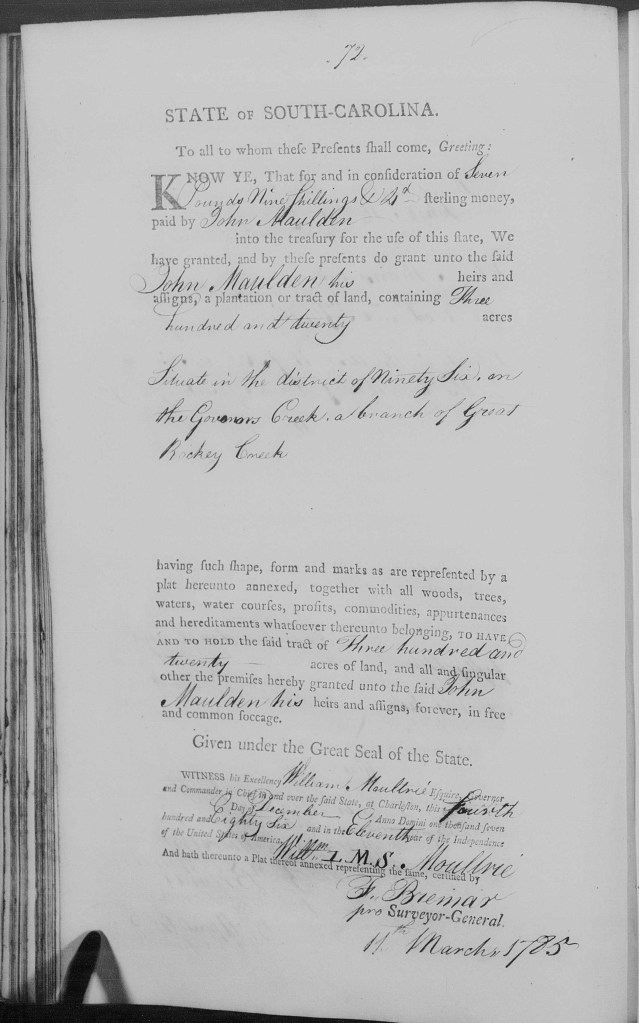
As a previous posting indicates, John Mauldin arrived in Ninety-Six District (later Pendleton County) from Granville County, North Carolina, by 11 March 1785 when Bernard Glenn surveyed 320 acres for him on Governor’s Creek of the Great Rocky (the spelling of his surname on this document is Maulden).[10] (See the image at the head of the posting.) The grant for this tract was made 4 December 1786.[11] It’s possible that John had ties to Wilkes County, Georgia, as well at this time, since John Maulding, who appears as a debtor to the British mercantile firm Alston, Young and Co. in Granville County, North Carolina, in February 1775, was the same man as John Mauldin, blacksmith, who went from Granville County to Wilkes County, Georgia, according to Ransom McBride. In a series of articles entitled “Claims of British Merchants after the Revolutionary War,” McBride abstracted material from the British Records Collection at the North Carolina Archives, and published the abstracts in North Carolina Genealogical Journal.[12]

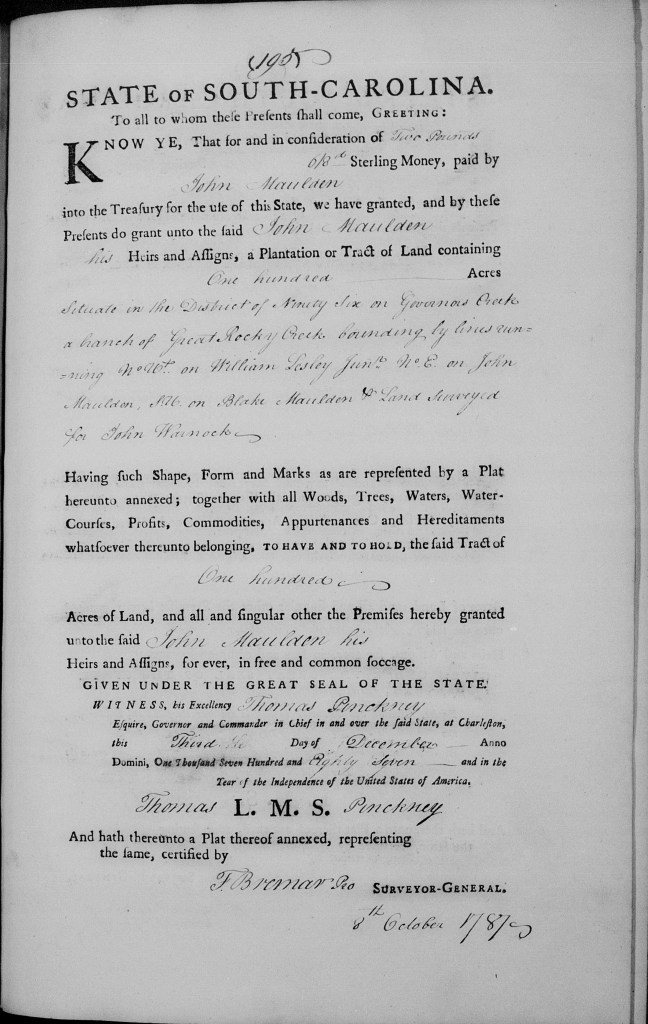

The posting linked at the head of the previous paragraph also states that on 10 August 1787, John Mauldin (his surname given as Maulden) had another plat for 100 acres on Governor’s Creek joining William Lesley, Blake Mauldin, and John Warnock.[13] The grant for this tract was made 3 December 1787.[14] Another grant for 100 acres on Governor’s Creek with the same neighbors was made to John Maulden on the same date.[15] Robert Z. Callaham notes that John Mauldin had acquired several hundred acres on both sides of Governor’s Creek prior to 1787, when the two grants were made on 3 December of that year for some of this land.[16]
On 10 April 1796, John Mauldin sold 120 acres of his land on Governor’s Creek to his son Harris Mauldin not long before Harris died prior to 27 June 1796 when his widow Hannah appealed for probate of his estate in Pendleton County giving bond with the Nathaniel Hall to whom John Mauldin sold land on Governor’s Creek in March 1791.[19] At Harris Mauldin’s estate sale on 10 October 1796, buyers included John Mauldin, John Lauderdale, and members of the Hall family.[20]

The deed for John Mauldin’s 10 April 1796 sale of land to Harris Mauldin identifies John as John Mauldin Sr. and states that the 120 acres John was selling Harris were out of a grant of 320 acres to John Mauldin bounded west by land of Jacob Gillison and east by land claimed by Robert Norris. The deed also states that Harris Mauldin was living on the tract sold to him. John Mauldin signed as John Mauldin Senr. with witnesses Nathaniel Hall and Patience Crenshaw. Within the deed is a receipt signed by John Mauldin stating that on the day of the deed, he had been paid $265 for the land, its full price, with the same two witnesses. On the 20th the two witnesses proved the deed, stating that it was a release of John Mauldin to Harris Mauldin, and it was recorded on the 24th.[21]
Nathaniel Hall, who pastored Upper Rocky Creek or Rocky Creek Baptist church in Pendleton County,[22] appears frequently in John Mauldin’s records and may have been a relative of Harris Mauldin’s wife Hannah. On 17 May 1791 John Mauldin appeared before Elijah Brown, a Pendleton County justice, declaring that he had sold Nathaniel Hall Sr. 100 acres of land for a certain mare, which he received through the hands of John Falconer, who informed John Mauldin that Hall told Falconer he had been exceedingly pleased with the transaction. John Mauldin signed this deposition and it was recorded 27 May 1791 with no witnesses.[23]
As a previous posting has noted, on 14 October 1792 William Brown of Wilkes County, Georgia, deeded John Lauderdale of Pendleton County, South Carolina, 200 acres on Great Rocky Creek, with the deed stating that the land started at the mouth of Beaver Creek, then ran down the south side of Great Rocky and joined Rachel Thompson’s land, the Widow Womack’s land, Jacob Gillison’s tract, and land laid out for John Mauldin.[24] As the posting I’ve just linked also states, according to Robert Z. Callaham, Jacob Gillison’s tract was, on its east corner, at the entrance to the present location of New Varennes church just west of the confluence of Beaver Creek and Rocky River.[25]
On 6 May 1793 John Johnson of Abbeville District, South Carolina, sold Harris Mauldin of Pendleton District for £50 80 acres in Washington District (that is, Pendleton, later Anderson County) on the waters of Rocky River. The deed states that this tract was bounded on the southeast and southwest by William Brown, on the southeast by John Mauldin, northeast by Blake Mauldin, and by the Rocky River. Witnesses to this deed were Joab Mauldin, John Mauldin Sr., and Peggy Mauldin, who signed by mark. The deed was recorded 27 June 1793.[26]

As noted above, John Mauldin Sr. remained alive in Pendleton County into 1796: on 10 May 1796 with wife Sarah, he sold Andrew Middleton Norris, all parties being of Pendleton County, 100 acres on Great Rocky Creek. The deed identifies John Mauldin as a blacksmith. A plat of this land included in the deed shows it on the north side of Governor’s Creek with Harris Mauldin’s land joining it on the west and Nathaniel Hall on the east, and with land laid out for John Mauldin on the north. John signed the deed and Sarah signed by mark. Thomas Millsap and Wesley and Lizia Mauldin witnessed. Millsap proved the deed on 13 June 1796 and it was recorded on the 20th.[27]
John Mauldin’s 3 December 1787 grants on Governor’s Creek date are noted in a deed dated 24 March 1791, when John sold 100 acres on Governor’s Creek to Nathaniel Hall and also in a deed dated 21 October 1800, when Lent Hall sold Martha Hall 90 acres on Governor’s Creek.[17] Robert Z. Callaham indicates that the large landholdings John Mauldin had acquired on Governor’s creek by 1787 were located south of Anderson paralleling present-day highway 284 east of Starr, South Carolina.[18]
Andrew Middleton Norris was a son of Robert Norris and Martha Mauldin, who was, it appears, another of John and Sarah Mauldin’s children. As a previous posting notes, Robert Norris witnessed John Lauderdale’s January 1795 deed to his children Sarah and James Lauderdale, along with Harris and John Mauldin. As noted above, when John Mauldin sold Harris Mauldin land in April 1796, the deed stated that the tract bordered land claimed by Robert Norris. Robert Norris connects to the Calhoun family of the Long Cane settlement in Abbeville County discussed in previous postings: his father Robert Norris married as his second wife Jean/Jane Ewing, the widow of Ezekiel Calhoun of the Long Cane settlement. The younger Robert was a son of the older Robert Norris by his first wife Elizabeth Wrentz.

The last clear record I’ve found for John Mauldin was his sale on 8 November 1796 of 100 acres on Rocky River to Thomas Millsap. The deed identifies John as John Mauldin Sr. and states that the tract was bounded by William Hall, Robert Harkness, and Elijah Brown. John signed with witnesses Martin Terrell and Wesley Mauldin. Terrell proved the deed on the day it was made and it was recorded 24 January 1797.[28]
By 9 August 1808, when he witnessed a deed by William Edmonson to Joab Mauldin (Anderson County, South Carolina Deed Bk. I&J, pp. 244-5), there’s a John Mauldin Sr. in Pendleton District records who is a John Mauldin of the generation after the John Sr. who seems to have died in or not long after 1796. This younger John Mauldin who was signing himself as John Sr. by August 1808 was John Jr. in 18 February 1793 when Roger Martin made a deed to John Mauldin Jr. with witnesses Joab Mauldin, Ancil Jarrot, and Ruth Martin (Anderson County, South Carolina, Deed Bk. B, p. 140). He was at that time John Jr. because the older John Sr. who died in or around 1796 was still living in 1793. The 1800 federal census for Pendleton District shows only one John Mauldin, and it’s clear this is John Jr. of the 1793 deed and John Sr. of the 1808 deed (1800 federal census, Pendleton District, South Carolina, p. 154B). The John Mauldin of the 1800 census is aged 26-44 (born 1754-1776) with a wife in the same age range and three small children in the household. He is living near members of the Jarrot family who appear in the 1793 deed with Joab and John Jr.
As these notes about John Mauldin indicate, in the absence of any one document proving that John Lauderdale’s wife Milbury Mauldin was a daughter of John Mauldin of Granville County, North Carolina, and Pendleton County, South Carolina, there’s a preponderance of evidence pointing to this conclusion. This is a conclusion that Lauderdale researcher Clint A. Lauderdale also reaches in his study of the Lauderdale family entitled History of the Lauderdales in America.[29]
A brief note about Milbury Mauldin’s given name: this given name does not appear (as Milbury or by other variant spellings) in either E.G. Withycombe’s The Oxford Dictionary of English Christian Names or George R. Stewart’s American Given Names. The 1790 federal census suggests that it was very uncommon at that period. Interestingly, the two instances in which it’s found are both in North Carolina where Milbury Mauldin Lauderdale was born between 1760 and 1770: the 1790 census shows a Milbry Dauge in Currituck County, North Carolina, and a Milberry Lynch in Johnston County, North Carolina.
It’s possible that this given name is derived from the surname Milbury (or a variant spelling). The surname itself appears to have been uncommon in the US in 1790. The only person with a surname similar to Milbury on the census of that year is Samuel Milbory of York, Maine, whose name appears in other documents as Milberry. By 1850, the given name Milbury (with several variant spellings) had become not uncommon in the U.S. and was used fairly widely throughout the U.S.
John Mauldin was not my only ancestor to move from Granville County, North Carolina, to Pendelton County, South Carolina, in the latter part of the 1780s and early 1790s. As was noted above, it seems John Mauldin arrived in Pendleton County at some point prior to 11 March 1785 when he had a survey for land on Governor’s Creek. John and wife Sarah sold land in Granville County on 28 December 1782, and may have been making that land sale in preparation to move to South Carolina.[30]
Another ancestral couple of mine, Jacob and Hannah Green Braselton, moved from Granville to Pendleton between 22 March 1792, when Jacob sold land in Granville County, and 2 September 1792, when he acquired land in Pendleton County. As a previous posting notes, in 1784 the South Carolina General Assembly passed “An Act for Establishing the Mode and Conditions of Surveying and Granting the Vacant Lands Within this State.” The posting I’ve just linked cites a valuable article by Wade Dorsey at the website of the South Carolina Department of Archives and History which notes that the state was in difficult financial circumstances after the British finally evacuated in 1783. The decision to offer vacant lands for sale was a way to replenish the public coffer.
Historians Frederick Van Clayton and David Ramsay explain that the 1784 law offering land for sale in the upcountry had much to do with the cession of land in the region by the Cherokees in 1777.[31] Having taken the British side during the Revolution, in 1777, the Cherokees ceded to South Carolina all their lands east of the Unacaye mountains, and in 1784 a land office was opened to sell this land. This spurred dramatic migration into Pendleton District and rapid settlement in the backcountry.
[1] 7 September 1962 DAR affidavit of Mattie Conwill Murphy, Clay County, Mississippi.
[2] Biographical and Historical Memoirs of Mississippi, etc., vol. 1 (Chicago: Goodspeed, 1891), pp. 1102-3.
[3] Oglethorpe County, Georgia, Deed Bk. K, pp. 90-1.
[4] Anderson County, South Carolina, Deed Bk. D, p. 318-9.
[5] 1830 federal census, Limestone County, Alabama, p. 11A.
[6] Anderson County, South Carolina, Deed Bk. D, pp. 365-6.
[7] South Carolina Genealogical Society, Lineage Charts, S. C. Genealogical Society Chapters, Vol. 2 (Columbia, 1977), chart no. 51.
[8] 1790 federal census, Pendleton County, South Carolina, p. 4.
[9] South Carolina State Plat Bk. 21 (Charleston Series), p. 8; and South Carolina Grant Bk. 19, p. 520.
[10] South Carolina Plat Bk. 17 (Charleston Series), p. 83.
[11] South Carolina Grant Bk. 14, p. 72.
[12] See Ransom McBride, “Claims of British Merchants after the Revolutionary War,” North Carolina Genealogical Journal 5,3 (August 1979), p. 38, abstracting material in British Records Collection at the North Carolina State Archives, Treasury Series T 79/83, microfilm box Z.5.149N.
[13] South Carolina State Plat Bk. 21 (Charleston Series), p. 69.
[14] South Carolina Grant Bk. 22, p. 195.
[15] Ibid., Bk. 21, p. 51.
[16] Robert Z. Callaham, Early Landholders South of Anderson, S.C. (Walnut Creek, California, 2012), p. 4.
[17] Anderson County, South Carolina, Deed Bk. A, pp. 273-275; Deed Bk. K, p. 254.
[18] Callaham, Early Landholders South of Anderson, S.C., pp. 4, 53, 55-6.
[19] Anderson County, South Carolina, loose-papers estate files box 13, no. 441, package 7.
[20] Ibid., and Anderson County, South Carolina, Probate Bk. 1793-9, pp. 107-8.
[21] Anderson County, South Carolina, Deed Bk. C, pp. 223-3. See also Callaham, Early Landholders South of Anderson, S.C., p. 53.
[22] See Leah Townsend, South Carolina Baptists, 1670-1805 (Florence, South Carolina, 1935), p. 193; and Louise Ayer Vandiver, Traditions and History of Anderson County (Atlanta: Ruralist, 1928), p. 219.
[23] Anderson County, South Carolina, Deed Bk. A, pp. 273-5.
[24] Ibid., Deed Bk. D, pp. 318-9.
[25] Callaham, Early Landowners South of Anderson, S.C., p. 55.
[26] Anderson County, South Carolina, Deed Bk. B, p. 165.
[27] Ibid., Deed Bk. C, p. 217.
[28] Ibid., p. 306.
[29] Clint A. Lauderdale, History of the Lauderdales in America, 1714-1850 (Bowie, Maryland: Heritage Books, 1998), pp. 23-4, 85.
[30] Granville County, North Carolina, Deed Bk. O, p. 291.
[31] Frederick Van Clayton, Settlement of Old Pendleton District, 1777-1800 (Easley, South Carolina: Southern Historical Press, 1988), p. 17; David Ramsay, Ramsay’s History of South Carolina from Its First Settlement in 1670 to the Year 1808, vol. 2 (Newberry, South Carolina: Duffie, 1858), p. 124.
 BEGATS AND BEQUEATHALS