Augusta County, Virginia, Records 1751-1770
By 1751, George Birdwell had married his wife prior to Mary and the couple had had at least one child, a son Robert who is discussed briefly in the posting linked above. Robert was likely born around or before 1745, since he had a son born in 1765 or 1766. George was, then, a young married man beginning to establish his family when he bought land in 1751 from James Patton.
In August 1756, George Birdwell was serving in an Augusta County militia company headed by Captain John Mathews.[1] Mathews, who died between 20 April 1757 when he made his will and 16 November 1757 when the will was probated, was one of the early settlers of Borden’s tract. He was an extensive landholder and a member of the Augusta parish vestry who lived in the forks of the James River north of George Birdwell’s land on the James near Fort Fauquier. John Mathews’ year of birth and his origins are murky. Some researchers estimate that he was born about 1697, and place his birth in Northern Ireland. Others suggest that he was Welsh-born and may have been born not long after 1700.[2]
Before becoming head of a militia company during the French and Indian War, when George Birdwell was in his company, John Mathews had served in the Augusta militia under John Buchanan in 1742.[3] As the previous posting notes, John Buchanan was commander of militia forces at Fort Fauquier in the 1750s and into the 1760s, and the town of Buchanan, which is near the site of the fort and also near the land on which George Birdwell lived, is named for John Buchanan.
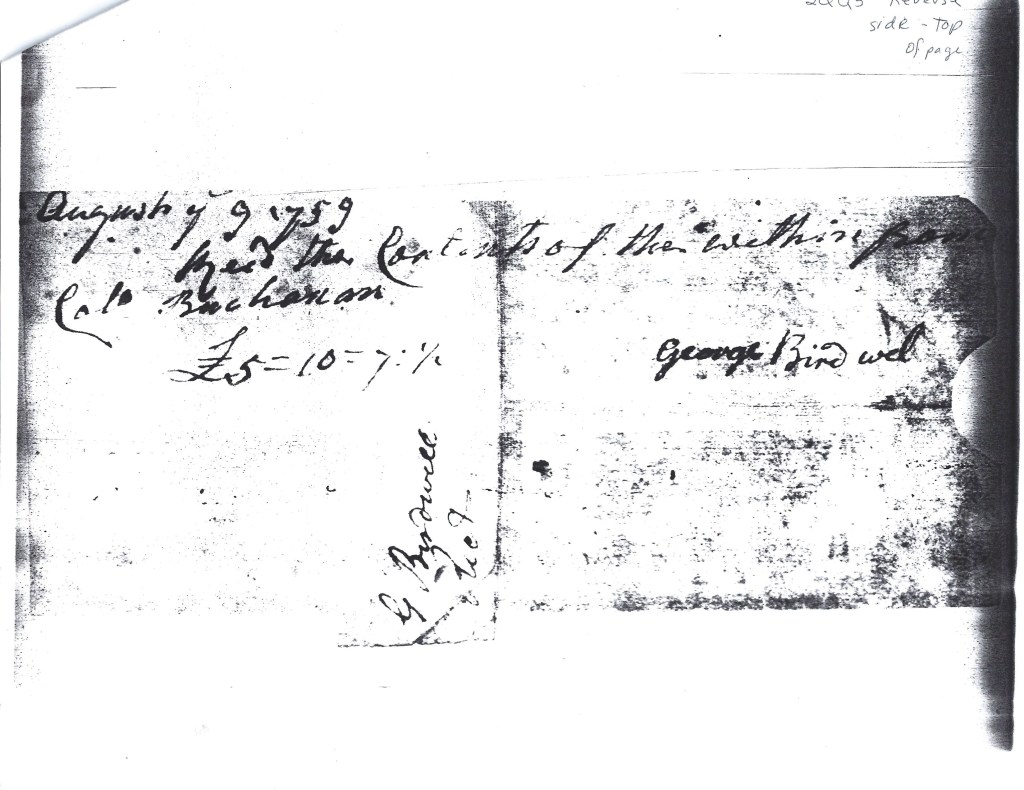
As a previous posting notes, in September 1758, George Birdwell furnished 885 pounds of beef to the troops at Fort Fauquier, and on 5 September 1758, John Buchanan paid him £5 10s 7½d for the beef, with George signing receipt for this payment at Fort Fauquier on 9 August 1759.[4] The posting I’ve just linked has a digital copy of this receipt, showing George signing as George Birdwel.
A previous posting contains some biographical information about John Buchanan (abt. 1720 – 1769), noting that Frederick B. Kegley states that he was a son of James Buchanan and Jane Sayers of Northumberland County, Pennsylvania, who likely came to Pennsylvania from Northern Ireland.[5] The linked posting also notes that John Buchanan married Margaret Patton, a daughter of James Patton, from whom George Birdwell purchased his land in 1751.[6] John Buchanan acquired land in Beverly Manor in 1738, and was a justice of the peace in Orange county by November 1741 and a militia captain by June 1742. He worked for James Patton in Patton’s land-speculating ventures and when Patton was awarded 100,000 acres in April 1745 and established Wood’s River Land Company, he made Buchanan his surveyor. Buchanan was a founding member of Augusta County court in 1745 and was made militia colonel in November 1752. In 1761-2, he served as county sheriff.[7]
Note the recurring pattern with men who rose quickly to prominence in early Augusta County, Virginia: a large number of them appear to have had Ulster Scots background, but their precise origins are murky. They also frequently came to the western Virginia frontier from the Middle Colonies, Pennsylvania in particular, where their parents or grandparents were immigrant settlers.
A number of Birdwell researchers have suggested that George Birdwell’s first wife died about 1757-9, and that he remarried his wife Mary not long after her death.[8] I think that the proposed date of death of George’s first wife and his remarriage to Mary is based on the fact that the last child George and his first wife had, a daughter Ann, is thought to have been born around 1753, and George and Mary’s first child, George, was born 18 October 1760. As we’ll see later, George’s 1781 will states that his children Sarah, Ann, and Robert were by a prior wife, indicating that he had probably married only once before he married Mary and that the three children born prior to his marriage to Mary were all by that one former wife.
The surname of George Birdwell’s wife Mary has not been proven. Claims have been made by Birdwell researchers that Mary was a member of the Looney family mentioned in the last posting, which descends from Robert Looney (abt. 1692 – 1769), who established the first ferry crossing on the James River in what’s now Botetourt County, and who operated a mill near where George Birdwell lived. About 1755, a fort was built near this mill and named Looney’s Fort; this fort became Fort Fauquier. Researchers who conclude that George Birdwell’s wife Mary was a member of the Looney family cite DNA evidence showing that there are genetic matches between George Birdwell’s family and the Looney family of Augusta-Botetourt County, Virginia, and point to a 28 August 1751 Augusta County court record stating that Mary, orphan daughter of Thomas Lunday, deceased, was bound out to William Williams, who intended to take her to North Carolina with him.[9] Thomas Looney was a son of Robert Looney, who is thought by some researchers to have been an immigrant to Maryland from the Isle of Man.
There are some problems with the proposal that George Birdwell’s wife Mary was the daughter of Thomas Looney, however. Though when and how Thomas Looney died are not clear, his estate was probated 19 November 1760 in Augusta County. But the court record I just cited states that Thomas Lunday was deceased by 28 August 1751. In addition, if, as that court record states, William Williams took Mary Lunday to North Carolina in the fall of 1751, how did she and George Birdwell connect and marry in the latter part of the 1750s in Augusta County, Virginia?
This discussion of Mary Birdwell’s proposed Looney ancestry is made perhaps more complicated by the fact that a line of Looneys long thought to descend from Robert Looney the immigrant do not match other known descendants of Robert, but are actually Birdwells genetically. They descend from George Birdwell though they carry the Looney surname. Kyle William Looney provides documentation to substantiate this claim in a May 2011 essay.[10]
In the 1760s and 1770s, there are repeated references to George Birdwell (or, as his surname is also spelled in some of these records, Burdwell) in Augusta and then Botetourt Counties following the separation of the latter county from Augusta in 1770. George also appears several times in records of Amelia County, Virginia: on 24 September 1761, the court order book of Amelia indicates that, as assignee of Charles Harrison, George Burdwell had filed a suit of debt vs. William Pearson, and an alias capias warrant had been issued for Pearson.[11]
Amelia is several counties east of Botetourt, and I’ve found no evidence that George Birdwell ever lived in that county. The suit he filed as Harrison’s assignee appears to have been a debt suit regarding some property Harrison assigned George in Amelia County. This suit is mentioned several more times in Amelia records in 1762 — on 25 March when George Burdwell appealed for an order of pluries capias against Pearson; on 29 October, when Pearson appeared in court and the case was continued for next court, and on 26 November when it was reported to court that Pearson was no longer an inhabitant of the county.[12]
George Birdwell also begins appearing in Augusta County court records on 20 November 1761 in the case of George Birdwell vs. Dennis Getty, with Getty asking for an extension in the case.[13] The surname is spelled Gatty in this record. On 19 February 1762, Getty pled not guilty, but on 18 November 1762, an Augusta jury found him guilty as charged and fined him £11.[14]
A bill in the Augusta County circuit court case of Dennis Getty vs. Madison’s executors states that Dennis Getty emigrated from Ireland to Virginia and settled in Botetourt County, where he died in 1779. Affidavits in the bond indicate that Dennis Getty was from the townland of Ray in the parish of Aughnish in County Donegal and had kinsmen in the townland of Aghangaddy Glebe in the same civil parish.[15]
Augusta court records in the 1760s several times show George Birdwell appointed with others to appraise estates of deceased residents of the county. On 21 August 1764, the court appointed David Looney, George Birdwell, Thomas Ramsey, and John Smith or any three of them to appraise estate of Jacob Stover deceased.[16]
In November 1764, Augusta Court records begin noting a case that Patrick Shirkey had filed against George Birdwell over a lease. On 3 November 1764, court minutes that in the case of Patrick Shirkey vs. George Birdwell, in lease, Birdwell said he was not guilty.[17] This case was continued on 25 March and 22 August 1765.[18]
At the 22 August 1765 court session, John Buchanan gave oath that he had testified two days on George Birdwell’s behalf in the case of Patrick Shirkey vs. George Birdwell, and the court ordered George to pay Buchanan a thousand fifty pounds of tobacco (or does the word “for” preceding “thousand” in these court minutes mean “four”?).[19]
On 17 October 1765, court minutes say that in the case of Patrick Shirkey vs. George Birdwell, both parties must submit to John Buchanan and William Preston or such persons as they shall appoint information about the matter of dispute between them.[20] The same court minutes say that John Buchanan had testified on behalf of Birdwell and Birdwell was ordered to pay Buchanan 125 pounds of tobacco for doing so.
Note that William Preston was a nephew of James Patton, John Buchanan’s father-in-law and the landowner from whom George Birdwell purchased his land in August County in 1751. Buchanan was closely connected to Preston and died at Preston’s residence at an unrecorded date.[21]
There is confusion in transcribed records regarding Patrick Shirkey (abt. 1720 – 1783), which sometimes render his surname as Shirley and not Shirkey. Descendants of Patrick also used the spelling Sharkey, the spelling that appears in Patrick’s Botetourt County will. Patrick purchased land from both James Patton and Benjamin Borden and operated a mill on the upper James.[22]
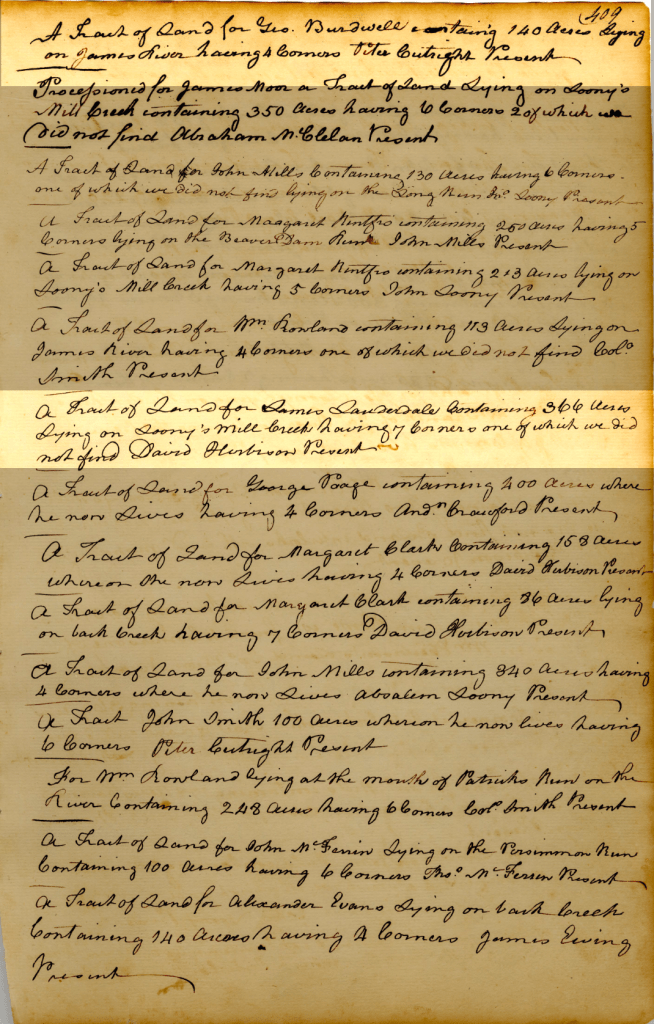
Minutes of the vestry of Augusta parish for 28 January 1765 state that in conformity to an order of vestry to procession lands on the James River to the south of Catawba Creek, the processioning had been carried out. Among those whose lands were processioned was George Burdwell’s, whose 140 acres on the James having four corners had been processioned with Peter Cutright present.[23] The same page of vestry minutes states that James Lauderdale’s 366 acres on Looney’s Mill Creek had been processioned pursuant to the same vestry order. In my own direct ancestral lines, these two families intersect through the marriage of James Birdwell (1795-1849), a grandson of George Birdwell, to Aletha Leonard, whose mother Sarah Lauderdale Leonard was a granddaughter of James Lauderdale.
The practice of processioning boundaries of land at routine intervals was an old English one that continued in colonial Virginia and was stipulated by acts of the Virginia legislature starting in 1662. As in England, “beating the bounds” of land or processioning its boundaries was delegated to the local parish, which organized groups of parish residents to walk the boundaries of plots of land, noting landmarks separating one tract from another. The owner of a parcel of land accompanied those processioning his (perhaps also her, but only rarely) boundaries, and when the processioning was completed, a record of the boundaries was made, noting the landowner’s agreement to the marking of boundaries.[24]
Not all of those whose names are listed in processioning records of a parish were by any means actually members of that Church of England parish. As a body of the established church in Virginia, the parish and its vestry had judicial obligations and prerogatives that went beyond religious functions. The large percentage of 18th-century residents of Augusta County were not Anglicans but “dissenters,” as the Church of England viewed them, many of them Presbyterians, as well as Baptists and members of German religious groups such as the Dunkards.
At the Augusta County court session of 22 August 1765, George Birdwell appears as a juror in the case of John Bowyer administrator of Caleb Harmon vs. Robert Read.[25] Minutes for the same court session say that George Birdwell was on the jury for the case of Michael and Mary Coger vs. Thomas Burk, but had been withdrawn from this jury.[26] George Birdwell continued serving on Augusta court juries on 21-2 August 1766, in the cases of Andrew Greer vs. Israel Christian and George Wilson vs. John Hutchinson Jr.[27]
Augusta court minutes show that on 17 August 1768 William Rowland, Jonathan Smith, Waller Stuart, George Burdwell or any three of them were appointed to appraise the estate of John Bowen, deceased.[28] And on 5 August 1769, when John Reed had a survey for 90 acres on the James River, the survey record notes that Reed’s land adjoined that of George Birdwell.[29]
In 1770, when the Virginia legislature created Botetourt County from a portion of Augusta, George Birdwell’s land fell into the new county. On 10 April 1770, Botetourt court records state that Thomas Rowland, George Burdwell, Isaac Vincent, and Joseph Looney had been ordered by court to report on the best way for a road from the county courthouse passing by George Skillern’s plantation.[30] Botetourt court records persistently use the Burdwell spelling for George’s surname. Note the name George Skillern, which we’ll meet again in a moment.
Botetourt County, Virginia, Records 1770-9
In 1770-1, George appears several times in Botetourt court records as a juror: on 10 September 1770 in the case of Hugh Allen vs. Moses Cavett; on 11 October 1771 in the cases of John Stewart vs. Samuel McRoberts and Isaac Bollinger vs. Patrick McDonald, both trespass cases; and on 13 November 1771 in the case of William Simpson vs. William Herbert.[31] Note the name of Moses Cavett, which we’ll meet again in a moment. Hugh Allen, son of Malcolm Allen, is thought to have been the father of Mary Allen who married George Birdwell’s son John.
In 1772, George Burdeel appears on a list of tithables in the tax district of F. Smith in Botetourt County.[32] On 12 November 1772, the Botetourt court appointed George Burdwell and others to work with their tithables to maintain Captain Crow’s road.[33]
The following year on 12 August 1773, Botetourt Court appointed George Burdwell a constable in place of Hugh Allen.[34] In the next month on 16 September, county court minutes show George serving as a juror in the case of John May and Co. vs. John Webb.[35] John again served as a Botetourt juror on 9 February 1774 in the case of Edward Wilson vs. William Man.[36]
On 11 February 1777, when Botetourt court appointed George’s son John Burdwell to survey a road from the Beaver Dam across the path at James Rowland’s to Andrew Henry’s new field, the tithables of George Burdwell and others were ordered to maintain this road.[37]
On 11 February 1778, Botetourt court minutes note that Thomas Reed had been appointed constable in room of George Birdwell, who had been discharged from that office.[38] I think it’s possible that George had resigned the office of constable because he was planning his move in 1779 to Sullivan County, North Carolina (later Tennessee), though he appears in Botetourt records again in September 1778 as an appraiser of the estate of along with Samuel Walker Sr. and Ebenezer Titus.[39]
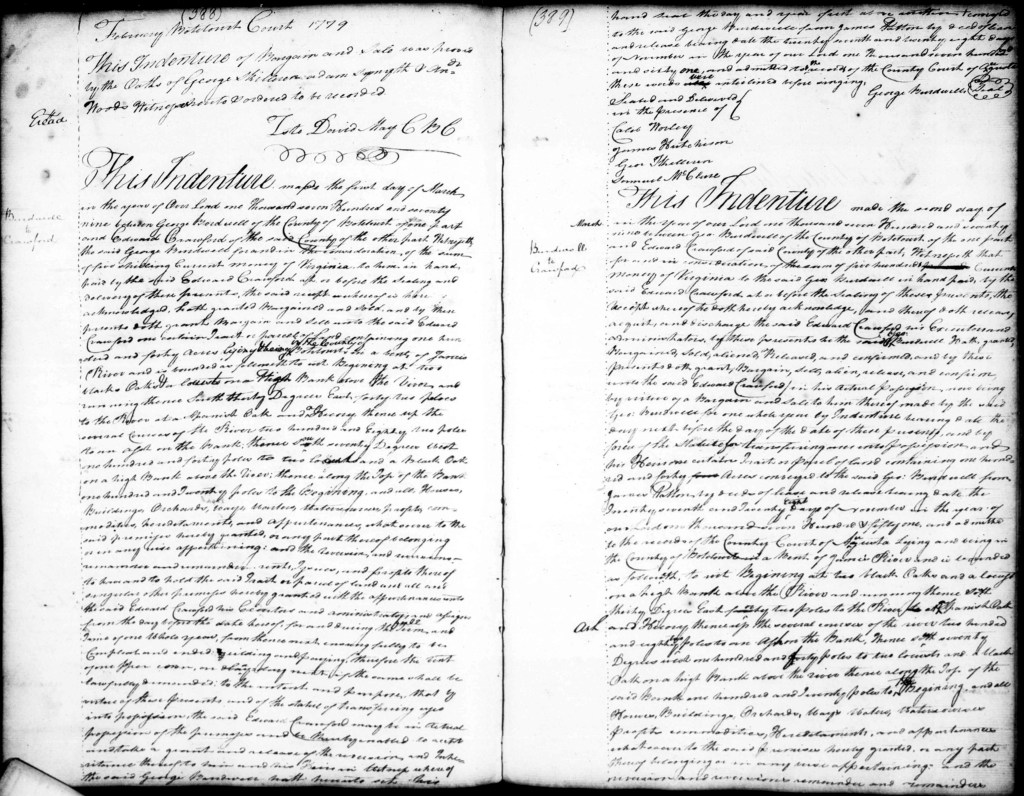
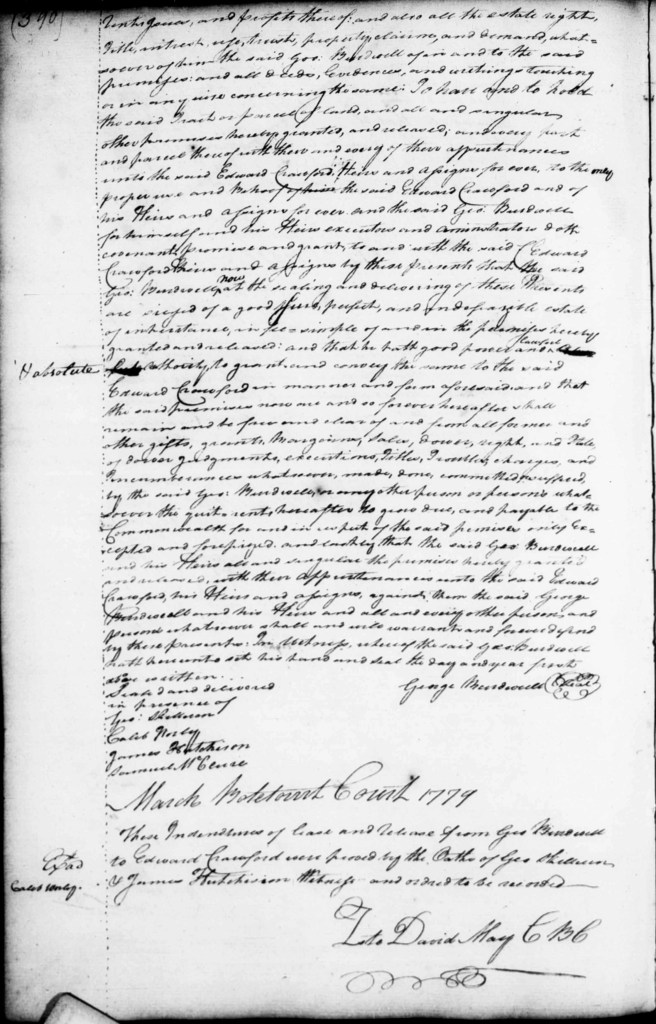
On 1-2 March 1779, George Birdwell sold his 140 acres in a bend of the James River in Botetourt County to Edward Crawford.[40] The deed states that the land sold for 500 pounds, but the word “pounds” is marked out and followed by “Current money of Virginia.” George signed the deed, with the deed book record spelling the surname as Burdwell. The deed was witnessed by George Skillern, Caleb Worley, James Hutchison, and Samuel McClure. Skillern and Hutchison proved the deed at March court in Botetourt and it was recorded.
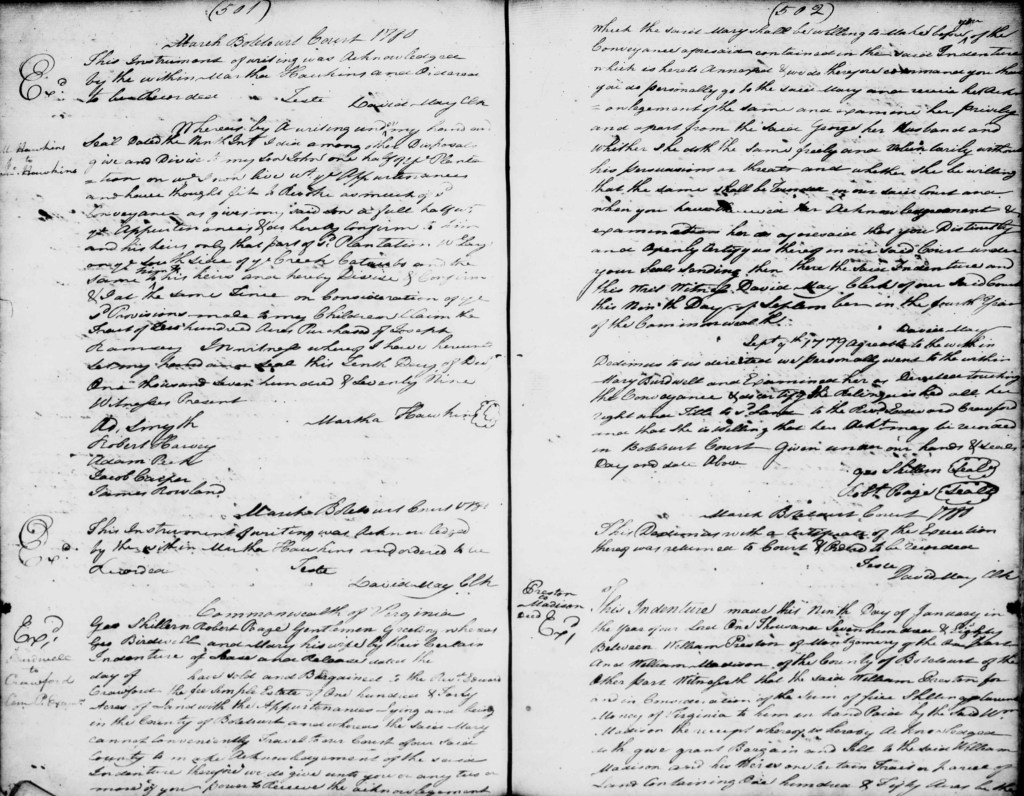
George and wife Mary had not left Botetourt County by 9 September 1779 – or Mary, at least, was still in Botetourt at that date – since a relinquishment of dower with that date in Botetourt records shows George Skillern and John Poage delegated by the court on 9 September 1779 to travel to Mary, who could not travel conveniently to the courthouse, to receive her relinquishment of dower in the land George had sold to Revd. Edward Crawford, as this document calls him.[41] The relinquishment of dower document states that Skillern and Poage traveled to Mary and she relinquished her dower interest in the land, and the document was recorded at March court 1781.
Note that Mary Birdwell had given birth to her penultimate child, a daughter Mary, on 24 July 1779, so it’s understandable that traveling to court in September 1779 would have perhaps presented challenges to her. It’s possible that George had already gone to Sullivan County, North Carolina, to prepare for his family’s move there, or perhaps both he and Mary had not yet left Virginia for what would become East Tennessee in 1796. A number of Birdwell researchers state that George Birdwell settled by March 1779 on a grant of 375 acres on both sides of the Holston River at Kendrick Creek in Sullivan County, but I find no record of such a grant. His son George had a grant for 375 acres on Kendrick Creek in Sullivan County on 24 November 1797.[42] I think that grant to George Birdwell’s son has been misread as a grant for George Sr.
The incentive for the opening of this region that was later East Tennessee to settlers of European descent at this time was the Treaty of Long Island of the Holston in July 1777, by which native Americans relinquished their claim to land in what became East Tennessee. This was followed by Isaac Shelby’s campaign against the Chickamaugas in the spring of 1779. In the fall of 1779, John Donelson moved with his new wife Mary Purnell from Virginia to what would later become East Tennessee, with the couple first arriving at Port Patrick Henry near Long Island on the Holston and then leaving there in December 1779 for the Cumberland country, where they arrived in April 1780 at what would become Nashville.[43]
A Revolutionary pension affidavit made by Richard Cavett on 19 August 1834 at Huntsville in Madison County, Alabama, states that he was 70 years old and had been born on the headwaters of the James River in Botetourt County, Virginia, and that soon after his birth, his father Moses Cavett had moved the family from Virginia to Sullivan County, North Carolina.[44] This affidavit suggests that Botetourt County, Virginia, people were already moving to Sullivan County, North Carolina, as early as the mid-1760s, and as with George Birdwell’s sons Moses and John, some of these folks then made their way in the early 1800s to Madison County, Mississippi Territory (later Alabama).
Some notes on several of the witnesses to George Birdwell’s March 1779 deed to Edward Crawford: George Skillern and Caleb Worley were roughly contemporaries of George, and both Caleb Worley and Samuel McClure had family ties to Malcolm Allen, who was mentioned previously as George Birdwell’s neighbor in Augusta-Botetourt and grandfather of Mary Allen, who married George’s son John Birdwell. George Skillern is thought to have been born in 1727 or 1728 in Northern Ireland. He arrived with his parents William and Elizabeth Skillern from Pennsylvania in Orange County, Virginia, on 24 July 1740 and died testate in Botetourt by April 1804.[45]
Caleb Worley, who is thought to have been born about 1730, probably in Lancaster County, Pennsylvania, married Malcolm Allen’s daughter Rebecca.[46] Samuel McClure was the son of John McClure (abt. 1725 – 1777), who is thought to have been an immigrant from County Donegal, Ireland, and who married Malcolm Allen’s daughter Mary.[47] The Mary Allen who married George Birdwell’s son John appears to have been a niece of Rebecca Allen Worley and Mary Allen McClure, a daughter of Rebecca and Mary’s brother Hugh Allen.
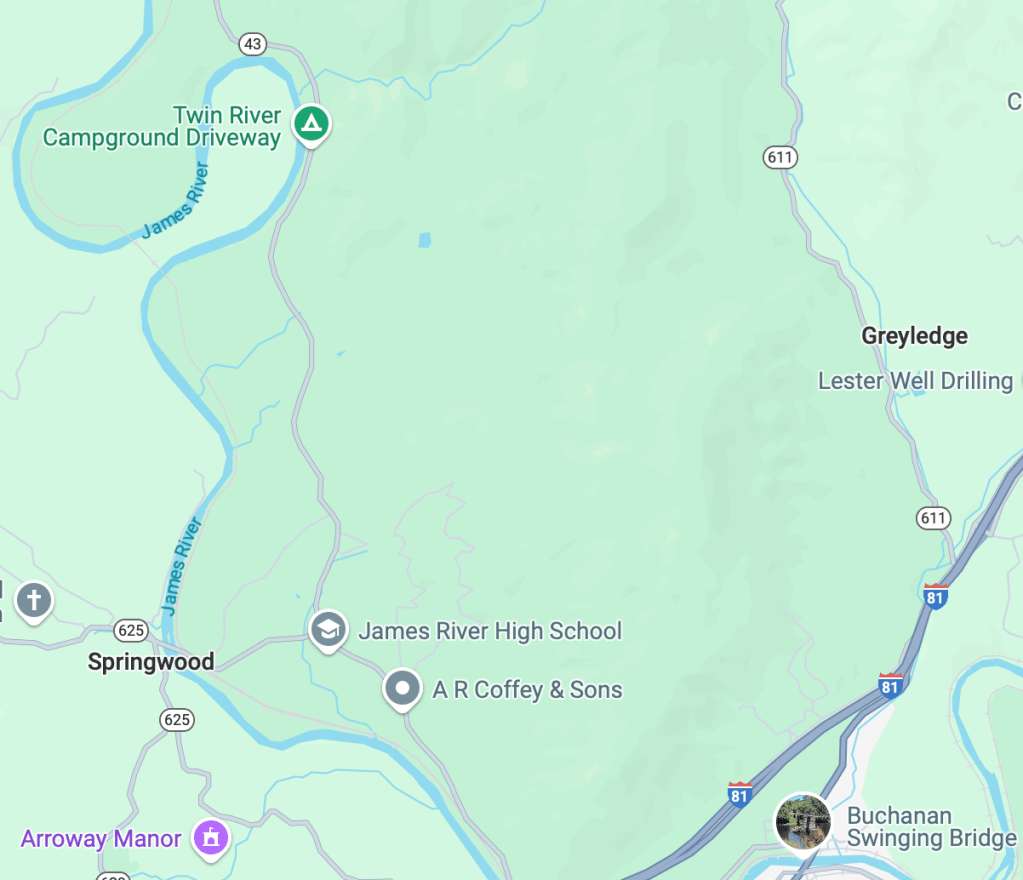
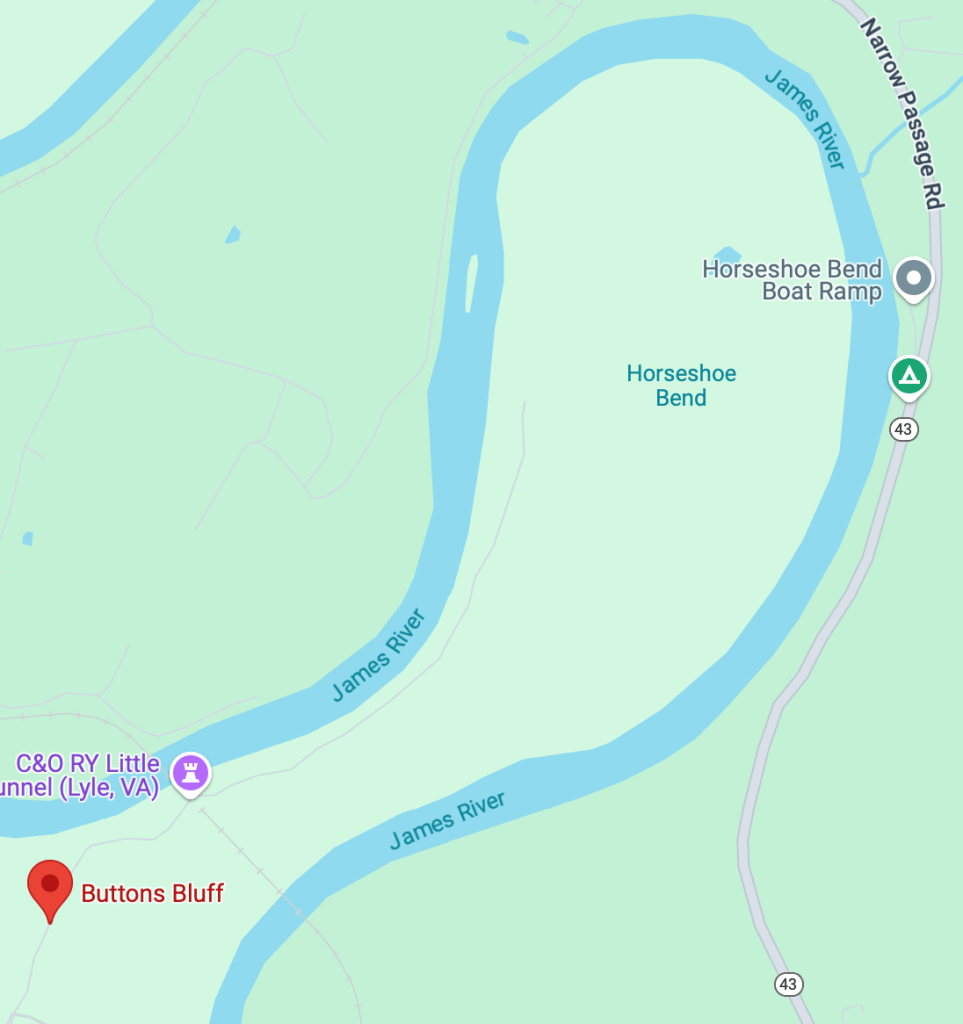
A report issued by the Fourth Annual Birdwells Across America Reunion held in Roanoke, Virginia, in July 1997 states that Edward Crawford sold George Birdwell’s 140 acres in the bend of the James in Botetourt County in 1800 to Robert Ritchy, and in 1997, the land was owned by a Finch family of Roanoke. This report indicates that when Reverend Crawford sold the land in 1800, another survey was done, which is in Botetourt County’s 1833-1842 Survey Record Bk., p. 30. A local road called Buttons Bluff Road located north of the community of Springwood runs into the Horseshoe Bend property owned by George Birdwell from 1751-1779, and in 1997, a Seibel family was living on the property, according to the Birdwell reunion report.
Move to Sullivan County, North Carolina (Later Tennessee), 1779 or 1780
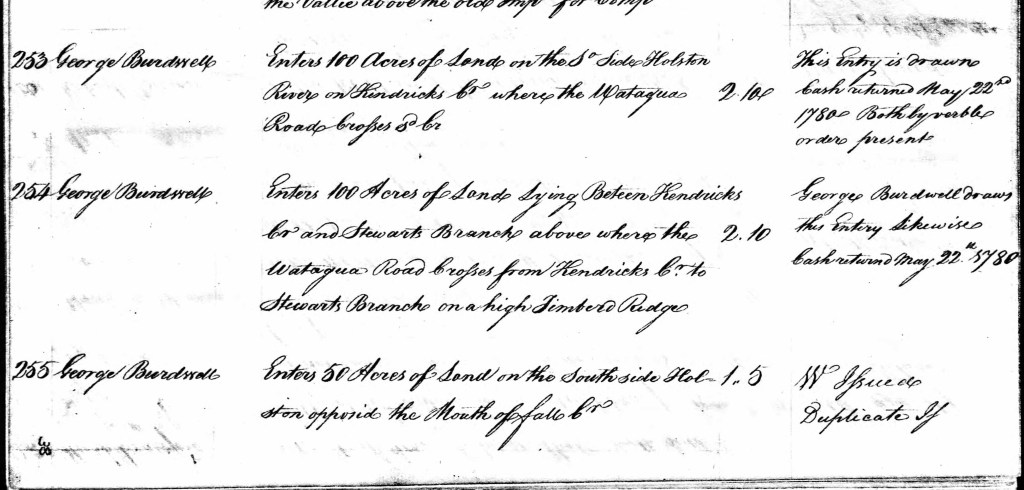
On 22 February 1780, George Burdwell entered one hundred acres of land in Sullivan County, North Carolina, joining William Blythe’s line on the north side of the Holston River at Fall Creek, and received a warrant for the land.[48] On 3 March 1780, George Burdwell entered three more tracts in Sullivan County, all on the south side of the Holston – two tracts of 100 acres each, one on Kendricks Creek where the Watauga road crossed the creek, the other between Kendricks Creek and Stewart Creek above where the Watauga road crossed Kendricks Creek; and 50 acres on the Holston opposite the mouth of Fall Creek. The Kendricks Creek referenced here is Kendrick Creek.
George paid for these parcels of land on 22 May 1780.[49] A 10 October 1783 deed of North Carolina to Alexander Cavett for 90 acres in Sullivan County on the north side of the Holston in Burnt Strip Bottom notes that the land Cavett was acquiring joined land of George Birdwell Sr.[50] Alexander Cavett was uncle of the Moses Cavett mentioned previously.

Tennessee land records show George Birdwell’s sons George and Benjamin also acquiring land in Sullivan County in the early 1780s. Benjamin filed an affidavit for a Revolutionary pension in Sullivan County on 25 September 1832, stating that he was drafted into service in the fall of 1781 in Sullivan County, North Carolina, where he was residing, and served under Colonel Isaac Shelby and Captain Cavit (i.e., Moses Cavett, discussed above).[51] He then volunteered in the fall of 1782 in Sullivan County, serving with Colonel John Sevier and Captain George Russell in expeditions against the Cherokee Indians.
George’s Will, Bedford County, Virginia 1781
On 14 September 1781, George Birdwell made his will in Bedford County, Virginia. The will reads as follows:[52]
In the Name of God amen I George Birdwell of Sullivan County North Carolina but at present in Bedford County Virginia of perfect Mind & Sound Memory do make this my last Will & Testament.
Imprimis I give & Bequeath to my Son Robert & my two Daughters Sarah and Ann which I had by a former Wife Twenty Shillings each –
Item to my loving Wife Mary my Sorrel Horse in her poſseſsion Mare called Trim – & To my Son George the Sorrel Horse in his Poſseſsion – To my Daughter Elizabeth the Black Mare which I have with me & to my son Benjamin a four year old Sorrel Mare which was called Betty, to them & theirs Heirs forever
All the Rest Residue & Remainder of my Estate Real & personal I give & Bequeath to my said Wife Mary & the children which She bore me Viz George, Elizabeth, Benjamin, Joseph, Moses, John, William, James, Joshua, Mary & Jane to them & their Heirs forever to be equally divided among them when my Daughter Jane shall arrive at the Age of fifteen – & my Will is that my Wife Mary & Son George may execute this my last Will & Testament
Dated this 14th Day of Sep. one thousand Seven hundred & eighty one.
Geo. Birdwel {SL}
Signed Sealed & Published in presence of
C. Clay
Reuben Slaughter
John Slaughter
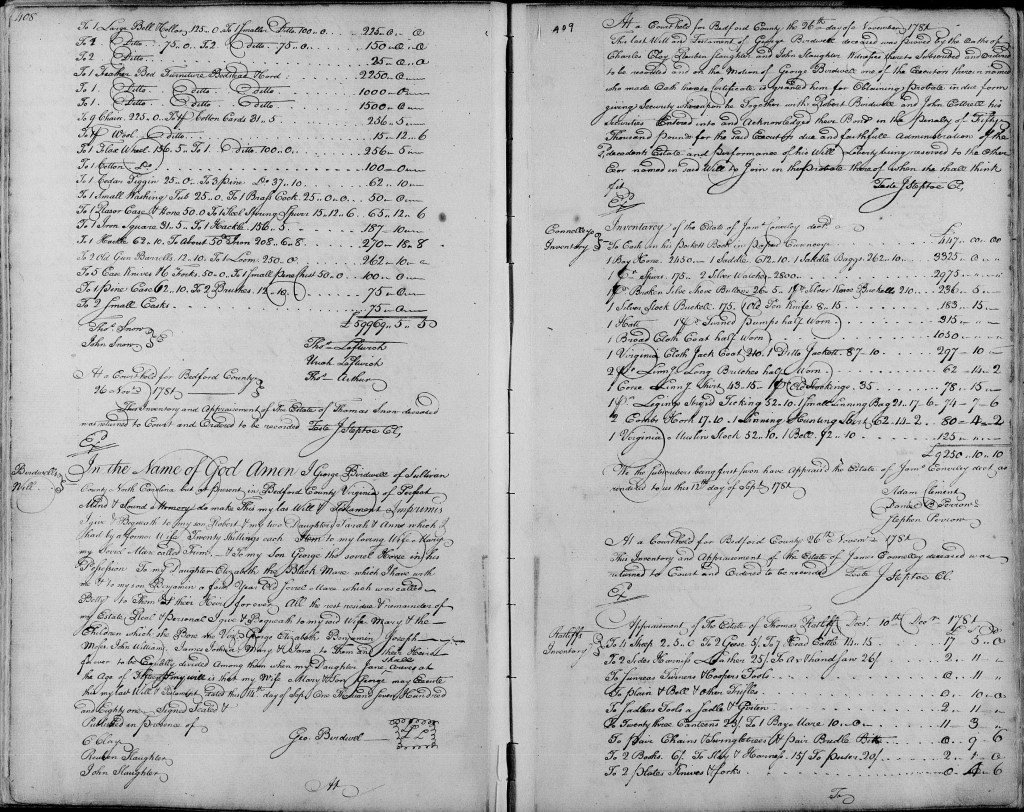
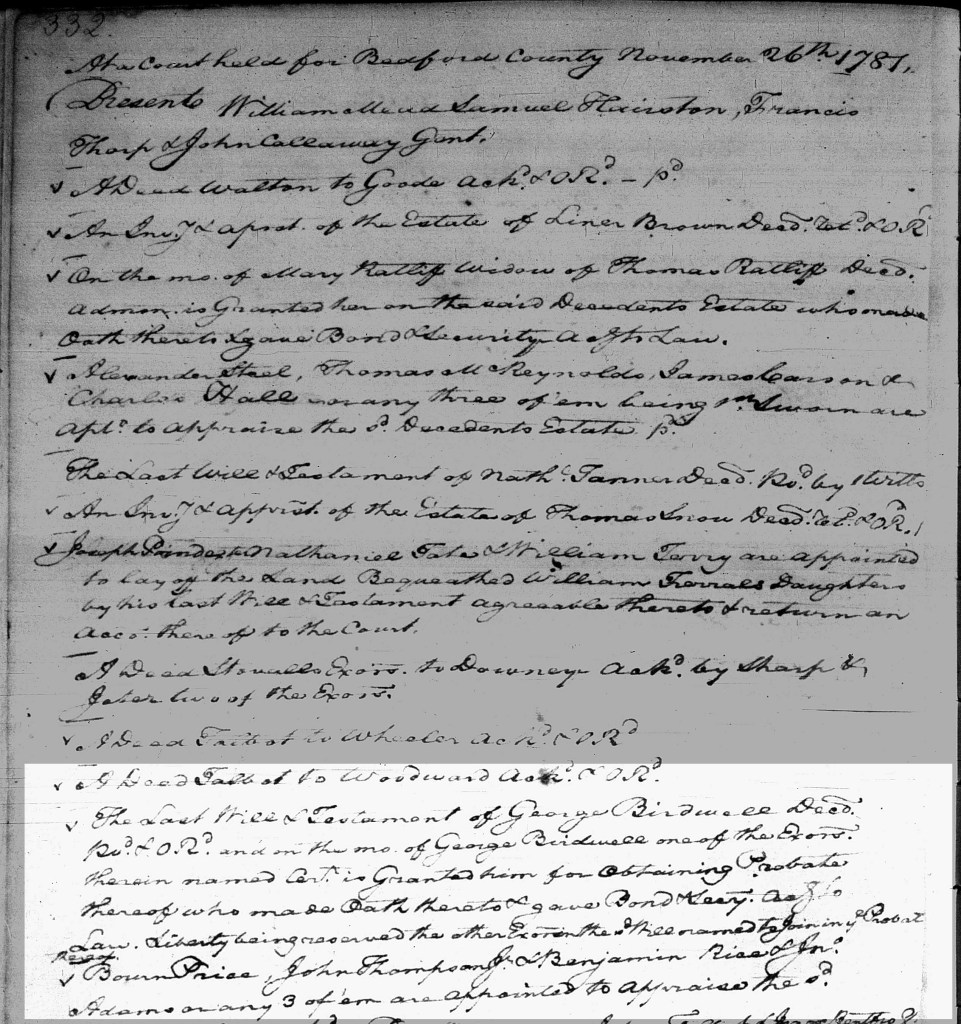
The will was probated at Bedford County court on 26 November 1781, with Charles Clay and Reuben and John Slaughter giving oath. At the motion of George Birdwell Jr. as one of the executors, it was then recorded and George was given probate after he had made bond of £50,000 with Robert Birdwell and John Cottrell as securities. The court record, which is appended to the will itself in Bedford’s Will Book 1, states that liberty was reserved to the other executor (i.e., Mary) to join in the probate when she might think fit. Court minutes for the probate action state that Bourn Price, John Thompson Jr., Benjamin Rice, and John Adams or any three of them were appointed to appraise the estate.[53]
Nothing in the will indicates why George Birdwell was in Bedford County at the time he made the will. Bedford borders Botetourt County on the east, so it’s possible George had returned to Botetourt County for some reason after his move to Sullivan County, North Carolina, and happened to be in the neighboring county of Bedford when he made his will. The short length of time between the will and its probate – 14 September to 26 November 1781 – makes me think that George may have been seriously ill when he chose to make his will and then have died not long after he made it, probably in Bedford County.
I have found no records connecting George Birdwell to the three men who witnessed his will, Charles Clay and Reuben and John Slaughter. Charles Clay (1745-1820) was an Anglican parson and friend of Thomas Jefferson who was a justice in Bedford from 1782-5 and represented Bedford County in the 1788 Virginia Ratifying Convention.[54]
Reuben (1733-1805) and John Slaughter (1732-1796) were brothers, sons of Francis Slaughter and Anne Lightfoot of Culpeper County, Virginia, a large landowner in Orange and Culpeper Counties. Reuben moved from Culpeper to Bedford sometime after 1777, with his brother John apparently joining him in that move, and was a militia captain in Bedford soon after he arrived there.[55]
Sullivan County, Tennessee, probate records from 1780 to 1838 were lost in a courthouse fire in 1863, but notes compiled by Lucille Mehrkam about George Birdwell’s probate records state that a volume of Sullivan County probate records dated 1780-4 shows a February 1782 probate account with George Birdwell Jr. and his mother Mary acting as executors of George Sr.’s estate and with Richard Gammon and Thomas Ramsey as security. I have not found this record.
As a previous posting notes, starting in 1797, several children of George Birdwell began filing quitclaims to their share of their father’s estate. The quitclaims relinquished these children’s interest in the estate to the executors George Birdwell Jr. and Mary Birdwell. The linked posting discusses the quitclaim filed by George’s son Moses on 3 October 1797 in Knox County, Tennessee, with the document then being filed in Davidson County on 26 July 1810, since the two executors of George Birdwell’s estate were living in that county in 1810.[56]
On 21 May 1798, George Birdwell’s son Robert quitclaimed his interest in his father’s estate to George Birdwell Jr. and Mary Birdwell.[57] The document states that Robert was living in Sullivan County, Tennessee, when he made this quitclaim.
[1] See Lloyd DeWitt Bockstruck, Virginia’s Colonial Soldiers (Baltimore: Genealogical Publishing Company, 1988), p. 323, citing an August 1756 militia list of Mathews’ company.
[2] See Joseph A. Waddell, Annals of Augusta County, Virginia, from 1726 to 1871 (Staunton, Virginia: Caldwell, 1902), pp. 31, 118, 137, 309-310; Alexander Scott, Withers, Chronicles of Border Warfare: A History of the Settlement by the Whites, of North-Western Virginia, and of the Indian Wars and Massacres in That Section of the Indian Wars and Massacres in That Section of the State (Cincinnati: Robert Clarke, 1895), pp. 51-52, 65-6; “John Mathews (American pioneer),” at Wikipedia; G. Melvin Herndon, “George Mathews, Frontier Patriot,” Virginia Magazine of History and Biography 77,3 (July 1969), pp. 307-328; and “John Mathews,” in the Old Augusta Project, Early Settlers of Augusta County, Virginia, Project at WeRelate.
[3] Waddell, Annals of Augusta County, p. 46.
[4] See Lyman Draper, Draper Manuscript Collection: The Preston and Virginia Papers, series QQ, vol. 2., p. 5; and Robert Douthat Stoner, A Seed-Bed of the Republic: A Study of the Pioneers in the Upper (Southern) Valley of Virginia (Berryville, Virginia: Virginia Book Company, 1962), p. 89.
[5] F.B. Kegley, Kegley’s Virginia Frontier: The Beginning of the Southwest, the Roanoke of Colonial Days, 1740-1783, with Maps and Illustrations (Roanoke, Virginia: Southwest Virginia Historical Society, 1938), p. 368.
[6] See Waddell, Annals of Augusta County, p. 113.
[7] See Donald W. Gunter, “John Buchanan (d. 1769),” Dictionary of Virginia Biography, online at Library of Virginia website; “John Buchanan (Virginia colonist),” at Wikipedia; and “Col. John Buchanan, of the Borden Tract and Reed Creek, Augusta County, VA,” in the Old Augusta Project, Early Settlers of Augusta County, Virginia, Project at WeRelate.
[8] This is stated in the report issued by the Fourth Annual Birdwells Across America Reunion held in Roanoke, Virginia, in July 1997, and in notes and a family history chart compiled by Jerry H. Birdwell of Bryan, Texas, on 10 November 1992.
[9] Augusta County, Virginia, Court Order Bk. 3, p. 181; see also “Looney DNA Project – Y-DNA Results Overview,” at FTDNA’s Looney DNA Project; and Ray Isbell, Find a Grave memorial page of Mary (Looney) Birdwell, Birdwell cemetery, Davidson County, Tennessee, created by Ray Isbell.
[10] See Kyle William Looney, “Jonathan and Joseph LOONEY-BIRDWELL” at Google Docs.
[11] Amelia County, Virginia, Court Order Bk. 6, p. 175.
[12] Ibid., pp. 245, 350-1, 371.
[13] Augusta County, Virginia, Court Order Bk. 7, p. 139.
[14] Ibid., pp. 179, 391.
[15] See Augusta County, Virginia, Chancery Court case file 1825-073, case 128, available digitally at Library of Virginia website. See also Lyman Chalkley, Chronicles of the Scotch-Irish Settlement in Virginia, Extracted from the Original Court Records of Augusta County 1745-1800, vol. 2 (1912; repr. Baltimore: Genealogical Publishing Company, 1974), p. 250, citing an 1820 bill found in loose papers of Augusta Circuit Court, old series 359, new series 130, Dennis Getty, of Botetourt, vs. Madison’s Executors; and “Dennis Getty” in the Old Augusta Project, Early Settlers of Augusta County, Virginia, Project at WeRelate.
[16] Augusta County, Virginia Court Order Bk. 9, p. 69.
[17] Ibid., p. 193, 463.
[18] Ibid., p. 272.
[19] Ibid., p. 464.
[20] Ibid., Bk. 10, pp. 22-3.
[21] Gunter, “John Buchanan (d. 1769).
[22] See Ruth Shirley, “Patrick Shirkey,” Shirley Family Association website; and “Ensign Patrick Sharkey,” Old Augusta Project, Early Settlers of Augusta County, Virginia, Project at WeRelate.
[23] Augusta County, Virginia, Augusta Parish Vestry Minutes 1746-1776, p. 409. The minutes are held by Augusta County Circuit Court and are available digitally online at the website of Augusta Circuit Court.
[24] See William H. Seiler, “Land Processioning in Colonial Virginia,” William and Mary Quarterly 6,3 (July 1949), pp. 416-436.
[25] Augusta County, Virginia, Court Order Bk. 9, p. 457.
[26] Ibid., p. 456.
[27] Ibid., Bk. 10, pp. 217, 229.
[28] Ibid., Bk. 12, p. 340.
[29] See Peter Cline Kaylor, Abstract of Land Grant Surveys, 1761-1791 (Harrisonburg, Virginia: Rockingham Historical Society, 1938), p. 53, citing Augusta County, Virginia, Survey Bk. O-1, p. 147.
[30] Botetourt County, Virginia, Court Order Bk. part 1, 1770-1771, p. 30.
[31] See Lewis Preston Summers, Annals of Southwest Virginia (Abingdon, Virginia: Summers, 1929), pp. 95, 137-8, 142.
[32] Stoner, Seed-Bed of the Republic, section X.
[33] Summers, Annals of Southwest Virginia, p. 164.
[34] Ibid., p. 199.
[35] Ibid., p. 207.
[36] Ibid., p. 216.
[37] Ibid., p. 259.
[38] Ibid., p. 267.
[39] Botetourt County, Virginia, Will Bk. A, p. 92; see Ann Chilton, Botetourt County, Virginia, Will Book A, 1770-1801 (Signal Mountain, Tennessee: Mountain Press, n.d.), p. 12.
[40] Botetourt County, Virginia, Deed Bk. 2, pp. 388-390.
[41] Ibid., pp. 501-2.
[42] See also North Carolina Grants in Tennessee, vol. 15, p. 237, no. 873; and H.T. and Muriel Clark Spoden, Historical Map of Long Island of the Holston (Kingsport, Tennessee, 1969), no. 240. Some Birdwell researchers cite Sullivan County, Tennessee, Deed Bk. 3, pp. 177-8 for this land record, but that deed is a 1 September 1800 deed of George Birdwell Jr. to his brother James Birdwell for 178 acres on Kendrick Creek.
[43] See Oliver Taylor, Historic Sullivan (Bristol, Tennessee: King, 1909), p. 75.
[44] NARA, Case Files of Pension and Bounty-Land Warrant Applications Based on Revolutionary War Service, compiled ca. 1800 – ca. 1912, documenting the period ca. 1775 – ca. 1900, RG 15, file of Richard Cavett, North Carolina, R 1820, available digitally at Fold3.
[45] “George Skillern” and “William Skillern” in Old Augusta Project, Early Settlers of Augusta County, Virginia, Project at WeRelate.
[46] “Caleb Worley” in ibid.
[47] “John McClure” in ibid.
[48] Tennessee Land Register, Series 2, Bk. 17, Sullivan County, 1780-1802, no. 225.
[49] Ibid., no. 253, 254, 255.
[50] Sullivan County, Tennessee, Deed Bk. 1, pp. 171-2.
[51] NARA, Case Files of Pension and Bounty-Land Warrant Applications Based on Revolutionary War Service, compiled ca. 1800 – ca. 1912, documenting the period ca. 1775 – ca. 1900, RG 15, file of Benjamin Birdwell, North Carolina, W 218, available digitally at Fold3.
[52] Bedford County, Virginia, Will Bk. 1, pp. 408-9. A previous posting provides a digital image of the original will, noting that it is the loose-papers probate files of Bedford County – see Odessa Morrow Isbell, Isbell Country: Genealogy of an Isbell Family (Gainesville, Texas: Gainesville Printing, 2000), p. 223.
[53] Bedford County, Virginia, Court Order Bk. 6, p. 332.
[54] John K. Nelson, “Clay, Charles (1745-1820),” Dictionary of Virginia Biography, vol. 3(Richmond: Library of Virginia, 2006), pp. 279-280.
[55] Encyclopedia of Virginia Biography, ed. Lyon Gardiner Tyler(New York: Lewis, 1915), p. 193; Raleigh Travers Green, Genealogical and Historical Notes on Culpeper County, Virginia (Culpeper, Virginia: R.T. Green 1900), p. 85; and “From George Washington to Ruben Slaughter, 25 February 1792,” at the National Archives’ Founders Online website.
[56] Davidson County, Tennessee, Deed Bk I, p. 1.
[57] Davidson County, Tennessee, Will Bk. 2, p. 108.
 BEGATS AND BEQUEATHALS
2 thoughts on “George Birdwell (bef. 1725 – 1781): Augusta and Botetourt County, Virginia, and Sullivan County, North Carolina, Records, 1751-1781”