I’m now going to return to the saga of Thomas Whitlock (though I also have more to report from my Salt Lake research trip, filling in yet more gaps in previous postings, and will be doing that soon). The 1810 federal census confirms that Thomas Whitlock had settled in Cumberland County by that date: his household appears on the census at Burkesville, the county seat, with one male aged 45+, one female aged 26-44, and two enslaved persons.[1]
Subsequent documents show that Thomas’s wife Hannah Phillips Whitlock was still living at this point, so the female aged 26-44 is Hannah, though the age bracket the census gives her makes her considerably younger than she actually was. As noted previously, we have proof that Thomas Whitlock and Hannah Phillips had married before 26 July 1769. They began having children around 1770 or shortly thereafter. The 1810 birthdate between 1766 and 1784 that the census gives for Hannah is impossible, given the pieces of information I’ve just noted.
We know that Thomas was living in Burkesville, since the section of the census in which he and Hannah are enumerated states that those listed in this section are living in “Burksville, the County Town of Cumberland.” Listed next to him is Abner Bryson, husband of Thomas’s daughter Nancy. Two houses away is a John Phillips: Is he a relative of Hannah Phillips Whitlock? On the same page is James Mackey, two of whose children married children of Abner Bryson and Nancy Whitlock.
Compiling a detailed picture of Thomas and Hannah’s years in Cumberland County, Kentucky, is complicated by the fact that the county courthouse in Burkesville has suffered multiple disasters — in 1826, 1865, and 1933 — in which many of the county’s early records were destroyed. Cumberland is in south-central Kentucky on the Tennessee border in the Pennyroyal/Pennyrile plateau region of Kentucky. Cumberland is west of and contiguous to Clinton County, Kentucky, which was formed in 1835 from Cumberland and Wayne Counties, the latter being the county in which, as has been previously discussed, Thomas Whitlock’s son-in-law Thomas Brooks and wife Sarah Whitlock settled. At the time in which Thomas Whitlock settled in Cumberland, it was bordered by Wayne. The Cumberland River runs through the county and the county seat, Burkesville is on the river.
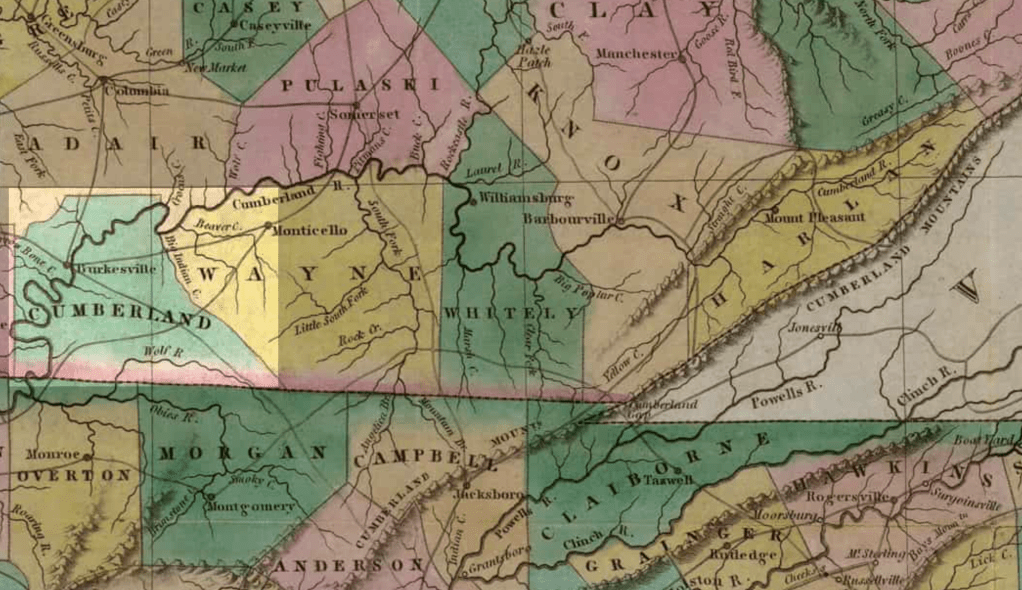
Obviously, a key factor in Thomas Whitlock’s decision to sell his land on Little Reed Island Creek of New River in Wythe County, Virginia, in 1805 and relocate to Kentucky was that he had lost his court battle with his daughter-in-law Mary Davies Whitlock, widow of Thomas’s son Charles, and had been forced by the court to cede half of his landholdings to Mary and her two daughters, Thomas’s granddaughters Hannah and Agnes Whitlock. This legal dispute and its outcome would no doubt have made for bruised feelings between the parties in the dispute. As also noted in the posting I have just linked, during this trial, Thomas’s nephew Thomas Whitlock, son of Thomas’s brother Charles, testified that, even before the trial, his uncle Thomas had spoken of removing to the west country. Cumberland County, Kentucky, would have attracted Thomas’s attention because, as the testimony in the Whitlock vs. Whitlock case shows us, quite a few Wythe Countians had already gone out to Wayne and adjoining Cumberland County, including Thomas’s son-in-law Thomas Brooks and wife Sarah Whitlock Brooks.
As Harriette Simpson Arnow notes, there was also rich farmland to be found in the Cumberland region of Kentucky along creek and river bottoms akin to the land on which Thomas Whitlock lived in Wythe County. In her book Seedtime on the Cumberland, she writes,[2]
As one travels east through Smith County or down into the region of the Caney Fork or even upriver into the wide bottoms of Cumberland County or to Meadow Creek in Wayne, the understanding [i.e., of why people would relocate to this region] is still easy; there is after 175 years of farming an air of peace and plenty — good homes, big barns, fat cattle, tall corn and tobacco, set mostly in wide valleys between low hills.
Thomas Whitlock Acquires Land in Cumberland County
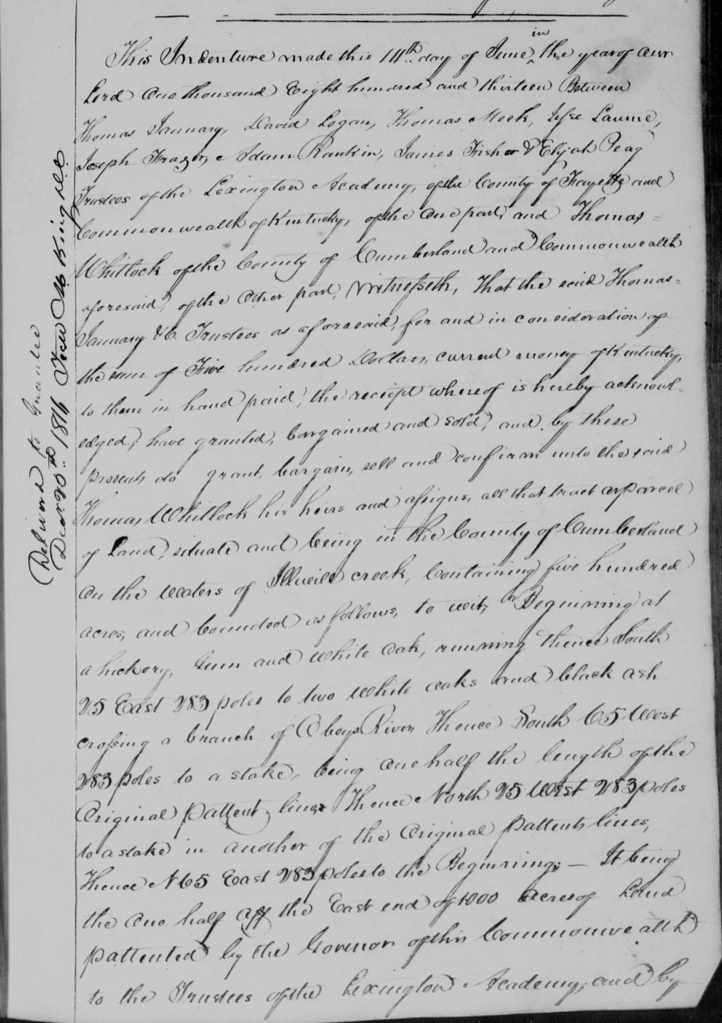
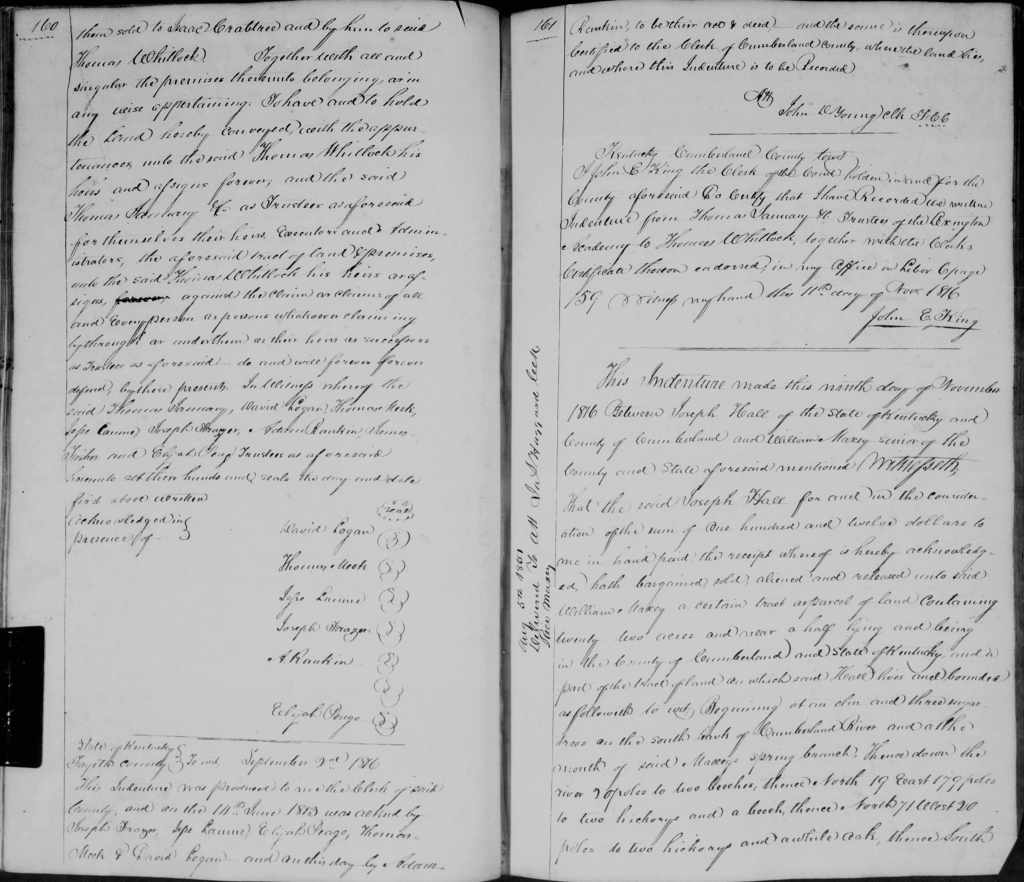
On 14 June 1813, the trustees of Lexington Academy in Fayette County, Kentucky, deeded to Thomas Whitlock of Cumberland 500 acres on the waters of Illwill Creek in Cumberland.[3] The deed shows the academy’s trustees Thomas January, David Logan, Thomas Meek, Jesse Lourne or Laurne,[4] Joseph Frazer, Adam Rankin, James Fisher, and Elijah Poage deeding the land to Thomas, and states that the land was half of a 1,000-acre tract patented by the governor of Kentucky for the Lexington Academy, and sold by them to Isaac Crabtree. I suspect what this statement means is that the academy had sold half of the 1,000 acres to Crabtree and was now selling the other half to Thomas Whitlock, who may have already been occupying this piece of land. The deed was signed by the academy trustees, with no witnesses, and they acknowledged it on the day it was made. It was proven on 2 September 1816, and recorded 11 November 1816.
Isaac Crabtree (1757-1849), a Maryland native, was an associate of Daniel Boone and was among a group of Longhunters who joined Boone on his 1773 expedition to Kentucky. He helped lay out the county seat of Wayne County, Monticello, and was elected to represent that county in the Kentucky legislature in 1806.[5]
The 1820 federal census enumerates Thomas Whitlock at Paoli in Cumberland County, Kentucky.[6] The household contains one male and one female, each aged 45+, and an enslaved male aged 14-25. As had been the case on the 1810 census, on this census, Thomas Whitlock is listed next to his son-in-law Abner Bryson. Paoli is an historical community on the line between Cumberland and Clinton Counties (that is, on the Cumberland-Wayne County line in Thomas Whitlock’s lifetime) some 19 miles southeast of Burkesville.
Illwill Creek, on whose waters the land Thomas Whitlock bought in June 1813 lay, was a tributary of the Obey River (subsequently dammed to form Dale Hollow Lake), joining the Obey about halfway between Burkesville and Paoli. Paoli was the county seat of Clinton County initially, when that county was formed in 1835. My reading of the 1810 and 1820 census and Thomas Whitlock’s land records in Cumberland County is that he and wife Hannah settled on Illwill Creek when they first arrived in Cumberland County, and he’s listed on the 1810 census in Burkesville and the 1820 census in Paoli because Thomas and Hannah were living about halfway between both communities.
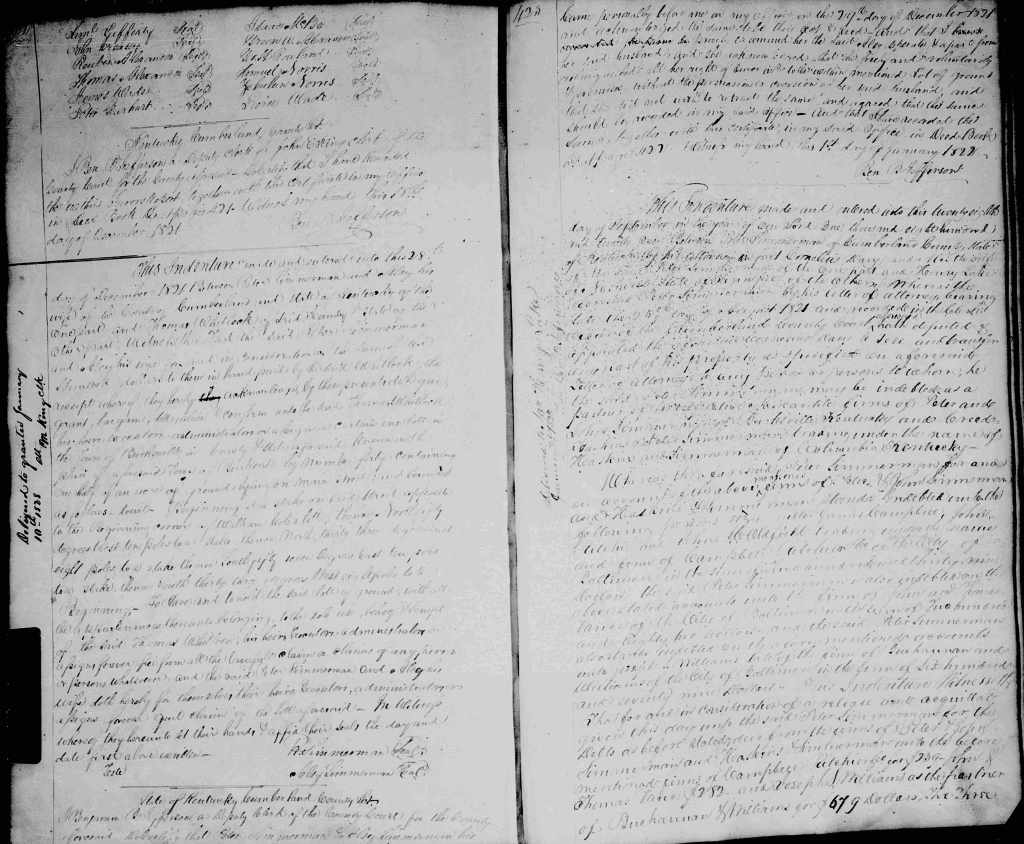
On 28 December 1821, Thomas Whitlock bought more property in Cumberland County, this time from Peter and Alsey (Thurman) Simmerman of Cumberland County.[7] The land was lot #40 in Burkesville, on Main Street, for which Thomas paid $600 in hand. The deed notes that the lot bordered one owned by William Cole. The deed is signed by Peter and Alsey Simmerman and has no witnesses. The Simmermans acknowledged the deed the following day, and it was recorded on 1 January 1822. A marginal note in the deed record states that it was delivered to the grantee on 10 January 1828.
Peter Simmerman was another Wythe County, Virginia, resident who had relocated to Cumberland County, Kentucky. His father Christopher Simmerman (1746-1813) donated (along with John Davis) the land on which Wytheville was founded. The Simmerman family operated the first tavern in Evansham, as Wytheville was initially called.[8] I suspect that, in buying a lot from Peter Simmerman, Thomas Whitlock was buying a town house in which he and Hannah could live at least part-time in the final years of their lives.
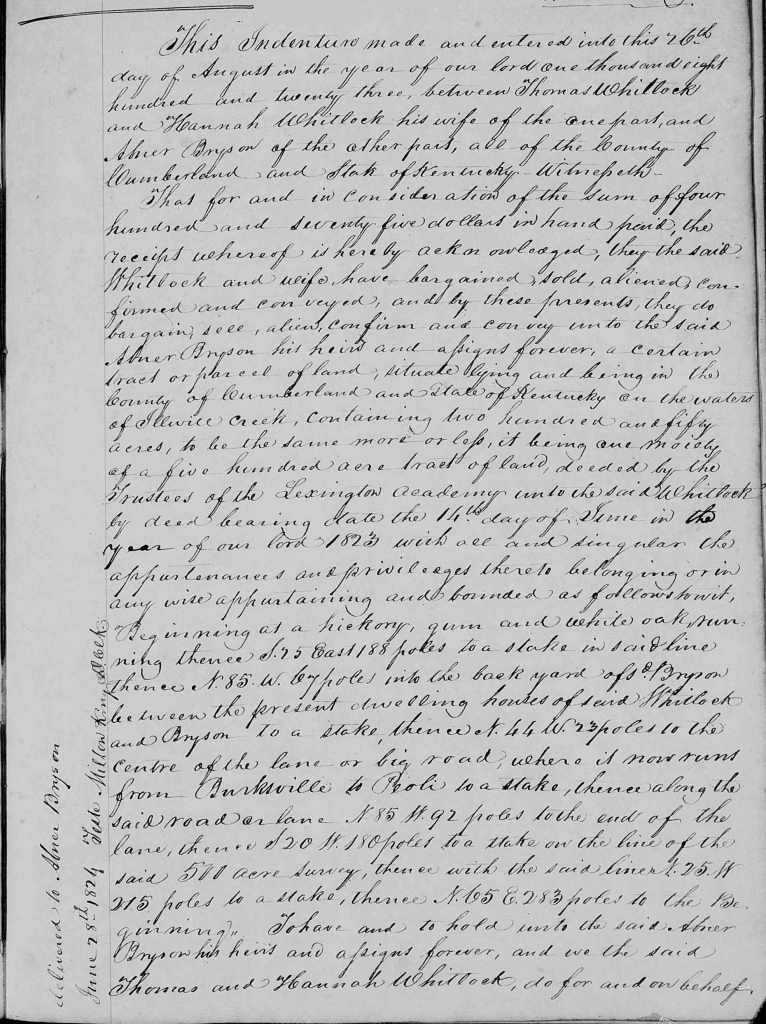
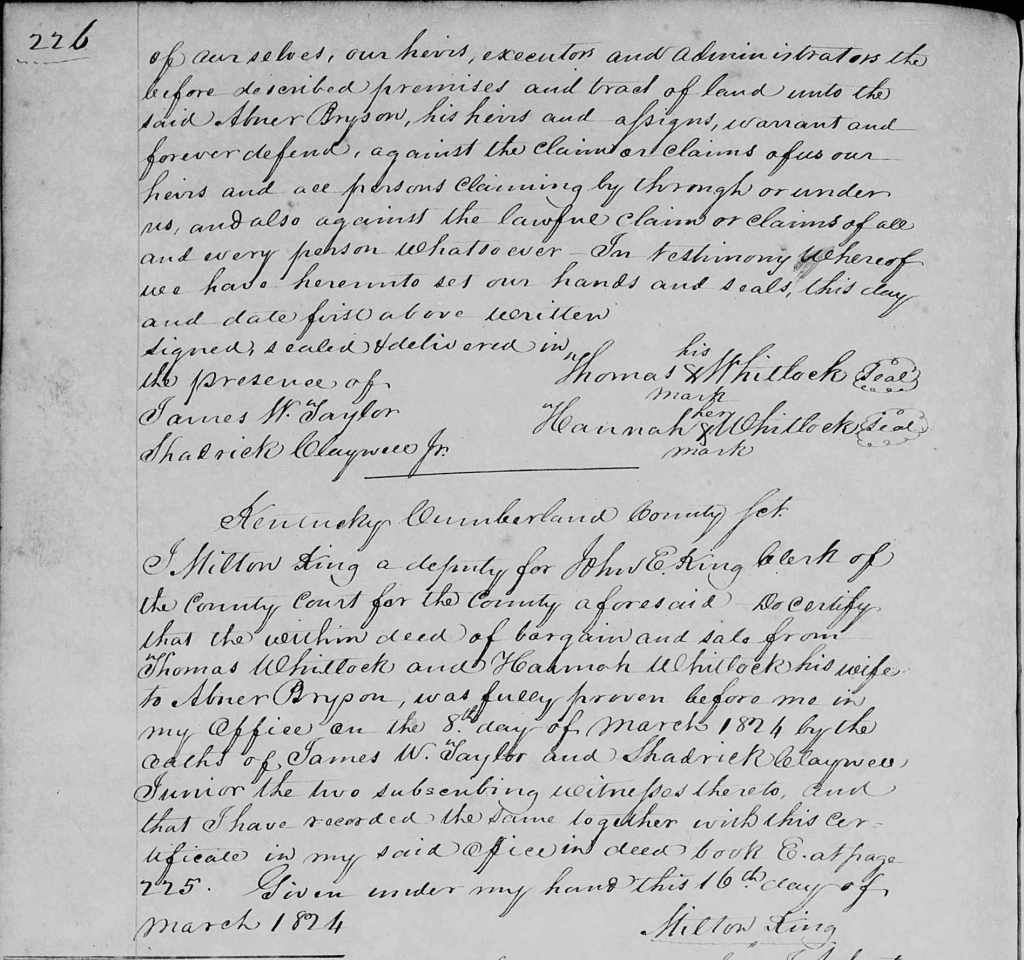
On 16 August 1823, Thomas and Hannah Whitlock sold half of their land on Illwill Creek to their son-in-law Abner Bryson, who paid $475 for the 250 acres.[9] The deed notes that the land bordered both Thomas Whitlock and Abner Bryson, and that both lived on these tracts of land. It also states that the land was along the road from Burkesville to Paoli. Thomas and Hannah both signed by mark, with James W. Taylor and Shadrick Claywell Jr. witnessing. On 8 March 1824 both witnesses proved the deed, and it was recorded on 16 March 1824. A marginal note states that the deed was delivered to Abner Bryson on 28 June 1824.
If the road from Burkesville to Paoli followed the route of present-day highway 90, then Thomas Whitlock lived at the head of Illwill Creek some 10 miles west of Paoli and 8.7 miles east of Burkesville, near the junction of highway 1880 (Irish Bottom Road) and highway 90.
Thomas Whitlock Makes His Will in Cumberland County
On 22 January 1824, Thomas Whitlock made his will in Cumberland County.[10] The will (a digital image is at the head of this posting) reads as follows:
I Thomas Whitlock of the county of Cumberland and State of Kentucky do make and ordain this to be my last will and testament in the following manner and form in the first place i allow all my estate both real and personal to be valued by two Juditious and Interested men chosen by my executors for that purpose and as for my negroes I do not wish them to be Sold from my family of children therefore I Shall dispose of them in the following manner that is i give and bequeath to my Daughter Sarah Brooks my negro woman named Lucy and her largest child named perlina, at their value to be Settled in her part of my estate also I give and bequeath to my daughter Nancy Bryson a negro boy named Elford and a negro girl named Kiza at their value to be Settled in her part of my estate I also give and bequeath to my Son in law William Hannah my negro man named Ben at his value to be Settled in his part of my estate then all the balance of my estate both real and personal I allow to be Sold on a credit of 12 months and the money arising from Such I Shall dispose of in the following manner that is to Say first I allow all my just debts and demands against me to be Settled and paid and I give and bequeath to my 2 grand Daughters the heirs of my Son Charles Whitlock Deceased Two dollars in full of their part of my estate then the balance and remainder of the money arising from the sale of my Estate and one hundred dollars in Silver which I loaned to my Son in law John Hammons and all other debts due to me I allow to be divided Equally to my three daughters Sarah Brooks Nancy Bryson and Milly Hust and to my two Sons in law William Hannah and John Hammons all which is to receive an equal part of the money from the Sale and the other debts due me counting the value and price of the negroes in their part of my estate to whom they are Bequeathed I likewise do Constitute make and ordain George Swope and William Wood Gentlemen Sole executors of this my last will and testament. I do hereby utterly disallow revoak and disanul every former will and testament ratifying and Confirming this alone and no other to be my last will and testament in witneſs whereof I have here unto Set my hand and Seal this 22d of January 1824.
Thomas Whitlock (seal)
Teste
Isaac Taylor
Wm M. Peery
James Peery
Note that the will does not state that Thomas signed by mark. Had he become literate in the final part of his life? If so, as noted previously, he and Hannah both signed their deed to Abner Bryson in August 1823 by mark.
Isaac Taylor and William M. Peery proved the will at Cumberland County court in May 1830 and it was recorded on 2 June 1830. This places Thomas’s death between the date the will was written, 22 January 1824, and May 1830. As noted above, the deed Thomas and wife Hannah made to their son-in-law Abner Bryson on 16 August 1823 was proven on 8 March 1824 and recorded on 16 March 1824, and was then delivered to Abner Bryson on 28 June 1824. I think it’s likely that Thomas was still living on these dates, but am not certain that was the case: Note that Thomas’s will makes no mention of Hannah, and this seems to indicate that she had died between 16 August 1823 and 22 January 1824, so it’s possible that Thomas died at some point in 1824 after making his will in January of that year — though the May 1830 probate date suggests to me that he likely died in 1830.
In my next posting, I’ll provide digital images of Thomas Whitlock’s estate documents, along with transcriptions and commentary.
[1] 1810 federal census, Cumberland County, Kentucky, p. 180.
[2] Harriette Simpson Arnow, Seedtime on the Cumberland (New York: Macmillan, 1960), p. 34.
[3] Cumberland County, Kentucky, Deed Bk. C, pp. 159-161.
[4] Both in the deed and the signature, this surname is difficult to read – Lourne? Laune? Larue?
[5] See LaVelda Faull, “Biography of Isaac Crabtree,” at the Pulaski County, Kentucky, GenWeb site.
[6] 1820 federal census, Cumberland County, Kentucky, p. 157.
[7] Cumberland County, Kentucky, Deed Bk. D, pp. 422-3.
[8] See Mary B. Kegley, Early Adventurers on the Western Waters, vol. 3: The New River of Virginia in Pioneer Days, 1745-1805 (Wytheville: Kegley Books, 1995), pp. 783-7.
[9] Cumberland County, Kentucky, Deed Bk. E, pp. 225-6.
[10] Cumberland County, Kentucky, Will Bk. B, pp. 423-4.


2 thoughts on “Thomas Whitlock (abt. 1745 – 1830) of Louisa and Wythe Counties, Virginia, and Cumberland County, Kentucky: Cumberland County Years”