A valuable starting point for documenting George Rice’s life: the bible register of George’s father Patrick Rice. You’ll note that I have stricken through some of the text in the opening paragraph of this posting. Since I published it in September 2021, a valuable document that I had not previously seen has come my way — a transcript of the register of the bible of George Rice’s father Patrick, a digital image of which is at the head of this posting. This bible record states the birthdate of George Rice, son of Patrick Rice and Elizabeth DeCow: 28 September 1735. Because I did not have this record when I first made this posting, I’m now revising it in July 2022 after a copy of a transcript of the bible of Patrick Rice has been kindly sent to me.
Some information about this record: it was sent to me by Margene Scott, a descendant of Patrick Rice’s grandson through John Jehu Rice, son of Elizabeth Rice, who was a daughter of George Rice and Elizabeth Brooks. Margene has the bible of Jehu Rice’s son George (b. 1827). Tucked into that bible, she tells me, are transcripts of Jehu Rice’s bible register and of the bible register of his grandfather Patrick Rice.
As you can see from the image at the head of the posting, the transcript of Patrick Rice’s bible register was made by John Seaton in April 1898. At that time, the bible of Patrick Rice belonged to Adolphus Lafayette Reid (1824-1915), a judge in Greenup, Kentucky, whose parents were Darius Bourne Reed and Caroline Roach. Caroline was a daughter of Ruth Rice and husband Micajah Roach. Ruth was a sister of Elizabeth Brooks who married George Rice. The present whereabouts of this bible are not known, according to Margene Scott. On Adolphus Lafayette Reid and Darius B. and Caroline Roach Reid, see this posting.
As the transcript of Patrick Rice’s bible also states, the bible was published in London in 1759 with Thomas Baskett as printer. Patrick Rice bought the bible 13 September 1771 from Joseph Day. Joseph Day (1740-abt. 1798) and wife Catherine Yarnall Day moved to Frederick County, Virginia, from Chester County, Pennsylvania, in 1766 after receiving a certificate of removal from their Friends’ monthly meeting in Chester County, the Nottingham Monthly Meeting, on 2 March 1766. A son of Joseph and Catherine Day, their son Joseph, married Margaret Brooks, daughter of Thomas Brooks and Margaret Beamont/Beamon — Thomas being a brother of Elizabeth Brooks who married George Rice. For more information on Joseph Day and Catherine Yarnall, see this posting.
The bible register also tells us that Patrick Rice married Elizabeth DeCow 3 December 1734. It does not state where this marriage occurred, but quite a few records place Elizabeth’s parents Jacob DeCow and Elizabeth Powell in Burlington County, New Jersey, at the time of this marriage. The DeCows were members of the Chesterfield Friends’ Monthly Meeting in Burlington County, and were part of the community of Quakers who had come there from Yorkshire, England, in the 1600s escaping persecution in England. I do not find a marriage record for Patrick Rice and Elizabeth DeCow in the minutes of Chesterfield Monthly Meeting, though I find marriages for several of Elizabeth’s siblings in these minutes. This leads me to conclude that Elizabeth married Patrick Rice out of the Quaker communion, and that Patrick was perhaps not a Quaker.
A letter Patrick and Elizabeth DeCow Rice wrote to Elizabeth’s brother Isaac on 10 September 1744, which is cited and discussed in this posting, states that Patrick and Elizabeth were living in Frederick County, Virginia, by that date. If they married in Burlington County, New Jersey, then it appears that they did not settle there for a long period, and that they moved soon after their marriage to Frederick County, Virginia. As Patrick and Elizabeth DeCow Rice’s oldest child, George Rice could, it seems to me, have been born in either location.
As I’ve noted previously, various indicators suggest to me that Elizabeth Brooks was likely born about 1747-1750, so she would have been some years younger than husband George Rice. I’ve also stated that I think George and Elizabeth married around 1767, since their oldest child, Ruth, appears on the 1850 federal census aged 81, which would make her birth year about 1769.[1]
Patrick Rice’s 1754 Deed to Sons George and Edmond
As I’ve noted previously, Patrick Rice eeded land in Frederick County for love and affection to his sons George and Edmund Rice on 25 September 1754 (I shared a digital image of this deed in my last posting).[2] In the deed, Patrick gave these two sons 300 acres on Long Marsh that had come to him as a grant from Lord Fairfax on 14 April 1752 and had been surveyed by George Washington.[3]
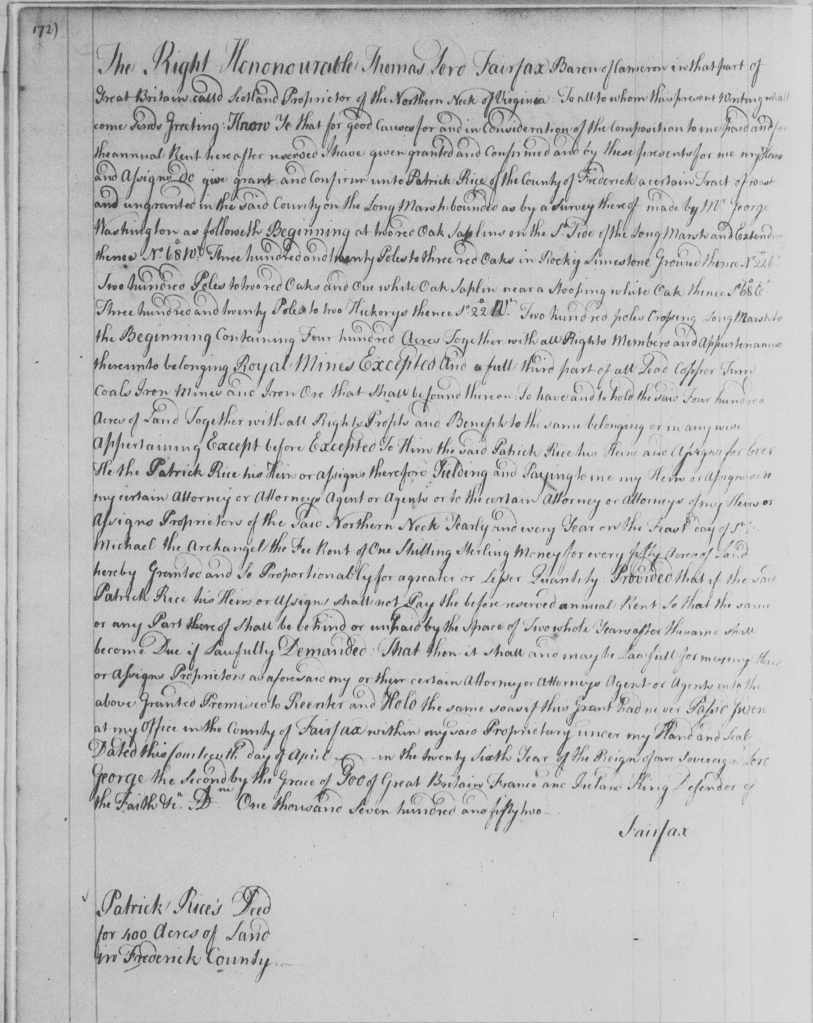
Patrick’s deed states that he was giving this land to his sons “for the better maintenance of them.” This phrase suggests to me that, as these two oldest sons of Patrick Rice entered their adult lives, he was providing them with land to start their adult lives. George was just turning 19 at the time, and his brother Edmund, who was born 6 January 1737, was 17. The grant for this tract states, by the way, that Patrick had received 400 acres on the south side of Long Marsh Creek; he gave 300 acres out of that grant to his sons two years later. When Edmond sold Michael and Bartholomew Smith 202½ acres out of his father’s 1754 gift to him and his brother George on 30 June 1773, the deed states that the land was at the head of Long Marsh Creek.[4]
George Rice’s French and Indian War Service

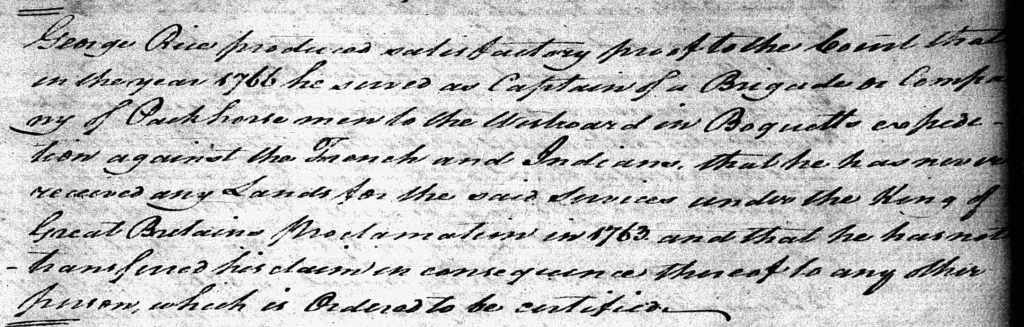
In my first edition of this posting in September 2021, which I’m now correcting after I received the transcript of Patrick Rice’s bible, I had discussed an affidavit George Rice gave in Frederick County, Virginia, in 1780 regarding his French and Indian War service under Henry Bouquet in the French and Indian War. On 8 March 1780 in Frederick County court, George Rice gave affidavit that “in the year 1766 he served as Captain of a Brigade or Company of Pack horsemen to the Westward in Bouquetts expedition against the French and Indians.”[5]
I had taken this affidavit to suggest that George Rice was a young man, perhaps 20-22, when he served under Bouquet. I now realize that this conclusion was not correct, and that George was a man of more mature years, 29 years old, when he gave this service. There is a problem with this affidavit, however. Henry Bouquet died 2 September 1765 — before George Rice claims that he was serving in Bouquet’s “westward” expedition. Bouquet’s Ohio expedition — and it’s surely to this expedition that George’s reference to serving in an expedition “to the Westward” under Bouquet points — took place in 1764.[6] As Erik L. Towne notes, after the Virginia legislature repeatedly refused to provide troops to Bouquet for this expedition, in early September 1764 Virginia troops marched under John Field from Winchester to Pittsburgh to serve with Bouquet in Ohio, and another set of Virginia soldiers under John McNeill soon followed suit.[7]
In my view, when George Rice provided an affidavit stating that he served in Bouquet’s westward expedition in 1766, he was likely either misremembering the year in which the expedition occurred, or was perhaps remembering the year in which his service ended. For reasons unclear to me, a number of sources have turned the year named by George Rice in his affidavit from 1766 to 1756.[8]
George Rice’s Revolutionary Service Documents Note That He Was “Old and Infirm” in 1778
George Rice served not only in the French and Indian War but also in the Revolution, in which he was first a lieutenant under Captain John Neville and then a captain in the 11th and 15th Virginia Regiment under the command of Colonel Daniel Morgan. I’ve found one document in his extensive Revolutionary papers (which include papers about bounty land claims) that appears to refer to George’s age.
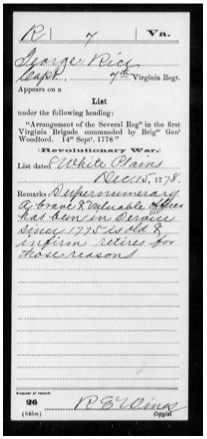
On 15 December 1778, after the Virginia continental troops were reorganized at White Plains, New York, under the authority of Brigadier General William Woodford, Woodford noted that George Rice had resigned his post in September 1778 (as a result of the reorganization of troops), and as he noted this, Woodford stated:
Captain George Rice, a brave and valuable officer, has been in service since 1775, is old & infirm & retires for those reasons.
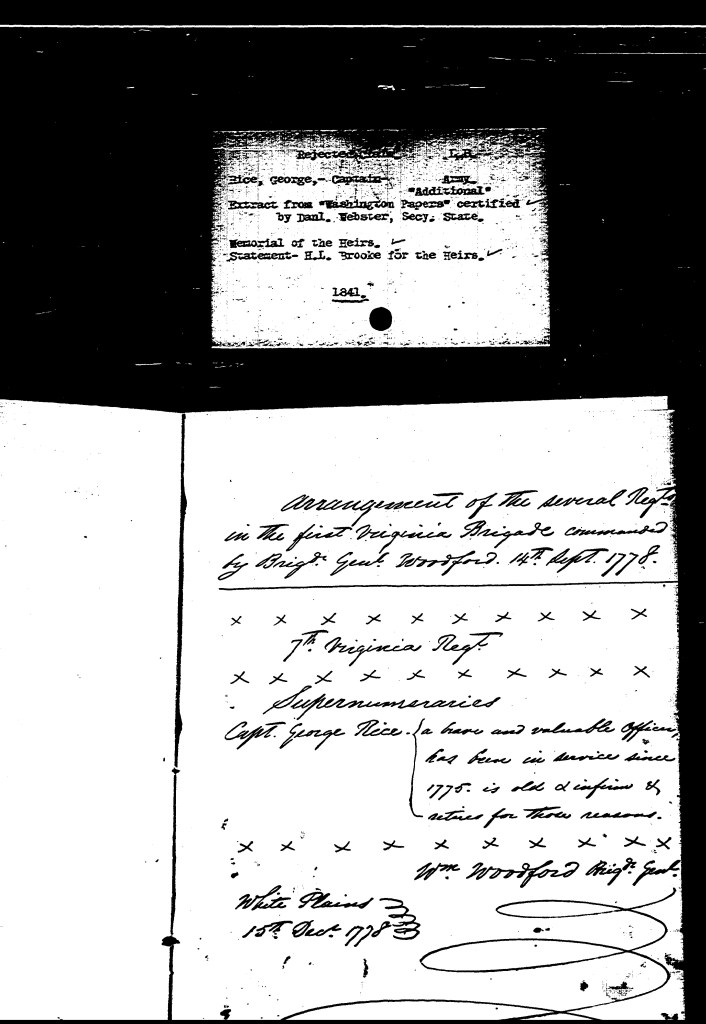
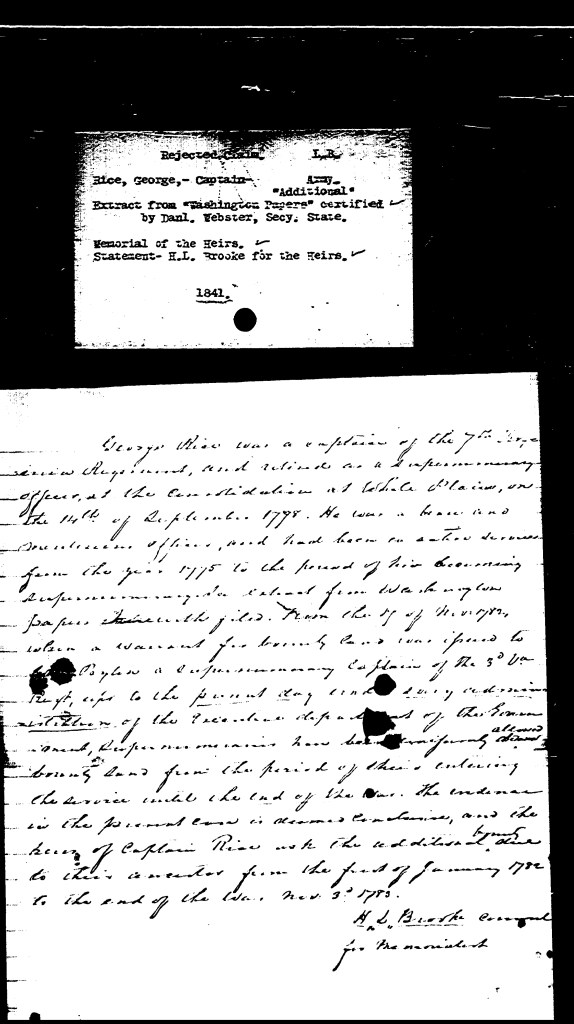
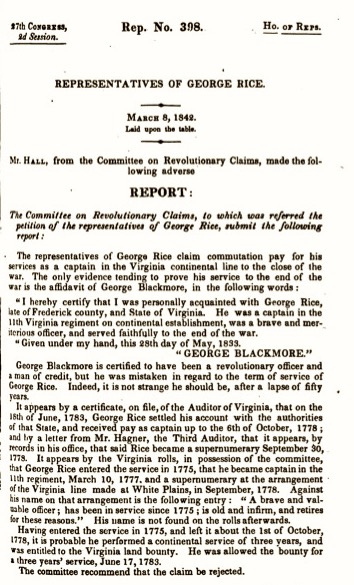
Woodford’s statement is cited in a claim that the attorney for George’s heirs, H.L. Brooke, presented in 1841 as the heirs sought unsuccessfully to claim more bounty land in George’s name (I say “more,” because George had claimed bounty land for his Revolutionary service in his lifetime). The claim was rejected, and the paperwork for the claim is now archived in the Revolutionary War Rejected Claims collection of Virginia Bounty Warrant applications held by the Library of Virginia. The index card for Woodford’s statement about George Rice in that collection indicates that the original is in the Washington Papers.[9] Woodford’s statement is also abstracted in George Rice’s Revolutionary service file held by the National Archives, with no reference to its source but with a notation that this summary of George Rice’s service as he became a supernumerary was made at White Plains on 15 December 1778.[10]
Other cards in the service packet confirm that George Rice resigned active service on 30 September 1778, after he had been listed for the early months of that year as sick and on furlough, while his company was at Valley Forge. In my view, this set of documents casts important light on what Woodford meant when he described George Rice as “old & infirm” in December 1778.
By the time he gave Revolutionary service, George Rice was, indeed, a seasoned soldier serving in his second military campaign during the Revolution, and in comparison with many others giving military service at this time, he would definitely have been older — older, in particular, than most of the troops he was commanding. As Rebecca Beatrice Brooks notes, “The majority of Continental soldiers [during the Revolution] were young men, usually around 17 or 18 years old.”[11] As Todd Andrlik indicates, though we tend to think of the Founding Fathers as grave elderly men (hence the relativity of the term “old”), the average of those signing the Declaration of Independence was 44, and more than a dozen of the signers were 35 or younger.[12] William Woodford, who characterized George Rice as “old & infirm” as Rice retired (or, more precisely, as he was retired) was himself 44 years old in 1778.
“Old” is a relative term. I think that in hearing that George Rice was considered “old” at the time he ended his second stint of military service in the fall of 1778, we’re encountering an explanation or justification for the retirement of an officer who may, indeed, have been suffering from sickness in the winter months of 1778, who had been absent from duty as a result, and who may have been worn out from his service in a second war. I do not think that Woodford’s statement means that George Rice was an old man as we’d think of that term currently — and it should be kept in mind that people did, in fact, age much more quickly in colonial America than they do in the America of the 21stcentury. As David Hackett Fischer has also noted, colonial Virginians tended to “make themselves a little older” than they actually were because the system of social status in colonial Virginia awarded seniority, especially among adult males.[13]
George Rice Begins Appearing in Frederick County Records Independently of His Father in March 1763
As far as I have found, the first appearance of George Rice in Frederick County records after the deeds his father Patrick made to him in the 1750s discussed above is March 1763, when George received a Northern Neck grant for 300 acres. Note that I say “as far as I have found” to underscore that my research is far from exhaustive, and I may have missed records — and would welcome being told this if that’s the case. I don’t find George appearing in Frederick County road orders (which start in 1743) until July 1768.
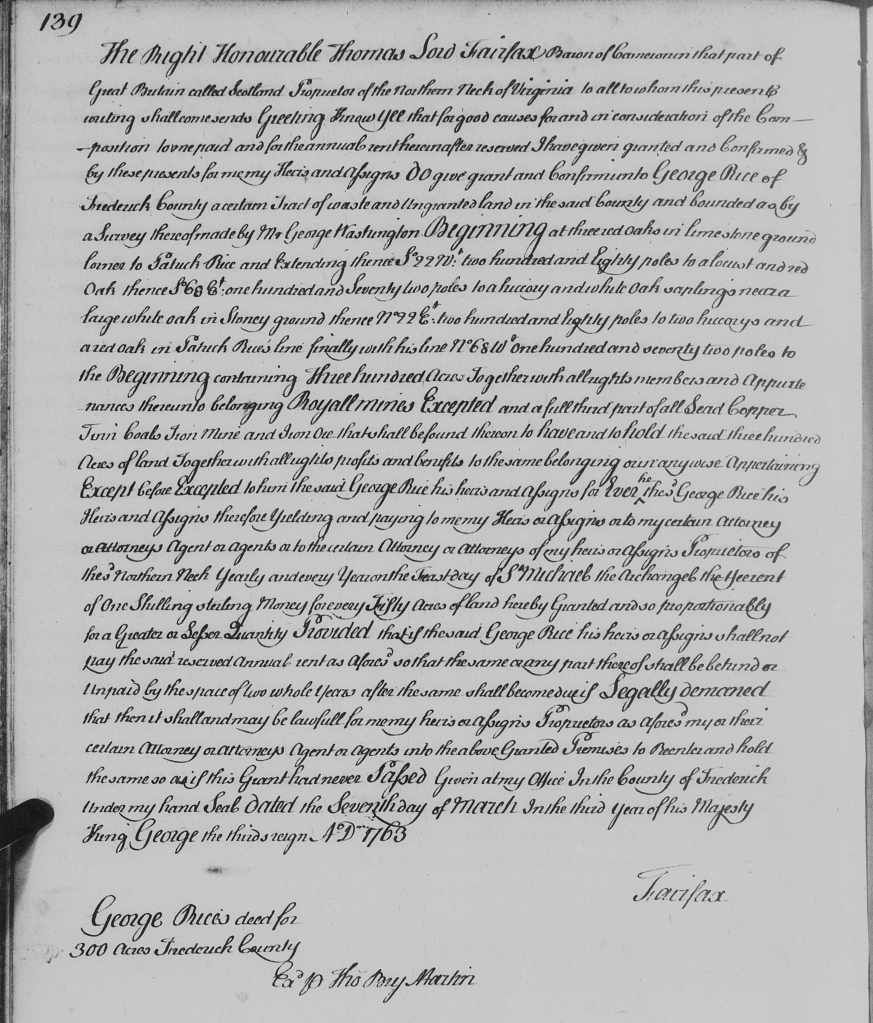
The first record I’ve found of George Rice as a person living an adult life independent of his father in Frederick County, Virginia, is the following: on 7 March 1763, George Rice received a Northern Neck grant of 300 acres from Lord Fairfax, the first of numerous land grants he was to obtain from the commonwealth of Virginia.[14] The grant states that George Washington surveyed the land and that its border lay along the line of Patrick Rice’s land. I suspect that George, who had likely previously been farming with his father Patrick, was launching his adult life at this point, intending to do military service in the French and Indian Wars and then to marry following that.
George Rice’s Service on the Vestry of Frederick Parish
According to Thomas K. Cartmell in his book Shenandoah Valley Pioneers and Their Descendants, George Rice was on the vestry of Frederick parish in 1764.[15]
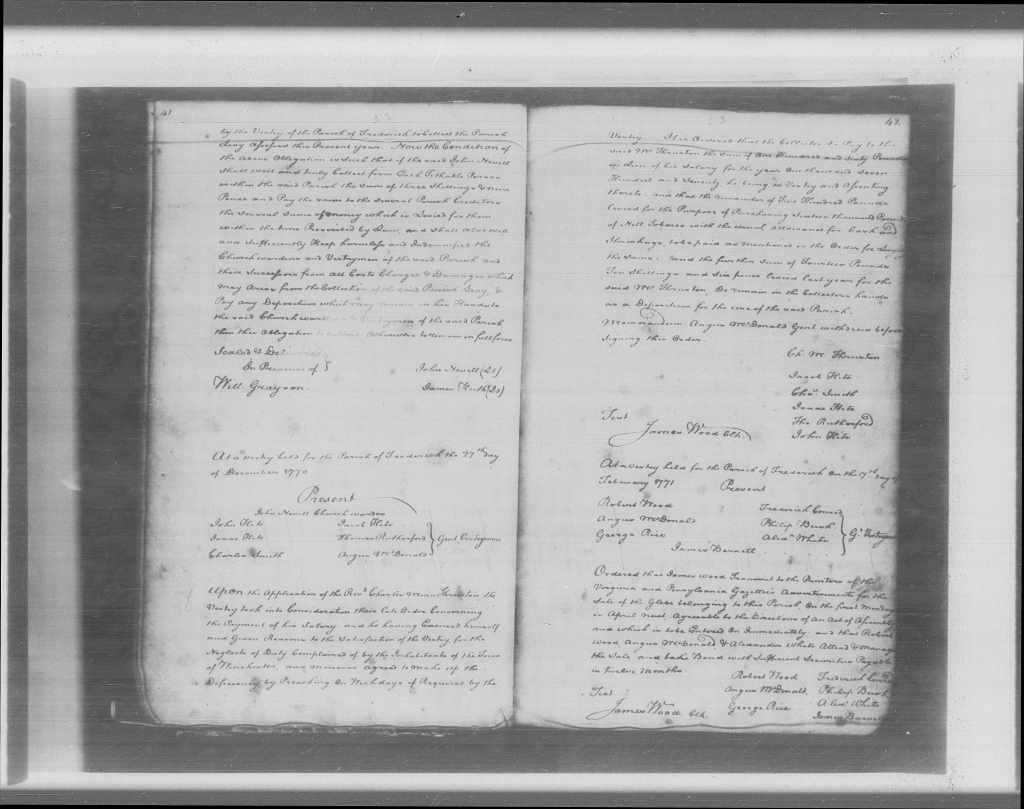
But Cartmell appears to be mistaken in claiming that George Rice was on the Frederick parish vestry in 1764. Though the parish was organized in 1744, its records from 1744 to 1764 do not exist. Extant vestry minutes began in 1764. My reading of the original minutes (available in digitized form at the Family Search website) indicates that George Rice first appears as a vestryman in the minutes for 7 February 1771.[16] Up to this point, he is never listed in vestry minutes as a vestryman. At some point between 27 December 1770 and 7 February 1771, he became a vestryman, an indicator of his rising status in the community as a man approaching 30 who had just given military service on the Ohio frontier and had married and begun to acquire property.
In my next posting, I’ll start sharing the documentation I have for his adult life in Frederick County, Virginia, and at the very end of his life, in Woodford County, Kentucky.
[1] 1850 federal census, Greenup County, Kentucky, dist. 1, p. 202 (dwelling 50, family 52). Ruth is enumerated in the household of her grandson Adolphus Lafayette Reid. Ruth’s surname is Roach on this census; she married Micajah Roach in Frederick County, Virginia, on 4 April 1786.
[2] Frederick County, Virginia, Deed Bk. 3, pp. 462-4.
[3] Northern Neck (Virginia) Grant Bk. H, p. 172.
[4] Frederick County, Virginia, Deed Bk. 16, pp. 309-310. Witnesses to Edmund’s deed were John Nevill, Edmund Lindsey, John Skelding, George Rice, and Daniel Hunsicker.
[5] Frederick County, Virginia, Court Order Bk. 17, p. 275.
[6] See William Smith, Historical Account of Bouquet’s Expedition Against the Ohio Indians, in 1764 Cincinnati, Clarke, 1868; Cyrus Cort, Col. Henry Bouquet and his campaigns of 1763 and 1764 (Lancaster, Pennsylvania: Steinman & Hensel, printers, 1883); Mary C. Darlington, ed., History of Colonel Henry Bouquet and the Western Frontiers of Pennsylvania, 1747-1764 (priv. publ., Pittsburgh, 1920); and “Bouquet’s Expedition” at the Ohio History Central website.
[7] Erik L. Towne, “‘British in Thought and Deed’: Henry Bouquet and the Making of Britain’s American Empire,” unpubl. Ph.D. dissertation, Bowling Green State University (2008), p. 111. University of Michigan’s Clemens Library has a collection of archival materials entitled “Bouquet’s Expedition against the Indians (1764)” consisting of two of Bouquet’s orderly books from the fall of 1764. As the online guide to this collection indicates, this material names officers serving under Bouquet and many soldiers, including ones from Virginia. The papers of Bouquet have been published by the Pennsylvania Museum and Historical Commission, and are available online vis Hathi Trust.
[8] See, e.g., see T.K. Cartmell, Shenandoah Valley Pioneers and Their Descendants: A History of Frederick County, Virginia, from Its Formation in 1739 to 1908 (Winchester: Eddy, 1909), p. 89; and Ben Hill Doster, The Doster Genealogy (Richmond: William Byrd Press, 1945), p. 43.
[9] See Bounty Warrants, Revolutionary War Rejected Claims files, file of George Rice, online in digitized form at Library of Virginia website. On this rejected claim, see also US Congress, Reports of Committees, 16th Congress, 1st Session – 49th Congress, 1st Session, vol. 2, report 398 (Washington, D.C., 1842).
[10] NARA, Compiled Service Records of Soldiers Who Served in the American Army During the Revolutionary War, Compiled 1894 – ca. 1912, Documenting the Period 1775 – 1784, RG 93 M881; online at Fold 3.
[11] Rebecca Beatrice Brooks, “Continental Soldiers in the Revolutionary War,” at her History of Massachusetts site.
[12] Todd Andrlik, “Ages of Revolution: How Old Were They on July 4, 1776?” Journal of the American Revolution online.
[13] David Hackett Fischer, Albion’s Seed: Four British Folkways in America (New York and Oxford: Oxford University Press, 1989), pp. 323-4.
[14] Northern Neck (Virginia) Grant Bk. M, p. 139.
[15] Cartmell, Shenandoah Valley Pioneers and Their Descendants, p. 181.
[16] Frederick County, Virginia, Frederick Parish Vestry Minute Bk. 1764-1812, p. 42.


4 thoughts on “Children of Mary Brooks (d. 1787, Frederick County, Virginia) — Elizabeth Brooks (1747/1750 – 1816) and Husband George Rice (1735 – 1792): Information About George’s Early Years”