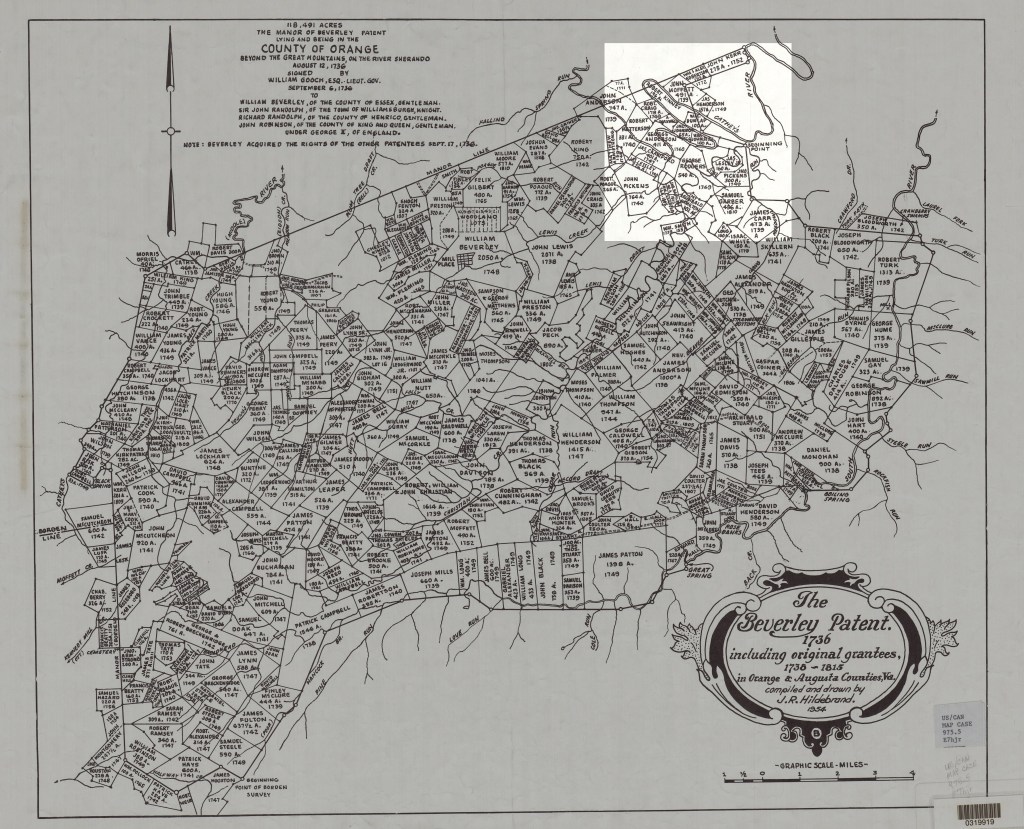
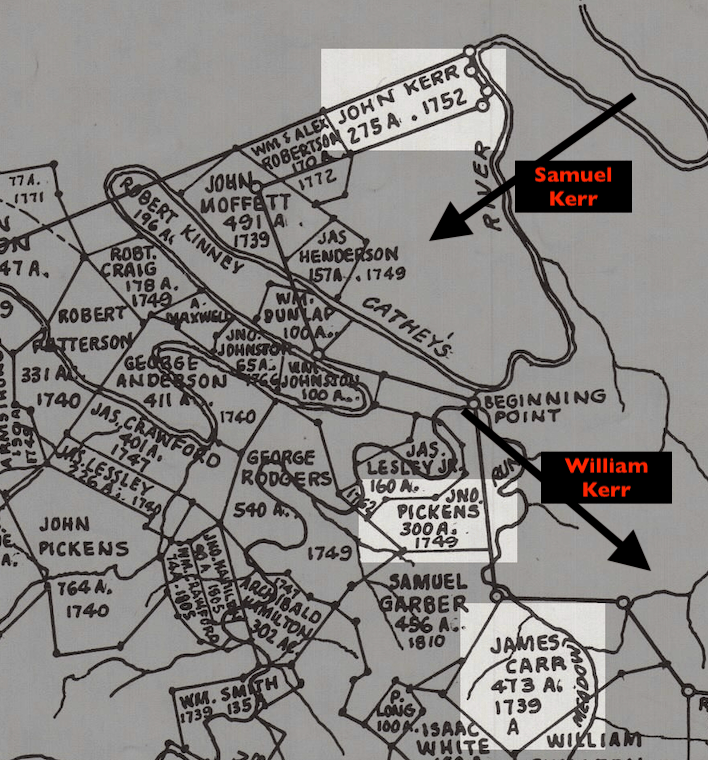
As previous postings have explained, since James Kerr died intestate in Augusta County prior to 20 March 1770 and there is not a will or an estate file stating his heirs, the names of his children (other than his eldest son John and John’s brother William) have to be inferred from a number of other Augusta County records, including the baptismal register kept by Reverend John Craig at Tinkling Spring Presbyterian church and land records showing where various Kerr families lived in that county from the 1740s forward.[2] The posting I linked at the head of this paragraph cites research notes of Jim Veregge, who points out that the Tinkling Spring baptismal register shows John, Andrew, William, and Samuel Kerr all having children baptized in that church between 1740 and 1749.[3] John and William both appear as James’s sons in Augusta County records. Andrew and Samuel are almost certainly other sons of James. Jim Veregge also notes that land records in Augusta County show these all of these Kerr men living in proximity to each other around Cathey’s River, later Middle River, near the northeastern boundary of Beverley Manor.[4]
Ulster Beginnings
I’ve seen no documents providing a precise or approximate date of birth for James Kerr. Perhaps because his oldest children, John and Elizabeth, are thought to have been born around 1710 or shortly thereafter, researchers of this Kerr family conventionally place James’s birthdate in the period 1682-7.[5] Published and online histories of the family often place James’s birth in Scotland. I’ve seen no evidence regarding his place of birth — except one should not that in an article discussing an upcoming Independence Day reunion of the Kerr family at New Hope, Virginia, in 1946, Kerr descendant W.L. Kerr states that James Kerr, progenitor of this Kerr family, was “Irish born.”[6] If this is a tradition that passed down in the Kerr family of Augusta County, then it would appear that James Kerr was likely born in Ulster.
The headright claim that James’s known son John filed on 27 March 1740 in Orange County, Virginia, discussed in a previous posting, states that at some point prior to 1740, John arrived in Philadelphia from Ireland, bringing his family with him, and then moved from Pennsylvania to Virginia.[7] Since it’s very likely that John came to America with his father James, this headright claim tells us that James Kerr apparently arrived from Ireland in Philadelphia prior to 1740, and that he had moved with his family from Pennsylvania to Virginia after the family’s immigration to Pennsylvania. John Kerr married Lucy Pickens, the widow of Matthew Gillespie, and according to some researchers, this marriage took place in Chester or Lancaster County, Pennsylvania, on 27 March 1730.[8] I have not found confirmation of this marriage date. Lucy Pickens married Matthew Gillespie on 2 September 1722 and he died in 1728.[9] As a previous posting notes, Lucy’s parents William Pickens and Margaret Pike had arrived in Pennsylvania from Ireland prior to 4 November 1722 when the minutes of Neshaminy Dutch Reformed church in Bucks County, Pennsylvania, say that “the new-comers from Eerlant (i.e., Ireland) who had been received on letters of attestation” (i.e., from their Presbyterian congregation in Ireland) included “Wellem pechens and his wife.”[10] The Neshaminy church minutes show Matthew Gillespie joining that church at the same time that William and Margaret Pickens first appear in Neshaminy records in November 1722.
In addition to Lucy, William and Margaret Pickens’s sons William and John also married children of James Kerr, his daughters Elizabeth and Eleanor — and, as I maintain in a previous posting, it seems to me highly likely that James Kerr’s son Samuel married another child of William and Margaret Pickens, their daughter Margaret. These Kerr-Pickens marriages suggest to me that at some point after the Pickens family arrived in Pennsylvania from Ireland by November 1722 (and the family must have been in Pennsylvania prior to 22 September 1722, if Lucy Pickens married Matthew Gillespie in Philadelphia on that date), the Kerr and Pickens families connected in Pennsylvania and then some family members made their move to Orange (later Augusta) County, Virginia.
If John Kerr married Lucy Pickens (Gillespie) in March 1730 in Pennsylvania, the families had already connected by this date, and the Kerrs were already in Pennsylvania prior to that date. As I’ve previously noted, in a letter he wrote to General Henry (“Light Horse Harry”) Lee on 28 August 1811, Andrew Pickens, whose father Andrew was a son of William and Margaret Pike Pickens, states that he was born on 19th September 1739 in Paxton township, Pennsylvania, and when he was very young, his father moved the family to a few miles west of Staunton, the county seat of Augusta County, Virginia.[11] This statement provides a valuable clue to the probable whereabouts of James Kerr before James also moved his family to Orange (later Augusta) County, Virginia, evidently some years before Andrew Pickens’s family came there.
In his history of the Tinkling Spring Presbyterian church of Augusta County, of which James Kerr was a prominent member, Howard McKnight Wilson notes that the Kerr family has a strong tradition that it arrived in what became Augusta County prior to John Lewis.[12] John Lewis, an Ulster Scots immigrant from Donegal, came to Orange (later Augusta) County from Lancaster County, Pennsylvania, by 1732, settling near what became Staunton, the county seat, which he founded.[13] Wilson adds that before relocating to Virginia, the Kerrs were part of the Donegal Presbyterian Society on the Susquehanna River in Pennsylvania.
Paxtang or Paxton, Lancaster County, Pennsylvania
Paxtang, or Paxton, as it has also been called, is a township now located in Dauphin County, Pennsylvania, on the Susquehanna River. Dauphin was formed from Lancaster County in 1785. The name derives from a word — Peshtank — from the Algonquian-speaking Susquehannock people, which appears to reference the abundant flowing water found in the region.[14] As H.M.J. Klein notes, Pennsylvania experienced successive waves of immigration from Ulster, with arrivals in Philadelphia from Ireland peaking initially in the period 1712-8.[15] After a lull in emigration from Northern Ireland when the Toleration Act was passed in 1719, another wave of Scotch-Irish emigration to Pennsylvania began in 1726 with Philadelphia as the main debarkation point. Crop failures in the following two years spurred emigration. Klein cites historian Robert Proud, who estimated that six thousand arrived from Ulster in 1726 and who found that from 1729 to 1750, immigration to Pennsylvania from Ulster averaged twelve thousand a year.[16]
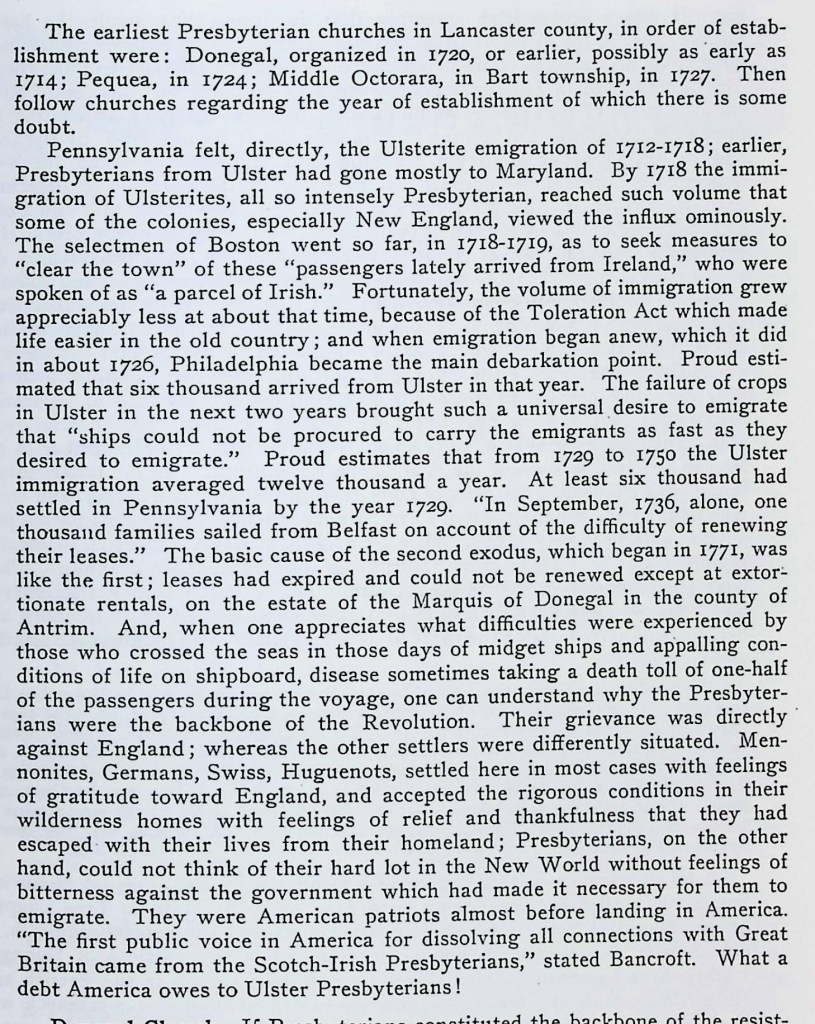
Richard K. MacMaster quotes Jonathan Dickinson, a Philadelphia merchant, who wrote in a letter dated 17 October 1719, “This summer we have had 12 or 13 sayle of ships from the North of Ireland with a swarm of people.”[17] As these Irish immigrants poured into the colony of Pennsylvania through the gate of Philadelphia, they quickly began moving west first through Chester County and then its daughter county of Lancaster. According to historian Henry Jones Ford,[18]
The principal field of Scotch-Irish occupation and settlement was the valley of the Susquehanna. From the original settlements on the Maryland line, the Scotch-Irish moved into the interior along the east side of the Susquehanna, settling by the side of the creeks whose waters they used for their mills. Marks of these early settlements are Upper Octorara Church, organized in 1720; Donegal, in 1721; Pequa, in 1724; Middle Octorara, in 1727; Derry, in 1729; and Paxtang, in 1729. Thus large Scotch-Irish settlements were made in Chester, Lancaster and Dauphin Counties in the first third of the century.
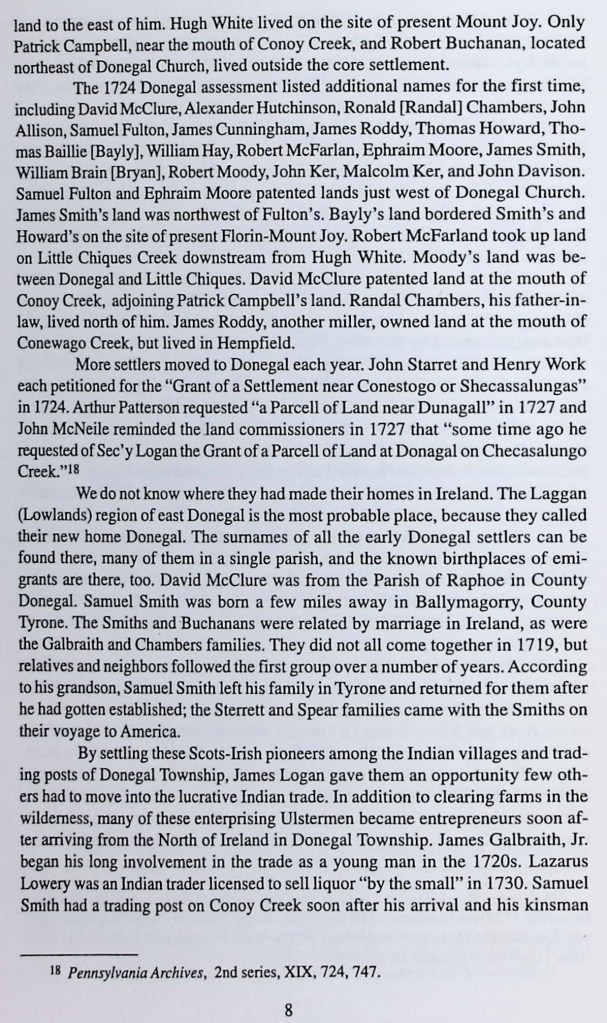
The Donegal Presbyterian Society on the Susquehanna River in which the Kerr family was active before heading to Virginia, according to Howard McKnight Wilson (see above), was the Donegal Presbytery, founded in East Donegal township in Lancaster County. Like Paxtang some 27 miles north and west from it, Donegal sits on the Susquehanna. According to MacMaster, most of the first settlers of the Donegal community were from the Laggan (lowland) area of east Donegal, whose presbytery, the Laggan Presbytery, supplied the Donegal church with its first ministry.[19] MacMaster says that the Ulster Scots who founded Donegal landed in Pennsylvania in the summer or fall of 1719, with James Logan, a fellow Ulsterman and agent for William Penn, operating the land office and recruiting many of these settlers to settle in Donegal, where he himself had landholdings that increased in value as others settled around his land.[20]
Paxtang is in some respects a “daughter” township of Donegal, a point that becomes evident as one follows the history of the chain of Presbyterian churches early Ulster Scots settlers founded in their trek westward through lower Pennsylvania. As Guy S. Klett notes, as the eastern parts of Pennsylvania became more thickly settled and land was not easily obtained, new immigrant settlers began to move west, with this westward movement increasing markedly in the decade of the 1720’s when the influx of Scotch-Irish was large.[21] Klett points out that the flow of settlement first struck the headwaters of streams flowing into the Susquehanna River, where, in 1721, those living along Conestoga Creek and Chicken’s Longus (Chiquesalunga) Creek sent Andrew Galbreath to petition the New Castle Presbytery for a minister, and George Gillespie was appointed to minister to Presbyterians of the area.[22]
J.Z. Ziegler writes,[23]
The first intimation of a church organization at Donegal is as follows: “In 1714, the tide of emigration following up the eastern side of the Susquehanna had reached the valley of the Chicquesalunga, now in Lancaster County, when Donegal Church was organized in that year.” —(West’s Origin and History of Donegal and Carlisle Presbytery.) And again: “Application was made by Andrew Galbraith to Newcastle Presbytery, August 1st, 1721, for supplies for Chickens Longus (Chicquesalunga*), and Gillespie and Cross were sent.”
As Helen Bruce Wallace and William Henry Egle tell us, tracing the early history of the churches at Donegal and Paxtang townships and identifying early settlers and church members in these places is made more difficult by the loss of records. Wallace notes that a limestone marker at the Paxton Presbyterian church states that the church may date from 1716, but confirming this information is a challenge due to the loss of the church’s early records.[24] Egle indicates that the minutes of the Philadelphia Presbytery from 1717-1733 are lost, as are the minutes of New Castle Presbytery from 1716 up to the constituting of Donegal Presbytery in 1732.[25]
The first regular preacher at Paxtang church, Reverend James Anderson (1678-1740) of Donegal, Pennsylvania, was appointed in 1726.[26] Anderson was educated at the University of Edinburgh and ordained by the Presbytery of Irvine, Ayrshire, Scotland, in 1708, and came to the colonies the year following, dying in Donegal township in 1740.
However, there are strong traditions that, prior to the installation of James Anderson as first pastor of the Paxtang church, the Reverend George Gillespie preached at Paxtang as early as 1715.[27] Charles Knowles Bolton thinks that Gillespie “had ridden from house to house on his lonely circuit as early as 1713, when he was stationed at the church at the head of the Christiana.”[28]
Reverend George Gillespie was born in Glasgow in 1683, and after having been educated there, was licensed by the Presbytery in 1712 and went to America the following year, being ordained 28 May 1713.[29] It would be interesting to know if he had any kinship connection to the Matthew Gillespie who married Lucy, daughter of William Pickens and Margaret Pike, in Philadelphia in September 1722 and then joined the Neshaminy Dutch Reformed church outside Philadelphia in November 1722, when William Margaret Pickens joined that church.
None of what I’ve just written about the township and church of Paxtang (or Paxton) provides specific information placing James Kerr and his family there before this family made its move to Virginia prior to 1732, if strong family traditions are to be believed. We do know from the testimony of General Andrew Pickens that he was born in that township on 13 September 1739, and that soon after his birth, his father, who had three (and by my count, four) siblings who married children of James Kerr, his family moved to Augusta County, Virginia, as James Kerr’s family had previously done.
Andrew Pickens’s father Andrew can definitely be placed in Paxtang by 27 March 1730, when a land warrant to Simon Edgell in that township states that his land bordered that of Andrew Pickens.[30] A warrant to Joseph Hoff on 16 march 1733 for land in Paxtang township also states that the land being warranted to him bordered Andrew Pickens.[31] With James Kerr having children marrying siblings of Andrew Pickens in the 1730s, it seems possible that James came to Virginia from that Pennsylvania township, though I do not have documentary proof of such a connection — and Kerr family traditions in Virginia place him in that colony by 1730.
In his book Pickens Families of the South, E.M. Sharp offers a tantalizing tidbit of information. Sharp states that a petition delivered by sundry inhabitants of Chester and Lancaster County to the Provincial Assembly on 21 May 1735 for a road from John Harris’s ferry to Edward Kennison’s plantation in the Great Valley was signed by John and Andrew Pickens, along with John, James, and David Kerr.[32] Sharp does not offer a citation of his source, and I have been unable to track it. Unless I’m mistaken, it may be held by the Pennsylvania state archives in a collection entitled “Records of the Proprietary Government or the Records of the Provincial Council” (Record group 21). I find a number of references to this petition and the road in minutes of the colony’s Assembly, and these indicate that the road began at John Harris’s house on the Susquehanna in Paxtang.[33] If Sharp’s information is correct, then the Andrew Pickens signing this petition would have been the father of General Andrew Pickens, and, as I’ve just noted, other records definitely place the older Andrew in Paxtang in the 1730s. John Pickens would have been the elder Andrew’s brother who married Eleanor, daughter of James Kerr. James Kerr had sons John, James, and David. If the elder James had already moved to Virginia prior to 1735, it seems possible that the John, James, and David Kerr signing this road petition were his sons of those names.
Miscellaneous Pennsylvania Kerr Records
Beyond these tidbits of information about Pickens and Kerrs families found in the Paxtang community by the 1730s, I have found no other conclusive information about when James Kerr arrived in Pennsylvania or about his movements within that colony before he went to Virginia. George West Diehl states that the Kerr family is found prior to 1722 in Donegal township in Lancaster County, along with the McClure family and others whose names later appear in Augusta County, Virginia, records.[34] Diehl does not cite a source for his information, though he may be citing the 1724 Donegal assessment cited by Richard MacMaster (see above), who notes that a John and Malcolm Ker appear on this assessment.
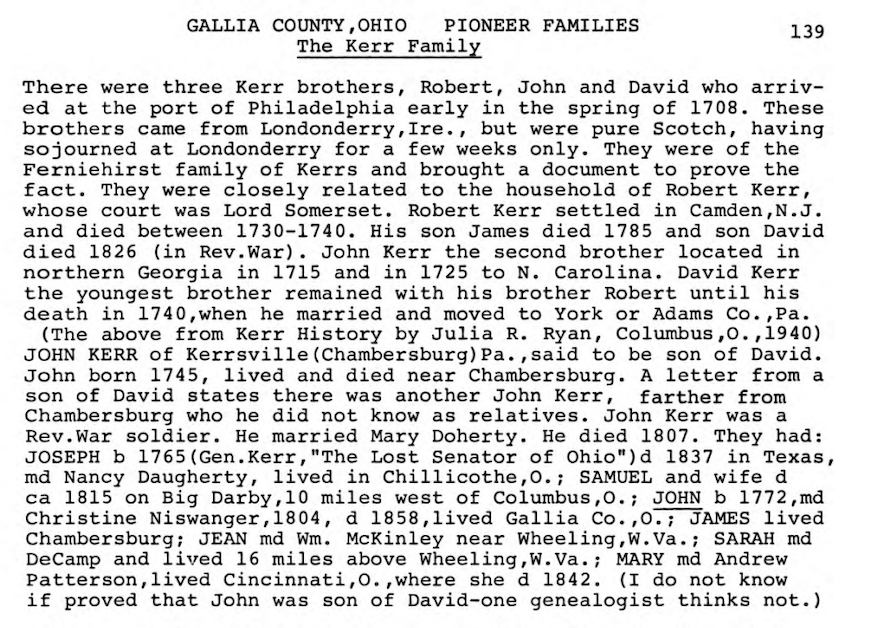
An article featuring “the Kerr family” in the journal Ohio, the Cross Road of Our Nation asserts that three Kerr brothers, Robert, John, and David arrived at the port of Philadelphia early in the spring of 1708, having sailed from Londonderry, Ireland, where they had sojourned only briefly after having arrived there from Scotland.[35] No documentation is provided for the claim that three Kerr brothers arrived in Philadelphia from Derry in the spring of 1708, and the proverbial predictably of the “three brothers arrived as immigrants, with one going here, one there, and the other in a different direction” raises my eyebrows. Nor, even if this report is accurate, do I have any information to connect James Kerr of Augusta County, Virginia, to the Kerrs named here. The Kerr family article cites as a source a history of the Kerrs written by Julia R. Ryan of Columbus, Ohio, in 1940. I haven’t been able to find this work anywhere.
In a series of articles he published in William and Mary College Quarterly Historical Magazine in 1925 and 1926, Charles E. Kemper proposes a method for identifying the pre-Virginia place of origin of early settlers of Augusta County.[36] Noting that “a heavy per cent, probably nine-tenths, of the settlers in the Valley of Virginia prior to 1775 came either from Philadelphia, Chester, Lancaster or Bucks counties in Pennsylvania,” Kemper states that he’s creating “sign board notes … to point to the county in Pennsylvania in which the settler lived prior to his removal to Virginia, and then to the county in Virginia in which he located.”[37]
Then he says that the goal of his notes is to match names of men who received early Pennsylvania land grants with names of men settling early in the Valley of Virginia. Kemper points to volume 24 of Pennsylvania Archives, Third Series, which lists the early Pennsylvania land grants, noting the county in which the land was located, its quantity, and who patented the land.[38]
Kemper notes that this methodology is not infallible, since more than one person can have the same surname and given name. In his second article in this series, he states,[39]
John Carr patented 200 acres of land in Lancaster County, Pa., January 13, 1737; he settled in present Augusta County, Va., prior to 1750. (The name is properly spelled Kerr.)
James Carr patented 200 acres of land in Lancaster County, Pa., January 14, 1737; he settled in Augusta County, Va., prior to 1750.
Unfortunately, these citations prove Kemper’s point about the unreliability of his methodology. John and James Carr were issued warrants for 200 acres (John) and 250 acres (James) in Paxtang township of Lancaster County on 13 January 1737.[40]
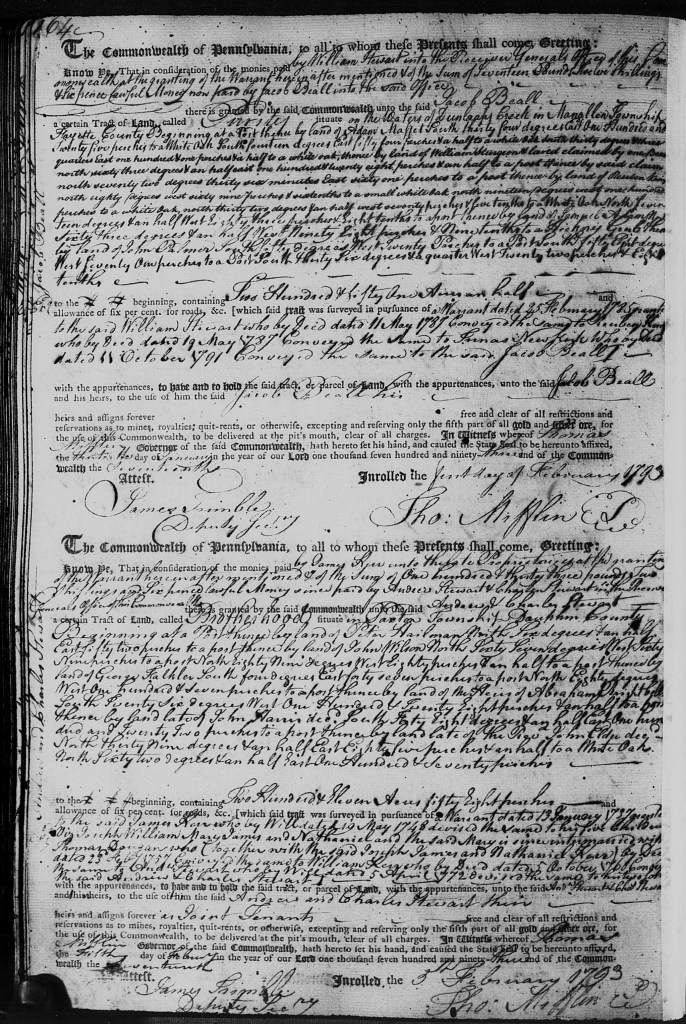
But go to the patent for this land recorded in Pennsylvania patent books, and you discover that that by his Lancaster County will dated 19 May 1748, James devised the land to his five children, Joseph, William, Mary, James, and Nathaniel. Mary married Thomas Dougan and she, with brothers Joseph, James, and Nathaniel, conveyed the land to their brother William, who by deed dated 5 October 1760 conveyed it to Andrew and Charles Stewart.[41] This is clearly not the James Kerr who settled in Augusta County, Virginia, around 1730.
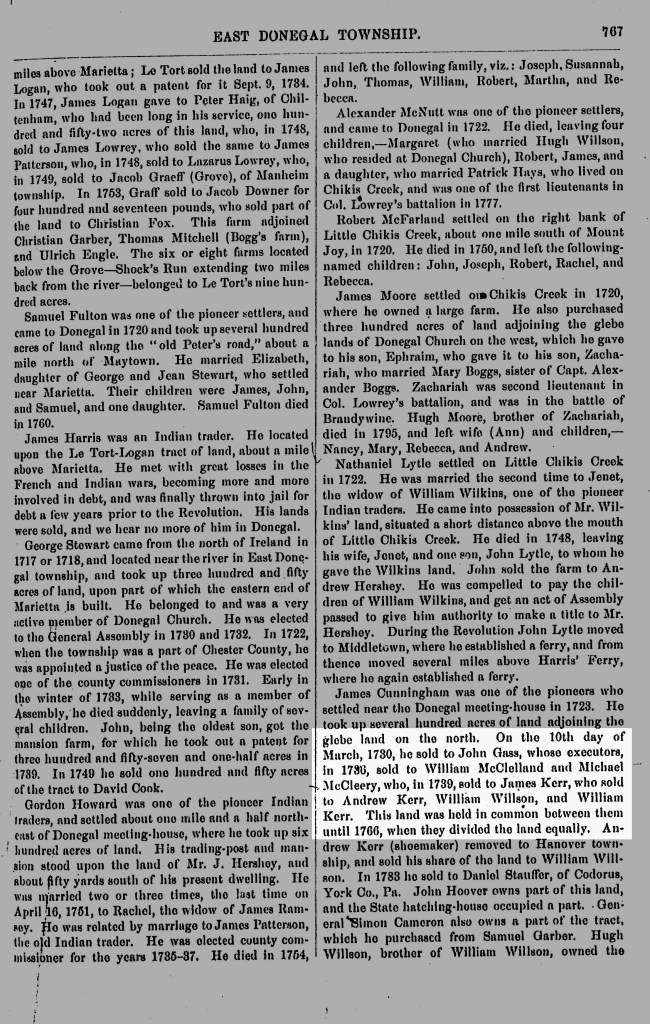
In Franklin Ellis’s history of families of Donegal township in Lancaster County, Pennsylvania, I find mention of yet another Kerr family found in that township.[42] Ellis states that James Cunningham, a pioneer settler of Donegal who lived near the Donegal church and whose land adjoined the glebe land of that Presbyterian church, sold land on 10 March 1730 to John Gass, whose executors sold this land in 1736 to William McClelland and Michael McCleery. Those gentlemen in turn sold Cunningham’s land in 1739 to James Kerr, who then sold it to Andrew Kerr, William Willson, and William Kerr. These three held the land in common until 1766, when they divided the land equally, with Andrew Kerr, a shoemaker, removing to Hanover township and selling his share of the land to William Willson.[43] Whether these Donegal township Kerrs are in any way connected to James Kerr of Augusta County, Virginia, I cannot say.
One final clue for anyone tracking the pre-Virginia origin of the James Kerr who arrived in Orange (later Augusta) County around 1730: on 17 May 1750, James Patton sold to James Carre, late of the province of Pennsylvania county of Lancaster, 474 acres in Beverley Manor that had been conveyed to Patton by William Beverley on 29 May 1741.[44] If this is James Kerr, the progenitor of the Augusta County Kerr family, then this deed definitely locates that James in Lancaster County, Pennsylvania, before he came to Virginia.
But a 1762 deed for this tract of land makes me wonder if this is the same James Kerr as James the progenitor of the Augusta County Kerrs. On James 17 August 1762, James Care of Roan County, North Carolina, sold Patrick Hays of Derry township in Lancaster County, Pennsylvania, the 474 acres he had acquired from James Patton in May 1750.[45] The deed, which also gives the surname as Carr and is signed by James Kerr, states that James had acquired this land from James Patton on 18 May 1750. On 17 August 1762 James Kerr acknowledged the deed in Augusta court.
I have found no records indicating that the James Kerr who arrived around 1730 in what would become Augusta County, Virginia, ever moved to Rowan County, North Carolina. He did have family members who did so, however, and they included his grandson James, son of John Kerr and Lucy Pickens. A page entitled “Records of James Kerr in Augusta County, VA” in the Early Settlers of Old Augusta County, Virginia project at WeRelate proposes that the James Kerr who acquired 474 acres of Beverley Manor land from James Patton in May 1750 and sold this tract to Patrick Hays in August 1762 is James, son of John and Lucy Pickens Kerr.[46]
[1] Orange County, Virginia, Deed Book 3, pp. 453-7.
[2] John Kerr, James Kerr’s eldest son, appealed for administration of James’s estate on 20 March 1770: see Augusta County, Virginia, Court Order Bk. 14, p. 65. On 23 March 1770, John gave bond for the estate administration in the amount of £1,000: see Augusta County, Virginia, Will Bk. 4, p. 287. The order book record of John Kerr’s appeal for administration of his father James’s estate states that John is James’s oldest son. Lyman Chalkley abstracts a 23 June 1748 entry in Augusta County Land Entry Book, stating that the document says that James Kerr had entered 400 acres between his own land and that of his son William and Beverley Manor: Chronicles of the Scotch-Irish Settlement in Virginia, Extracted from the Original Court records of Augusta County, 1745-1800, vol. 2 (Rosslyn, Virginia: Commonwealth Printing Company, 1912-3), p. 380. I have not seen the original record. This land entry book is not among the filmed and digitized by FamilySearch.
[3] Jim Veregge, “Descendants of James Kerr” at Rootsweb. See also Vincent Brown Kerr, Brief History of Kerrs and Kin, 1730 to 1930 (Staunton, Virginia, 1930), p. 4.
[4] Veregge, “Descendants of James Kerr.” On the Tinkling Spring baptismal register, see “Book containing baptisms, Oct. 1740-Sept. 1749,” in the collection of the personal papers of Reverend John Craig (held by Union Theological Seminary’s library in Richmond) filmed and digitized by the Family History Library in Salt Lake City and available digitally at FamilySearch. See also Howard McKnight Wilson, The Tinkling Spring, Headwater of Freedom: A Study of the Church and Her People, 1732-1952 (Fishersville, Virginia: Tinkling Spring and Hermitage Presbyterian Churches, 1954).
[5] See Veregge, “Descendants of James Kerr,” and “James Kerr” in the Early Settlers of Augusta County, Virginia project at WeRelate.org.
[6] W.L. Kerr, “The Kerr Clan Independence Day Reunion at New Hope Augusta Co,” Highland Recorder [Monterey, Virginia] (28 June 1946), p. 2, col. 1.
[7] Orange County, Virginia, Court Order Bk. 2, p. 138.
[8] Veregge, “Descendants of James Kerr,” and “John Kerr” in the Early Settlers of Augusta County, Virginia project at WeRelate.org. Prior to 1728, Lancaster County was part of Chester County.
[9] See FamilySearch database Pennsylvania, Marriages, 1709-1940.
[10] William J. Hinke, “Church Record of Neshaminy and Bensalem, Bucks County, 1710-1738,” Journal of the Presbyterian Historical Society 1,1 (May 1901), p. 129. Letters of attestation: as William J. Roulston notes, “A member of one [Presbyterian] congregation who wished to move to another could apply to the Session for a transfer certificate testifying to his or her good standing in the church. This was a handwritten document, signed by the minister and at least some of the elders. They are also known as testimonials and certificates of disjunction” — Researching Presbyterian Ancestors in Ireland (Glasgow: Bell & Bain, 2020), p. 95.
[11] The original letter is in the Thomas Sumter Papers, 1763-1885, of the Lyman Draper Manuscript Collection held by Wisconsin Historical Society—series VV, volume 1.
[12] Wilson, Tinkling Spring, p. 11, citing Vincent Brown Kerr, Brief History of Kerrs and Kin, 1730 to 1930 (Staunton, Virginia, 1930), p. 3.
[13] “John Lewis (Virginia colonist),” Wikipedia. See also Henry Howe, Historical Collections of Virginia (Charleston, South Carolina: Babcock & Co. 1845); and Irvin Frazier and Mark W. Cowell Jr., The Family of John Lewis, Pioneer (San Antonio: Fisher Publications, 1985).
[14] William Henry Egle, History of the Counties of Dauphin and Lebanon in the Commonwealth of Pennsylvania: Biographical and Genealogical (Philadelphia: Everts & Peck, 1883), p. 286.
[15] H.M.J. Klein, ed., Lancaster County, Pennsylvania: A History, vol. 2 (New York and Chicago: Lewis, 1924), p. 777. On the Ulster famine of 1727 and emigration to Pennsylvania, see also Wayland F. Dunaway, The Scotch-Irish of Colonial Pennsylvania (Chapel Hill: University of North Carolina Press, 1944), p. 30.
[16] Citing Robert Proud, The History of Pennsylvania, in North America (Philadelphia: Poulson, 1798-9).
[17] Richard K. MacMaster, Donegal Presbyterians (Morgantown, Pennsylvania: Masthof, 1995), p. 1, quoting Dunaway, Scotch-Irish of Colonial Pennsylvania, p. 34, who is citing Dickinson, Copy Book of Letters, pp. 288, 294.
[18] Henry Jones Ford, The Scotch-Irish in America (Princeton: Princeton University Press, 1915), p. 266.
[19] MacMaster, Donegal Presbyterians, p. 3.
[20] Ibid., p. 2.
[21] Guy S. Klett, “Scotch-Irish Presbyterian Pioneering Along the Susquehanna River, Pennsylvania History: A Journal of Mid-Atlantic Studies 20,2 (April 1953), pp. 165-6.
[22] Ibid., citing Minutes of the Presbytery of New Castle I, pp. 35, 108.
[23] J.L. Ziegler, An Authentic History of Donegal Presbyterian Church: Located in East Donegal Township, Lancaster Co., Pa. (Mount Joy, Pennsylvania, 1902), p. 9. Ziegler’s note for Chicquesalunga, a word beside which he places an asterisk, reads, “The stream from Donegal Spring was called Little Chicquesalunga Creek in a deed of the Rev. Peter Nissley, situated about three-fourths of a mile east from the [Donegal] Church.”
[24] Helen Bruce Wallace, Historic Paxton: Her Days and Her Ways, 1722-1913 (Paxton Presbyterian Church, 1913), p. 17.
[25] William Henry Egle, Glimpses of the History of Old Paxtang Church: An Address Delivered at the 150th Anniversary of the Laying the Cornerstone of the Present Church (Harrisburg: Harrisburg Publishing Company, 1890), pp. 12-13.
[26] “Scots and Scots Descendant in America, Part I — Scots in the Settlement and Development of The United States, Scottish Clergymen and Educators” at Electric Scotland.
[27] George P. Donehoo, Harrisburg, the City Beautiful, Romantic and Historic (Harrisburg: Telegraph, 1927), p. 250.
[28] Charles Knowles Bolton, Scotch Irish Pioneers in Ulster and America (Boston: Bacon and Brown, 1910), p. 281. On Gillespie, see Wallace, Historic Paxton, p. 128.
[29] Egle, Glimpses Of The History Of Old Paxtang Church, p. 10; and “Scots and Scots Descendant in America, Part I — Scots in the Settlement and Development of The United States, Scottish Clergymen and Educators” at Electric Scotland. George Gillespie’s tombstone in Head of Christiana Church cemetery in New Castle, Delaware, also contains biographical information about him.
[30] This is noted in a patent made on 25 February 1744 to Richard Edgell for the same land: Pennsylvania Patent Bk. A-12, pp. 62-4.
[31] Warrants and Surveys of the Province of Pennsylvania Bk. 7, p. 113.
[32] E.M. Sharp, Pickens Families of the South (Memphis, 1963), p. 3.
[33] Paxtang township is adjacent to the town of Harrisburg, named for John Harris, an English-born trader who is said to have been the first European settler of Paxtang: see George P. Donehoo, Harrisburg and Dauphin County: A Sketch of the History for the Past Twenty-Five years, 1900-1925 (Dayton: National Historical Association, 1925), pp. 49-50.
[34] A. Maxim Coppage, comp., Rockbridge County, Virginia Notebook: Compiled from Articles by Dr. George W. Diehl as Published in the News-Gazette, Lexington, Virginia (Utica, Kentucky: McDowell, 1982), p. 35. This volume consists of reproductions of articles that Diehl published in the News-Gazette of Lexington, Virginia.
[35] “The Kerr Family,” Ohio, the Cross Road of Our Nation: Records & Pioneer Families 10, 3 (July-September 1969), p. 139. No author’s name is given. See also Silva Wilson Partridge and Oscar C. Paisley, Paisley and Allied Lines Supplementals from Rankin – Wharton (Coeur d’Alene, Idaho, 1972).
[36] Charles Kemper, “Early Settlers in the Valley of Virginia,” William and Mary College Quarterly Historical Magazine 5,4 (October 1925), pp. 259-265.
[37] Ibid., p. 259.
[38] Ibid., p. 260, citing Pennsylvania Archives Third Series, vol. 24, ed. William Henry Bole (Harrisburg: William Stanley Ray, State Printer, 1897).
[39] Charles Kemper, “Early Settlers in the Valley of Virginia,” William and Mary College Quarterly Historical Magazine 6, No. 1 (January 1926), p. 57, citing Pennsylvania Archives Third Series, vol. 24, p. 377, which offers a list of warrantees of land in Lancaster County 1733-1896.
[40] See Warrant Bk. A-86, pp. 225, 231 and B-8, 234. The warrants were 89 (James) and 90 (John).
[41] Pennsylvania Patent Bk. P-19, p. 164. James Kerr’s will is in Lancaster County, Pennsylvania, Will Bk. J-1, p. 116.
[42] Franklin Ellis, History of Lancaster County, Pennsylvania: With Biographical Sketches of Many of Its Pioneers and Prominent Men (Philadelphia: Everts & Peck, 1883), p. 767.
[43] See Lancaster County, Pennsylvania, Deed Bk. X, pp. 401-4.
[44] Augusta County, Virginia, Deed Bk. 2, pp. 737-740.
[45] Ibid., Deed Bk. 10, pp. 431-5.
[46] “Records of James Kerr in Augusta County, VA” in the Early Settlers of Old Augusta County, Virginia project at WeRelate.

