According to McAdams, a family tradition maintains that this bible was in a trunk that fell into the Duck River near Shelbyville, Tennessee, as the Leonards crossed the river on their way to settle in Lincoln (later Marshall) County after they left South Carolina. Both McAdams and Matthews state that the bible was printed in 1766. McAdams says it was printed in England, but Matthews indicates that it was printed in Edinburgh by Alexander “Wincaid.” This was Alexander Kincaid, the royal printer from 1749 into the 1770s.[2] Matthews specifies that the bible is not a complete bible but the New Testament.
Neither McAdams nor Matthews states who transcribed the bible register for them, or whether they themselves are the transcribers. Matthews refers to a Charles Leonard of Sparta, Tennessee, who may be the transcriber on whom she’s relying. According to Matthews, the title page of the bible register reads,
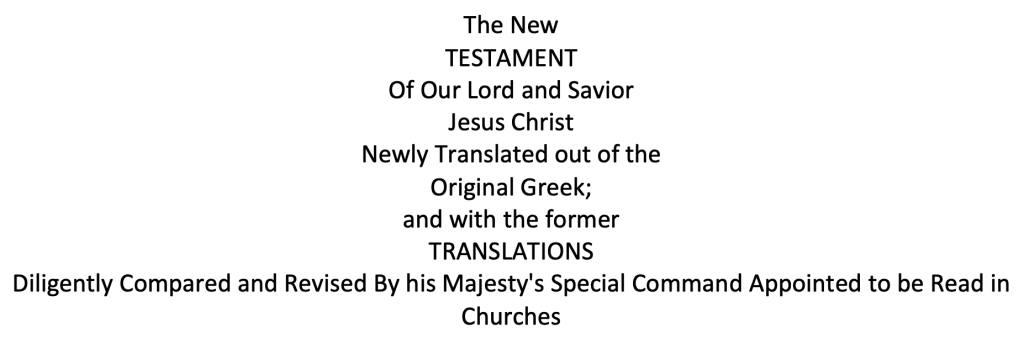
On the same page written under that title are the names Robert Lineard and Honour Lineard, with a crest and with the publication information — Edinburgh, MDCCLXVI, and Alexander Kincaid His Majesty’s Printer — under the names Robert and Honour Lineard.
McAdams’ transcription does not contain this information, other than the publication date. Note that if Matthews’ transcription is accurate, this New Testament belonged originally to Robert Leonard and wife Honor, and passed from them to their son Thomas.
The only partial pieces of information McAdams’ transcriber could read in the bible register were the following:[3]
Thomas Leonard His Bible 1784 (born 1752, died 1832)
Hannah Leonard (born 1752, died 1842)
Robert born 1760 in Oct
⏤ 1777
⏤ 1779
⏤ 1781
Feb 14, 1777 ⏤ 47
Matthews’ transcriber makes out more pieces of information in the bible register:
Robart ? Lenard was
febury 14 in the yeare 1747
Robart L. ⏤ born
year of 1747
Robert Leieard his
book the ⏤ if he
and not to ⏤ but
Robert Leneard was born
in the year 1760 and
in the 10th day of October
John Leneard was
in the year 1779
Thomas Leneard
in the year 1781
Matthews also states that the inscription that McAdams’ transcriber read as “Thomas Leonard His Bible 1784” is written on the back side of the hard cover of the New Testament and reads, “Thomas Leneard, his Bible, 1784, Hannah Lenard.”
Since I haven’t seen the original document or photocopies or digital images of this document, I want to be careful not to make unfounded assumptions about what the unnamed transcribers cited by McAdams and Matthews saw in this bible register. What does seem clear is that this is a New Testament printed by Alexander Kincaid in Edinburgh in 1766 that originally belonged to Robert Leonard and wife Honor. It passed to their son Thomas, who appears to have written his name in the bible in 1784.
Leonard researcher Frances West of Fayetteville, Tennessee, has proposed that the 14 February 1747 date, with whatever information is written next to that date apparently obscured by water damage, is the date of Robert Leonard’s marriage to Honor Pritchard.[4] This is a conjecture, but I think it’s one well worth considering. We know for certain that Robert and Honor had a son Thomas born in 1752, and it appears that a son William was born earlier than that date, if he was indentured in 1755.[5] A marriage date of 1747 for Robert and Honor would fit these pieces of information.
If we add to this Thomas Dunlap Leonard’s statement in his 1883 “Biography of the Leonards” that Robert married Honor Pritchard, “an English lady,” soon after her arrival in America, then the picture that emerges, it seems to me, is the following: if Robert Leonard was an immigrant to the American colonies as many of his descendants have assumed, then he preceded wife Honor Pritchard to the colonies and married her soon after her arrival from England. But as I stated in my first posting about Robert Leonard’s life, it’s not clear to me that Robert Leonard was an immigrant. At least, I haven’t seen clear documentary evidence of that fact. I think the assumption that he came to the colonies as an immigrant reads into what Thomas D. Leonard says about his being a soldier of the English Army more than can be read into that text, and assumes that Robert came to the colonies as an English soldier, when, in fact, his service in the British military unit the 35th Regiment of Foot postdates his earlier service as a colonial soldier under John Dagworthy.
As I’ll explain in more detail in a posting focusing on the documentation of Robert’s French and Indian War years, if he had already begun serving under Dagworthy by 1747, then it should be noted that Dagworthy had not yet begun commanding troops on the western Maryland frontier in that year. In 1747, he was in his home colony of New Jersey where he was captain of a company of soldiers defending the western parts of New Jersey and Pennsylvania.
I have found no information indicating precisely where Robert Leonard was living prior to 1755, when we can document that he was serving under Dagworthy in Frederick County, Maryland. Dagworthy did not have troops in Maryland until the latter part of 1754, when Maryland troops were mustered to serve under him and Fort Cumberland was built. If Robert Leonard’s connection as a professional soldier with Dagworthy predates that period, then it’s possible — and this is pure conjecture in the absence of documentary evidence — that he was serving with Dagworthy in New Jersey before Dagworthy had soldiers in Maryland, and that he and Honor Pritchard would have met and married in New Jersey.
Two other items to focus on in Matthews’ transcription of Robert Leonard’s bible register: as she notes, the John and Thomas Lennard born in 1779 and 1781 per the bible record are undoubtedly the sons of Thomas Leonard (1752-1832) and Hannah James who had those names. As we’ve seen, it can be documented that Thomas and Hannah’s son Thomas was, in fact, born in 1781. But Thomas Dunlap Leonard thought that John was born after his brother Thomas, and as I’ve noted previously, a birthdate of 1782-4 for John seems to fit what we know about him. So if this bible record provides an accurate statement of when Thomas and Hannah James Leonard’s sons Thomas and John were born, John was older than Thomas.
And the second and final item to consider in Matthews’ transcription of the Leonard bible: I’m tempted to think that the 10 October 1760 date of birth for Robert Leonard may be the birthdate of Robert, son of Robert and Honor Pritchard. As I’ve explained, it seems to me that Thomas D. Leonard is not correct in placing him as the first child of Robert and Honor. If the 1830 federal census has an accurate birth range for him in showing him born between 1760 and 1769, then a 1760 birthdate for the younger Robert would fit such facts as we have at our disposal.
I do want to underscore yet again that I have not seen the original New Testament from which these transcriptions are taken; I do not know who made the two transcriptions; they do not entirely concur with each other; and the original is said to be heavily water-damaged. So the conjectures I’m offering here on the basis of limited evidence should not be taken as set in stone.
You see why, in the opening part of this series of postings about Robert Leonard, I noted that the good documents we have for Robert pose some vexing problems as we try to read and interpret some of them: though we have some good first-hand documents, these do not always hang together, and in the case of the bible register and Robert’s military discharge paper, the documents are partially destroyed and difficult to read. In my next posting, I’ll take a close look at the military discharge document.
[1] Carolyn McAdams, Marshall County, Tennessee, Bible Records, ed. Helen Crawford Marsh (Lewisburg, Tennessee: Marshall County Historical Society, 1981), pp. 73-4; Audrey M. Matthews, The Tennessee Phantoms (Prosser, Washington, 1989), p. 334.
[2] “Alexander Kincaid,” Wikipedia.
[3] Is the material placed in parentheses — (born 1752, died 1832) and (born 1752, died 1842) — written in the bible or has the transcriber added this material?
[4] This information is in notes shared with me in 1997 by researcher Nancy Breidenthal, which may have been published at her now-defunct website, Nancy’s Dead Relatives.
[5] Frederick County, Maryland, Land Record Bk. E, pp. 659-660.


One thought on “Robert Leonard (bef. 1730 – 1780): Bible Printed by Alexander Kincaid, Edinburgh, in 1766”