I’ve told some of the story of Thomas Leonard’s move from South Carolina to Tennessee in a posting about his son Thomas Lewis Leonard, who is my ancestor. As the linked posting says, an 1883 family history written by Thomas Dunlap Leonard, a grandson of Thomas Leonard who grew up knowing his grandparents Thomas and Hannah Leonard and hearing their account of the family’s history, states that Thomas and Hannah moved their family from South Carolina to Tennessee in 1806.[1]
Arrival in Tennessee
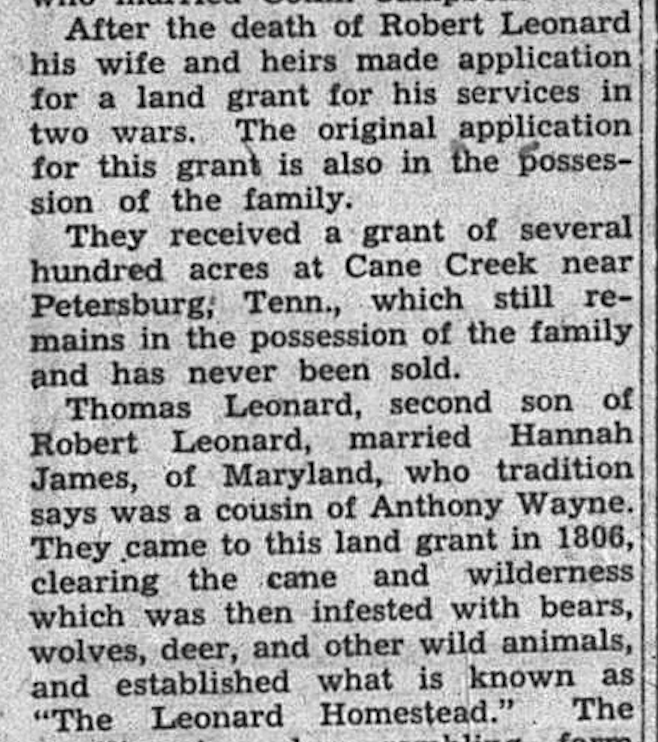
The 1806 date for the family’s move is repeated in other published accounts of this Leonard family.[2] Family histories assigning an 1806 date for the arrival of the Thomas Leonard family in Lincoln County, Tennessee, also state that the family received a land grant on Cane Creek in Lincoln (later Marshall) County for the service of Thomas’s father Robert Leonard in the French and Indian and Revolutionary Wars. According to Angelina May Gill Wallace, a great-granddaughter of Thomas’s daughter Hannah Leonard Moore, the original papers for this land grant remained in the possession of the Leonard family at Petersburg, Tennessee, in 1947 when Wallace’s article was published.
The document to which Angie Gill Wallace refers was, however, not a land-grant document. It was, rather, the 12 September 1800 power of attorney that Thomas, his brother Robert and brother-in-law Colin Campbell, and mother Honor Leonard gave to James Irwin in Pendleton District, South Carolina, authorizing Irwin to claim back pay and any possible land grant due to them for Robert Leonard’s service in the two wars. This power of attorney is discussed and transcribed in a previous posting.
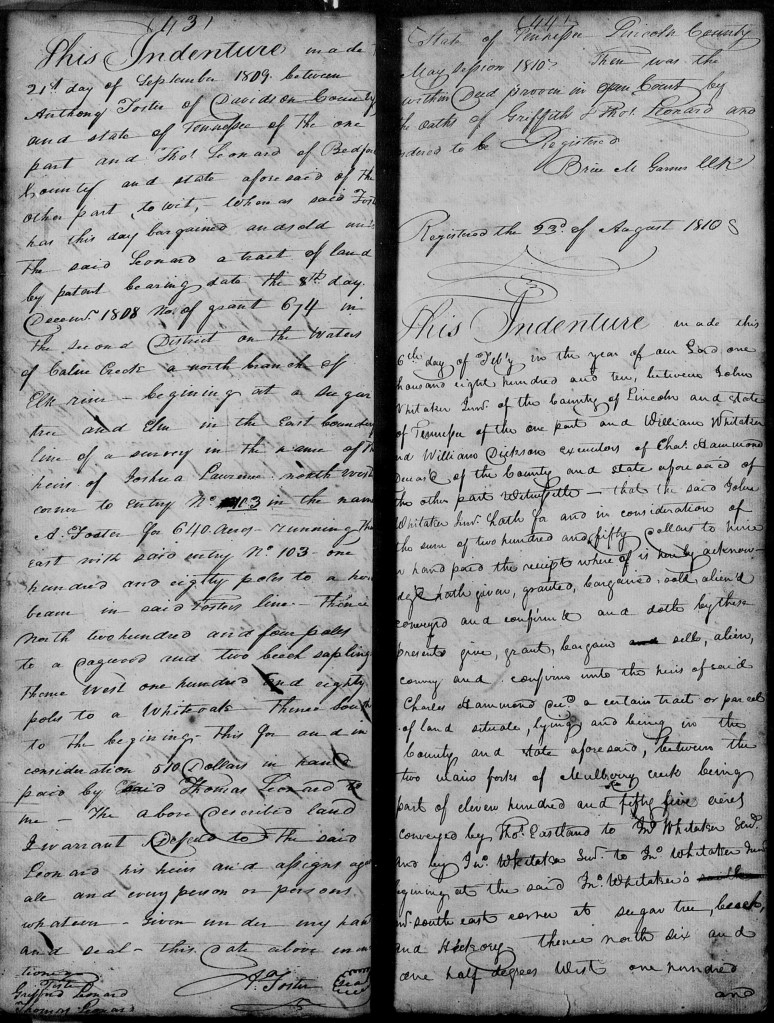
I have found no record of a land grant given to the Leonard family in Tennessee (or elsewhere) for Robert Leonard’s service. As I’ve previously explained, the first record I find for this family in Lincoln County, Tennessee is a deed for Thomas’s purchase of 640 acres from Anthony Foster on a north branch of Elk River on 21 September 1809.[3] The north branch of Elk River to which the deed refers is Cane Creek, which flows into Elk River, tributary of the Tennessee River that meets the Tennessee River in Limestone County, Alabama. Elk River does not at any point run through Marshall County, Tennessee, though it flows through Marshall’s parent county of Lincoln.
Thomas Leonard’s September 1809 land purchase in Lincoln County, Tennessee, followed his and wife Hannah’s sale of their homeplace in Pendleton District, South Carolina, on 29 January 1808 and Hannah’s relinquishment of dower for this sale on 15 February 1808.[4] It’s clear that the Leonard family made its move from South Carolina to Tennessee between 25 February 1808 and 21 September 1809.
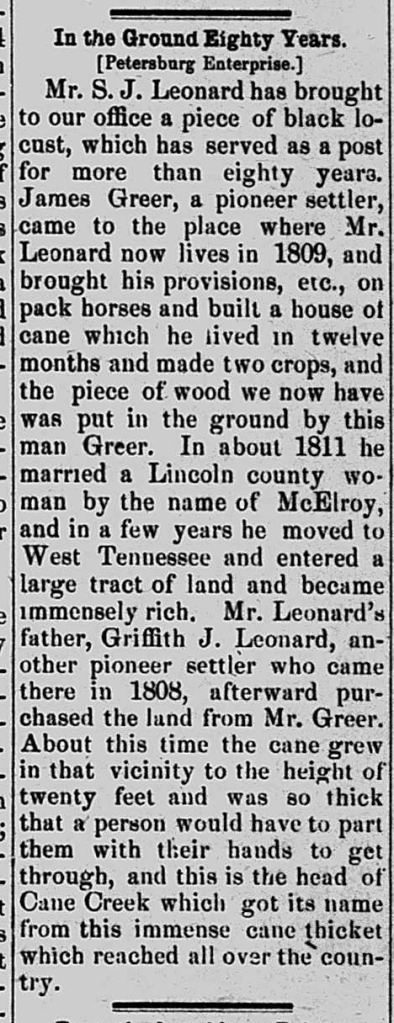
These dates correspond with information that appears in a November 1894 article published in the Fayetteville [Tennessee] Observer.[5] The article quotes S.J. Leonard of Petersburg, a grandson of Thomas and Hannah Leonard and a son of their son Griffith James Leonard. Samuel James Leonard states in the article that his father Griffith came to Cane Creek in Lincoln (later Marshall County) in 1808. As we’ll see below, Thomas Leonard willed his land on Cane Creek near Petersburg to his son Griffith, who lived and farmed with his father after the family settled on Cane Creek, inheriting the Leonard homestead that will be discussed below.
A previous posting discusses Thomas Leonard’s September 1809 purchase of 640 acres in Lincoln County in detail. As the posting notes, Thomas’s sons Griffith and Thomas witnessed Anthony Foster’s deed to their father and proved the deed at May court 1810.[6] A land entry recorded by Charles Gibson on 14 April 1811 at the head of Cane Creek and the north Branch of Elk River states that the land Gibson was entering joined land on which Thomas Leonard was living at that time, which had originally been granted to Anthony Foster.[7] When Robert Leonard, son of the elder Thomas, entered forty acres on the head of Pigeon Roost, a branch of Cane Creek on 16 April 1818, the entry again stated that Thomas Leonard was living on adjoining land acquired from Anthony Foster.[8]
Also previously noted: Leonard researcher Sue Cooper suggests that Thomas Leonard and his brothers Robert and William may actually have moved initially from South Carolina to Sumner County, Tennessee. She bases this conjecture on the fact that a ledger of an unidentified Sumner County merchant she has seen shows these three men with accounts in 1806-7. It’s well documented that Thomas and his brother Robert did settle with their mother Honor and with brother-in-law Campbell in Lincoln (later Marshall) County, Tennessee, but it can also be shown that William died testate in Anderson County, South Carolina, in March 1811.[9] And it’s clear that Thomas Leonard was still living in Pendleton District, South Carolina, in January 1808 when he and wife Hannah sold their homeplace there.
1810-1820
Histories of Lincoln and Marshall Counties note that by 1810, Thomas Leonard was settled on the middle fork of Cane Creek in that county. Goodspeed’s history of Lincoln County notes that Thomas was a settler on Cane Creek in the first or second decade of the 19th century.[10] A 19 June 1810 court record states that he was assigned by the court to oversee a road from the west fork of the west side of Little River where the road intersected the road from Jefferson to the mouth of Little River near Major Smith’s.[11]
At some point after the family arrived in Tennessee, Thomas Leonard’s family built a house on their homestead north of Petersburg that stood until the latter half of the 20th century. I have not seen information dating the initial construction of this house. The spring 1979 issue of Marshall County Historical Quarterly has a picture of the old Leonard homeplace on its cover (see the image at the head of this posting).[12] The house was a two-story white frame house with chimneys at both ends and porches on front and back. It appears to have been built in the early Greek Revival pattern of antebellum Southern farmhouses, and to have been added onto as the family grew, so that there was large lean-to wing projecting out of the back of the house.
In her Marshall Gazette article of September 1947, Angie May Gill Wallace talks about the “Leonard homestead” established by Thomas Leonard’s family.[13] She describes the old Leonard house as follows:
The dwelling is a low rambling farmhouse with wide porches constructed of logs and clapboard. The farm buildings are in excellent repair, having been recently heired by Mr. John Wilson of Lewisburg, Tenn., who is a grandson six generations removed. … At the termination of one of the garden walks is the family graveyard where Thomas and Hannah Leonard with many of their descendants are buried.
In an article she published in 1975 in the Marshall County, Tennessee, Historical Quarterly, Elizabeth Baxter notes that the cemetery that Angie Gill Wallace says is at the termination of a garden walk from the old Leonard house is on a hill overlooking a lake, and is shaded by trees that lend their beauty to the site.[14] It’s not clear to me what lake Baxter is referring to here. Cane Creek is definitely visible from the hill on which the cemetery stands, and to the east of the creek is a body of water that may be a pond or small lake, but I’m not sure that water feature is visible from the cemetery.
A biography of Dr. John Norris Cowden in Tennessee, the Volunteer State also speaks of the old Leonard House as it stood in 1923.[15] John N. Cowden was a son of Dr. John Cowden and Mary Hannah Leonard, a daughter of Thomas Leonard’s son Griffith James Leonard. The biography states: “Thomas Leonard, removed from North [sic] Carolina to Tennessee, settling on a land grant, and the old mill, house and barn which were erected one hundred and twenty-six years ago are still standing on the farm, which is now owned by W. S. Leonard, an uncle of the subject of this review.”[16]
As a previous posting notes, the old Leonard house and family cemetery behind it are located about 2½ miles north of Petersburg at what’s now called Leonard Bluff on Liberty Valley Road.[17] As the linked posting says, I visited the cemetery in February 2008, noting that the old homestead house was no longer standing.
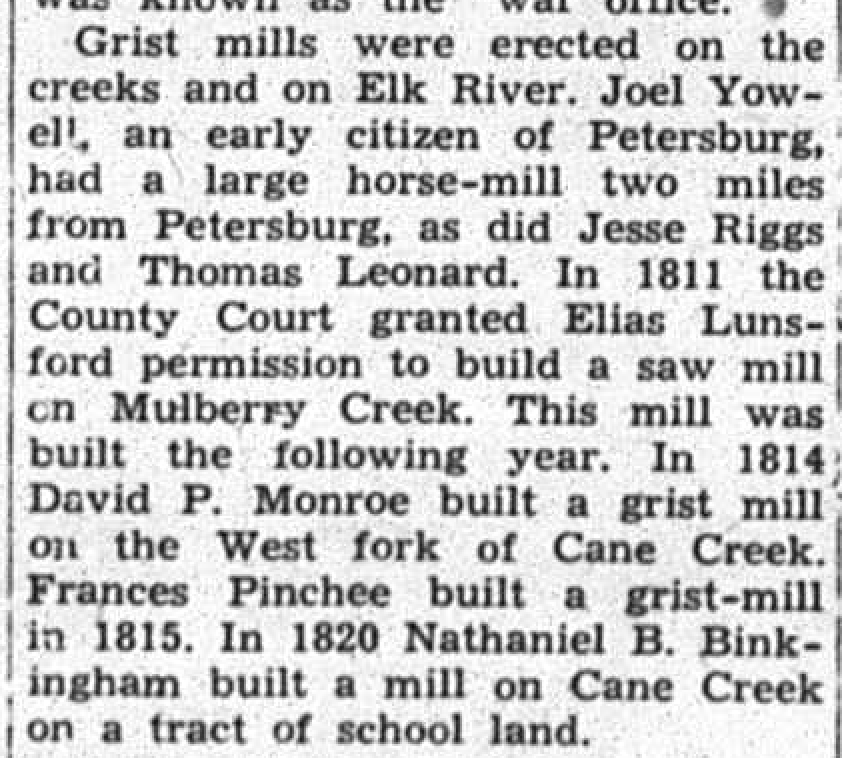
As the biography of John Norris Cowden indicates, after settling on Cane Creek, Thomas Leonard erected a mill on his land. Berry C. Williams provides the following information:[18]
Joel Yowell, an early citizen of Petersburg, had a large horse-mill two miles from Petersburg, with a hand-bolting machine attached. Jesse Riggs and Thomas Leonard also had mills of this kind. Leonard and Yowell had wheat threshers attached to their mills, and Leonard also had a cotton-gin attached.
According to Helen and Timothy Marsh, an old clerk’s list of early land transactions in Lincoln County that were otherwise not recorded shows that in May 1810, Anthony Foster deeded to Thomas Leonard another 230 acres in Lincoln County, which Foster had acquired as a Tennessee land grant.[19] The deed was proven at Lincoln County court on 28 May 1810 by oaths of Griffith and Thomas Leonard, with the surname spelled as Linard.[20] Immediately preceding this notation in the court minutes books is a record of a grant of 230 acres by the state of Tennessee to Anthony Foster, with the note that this was grant no. 674. The same court minutes state that at this court session, Thomas proved his ear mark, a swallow fork in each ear. In addition to the other early records I’ve just cited, an 1810 Lincoln County muster roll of local militiamen includes Thomas.[21]
As the last posting notes, after his move to Tennessee, Thomas Leonard appeared in litigation in Pendleton District, South Carolina. The linked posting discusses a lawsuit filed by Thomas in May 1810 regarding a promissory note that had been assigned to him by William Glenn, to whom Thomas and wife Hannah sold their South Carolina homeplace. An 8 February 1812 deed in Pendleton District also notes that Patrick Norris had sold Ezekiel Pickens 140 acres on Oolenoy Creek of the Saluda River on 7 October 1811, pursuant to an October 1810 judgment for Thomas Leonard in this suit re: the promissory note, Thomas Leonard vs. John McClure.[22]
Lincoln County court minutes for 27 May 1811 show Thomas Leonard on a road jury to mark a road the nearest and best way from Fayetteville to the Bedford County line and on to Fishing Ford and Nashville.[23] Because Thomas Leonard’s son of the same name was of age by 1811 and had not yet moved from Tennessee to Alabama, this record could refer to either of the two Thomas Leonards. As a previous posting notes, another 1811 court order specifies that the Thomas Leonard to whom the order was issued was Thomas Sr.: on 28 August 1811, the county court ordered Thomas Leonard Sr. to oversee a road from Robert Leonard’s to Gibson’s Gap, with hands to work under him including his sons Thomas, Hezekiah, Griffith, and Samuel Leonard.[24] Since many Lincoln County documents in the period 1808-1818 when both Thomases were living in Lincoln County and both of age do not use the Sr. or Jr. designation, it is not always simple to know to which Thomas the documents refer.
Court minutes for 3 May 1814 report that Thomas Leonard had been indicted by the state of Tennessee on a charge of tippling.[25] The court minutes about this case state that James Greer, prosecutor, and Arthur Brooks, witness on behalf of the state, had been required to post bond ($100 for Greer and $50 for Brooks) on condition that they appear to give testimony against Thomas Leonard. I take the charge to mean that Thomas was distilling and selling whiskey. As we’ll see later when we have a look at Thomas’s will, the will confirms that he had a still, which he bequeathed to son Griffith in his will.
On 7 May 1814, no true bill was found in the state’s case against Thomas on the charge of tippling.[26] The grand jury ordered the state to pay costs. It’s interesting to note that two days prior to this, Thomas’s son Colin Campell Leonard had been given permission by the court to keep an ordinary at his father’s house.[27] At the same May 1814 court session, the state charged James Greer, the prosecutor in Thomas Leonard’s case, with tippling. Also at this court session, a charge of assault and battery against Thomas’ son Colin was continued. On 4 August 1814, Colin was found guilty of assault and battery on James Greer. This series of court records make one wonder if a dispute between Greer and the Leonard family over the market for whiskey was driving Greer’s prosecution of Thomas Leonard for operating a tippling house.
In his 1883 history of the Leonard family, Thomas Dunlap Leonard observes that “Uncle Colin was dissipated (drank) in early life,” but had been a good soldier in the Indian War of 1812-4.[28] Thomas D. Leonard went on to observe that Colin had been a true friend to his friends and a bitter enemy to his enemies, and possessed noble and generous principles. In his later life, he had steady habits, and became a Methodist preacher, Thomas D. Leonard added.
On the subject of fighting and carousing: Goodspeed’s history of Lincoln County says that Petersburg, Fayetteville, and Arnold’s Grocery (now Smithland) were noted places for the settlement of all sorts of grudges in “pummelling” fights.[29] Apparently the fights were public spectacles and the onlookers assured that fair play occurred, biting and weapons being outlawed.
Court minutes for 9 November 1814 show Thomas Leonard having resigned from his position as overseer of a local road and Stephen Harmon appointed “in room of” Thomas.[30] This record could possibly refer to Thomas’s son Thomas, who might by this point have begun his preparations to move his family to Alabama. A Thomas Leonard continues to appear in court minutes as a juror: court minutes for 18 February 1815 show him on a jury that found John Porter guilty of hog stealing.[31] In May 1815, Thomas Leonard is listed among those owing notes to the estate of George C. Witt in Lincoln County.[32]
On 3 May 1815, Thomas or his son Thomas appears in court minutes on a jury in the case of Samuel A. Harris vs. Thomas Shute.[33] This may be the case that is listed in the same court session as James Harris vs. Thomas Shute.[34] At issue in the case was a dispute about who caveated a tract of land.
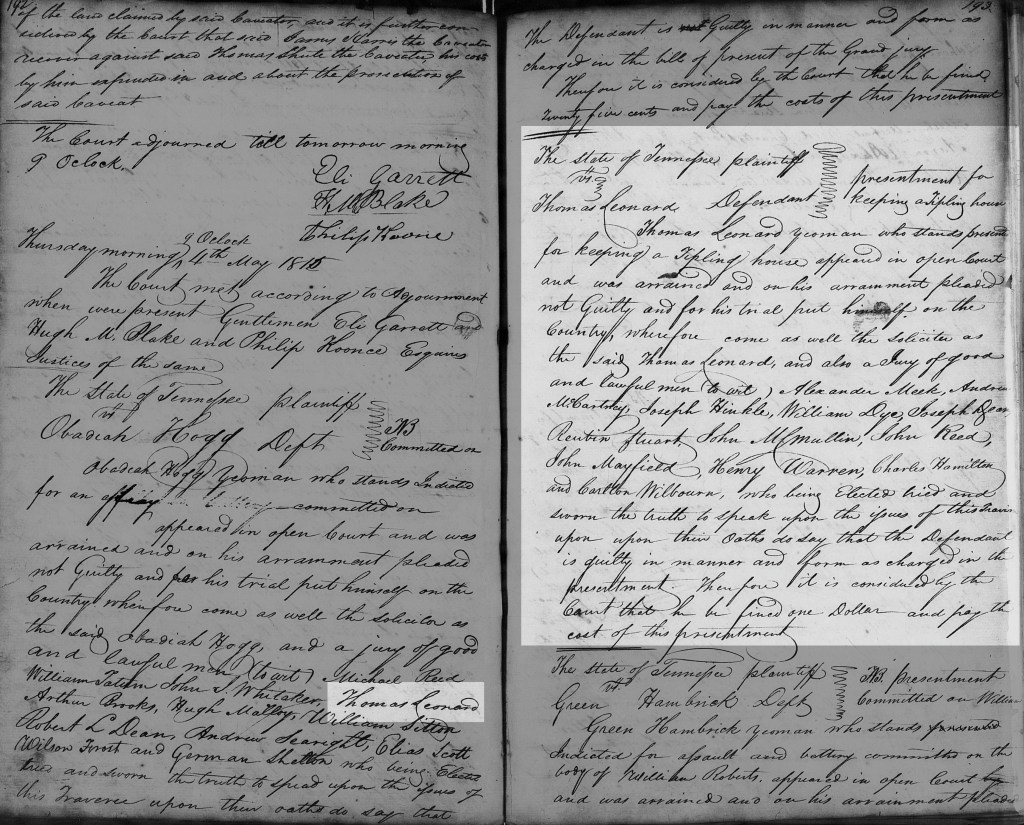
On 4 May 1815, the elder Thomas Leonard was tried on the state charge of tippling.[35] The court record identifies him as a “yeoman,” stating that he had pled not guilty and “for his trial put himself on the County.” The jury, which included his nephew Joseph Dean, found him guilty, fining him a dollar plus costs. On the same day at the same court session, Thomas or his son of the same name was on a jury that tried Obediah Hogg on a state of Tennessee indictment of assault and battery.
Court minutes for 8 May 1816 show Thomas or his son Thomas serving as a juror along with Griffith Leonard in the case of James Daniel vs. John Bell.[36] A 21 April 1818 survey of thirty-five acres on the headwaters of Cane Creek in Lincoln County for land assigned by Brin(?) M. Gassen says that the tract bordered land assigned by Anthony Foster to Thomas Leonard, on which Leonard was then living.[37]
23 October 1819, Thomas was on a jury in several Lincoln County trials.[38] We can know with certainty now that this is the elder Thomas, since his son of that name moved to Alabama in 1818.
1820-1830
The 1820 federal census enumerates the household of Thomas Leonard in Lincoln County with one free white male aged 26-44, one free white male aged 45+, and a free white female aged 45+.[39] Thomas is also shown as holding four enslaved people. Next to Thomas is the household of son-in-law William Depriest Moore, who married Thomas’ daughter Hannah, and next to William Moore is Thomas’s brother-in-law Colin Campbell. The younger male in the household with Thomas and Hannah Leonard is their unmarried son Griffith James Leonard.
As previously discussed, Thomas’s son Thomas Lewis Leonard sold two tracts of land on Cane Creek in Lincoln County to his uncle Colin Campbell on 16 August 1822, one containing 135 acres and the other twenty acres.[40] The posting I’ve just linked notes the documents showing when Thomas Leonard younger obtained these pieces of land, and their location next to his father’s original 640-acre tract. On 27 January 1823, both deeds were proven in court by the subscribing witnesses.[41]
Thomas Leonard’s family appears on the 1830 federal census in Lincoln County with one male 30-40, one male 80-90, and 1 female 70-80.[42] In the household are also eight enslaved persons: slaves: one male 10-24, two males 36-55, and 3 males 55-100; one female 55-100, and one female over 100.
The male aged 30-40 in Thomas Leonard’s household in 1830 was, again, Thomas’s son Griffith James Leonard, who was born 25 September 1787, according to his tombstone in the Leonard family cemetery.[43] In his 1883 Leonard family history, Griffith’s nephew Thomas Dunlap Leonard states that Griffith remained with his parents until their death, bestowing care on them in their old age.[44] As has been previously noted and as we’ll see in more detail a moment, Thomas Leonard’s 9 July 1829 will left the Leonard homeplace outside Petersburg to his son Griffith, who lived his whole life at the homeplace, according to Angie May Gill Wallace, and left it to his youngest son William Stephens (Bud) Leonard.[45]
Thomas Sr. and Jr. are on an 1830 tax list in Lincoln County in the district of Thomas’s son-in-law Capt. William D. Moore’s. Thomas Sr. is taxed for 230 acres on Cave Creek. His son Griffith is also taxed for 128 acres on Cave Creek in the same district, on Cave Creek. Since Thomas’s son Thomas was in Limestone County, Alabama, by this time, the tax list appears to indicate not that he lived in Tennessee, but still owned land there.
Lincoln County court minutes for 24 January 1832 reference the case of John Nield vs. Thomas Leonard.[46] The minutes state that the sheriff had been ordered by the court to sell a tract of land on which Thomas Leonard lived on the waters of Cane Creek, on which James Rust (had previously?) lived, to satisfy a judgment against Thomas handed down on 16 July 1831. It’s not clear to me what this case was about and not at all clear that Thomas Leonard lost land due to a court judgment not long before his death.
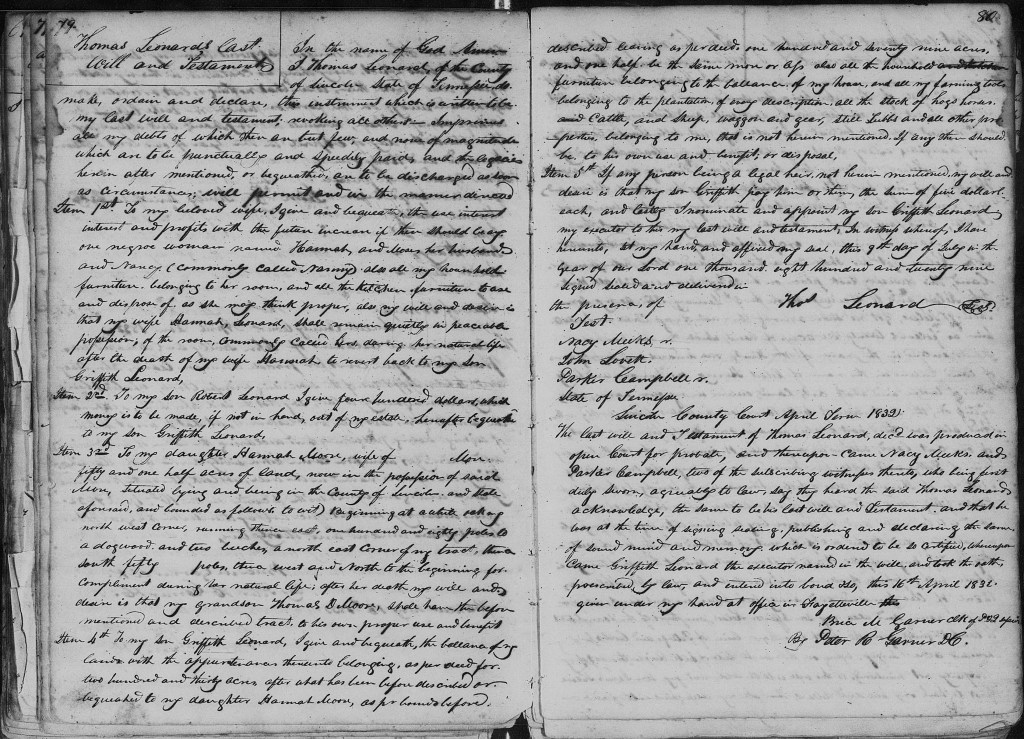
Thomas Leonard’s Will and Probate
Thomas Leonard made his will in Lincoln County on 9 July 1829.[47] The will reads as follows:
Thomas Leonards last will and Testament In the name of God Amen I, Thomas Leonard of the County of Lincoln State of Tenneſsee do make, ordain and declare, this instrument which is written to be my last will and testament; revoking all others — Imprimis all my debts of which there are but few, and none of magnitude which are to be punctually and speedily paid, and the legacies herein after mentioned, or bequeathed , are to be discharged as soon as circumstance; will permit and in the manner directed
Item 1st To my beloved wife, I give and bequeath, the use interest (word is repeated) and profits with the future increase if there should be any one negroe woman named Hannah, and Moses her husband and Nancy (commonly called Nanny) also all my household furniture belonging to her room, and all the Kitchen furniture to use and dispose of as she may think proper, also my will and desire is that my wife Hannah, Leonard, Shall remain quietly in peaceable poſseſsion, of the room, commonly called hers, during her natural life after the death of my wife Hannah to revert back to my Son Griffith Leonard,
Item 2nd To my son Robert Leonard I give four hundred dollars, which money is to be made, if not in hand, out of my estate, hereafter bequeathed to my son Griffith Leonard,
Item 3rd To my daughter Hannah Moore, wife of Moore fifty and one half acres of land, now in the poſseſsion of said Moore, situated lying and being in the County of Lincoln and State aforesaid, and bounded as follows to wit) Beginning at a White oak my north west corner, running thence east, one hundred and eighty poles to a dogwood and two beeches, a north east corner of my tract thence south fifty poles , thence west and North to the beginning for compliment during her natural life; after her death my will and desire is that my grandson Thomas D Moore, shall have the before mentioned and described tract, to his own proper use and benefit
Item 4th To my son Griffith Leonard, I give and bequeath, the ballance of my land , with the appurtenances thereunto belonging, as per deed for two hundred and thirty acres, after what has been before described or bequeathed to my daughter Hannah Moore, as per bounds before described leaving as per deed one hundred and seventy nine acres, and one half of the same more or leſs also all the household
and kitchenfurniture belonging to the ballance of my house, and all my farming tools belonging to the plantation, of every description, all the stock of hogs horses and cattle, and Sheep, waggon and gear, still Tubbs and all other properties belonging to me, that is not herein mentioned. If any then Should be, to his own use and benefit; or disposal,
Item 5th If any person being a legal heir, not herein mentioned, my will and desire is that my son Griffith pay him or them, the sum of five dollars each, and lastly I nominate and appoint my Son Griffith Leonard my executor to this my last will and testament, In witness whereof, I have hereunto, set my hand, and affixed my seal, this 9th day of July in the year of our Lord one thousand eight hundred and twenty nine
Signed Sealed and delivered Thos Leonard (seal)
in the presence of Test
Nacy Meeks
John Lovett
Parker Campbell
State of Tenneſssee
Lincoln County Court April Term 1832
The last will and Testament of Thomas Leonard, decd was produced in open Court for probate, and thereupon came Nacy Meeks, and Parker Campbell, two of the subscribing witneſses thereto, who being first duly sworn, agreeably to law, say they heard the said Thomas Leonard acknowledge, the same to be his last will and Testament. and that he was at the time of signing sealing publishing and declaring the same, of sound mind and memory. which is ordered to be so certified, whereupon came Griffith Leonard the executor named in the will, and took the oath, prescribed by law, and entered into bond & so, this 16th April 1832. given under my hand at office in Fayetteville this
Brice M Garner Clk of P&P Superior
By Peter R Garner DC
Lincoln County court minutes show Nacy Meeks and Parker Campbell proving Thomas Leonard’s will on 16 April 1832 and Griffith Leonard being appointed executor on that date.[48] Thomas Leonard’s tombstone in the Leonard family cemetery records his date of death as 8 April 1832. With his will having been proven in court on 16 April, his son and executor Griffith Leonard returned the inventory of the estate on 16 July 1832, Griffith Leonard returned the estate inventory.[49]
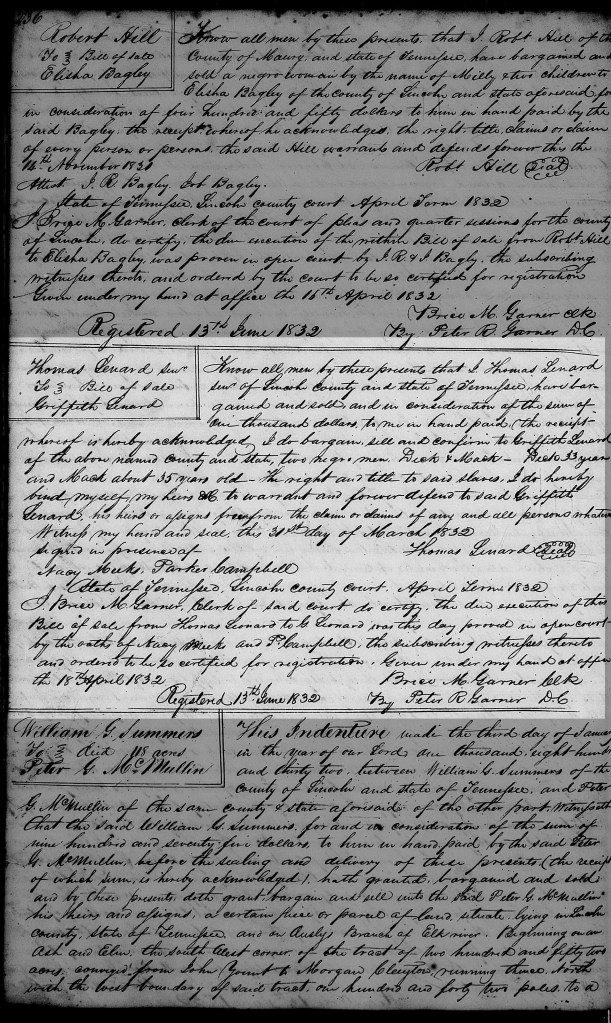
Shortly before his death, on 31 March 1832, Thomas sold his son Griffth enslaved persons Dick and Mack for $1,000.[50] The deed identifies Thomas as Thomas Lenard Senr. of Lincoln County, and is signed Thomas Lenard. Nacy Meeks and Parker Campbell witnessed this deed. Court minutes for 17 April 1832 show the deed proven in court on 16 April 1832 by Nacy Meeks and Parker Campbell, at the same time they proved the will of Thomas Leonard.[51]
Thomas D. Leonard offers a florid, sentimental tribute to his grandparents Thomas and Hannah James Leonard in his biography of the Leonards.[52] He states,
Thomas Leonard, [Hannah James’s] husband and her and family constituted a God loving family. Then [sic: he means “when”] they came to Lincoln County in 1806, their children were grown. Three of them were married.
The blessings and sentiments contained in the CXXVIII Psalm, pro[p]riety be applied to their family, also the same blessings are clearly verified in their children, and grandchildren, vis “Blessed is everyone that feareth the Lord and walketh in his ways for thou shall eat the labor of thy hand.” Happy shalt thou be and it shall be well with thee, thy wife shall be as a fruitful vine by the side of thy house: thy children like olive plants round thy table. Behold that thus shalt the name be blest that feareth the Lord.” Can any one of the older and thinking ones of their descendants say that these promises does [sic] not apply to the family of Thomas and Hannah Leonard? Has not their example been a light to us that knew them? Have we not remembered their teachings a thousand times through our lives? Does not thee by precept and example of the parents extend to the children to the third fourth generation of them that love the Lord, as well as to those that hate him. I love to know that I have descended from such noble spirits. I love to know that their offspring have inherited their noble disposition and have been guided by their teachings.”
Thomas’s wife Hannah lived ten years following his death, dying 3 November 1842 at the Leonard homeplace outside Petersburg. Thomas and Hannah are buried together in the family cemetery behind the site of the old house. Her tombstone records her date of birth as 2 November 1752.[53] I’ll have more to say about Hannah in future when I trace the James family line.
A Brief Postscript
A little postscript about a source that is sometimes cited in discussions of Thomas Leonard, which has incorrect information about his life during the American Revolution. In a letter dated 4 July 1874, William Simpson, a grandson of Thomas Leonard’s brother-in-law Harmon Cummings, states that Thomas Leonard was a Hessian soldier whom Harmon Cummings took prisoner in Trenton, New Jersey, during the Revolutionary War.[54] Simpson, who was living in Jacksonville, Florida, when he wrote this letter, was a son of Mary Cummings and Thomas Simpson; Mary was a daughter of Harmon Cummings and Mary James, a sister of Hannah James Leonard.
It’s not clear to me whether Harmon Cummings himself was the source of the incorrect information that Thomas Leonard was a Hessian soldier held prisoner at Trenton, New Jersey, during the Revolution, or whether that information is something his grandson William Simpson acquired somewhere. As we’ve seen, there’s solid documentation that Thomas Leonard was the son of a professional soldier, Robert Leonard, who was in Maryland not long after 1750 to help guard the frontier of western Maryland as the tensions that led to the French and Indian War began to develop, and who then joined a British Army unit, HM 35th Regiment, during the Seven Years’ War. As the linked posting also shows, there’s equally solid documentation showing that Thomas was a member of the first military company organized for the Revolutionary war in Hagerstown, Maryland, on 6 January 1776.
Thomas Leonard was neither German (Hessian) nor a hireling for the British Army during the Revolution. There actually was a Thomas Leonard serving as a Loyalist major for the British who was taken prisoner at Trenton, New Jersey, when Harmon Cummings was there during the Revolution. But this is an entirely different man than Thomas, son of Robert Leonard and Honor Pritchard. This Thomas was born in 1708 in Monmouth County, New Jersey, and was a son of either Nathaniel or Thomas Leonard.[55]
In my next posting, I’ll provide some brief information about the children of Thomas Leonard and Hannah James.
[1] Thomas Dunlap Leonard, “Biography of the Leonards” (1883 manuscript now circulated as typescript; present whereabouts are not known).
[2] See J. Lester Wolfe, “Thomas Leonard,” in Heritage of Lincoln County, Tennessee, ed. Lincoln County Heritage Book Committee (Waynesville, North Carolina: County Heritage, 2005), p. 414; and Angie May Gill Wallace, “History of Marshall County Families,” Marshall Gazette (19 September 1947), p. 3. The article states that it was written for the Robert Lewis chapter of DAR.
[3] Lincoln County, Tennessee, Deed Bk. A, pp. 43-4.
[4] Anderson County, South Carolina, Deed Bk. I & J, p. 278.
[5] “In the Ground Eighty Years, Fayetteville [Tennessee] Observer (8 November 1894), p. 2, col. 3. The article was originally published in the Petersburg Enterprise.
[6] Lincoln County, Tennessee, Deed Bk. A, pp. 43-4.
[7] Lincoln County, Tennessee, Land Entries Series 2, 1817-1823, p. 77.
[8] Ibid., p. 132.
[9] See Anderson County, South Carolina, Will Bk. A, pp. 129-130.
[10] Goodspeed’s History of Lincoln County, Tennessee (Nashville: Goodspeed, 1886; repr. Columbia, Tennessee: Woodward & Stinson, 1972), p. 768.
[11] Lincoln County, Tennessee, Court Minutes Bk. February 1810-1810, pp. 9-10, 15-6.
[12] Marshall County Historical Quarterly 10,1 (Spring 1979).
[13] Wallace, “History of Marshall County Families.”
[14] Elizabeth Lucie Leonard Baxter, “Leonard Family,” Marshall County, Tennessee, Historical Quarterly 6,2 (summer 1975).
[15] John Trotwood Moore and Austin P. Foster, Tennessee, the Volunteer State, 1769-1923, vol. 3 (Chicago: S.S. Clarke, 1923), pp. 238-241.
[16] I’m dubious about the claim of this biography that the Leonard house was built in 1797. I suspect that the rambling old farmhouse that was erected at some point in the 19th century was on the site of and may have incorporated an earlier house that may have dated to the early 19th century when the Leonards arrived on Cane Creek. That original house would likely have been a log cabin.
[17] In a telephone conversation with me on 16 December 1996, Jackie Leonard of Athens, Alabama, told me that Leonard homestead land was owned in 1996 by Tommy Wilson, owner of a horse farm, Ridge Vale Farms, whose address was Rt. 1, Petersburg, TN 37144.
[18] See also Berry C. Williams, “A Brief History of Lincoln County,” Fayetteville Observer (16 January 1951), unpaginated 100th anniversary edition. See also Goodspeed’s History of Lincoln County, Tennessee, p. 769.
[19] Helen C. and Timothy R. Marsh, Early Unpublished Court Records of Lincoln County, Tennessee (Easley, South Carolina: Southern Historical Press, 1993), p. 126.
[20] Lincoln County, Tennessee, Court Minutes Bk. February 1810-1810), p. 9.
[21] “Muster Roll — War of 1812,” Lincoln County, Tennessee, Pioneers 24,1 (January 1995), pp. 27-8.
[22] Anderson County, South Carolina, Deed Bk. M, p. 33. On Patrick Norris, who is part of my Calhoun family kinship network in Abbeville and Pendleton District, see this previous posting. Patrick was the son of Robert Norris and Jean/Jane Ewing, and married Rachel Calhoun, daughter of William and Agnes Calhoun. On Ezekiel Pickens, son of Andrew Pickens and Rebecca Calhoun and a member of my Calhoun-Pickens kinship network, see this previous posting.
[23] Lincoln County, Tennessee, Court Minutes Bk. February 1811-February 1812, p. 57.
[24] Ibid., pp. 120-1.
[25] Lincoln County, Tennessee, Court Minutes Bk. March 1814-November 1816, p. 13.
[26] Ibid., pp. 36-7.
[27] Ibid., p. 21.
[28] Thomas Dunlap Leonard, “Biography of the Leonards.”
[29] Goodspeed’s History of Lincoln County, Tennessee, p. 769.
[30] Lincoln County, Tennessee, Court Minutes Bk. March 1814-November 1816, p. 101
[31] Ibid., p. 147.
[32] Lincoln County, Tennessee, Will Bk. March 1809-April 1824, p. 108; and see Frances T. Ingmire, Lincoln County, Tennessee, Wills, Inventories, and Miscellaneous, March 1809-April 1824 (St. Louis, 1984), p. 30.
[33] Lincoln County, Tennessee, Court Minutes Bk. March 1814-November 1816, p. 188.
[34] Ibid., pp. 190-2.
[35] Ibid., p. 193.
[36] Ibid., p. 345.
[37] Tennessee Plats and Surveys 1817-1822, p. 77.
[38] Lincoln County, Tennessee, Court Minutes Bk. October 1819-July 1823, pp. 21-3
[39] 1820 federal census, Lincoln County, Tennessee, p. 12 (119).
[40] Lincoln County, Tennessee, Deed Bk. B, pp. 226-8. On 31 December 1832, Colin Campbell sold the 135-acre tract to his nephew Griffith James Leonard, Thomas’s son: see Lincoln County, Tennessee, Deed Bk. I, pp. 251-2. See also North Carolina-Tennessee Land Grant Bk. S, p. 868, warrant no. 3847.
[41] Lincoln County, Tennessee, Court Minutes Bk. October 1819-July 1823, p. 604.
[42] 1830 federal census, Lincoln County, Tennessee, p. 178.
[43] Photos of the tombstone by Jimmy Trout are at the Find a Grave memorial page of Griffith J. Leonard, Leonard cemetery, Marshall County, Tennessee, created by Louise Jenkins.
[44] Thomas Dunlap Leonard, “Biography of the Leonards.”
[45] A Wallace, “History of Marshall County Families.”
[46] Lincoln County, Tennessee, Court Minutes Bk. April 1830-October 1833, p. 316.
[47] Lincoln County, Tennessee, Will Bk. 1, 1827-1850, pp. 79-80. WPA workers Katherine Rhea and Mary Earle Parks published a transcript of the will in 1936: see Will Books, 1810-1850, Lincoln County, Tennessee (WPA Historical Records Project, 1936), pp. 44-5.
[48] Lincoln County, Tennessee, Court Minutes Bk. April 1830-October 1833, p. 329.
[49] Ibid., p. 368.
[50] Lincoln County, Tennessee, Deed Bk. I, p. 236.
[51] Lincoln County, Tennessee, Court Minutes Bk. April 1830-October 1833, p. 332.
[52] Thomas Dunlap Leonard, “Biography of the Leonards.”
[53] See the Find a Grave memorial page of Hannah James Leonard, Leonard cemetery, Marshall County, Tennessee, created by Donna B., maintained by LookingforFamily, with tombstone photos by JimmyTrout. This site incorrectly names her Hannah Leona James Leonard. I’ve seen no documents giving Hannah James a middle name, and suspect that the Leona is a misreading of part of her name on her tombstone: Hannah LEONArd.
[54] I have a transcript of William Simpson’s letter sent to me in May 2008 by Cummings researcher Stephen Ehat, who told me that Mary Ann McDonald of Lyman, Wyoming, had a photocopy of the original letter. I don’t have information about who might own the original.
[55] See Clifford Neal Smith, Muster Rolls and Prisoner of War Lists in American and Archival Collections Pertaining to the German Mercenary Troops (DeKalb, Illinois: Westland, 1974, pp. 91-2.
 BEGATS AND BEQUEATHALS
One thought on “Thomas Leonard (1752-1832), Son of Robert Leonard and Honor Pritchard: Lincoln County, Tennessee, Years (1808-1832)”