Maryland Years, 1781-6
The 1883 manuscript of Thomas Dunlap Leonard discussed previously (and also here) states that Thomas’ parents Thomas Leonard (1752-1832) and Hannah James “of Maryland” (1752-1842) married about 1775 and “after living in Maryland for several years after their marriage in 1775 and the birth of several children they moved to South Carolina.”[2] Since a stream of documents from September 1762 to March 1792 consistently shows Hannah’s father Griffith James living in Sharpsburg, Maryland, in that time frame, it seems reasonable to assume that Thomas Leonard and Hannah James married in Hannah’s home community of Sharpsburg. I also suspect that Thomas and Hannah lived in Sharpsburg near or with the family of her father Griffith James following their marriage, and that this is where Thomas Lewis Leonard was born.
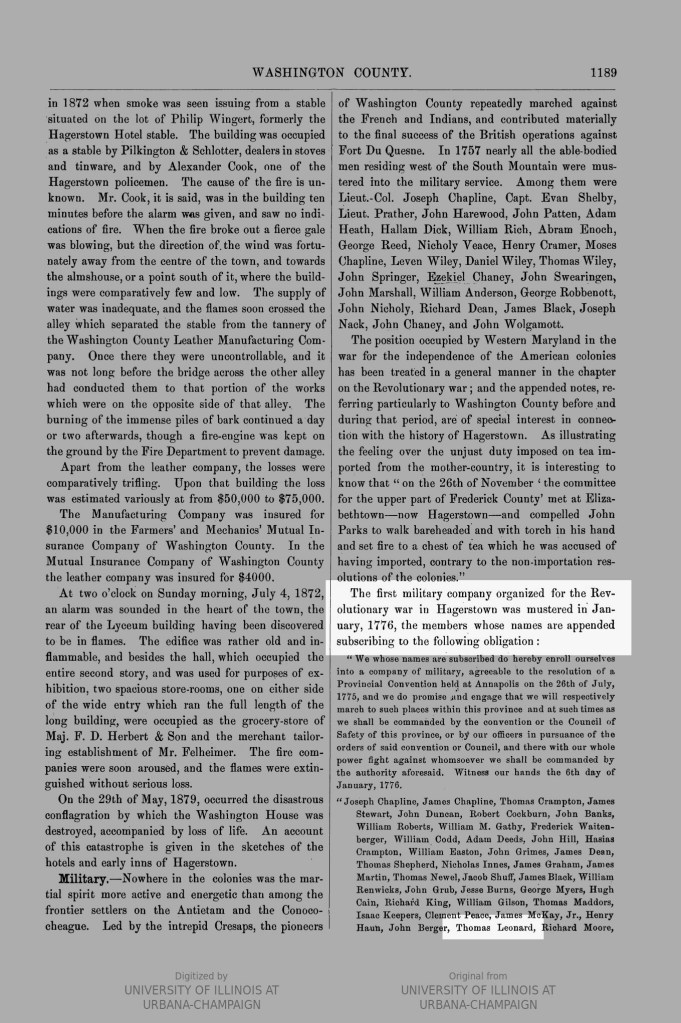
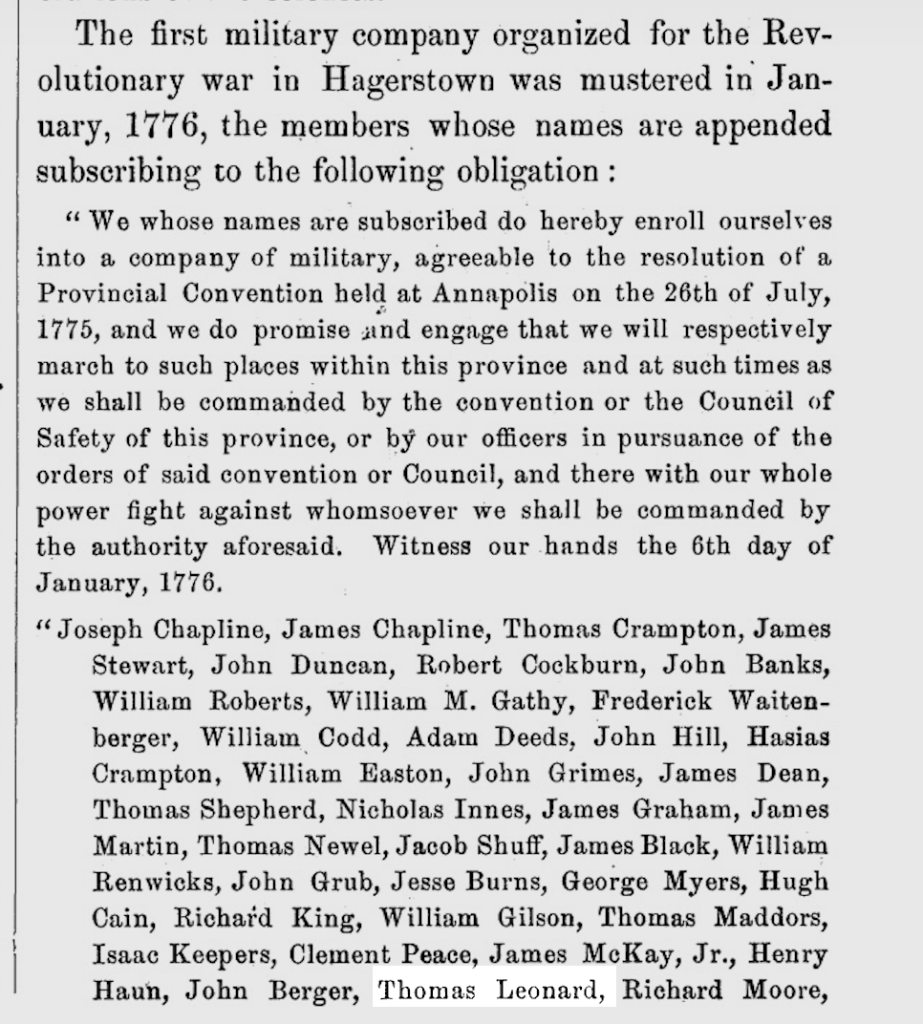
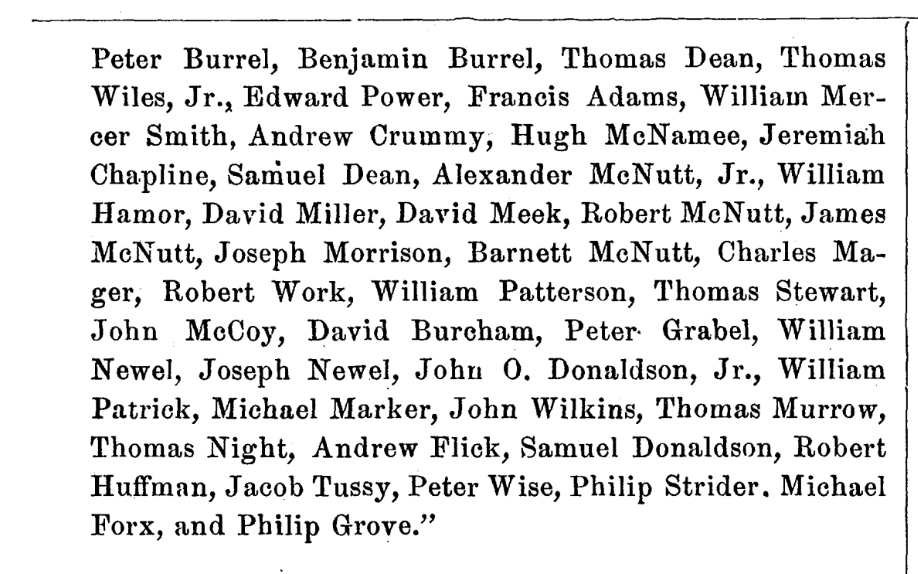
A January 1776 record definitely places Thomas Leonard in the part of Frederick County, Maryland, that would become Washington County in September 1776: as Thomas J. Scharf states,[3]
The first military company organized for the Revolutionary war in Hagerstown was mustered in January, 1776, the members whose names are appended subscribing to the following obligation: “We whose names are subscribed do hereby enroll ourselves into a company of military, agreeable to the resolution of a Provincial Convention held at Annapolis on the 26th of July, 1775, and we do promise and engage that we will respectively march to such places within this province and at such times as we shall be commanded by the convention or the Council of Safety of this province, or by our officers in pursuance of the orders of said convention or Council, and there with our whole power fight against whomsoever we shall be commanded by the authority aforesaid. Witness our hands the 6th day of January, 1776.”
Scharf then lists the signatories to this declaration. They include Thomas Leonard, who signed next to Richard Moore. Richard was the son of Daniel Moore, who lived in Sharpsburg next to a Dean family intermarried with the family of Griffith James, whose land was across the road from the land of Griffith James.[4] Also signing the declaration were Samuel and Thomas Dean. Samuel Dean was Thomas Leonard’s brother-in-law; he married Hannah James’ sister Gwendolyn in Sharpsburg in 1773. Thomas Dean was Samuel’s brother. This militia unit was under the command of Joseph Chapline, founder of Sharpsburg and connected to Hannah James Leonard’s father Griffith James from the time Griffith James first appears in Sharpsburg records in September 1763.[5]
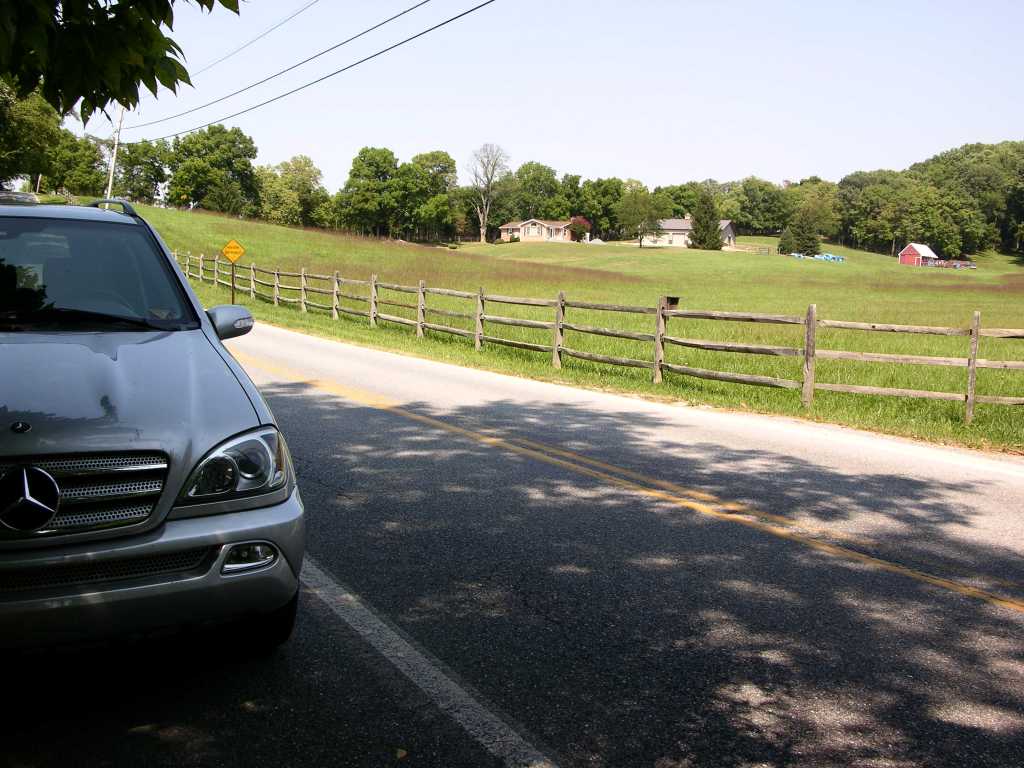
Hagerstown, where this militia unit was formed, is a bit over thirteen miles north of Sharpsburg. The town was originally known as Elizabethtown, and Scharf is citing minutes of the Elizabethtown District Committee of Observation for 5 June 1776, which say that on that date, a list was presented to the committee compiled on 6 January 1776 of a group of men who signed their names to a resolution to form a militia per a resolution of the Provincial Convention held at Annapolis on 26 July 1775.[6]
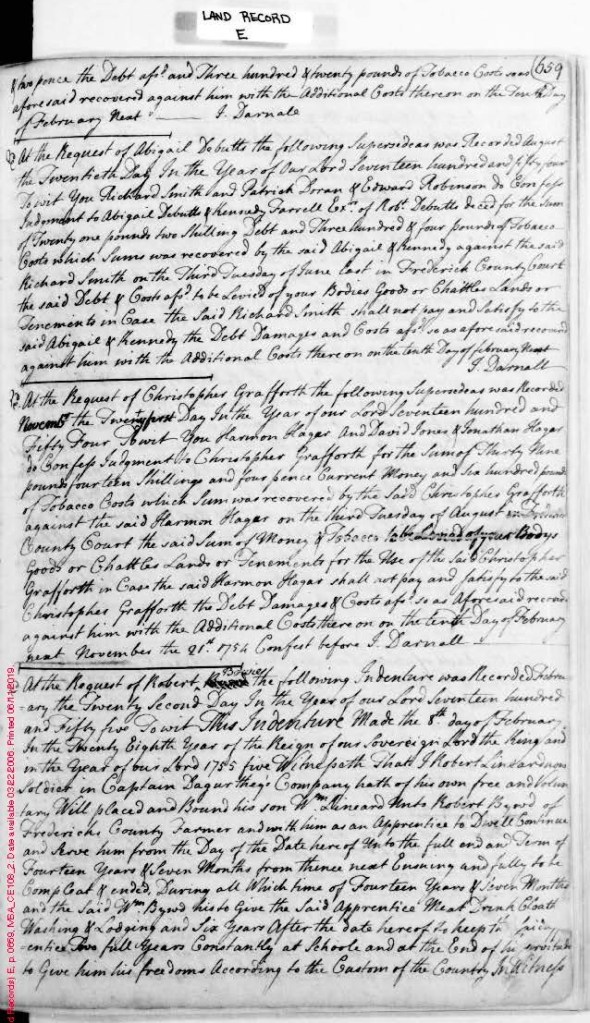
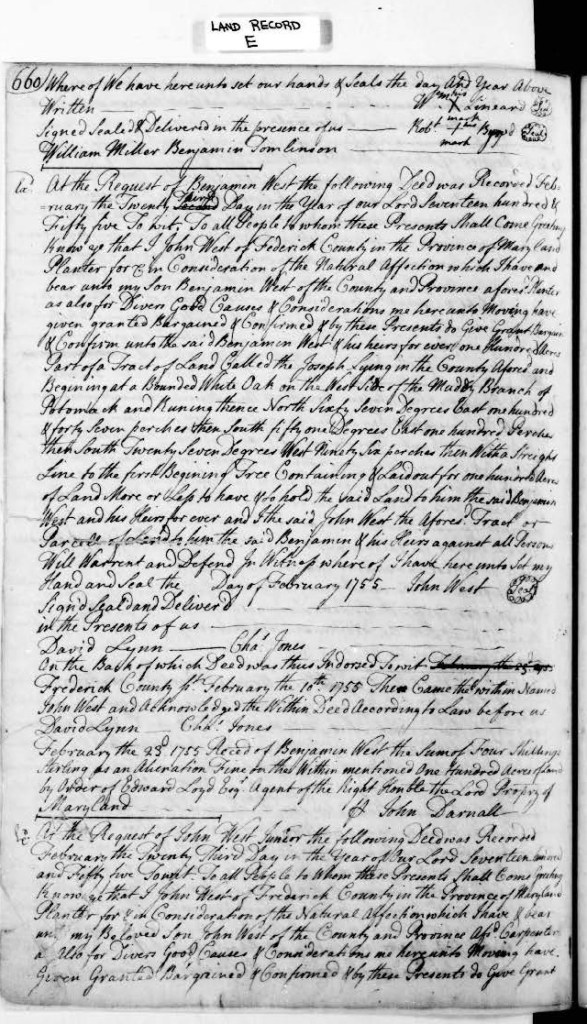
Various records place Thomas Leonard’s father Robert Leonard, a British professional soldier, at Fort Frederick some eighteen miles west of Hagerstown in the period leading up to the Revolution. Historian Henry Peden notes that Robert Leonard was stationed at Fort Frederick by August 1757, and that the account book of Colonel John Dagworthy, field commander at Fort Frederick in 1756, shows Robert Leonard paid for service by Dagworthy on 7 March 1763.[7] A document dated 8 February 1755 shows Robert Leonard indenturing his son William on that date to a local farmer.[8] In this document, Robert identifies himself as a soldier serving under Captain “Dagurthey.” When Fort Frederick was built in 1756, its construction was financed by Joseph Chapline of Sharpsburg, the same Joseph Chapline with ties to Griffith James, whose daughter Hannah married Robert Leonard’s son Thomas in or about 1775.[9]
As a previous posting notes, Thomas Dunlap Leonard (1810-1888) states explicitly in his manuscript about the Leonard family that Robert Leonard was a soldier: the manuscript describes Robert as “a soldier of the English Army” and notes that in Thomas D. Leonard’s lifetime, Robert’s discharge papers from the English army were in the possession of his uncle Griffith James Leonard, son of Thomas Leonard and Hannah James. Thomas D. Leonard states that he had seen the discharge papers. As the posting linked at the head of this paragraph also notes, Thomas D. Leonard grew up knowing his grandparents Thomas and Hannah James Leonard both of whom died after Thomas D. Leonard reached young adulthood, and it’s clear that much of his information about the first generation of this family in America comes from their testimony.
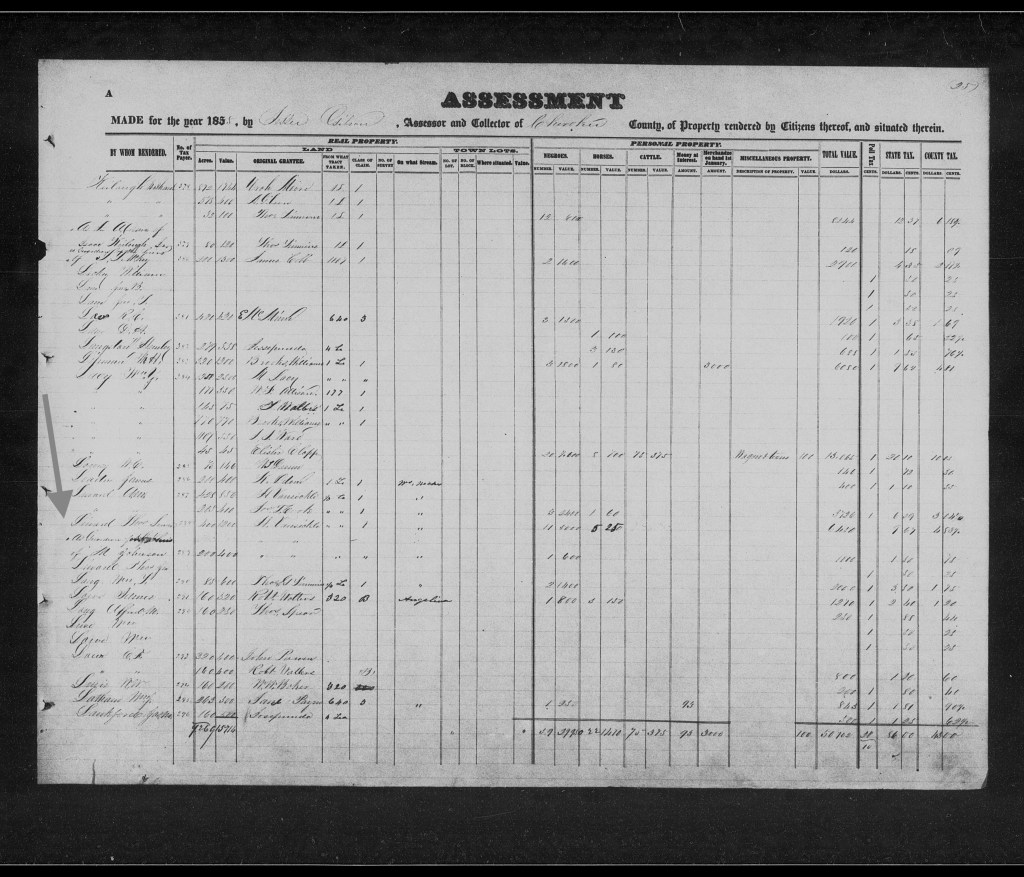
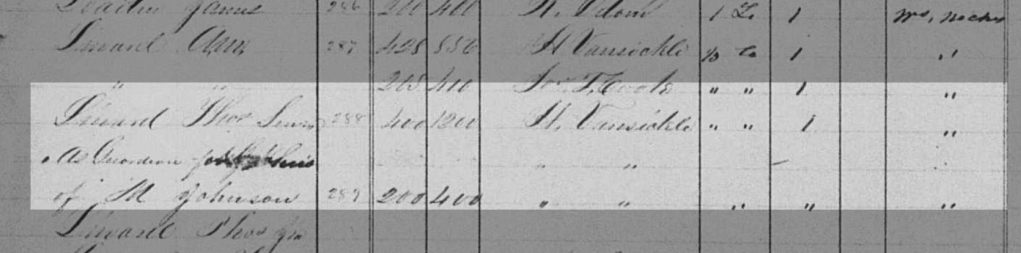
A prefatory note about Thomas Lewis Leonard’s name: a number of published family trees and other published sources both in print and online give Thomas the middle name Alfred. His name appears in almost every document I’ve found as simply Thomas Leonard. However, the 1855 tax list of Cherokee County, Texas, shows him with the middle name Lewis: his name is written as Thomas Lewis Linard in this document.[10] It’s clear that the man with this name on this 1855 tax list is Thomas Leonard (1781-1870); his son Thomas Jr., who was born in 1829, is enumerated next to Thomas Lewis Leonard with the junior designation next to his name. This tax listing also states that Thomas Lewis Linard/Leonard was being taxed as guardian of the heirs of M. Johnson. Thomas Leonard’s daughter Maria, who married Marmaduke Johnson, died in Cherokee County on 20 September 1848, and as we’ll see down the road, in December 1849, Cherokee County court gave her father Thomas Leonard guardianship of her minor children, though their father was still living.
South Carollna Years, 1786-1808
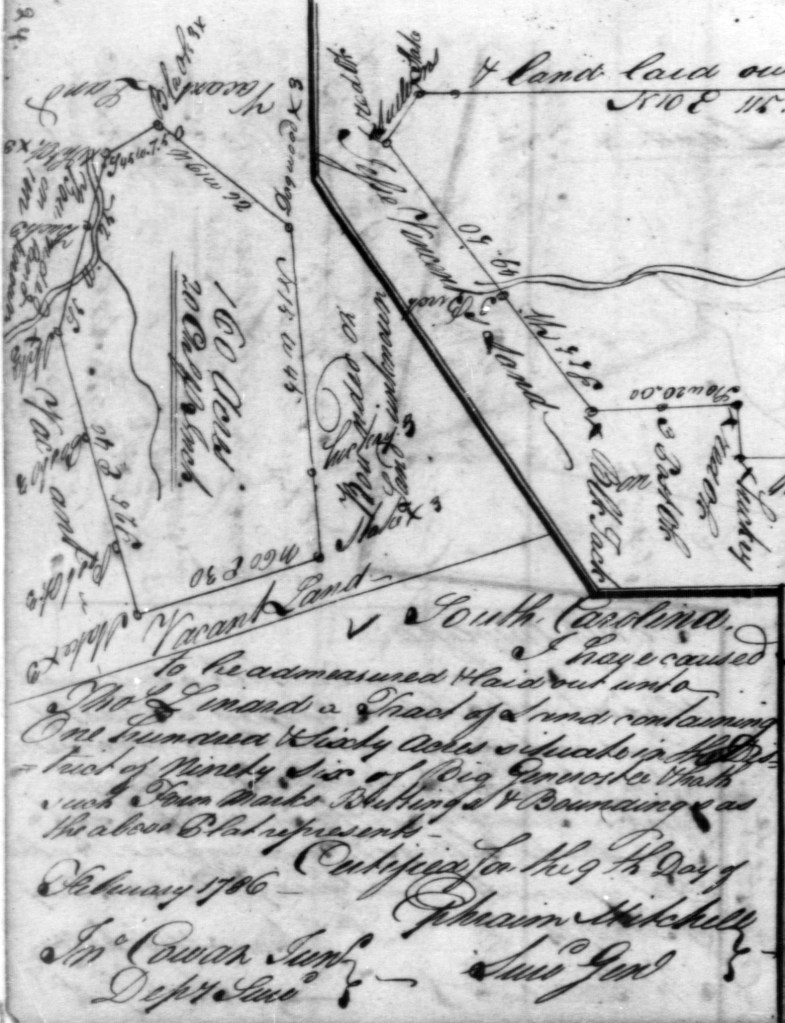
I noted previously that Thomas D. Leonard’s manuscript states that following their marriage about 1775, Thomas Leonard and wife Hannah James lived a few years in Maryland, where they married, having a number of children born to them there, and then moved to South Carolina. The manuscript does not date the family’s move from Washington County, Maryland, to Ninety-Six (later Pendleton) District, South Carolina. But we can fairly well pinpoint the Leonard family’s arrival in South Carolina from a plat for 160 acres on the Big Generostee in Ninety-Six District that was made for Thomas Leonard (Linard in this document) on 9 February 1786.[11] The grant for this land was made to Thomas (again, with his surname spelled Linard) on 6 November 1786.[12]
The 1786 arrival date in South Carolina concurs with information reported by the families of two sisters of Hannah James Leonard whose families moved to South Carolina along with Thomas and Hannah Leonard. Both the family of Hannah’s sister Gwendolyn, who married Samuel Dean, and of her sister Mary, who married Harmon Cummings, state that these families came to South Carolina from Washington County, Maryland, with the Leonard family in 1786.[13] The 1790 federal census of Pendleton District, South Carolina, confirms that these three families had settled near each other by that date in what had now become Pendleton District.[14] A 4 May 1826 deed that Samuel Dean made to his son Moses for 330 acres on Mountain Creek of the Big Generostee tells us that Samuel’s land shared a dividing line with land owned by Thomas Leonard prior to Thomas’ removal to Tennessee.[15]
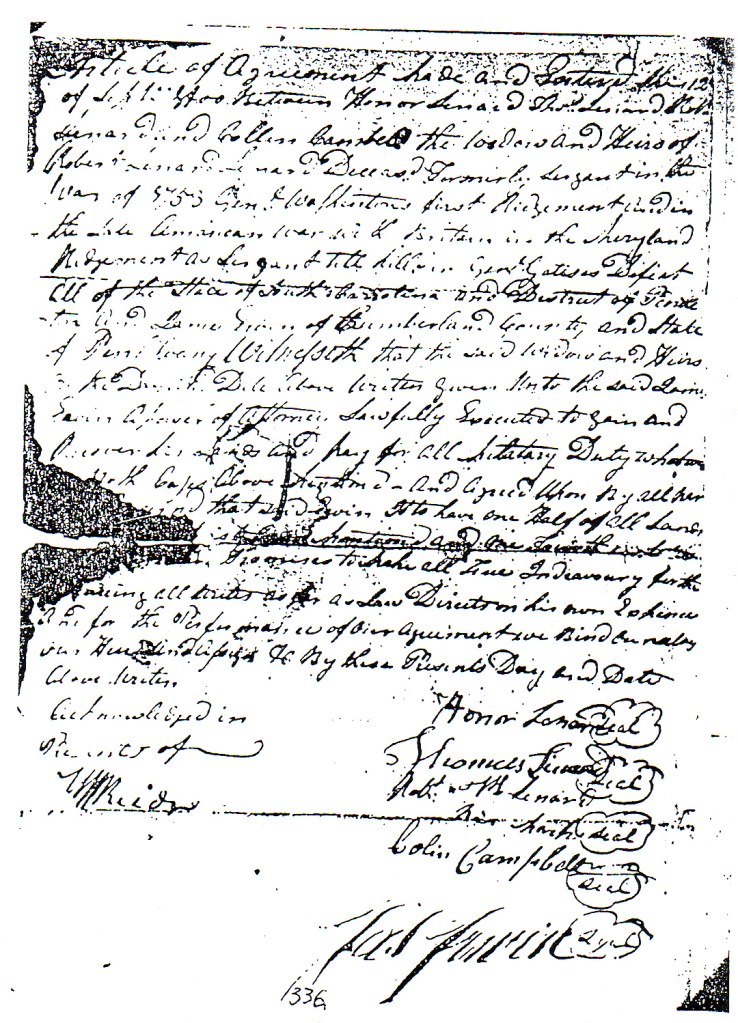
In the latter part of 1793, Griffith James and wife Mary would join their children who had moved to South Carolina and would settle among them. It also appears that when the children of Robert Leonard and wife Honor Pritchard moved in 1786 from Maryland to South Carolina — Thomas Leonard was joined in the move by brothers William and Robert and sister Mary Ann with husband Colin Campbell — their widowed mother Honor accompanied them. A 12 September 1800 document preserved by their descendants in Marshall County, Tennessee, shows Honor Leonard and sons Thomas and Robert, along with Colin Campbell, giving power of attorney to James Irwin in Cumberland County, Pennsylvania, to represent them as they claimed a land grant for Robert Leonard Sr.’s Revolutionary service. The power of attorney states that Robert Leonard was a lieutenant in the Maryland regiment and that he was killed at General Gates’ defeat in South Carolina (i.e., at the battle of Camden in August 1780), and that the signatories were living in Pendleton District, South Carolina, when they signed this power of attorney.[16]
Thomas Lewis Leonard would have been five years old when his family moved from Maryland to South Carolina. He came of age in the South Carolina upcountry in northwest South Carolina in what became Pendleton District in 1789 and later became Anderson County. As a previous posting notes, about 1800 in Pendleton District Thomas married Sarah M. Lauderdale, daughter of John Lauderdale and Milbury Mauldin. No marriage record appears to be extant. This date is based on the birth of Thomas and Sarah’s first child, their daughter Aletha, in 1803. Sarah’s father John Lauderdale began acquiring land on the Big Generostee in Ninety-Six District in November 1786.[17] The 1800 federal census of Pendleton District suggests that the Leonard and Lauderdale families lived not far apart from each other: the families are enumerated on consecutive pages.[18]
As a previous posting states (naming Thomas Lewis Leonard’s father as Robert, instead of Thomas, his correct name), “Thomas, the 2nd son of Robert and Hannah Leonard married Sarah Lauderdale in So Carolina, moved to Lincoln Co Tn with his father in 1806.”[19] It’s possible that the Leonard family had begun to prepare for its move to Lincoln County, Tennessee, in 1806, but a deed that Thomas Leonard made in Pendleton District on 29 January 1808 states that Thomas was still living there on that date: Thomas sold William Glenn 506 acres in Pendleton District with the deed stating that both parties were living there.[20] Thomas’ wife Hannah relinquished her dower rights in the land on 15 February 1808, an indicator that the family was selling its homeplace and moving away, and on the same day, Thomas’ brother-in-law Colin Campbell, husband of Thomas’ sister Mary Ann Leonard, who had witnessed the deed, proved it. Thomas signed this deed, with wife Hannah using her mark.[21]
Tennessee Years, 1808-1808
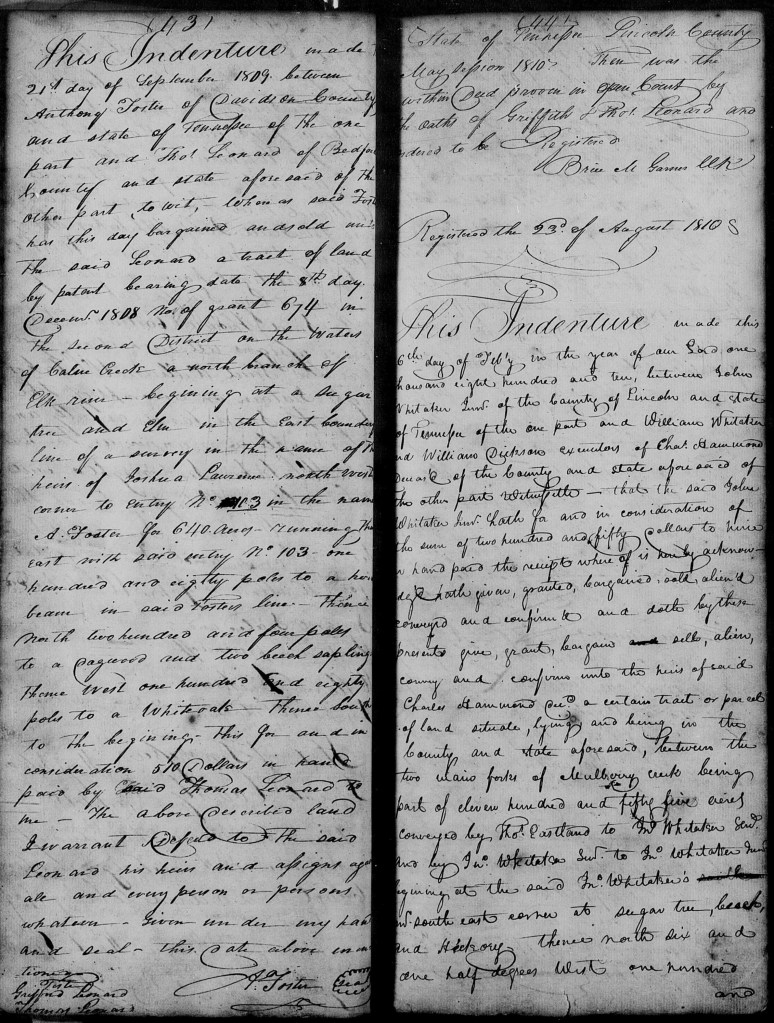
It seems clear that the Leonard family had arrived in Lincoln County by 21 September 1809 when Thomas Leonard — this is, it seems to me, the elder Thomas who was father of Thomas Lewis Leonard — bought 640 acres on the north branch of the Elk River from Anthony Foster, with sons Griffith and Thomas (Lewis) Leonard witnessing the deed and proving it at May court 1810.[22] A land entry recorded by Charles Gibson on 14 April 1811 at the head of Cane Creek and the north Branch of Elk River states that the land Gibson was entering joined land on which Thomas Leonard was living at that time, which had originally been granted to Anthony Foster.[23] When Robert Leonard, son of the elder Thomas, entered 40 acres on the head of Pigeon Roost, a branch of Cane Creek on 16 April 1818, the entry again stated that Thomas Leonard was living on adjoining land acquired from Anthony Foster.[24]
I think it’s possible, but don’t have certain proof of this, that Thomas Leonard’s son Thomas Lewis Leonard was farming with his father Thomas at this point and living with his family on the same 640-acre tract his father had bought from Anthony Foster in September 1809. Lincoln County court minutes on 28 August 1811 show Thomas Leonard Sr. being ordered by the county court to oversee a road from his homeplace to Gibson’s Gap, with hands to work under him including his sons Thomas (i.e., Thomas Lewis Leonard), Hezekiah, Griffith, and Samuel Leonard.[25] Madison County, Mississippi Territory, records suggest that Thomas’ second son John had relocated to north Alabama by this point, and Lincoln County records suggest that the oldest son, Robert, was living with his family independently of his father in 1811. Thomas Lewis Leonard was the next son after John, and was followed by brothers Hezekiah, Samuel, Griffith James, and Colin Campbell Leonard.
After his move to Limestone County, Alabama, in 1818, Thomas Lewis Leonard made two deeds for land in Lincoln County, Tennessee, to his uncle Colin Campbell in August 1822 that allow us to locate some valuable information about this Thomas in Lincoln County records before he left Tennessee for Alabama. This information is all the more helpful when many Lincoln County documents in the period 1808-1818 do not use the Sr. or Jr. designation for the two Thomas Leonards who were of age in those years.
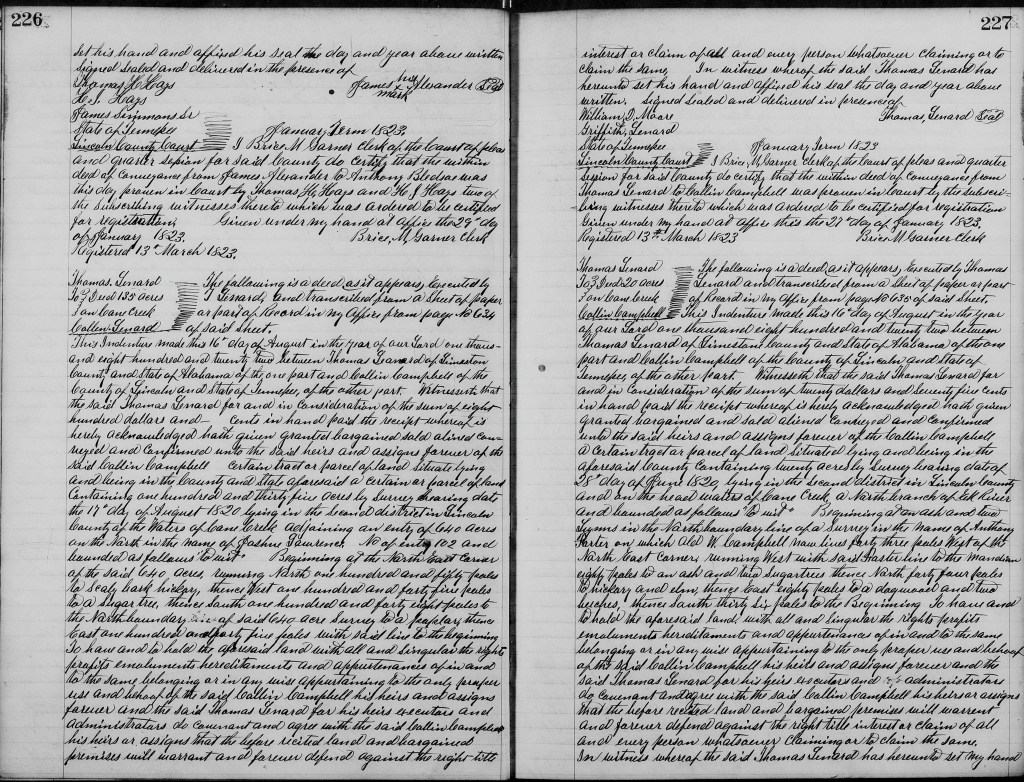
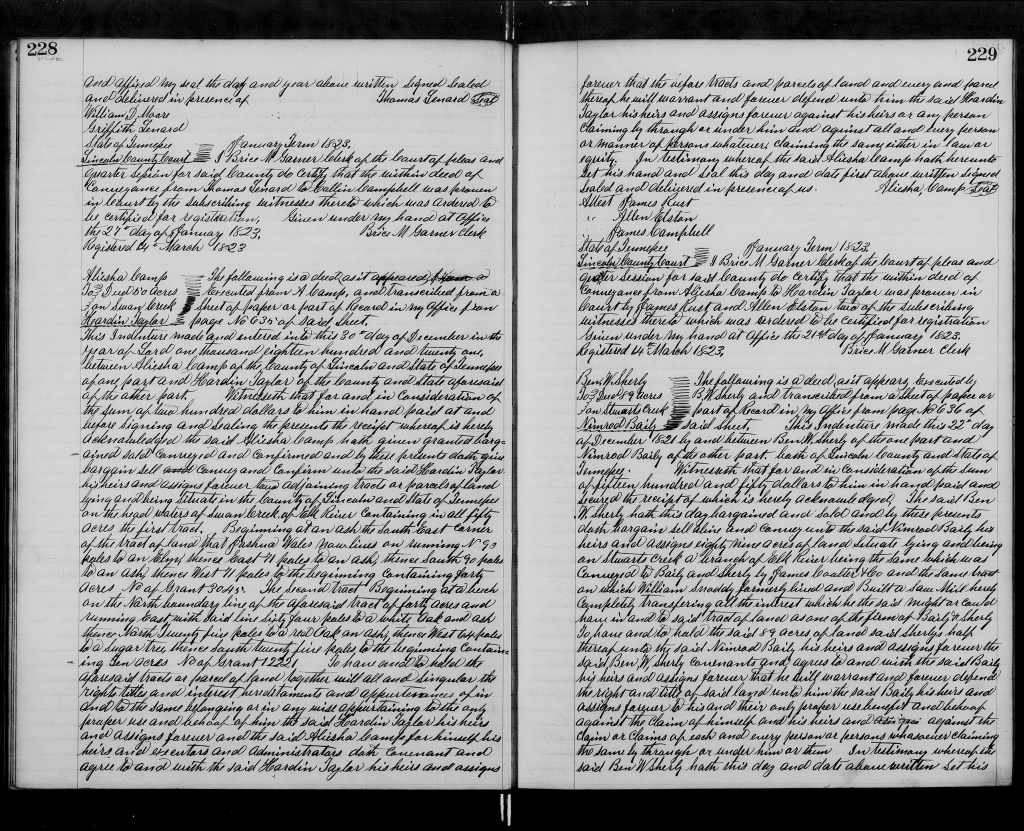
On 16 August 1822, Thomas Leonard made two deeds to Colin Campbell for tracts of 135 acres and 20 acres in Lincoln County, Tennessee.[26] The two deeds recording this land sale both state that Thomas Leonard was living in Limestone County, Alabama, when he sold the land. So this tells us that the Thomas deeding the land was Thomas Lewis Leonard and not his father Thomas Leonard. Both pieces of land were on the headwaters of Cane Creek. These deeds were witnessed by Thomas Lewis Leonard’s brother Griffith James Moore and brother-in-law William Depriest Moore, husband of Thomas and Griffith’s sister Hannah Leonard.
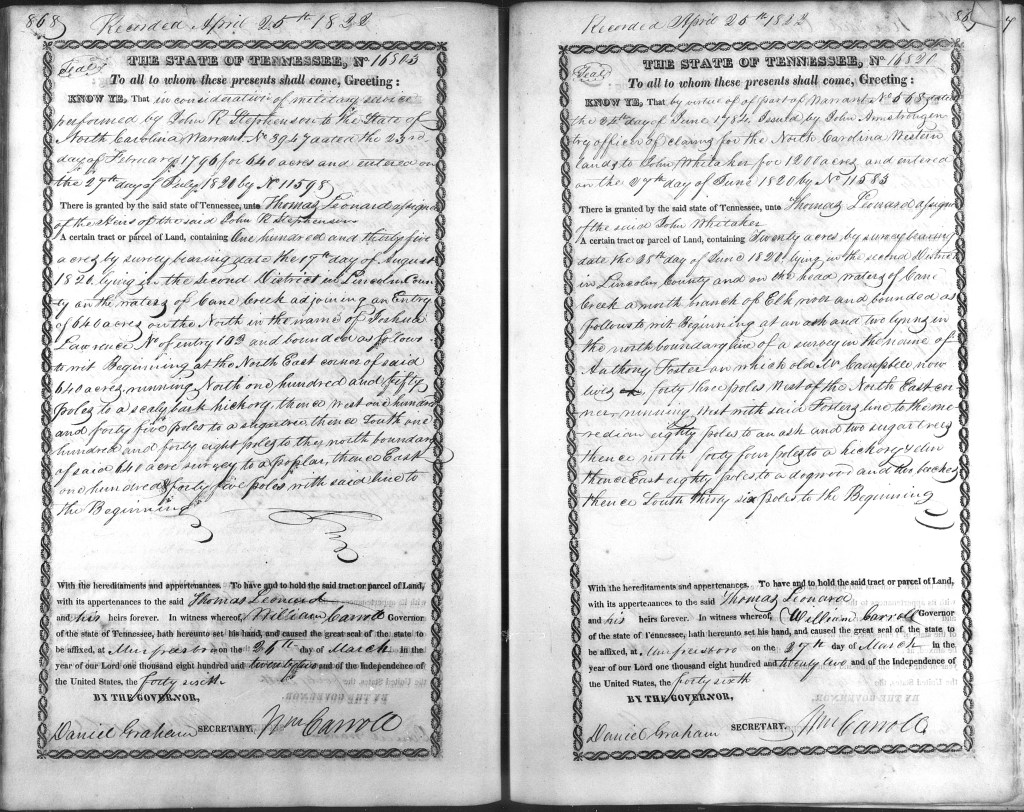
A Tennessee land grant dated 24 March 1822 shows Thomas Leonard being granted the 135-acre tract on that date, and another grant dated 27 March 1822 records his grant of the 20-acre tract.[27] The grant for the 135 acres states that this land was assigned to Thomas Leonard by the heirs of John R. Stephenson, who had a warrant (no. 3947) for 640 acres on 23 Feb 1796. The 640 acres were entered 27 July 1820 (entry no. 11598) and surveyed 17 August 1820.
The 20-acre tract was assigned to Thomas Leonard by John Whitaker, who had a grant of 1,200 acres (warrant no. 568) on 24 June 1784. The 1,200 acres were entered 27 June 1820 (entry no. 11583) and surveyed 28 June 1820. This survey document shows this land adjoining Anthony Foster’s land on which Thomas’ father Thomas Leonard lived along with a widow Campbell who must have been, I’m assuming, the wife of a William Campbell named mentioned below; Thomas Leonard’s brother-in-law Colin Campbell died 27 May 1832, so this is not Colin’s widow Mary Ann Leonard Campbell.[28]
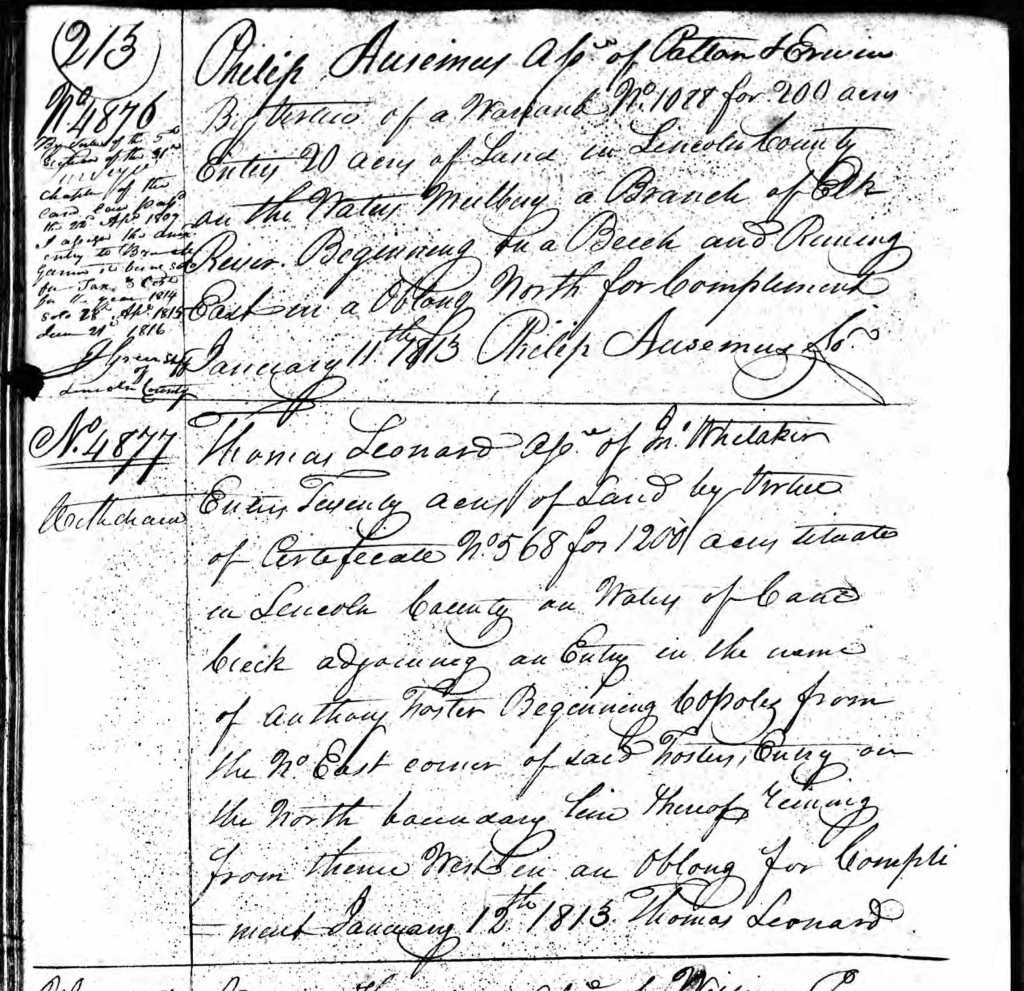
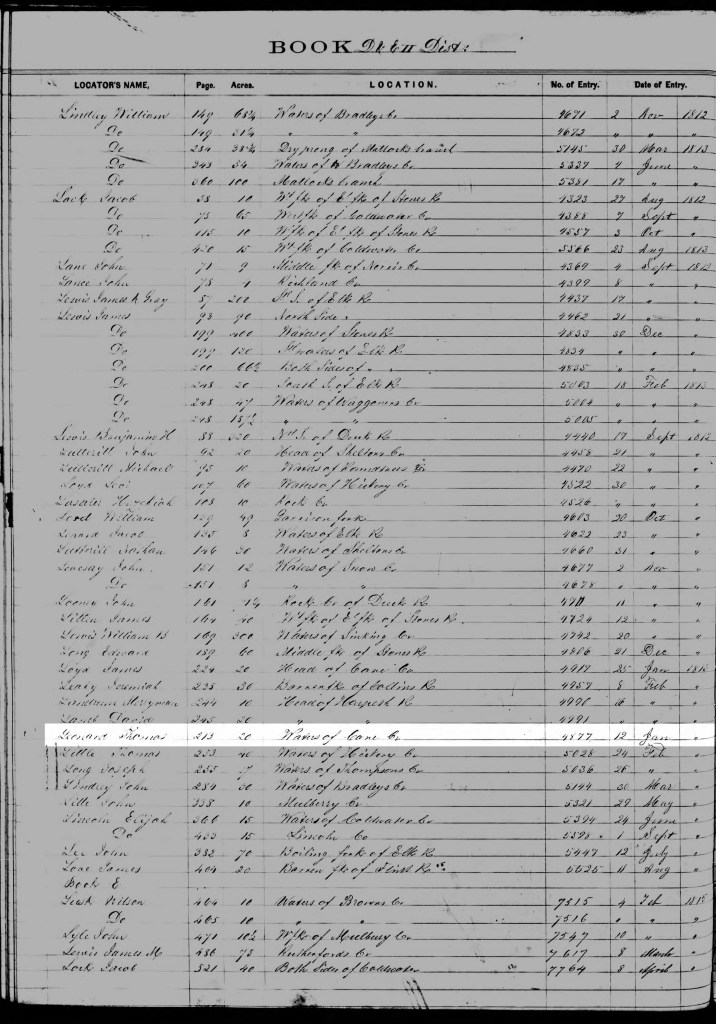
Though the 27 March 1822 grant to Thomas Leonard states that John Whitaker entered this land on 27 June 1820, Tennessee land entry books for 1812-3 show Thomas Leonard entering the 20 acres on 12 January 1813.[29] A second entry of the 20 acres by Thomas Leonard dated 26 June 1820 is recorded in a later entry book.[30] The survey for the 20-acre dated 28 June 182- says that the land was on the waters of Cane Creek, a north branch of Elk River, near land claimed by Anthony Foster and William Campbell.[31] The 24 March 1822 grant of the 135-acre tract to Thomas Leonard states that the land joined land granted to Joshua Lawrence. When Thomas’ father, the elder Thomas Leonard (1752-1832) both 640 acres from Anthony Foster in September 1809, the deed for this land stated that it bordered land granted to Joshua Lawrence.
This chain of land documents suggests that soon after Thomas Lewis Leonard arrived in Lincoln County, Tennessee, with his father and siblings, along with his father’s brother Robert and sister Mary Ann with husband Colin Campbell, and the family matriarch Honor Leonard, Thomas Lewis Leonard entered land by in January 1813 next to land that his father Thomas had bought in September 1809. After leaving Tennessee in 1818, Thomas Lewis Leonard sold this land to his uncle Colin Campbell in August 1822. If Thomas Lewis Leonard farmed with his father during the years in which he and his family resided in Lincoln County — 1808-1818 — he may have lived on his father’s 640-acre tract. Otherwise, the two tracts that Thomas Lewis Leonard sold to Colin Campbell in 1822 may have been his homeplace in the decade in which he lived in Lincoln County, in which his wife Sarah Lauderdale Leonard gave birth to four daughters — Cynthia, Matilda Caroline, Maria W., and Minerva D. Leonard. Prior to moving to Tennessee, in South Carolina, the couple had three daughters born to them: Aletha R., Hannah, and Milbury.
In my next posting, I’ll pick up the story of Thomas Lewis Leonard from the point at which he left Tennessee for Alabama in 1818.
[1] 1850 federal census, Cherokee County, Texas, p. 876 (dwelling and family 474; 7th November); 1860 federal census, Cherokee County, Texas, beat 1, Rusk post office, p. 411 (dwelling and family 27; 4 June).
[2] Thomas Dunlap Leonard, “Biography of the Leonards” (1883 manuscript now circulated as typescript; present whereabouts are not known).
[3] See J. Thomas Scharf, History of Western Maryland: Being a History of Frederick, Montgomery, Carroll, Washington, Allegany, and Garrett Counties, etc., vol. 2 (Philadelphia: L.H. Everts, 1882), pp. 1189-1190.
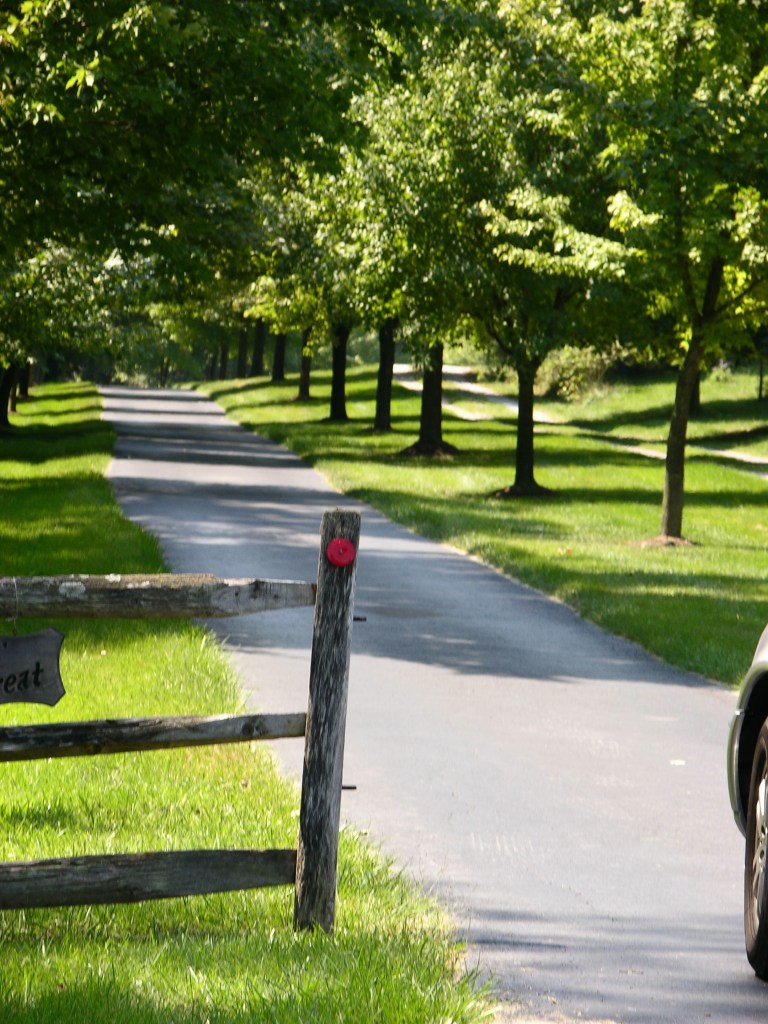
[4] The Dean home tract, Hunting the Hare, and Griffith James’ home tract, Pough, were across from each other on present-day Burnside Bridge Road close to its intersection with present-day Mills Road just outside Sharpsburg to the southeast. I visited this area in August 2007 and took photos of both pieces of land.
[5] See Frederick County, Maryland, Deed Bk. J, pp. 798-802, stating that Chapline had sold 215 acres to Daniel Moore and Griffith James. On Joseph Chapline and the founding of Sharpsburg, see Edward C. Papenfuse, A Biographical Dictionary of the Maryland Legislature, 1635-1789 (Baltimore: Johns Hopkins University Press, 1979); Lee and Barbara Barron, The History of Sharpsburg, Maryland, Founded by Joseph Chapline 1763 (1972), pp. 8f; Maria J. Liggett Dare, Chaplines from Maryland and Virginia (priv. publ., 1902); and Thomas J.C. Williams, A History of Washington County, Maryland, etc., vol. 1 (Hagerstown, 1906; repr. Baltimore: Regional Publishing Company, 1968), pp. 23-4.
[6] See Henry C. Peden Jr., Revolutionary Patriots of Washington County, Maryland 1776-1783 (Westminster, Maryland: Family Line, 1998), p. 210, citing “Proceedings of the Committee of Observation for Elizabeth Town District [Washington County],” Maryland Historical Magazine 12 (1917), p. 270; and Williams, A History of Washington County, p. 1189. Thomas Leonard’s sister Mary Ann married Colin Campbell at Hagerstown on 27 July 1780, and Hannah’s sister Mary James married Harmon Cummings 7 September 1779 at Hagerstown. Both couples were married by Reverend George Mitchell of Hagerstown.
[7] Henry C. Peden Jr., Marylanders and Delawareans in the French and Indian War 1756-1763 (Lewes, Delaware: Colonial Roots, 2004).
[8] Frederick County, Maryland, Land Record Bk. E, pp. 659-660. The farmer’s name appears in this document as both Robert Bowies and William Byard.
[9] Peden Jr., Marylanders and Delawareans in the French and Indian War 1756-1763, p. 54.
[10] 1855 tax list, Cherokee County, Texas, p. 25A, available digitally at FamilySearch.
[11] South Carolina Plat Books (Charleston Series), vol. 16, p. 35; and Ninety-Six District, South Side of Saluda, Commissioner of Locations Plat Bk. B, p. 113, giving the plat date as 21st February. The same page has a plat to Thomas Leonard’s brother William dated 22 February.
[12] South Carolina Grant Bk. 15, p. 416.
[13] See Beverly Dean Peoples and Ralph Terry Dean, Country Cousins: Descendants of Samuel Dean, 2nd ed. (Franklin, North Carolina: Genealogy Publishing Service, 2001), p. 5; and Louise Ayer Vandiver, Traditions and History of Anderson County (Atlanta: Ruralist, 1928), pp. 71-2, both citing oral tradition handed down by Gwendolyn James Dean and Harmon Cummings to their descendants.
[14] 1790 federal census, Pendleton District, South Carolina, p. 6.
[15] Anderson County, South Carolina, Deed Bk. R, p. 482.
[16] I have not found this power of attorney in records of either Cumberland County, Pennsylvania, or Anderson County, South Carolina. The original, of which I have a photocopy and digital copy, was owned by descendant Leonard Wilson of Petersburg, Tennessee, up to 1972, when he died. I do not know its whereabouts at present.
[17] South Carolina State Plat Bk. 21 (Charleston Series), p. 8. It’s clear that Thomas Lewis Leonard was of age and married by 21 November 1804 when his father Thomas made a deed in Pendleton District to Samuel Copeland using the suffix senior for his name: Pendleton District, South Carolina, Deed Bk. I & J, p. 123.
[18] 1800 federal census, Pendleton District, South Carolina, pp. 110A (Thomas Leonard) and 111A (John Lauderdale).
[19] The claim that the Leonard family moved from Pendleton District, South Carolina, to Lincoln County, Tennessee, appears in various published sources, but without documentation that I have seen: see, e.g., J. Lester Wolfe, “Thomas Leonard,” in Heritage of Lincoln County, Tennessee (Waynesville, North Carolina: County Heritage, 2005), p. 414. A number of Leonard researchers have reported in family trees and published articles that the Leonard family received a grant for Robert Leonard’s Revolutionary War service on Cane Creek in Lincoln (later Marshall) County, Tennessee, in 1806, but I have not seen corroboration of that grant.
[20] Pendleton District, South Carolina, Deed Bk. I & J, p. 278. It appears that litigation ensued over this land sale: Pendleton District Judgment Rolls for a case numbered 886 show that in 1810, Thomas Leonard filed suit to recover a debt of $200 owed him by John McClure and Colin Campbell. At issue was a note McClure had made to William Glenn and which Glenn then assigned to Thomas Leonard in November 1808, evidently as partial payment for the land Leonard sold Glenn. I think it’s possible that Colin Campbell was party to the suit because he had gone surety with McClure re: the note given in payment to Thomas Leonard. The case file shows Thomas Leonard appearing in Pendleton court in October 1810. I suspect he had already settled in Tennessee and had returned to South Carolina for this court hearing. An 8 February 1812 deed in Pendleton District notes that Patrick Norris had sold Ezekiel Pickens 140 acres on Oolenoy Creek of the Saluda on 7 October 1811, pursuant to an October 1810 judgment for Thomas Leonard in a suit of Thomas Leonard vs. John McClure (Anderson County, South Carolina, Deed Bk. M, p. 33). On Patrick Norris and Ezekiel Pickens, see here. Patrick Norris was a son of Robert Norris and Jean/Jane Ewing who married Rachel, daughter of William Calhoun and Agnes Long. William Calhoun was a brother of Ezekiel Calhoun, who was Jean/Jane Ewing’s husband prior to Robert Norris. Ezekiel Pickens was a son of Andrew Pickens and Rebecca Calhoun, a daughter of Ezekiel Calhoun and Jean/Jane Ewing.
[21] As a previous posting has noted, Leonard researcher Sue Cooper suggests that Thomas Leonard and his brothers Robert and William may actually have moved initially from South Carolina to Sumner County, Tennessee. She bases this conjecture on the fact that a store ledger of an unidentified Sumner County merchant she has seen shows these three men with accounts in 1806-7. It’s well documented that Thomas and his brother Robert did settle with their mother Honor and with brother-in-law Campbell in Lincoln (later Marshall) County, Tennessee, but it can also be shown that William died testate in Anderson County, South Carolina, in March 1811: see Anderson County, South Carolina, Will Bk. A, pp. 129-130. Note that an article in the Fayetteville [Tennessee] Observer entitled “In the Ground Eighty Years,” published 8 November 1894, says that S.J. Leonard of Petersburg had stated that his father Griffith J. Leonard came to Cane Creek in Lincoln County (later Marshall County) in 1808 (p. 2, col. 3). The article was originally published in the Petersburg Enterprise. S.J. Leonard was Samuel James Leonard, son of Griffith James Leonard, brother to Thomas Lewis Leonard.
[22] Lincoln County, Tennessee, Bk. A, pp. 43-4. This deed states that Robert Leonard was in Bedford County (adjoining Lincoln on the north) when the deed was made.
[23] Lincoln County, Tennessee, Land Entries Series 2, 1817-1823, p. 77.
[24] Ibid., p. 132
[25] Lincoln County, Tennessee, Court Minutes Bk. 1, pp. 120-1.
[26] Lincoln County, Tennessee, Deed Bk. B, pp. 226-7.
[27] Tennessee Land Grant Bk. S, pp. 868-9, grants 16803 and 16820.
[28] Tennessee Plats and Surveys, 1817-1821, series 3, p. 401.
[29] Tennessee Land Entries 1812-3, series 2, p. 213, entry no. 4877. This same date is stated in Tennessee Land Entries 1811, unpaginated, arranged by entry date.
[30] Tennessee Land Entries 1817-1823, series 2, p. 273.
[31] Tennessee Plats and Surveys 1817-1821, series 3, p. 401.
 BEGATS AND BEQUEATHALS