I’m now going to turn my attention to the Leonard ancestral line. I’m beginning my series on that family line by talking about Aletha Leonard. In addition to the postings I’ve linked in the paragraph above, you can find information about Aletha in two postings I’ve made previously about her husband James G. Birdwell:
James G. Birdwell (1795-1849): Georgia and Alabama Years
James G. Birdwell (1795-1849): Louisiana Years
First a note about Aletha’s given name: it appears in various documents as Aletha, Alitha, Lethe, and Leatha, the latter two renditions obviously nicknames. According to E.G. Withycombe, the given name Alethea or Alithea is the English transliteration of the Greek word for “truth,” and was used as a given name in England from the 17th century.[1] Withycombe notes that the name has been spelled in various ways in the centuries in which it’s been used as a female surname in the British Isles and elsewhere.
George R. Stewart’s American Given Names has essentially the same information, though Stewart says, curiously, that Alethea “may not actually exist in the American name-pool.”[2] If Stewart means to say that this specific spelling — Alethea — hasn’t been common in the US, he might be correct. But with the spelling Aletha, this name has frequently been used in the US as a female given name: the 1850 federal census lists 342 Alethas (a few with the census taker spelling the name Eletha). This given name has been far from uncommon in American families. Aletha Leonard Birdwell’s grandmother Milbury Mauldin Lauderdale had a sister Frances (husband Burgess Reeves) who named a daughter Aletha, and in that family line, the given name passes down repeatedly. I suspect that the name Aletha came to Thomas Lewis Leonard and wife Sarah M. Lauderdale, in fact, from Sarah’s aunt Frances Mauldin Reeves. Her Aletha was born in 1785, and this family lived in Pendleton District, South Carolina, as did Thomas and Sarah for the first years of their marriage, in which their daughter Aletha, their oldest child, was born.
In the first of the two postings about James G. Birdwell for which I’ve provided links above, I cite an 1883 manuscript written by a first cousin of Aletha Leonard Birdwell’s father Thomas Lewis Leonard, which contains a piece of biographical information about James Birdwell and wife Aletha Leonard. As that posting explains, the primary author of this manuscript, which is entitled “Biography of the Leonards,” was Thomas Dunlap Leonard (1810-1888), a son of Robert Leonard, a brother of Aletha’s father Thomas Lewis Leonard. About James Birdwell and Aletha Leonard, Thomas Dunlap Leonard has the following to say:
Thomas and Sally Leonard’s oldest child, a daughter named Alitha was born in So Carolina about the year 1803. She was married to James Birdwell in Limestone Co Al, a farmer. He was a sober, steady man of good habits and of good family. Moses Birdwell, his father, I was well acquainted with and know him to be a good citizen. James Birdwell came to Louisiana, east of the Red River in 1840 where he and Alitha died in a few years, having 3 daughters that had md. and 4 younger sons that were not gôrwn [sic] All was of good habits. I have not known anything of then for 40 years.
As the previously linked posting indicates, Thomas Dunlap Leonard’s manuscript was at some point transcribed as a typescript (of 28 single-spaced pages) and that’s the only format in which I’ve read it, as it has circulated for years among Leonard researchers. Thomas completed the manuscript in 1883 while living with his cousin Elizabeth Frances Leonard Norris in Waller County, Texas, and after this, Joseph J. Gill, husband of Thomas’ first cousin Angelina Moore, made some brief additions to the work in 1884. I have been unable to find the whereabouts of the original.
The manuscript notes that Thomas D. Leonard grew up in Tennessee knowing his grandparents Thomas Leonard (1752-1832) and Hannah James (1752-1842), both of whom died after he had grown to manhood. Thomas and Hannah, both native Marylanders, moved their family with Thomas’ mother Honor Pritchard Leonard from South Carolina to Lincoln County, Tennessee, in or about 1808, settling near what is now the town of Petersburg in Marshall County, which was formed from Lincoln. Thomas D. Leonard’s manuscript gathers information about this Leonard family from the generation of the immigrant ancestors Robert Leonard and wife Honor Pritchard, noting that Robert was an English soldier who settled in Maryland and was killed during the Revolution (as a Maryland soldier) at the battle of Camden in August 1780.
It’s clear that much of the information about the immigrant generation of this Leonard family recorded by Thomas D. Leonard comes from oral history his grandfather Thomas Leonard, son of Robert and Honor Leonard, and his grandmother Hannah shared with him. Information on subsequent generations seems to have been carefully compiled by Thomas D. Leonard over the course of his life as he lived among, interacted with and visited, and corresponded with far-flung branches of this Leonard family. In comparing what Thomas D. Leonard says about the various lines of this Leonard family with documented sources, I’ve found that his history is remarkably reliable. He knew the people he was talking about, and knew them well.
In the case of Thomas D. Leonard’s uncle Thomas Lewis Leonard, father of Aletha Leonard Birdwell, not only did Thomas live near his uncle’s family in Tennessee, but Thomas D.’s father Robert Leonard followed his brother Thomas Lewis Leonard in moving from Tennessee to north Alabama, and Thomas D. Leonard knew the family of his uncle Thomas Lewis Leonard in Alabama, too.
As noted in a previous posting, Thomas D. Leonard’s manuscript states that his uncle Thomas and wife Sarah M. Lauderdale moved their family from South Carolina to Tennessee in 1806. I find this family in the records of Pendleton District, South Carolina, where Thomas and Sarah’s daughter Aletha was born about 1803, up to 1808. Immediately following the Revolution, the widowed mother of the Leonard family, Honor Pritchard Leonard, moved from Sharpsburg, Washington County, Maryland, to Pendleton District, South Carolina, with her sons, including Thomas Leonard (1752-1832) and wife Hannah James. As we’ve seen, in about 1800 in Pendleton District, Thomas and Hannah’s son Thomas Lewis Leonard (1781-1780), father of Aletha Leonard, married Sarah M. Lauderdale, a daughter of John Lauderdale and Milbury Mauldin, who was born in Wilkes County, Georgia. Thomas D. Leonard’s manuscript notes that after moving from South Carolina to Tennessee, in 1818 Thomas Lewis Leonard then moved his family to Limestone County, Alabama.
Aletha Leonard spent the first few years of her life, then, living in Pendleton District, South Carolina, then spent her girlhood in what was then Lincoln County, Tennessee, and later Marshall County, and during her teen years, her father moved the family from Tennessee to Limestone County, Alabama, where Aletha married James G. Birdwell prior to 8 January 1820.
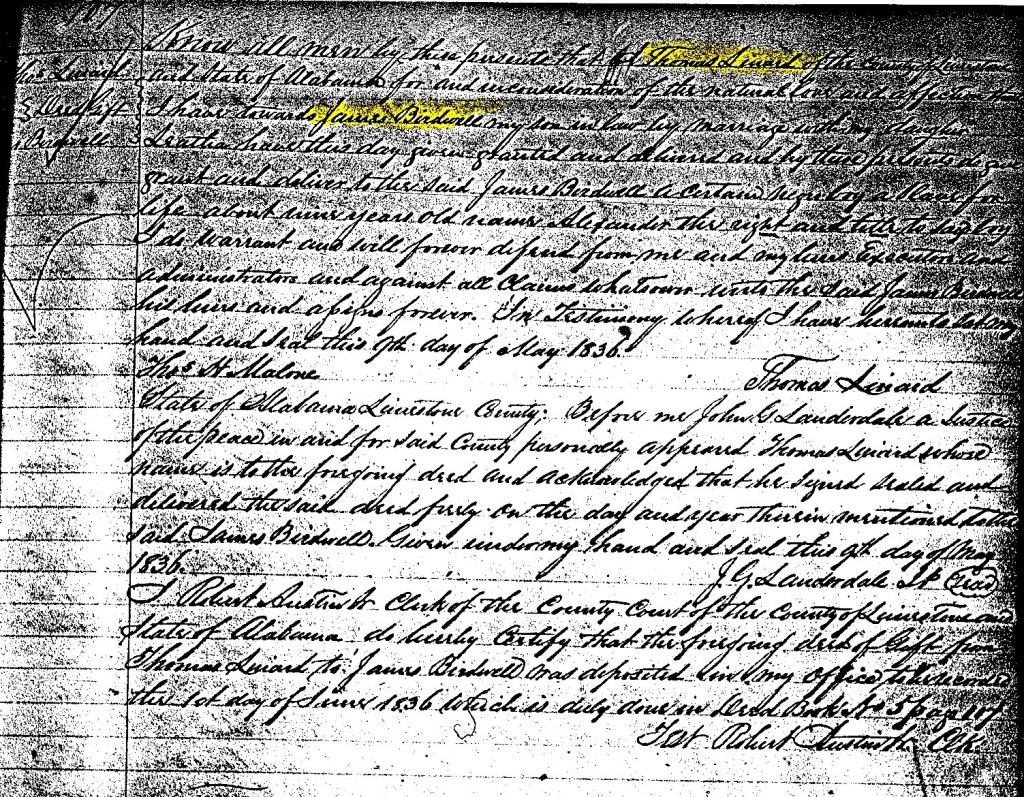
Aletha and husband James Birdwell lived the first several years of their married life in Limestone County, having four children born to them in that county: Elvira, Hannah, John B., and Dewitt Clinton Birdwell. In 1830, James and Aletha moved their family to Jackson County, Alabama, which had been created from the Cherokee Cession in 1819 and joins Madison County on the east. During the years they spent in Jackson County from 1831-6, on 9 May 1836 in Limestone County, Aletha’s father Thomas Leonard deeded to James Birdwell for love and affection an enslaved boy named Alexander, nine years old.[3] The deed of gift states that James was Thomas’ son-in-law through marriage to Thomas’ daughter, whose name appears as Leatha here. Thomas proved the deed on the day it was made before John Gammel Lauderdale, a justice of the peace who was his brother-in-law, brother of Thomas’ wife Sarah M. Lauderdale.
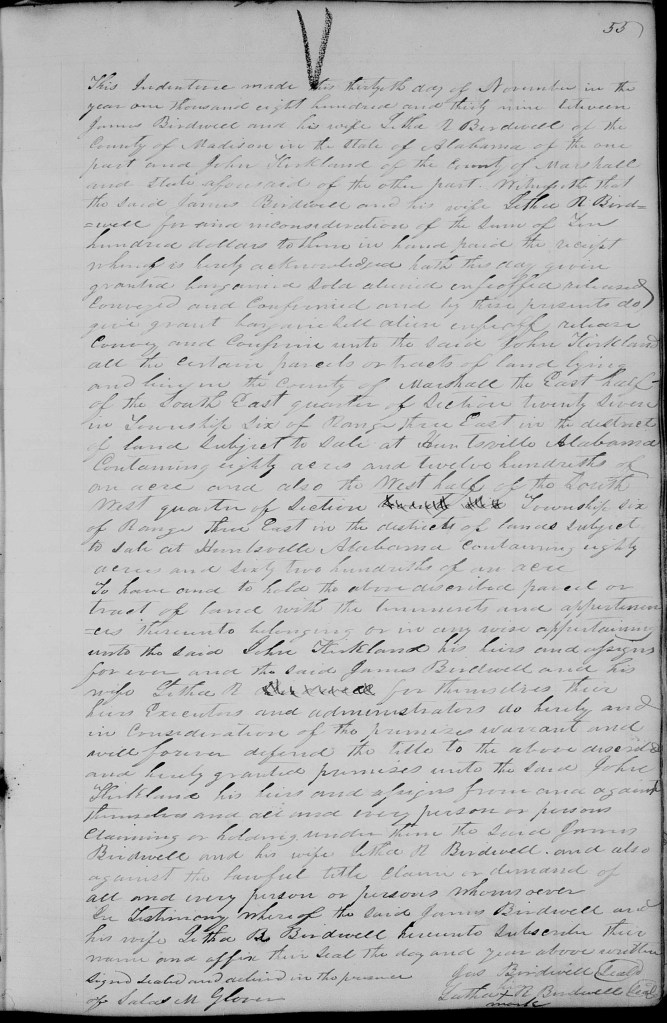
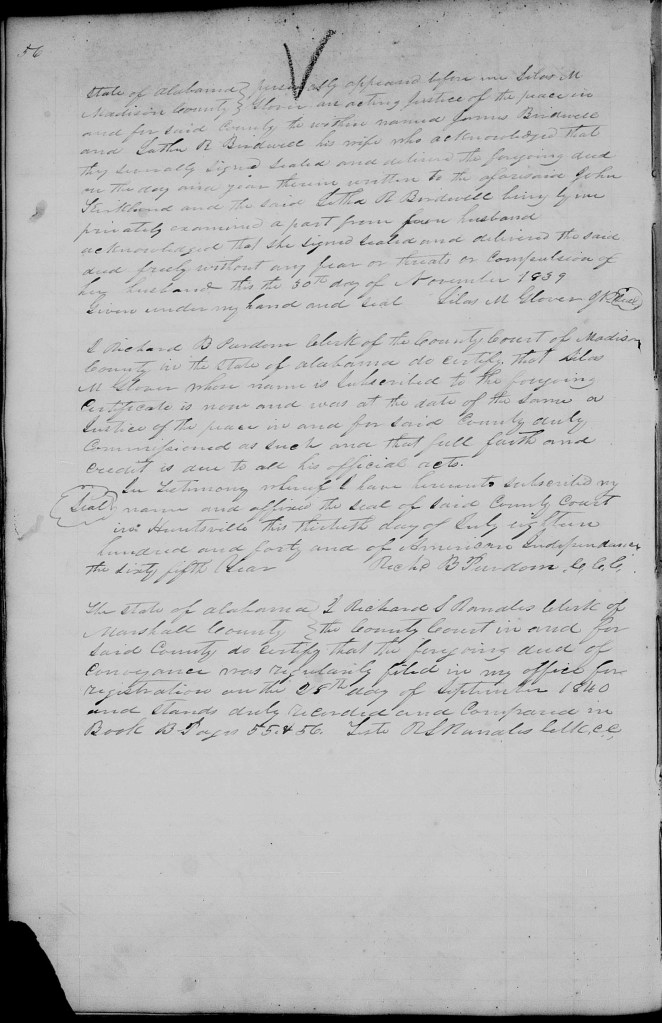
While living in Jackson County, James and Aletha Birdwell had three more children born to them: Thomas, Camilla, and Frances C. From 1836 to 1839, James and Aletha Birdwell lived in Marshall County, Alabama, which was formed in 1836 from Blount and Jackson Counties and the Creek Cession. On 30 November 1839 in Marshall County, James and wife Aletha sold to John Kirkland tracts of land that James’ father Moses Birdwell had patented in Jackson County in 1830, which had fallen into Marshall County at that county’s formation.[4] This land appears to have come into James’ hands due to a debt Moses had incurred to his son James. The deed suggests to me that James and Aletha had probably been living on and farming this land since the first part of the 1830s. This document was signed by James and Aletha, James signing and Aletha (who is called Letha R. Birdwell in the deed) making her mark. The deed states that James and Aletha were in Madison County at the time it was made.
It’s clear to me that, with this land sale and their temporary relocation to Madison County, James and Aletha were in the process of moving their family to Louisiana when they sold their Alabama land. As noted previously, Thomas Dunlap Leonard says that the Birdwell family moved to Louisiana from Alabama in 1840. Prior to James and Aletha’s sale of their Marshall County land in November 1839, in May 1839, Aletha’s father Thomas Lewis Leonard had sold his land in Limestone County, Alabama, and moved to Texas, with court records stating that he had “absconded” from the county in May 1839 – that is, he left debts behind. GTT — Gone to Texas— the deed and court books of north Alabama counties often note in this period when planters ruined by the economic bust of the first part of the 1830s upped stakes and went west, frequently leaving unresolved debts .…
As we’ve seen previously, the 1840 federal census confirms Thomas Dunlap Leonard’s information that by 1840 the family of James Birdwell had settled east of the Red River in Louisiana. This census enumerates the family in Natchitoches Parish, which was, in 1840, a large parish in northwest Louisiana through which the Red River ran. As the posting I’ve just linked states, all indicators suggest that James Birdwell settled his family in a portion of Natchitoches Parish that in 1870 became Red River Parish, and whose western boundary is the Red River.
The 1840 census shows James Birdwell’s family with two males 5-9, one male 10-14, and one male 40-49, as well as one female under 5, one female 5-9, two females 15-19, and one female 30-39.[5] Also in the household are fifteen enslaved persons, one male under 10, two males 10-24, one male 24-36, two males 36-55, three females under 10, two females 10-24, two females 24-36, one female 36-55, and one female 55-100.
I’ve puzzled over this census enumeration of fifteen enslaved persons in James Birdwell’s household in 1840. The 1830 federal census shows him holding no enslaved people. As we’ve seen, in 1836, Aletha’s father deeded an enslaved boy named Alexander to James and Aletha, and the combined succession record of James and Aletha in DeSoto Parish, Louisiana, dating from 1850, shows only one enslaved person in the estate, a boy named Benton.
As I’ve thought about the listing of fifteen enslaved persons in James Birdwell’s household in 1840, I’ve realized that the 1830 federal census listing for Thomas Lewis Leonard in Limestone County, Alabama, shows Thomas holding fourteen enslaved persons, with one free man of color also found in the household.[6] Then in 1840, after Thomas Lewis Leonard had arrived in Texas, the 1840 census of the Republic of Texas shows Thomas settled in Houston (later Cherokee) County, Texas, with 1,420 acres of land and fifteen enslaved persons.[7] Thomas Leonard sold his Alabama land in May 1839 and James Birdwell followed suit in November 1839. I suspect the two families went west together, or Thomas preceded his son-in-law James Birdwell and wife Aletha by a few months, settling in what would become Cherokee County where he and wife Sarah M. Lauderdale Leonard would die. For whatever reason, it seems to me that the enslaved persons of Thomas Lewis Leonard were placed in the hands of James Birdwell in Louisiana until both families were fully settled in their new homeplaces.
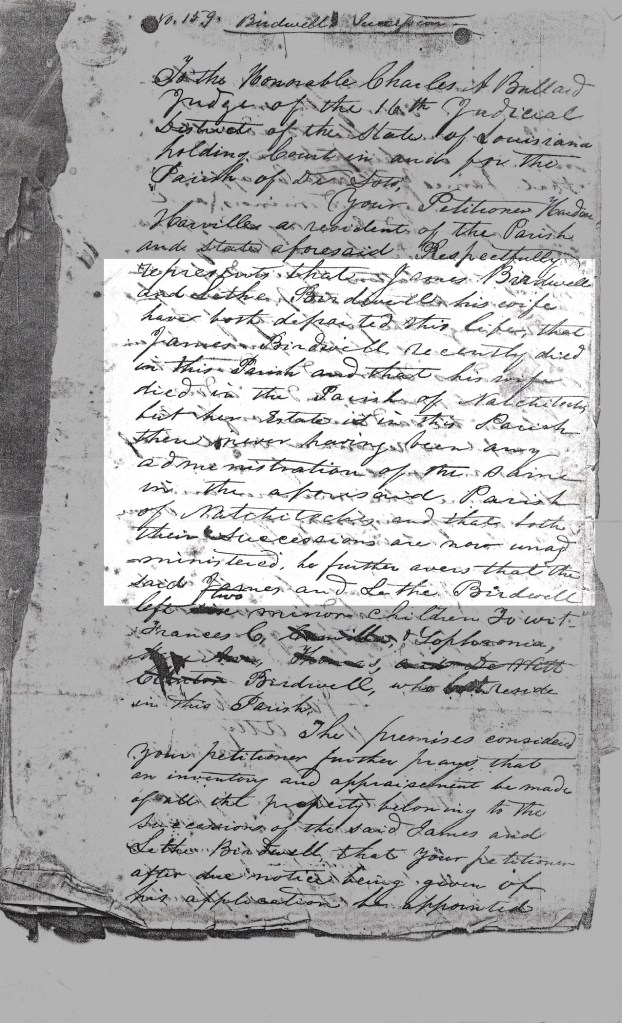

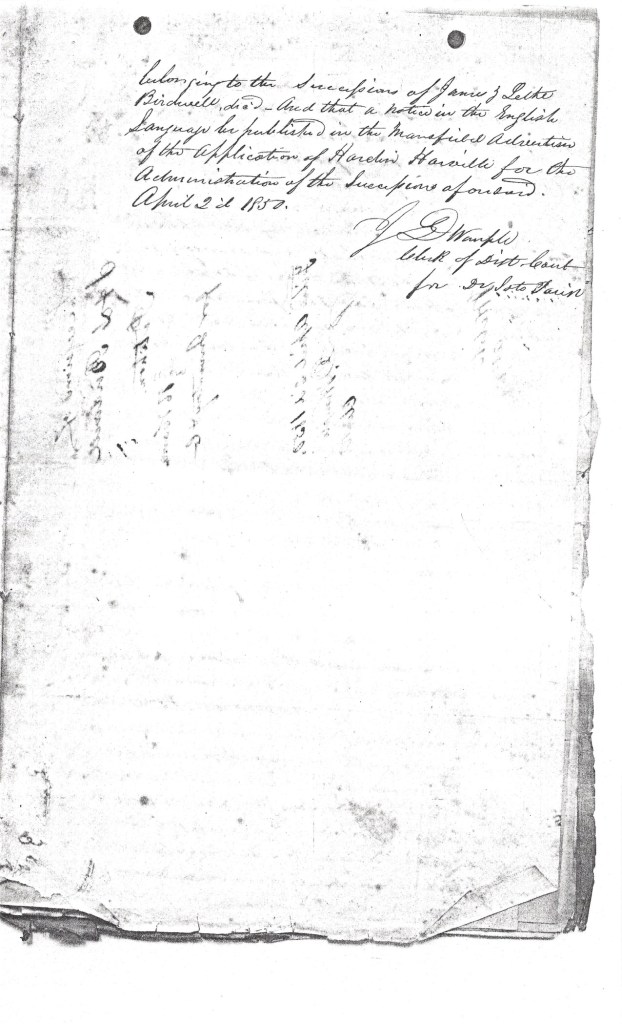
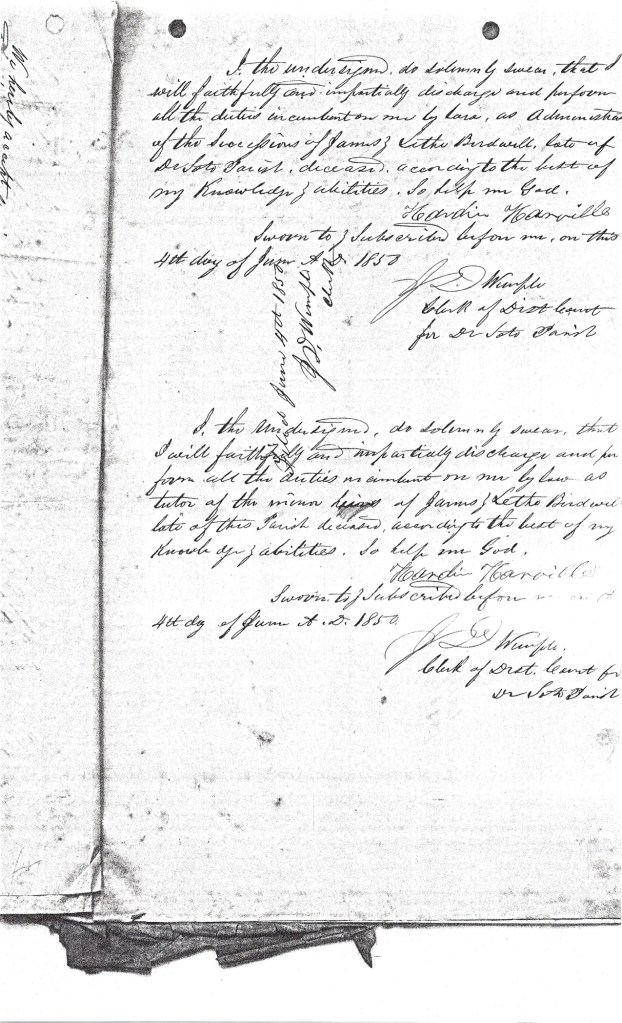
Thomas D. Leonard states that both James and wife Aletha died “in a few years” after they moved to Louisiana in 1840. As a previous posting notes, James’ death is recorded in the 1850 federal mortality schedule for DeSoto Parish, which states that he died in that parish of cholera in December 1849.[8] On 2 April 1850, Hardin Harville, husband of James and Aletha’s daughter Hannah, filed an appeal to administer the combined succession of James and Aletha in DeSoto Parish.[9] The appeal for administration states that James Birdwell had recently died in DeSoto Parish and that his wife Lethe had predeceased him, dying in Natchitoches Parish.
It appears that Aletha died around the time of the birth of her last child, Mary Ann, who was born in 1845. It’s possible, I think, that Aletha died giving birth to Mary Ann, though I have no information to prove (or disprove) that deduction. Between 1845-8, James then moved to DeSoto Parish, where, as stated above, he died in December 1849.
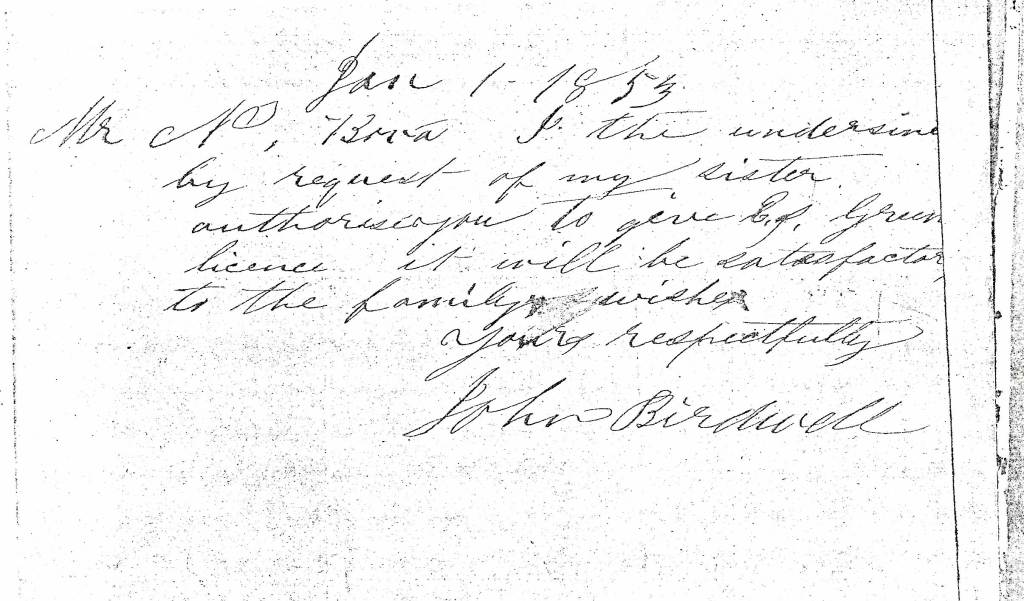
While James Birdwell and wife Aletha were living in Natchitoches Parish, their last two children, daughters Sophronia and Mary Ann, were born. Thomas Dunlap Leonard says that James and Aletha had four sons. I’ve found documentary evidence of only three sons, and have concluded that Thomas D. Leonard is mistaken in thinking there was a fourth son. James and Aletha’s combined succession file lists six minor children including DeWitt Clinton Birdwell born about 1831) and Thomas (born 18 June 1832). We know that John B. Birdwell (who was born 1 July 1828) was also a son of James Birdwell and Aletha Leonard, because, when his sister Camilla married Ezekiel Samuel Green in Pointe Coupee Parish on 2 January 1853, John wrote a permission note, as head of her family, for Camilla’s marriage on 1 January, stating that Camilla was his sister.
The 1830 federal census shows only one male under five in the household of James and Aletha Birdwell in Limestone County, Alabama.[10] This is clearly their son John. As we’ve just seen, the 1840 census enumerates in James Birdwell’s household in Natchitoches Parish, Louisiana, two males 5-9, and one male 10-14. These are John B. again with his two younger brothers Dewitt Clinton and Thomas. As far as I can determine, there were no other sons than these three born to James Birdwell and Aletha Leonard.
[1] E.G. Withycombe, The Oxford Dictionary of English Christian Names (New York: Oxford University Press, 1977), p. 12.
[2] George R. Stewart, American Given Names ((New York: Oxford University Press, 1979), p. 54.
[3] Limestone County, Alabama, Deed Bk. 5, p. 107. Thomas Leonard’s surname is given as Linard in this deed.
[4] Marshall County, Alabama, Deed Bk. B, pp. 55-6.
[5] 1840 federal census, Natchitoches Parish, Louisiana, p. 173.
[6] 1830 federal census, Limestone County, Alabama, p. 11B.
[7] See Gifford White, 1840 Census of the Republic of Texas (Austin: Pemberton, 1966), p. 79.
[8] 1850 federal mortality schedule, DeSoto Parish, Louisiana, p. 168, l. 11.
[9] DeSoto Parish, Louisiana, succession file no. 159; and DeSoto Parish, Louisiana, Succession Bk. D, pp. 643-650.
[10] 1830 federal census, Limestone County, Alabama, p. 42A.
 BEGATS AND BEQUEATHALS
3 thoughts on “Aletha R. Leonard (abt. 1803 – abt. 1845), Wife of James G. Birdwell”