Joseph Pryor of Tuscaloosa County, Alabama: Pre-Alabama Records Gap and Importance of Church Minutes
You’ve been there no doubt. I’ve been there myself more times than I like to remember, trying to find traces of an ancestor who seems just to vanish as I follow her or his migrations from place to place. My early Tuscaloosa County, Alabama, ancestors had a penchant for doing that. Their families had moved from Virginia to Tennessee, or Virginia to South Carolina and then Tennessee, before they settled in Tuscaloosa County. And their Tennessee sojourn was, I discover as I research them, full of mysteries. I could determine when they arrived in Tuscaloosa County, find lots of information on them in their pre-Tennessee period, but for some reason, as they trekked across Tennessee, they seemed to fall into an information abyss.
As it turns out, a primary reason for this inability to track those Tennessee-to-Alabama ancestors is that as they migrated through Tennessee, they settled in counties whose records are now lost. In what follows, I’m going to talk about one of those early Tuscaloosa County settlers in my family tree, Joseph Pryor (1767-1851), who came to Tuscaloosa County before the county was even formed. I can fairly confidently track Joseph in his growing-up years in East Tennessee up to about 1800, and I know where he was in Tennessee from around 1810 to 1816, when he left for Alabama.
But there’s a gap period from about 1800 to 1810 when I lose sight of him. I’ve now determined this gap exists because the Middle Tennessee County in which he lived from 1802 to 1810, Jackson County, is a burnt-records county. And one valuable record, a set of church minutes from that county, is my primary way of pinpointing him and his family in Jackson County in his “lost” years and determining where his family lived in the county.
This article continues a discussion of Joseph Pryor that I began with a previous article in Roots & Branches in August 2025.[1] In that article, I explained that there has been confusion about the background of the Joseph Pryor who died in Tuscaloosa County prior to 15 December 1851, when Joseph’s will was probated by his executors, his son John Pryor and son-in-law Zachariah Sims Simpson.[2]
As my August 2025 article explains, a number of researchers of this Pryor family have misidentified the Joseph Pryor who died in 1851 in Tuscaloosa County as a Joseph Pryor who died before 2 December 1833 in Bourbon County, Kentucky, and whose father Joseph Pryor Sr. died in the same county between 13 December 1812, when he made his will, and February 1813, when the will was probated.[3] The confusion has been exacerbated by the fact that in the past, both DAR and SAR accepted descendants of Joseph Pryor of Tuscaloosa County on the basis of the claim that he was the Joseph Pryor Jr. named in the December 1812 will of Joseph Pryor Sr. of Bourbon County, Kentucky.
My previous Roots & Branches article also tells you that a family bible belonging to Joseph Pryor of Tuscaloosa County and his wife Sarah was once extant, with photocopies of its bible register still available, and this bible record shows Joseph and Sarah having children born from 1793 to 1816. Census data and biographies of those children show all of them born in Tennessee. The last child born to Joseph and Sarah Pryor, a daughter Rebecca who was born 29 April 1817, was born in Alabama. The sister prior to her, Margaret, was born 10 February 1816 in Tennessee. So the family of Joseph Pryor moved from Tennessee to Alabama between the February 1816 date and the April 1817 date.
Joseph Pryor: Greene County, Tennessee, Years (1783-abt. 1800)
My August 2025 article also told readers that an 18 December 1815 deed in Warren County, Tennessee, shows Mourning White of Logan County, Kentucky, deeding to Joseph Pryor of Warren County, Tennessee, an enslaved girl named Hannah.[4] Mourning (who was the daughter of Thomas Thomson [abt. 1718-1774] of Louisa County, Virginia) was the widow of a Richard Pryor who is found in the records of Greene County, Tennessee, from 1783-1795, and before 1783, in the records of Washington County, North Carolina (later Tennessee). This Pryor family came to Tennessee from Louisa or Amherst County, Virginia.
Greene County records show Richard Pryor making preparations in the years before 1796 to move out of that county. In February 1794, Richard’s wife Mourning Pryor received a letter of dismission from Big Pigeon Baptist church in Greene County (later Cocke County), of which she had been a founding member on 6 December 1787.[5] On 20 September 1795, Richard Pryor sold the last of his land in Greene County and on 20 March 1796, he purchased from Joseph Pryor of Greene County 2,565 acres of land on Caney Fork of the Cumberland River in Sumner County, Tennessee, with the deed stating that Richard Pryor was now living in Logan County, Kentucky, which is in southern Kentucky on the Tennessee border.[6]
Richard Pryor died in Logan County by 8 August 1797, when his widow Mourning appealed for administration of his estate.[7] By 1800, Mourning had married a second husband, Thomas White. On 29 November 1811, the heirs of Richard Pryor made a deed in Logan County selling their shares of a tract of Richard’s land in Logan County to one of the heirs, Jonathan Pryor.[8] All of Richard’s heirs (i.e., his sons and sons-in-law) signed this deed, stating that they were heirs of Richard Pryor. One of the heirs signing this deed was Joseph Pryor.
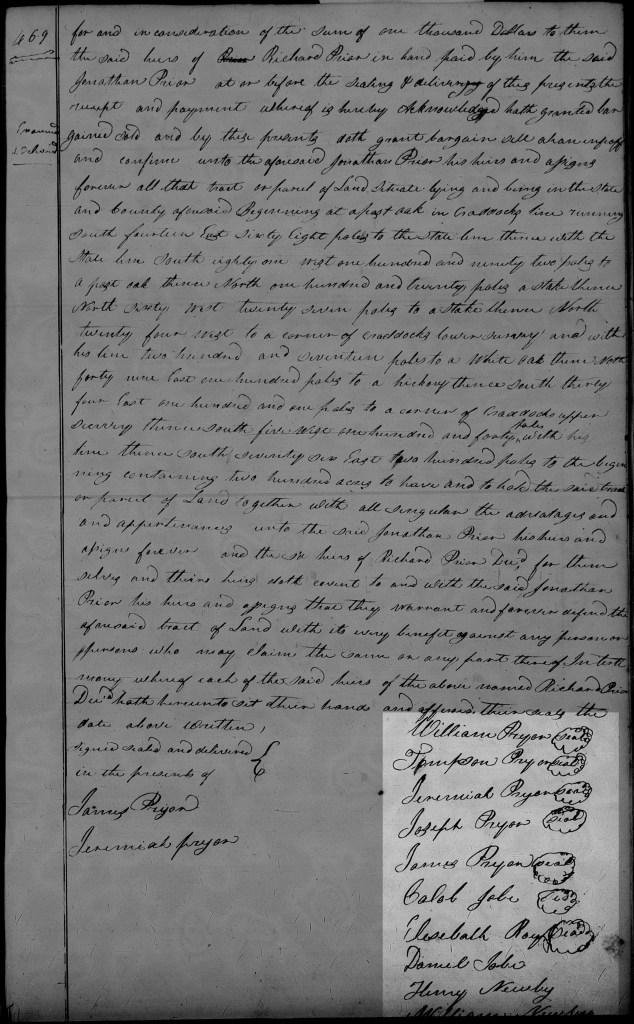
As my previous article indicates, I’ve concluded that the Joseph Pryor to whom Richard Pryor’s widow Mourning White sold an enslaved girl in Warren County, Tennessee, in December 1815 is the son of Richard and Mourning Thomson Pryor (later White) who signed the 1811 deed of Richard Pryor’s heirs, and is the Joseph Pryor who then moved to what would soon be Tuscaloosa County, Alabama, between the February 1816 date and the April 1817 date.
The Joseph Pryor who disappears from Warren County, Tennessee, records after 1816 shows up in the records of that county by 11 June 1811, when he bought from Richard Cantrell for $700 a 100-acre tract on Charles Creek of Collins River on which Cantrell was then living.[9] As I’ll explain below, I think it’s likely that Joseph and wife Sarah moved to Warren County in 1810 from Jackson County, Tennessee. If this Joseph was the son of Richard and Mourning Pryor (and I’m confident he was), he would have spent the first part of his life in Tennessee in Greene County, and would have come of age and married there: Joseph’s family bible states that he was born 1 December 1767. The family bible states that Joseph’s wife was named Sarah — no maiden name is stated — and that she was born 25 November 1776. The couple’s first child, a daughter Mary, was born 25 May 1793, according to the bible register. These pieces of information suggest that Joseph Pryor likely married wife Sarah about 1791, when his parents Richard and Mourning can be placed by a number of documents in Greene County, Tennessee. In 1791, Joseph would have been 24 and Sarah 15.
Numerous pieces of information that would take me down a sidetrack if I discussed them here tell me that Joseph Pryor’s wife Sarah was the daughter of Samuel Odle and Elizabeth Job of Greene County, Tennessee, who came to Tennessee from Shenandoah County, Virginia. Samuel Odle died in Greene County with a will dated 5 July 1788.[10] The will, which was filed in Jefferson County, Tennessee, and probated in Washington County though it identifies Samuel Odle as a resident of Greene County, names a daughter Sarah, who was not married by 1788.[11]
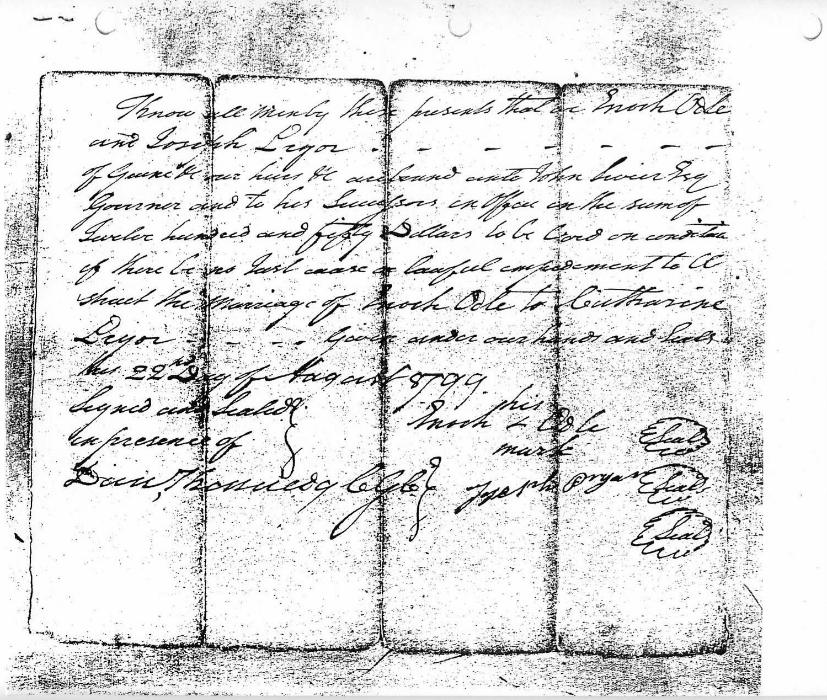
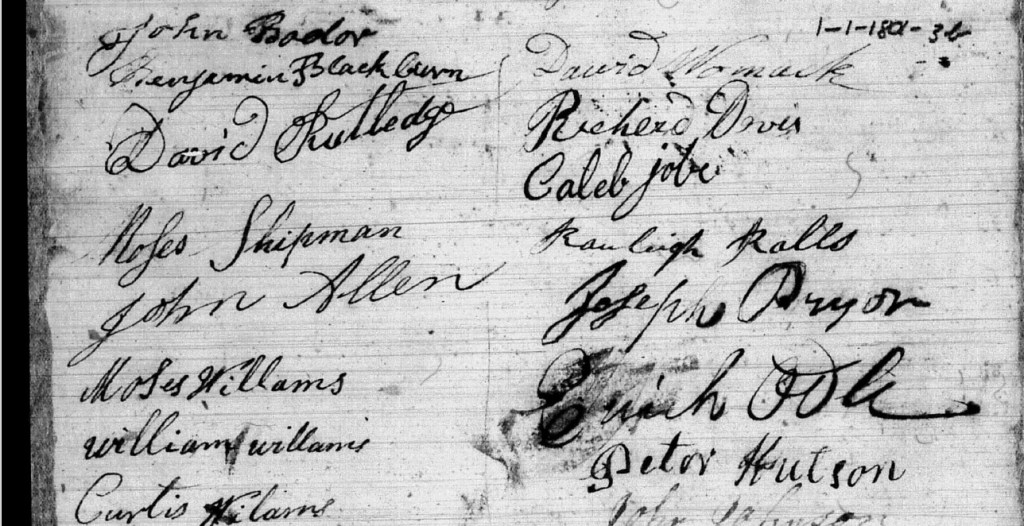
Joseph Pryor and wife Sarah appear to have remained in Greene County several years after his parents Richard and Mourning Pryor left that county for Logan County, Kentucky. Joseph was in Greene County up to 22 August 1799 when Sarah’s brother Enoch Odle (who is also named in Samuel Odle’s will) married Catherine Pryor in that county and Joseph signed as bondsman for Enoch Odle as Enoch made bond for this marriage.[12] Soon after this date, it appears that Joseph and Sarah left Greene County for Smith County, Tennessee, where Joseph Pryor and Enoch Odle signed a petition to the Tennessee legislature on 1 January 1801.[13] Their signatures are next to each other, one after the other, with Caleb Jobe signing several names above theirs.
Before moving from Greene County, Joseph also signed a petition in November or December 1789 in which those living south of the French Broad in Greene County asked the North Carolina General Assembly for relief from predations of the Cherokees.[14] Among the signatories to this petition were William and Joseph Pryor (both signing their surnames as Pryar).[15]
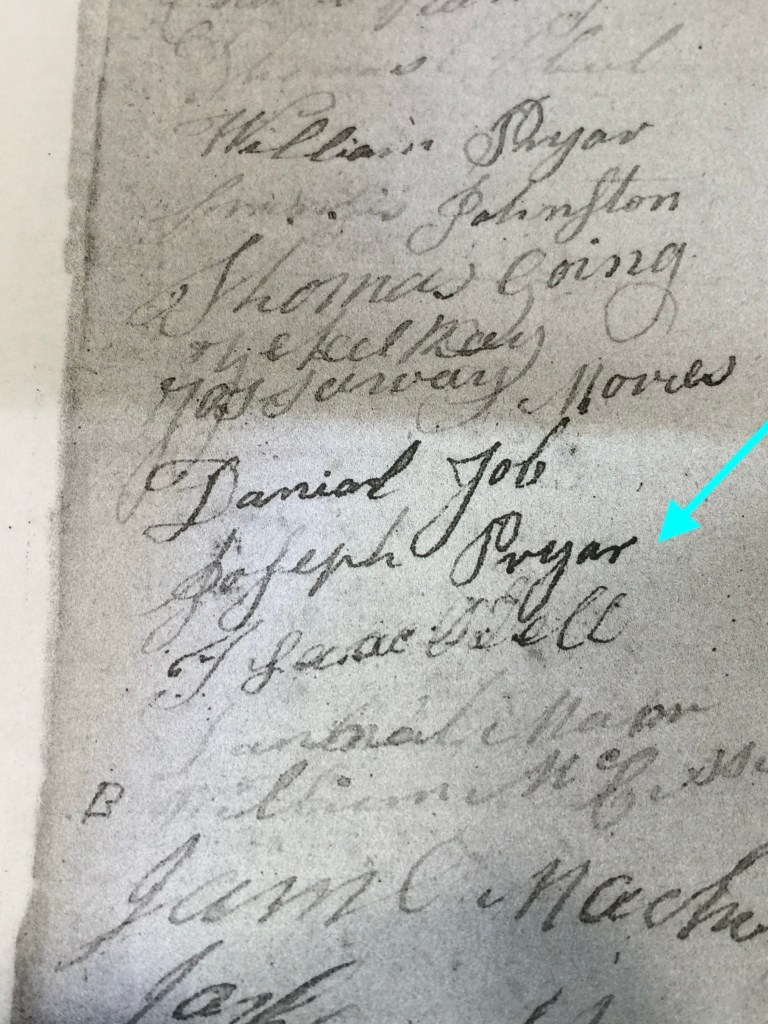
The William Pryor signing this petition was another son of Richard and Mourning Thomson Pryor, who is among the heirs signing the 1811 Logan County, Kentucky, deed of Richard’s heirs. His signature appears several signatures ahead of the signature of Joseph Pryor. Joseph Pryor signed — and this is a significant and noteworthy point — between Daniel Job (1758/1760 – abt. 1864) and Isaac O’Dell (1750-1834). Both men were relatives of Sarah Odle, Joseph Pryor’s wife. Daniel Job was a son of Samuel Job (1735-1819) and Dorcas McKay (abt. 1735-1819), who show up by 1802 in an important set of church minutes in Jackson County, Tennessee, which prove that Joseph Pryor and wife Sarah were living in that county by 1802. Daniel Job was a brother-in-law of Joseph and William Pryor; he married Richard and Mourning Pryor’s daughter Mourning Pryor.
Isaac O’Dell/Odle witnessed and probated the will of Samuel Odle, father of Sarah Odle Pryor, and was a nephew of Samuel Odle, a son of Samuel’s brother Caleb Odle, and thus a first cousin of Sarah Odle Pryor. So to sum up: we can place Joseph Pryor, son of Richard Pryor and Mourning Thomson, in Greene County, Tennessee, records up to 1799, at which point it appears this family left Greene County about 1800, and from 1811 to 1816, when the Pryor family moved from Tennessee to Tuscaloosa County, Alabama, we can place these folks in records of Warren County, Tennessee.
Joseph Pryor: The “Lost” Years in Middle Tennessee (abt. 1800 – abt. 1810)
But there’s a gap between 1801, when we know Joseph had moved to Smith County in Middle Tennessee, and 1811, when he begins appearing in Warren County records. Where was Joseph Pryor during the years 1801-1811, when we know from census data and other information that he and wife Sarah were living in Tennessee, as the first ten of their eleven children were born from 1793 to 1816? Filling that gap is made more difficult by the fact that several men named Joseph Pryor are found in the records of Greene County and in Middle Tennessee counties from the 1780s up to 1820. As I stated above, just after Richard and Mourning Pryor moved from Greene County to Kentucky late in 1795 or early in 1796, a man named Joseph Pryor of Greene County sold Richard a large tract of land in Middle Tennessee in Sumner County.
Greene County records show that, in addition to Joseph Pryor son of Richard, there were also a Joseph Pryor Sr. and Jr. who were evidently father and son, with the younger of these two Josephs of age by 1796.[16] Three Joseph Pryors were living in Greene County in the 1790s, all of age by 1796. Many researchers, I included, have thought that these two Joseph Pryors Sr. and Jr. are the Joseph Pryor Sr. and Jr. who are in Bourbon County, Kentucky, records by 1808. I’m beginning to ask myself if this is a correct deduction, however. I have begun to think that the two Josephs in Bourbon County records never lived in Tennessee, but moved to Kentucky directly from Botetourt County, Virginia. As I try to disentangle Joseph Pryors in Middle Tennessee records in the first decades of the 1800s, I’ve begun to conclude that the Joseph Pryor Sr. and Jr. (who appear to be closely related to the family of Richard Pryor) moved, as did most of Richard Pryor’s children, to Middle Tennessee from Greene County, and remained in Tennessee.
When Richard Pryor acquired 2,565 acres in Sumner County in 1796, several of his children, including his son William, who may have been his first-born son with Joseph next among Richard’s sons, settled in Sumner County and lived on Richard’s land there. In 1799, Smith County was formed from Sumner, and Richard’s tract fell into that county, with William and his son Joseph Pryor then showing up for a short period of time in Smith County. In 1801, another county, Jackson County, was formed from Smith.
In its early period, Jackson County is something of a black hole for genealogical researchers, since its early records burned in 1872. Tax lists from 1802 and 1803 have survived, and the 1803 tax list shows both Joseph and William Pryor taxed in Jackson County in that year.[17] In 1802, the tax list shows only William.[18]
For those researching early settlers of Jackson County, Tennessee, state-level land records also help fill in the gap caused by the destruction of Jackson County records in 1872. And for those searching for the whereabouts of Joseph and Sarah Pryor after they left Greene County about 1799 or 1800 and before Joseph shows up in Warren County records by 1811, there’s one other extremely valuable record. This is the minutes of Spring Creek Baptist church of Jackson County.
Spring Creek Baptist Church Minutes, Jackson County, Tennessee
When Spring Creek Baptist church was constituted in Jackson County on 7 July 1802, Joseph’s wife Sarah shows up as a constituting member of the church (see the digital image at the head of this posting).[19] Spring Creek church is near Cookeville in Jackson County at the intersection of Dodson Branch highway (state highway 135) and South Smith Chapel road.[20] This is in southeast Jackson County not far from the Putnam County line. The original church was located about a mile north from the present location of the church at the intersection of highway 135 and South Smith Chapel road.
Several months after Sarah Odle Pryor helped establish Spring Creek Baptist church in July 1802, on 13 November 1802 Sarah’s cousin Dorcas McKay Job, wife of Sarah’s cousin Samuel Job and mother of Daniel Job who married Richard and Mourning Thomson Pryor’s daughter Mourning, joined Spring Creek church. These are the Samuel and Daniel Job and Dorcas McKay Job discussed above. Spring Creek church minutes note that Dorcas joined that church by letter.
Along with Mourning Thomson Pryor, mother-in-law of Sarah Odle Pryor, Dorcas had been a constituting member of Big Pigeon Baptist church in Greene County on 6 December 1787.[21] The first meeting place for the Big Pigeon church was, according to minutes of that church, at the house of Samuel and Dorcas McKay Job. Researcher Ann Jobe Brown thinks that the letter of membership Dorcas Job brought to Spring Creek church in November 1802 was her dismission letter from Big Pigeon Baptist church.[22]
Both Samuel Job and wife Dorcas McKay were cousins of Joseph Pryor’s wife Sarah Odle Pryor. Sarah’s mother Elizabeth Job Odle was a cousin of Samuel Job on the Job line, but through her grandmother Margaret McKay Job, Elizabeth was also related to Dorcas McKay Job, whose father Zachariah McKay was a brother of Margaret McKay Job. Both the Job and McKay families were Quaker families that had moved down from the middle colonies to Virginia in the first half of the 1700s, with the progenitor of the McKay family, Robert McKay, organizing and financing (and profiting from) a large exodus of Quaker families from New Jersey, Pennsylvania, Delaware, and Maryland to Virginia.
According to C.P Cawthorn and N.L. Warnell in their history of pioneer Baptist churches of south-central Kentucky and the upper Cumberland region of Tennessee, a number of members of the Big Pigeon church moved as a group to the upper Cumberland area, with many members of the group settling in Kentucky, where they founded Old Mulkey Baptist church (also known as Mill Creek church), which preserved the constitution of the Big Pigeon church. Cawthorn and Warnell note that one wave of this migration took place in 1787 with John and Philip Mulkey of the Big Pigeon church moving from Greene County to present Monroe County, Kentucky, with the members of the Job family accompanying them.[23]
Philip Mulkey spent time living in Jackson County, Tennessee, however. As Lewis Kerry Smith, who owned the original minutes of Spring Creek Baptist church after they passed to him from his grandfather Daniel Morgan Morgan, notes in an undated article entitled “Gainesboro Sketches, Sketch No. 1,” Philip Mulkey was one of the commissioners appointed to lay off Jackson County’s seat at Gainesboro in 1817.[24] Smith says that Mulkey was a preacher whom he heard spoken of at the house of his grandfather Morgan when he was a boy.
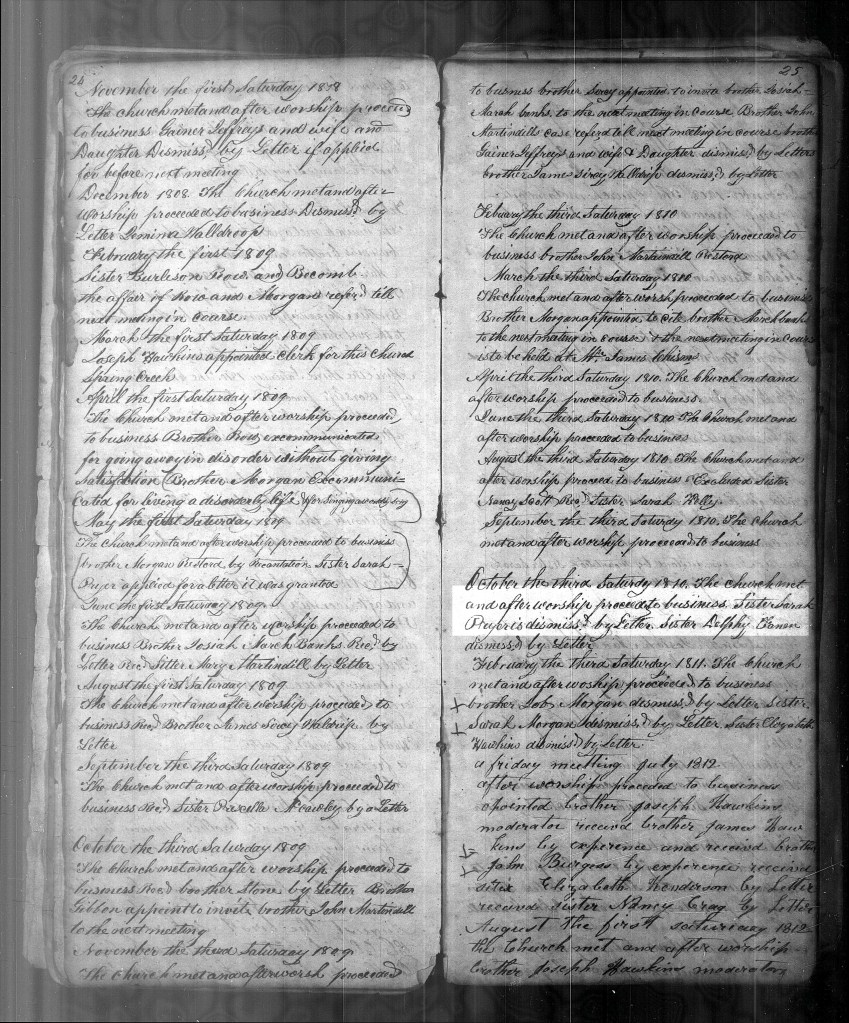
Sarah Odle Pryor continues appearing in the minutes of Spring Creek Baptist church in Jackson County from its formation in July 1802 up to the 3rd Saturday in October 1810, when church minutes show her receiving a letter of dismission. A list of members made on the 3rd Saturday in 1804 and another made in 1805 show her continuing as a church member in those years, and on 1 January 1808, church minutes state that she had been paid 12 cents for supplying wine for the Lord’s Supper celebration. The fact that Sarah is in Spring Creek Baptist minutes from July 1802 through October 1810 is a very good indicator that Joseph and Sarah Odle Pryor were living in Jackson County during that time frame.[25] The October 1810 dismission letter for Sarah at Spring Creek church suggests to me that at this point, the family was making plans to move to Warren County, where, as noted previously, Joseph acquired 100 acres on Charles Creek of Collins River on 11 June 1811 with the deed stating that Joseph lived in Warren County.
To sum up: when you encounter a puzzling gap in records as you research the migrations of an ancestral family, if you determine that gap was due to the loss of records in a place in which your family lived, don’t overlook church records as a way to address that gap. Tennessee state-level land records add further confirmation that Joseph Pryor lived in Jackson County in his “lost” period from 1802-8. They show, in fact, that he and his wife Sarah’s brother Enoch Odle lived on adjoining tracts of land.
But it’s the Spring Creek church minutes that provide the essential piece of information we need to place this family in Jackson County in this time frame, since, by naming Joseph’s wife Sarah, the church minutes allow us to sort this particular Joseph Pryor from other Josephs who seem also to have been living in Middle Tennessee counties at this time.
If you’re lucky enough to find surviving church minutes for ancestors who trekked across the states of the old southwest in the first half of the 1800s, those minutes can fill in important pieces of your gap. Comb published histories of your problem counties, books and journal articles discussing the formative years of those counties, to see if you can spot mention of extant church minutes. As you do a locality church for a particular county in the FamilySearch catalogue, don’t forget to click on the categories “church history” and “church records.”
When you find that the church records you need do exist, then look to see both what transcriptions of those records are available and whether there are digital or microfilmed copies of the originals. Transcriptions are invaluable and very helpful, but it’s important always to read the original minutes with your own eyes, when you have a chance to do so, since transcribers sometimes miss or misread things.
Look at the holdings of state archives and state libraries, too, to see what church minutes may have ended up there, or at archival holdings of colleges and universities that may specialize in collecting church minutes — e.g., the special collections and holdings of Furman University Library in Greenville, South Carolina, which has a rich repository of Baptist church records. Also search for regional or localized archival holdings: after years of searching to find the original minutes of Bethel Baptist church in Tuscaloosa County, Alabama, which Sarah Odle Pryor joined by letter in November 1819, I finally found those minutes at the Western Alabama Heritage Learning Center in Northport, whose staff graciously let me read and copy portions of those minutes.
The information you’re seeking and not finding may well be out there, if you only look in the right place….
[1] “Joseph Pryor of Tuscaloosa County, Alabama,” Roots & Branches 50,3 (August 2025), pp. 12-21.
[2] Joseph Pryor made his will in Tuscaloosa County on 22 September 1851 (Tuscaloosa County, Alabama, Will Bk. 1, p. 286). On 15 December 1851, John Pryor and Zachariah S. Simpson gave bond in the amount of $32,000 as executors of the will (Tuscaloosa County, Alabama, Orphans Court Minutes, 1850-4, p. 380; and Probate Court Bond Book 1850-1853, p. 75).
[3] Bourbon County, Kentucky, Court Order Bk. K, p. 292; Bourbon County, Kentucky, Will Bk. B, p. 330.
[4] Warren County, Tennessee, Deed Bk. B, p. 228. The bill of sale was entered 11 June 1816 and recorded 11 July 1816.
[5] C.P Cawthorn and N.L. Warnell, Pioneer Baptist Church Records of South-Central Kentucky and the Upper Cumberland of Tennessee (n.p., 1985), pp. 421f; W.J. McSween, Early Recollections of Newport and Cocke County, (Newport Times, 1903); Ruth Webb O’Dell, Over the Misty Blue Hills: The Story of Cocke County, Tennessee, p. 150, transcribing the original minutes of the Big Pigeon church; Elizabeth Pryor Harper, Twenty-One Southern Families: Notes and Genealogies (Albuquerque, 1985), p. 149. See also Katherine Reynolds, Index to the Minutes of the Big Pigeon Baptist Church, 1787- 1874, prepared in 1968 for the Samuel Sorrell chapter of DAR, Houston, Texas.
[6] Greene County, Tennessee, Deed Bk. 6, pp. 432-3, and Sumner County, Tennessee, Deed Bk. 1, p. 229.
[7] Logan County, Kentucky, Court Order Bk. A-1, p. 67.
[8] Logan County, Kentucky, Deed Bk. C, pp. 467-470.
[9] See Warren County, Tennessee, Deed Bk. A, p. 317. The deed is erroneously listed in the index to the original deed book as Richard Cantrell to Joseph Priest; the deed itself gives the surname as Pryor and states that both parties lived in Warren County. On 25 May 1813, Joseph Pryor then purchased a second tract of 100 acres on Charles Creek, this land purchase being from Charles Sullivan (ibid., p. 388). Warren County’s seat, McMinnville, is directly south of the junction of Charles Creek and the Collins River.
[10] Jefferson County, Tennessee, Will Bk. 1, p. 45.
[11] Ibid., and Washington County, Tennessee, Court Order Bk. 1, pp. 361-2.
[12] The original marriage bond is on file in the loose-papers marriage files of Greene County, Tennessee. I have never been able to figure out to which Greene County Pryor family Catherine belongs. She can’t have been the daughter of Richard Pryor and Mourning Thomson, since she and Enoch Odle do not appear among the estate heirs in 1811 when the heirs signed a deed selling their portion of Richard Pryor’s land to Jonathan Pryor. Her tombstone in O’Dell cemetery in Wright County, Missouri, says that she was born in 1780 in Tennessee: Find a Grave memorial page of Catherine Pryor Odle, O’Dell cemetery, Wright County, Missouri, created by D.R. O’Dell, maintained by Stacey Muldering, with a tombstone photo by D.R. O’Dell. Note that Tennessee did not become a state until 1796.
[13] Tennessee State Library and Archives, Tennessee Legislative Petitions, Legislative Petition Smith County Residents, 1 January 1801. I’m grateful to TSLA for providing me with a digital copy of the original petition.
[14] Petition Sundry Inhabitants South of French Broad, North Carolina General Assembly Session Records, box 4, folder 81 at the North Carolina Archives — see Roberta Estes, “Petition Sundry Inhabitants South of French Broad,” at the Native Heritage Project website. See also Vanessa Wood, “Signature William Pryor and Joseph Pryor on French Broad Petition,” at her former Tennessee Pryors website. This posting has a digital image of the signatures of William and Joseph Pryor.
[15] The signature of Joseph Pryor on the 1789 Greene County petition and on the 1799 Greene County bond for Enoch Odle’s marriage to Catherine Pryor is not a perfect match — the initial J in the two signatures is somewhat different — but the two signatures are close enough that it seems clear to me they are the signature of the same man. Both signatures slant noticeably to the right; both use the old-fashioned medial S that looks in some renditions like an F; both have the same shape for the letter P in the surname; and both sign the surname Pryor as Pryar.
[16] On 8 October 1796 in Greene County, Joseph Pryor Sr. sold 200 acres south of the Nolichucky in Greene County to Joseph Pryor Jr., with the deed specifying the Sr. and Jr. designations and stating that both lived in Greene County: see Greene County, Tennessee, Deed Bk. 2, p. 61.
[17] A microfilmed copy of the tax list is in “Early Tax Lists of Tennessee” at the Tennessee State Library and Archives. Digital copies are available in Ancestry’s collection Tennessee, U.S., Early Tax List Records, 1783-1895. A transcription of the 1803 Jackson County tax list is at Jame Paessler, “Jackson County 1803 Tax List,” Ansearchin’ News 42,3 (fall 1995), pp. 113-115. See also Vanessa Wood’s commentary at “Tennessee Counties — J,” Tennessee Pryors website.
[18] A microfilmed copy of the tax list is in “Early Tax Lists of Tennessee” at the Tennessee State Library and Archives. Digital copies are available in Ancestry’s collection Tennessee, U.S., Early Tax List Records, 1783-1895.
[19] The original church minutes covering the years 1802-1868 but excluding the Civil War years are available digitally via FamilySearch. A transcription by J. Hobart Bartlett and Jane K. Wall entitled Minutes of the Spring Creek Baptist Church of Jackson and Overton Counties, Tennessee, 1802-1868 (Excluding the Civil War Years) (n.p., n.d., perhaps 1970s), is also available digitally at FamilySearch. Bartlett and Wall state that when they transcribed these church minutes, the original minutes were in the hands of Sanford Byrom Smith of Hockessin, Delaware. They had passed to his mother Leonore Byrom Smith when her husband Lewis Kerry Smith died. Prior to that, they appear to have been in possession of Lewis Kerry Smith’s grandfather Daniel Morgan Morgan.
[20] “Spring Creek Baptist Church,” Historical Markers Database site, a page originally created by Duane and Tracy Marsteller.
[21] See supra, n. 5.
[22] “Samuel Job — Dorcas McKay,” My Jobe Ancestors. When people moved away from a Baptist church, they received letters stating that they were members in good standing, and when they arrived at a new place and joined another Baptist church, they would then be accepted by the new church on the basis of that letter: they “moved their letter” to the new church.
[23] C.P Cawthorn and N.L. Warnell, Pioneer Baptist Church Records of South-Central Kentucky and the Upper Cumberland of Tennessee, p. 514.
[24] Lewis Kerry Smith’s article has been clipped and preserved in Garland Draper’s Historical Scrapbook of Jackson County, Tennessee, available digitally at FamilySearch.
[25] The minutes of Spring Creek Baptist church show “Darcas” Job dismissed by letter on the 6 April 1805 and the church’s 1805 membership list confirms that she had a dismission letter in that year. From 1805-8, the family of Samuel and Dorcas McKay Job appears in Jackson County and White County, Tennessee, records.
 BEGATS AND BEQUEATHALS