I’m trying to save and share this information because I don’t want it to be lost. As the linked postings explain, I am writing these memoirs primarily for my nieces and nephews, so that they will have this information about the WWII lives of the men of their grandparents’ generation, and so that they may pass this information on to their children if they wish.
I never knew my uncle Carl, who was my mother’s half-brother, so I never heard his own accounts of being in World War II. Carl was a son of my grandfather William Zachariah Simpson by his first wife Cora Harwell. Cora died a week after giving birth to Carl on 19 November 1908: she died as a result of childbirth. My grandfather then remarried in June 1912 to my grandmother Hattie Batchelor, his second wife, who raised Carl from that point forward. Up to 1912, he had been raised by his father and grandmother Samantha Braselton Simpson, who died in January 1912.
As I was growing up, I did hear stories told by my grandmother Hattie and by my mother and siblings about Carl’s war experiences. I was told that he was in a cavalry unit in the Army and had been in the disastrous landing at Anzio in Italy in the early part of 1944, a military operation in which many American lives were lost. After his military unit entered Italy, it marched north through Italy and eventually east into Russia.
I was told that after he returned home, very much traumatized by the war and psychologically fragile (as an adult, he had a serious drinking problem and could often be unstable and violent), Carl said that many of the Italians he and his fellow soldiers encountered in 1944, as the war was winding down, were hungry. As a result, when horses in the Army unit were shot in Italian streets, people would pour out of their houses to harvest the horse meat for their families.
Carl also said that what he and his fellow soldiers saw as they marched into Russia was unbelievably horrifying. Death was everywhere, with corpses lying by the side of the road. As all this was happening to him, his family couldn’t get much information about where he and his brother W.Z. (Dub) were, what they were going through. Such communications as they got were heavily censored. They relied on what the newspaper could tell them, guessing at where Carl and Dub might be. My grandmother faithfully cut out any newspaper article that she thought might preserve information about her son and step-son. She created a large scrapbook of newspaper articles from the war, focused on where she thought Carl and Dub were, what they were going through.
I’ve been able to document some of both Carl and Dub’s military careers — and I have photos of both of them from the war years — but few records seem to be extant. I think their personnel files did not survive the fire at the National Personnel Records Center in St. Louis in 1973.
Prior to enlisting in the Army, Carl was a member of the Civilian Conservation Corps (the CCC) in 1935. He was in the Camp Douglas, Arkansas, CCC camp, which moved from there to Sheridan. My father, Ben D. Lindsey, was also in the CCC prior to the war, and was sent by the CCC to do forestry work in Wisconsin, where he attended classes at Marquette University in Milwaukee. The CCC was a federal program set up during the presidency of Frankin D. Roosevelt to provide work for young single men during the Depression. The work often included forestry work, building roads and bridges, helping to enhance national and state parks, and so on. Many of the beautiful stone bridges, archways, and walkways in state parks, as well as well-crafted cabins in state parks, were built by CCC workers.
When WWII broke out, Carl registered for the draft on 16 October 1940 at his hometown of Redfield, Arkansas. The draft registration form gives his date of birth and states that he was born in Redfield, and lists his contact person as his mother Hattie Simpson. It states that he was working for M.B. McBurnett of North Little Rock, though this line is crossed out. Matt Benjamin McBurnett was a cousin of Madison Levi McBurnett, who was married to a cousin of Hattie Simpson, Janie Byrd, a teacher in Redfield prior to her marriage. The draft registration form states that Carl was 5’9½” in height, weighed 145 pounds, and had brown hair, gray eyes, and a ruddy complexion.
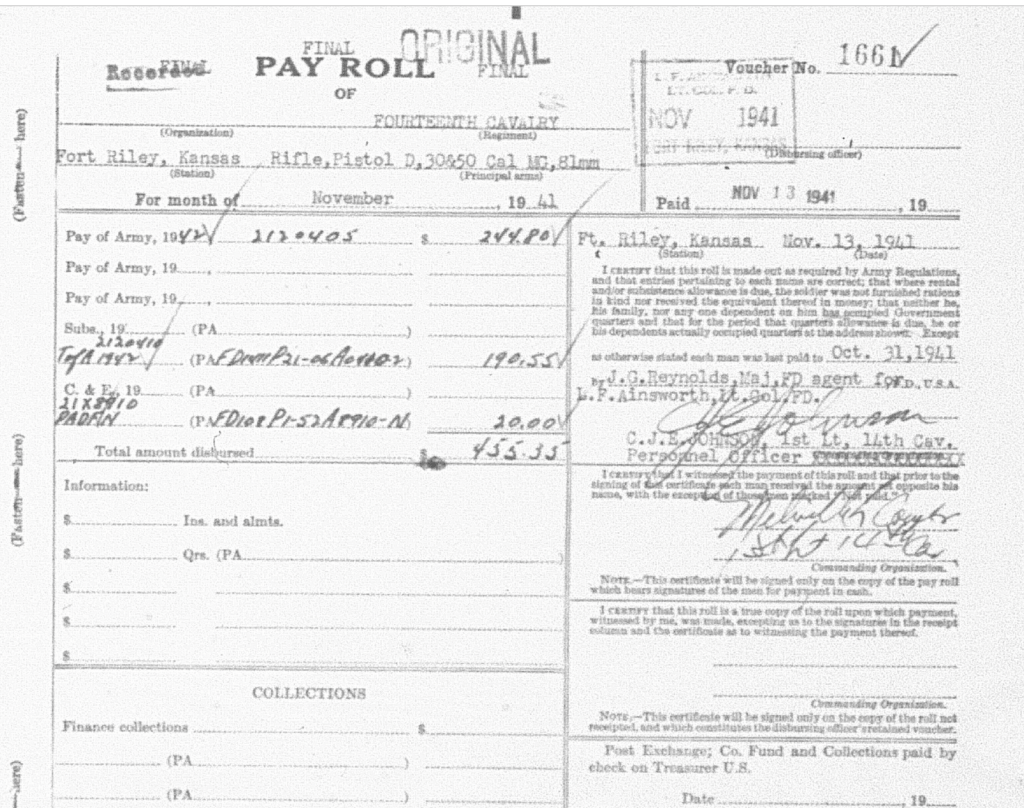
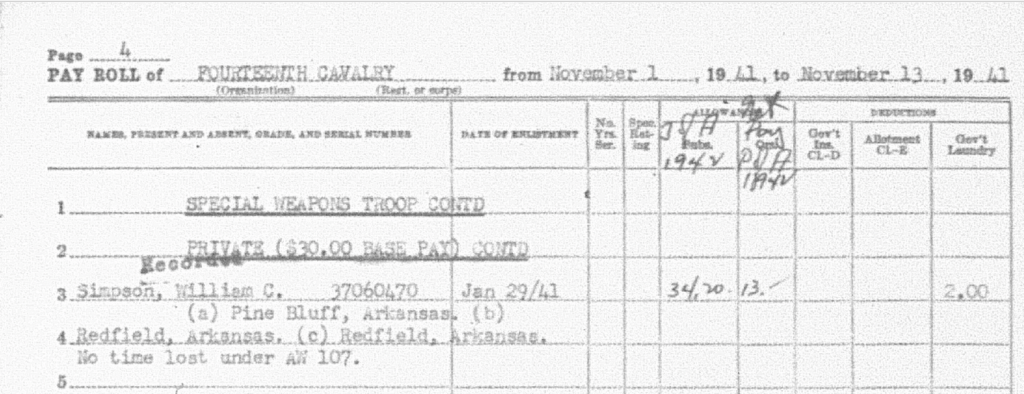
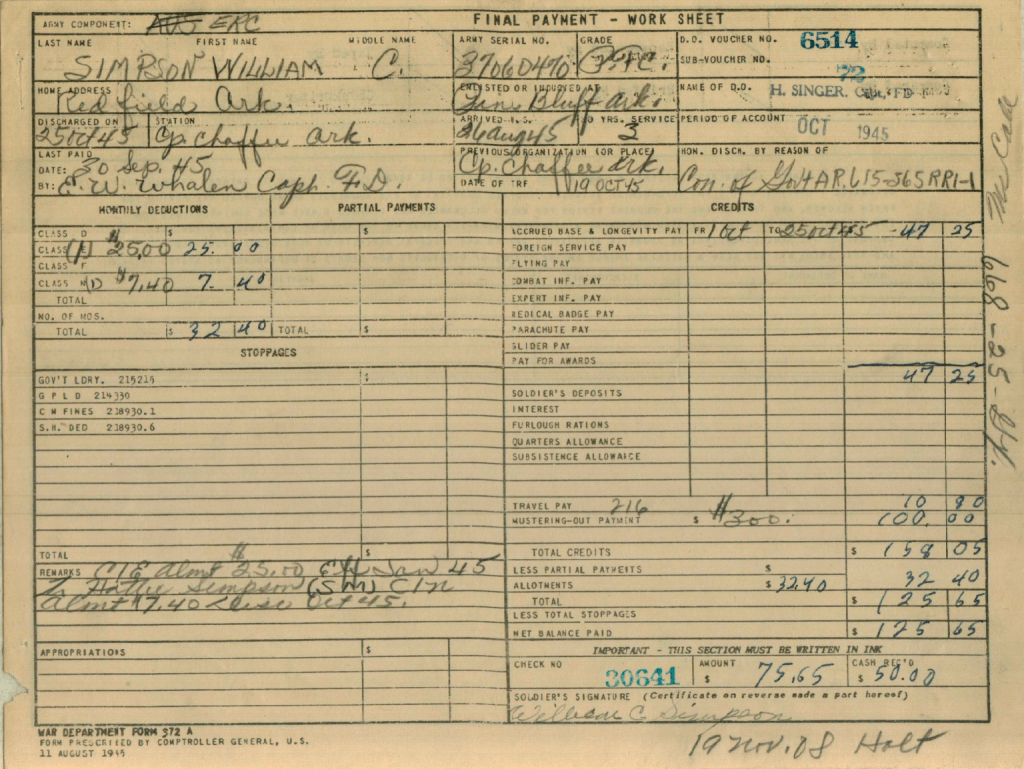
At some point following his draft registration, Carl enlisted in the Special Weapons Troop of the Army’s 14th Cavalry on 29 January 1941. I have not found the enlistment papers, but this date of enlistment is given on a record of a final payment made to Carl on 25 October 1945. The pay roll states that he served in the Special Weapons Troop of the 14th Cavalry, based at Fort Riley, Kansas. A final payment sheet in his service file states that he was discharged on 25 October 1945 at Fort Chaffee, Arkansas, with the final payment to him made 25 October 1945 at Pine Bluff, Arkansas. I have pictures taken of Carl at Camp Funston at Fort Riley, Kansas, in 1941, showing Carl in this Army unit.
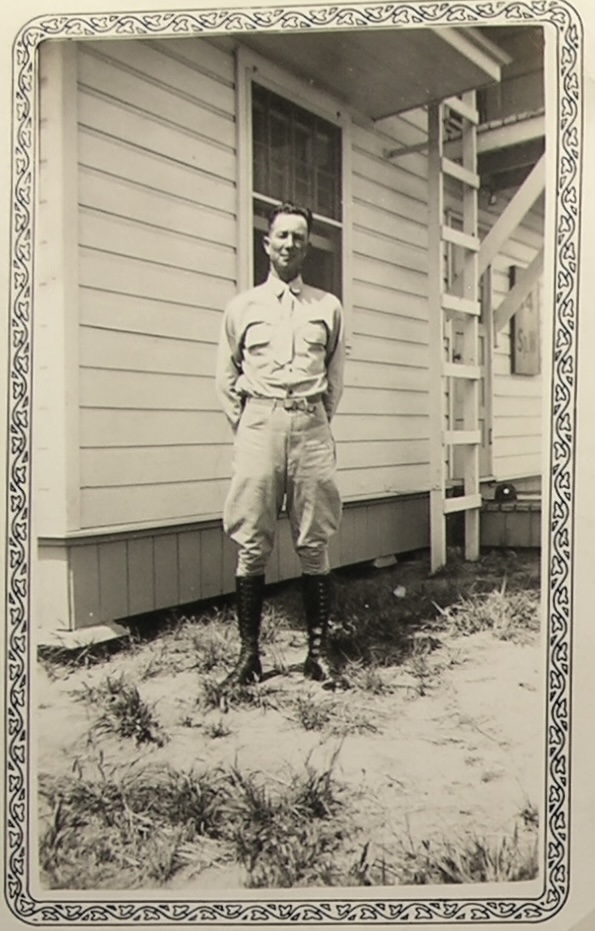
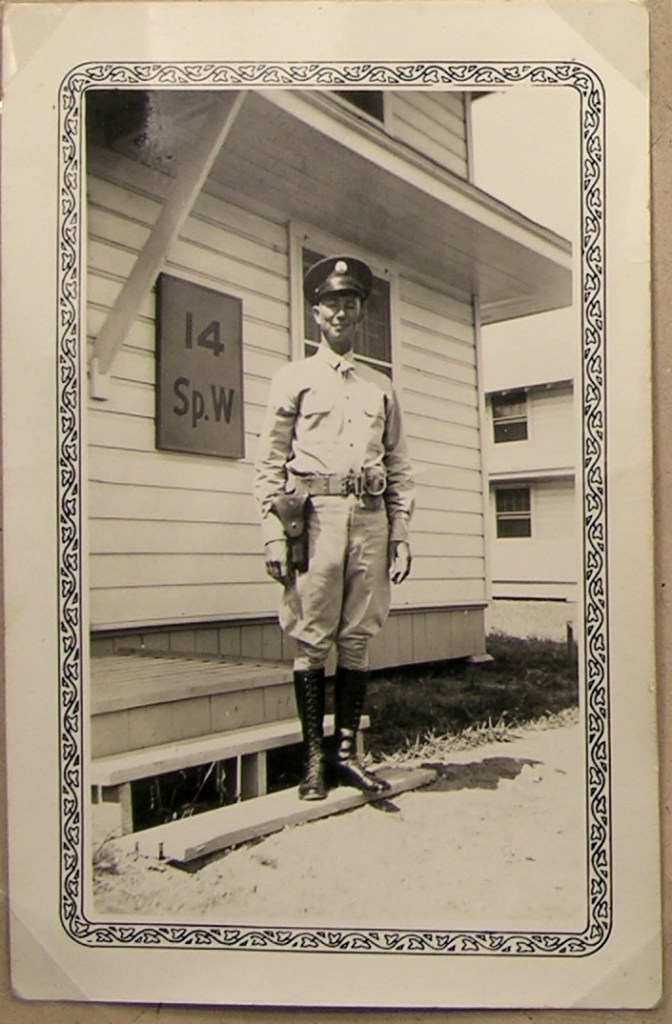
Prior to being shipped to Europe, Carl’s cavalry unit must have been moved to an Army training camp in California, since I remember being told that my grandmother Hattie was worried about how he was doing while stationed in California, and she planned a driving trip from Arkansas to California to see Carl and the family of her niece who lived at Lodi. My mother was the driver for the trip (she was the only son or daughter whom my grandmother trusted to drive), and I believe my mother’s sisters Kat, Margaret, and Billie also went on this trip to see Carl.
While they were in California at Carl’s Army camp, my mother managed to fall into a river. She was not a swimmer, and Carl saved her life, jumping into the river and pulling her out.
I’m not sure when Carl’s troop was sent to Europe. I do know from stories I heard told that his Army unit first spent time in England, and from there, was sent into battle on the continent. I don’t have any documentation at all of this period of his life in the Army, other than the family stories I recount above. From what I was told, Carl came back from the war wrecked by his experiences, and his trauma wasn’t made any better due to his alcoholism. I was told that he had always been an omnivorous reader and a very bright man, and that he’d lie on the floor in front of the fireplace much of his life, reading anything he could find to read by the light of the fire, and when he returned from service, sometimes talking, if coaxed, about what happened to him in the war.
He was convinced due to what he’d seen and read that Russia would soon become a serious threat to the U.S., though the Russians had been American allies during the war. I suspect that he and his first cousin Fred Arendale, whose mother Augusta Simpson Arendale was Carl’s aunt, talked about this, since Fred’s granddaughter Constance Arendale Henry has told me she has found documents showing that Fred had an extraordinary interest in what was happening in Russia after WWII. Carl and Fred were close in age and grew up close to each other. I often heard it said, as I was growing up, that a teacher in the high school in Redfield said that Carl Simpson and Fred Arendale were the two smartest pupils he ever taught.
I have a letter that Carl wrote his sister Pauline on 25 February 1945. The letter may indicate that he had returned to the U.S. by that point, since it was mailed from 340 MPEG Sect., E.A.P.O., New York, New York. It identifies Carl as PFC William C. Simpson, ASN 37060470. The letter is actually a photocopy of the original and has the censor’s stamp of approval. I think the Army censor must have kept the handwritten original and sent Pauline a photocopy. Carl mentions various family members in the letter, but it contains no real news of his war activities.
On 4 January 1946, Carl re-enlisted at Little Rock. The enlistment papers state that he was born in 1908 in Jefferson County, Arkansas, and was enlisting as a private for the Panama Canal Department. The papers state that he was 6 feet tall and weighed 170 pounds.
When Carl’s sister Billie graduated from Redfield High School in 1946, she sent him a graduation announcement in April 1946. I have the announcement, which was addressed to Carl at Hdq. Det. 3384 S.C.V., New Cumberland, Pennsylvania. A 19 December 1946 Christmas card his step-mother Hattie sent him is also addressed to him in New Cumberland, but to 2232 A.S.V. U.S.D.B.
By 5 May 1947, it appears that Carl was out of service or on leave and working at a steel plant in Lorain, Ohio. I have a 5 May 1947 letter his step-mother Hattie sent him there, which mentions his work in the steel plant. Hattie, who was very concerned about Carl’s state of mind and his well-being, feared that this work was too hard for him and encourages him to work instead at “little jobs.”
I also have a card that Carl’s sister Margaret wrote him on 9 June 1947, not too many weeks before his death. The card is addressed to him at 435 Broadway, Lorain, Ohio.
In 1947, my grandmother Hattie sold her house in Redfield and moved from Redfield to Little Rock, with her children who had not yet married — Katherine/Kat, Dub, Clotine, and Billie — accompanying her and living with her in the house they bought together in Little Rock’s Hillcrest neighborhood. From what I was told growing up, Carl did not handle the loss of his childhood home in Redfield well. He had lost his mother soon after birth, been raised by a step-mother who had six children of her own, lost his father when he was a young man, and the Redfield home had been the center of his life up to 1947.
He was also deeply troubled, drinking heavily, and unable to find steady employment. He felt like a failure when all of his half-siblings had found good jobs after the war: Katherine and Pauline had graduated from college and were teaching, Margaret, Clotine, and Billie had gone to Draughon’s Business College in Little Rock and had well-paying jobs, and Dub was managing the lab at Minnesota Mining and Manufacturing. Carl had knocked about, moving from place to place, drinking, dealing with PTSD.
Things came to a head when Carl came back to Little Rock after his step-mother and half-siblings had moved there. There was some kind of quarrel on 3 July 1947. What my mother told me was that Carl had attempted to start a fight with Dub, she intervened and Carl slapped her so hard in her face that her head spun around.
He then snatched the keys to the family car from the mantelpiece in the living room and drove off. My grandmother was beside herself with worry and tried following him on foot up the street, collapsing under a tree with what was later thought to have been a heart attack.
She and Carl’s half-siblings thought that Carl had likely driven to their former house in Redfield, so they got a car and drove there, staying the night with my grandmother’s niece Bernice Murdock Mobley and her husband Fray Mobley. Fray went to their old house and found Carl there and talked to him. He came back saying he thought Carl would be okay, that he was drinking and just needed to sleep things off.
The next morning, Carl was found dead in the old family house in Redfield. He had shot himself an hour before midnight. My mother (Clotine) was the family member sent to the funeral home in Pine Bluff to identify his body, and she had recurring nightmares throughout her life after that. He had shot himself behind his right ear with a shotgun. Carl had removed most of the shots from the shotgun shell, to minimize the damage to his head. When my mother identified his body, there was blood streaming from that ear, and she never got over the shock of seeing that. She dreamed persistently after that that Carl came knocking at her door and when she opened it, he was covered in blood. In some ways, she felt guilt for having incited him, she felt, by intervening in his quarrel with Dub.
Though she was Carl’s step-mother and not his biological mother, and though the violence and instability he displayed when he drank often made life very difficult for her and her children, my grandmother Hattie regarded Carl as a son, one she loved, and grieved his death very much. She would sometimes say in years after Carl took his life that losing a child was the greatest pain anyone could have, and only those who had been through that experience knew how painful it was.
An article reporting Carl’s death in the Pine Bluff Commercial newspaper on 4 July 1947 states that he had the rank of T-5 (technician fifth grade, with pay equivalent to a sergeant) and was on terminal leave from Carlisle Barracks at New Cumberland, Pennsylvania, with the leave to expire at midnight on 4 July. The article states that his relatives reported that Carl had talked of re-enlisting for three years and asking for overseas duty, but was undecided. He had served six years in the Army, including twenty-four months In the European theater.
After Carl’s death, an Army friend of his, G.B. Reed of 224 S. Edgefield in Dallas, wrote Carl’s sister Kat on 18 January 1948. His letter expresses his shock and dismay at Carl’s suicide, and speaks of their experience in the Army. G.B. Reed says that he was in the Front Line Infantry (36th Division), and was wounded and reclassified and assigned to Carl’s outfit, M.P.E.G. (Military Police Escort Guard), a small outfit of only about thirty men.
I think that this M.P.E.G. unit must have been separate from the Cavalry unit in which Carl entered service. George Reed’s letter says that prior to Reed’s joining the unit, Carl had had some trouble with his first sergeant. I was told stories about this trouble when I was growing up. The stories said that the sergeant picked on a certain member of the unit, a younger man whom the sergeant ridiculed as a weakling. This angered Carl, and when the sergeant forced the man to carry every soldier’s knapsack on a hike one day, Carl spoke up and said that he wouldn’t stand by in silence while that younger man was targeted. Carl then took the knapsacks from his fellow soldier and began carrying them. When the sergeant ordered Carl to return the knapsacks to the soldier being targeted, Carl refused, and he and the sergeant then fought. The upshot was that Carl was court-martialed.
G.B. Reed’s letter states that Carl ran into trouble because he was intent on defending the rights of the men in his unit. The letter notes that the sergeant would steal part of the men’s rations, and Reed and Carl objected to this. The letter goes on to say, “Every one said Carl had the highest I.Q. in the outfit, but they wouldn’t make him a sgt. because he was dangerous….If holding up for your rights makes you dangerous, I guess they were right.”
So that’s what I know about the WWII experiences of my uncle Carl. Piecing together the information that Carl was stationed at Carlisle Barracks in Pennsylvania following his return to the US with the statement of G.B. Reed that Carl was in a Military Police Escort Guard unit, I think that it was his military police work that had him stationed at Carlisle Barracks, since that military base had a military police school on it. I also think that by the time Carl was sent to Italy, he may have transferred from the cavalry to the M.P.E.G. unit and that he served in Italy and Russia in that unit. A primary task of the military police in the Army operations in Italy and Russia was to take control of German and Italian prisoners and see that they were sent to prisoner of war camps after they were captured.
He was, if the stories I was told as I grew up are accurate, a very bright man troubled by alcoholism. When he drank, he became violent and abusive to those around him. He did not have much opportunity to get the education he might have wanted to have as he grew up during the Depression in a small Southern town without many educational opportunities. War scarred him and made his drinking and mental instability worse, and when he returned from WWII, he felt he could not fit in, could not find work, was a failure in comparison to his half-siblings. The tragic outcome was that he took his own life.


4 thoughts on “A Series of WWII Memoirs (4): William Carl Simpson (1908-1947)”