On 9 November 1790, court minutes say that a scire facias was issued to show cause why the recognizance of John Lauderdale should not be forfeited and the case called to trial after he received the indictment and then failed to appear in court.[5] The court then ordered that the recognizance of Matthew Morgan, Ambrose Nichols, Thomas Moss, Price Williams, Jesse Garland, Timothy Reeves, Jonathan Watson, and James Moss be continued in the case of The State vs. John Lauderdale until the next court.[6]
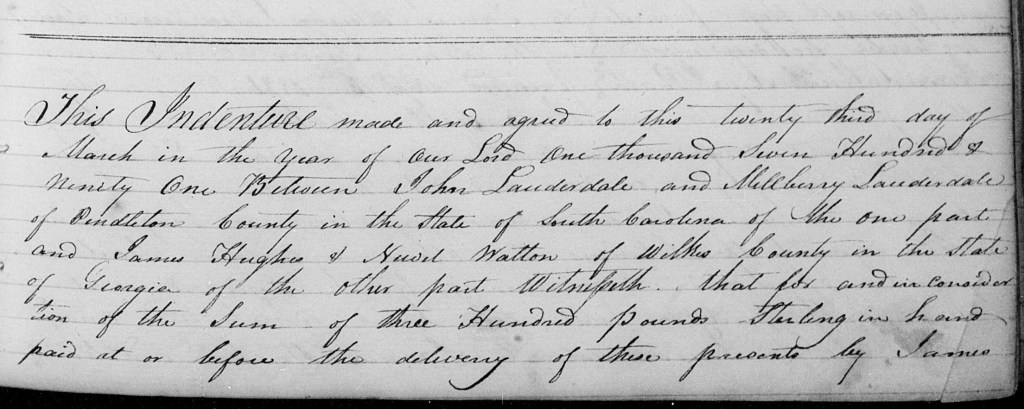

As this case was continuing to unfold in court, on 23 March 1791, for £300 John Lauderdale and wife Milbury (her name given as Millberry here) of Pendleton County, South Carolina, sold James Hughes and Newell Walton of Wilkes County, Georgia, their tract of 400 acres in Wilkes County.[7] John and Milberry both signed, with Buckston(?) Lipsey and Isaac Hurbert witnessing the deed, which was recorded years later on 11 April 1821. The deed speaks of meadows, orchards, and buildings, and this language, along with Milberry’s role in selling the land as John’s wife, indicates that the couple were selling their homeplace in Wilkes County after having moved to South Carolina. Note that this deed was recorded in Oglethorpe County, which was formed from Wilkes in 1793, an indicator that after 1793, John and Milbury’s land fell into the latter county, which borders Wilkes on the southeast.
As was noted previously, on 31 March 1791, John Lauderdale sold to Jesse Brown 200 acres out of the grant of 456 acres on Big Generostee he had received from the state on 3 December 1787.[8]
To return to the petty larceny case against John: on 24 January 1792, Pendleton court minutes say that the recognizance of the witnesses in The State vs. John Lauderdale was continued again until next court.[9] On 25 June 1792, the trial was held, and John was found guilty.[10] He was remanded to jail and two days later, was sentenced to be whipped at 1 o’clock in the afternoon with thirty-nine lashes on his back.[11] The jury that convicted John Lauderdale of petty larceny included his brother-in-law Joab Mauldin and Thomas Leonard, whose son Thomas Lewis Leonard would marry John’s daughter Sarah. On the same day that he was convicted, John Leatherdale was serving as a petit juror with Thomas Leonard’s brother William and with Robert Looney, a former neighbor of John’s in Botetourt County, Virginia.

On 14 October 1792, John Lauderdale bought from William Brown for £100 294 acres on Great Rocky Creek in Pendleton County.[12] The deed states that William Brown was of Wilkes County, Georgia, and John Lauderdale of Pendleton County, South Carolina. The deed states that the land John was acquiring ran from the mouth of Beaver Creek on the south side of Great Rocky and joined the Widow Rachel Thompson’s, Widow Womack’s, then the boundaries of land laid out for Jacob Gillison and John Mauldin, and from there ran to Great Rocky. Samuel Croft and James Linn witnessed the deed, and it was proved by John Lauderdale on 18 January 1797 and recorded 18 March 1797. Note that the land seems to be part of the 300 acres on which John Lauderdale was living in January 1795 when he deeded his land to his children Sarah and James, noting that he had squandered their inheritance of £100 from their grandfather.
It’s noteworthy that John Lauderdale bought these 294 acres from William Brown for £100, the amount his 1795 deed says that their grandfather (Mauldin) had given to Sarah and James Lauderdale. As a previous posting notes, John Mauldin was still living when the 1795 deed of John Lauderdale was made to his children Sarah and James, with John Mauldin witnessing that deed. Prior to this, on 6 May 1793 John witnessed a deed of John Johnson to Harris Mauldin, a son of John Mauldin, of land on Rocky River in Pendleton County.[13] In witnessing this deed, John Mauldin signed as Sr., indicating that this was the elder John Mauldin who was father of Harris Mauldin, Milbury Mauldin Lauderdale, and others. Pendleton County deed records show John Mauldin Sr. living into 1796.
According to Robert Z. Callaham, the Jacob Gillison tract referenced in William Brown’s October 1792 deed to John Lauderdale was, on its east corner, at the entrance to the present location of New Varennes church.[14] On the significance of the Varennes church and community as a landmark for the vicinity in which John Lauderdale lived in the 1790s, see the previous posting.

William Brown’s plat for the 294 acres on Rocky Creek that he sold to John Lauderdale in October 1792 is dated 22 October 1785.[15] The plat shows the tract being just south and west of the confluence of Beaver Creek and Great Rockey (the spelling used in the plat) Creek, with Beaver Creek forming part of its northern boundary and Great Rockey forming its eastern boundary. Joining the land on the northeast is land laid out to the Widow Thompson and on the west across Rockey Creek land laid out to David Hopkins.

The map for this area in Robert Mills’ 1825 atlas of South Carolina shows Varennes Tavern post office just west of the confluence of Beaver Creek and Rocky River.[16] The map of the region around Varennes church in Robert Z. Callaham’s book about landholders south of Anderson shows Varennes church just southwest of where Beaver and Rocky meet, with Leatherdale Road running from the west to Varennes church.[17] Google’s map of the current topography shows Beaver and Rocky joining with Varennes Presbyterian church just southwest of the juncture of the two streams, with Governor’s Creek, where John Mauldin’s land was, just south of Varennes church. An image of the Callaham map is at the previous posting.
John Lauderdale’s sale of land to Jesse Brown in March 1791 and his purchase of land from William Brown in October 1792 make me wonder if Jesse and William were related to each other. I haven’t been able to find enough solid information on these Brown men to determine if they were relatives of each other. I do find some indicators that Jesse may have had ties to the Walker family discussed previously.
As I just noted above, the two consecutive deeds that John Lauderdale made on 2 January 1795 (see here and here), in which he deeded the 300 acres on which he and his family lived to his children Sarah and James after having wasted their inheritance from their grandfather Mauldin, provide some valuable clues as to where the family was living at this time.[18] The deed to Sarah says that her 150 acres bounded on Thompson’s land, and the deed to James says his 150 acres were bounded by Brown and (Thomas) Millsap. Thompson is obviously the widow Rachel Thompson referenced in the October 1785 plat for the 294 acres that William Brown sold John Lauderdale in October 1792, and Brown is William Brown. These 300 acres seem to include the 294 acres that John Lauderdale bought from Brown in October 1792.


On 7 November 1795, John Lauderdale and wife Milbury deeded to Peter Keys (Kays in some documents) the land John had bought from William Brown in October 1792. Two separate instruments capture the transaction. In the first, John states that he had failed to pay Jesse Brown £100 he owed Brown. In a court judgment in January 1795, John became liable for a bond he had given on Brown’s behalf, and the obligation fell into the hands of Peter Keys. John owed Keys £26 6s.[19] Then in a separate deed, John and wife Millbury, as the deed spells her name, sold (or mortgaged to?) Keys for £20 the 294 acres John had bought from Brown, with J. (probably Joab) Mauldin and R. Harkness witnessing.[20] Though Milbury’s name is given in the deed, she is not shown signing it. The first of the two documents states that John lived on the land he had bought from William Brown.
On the same day the following year — 7 November 1796 — for £50, John Lauderdale and wife Milbury (the deed uses that spelling of her name and states that she was John’s wife) sold 134 acres on Great Rocky Creek in Washington District of Pendleton County to Peter Kays (Keys in other documents), with John Tuggle, Daniel Pettiford, and Lazarus Tilly witnessing.[21] The deed was proved by Tilly on 14 March 1797 and recorded 18 March. John signed and Milbury signed by mark. The deed says that the land began at Beaver Creek’s mouth and was bounded by James Thompson’s land, Kays’ corner, Widow Mauldin, Thomas Millsap, and Great Rocky.
Robert Z. Callaham thinks that this tract was out of the 294 acres John Lauderdale purchased from William Brown in October 1792.[22] Callaham thinks John and Milbury lived on 66 acres of the land after deeding the rest to Keys. Callaham also notes that John’s father-in-law John Mauldin owned land on Governor’s Creek immediately south of this piece of land. He points out that the William Brown deed of 1792 shows John Mauldin as a neighbor to William Brown. Callaham also appears to think that the Widow Mauldin named as the Lauderdales’ neighbor in this deed was Sarah, wife of John Mauldin Sr. — Milbury’s mother. But Milbury’s father John Mauldin was still living on 7 November 1796 and made a deed the following day to Thomas Millsap. The Widow Mauldin living next to the Lauderdales on 7 November 1796 was Milbury’s sister-in-law Hannah Mauldin, widow of Sarah’s brother Harris Mauldin whose estate was probated by Hannah on 27 June 1796.[23]
The November 1797 deed to which Callaham is referring shows Peter and Lettice Kays selling to James Thompson, all of Pendleton County, 495 acres at the confluence of Beaver Creek and Rocky River. The deed notes that the land the Keys were selling bordered Thompson, Harris Mauldin, and Thomas Millsap. The Widow Thompson tract had, Callaham thinks, gone to James Thompson from Rachel Thompson.[24] Callaham again notes that Harris Mauldin appears to have acquired some of John Mauldin’s land and thinks that this proves that Harris was likely a son of John Mauldin and therefore a brother to Milbury Mauldin Lauderdale.
On 5 April 1797, John was a buyer at the sale of the sale of the estate of John Norris in Pendleton County.[25] John Norris was a half-brother of Robert Norris who, as a previous posting notes, married Winnifred Mauldin, a sister of Milbury Mauldin Lauderdale. John Norris lived on Great Rocky Creek/Rocky River on land bordering William and Rachel Thompson — i.e., on land close to the land John Lauderdale acquired from William Brown in October 1792.[26] The Norris file in the Leonardo Andrea collection of South Carolina genealogical notes and family histories has material from an unidentified source stating that John Norris and his family lived near Varennes church. John Norris apparently operated and perhaps established the Varennes tavern that took its name from the church. Members of the Norris family played a leading role in the Varennes congregation from its inception;[27] much of the land in the vicinity of the church had originally belonged to Jean/Jane Ewing, mother of John Norris, who married Robert Norris elder following the death of her first husband Ezekiel Calhoun.
On 10 October 1797, John Lauderdale was a buyer at the estate sale of his brother-in-law Harris Mauldin.[28] Note that William Brown was one of the appraisers of Harris Mauldin’s estate. On 24 January 1799, John bought at the estate sale of Philip Phagan in Pendleton County.[29]
John Lauderdale was enumerated on the 1800 federal census of Pendleton District, South Carolina, with a household comprised of three males under 10 (James, Josiah, and John), one over 45 (John elder), and females aged 10-16 (Sarah) and 36-45 (Milbury), along with one enslaved person.[30] This household is no. 407 in Col. Brown’s regiment. Note that the same regiment includes (no. 375) Thomas Leonard, whose son Thomas Lewis Leonard married John Lauderdale’s daughter Sarah about 1800.
According to Marian Walters Acker, John Lauderdale appears on the tax list of Franklin County, Georgia, in 1801-2 with land adjoining land of David Northington/Norrington.[31] This is the David Northington to whom Christopher Williman sold John Lauderdale’s Franklin County bounty land on 18 December 1800, after Williman had bought the land from John Lauderdale. But when one checks the original tax lists for these years (and 1803), it’s clear that the mention of John Latherdale (1802) or Leatherdill (1803) in these tax lists is to note that he was the original grantee of the land for which Northington is being taxed. I have found no indicators that John Lauderdale owned any other land in Franklin County than the bounty land he received there for his services as a Georgia Refugee soldier.
In 1802, John Leatherdale acquired two tracts of land on Weaver Creek in what was now Pendleton District. On 6 April 1802, William Reed and wife Violet sold John Leatherdale 136 acres on both sides of Weaver Creek joining land laid out for Samuel Weaver and Hunter.[32] And on 14 July 1802, John Leatherdale bought 50 acres on both sides Weaver Creek from Abraham (Abram: both spellings are used in the deed) Duff and wife Linny or Lanny (both spellings appear in the deed). Linny’s signature is by mark and is described as “his” mark, but I suspect this is Abram’s wife.[33] I think this land is in what became Pickens County in 1826, north of Anderson County. I think John and his family may well have moved up to this vicinity after John was forced to sell his land on Rocky River to Peter Keys in 1795-6.
According to an unpublished lineage essay of Dr. J.A. Lauderdale and to the September 1962 affidavit of Mattie Conwill Murphy discussed in a previous posting, citing information handed down among John Lauderdale’s descendants, in 1806, John and his family left Pendleton District to move to Sumner County, Tennessee, where his father James Lauderdale died in 1796. If the family moved after 1796 to the part of Pendleton District that later became Pickens County, they were already moving in that direction, since this part of South Carolina is near the Tennessee border. The index to deeds for Anderson County, South Carolina, shows a number of instruments naming John Lauderdale filed in 1806-7. These are in deed books to which I do not have access via the FamilySearch website, so I can’t include this material in the current discussion of John Lauderdale’s years in South Carolina.[34]
In my next posting, I’ll discuss the information I have about John Lauderdale’s years in Sumner and Lincoln County, Tennessee, and his final years in Limestone County, Alabama.
[1] Pendleton County, South Carolina, Court Minutes 1790-3, p. 23.
[2] Ibid., p. 25.
[3] Ibid., p. 28.
[4] Ibid., p. 41.
[5] Ibid., p. 43.
[6] Ibid., p. 44.
[7] Oglethorpe County, Georgia, Deed Bk. K, pp. 90-1.
[8] Anderson County, South Carolina, Deed Bk. B, p. 257.
[9] Pendleton County, South Carolina, Court Minutes 1790-3, p. 114.
[10] Ibid., pp. 131, 138.
[11] Ibid., pp. 140, 143.
[12] Anderson County, South Carolina, Deed Bk. D, pp. 318-9.
[13] Ibid., Bk. B, p. 165.
[14] Robert Z. Callaham, Early Landholders South of Anderson, S.C. (Walnut Creek, CA, 2012), p. 55.
[15] South Carolina State Plat Bk. 9 (Charleston Series), p. 523.
[16] Robert Mills, Atlas of the State of South Carolina (1825).
[17] Callaham, Early Landholders South of Anderson, S.C., p. 89.
[18] Anderson County, South Carolina, Deed Bk. D, pp. 365-6.
[19] Ibid., Bk. C, pp. 111-2.
[20] Ibid., pp. 112-3.
[21] Ibid., Bk. D, p. 318-9.
[22] Callaham, Early Landholders South of Anderson, S.C., p. 56.
[23] See Anderson County, South Carolina, loose-papers estate files box 13, no. 441, package 7; and ibid., citing Anderson County, South Carolina, Deed Bk. C, p. 380.
[24] Callaham, Early Landholders South of Anderson, S.C., p. 57.
[25] Anderson County, South Carolina, Probate Judge Estate Records 1797-1799, pp. 111-3.
[26] Callaham, Early Landholders South of Anderson, S.C., pp. 3, 12, 20, 51-2.
[27] See F.D. Jones and W.H. Mills, ed., History of the Presbyterian Church in South Carolina (Columbia: Bryan, 1926), pp. 972-3, noting that the original elders of Varennes church included Patrick Norris (a brother of John Norris) and James Thompson, who inherited the land of Widow Rachel Thompson. Members of the Hillhouse family, which was intermarried with the Norris family, also played a significant role in the formative years of the Varennes church. On Varennes and the role played by the Norris and Thompson families in its early history, see also Louise Ayer Vandiver, Traditions and History of Anderson County (Atlanta: Ruralist, 1928), pp. 190-1.
[28] Anderson County, South Carolina, Probate Judge Estate Records 1797-1799, pp. 106-7. See also Anderson County, South Carolina, loose-papers estate files box 13, no. 441, package 7.
[29] Anderson County, South Carolina, Probate Judge Estate Records 1797-1799, p. 156.
[30] 1800 federal census, Pendleton District, South Carolina, p. 111.
[31] Marian Walters Acker, Franklin County, Georgia, Tax Digest,vol. 1: 1798-1807 (Birmingham, Alabama, 1980), pp. 68 and 99 and
[32] Anderson County, South Carolina, Deed Bk. H, p. 208.
[33] Ibid., p. 212.
[34] Lease and release to John Champneys, Anderson County, South Carolina, Deed Bk U6, p. 353; S & C & T & D to John Hart, ibid., Bk. Z6, p. 148; and L & R & RD to James Kennedy and wife, ibid., p. 150.
 BEGATS AND BEQUEATHALS
3 thoughts on “John Lauderdale (1745 – 1830/1840): South Carolina Records, 1790-1806 (4)”