The posting linked at the start of the last paragraph has digital images of the warrant, two survey plats, and the grant document.[1]
As has also been noted previously, the day before John Lauderdale wrote his petition for bounty land, his commander in the Georgia Refugees, Major Tobias Boykin, wrote a note certifying John as a Refugee soldier, and General John Twiggs signed his acceptance of this certification.
At the time he petitioned for bounty land in Franklin County, John Lauderdale was apparently living in Wilkes County, Georgia, the county in which the Refugee soldiers were concentrated, as was explained in a previous posting.[2] We can deduce this by the fact that he appears on a tax list in Wilkes County in 1785 taxed for 400 acres of land and one poll.[3] As Mary Novella Gibson-Brittain, Marie Brittain Craig, and Marjorie Craig Churchill note, Wilkes County was a Whig stronghold during the Revolution and for that reason was known among Georgia counties as “the Hornet’s Nest.”[4]
As Alex M. Hitz indicates, the Refugee soldiers receiving bounty land in Franklin County included men who had fled from the state when the British took control of the colony and had enlisted in militia regiments in South Carolina and North Carolina.[5] Hitz notes that each Refugee was entitled to 287½ acres of land from the Bounty Reserve located in the south end of old Franklin County and the north end of old Washington County, territory that is today part of Oconee, Oglethorpe, and Greene Counties.
As a previous posting indicates, the 1850 and 1860 federal censuses place the birth of John Lauderdale’s first child by wife Milbury Mauldin, their daughter Sarah, in 1785 or 1786.[6] Sarah’s date of birth suggests that John likely married Milbury, daughter of John Mauldin of Pendleton County, South Carolina, about 1784 or 1785. At its formation in 1777, Wilkes County occupied a large area of east central Georgia bordering on the Savannah River, with Pendleton County, South Carolina, just across the river: as Elizabeth B. Cooksey states, when Wilkes was formed, it occupied the land lying between the Broad River and the Savannah River, which today includes Elbert and Lincoln Counties, as well as parts of Oglethorpe, Taliaferro, and Warren Counties.[7]
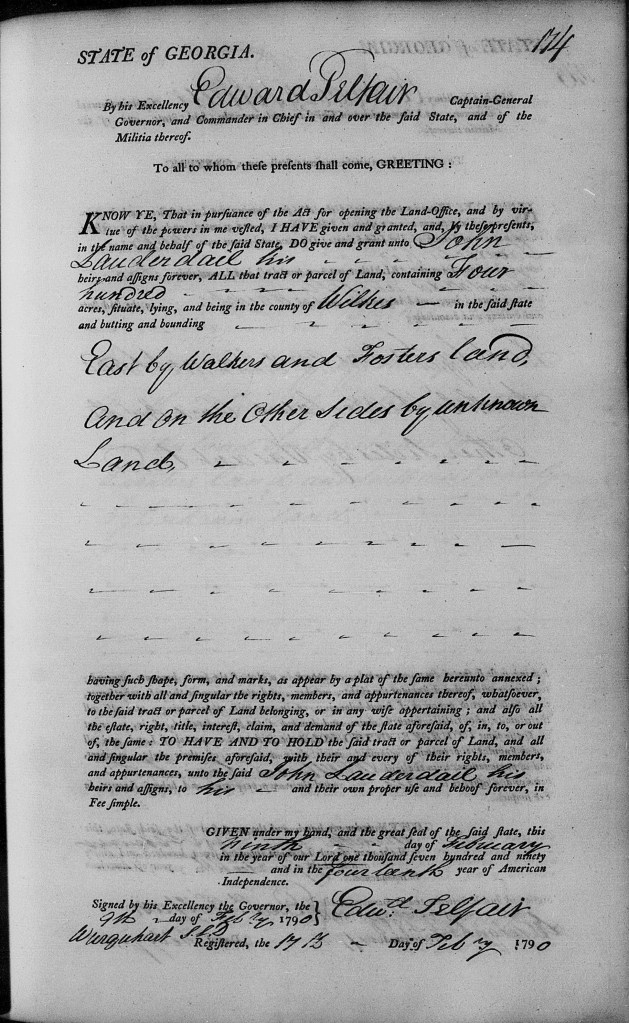
On 17 February 1790, the state of Georgia granted John 400 acres in Wilkes County on Mill Creek.[8] The grant, which gives John’s surname as Lauderdail, states that the tract was bordered east by Walker and Foster and on other sides by “unknown land.” I think it’s likely that these 400 acres are the same land for which John had been taxed in 1785, and that he had been living on this piece of land from at least 1785. At her now-defunct website Nancy’s Dead Relatives, Nancy Breidenthal noted that the Mauldin family and a Gammel/Gamble family intermarried with it also had land in Wilkes County during this period, with the Mauldins living in Pendleton County, South Carolina.

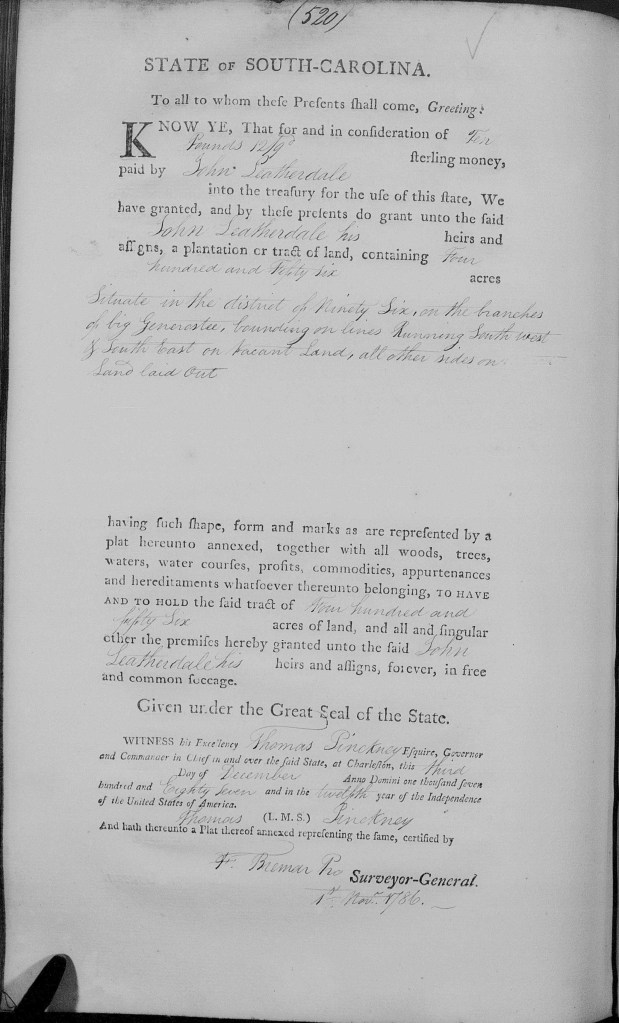
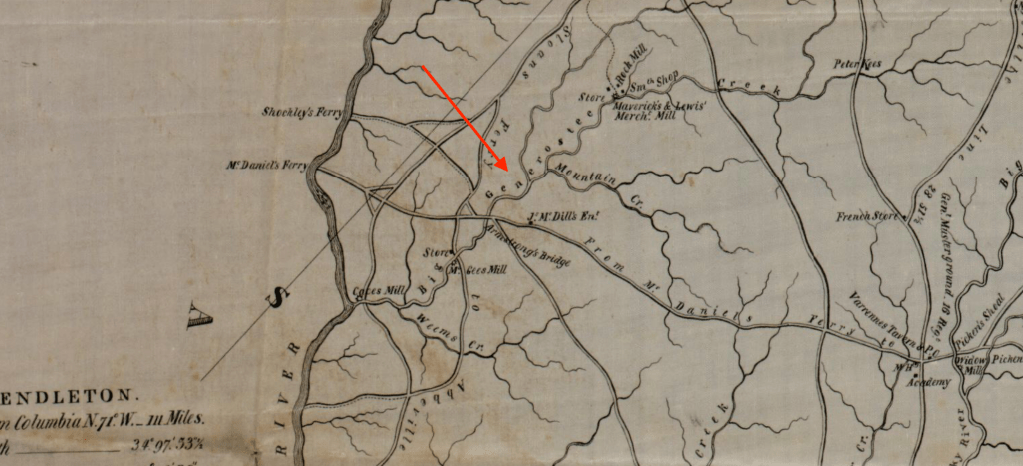
That John Lauderdale had a foot in both Georgia and South Carolina in this period is evident from a South Carolina land grant to him in 1787. On 1 November 1786, a survey and plat were made for John Leatherdale for 456 acres on a branch of Big Generostee Creek in Ninety-Six District (the land was in Pendleton County, later Anderson County).[9] The state of South Carolina made its grant of these 456 acres to John Leatherdale on 3 December 1787.[10] The grant states that the tract was on branches of Big Generostee bounding on both east and west on vacant land and on occupied land on its other sides.
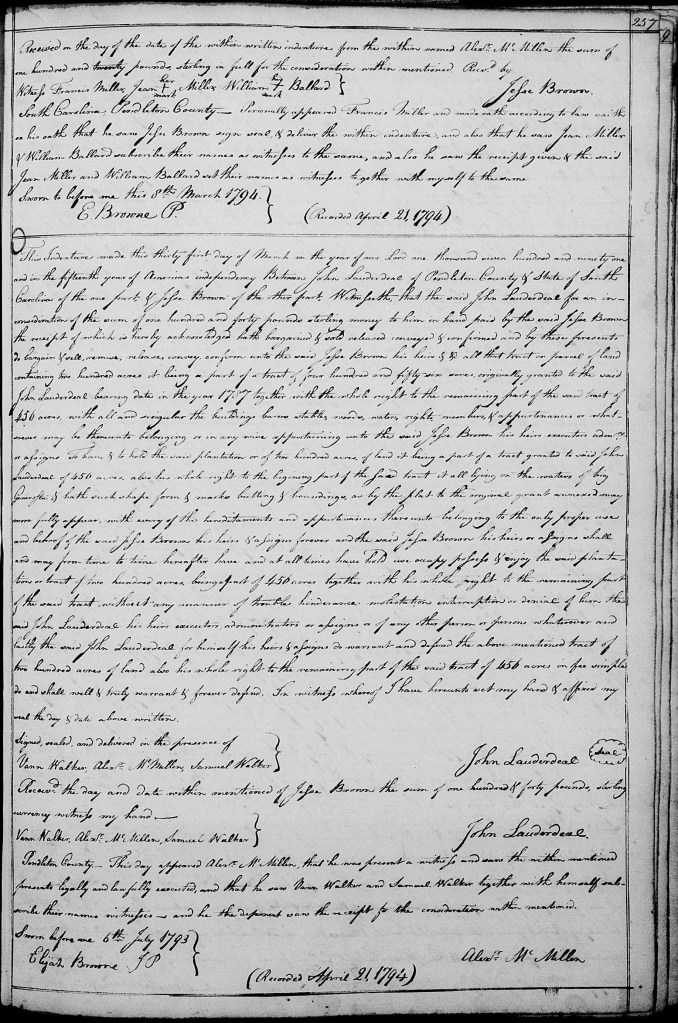
On 31 March 1791, John sold the 456 acres to Jesse Brown for £140.[11] The deed, which John signed as John Lauderdeal, says that John was living in Pendleton County at the time and that the land lay in that county on the waters of Big Generostee and had come to John as a grant in 1787. Witnesses were Vann Walker, Alexander McMillan, and Samuel Walker. McMillan proved the deed on 6 July 1793 and it was recorded 21 April 1794. Note that, as mentioned previously, John Lauderdale’s 400-acre grant in Wilkes County in 1790 says that his land bordered Walker.
As Nancy Breidenthal noted at her website Nancy’s Dead Relatives, other families from Looney’s Creek in Botetourt County, Virginia, where John was born and grew up (this was Augusta County at the time of John’s birth) also settled on Big Generostee in Pendleton County, South Carolina, including the Looneys and Sloans. Also living on Big Generostee were the families of Thomas Leonard and Griffith James, who would connect to John Lauderdale through the marriage of Thomas Lewis Leonard, son of Thomas Leonard and Hannah James, to John Lauderdale’s daughter Sarah.


On 10 August 1790, John Lauderdale sold the 287½ acres on Bear Creek, waters of Broad River, that he had been granted in 1785 as bounty land in Franklin County, Georgia.[12] John sold the land, on which he had evidently never lived, to Christopher Williman of Charleston, with the deed stating that John was living in Pendleton County, South Carolina, but “late of Wilkes County in the State of Georgia.” John sold the land for £50, with the deed noting that he was a planter and had received the land by a bounty grant on 12 October 1785. John signed as John Lauderdale, with witnesses Robert Anderson and George Brownlee.
Robert Anderson, the Revolutionary general for whom Anderson County, South Carolina, is named, has been discussed previously here in repeated postings, noting that he was a friend and neighbor of General Andrew Pickens, who married Rebecca, daughter of Ezekiel Calhoun. As I’ve previously noted, in my own ancestral tree, the line of Ezekiel Calhoun ties together with the line of John Lauderdale through the marriage of Ezekiel Samuel Green, a descendant of Ezekiel Calhoun, to Camilla Birdwell, a descendant of John Lauderdale, in Pointe Coupee Parish, Louisiana, on 2 January 1853.
A footnote to John Lauderdale’s August 1790 deed of his Franklin County, Georgia, land to Christopher Williman: on 18 December 1800, William sold the tract to David Northington, with the deed noting that the land had been granted to John Lauderdale for Revolutionary service on 12 October 1785.[13]
The statement that John Lauderdale was “late of Wilkes County in the State of Georgia” in his August 1790 deed to Christopher Williman appears to indicate that at some point not long before 1790, he moved his family from Wilkes County, Georgia, to Pendleton County, South Carolina. The family of John Lauderdale appears on the 1790 federal census in Pendleton County with a household comprised of a white male over 16 (John) and two white females (John’s wife Milbury and daughter Sarah).[14] John’s surname is given as Laderdale on the census. Enumerated next to him is Samuel Walker, who is likely the man of that name who witnessed his 31 March 1791 deed to Jesse Brown discussed above.
According to the Jeff Ross Papers at the Tennessee State Library and Archives papers, Samuel Walker was the son of Charles Walker, who was born in 1727 in Prince George’s County, Maryland, and who was perhaps a Presbyterian minister. A transcript of the Walker material in the Jeff Ross Papers done by Charles Brashear is available online at the Walker Family Gathering website, which notes that Jeff Ross (1849-1929) was a grandson of Charles Walker.[15] The Jeff Ross Papers indicate that the Vann Walker who witnessed John Lauderdale’s 31 March 1791 deed of 456 acres in Pendleton County along with Samuel Walker was Samuel’s nephew.
Some Lauderdale researchers have indicated that when John Lauderdale moved his family from Wilkes County, Georgia, to Pendleton County, South Carolina, in the late 1780s, the Lauderdales settled on land that belonged to Milbury Mauldin Lauderdale’s father John Mauldin. I have not found a document proving this claim. It may be based on the fact that, as a previous posting explains (and also here), when John Lauderdale deeded the 300-acre tract of land in Pendleton County on which he was living on 2 January 1795 to his children James and Sarah, the deed stated that John was taking this step because he had wasted his children’s inheritance of £100 from their grandfather. The deed doesn’t state that the land on which the Lauderdales were living had also come from their grandfather, but some researchers have assumed that this was the case. As the postings I’ve just linked explain, the grandfather in question was John Lauderdale’s father-in-law John Mauldin.
By the latter part of the 1780s, John Mauldin had acquired considerable acreage along Governor’s Creek in Pendleton County. On 11 March 1785, he had a plat for 320 acres in Ninety-Six District (i.e., Pendleton/Anderson County) on Governor’s Creek.[16] The grant for this tract was made 4 December 1786.[17] On 10 August 1787, John Mauldin (his surname given as Maulden) had another plat for 100 acres on Governor’s Creek joining William Lesley, Blake Mauldin, and John Warnock.[18] The grant for this tract was made 3 December 1787.[19] Another grant for 100 acres on Governor’s Creek with the same neighbors was made to John Maulden on the same date.[20] Robert Z. Callaham notes that John Mauldin had acquired several hundred acres on both sides of Governor’s Creek prior to 1787, when the two grants were made on 3 December of that year for some of this land.[21]
Governor’s Creek runs south of Anderson, the county seat of Anderson County, paralleling present-day highway 28 east of Starr. On the basis of deeds I’ll discuss in more detail in my next possting, Robert Z. Callaham concludes that in the 1790s, John Lauderdale’s family was living on land on Rocky River (also known as Rocky Creek and Great Rocky Creek) joining land of John Mauldin.[22] This land was just north of the land John Mauldin held on Governor’s Creek and near Varennes church in the vicinity of Starr, a community about halfway between Anderson and Iva in Anderson County. Varennes is an historic Presbyterian church on Leatherdale Road just east of highway 28, which runs from Anderson to Abbeville. Note the road’s name: I suspect this road name points back to the John Lauderdale who was living in this vicinity by 1790. These landmarks are helpfully marked on two maps in Callaham’s book about early landholders south of Anderson, one showing the region around Varennes church in relation to the entire area south of Anderson and the other focusing in a close-up way on the area around Varennes church.[23] See the head of this posting for the two Callaham maps.
In my next posting, I’ll discuss John Lauderdale’s years in Pendleton County from 1790 to 1806, when family tradition says he moved his family from South Carolina to Sumner County, Tennessee, to join his relatives there.
[1] See John Lauderdale loose-plats file, Georgia Surveyor General Department, and Franklin County, Georgia, Bounty Bk. HHH, p. 700. See also Silas Emmett Lucas Jr., Index to the Headright and Bounty Grants of Georgia 1756-1909 (Greenville, South Carolina: Southern Historical Press, 1982), p. 377, Lucien Lamar Knight, Georgia’s Roster of the Revolution (Atlanta: Index Printing, 1920), p. 240; and Franklin County Historical Society, History of Franklin County, Georgia (Roswell, Georgia: W.H. Wolfe, 1986), p. 64.
[2] On John Lauderdale’s probable residence in Wilkes County when he petitioned for bounty land, see Eugenia Lauderdale Messick, “John Lauderdale, ‘Refugee Soldier,’ American Revolution,” unpublished article written in 1996, a copy of which Eugenia kindly sent me on 29 April 1997.
[3] Grace Gillam Davidson, Early Records of Georgia, vol. 2: Wilkes County (Macon: J.W. Burke, 1932), p. 70.
[4] The History and Genealogy of Some Pioneer North Alabama Families (Flagstaff, Arizona: Northland, 1969), p. 69.
[5] Alex M. Hitz, “Georgia Bounty Land Grants,” Georgia Historical Quarterly 38,4 (December 1954), pp. 337-348.
[6] 1850 federal census, Cherokee County, Texas, p. 876 (dwelling/family 473; 7th November); and 1860 federal census, Cherokee County, Texas, beat 1, p. 411B (dwelling/family 29; 4 June), household of A.M. Leonard.
[7] Elizabeth B. Cooksey, “Wilkes County,” New Georgia Encyclopedia, a project of the University of Georgia system.
[8] Georgia Land Grant Bk. TTT, p. 174.
[9] South Carolina State Plat Bk. 21 (Charleston Series), p. 8.
[10] South Carolina Grant Bk. 19, p. 520.
[11] Anderson County, South Carolina, Deed Bk. B, p. 257.
[12] Franklin County, Georgia, Deed Bk. C, pp. 88b-90b.
[13] Ibid., Deed Bk. O, pp. 262-3.
[14] 1790 federal census, Pendleton County, South Carolina, p. 4.
[15] “The Jeff Ross Papers,” Walker Family Gathering.
[16] South Carolina State Plat Bk. 17 (Charleston Series), p. 83. The plat spells John’s surname as Maulden. See also Robert Z. Callaham, Early Landholders South of Anderson, S.C. (Walnut Creek, CA, 2012), p. 37.
[17] South Carolina Grant Bk. 14, p. 72.
[18] South Carolina State Plat Bk. 21 (Charleston Series), p. 69. The plat gives John’s surname as Maulden.
[19] South Carolina Grant Bk. 22, p. 195.
[20] Ibid., Bk. 21, p. 51.
[21] Callaham, Early Landholders South of Anderson, S.C., p. 4. The 3 December 1787 grant date is stated in a deed dated 24 March 1791, when John Mauldin sold 100 acres on Governor’s Creek to Lent Hall (Anderson County, South Carolina, Deed Bk. A, pp. 273-275) and also in a deed dated 21 October 1800, when Lent Hall sold Martha Hall 90 acres on Governor’s Creek (Anderson County, South Carolina, Deed Bk. K, p. 254). These deeds state that the grant to John Mauldin was recorded in Grant Bk. VVVV, p. 195.
[22] Callaham, Early Landholders South of Anderson, S.C., p. 56.
[23] Ibid., pp. 81, 89.
 BEGATS AND BEQUEATHALS
3 thoughts on “John Lauderdale (1745 – 1830/1840): Georgia and South Carolina Records to 1790 (3)”