Finally, the John Lauderdale who married Milbury Mauldin has been somewhat elusive because at some point prior to 1784, he moved away from the rest of his family, who were in Botetourt County, Virginia, disconnecting himself from them and records about them as he settled in Georgia and then South Carolina. Why and precisely when he made that move has been mysterious to those researching this John Lauderdale, though there are some fairly strong records suggesting that he definitely does connect to the family of a James Lauderdale who lived in Botetourt County to the very end of his life, before he died testate in Sumner County, Tennessee, in 1796 with a will naming a son John.
Given the confusion that has long hampered attempts to form a clear picture of the John Lauderdale who lived in Wilkes County, Georgia, and Pendleton County, South Carolina, before moving to Tennessee and then Alabama, it’s important to pinpoint documents that allow us to separate fact from fiction and to ground our analysis in records that undeniably have to do with this John Lauderdale and not other men with that name. In this posting, I’m going to highlight some key documents that set us off on the right path in sketching a picture of the John Lauderdale who married Milbury Mauldin.
The first such documents are the 2 January 1795 deeds of gift that we’ve already discussed, in which John Lauderdale deeded property to his children James and Sarah in Pendleton County, South Carolina.[1] These deeds of gift (of which there’s a digital image in the posting I’ve just linked) establish that the John Lauderdale living in Pendleton County in the 1790s (with wife Milbury, as other records show) was father of a son James and a daughter Sarah. The two deed of gifts, one preceding the other in Pendleton County deed books, state this: in these deeds, John names James as his son and Sarah as his daughter.
These January 1795 deeds of gift also clearly place John Lauderdale in Pendleton (later Anderson) County, South Carolina, at the time they were made. Other deeds of John Lauderdale in Franklin County, Georgia, and Pendleton County, South Carolina, that I’ll discuss later allow us to identify the John Lauderdale with daughter Sarah and son James in Pendleton County with a John Lauderdale who petitioned for bounty land in Franklin County, Georgia, in 1784 for service as a “Refugee soldier” in Georgia during the Revolution. As the posting linked above also notes, John Lauderdale was living in Wilkes County, Georgia, across the Savannah River from Pendleton County, South Carolina, when his daughter Sarah was born in 1785 or 1786.
This much is clear and is firmly established by documentary evidence. However, there has been great confusion regarding the John Lauderdale of Pendleton County, South Carolina, and Georgia due to the belief of a number of researchers that the John Lauderdale who was father of James and Sarah was son of an older John Lauderdale who also lived in Pendleton County, South Carolina, and in Georgia — though no evidence suggests to us that there were two men named John Lauderdale living in these areas in the time frame of these records.
A primary reason that some researchers have wanted to multiply the single John Lauderdale of Pendleton County, South Carolina, and Wilkes County, Georgia, in the 1780s and 1790s is that subsequent records (and family tradition) suggest that John Lauderdale, father of Sarah and James, was born in the 1740s. Because John Lauderdale’s wife Milbury Mauldin was a number of years his junior, there have been suggestions (based on no documentary evidence at all) that there were two John Lauderdales living in Pendleton County and Georgia in this period, father and son, with the son marrying Milbury Mauldin.
As an example, in an article he wrote about John Lauderdale of Pendleton County in February 1996, Clint A. Lauderdale proposed that the John Lauderdale who gave Revolutionary service died in Pendleton County in January 1795, leaving a son John who was born in 1768 and who married Milbury Mauldin. Clint Lauderdale’s analysis is then echoed in an article in Maitland Matters published in spring 1996 and apparently written by the editor of that newsletter.[2]
No record anywhere shows John Lauderdale of Pendleton County, South Carolina, dying there in January 1795, the month in which he made his deed of gift to children Sarah and James. All records pertaining to that John Lauderdale make plain that he was the John Lauderdale who married Milbury Mauldin. He did have a son John, whose full name was John Gammel Lauderdale, but that son John was not born in 1768: his date of birth stated in multiple sources was 13 March 1798.[3] The 1768 birthdate for John Lauderdale who married Milbury Mauldin appears to rest on confusion between John Lauderdale with wife Milbury and a John Lauderdale who was his nephew, son of his brother James and wife Sarah Mills: James and Sarah Mills Lauderdale had a son John who was born 16 September 1768 and who died in Sumner County, Tennessee.
By the time he published his book History of the Lauderdales in America in 1998, Clint Lauderdale had changed his mind about the two John Lauderdales of Pendleton County, South Carolina. This study recognizes that there was only one John Lauderdale living in Pendleton County, South Carolina, and Georgia in the 1780s and 1790s, that this John married Milbury Mauldin, and that John and Milbury moved to Limestone County, Alabama, with their children Sarah Leonard, John Gammel Lauderdale, and Josiah Mauldin Lauderdale, and both John and Milbury died there at advanced ages.[4] In a letter she sent me on 29 April 1997, Eugenia Lauderdale Messick states,
I have never believed there were two generations of Johns in South Carolina. Clint has recanted recently. Someone apparently convinced him that he was wrong.
What I’ve written thus far does not even touch on the additional confusion about how the John Lauderdale found in South Carolina and Georgia records fits into the Lauderdale family that arrived in Augusta (later Botetourt) County, Virginia, from Pennsylvania in the 1730s. As we’ll see in a moment, a bible owned by John of South Carolina and Georgia indicates that he definitely belonged to this Virginia family, but since it seems there was more than one John Lauderdale living in Augusta (and later Botetourt) County after the John later found in South Carolina and Georgia was of age, there has been confusion about which John is which. This is a point I’ll discuss further down the road.
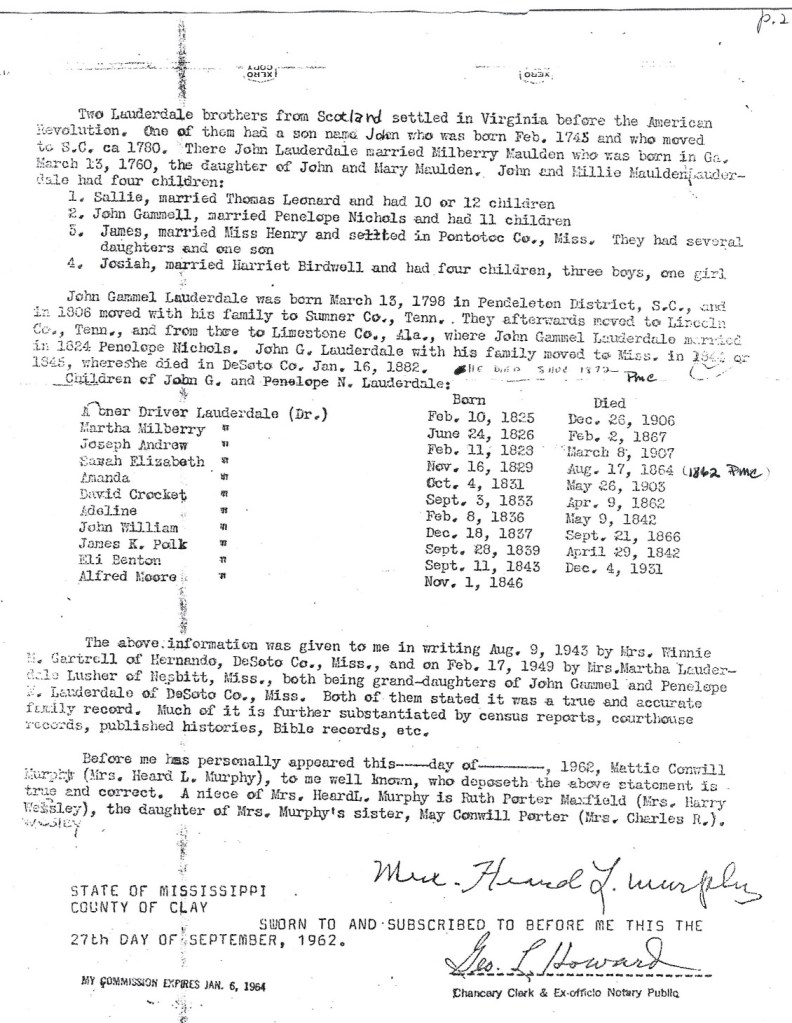
Now for some specific information about the date of birth of the John Lauderdale found in Pendleton County, South Carolina, and Georgia records in the 1780s and 1790s: in an affidavit she gave on 27 September 1962 before the chancery clerk of Clay County, Mississippi, Mattie Conwill Murphy, a descendant of John Lauderdale, stated that John Lauderdale was born in Virginia in February 1745. The affidavit also says that this information and other pieces of family history stated in the affidavit had been given to Murphy in writing on 9 August 1943 and 17 February 1949 by two other descendants of John Lauderdale, Winnie H. Gartrell of Hernando, Mississippi, and Martha Lauderdale Lusher of Nesbit, Mississippi. As I noted above when I cited this material previously (see n. 3), a typescript copy of this affidavit sent to me by researchers Imogen Turman and Penny Culver does not indicate the source of the typescript. The affidavit appears to me to have been made as part of an application for DAR membership.
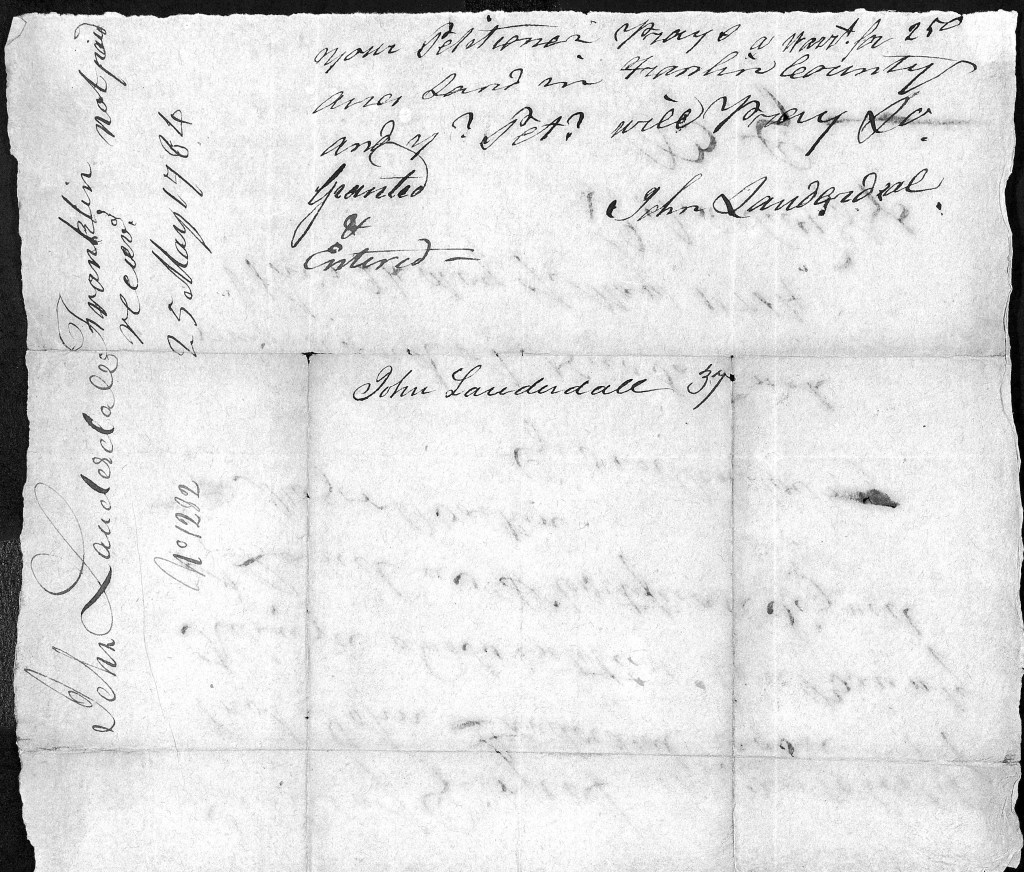
In a document she wrote in 1996 entitled “John Lauderdale, ‘Refugee Soldier,’ American Revolution,” Eugenia Messick notes that when John Lauderdale petitioned for bounty land in Franklin County, Georgia, on 25 May 1784, signing his name as John Lauderdal, the official who filed the petition wrote John’s name again under his signature (spelling the surname Lauderdall), following the name with the number 37.[5] Eugenia Messick suggests that this was John’s age in 1784. If this suggestion is correct, then John may have been born in 1747. In History of the Lauderdales in America, Clint A. Lauderdale accepts this suggestion and makes 1747 John’s year of birth.[6]

Regarding John’s date of birth, there’s also this to consider: as I’ll discuss in more detail later, John and Milbury Lauderdale moved to Limestone County, Alabama, from Tennessee about 1819 with several of their children. Though it’s clear that John and Milbury were still living in that county in 1830, John is not on the federal census for Limestone County in that year. But in 1830, the household of his son John Gammel Lauderdale in Limestone County contains a male aged 80-89 and a female aged 60-69.[7] It seems reasonable to think that these elderly household members are John G. Lauderdale’s parents John and Milbury Mauldin Lauderdale. They are not John G. Lauderdale’s father- and mother-in-law, John and Martha Driver Nichols, parents of John G.’s wife Penelope: John Nichols is head of a household in Limestone County in 1830, with a male aged 50-59 and a female aged 40-49 in the household.[8]
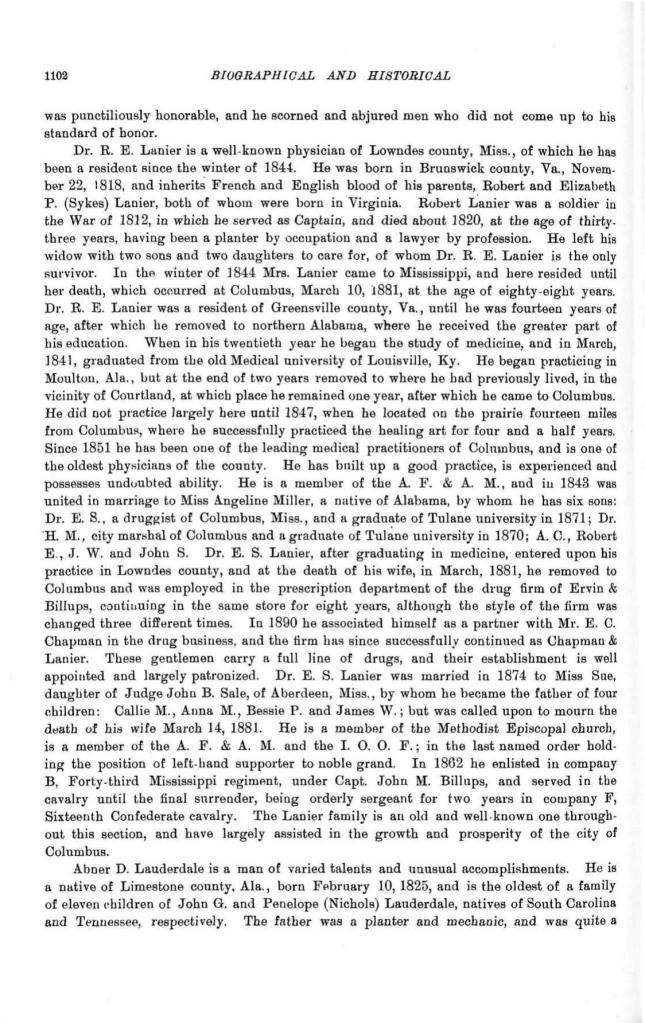
If I’m correct in deducing that the elderly couple living in the household of John Gammel Lauderdale in Limestone County, Alabama, on the 1830 census are John Lauderdale and wife Milbury, note that this census places John’s birth between 1741-1750 and Milbury’s between 1761-1770. In addition to stating that John was born in February 1745, the September 1962 affidavit of Mattie Conwill Murphy citing information provided by two descendants of John Gammel Lauderdale in the 1940s states that Milbury Mauldin Lauderdale was born 13 March 1760.[9] A biography of Abner Driver Lauderdale, son of John Gammel Lauderdale and Penelope Nichols, which I mentioned previously (see n. 3), states that Abner’s father John G. Lauderdale was son of John Lauderdale and Milbury Maudlin [sic], natives of South Carolina. The biography states that John G. Lauderdale was also born in South Carolina, and lived during his adult life in Limestone County, Alabama. Mattie Conwill Murphy’s September 1962 affidavit says,
John Gammel Lauderdale was born March 13, 1798 in Pendeleton [sic] District, S.C., and In 1806 moved with his family to Sumner Co., Tenn. They afterwards moved to Lincoln Co., Tenn., and from there to Limestone Co., Ala., where John Gammel Lauderdale married in 1824 Penelope Nichols.
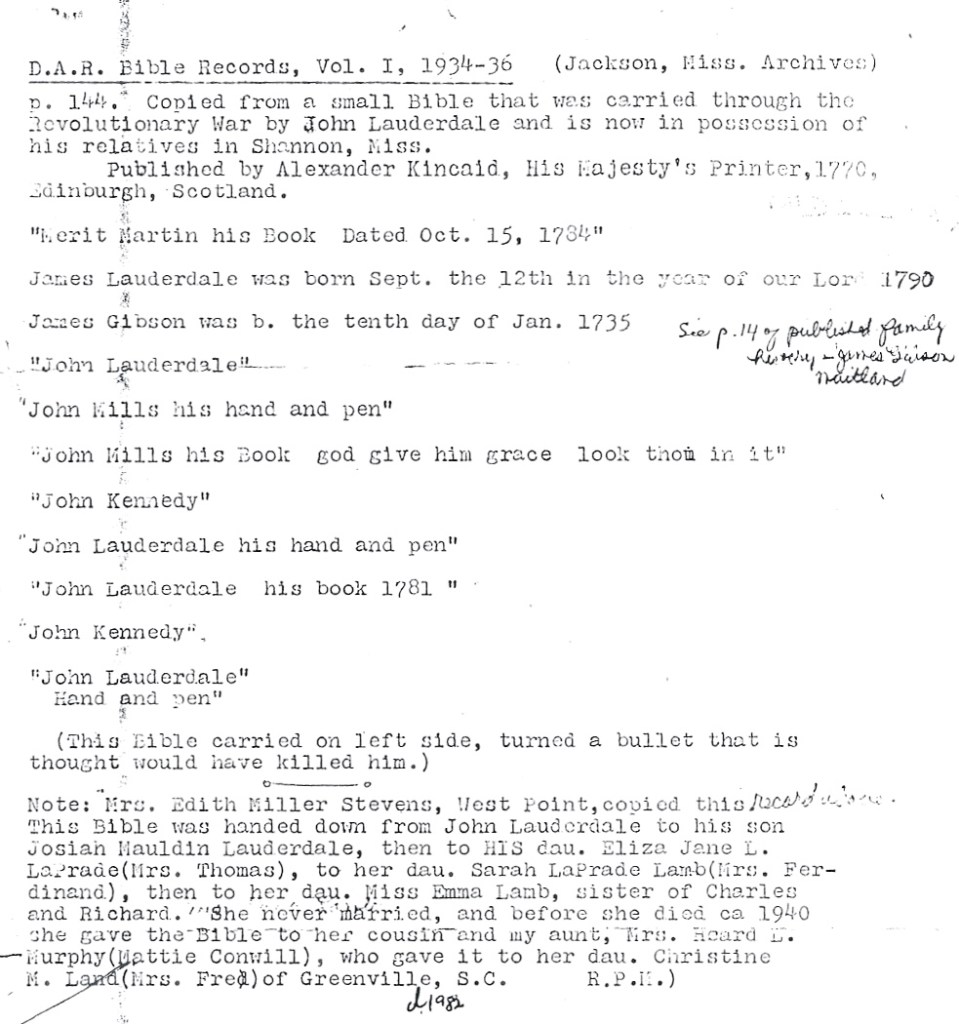
There’s one final document I’d like to discuss in this preliminary examination of foundational documents that are essential to correct identification of the John Lauderdale who lived in Pendleton District, South Carolina, Wilkes County, Georgia, and then Tennessee and Alabama: this is a bible that belonged to John Lauderdale and has passed down among his descendants. I have not seen this bible and do not have a copy of the original bible record. In 1998, this bible was in the possession of Nancy Land Baldwin of Greenville, South Carolina, a descendant of John Lauderdale. I was in touch with Nancy Baldwin in October 1998; she told me that the bible register is now so faint that it’s almost illegible, and that a transcription of this bible register produced for DAR records and appended to Mattie Conwill Murphy’s September 1962 affidavit discussed above is faithful to the original. A digital image of this transcription is found above in the section of this posting discussing Mattie Conwill Murphy’s affidavit.
As I’ve noted previously (see n. 3), the typescript copies of the Murphy affidavit that two Lauderdale researchers have sent me is from an unidentified source. I have tried without success to track the source of this document. It may have been written for inclusion in some compilation of DAR records, but if so, nothing in the transcription allows me to know what compilation that might be. Included with the affidavit and preceding it is a transcription of records written in John Lauderdale’s bible, with notes about the bible’s history and provenance. The header for the discussion of this bible reads, “D.A.R. Bible Records, Vol. I, 1934-6 (Jackson, Miss. Archives).”
I assume that this header indicates that the information about John Lauderdale’s bible which follows appeared in a volume of DAR bible records published in 1934-6, probably by a Mississippi DAR chapter. This publication may, in fact, be a volume of bible records that appears in the catalogue of the DAR library under the title Mississippi DAR GRC report; s1 v012: bible records and a few prerequisite items [bk. 1] (Mississippi DAR, G.R.C., 1934-6). I have not seen this publication.
The notes appended to the transcription of the bible register state that the bible was published by Alexander Kincaid in Edinburgh in 1770. Nancy Baldwin confirmed this information when she and I corresponded about the bible in 1998. Additional notes appended to the transcription of the bible record say that the bible passed from John Lauderdale to his son Josiah Mauldin Lauderdale, then to Josiah’s daughter Eliza Lauderdale Laprade, from her to her daughter Sarah Martin Laprade Lamb, and then to her daughter Emma Lamb, who gave the bible to her cousin Mattie Conwill Murphy. From her, the bible went to Mattie Murphy’s daughter Christine Murphy Land. If I’m not mistaken, Nancy Land Baldwin, who owned the bible in 1998, is a daughter of Christine Land.
The transcription of the bible record that is attached to Mattie Conwill Murphy’s 1962 affidavit indicates that it was done by Edith Miller Stevens of West Point, Mississippi. With the exception of the birthdate of John Lauderdale’s son James and of James Gibson, the material in this bible record is not the kind of material found in a traditional bible register. Rather, it’s a list of names, some of them names of owners of the bible, it appears. The bible record reads as follows (and, again, Nancy Baldwin confirmed to me in 1998 that this transcription is a faithful rendition of what’s written in the now-illegible original):
Merit Martin his Book, Dated Oct. 15 1784
James Lauderdale was born Sept. the 12th in the year of our Lord 1790
James Gibson was b. the tenth day of Jan. 1735
John Lauderdale
John Mills his hand and pen
John Mills his Book god give him grace look thou in it
John Kennedy
John Lauderdale his hand and pen
John Lauderdale his book 1781
John Kennedy
John Lauderdale hand and pen
So why pay attention to this bible record? First, the provenance of the bible tells us clearly that this is a book that belonged to the family of John Lauderdale of Limestone County, Alabama, who was in possession of the bible at the end of his life and passed it to his son Josiah Mauldin Lauderdale. The bible points us back to the John Lauderdale who lived in Pendleton County, South Carolina, Wilkes County, Georgia, Tennessee, and Alabama.
Second, the bible register contains the date of birth of the son James Lauderdale to whom John made a deed of gift in Pendleton County in January 1795, underscoring that the John Lauderdale who died in Limestone County, Alabama (apparently between 1830 and 1840) is the same John Lauderdale who made that deed of gift.
And finally, the appearance of the name John Mills in the list of names recorded in the bible points us back to Botetourt County, Virginia, where a James, William, and John Lauderdale were serving in Captain John Mills’ militia company on 31 October 1782.[10] The name John Mills links the John Lauderdale who owned this bible to Botetourt County, Virginia, and to the Lauderdale family of that county. The John Mills in whose militia company James, William, and John Lauderdale served in 1782 fathered a child by Elizabeth Lauderdale, daughter of James Lauderdale, who named Elizabeth and her son John Mills in his 22 September 1796 will in Sumner County, Tennessee.[11] Elizabeth Lauderdale sued John Mills in Botetourt County on 10 February 1773 for breach of his promise to marry her; Elizabeth’s sister Anna then sued John Mills’ brother James Mills in Botetourt County on 11 October 1784 for breach of his promise to marry her.[12] John and James were sons of an older John Mills who died in Botetourt County in 1782. There were multiple ties between the Lauderdale and Mills families who lived near each other on Looney’s Creek in Botetourt County, Virginia. I’ll discuss more of these in my next posting focusing on records that explain, I believe, what John Lauderdale was doing in the years immediately prior to his relocation to Georgia by 1784.
Clint Lauderdale has concluded that the John Lauderdale serving in the Botetourt County militia under Captain John Mills in October 1782 was the John Lauderdale who appears not long after this in Georgia records and then in Pendleton County, South Carolina.[13] I think this is correct, and that the James, William, and John Lauderdale found in the 1782 Botetourt militia list of men serving under John Mills are the sons of these names whom James Lauderdale named in his September 1796 Sumner County, Tennessee, will. As noted previously, James Lauderdale younger, son of James (d. 1796) also married a Mills, a Sarah Mills whose parents haven’t been identified, as far as I’ve found, and members of the Mills family and interrelated Looney family moved with the Lauderdale family from Botetourt County to Sumner County, Tennessee. I’ll talk further about this in my next posting, since these connections help us understand, I think, how John Lauderdale ended up moving from Botetourt County to Georgia prior to 1784.
A tradition that has passed down among descendants of John Lauderdale is that he carried his bible during battle as he did Revolutionary service, and that the bible stopped a bullet and saved his life. The transcription of the bible record produced by Edith Miller Stevens states, “This Bible carried on left side, turned a bullet that is thought would have killed him.”
In my next posting, I’ll try to make sense of a number of records including John Lauderdale’s bounty-land grant in Franklin County, Georgia, for service as a “Refugee soldier” in Georgia, that I think may well account for what John Lauderdale was doing during the years of the American Revolution, and how he got to Georgia.
[1] Anderson County, South Carolina, Deed Bk. D, pp. 365-6.
[2] See Clint A. Lauderdale, “John Lauderdale of Pendleton County, South Carolina,” which appears to have been published in Maitland Matters newsletter in February 1996. The copy of the article I have was sent to me in May 1997 by Imogen Turman of Jackson, Mississippi, with a notation that it had been published in the Maitland Society’s newsletter. In an article entitled “James Lauderdale, the ‘Emigrant’s’ Son” published in spring 1996 and apparently written by the newsletter’s editor, it’s stated that an older John Lauderdale of Pendleton County died there in January 1795, leaving children James, Sarah, and a son John who was born in 1768 and married Milbury Mauldin.
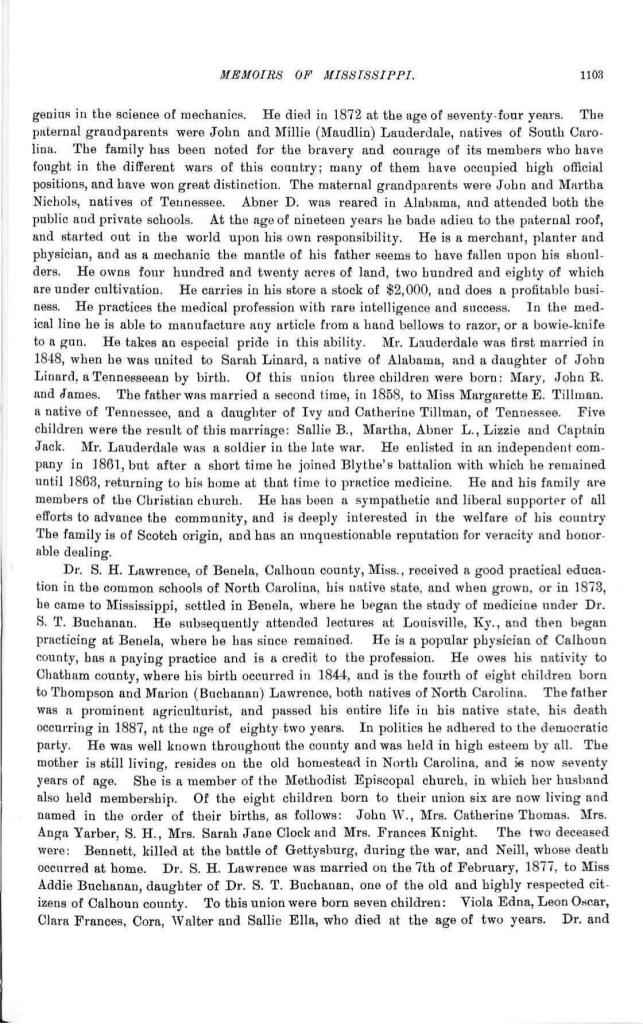
[3] This date of birth is recorded on the tombstone of John G. Lauderdale in Bakers Chapel cemetery, Hernando, DeSoto County, Mississippi: see the Find a Grave memorial page for John Gammel Lauderdale, created by Rachelle Ashmore Sanders, with a tombstone photo by Sanders. See also an affidavit given on 27 September 1962 by Mattie Conwill Murphy before the chancery clerk of Clay County, Mississippi, which states that this birthdate of John Gammel Lauderdale, his parents’ names, and other family information had been given to her in writing on 9 August 1943 by Ms. Winnie H. Gartrell of Hernando, Mississippi, and on 17 February 1949 by Ms. Martha Lauderdale Lusher of Nesbitt, Mississippi. I’m not certain of the source of my copy of this affidavit, which is a typescript sent to me in May 1997 by Imogen Turman of Jackson, Mississippi, and also in April 1997 by Penny Culver of West Helena, Arkansas. The affidavit appears to have been given as part of an application for DAR membership. Finally, a biography of Abner Driver Lauderdale, son of John Gammel Lauderdale and Penelope Nichols, states that Abner’s father John G. Lauderdale, son of John and Millie Maudlin [sic] Lauderdale, natives of South Carolina, died in Limestone County, Alabama in 1872, aged seventy-four years: see Biographical and Historical Memoirs of Mississippi, etc., vol. 1 (Chicago: Goodspeed, 1891), pp. 1102-3.
[4] Clint A. Lauderdale, History of the Lauderdales in America, 1714-1850 (Bowie, Maryland: Heritage Books, 1998), pp. 13, 22-5, 85.
[5] Eugenia Lauderdale Messick, “John Lauderdale, ‘Refugee Soldier,’ American Revolution,” unpublished article written in 1996, a copy of which Eugenia kindly sent me on 29 April 1997.
[6] Clint A. Lauderdale, History of the Lauderdales in America, p. 22.
[7] 1830 federal census, Limestone County, Alabama, p. 11A.
[8] Ibid., p. 3A.
[9] See supra, n. 3.
[10] Anne Lowry Worrell, Early Marriages, Wills, and Some Revolutionary War Records, Botetourt County, Virginia (Baltimore: Genealogical Publishing Co., 1976), p. 48, citing the original militia lists on file in Botetourt Co. courthouse. F.B. Kegley reports that Captain Mills’ company was comprised of men living on the lower half of Looney’s Mill Creek and Back Creek, extending as far west as James Moore’s and Thomas Rowland’s: see Kegley’s Virginia Frontier: The Beginning of the Southwest, the Roanoke of Colonial Days, 1740-1783, with Maps and Illustrations (Roanoke: Southwest Virginia Historical Society, 1938), p. 418. On 10 August 1780, Botetourt County court minutes state that John Mills Jr. had been made captain in Thomas Rowland’s militia company, with James Leatherdale appointed lieutenant: see Lewis Preston Summers, Annals of Southwest Virginia (Abingdon, Virginia: Summers, 1929), p. 327, abstracting court minutes.
[11] Sumner County, Tennessee, Will Bk. 1, pp. 39-41. Elizabeth Leatherdale brought suit against John Mills in Botetourt County, Virginia, on 10 February 1773, for breach of contract in promising to marry her when she bore his son John Mills on 1 April 1771: see Botetourt County Court Minutes Bk. 1, p. 39. Elizabeth won the suit and John Mills went on to marry Martha Ewing.
[12] Botetourt County, Virginia, Court Order Bk. 1780-1784, p. 655. See also Elizabeth Shown Mills’ 8 February 2019 report (updated 11 July and 10 November 2022) report “Augusta County & the Virginia Frontier, Mills & Watts: Initial Survey of Published Literature, principally” at her Historic Pathways website.
[13] Clint A. Lauderdale, History of the Lauderdales in America, p. 22.
 BEGATS AND BEQUEATHALS
4 thoughts on “John Lauderdale (1745 – 1830/1840), Father of Sarah Lauderdale Leonard (1)”