This final posting in the series about George Birdwell’s children will discuss the last five children George had by wife Mary — William, James, Joshua, Mary, and Jane. Because most of these Birdwell children have not been as extensively researched as George’s older children, and because there has been much confusion about some of them, I’m providing a more complete account of their lives than I have done in what I have written about their older siblings.

10. William Birdwell was born 10 February 1772 in Botetourt County, Virginia. This date of birth is recorded in the register of the Birdwell family bible that passed down (and see here) in the family of George Birdwell’s son John Birdwell (1770-1854).
Birdwell researchers frequently state that William’s wife was a Lefever whose given name was either Elizabeth (Betsy) or Rachel. It is not clear to me where the information that William married a Lefever comes from. A Rachel Burdwell aged 70 and born in Virginia, who is in the household of Ellis (Elias) Fawbush in Jackson County, Tennessee, on the 1850 federal census, appears to be William’s widow.[1] If the information that William married a Lefever is accurate, then it appears his wife was Rachel Lefever. The couple seems to have married around 1800, probably in Sullivan County, Tennessee, where a number of records place William at that period.
William Birdwell lived in Sullivan County until 1806, when he moved to Jackson County, Tennessee, though a 1798 Davidson County deed discussed below indicates that he may have lived at some point in Knox County with his brothers George and Joseph. On 10 October 1796, William was commissioned a lieutenant of the Sullivan County militia.[2] On 3 November 1797, William quitclaimed his interest in his share of his father’s estate.[3] The quitclaim document, which notes that William Birdwell was of Sullivan County, Tennessee, was filed in Davidson County where William’s brother George and mother Mary, executors of the estate of George Birdwell Sr., were living. This document was not recorded until 23 February 1811 after Jesse Craft, one of the witnesses, proved the quitclaim in Montgomery County, Tennessee, court on 16 October 1810.[4] As we’ve seen, William’s brother Moses Birdwell filed a quitclaim to his interest in their father’s estate on 4 November 1797, the day after his brother William made his quitclaim.
On 7 April 1798, William Birdwell’s brother George sold William and his brother Joseph 320 acres of land in Davidson County, Tennessee, with the deed stating that the land was a mile above Heaton Station and was part of a patent of 640 acres made by George Birdwell on 26 June 1793 (patent 374).[5] The deed identifies all three brothers as residents of Knox County. George signed this deed with witnesses Charles McClung and Garrett Fitzgerald and with Fitzgerald proving it on 19 May in Davidson County. On Charles McClung, who witnessed Moses Birdwell’s 4 November 1797 quitclaim to his interest in his father’s estate and who laid out the town of Knoxville, see this previous posting.[6]
On 1 October 1798, William Birdwell was taxed for 320 acres on Wells Creek in Davidson County.[7] By October 1800, he had failed to pay taxes on the land, since on 22 October 1800, the Tennessee Gazette reported that the land of William Birdwell on waters of Wells Creek in Davidson County was to be sold for taxes.[8] As we’ve seen previously, by 1802, William’s older brother George Birdwell bought more land in Davidson County, which is in Middle Tennessee, and at that time or shortly after, he moved there from Knox County in East Tennessee along with William and George’s mother Mary Birdwell.
On 16 December 1800, George Birdwell of Knox County sold James Birdwell of Sullivan County 178 acres on Kendrick Creek. George signed this deed with witnesses Vancel Allen and William Birdwell, and William proved the deed in Sullivan County court in May 1801 and it was recorded 1 June 1801.[9] James and William were both brothers of George Birdwell. As a previous posting notes, when George Birdwell Sr. moved to Sullivan County in 1779 or 1780, he settled on Kendrick Creek, with a number of his sons also buying land there and living on that creek.
On 30 December 1800, William Birdwell witnessed a deed of the commissioners of Jonesborough, county seat of Washington County, Tennessee, to Jacob Friend.[10] Washington County borders Sullivan County on the south. I don’t read this document as an indicator that William had moved to Washington County, since no other records from this time frame place him in Washington County and other records show him living in Sullivan County. At February court 1802, William Birdwell proved a deed of his brother George Birdwell to John Walley in Sullivan County.[11]
In 1805, William Birdwell is, if I am reading the murky copy of Roane County’s tax list for that year correctly, enumerated along with his brother John and brother-in-law Henry Landers: see the discussion of Mary Birdwell and husband Henry Landers below for more information about this.
By 1806, William Birdwell had moved to Jackson County in Middle Tennessee, where he signed a petition on 8 July calling for the county to be reduced to a manageable size and to have its county seat fixed at Fort Blount.[12] Fort Blount, which was on the Cumberland River southwest of the current county seat, Gainesboro, was made the county seat and continued in that capacity until 1818, when the county seat was moved to Gainesboro.[13]
On 9 June 1815, with the bill of sale noting that he lived in Jackson County, William Birdwell sold Matthew Cunningham of Giles County an enslaved woman named Rhoda, aged about twenty-five, and her children Quilla, aged about seven, Andrew, aged about three, and Madison, aged two months.[14]
William Birdwell was enumerated on the 1820 federal census in Jackson County, Tennessee, but doesn’t appear on the federal census after that date, so it seems he died between 1820 and 1830, very likely in Jackson County.[15] Jackson County probate records from the years 1801 to 1871 were destroyed in a courthouse fire, so there’s no probate record for William. An 11 October 1821 inventory of notes held by William’s brother-in-law Henry Landers in Lawrence County, Alabama, at Henry’s death shows a note for $30 owed by William Birdwell.[16] Henry Landers married William’s sister Mary.
A Find a Grave memorial page for William Birdwell suggests that he is buried in a Birdwell family cemetery in Jackson County. If that’s correct information, note that his grave has no marker, and all tombstones in this cemetery date from a period quite a bit later than William’s death.[17]
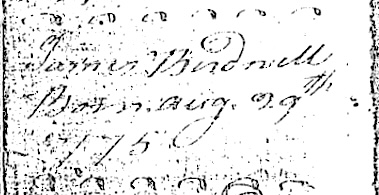
11. James Birdwell was born 29 August 1775 in Botetourt County, Virginia. This date of birth is recorded in the family bible cited previously. I have not found a marriage record for James or a document giving his wife’s name, though the 1840 federal census cited below suggests that by 1840, he may have had a wife.
The James Birdwell who was son of George and Mary Birdwell has been confused with a James Birdwell of Barren and Monroe Counties, Kentucky, who, as Aggie Birdwell indicates, is almost certainly a son of George Birdwell’s son Robert by George’s wife prior to Mary.[18] As Aggie Birdwell notes, the James Birdwell who was son of George and Mary lived for years in Sullivan County, Tennessee, and is found consistently in records there over a long time span. At the end of his life, he sold his land there and joined his brother William’s family in Jackson County, Tennessee, dying there.
As we saw above, on 16 December 1800, James’ brother George Birdwell of Knox County sold James Birdwell of Sullivan County 178 acres on Kendrick Creek in Sullivan County.[19] George signed with witnesses Vancel Allen and William Birdwell and with William proving the deed in Sullivan County court May 1801 and it being recorded 1 June 1801.
On 27 July 1810 while living in Sullivan County, James quitclaimed his interest in his father’s estate to his brother George and mother Mary Birdwell in Davidson County, Tennessee.[20] The quitclaim is also recorded in Blount County, Tennessee.[21] See the digital image at the head of the posting.
On 20 August 1814, James entered land in Sullivan County in the sixth district of Tennessee. The land was assigned to him by William Young, and on 1 September 1815, he received 20 acres on Kendrick Creek in Sullivan County.[22]
On 27 November 1823, Mc. Ozburn of Sullivan County sold to James Birdwell of the same county ten acres of land on the south side of Holston River bordering James Birdwell’s land.[23] Ozburn signed by mark with witnesses John Smith, David Perry, and Robert Easley. Easley and Perry proved this deed in Sullivan County at May court 1824 and it was recorded on 22 June 1824. As we’ve seen previously, James’ brother Benjamin Birdwell married David Perry’s daughter Mary.
On 17 January 1824 in Sullivan County, James Birdwell sold David Perry (the surname is spelled Parry in the deed) forty acres of land on Kendrick Creek out of the land on which James was living.[24] James signed with John F. Smith, Benjamin Birdwell, and Joseph Coin (or Cain?) witnessing. James proved the deed in May 1824 and it was recorded 1 July 1824. As I’ve just noted, David Perry was the father-in-law of Benjamin Birdwell.
On 21 August 1826 in Sullivan County, James Birdwell deeded to John F. Smith an acre and a half of land on the east side of Kendrick Creek, out of a grant to James in 1814.[25] James signed, with witnesses William Morell and F.A. Vincent.
On 29 December 1826, James Birdwell of Sullivan County sold Richard Gammon of the same county a messuage and tenements south of the Holston on Kendrick Creek.[26] No acreage is stated. James signed with John Whitlock and Jesse James witnessing. The two witnesses proved the deed at November court 1827 and it was recorded 14 December 1829.
On 18 February 1828, James Birdwell of Sullivan County sold Jonathan Buckelew and David Bacon of the same county the plantation on which James lived in Sullivan County, 215 acres.[27] James signed with John G. Boyd and William Carroll witnessing. James proved the deed at February court 1828 and it was recorded 17 March 1828.
After the sale of his Sullivan County homeplace, it’s clear to me that James moved to Jackson County, Tennessee, where his widowed sister-in-law Rachel Lefever Birdwell, wife of James’ brother William, was living. A James Birdwell appears on the 1830 federal census in Jackson County, but if this man’s age is given correctly —30-39 — he is not James Birdwell, son of George and Mary. I think this James Birdwell was a son of William and Rachel Birdwell.
In 1840, the James Birdwell who was son of George and Mary does show up on the federal census in Jackson County, with his age stated as 70-79 and with a female aged 60-69 in the household.[28] These are the only two persons in the household. If the female member of the household is not James’ wife, it’s possible she’s his sister-in-law Rachel Birdwell, though note that on the same census, Joseph Birdwell, a known son of William Birdwell and Rachel Lefever, has a female aged 70-79 in his household, and this may be his mother Rachel.
The 1850 federal mortality schedule for Jackson County shows that James Burdwell, aged 73, born in North Carolina, died of consumption in Jackson County in February 1850.[29] I have found no burial information for James Birdwell. The North Carolina birthplace is, of course, not correct. James was born in Botetourt County, Virginia, in 1775, before his family moved in 1779 or 1780 from there to Sullivan County, North Carolina (later Tennessee).
The James Birdwell of Barren and Monroe County, Kentucky, who has been confused with James Birdwell, son of George and Mary Birdwell, was in Barren County by 1804 when he was a chain carrier for a survey for John Harris in Barren County.[30] As documents discussed above show, at this point in time and for years after that, the James Birdwell who was son of George and Mary Birdwell was living in Sullivan County, Tennnesse.
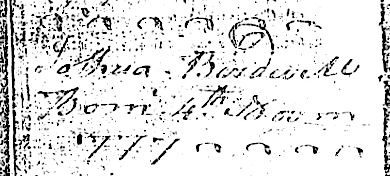
12. Joshua Birdwell was born 4 November 1777 in Botetourt County, Virginia. This date of birth is recorded in the Birdwell family bible cited previously.
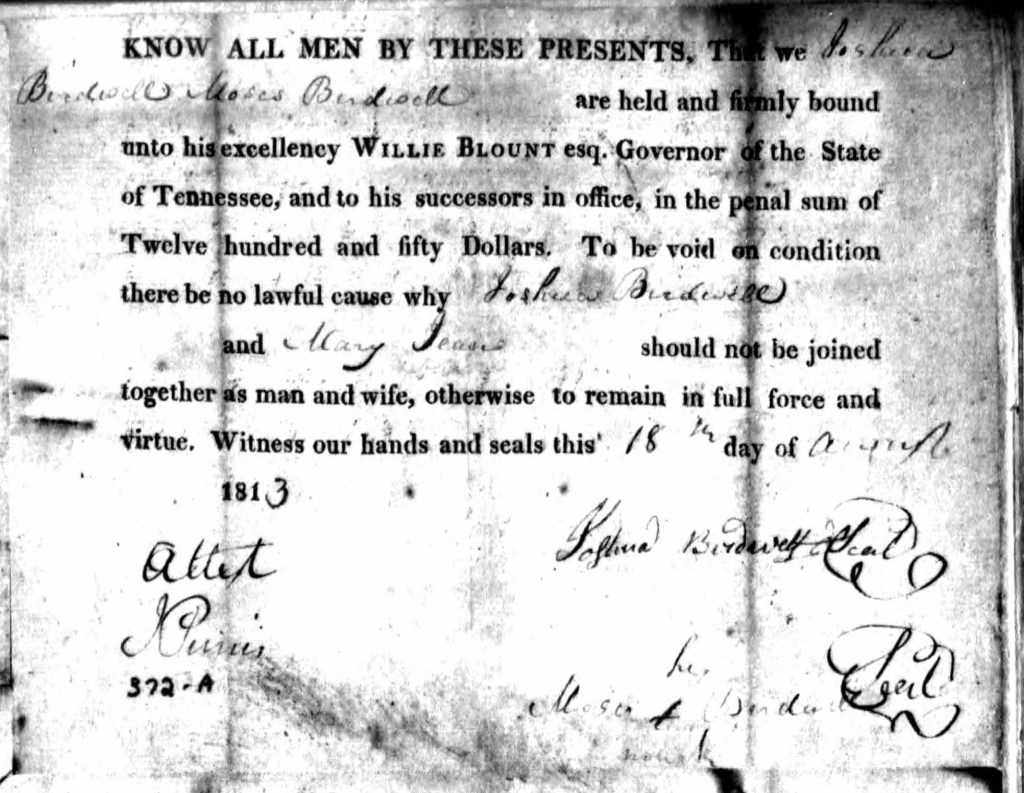
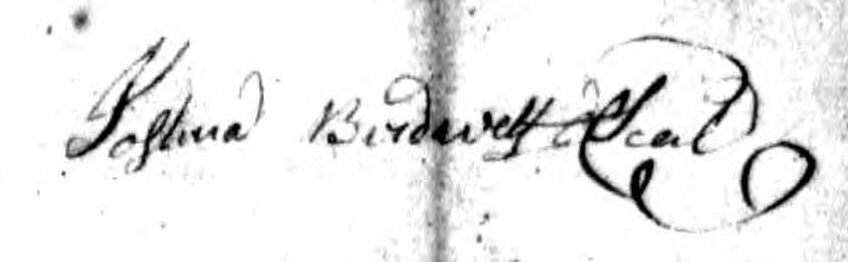
Joshua lived most of his adult life in Roane County, Tennessee, until at the very end of his life, he moved to Blount County, where he died. In Roane County on 18 August 1813, he gave bond with his brother Moses Birdwell to marry Mary Jeans.[31] Aggie Birdwell thought that Mary was likely a second wife for Joshua, and I believe she was correct about that.[32]
On 14 November 1797 while living in Sullivan County, Joshua Birdwell quitclaimed his interest in the estate of his father George Birdwell to his brother George and mother Mary Birdwell in Davidson County.[33] The document was recorded 26 July 1810, in Davidson County, noting that the quitclaim was originally made 14 November 1797. The same quitclaim was also recorded on 26 June 1810 in Blount County, Tennessee, noting that Joshua and his siblings Jean (Jane), James, and Mary had quitclaimed their interest in their father’s land in Davidson County.[34]
Joshua was a buyer at the undated estate sale of his brother Joseph Birdwell in Knox County, Tennessee, in or prior to January 1804, when the undated sale account was returned to Knox County court.[35] As we’ve seen previously, Joseph died in Knox County prior to October 1801, when his widow Rachel and her brother Andrew Russell appealed for administration of Joseph’s estate.
Joshua Birdwell was in Roane County by 1805, since he appears on the tax list of that county in that year.[36] Roane is contiguous to and west of Knox County, with the easternmost tip of Roane touching the westernmost tip of Knox. As we’ve seen previously, by 1802, Joshua’s older brother John Birdwell had settled in Roane County.
On 15 June 1807, Joshua Birdwell was appointed a juror in Roane County.[37] On 10 May 1808, he appears on Captain Wallis’ tax list in Roane County, with his brother John being listed in the same tax district on this 1808 tax list.[38]
At July court 1811 in Roane County, John Birdwell was ordered by the court to oversee the laying of a road from the upper end of the pawpaw plains to the top of Bradbury’s Ridge, beginning on the Clinch River above Pickle’s place, with the road passing Brock, both of the Birdwells, and Morrow to Bradbury’s Ridge, then along the Ridge to Clinch River, and thence to its beginning.[39]
On 1 June 1812 in Roane County, Joshua bought 200 acres from Thomas C. Clark, both men living in Roane County.[40] In 1812, he also appears on the tax list of Captains Matlock and Walker in Roane County.[41]
On 21 August 1813, Joshua Birdwell witnessed a deed by Jason Matlock to George Davis in Roane County.[42] And on 27 September 1814 in Roane County, he witnessed a deed by James Morrow to Abraham West, both residents of Roane County.[43]
On 27 October 1820, Joshua’s brother John Birdwell, then living in Lawrence County, Alabama, sold Samuel Andrew of Roane County 100 acres in Roane County, with Joshua Birdwell of Roane County acting as his brother John’s power of attorney.[44]
On 28 January 1822, a deed to Joshua from Nathan Nail and John Given for 69 acres of land in Roane County was proved in court by Joshua Birdwell.[45] On 14 February 1822, Joshua Birdwell had a survey in Roane County for two acres of land on the north bank of Clinch River, entry no. 3563 made on 23 April 1821, with certificate 1384 issued to Andrew Donovan.[46]
On 1 June 1829, Isaac West sold Joshua Birdwell, both men residing in Roane County, 80 acres of land on the north side of Clinch River in Roane.[47] The deed speaks of appurtenances, so it’s possible Joshua was buying land that had a house or other structures on it. On 28 July 1830, Joshua was a juror in Roane County in the case of Tennessee vs. Archibald Dotson.[48]
By November 1835, Joshua Birdwell had moved from Roane County to Blount County southeast of Roane. On 2 November 1835 with the deed stating that he was residing in Blount County, Joshua sold Richard White 153 acres on Clinch River in Roane County.[49] Joshua signed the deed with Gray Haggard and Robert Z. Hazzard witnessing. Haggard proved it in Roane County on 28 February 1839 and Hazzard on 7 March 1839, and it was recorded on 15 March.
In 1839, Joshua is on the Blount County tax list. By 5 August 1839, he had died in Blount County. On that date, Samuel Jackson gave bond with Robert A. Tedford and William Maxwell to administer the estate of Joshua Birdwell.[50]
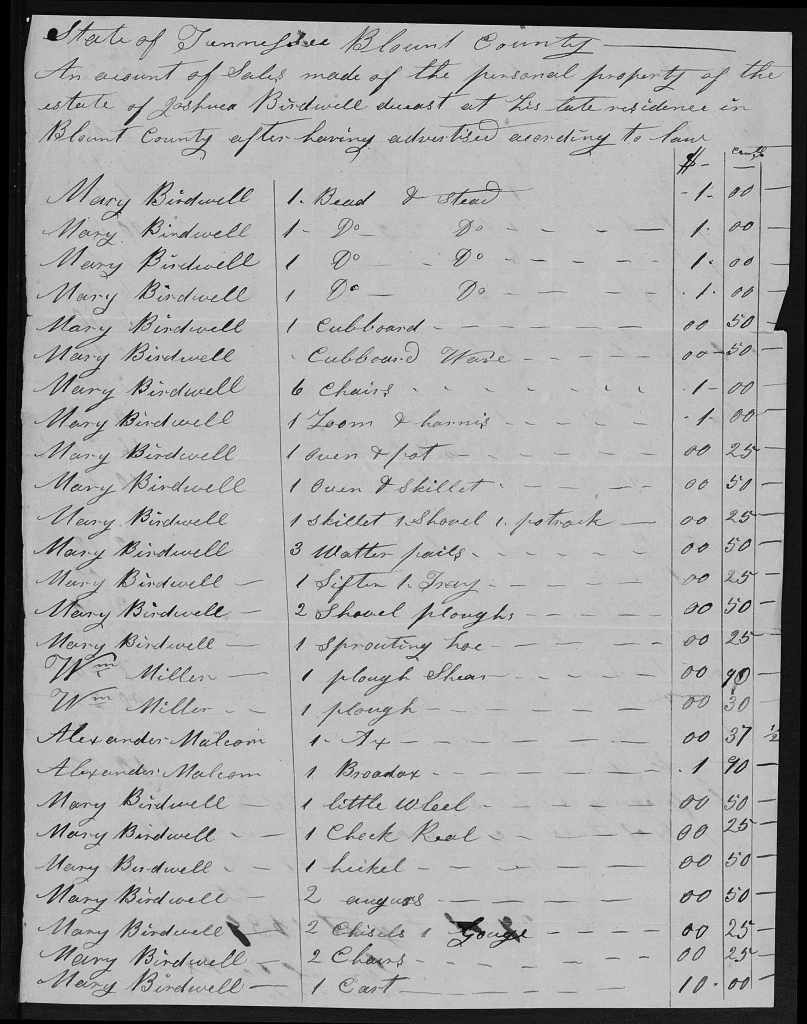

An inventory of Joshua’s estate and the dower share given to his widow Mary were recorded at Blount County court on 7 October 1839.[51] Joshua’s loose-papers estate file in Blount County has an account of the sale of his estate; the account is not dated, but was recorded 27 August 1839. The widow Mary was the primary buyer.
Joshua’s burial place is not known.[52]
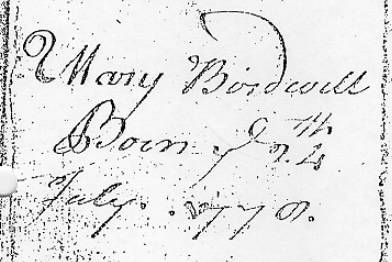
13. Mary Birdwell was born 24 July 1779 in Botetourt County, Virginia. This date of birth is recorded in the Birdwell family bible cited previously. About 1800, probably in Roane County, Tennessee, she married Henry Landers. Henry is on the 1802 Roane County tax list in Captain Richard Oliver’s tax district along with Mary’s brother John.[53]
Henry Landers was a juror in Roane County on 4 June 1802 and again on the third Monday in March 1804.[54] He appears on the 1805 tax list in Roane County and was again a juror there on the third Monday in March 1805.[55] I find him on a Roane County jury again on the third Monday in March 1807, and after this, it appears he and wife Mary and their family joined her brother John in moving from Roane County to Madison County, Mississippi Territory (later Alabama).[56] As a previous posting has noted, they’d be joined there in 1811 or 1812 by John and Mary’s brother Moses Birdwell, who named one of his sons Henry Landers Birdwell.
Henry Landers appears with his family on the 1809 census of Madison County.[57] As noted above, Mary was among the Birdwell siblings whose quitclaim on their father’s estate was filed in Blount County, Tennessee, on 26 June 1810.[58]
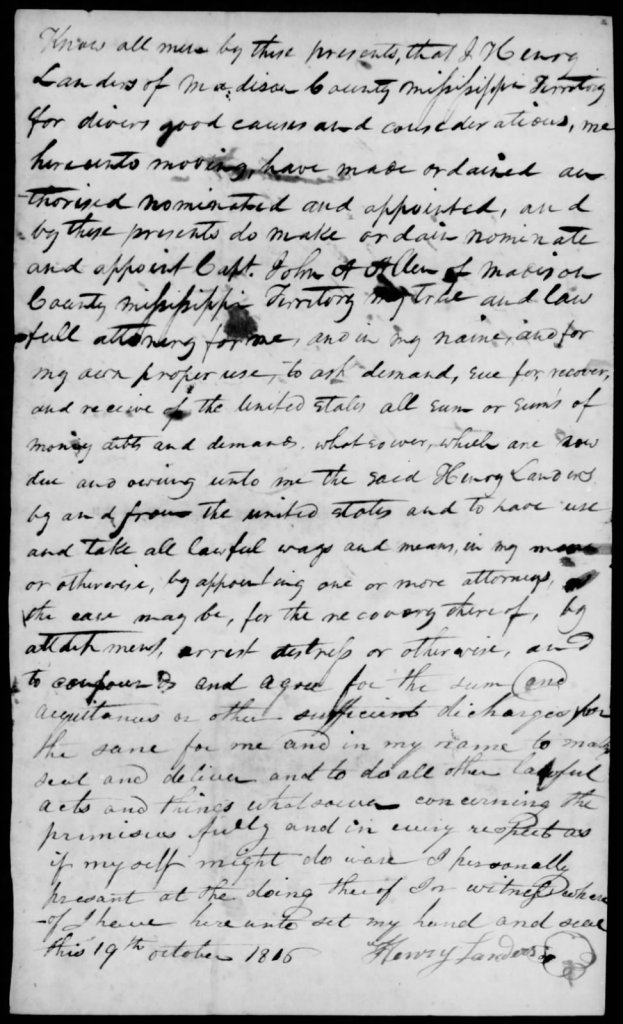
In December 1814, Henry Landers served as a private in Lieutenant Drury M. Allen’s Company of Mounted Gunmen of the Mississippi Militia during the War of 1812.[59] In his service packet, there’s a note signed by Henry on 19 October 1816 appointing John Allen of Madison County Henry’s lawful attorney to receive any money due to Henry for his service.
Henry Landers is enumerated on the tax list in Madison County in 1815 and 1816 and in 1820, appears on the 1820 Alabama state census in Lawrence County, which was formed in 1818.[60]
By 28 September 1818, Henry was acquiring land in Lawrence County, Alabama. Huntsville federal land office’s tract books show Henry buying the east ½ northeast ¼ of section 32, township 6, range 8 west on that date, with the land assigned to his widow Mary as administrator of Henry’s estate on 26 June 1829.[61] Another tract that Henry acquired on 6 January 1819, the west ½ northwest ¼ of the same township and range, section 33, was also assigned to Mary as estate administrator on 26 June 1829.[62]
On 28 February 1820, Henry Landers and wife Polly sold Anthony H. Metcalf, all identified as residents of Madison County in the deed, the northwest ¼ of section 6, township 2, range 1 east in Madison County.[63] Henry signed the deed with Polly making her mark and relinquishing dower the same day. There were no witnesses.
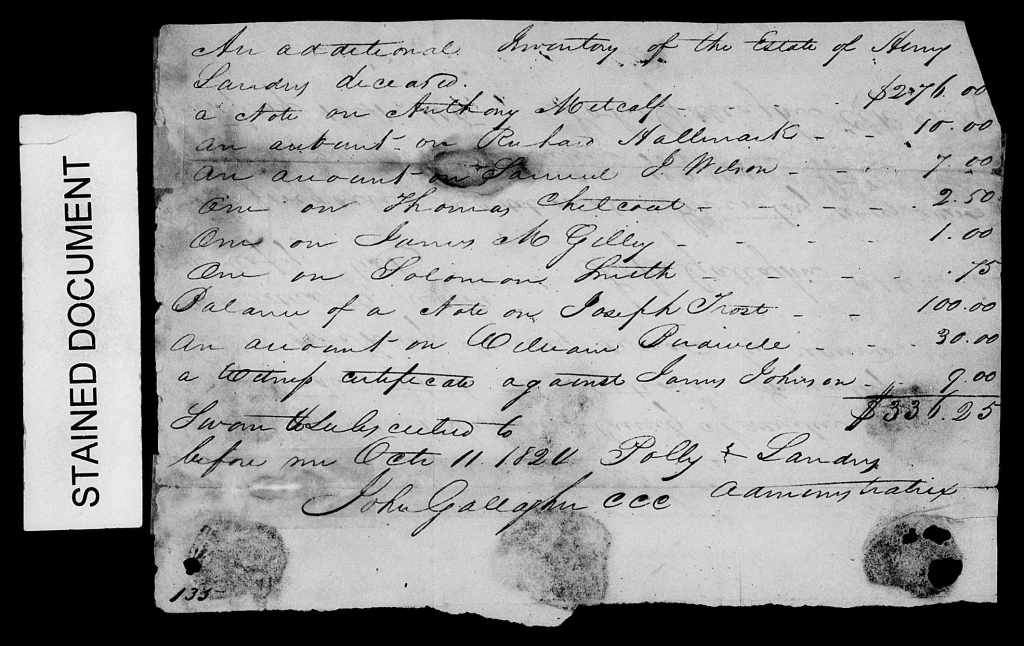
By 11 October 1821, Henry Landers had died in Lawrence County (but note the date below when the appeal was made to probate Henry’s estate: was the year recorded incorrectly on the document dated October 1821?). A loose-paper Orphans Court estate file for Henry in Lawrence County includes an inventory of notes owed to his estate at his death, signed (by mark) by Polly Landers, and dated 11 October 1821.[64]
Henry apparently died testate, though I do not have a copy of his will — digitized copies of Lawrence County, Alabama, will books are under lock and key at the FamilySearch site. The appeal for probate was made 8 September 1823; as I state above, the probate date makes me wonder if the 11 October 1821 inventory of notes was erroneously dated 1821 and should have been dated 1823.[65]
On 1 February 1830, the heirs of Henry Landers’ estate acquired two tracts of 77.28 acres each of federal land from the Huntsville land office, the east ½ northwest ¼ and west ½ southeast ¼ of section 32, township 6, range 8 west, with the land patents stating that the land had been assigned by John Wilson.[66] On 10 September 1838, in her own name, Mary Landers of Lawrence County acquired two more tracts of 77.28 acres of land each, the east ½ southeast ¼ and west ½ southeast ¼ of section 32, township 6, range 8 west.[67] In the index to the Bureau of Land Management’s General Land Office, Mary’s surname is incorrectly given as Sanders and not Landers.
Chuck Landers, whose research has been invaluable in establishing that Henry Landers married Mary, daughter of George and Mary Birdwell, thinks that Mary Birdwell Landers is a woman whose name has usually been transcribed as Mary Sanders on the 1840 federal census of Lawrence County.[68] Mary “Sanders” on the 1840 federal census in Lawrence County is aged 60-69 and has in her household only two males aged 20-29. There are also nine enslaved people in the household. Though most of Henry and Mary Landers’ children were living in Lawrence County in 1840 and the sons should appear on the census of that year with the surname Landers, indices to the 1840 Lawrence County federal census show no one with the surname Landers. Henry and Mary’s sons William and John were enumerated next to each other on this census, with their surname transcribed in census indices as Sanders.[69]
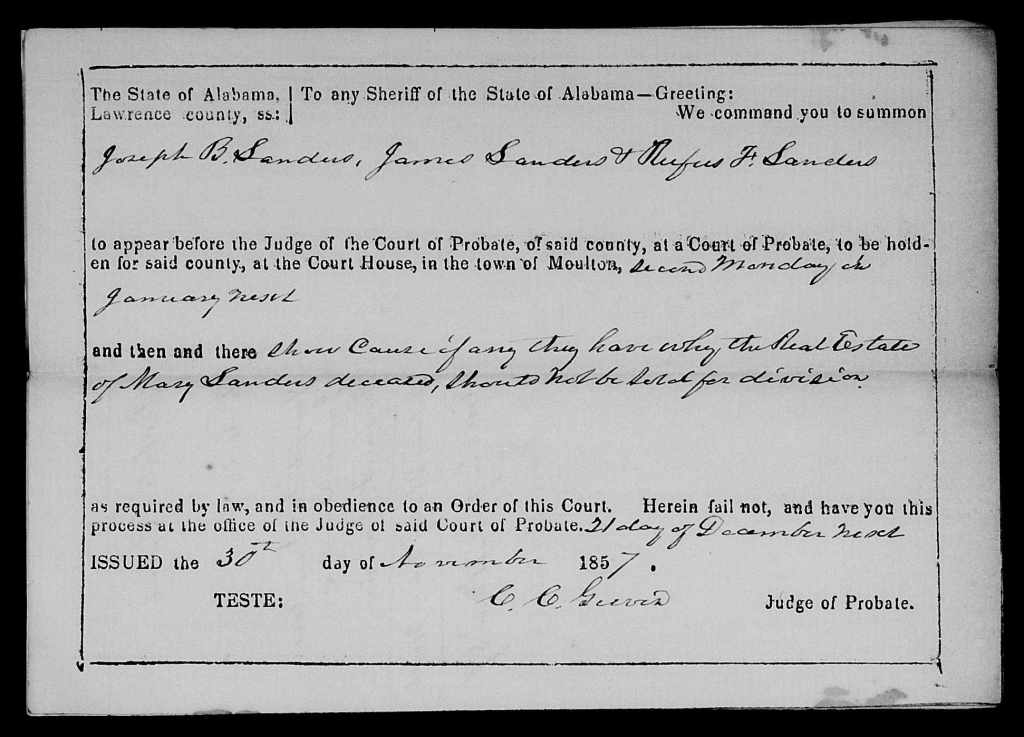
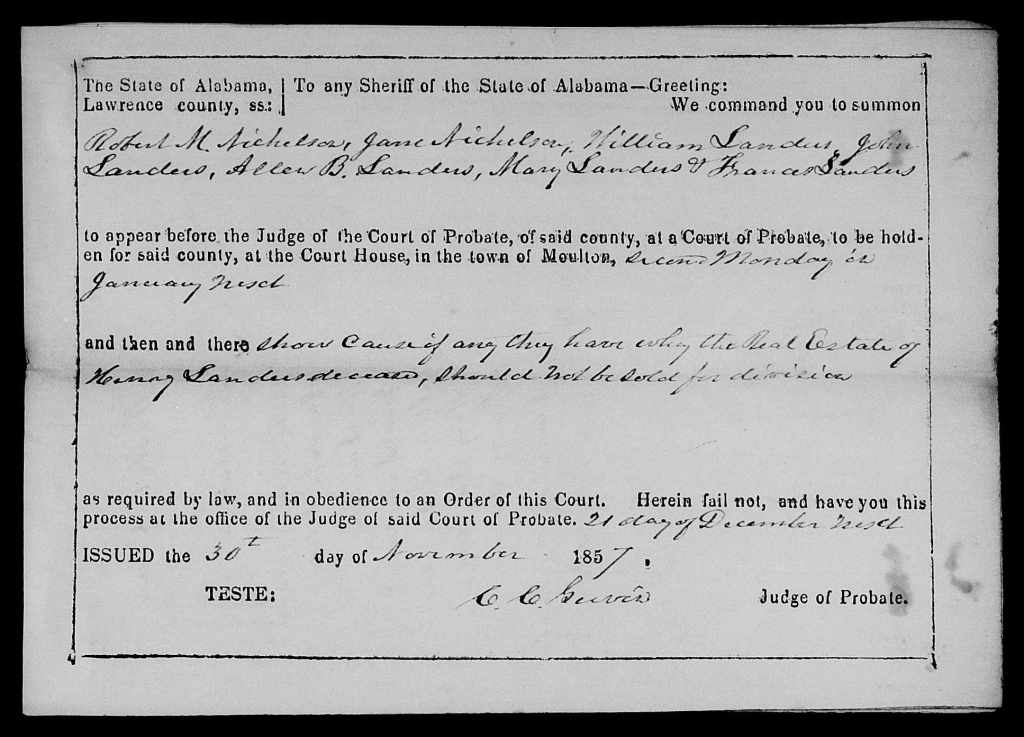
By 24 October 1857, Mary had died in Lawrence County: on that date, her son John Landers obtained probate of her estate and of the estate of Henry Landers that had remained in Mary’s hands. On 27 November 1857, the Moulton Democrat published a notice dated 24 October, stating that John had gotten probate of the estate of Mary Landers, deceased.[70] Mary’s loose-papers estate file has a court summons to her heirs dated 30 November 1857, notifying them of a forthcoming court hearing to determine whether Mary’s real estate should be sold.
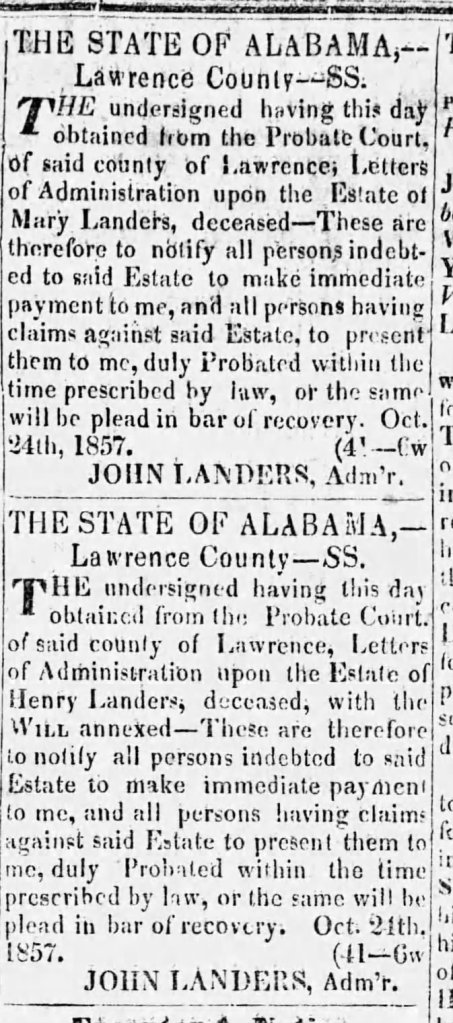
On 4 December 1857, the Moulton Democrat posted a notice of John Landers’ intent as administrator of Mary Landers to sell her land, naming her children as Jane (married Robert Nicholson), John, Joseph B., William, James, Alfred, Rufus, and Elijah. Elijah was deceased and his children John, Allen B., Mary, and Frances were his heirs.[71] Joseph B. was Joseph Birdwell Landers, and Allen B. was Allen Birdwell Landers.
This Landers family lived at Landersville in Lawrence County, some six miles west of Moulton. The community was named for Henry and Mary Birdwell Landers’ son John.
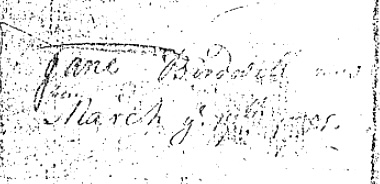
14. Jane Birdwell was born 17 March 1781 in Sullivan County, North Carolina (later Tennessee). This date of birth is recorded in the Birdwell family bible cited previously.
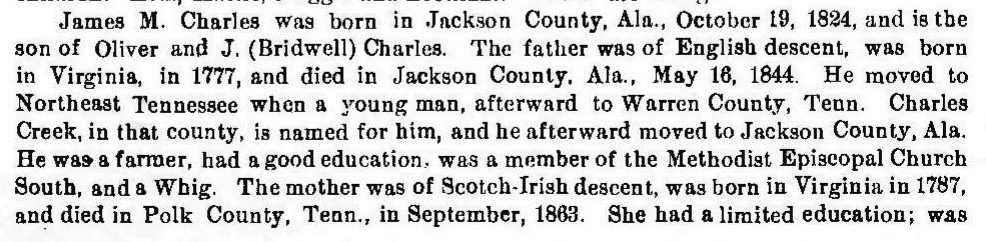
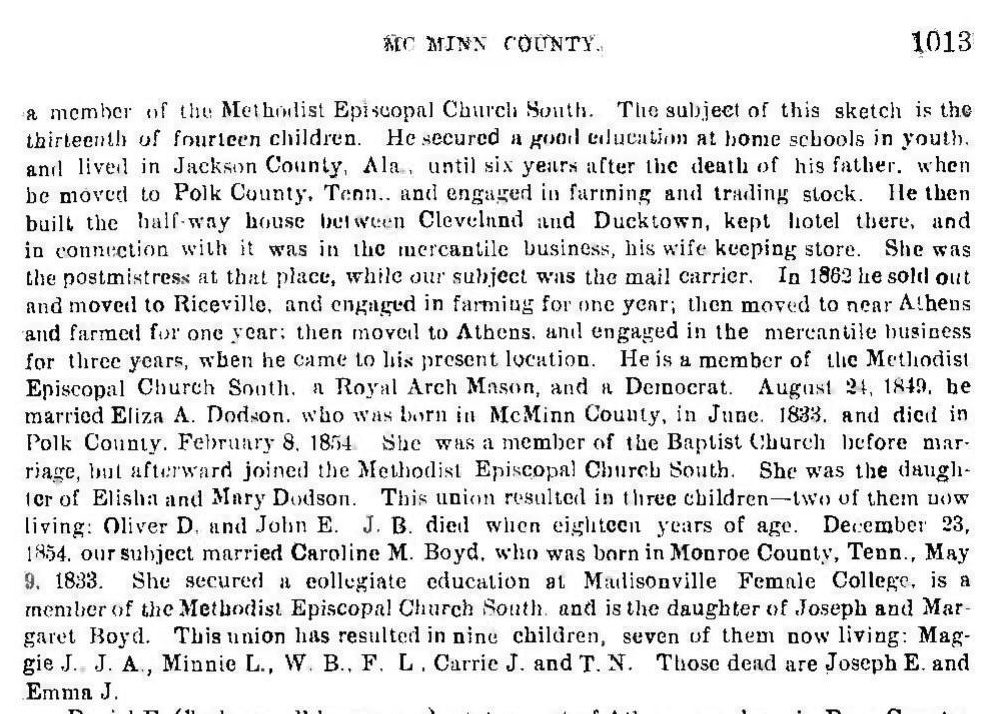
Researchers of the family of George Birdwell have frequently concluded that George and Mary Birdwell’s daughter Jane is a J. Bridwell, wife of Oliver Charles, mentioned in a biography of their son James M. Charles of McMinn County in Goodspeed’s History of Tennessee.[72] About J. Bridwell, Goodspeed states the following:
James M. Charles was born in Jackson County, Ala., October 19, 1824, and is the son of Oliver and J. (Bridwell) Charles. The mother was of Scotch-Irish descent, was born in Virginia in 1787, and died in Polk County, Tenn., in September, 1863. She had a limited education; was a member of the Methodist Episcopal Church South.
The 1860 federal census for Polk County, Tennessee, shows that J. Bridwell Charles was Jane Charles.[73] This census shows Jane Charles as aged 71 and born in Tennessee. Despite the surname discrepancy — Bridwell and not Birdwell — and the discrepancy between what Goodspeed and the 1860 census say about her age as compared with her birthdate in the Birdwell family bible, I think that Jane Charles very likely is George and Mary Birdwell’s daughter Jane.
My primary reason for concluding this is that the migration path of Oliver Charles closely parallels the migration path of several of George and Mary Birdwell’s sons, in the same time frame in which those Birdwell men moved about. In 1805, Oliver Charles was living in Hawkins County, Tennessee, which borders Sullivan County, where the Birdwell family had settled in 1779-1780, on the west. On 3 April 1805, Oliver bought land in Hawkins County from Mark Chambers, with the deed stating that both men resided in Hawkins County.[74]
The preceding deed was witnessed by James Charles, who was, according to a deed Oliver Charles made in Hawkins County on 20 September 1806, Oliver’s father. On that date, Oliver Charles sold James Charles the land he had bought from Mark Chambers, with the deed stating that James was Oliver’s father and that both lived in Hawkins County.[75]
I have not found a marriage record for Oliver Charles and Jane Birdwell, but I think it’s likely they married around 1800-1805, probably in Sullivan County.
Prior to August 1807, Oliver Charles had followed the migration pattern of several of George Birdwell’s sons previously discussed, from Sullivan (in Oliver’s case, Hawkins) County to Roane County. A 3 August 1807 East District of Tennessee grant to David McClellan in Roane County says the land granted to McClellan had originally been certified to William Armstrong, who assigned it to Oliver Charles, who then assigned it to McClellan.[76] No date is stated for when Charles assigned this land to Armstrong, but this grant record indicates that Oliver Charles was in Roane County prior to August 1807.
After this, Oliver Charles continues in Roane County records up to around 1810-5, when he moved from Roane to Warren County, Tennessee, a Middle Tennessee county several counties west of Roane. Roane court minutes for 24 September 1807 note that the case of Oliver Charles vs. William Willis, a defamation case, was before the court.[77] Roane court minutes note the continuation of this case on 24 March 1808.[78]
On 24 March 1808, Roane court minutes record the case of John White and Nathaniel Cox vs. Oliver Charles, a case of debt.[79] The court minutes regarding this case state that on 22 December 1807, a capias warrant had been issued for Oliver Charles.
On 22 June 1808, Oliver Charles was a juror in Roane County.[80] On 16 September 1808, Oliver made a bill of sale for a bay horse to Peter Avery in Roane County.[81] Oliver Charles appears again as a juror in Roane court minutes on 21 March 1809.[82] On 19 April 1810, county court minutes note another debt case against Oliver, the case of Francis Dalzeal (?) vs. Oliver Charles.[83] Finally, on 15 October 1810, Oliver was appointed to the circuit court jury in Roane County.[84]
As noted previously, Jane (her name given here as Jean) was among the Birdwell siblings whose quitclaim to their interest in their father’s estate was recorded on 26 June 1810 in Blount County, Tennessee.[85]
By August 1815, Oliver Charles was residing in Warren County, Tennessee. In an address he gave to the Middle Tennessee Club of Hamilton County on 7 March 1938, Judge L.D. Miller identifies Oliver Charles as an “early settler” of Warren County, which was founded in 1807.[86]
On 14 August 1815, a Tennessee Mountain District grant to Thomas Hopkins in Warren County states that land being granted to Hopkins on that date on Burleson’s Creek of Town Creek, waters of Collins River, bordered land then occupied by Oliver Charles.[87]
On 5 November 1817, Oliver Charles bought land in Warren County from Abednego Green and Isaac Campbell, all of these men residents of Warren County.[88] On 5 May 1818, James Cain, who co-owned the land sold by Green and Campbell, made his deed for the same tract to Oliver Charles.[89]
By 1819, Oliver Charles had left Tennessee and moved to northeast Alabama, where he signed a petition to the U.S. Secretary of War in that year (it was not dated except for the year, but was received by the government office in August 1819) asking that settlers on Cherokee lands in the Cherokee Nation (settlers of European descent, obviously) not be treated as squatters and removed from their land.[90] An 1819 tax list confirms that Oliver Charles was a resident of the Cherokee country in Alabama by that year.
Though Oliver Charles was no longer living in Warren County, Tennessee, in 1827, on 12 March 1827, he received a state grant in that county for land on the mountain west of Dry Creek on Town Creek, waters of Collins River.[91]
In December 1819, the federal government removed the Cherokees from their territory in northeast Alabama and Jackson County was formed. After this point, Oliver Charles begins appearing in the records of that county. On 24 November 1831, he was a chain carrier in Jackson County for a survey for Samuel Welch.[92]
Jackson County is in extreme north Alabama where, as we’ve seen, a number of Jane Birdwell’s siblings had settled previously in nearby counties bordering Tennessee. It’s in the northeastern corner of the state, bordering Madison County, where John and Moses Birdwell first settled when they arrived in what would soon become Alabama, and where, as noted above, their sister Mary and husband Henry Landers also settled when they moved from Tennessee.
On 3 October 1832, Oliver Charles bought federal land in Jackson County from the Huntsville land office, the southeast ½ northwest ¼ of section 15, township 2, range 8 east.[93] This land is east of Stevenson, Alabama, and is some forty miles southwest of Chattanooga. Oliver received the certificate for this tract of 39.75 acres on 10 September 1834.[94]
On 2 December 1839 in Jackson County, Oliver Charles was security in a deed of trust that Hamilton Anderson made to Edmund Pearson.[95] The deed of trust shows Oliver Charles signing his name while Anderson made his mark.
The Goodspeed biography of Oliver and Jane Charles’ son James M. Charles cited above states that Oliver Charles died in Jackson County on 16 May 1844, and that he was born in Virginia in 1777. According to the biography, Oliver Charles moved to northeast Tennessee as a young and from there to Warren County, where Charles Creek in that county is named for him.
James M. Charles’ biography states that six years following his father’s death, James, who was born in Jackson County on 19 October 1824, moved from there to Polk County, Tennessee. At that point it appears that his widowed mother Jane, who was living in James’ household in Polk County on the 1860 federal census, joined her son in the move from Alabama to east Tennessee, dying in Polk County in September 1863, as the biography indicates. I have not found burial information for either Oliver Charles or Jane Birdwell Charles.
[1] 1850 federal census, Jackson County, Tennessee, p. 220 (dwelling/family 856, 26 October).
[2] Commission Book 1796-1800, transcribed by Tennessee Daughters of the America Revolution in Sullivan County, Tennessee Records (1971), p. 75.
[3] Davidson County, Tennessee, Deed Bk. I, p. 78.
[4] The probate statement is in the Davidson County, Tennessee, document, and see also Montgomery County, Tennessee, Court Minutes Bk. 2, p 117.
[5] Davidson County, Tennessee, Deed Bk. D, pp. 418-9.
[6] See “Charles McClung,” Wikipedia.
[7] Davidson County, Tennessee, Tax List 1798.
[8] Tennessee Gazette (22 October 1800), p. 1, col. 1.
[9] Sullivan County, Tennessee, Deed Bk. 3, p. 378.
[10] Washington County, Tennessee, Deed Bk. B, p. 614.
[11] Sullivan County, Tennessee, Deed Bk. 3, p. 422.
[12] “Petition asking reduction of Jackson County to constitutional size and to locate a permanent county seat” (1806), petition 6, session 1; see Tennessee State Library and Archives microfilm roll 3, Legislative Petitions, 1805-1812.
[13] See “Fort Blount,” Wikipedia
[14] Giles County, Tennessee, Deed Bk. B, pp. 300-1.
[15] 1820 federal census, Jackson County, Tennessee, p. 2.
[16] Lawrence County, Alabama, Loose-Papers Orphans Court Estate files, “Landers, Henry, estate, Landers, Mrs. Polly, execrx.,” container 174, folder 38.
[17] Find a Grave memorial page for William Birdwell, Birdwell cemetery, Jackson County, Tennessee, created by Betty Young Bray, maintained by Lisa Alderidge.
[18] Aggie Birdwell and Jane LeFevre Teal, “Introduction,” at A.J. Lambert’s Denny-Loftis Genealogy website. This article is part of a series of articles published by J. Weldon Birdwell in a now-defunct publication entitled Birdtracks, which gathered research and articles compiled by Birdwell researchers. This publication was previously hosted by a Rootsweb site whose material is no longer available online.
[19] Sullivan County, Tennessee, Deed Bk. 3, p. 378.
[20] Davidson County, Tennessee, Deed Bk. I, p. 2.
[21] Blount County, Tennessee, Court Minutes Bk. B, p. 253.
[22] East District of Tennessee Land Grants, Bk. 4, p. 318.
[23] Sullivan County, Tennessee, Deed Bk. 10, p. 9.
[24] Ibid., p. 20.
[25] Ibid., p. 261.
[26] Ibid., pp. 368-9.
[27] Ibid., pp. 392-3.
[28] 1840 federal census, Jackson County, Tennessee, p. 269A.
[29] 1850 federal mortality schedule, Jackson County, Tennessee, p. 420.
[30] Vivian Rousseau and Sandra K. Gorin, Old Surveys, Barren County, Kentucky, 1799-1835, Edmund Rogers & Daniel Curd (Gorin, 1990), p. 8 (p. 33 in original survey book).
[31] The bond is in the loose-papers marriage files of Roane County, Tennessee.
[32] Birdwell and Teal, “Introduction.”
[33] Davidson County, Tennessee, Deed Bk. I, p. 1.
[34] Blount County, Tennessee, Court Minutes Bk. B, p. 253.
[35] Knox County, Tennessee, Estate Book 1792-1811, pp. 136-8.
[36] Mable Harvey Thornton, Pioneers of Roane County, Tennessee, 1801-1830 (Thornton, 1966), p. 18.
[37] Roane County, Tennessee, Court Minutes Bk. B, p. 299.
[38] Emma Middleton Wells, The History of Roane County, Tennessee, 1801-1870 (Chattanooga, 1927), pp. 15, 31.
[39] Thornton, Pioneers of Roane County, p. 35.
[40] Roane County, Tennessee, Deed Bk. D-1, pp. 131-2.
[41] Thornton, Pioneers of Roane County, p. 37.
[42] Roane County, Tennessee, Deed Bk. D-1, pp. 351-2.
[43] Roane County, Tennessee, Deed Bk. DB E-1, pp. 271-2.
[44] Ibid., pp. 537-8.
[45] Roane County, Tennessee, Court Minutes Bk. July 1821-April 1823, p. 69.
[46] Kingston, Tennessee, Survey Bk. B-1, p. 429.
[47] Roane County, Tennessee, Deed Bk. F-1, pp. 520-1.
[48] Roane County, Tennessee, Quarterly Court Minutes Bk. 1830-1, p. 140; and Roane County, Tennessee, County Court Minutes Bk. April 1830 – October 1831, p. 75.
[49] Roane County, Tennessee, Deed Bk. G-1, pp. 701-2.
[50] See the original bond in Joshua Birdwell’s loose-papers estate file in Blount County, and Blount County, Tennessee, Court Minutes Bk. 5, p. 260.
[51] Blount County, Tennessee, Court Minutes Bk. 5, p. 267.
[52] See Find a Grave memorial page for Joshua Birdwell, burial place unknown, created by Ray Isbell.
[53] The original tax list is in Tennessee State Library and Archives. It enumerates Henry Landers as no. 233 in Roane County. Due to bleed-through from ink on both sides of the paper on which the list was compiled, names are difficult to read. No. 204 on the list appears to me to be Mary Birdwell’s brother William Birdwell, though the surname is not easy to see. A digital image of the tax list is in Ancestry’s collection Tennessee, U.S., Early Tax List Records, 1783-1895, digitizing a microfilmed copy of the original document in TSLA. See also Wells, The History of Roane County, Tennessee, p. 15.
[54] Roane County, Tennessee, Court Minutes Bk. A, pp. 23, 183-5.
[55] Ibid., p. 333.
[56] Ibid., Bk. C, p. 9.
[57] Clarence Edwin Carter, ed., Territorial Papers of the United States, vol. 5: The Territory of Mississippi, 1798-1817 (Washington, D.C.: Government Printing Office, 1937), p. 687.
[58] See supra, n. 21.
[59] NARA, Carded Records Showing Military Service of Soldiers Who Fought in Volunteer Organizations During the War of 1812, compiled 1899 – 1927, documenting the period 1812 – 1815, RG 94, available digitally at Fold 3.
[60] Alabama state census, 1820, Lawrence County, unpaginated.
[61] Huntsville, Alabama, Land Office Tract Bk. 7, p. 169.
[62] Ibid., p. 183.
[63] Madison County, Alabama, Deed Bk. F, p. 179.
[64] See supra, n. 16.
[65] Lawrence County, Alabama, Will Bk. 1, p. 20; Lawrence County, Alabama, Orphan’s Court Book B, p. 62.
[66] Alabama Credit Volume Federal Patent Bk. 128, pp. 453-4, no. 2751 and 2752.
[67] Alabama State Volume Patent Bk. 3560, pp. 405-6, no. 9835-6.
[68] 1840 federal census, Lawrence County, Alabama, p. 200. Weldon J. Birdwell summarized Chuck Landers’ research findings in a posting in August 1999 to the now-defunct Birdwell discussion group at Rootsweb. See also Daniel J. Landiss’ also defunct Landers family tree, “Descendants of John Landers,” previously at Genealogy.com.
[69] 1840 federal census, Lawrence County, Alabama, p. 196.
[70] Moulton Democrat (27 November 1857), p. 3, col. 3. See also Lawrence County, Alabama, Probate Court Loose-Papers Estate file, box 199, file 39, Mary Landers estate; and Lawrence County, Alabama, Circuit Court Loose-Papers case file, box 132, file 39 J.M. Burroughs vs. William Landers case 7085.
[71] Moulton Democrat (4 December 1857), p. 2, col. 5.
[72] Goodspeed’s History of Tennessee Containing Historical and Biographical Sketches of Thirty East Tennessee Counties, etc. (Chicago and Nashville: Goodspeed, 1887), pp. 1012-3.
[73] 1860 federal census, Polk County, Tennessee, district 5, Benton post office, p. 91 (dwelling/family 619; 17 July).
[74] Hawkins County, Tennessee, Deed Bk. 4, p. 113.
[75] Ibid., p. 193.
[76] East District of Tennessee Land Grants Bk. 1-1, p. 474. See also Kingston, Tennessee, Surveyor Bk. March 1807 – Nov. 1813, p. 2, which gives Armstrong’s name as John.
[77] Roane County, Tennessee, Court Minutes Bk. C, p. 6
[78] Ibid., p. 130.
[79] Ibid., Bk. B, p. 135.
[80] Ibid., Bk. C, p. 180.
[81] Roane County, Tennessee, Deed Bk. A, p. 106 and Bk. C-1, pp. 70-1.
[82] Roane County, Tennessee, Court Minutes Bk. B, p. 47.
[83] Ibid., Bk. C, p. 213.
[84] Ibid., Bk. Sept. 1808 – Oct. 1812, p. 247.
[85] See supra, n. 21.
[86] L.D. Miller, “Extracts from an Address,” Warren County Times and McMinnville New Era (22 April 1938), p. 4, col. 2.
[87] Tennessee Mountain District Land Grants Bk. 5, p. 298.
[88] Warren County, Tennessee, Deed Bk. B, pp. 336-7.
[89] Ibid., pp. 95-6.
[90] “Memorial to the Secretary of War from the Cherokee Country,” in Charles Edwin Carter, ed., The Territorial Papers of the United States, vol. 18: The Territory of Alabama, 1817-1819 (Washington, D.C.: Government Printing Office, 1952), p. 616.
[91] Tennessee Grant Records Bk. 1826-8, p. 536.
[92] Jackson County, Alabama, Deed Bk. D, p. 95.
[93] Huntsville, Alabama, Federal Land Office Tract Bk. 7, p. 114.
[94] Alabama, State Volume Patent Bk. 1260, p. 200, certificate 5352.
[95] Jackson County, Alabama, Deed Bk. A, pp. 269-270.
 BEGATS AND BEQUEATHALS