

The copies of pages of the George Birdwell bible register produced by Texas DAR in 1955 state that Mrs. E.W. LeFevre of Eden, Texas, a descendant of George Birdwell’s son Joseph, had supplied photocopies of the bible register, noting that in 1955, the bible belonged to Mrs. H.L. Stone of San Angelo, Texas. Notes made by Jerry H. Birdwell Jr. of Bryan, Texas, in November 1992 state that George Birdwell’s bible was brought by his son John (1770-1854) to Texas and descended from John to his son Colonel Allen Birdwell (1802-1893).[3] These notes identify the Mrs. H.L. Stone who owned the bible in 1955 as Lucille Stone, and state that she was a granddaughter of Allen Birdwell. Jerry Birdwell thought that, in 1992, the bible belonged to another Mrs. Stone of Houston.
Lucille Stone was a daughter of Allen Birdwell’s daughter Ada B. Birdwell and husband John Abe March. She married Hugh Lamar Stone. A discussion of George Birdwell’s bible in an article about Birdwell genealogy written in 1991 by Jane LeFevre Teal suggests to me that Jane Teal, daughter of Hazie Davis LeFevre – the Mrs. E.W. LeFevre mentioned above – may have owned this bible in 1991.[4]
I’ll discuss George Birdwell’s bible register in more detail in a subsequent posting about George himself. For now, as I am citing this document for information about the birthdate of his son Moses, I wanted to offer some notes on the provenance of this bible, and where photocopies or digital copies of the bible register may be found.
George Birdwell was married twice. His first wife’s name is not known. His second wife Mary is said by many Birdwell researchers to have been née Looney, though I’m unaware of documented proof of that claim. The bible records the names and dates of birth of all of George’s children by wife Mary. George Birdwell’s 14 September 1781 will, which he made in Sullivan County, North Carolina (later Tennessee), but which is filed in Bedford County, Virginia, names his children by both marriages and names his second wife Mary.[5]
All the names and birthdates of George’s children entered into the bible register except the name and date of birth of his last child Jane give the appearance of having been written by the same hand. There’s no indicator in the bible register of who made these entries. Since the bible is contemporaneous with George, who is thought to have been born about 1720 and who died between 14 September and 26 November 1781, many researchers have thought George Birdwell himself made these entries in the bible register.


However, in my view, the handwriting in the bible entries does not match that of George Birdwell. On 9 August 1759 at Fort Fauquier in Augusta County, Virginia, George Birdwell signed a receipt for £5 10s 7½d he had received from Colonel John Buchanan as payment for 885 pounds of beef he had furnished Buchanan’s troops at the fort in September 1758. Buchanan paid him on 5 September 1758 and George Birdwell then gave receipt on 9 August 1759, signing his name as George Birdwel.[6] George Birdwell also used the same spelling of his surname as he signed his will on 14 September 1781 in Bedford County, Virginia.[7]
When I compare George Birdwell’s signature in these two documents with the handwriting of the bible entries, it appears to me that a different hand than George’s wrote the entries in the Birdwell bible. The capital G George used is different from that same letter as it appears in the entries in his bible. He also used the printed shape of lowercase r instead of the cursive shape of that letter. And, of course, it should also be noted that he signed his name with the spelling Birdwel instead of Birdwell for his surname – and that spelling does not appear in the bible entries.

On 24 January 1854 in Rusk County, Texas, George Birdwell’s son, who brought the Birdwell bible to Texas as stated previously, made his will.[8] When I compare John Birdwell’s signature to his will with the handwriting of the entries in the Birdwell bible, it appears to me that these entries were very likely written by John Birdwell and not his father George. John spelled his surname Birdwell and not Birdwel; the capital B he used for his surname as he signed his will is identical to the one that appears in the bible entries; and he used the cursive lowercase r and not the printed shape of lowercase r. The only letter that differs slightly in John’s signature to his will from the handwriting in the bible register is the capital J; but the variation is not dramatic and may be insignificant here.
A common practice as children married and left home from the colonial period into the nineteenth century was to obtain a bible for their new family and then copy into it information that had been written in the bible register of their parents. I think it’s possible that the bible George Birdwell’s son John brought to Texas in the 1830s was John’s family bible and not his father George’s, and that John Birdwell wrote the names and dates of birth of himself and his siblings in that bible, copying this information from a bible owned by his parents. The only problem with this deduction is that one would also expect John to have recorded information about his own family in the bible register, and this bible register does not have that kind of information. Whatever the explanation, though, I’m fairly certain that the handwriting of this bible register is John’s and not his father George’s.
A note about when John Birdwell moved to Texas from Alabama: Carolyn Murray Greer states,[9]
He first came to Texas in 1838 by some accounts, while one reference gives a date as early as 1835, he did not move permanently until 1842 after the death of his wife, Mary Allen Birdwell. His son, Col. Allen B. Birdwell, wrote in his own notebook ledger that he moved to Texas in 1842 and that his father John Birdwell lived with him in Nacogdoches County. John Birdwell was still living in Allen Birdwell’s household in Rusk County in the 1850 census. The Handbook of Texas by the Texas State Historical Association, says: “Allen Birdwell’s father John may have moved to Nacogdoches County, Texas, in 1838, and Allen and his wife Lucinda (Ross) followed by 1842.”
Virginia Years, 1747-1779
Records from February 1747 to March 1779 place George Birdwell in Augusta County, Virginia. This is in all likelihood where Moses Birdwell was born on 15 October 1769. George had 140 acres of land surveyed in Augusta County on 16 February 1747.[10] This land fell into Botetourt County at that county’s formation in 1770, and was in a bend of the James River northeast of Fincastle, Botetourt’s county seat, identified on older county maps as Horseshoe Bend. The bend is just north of where Fort Fauquier stood at Looney’s Ferry, where Looney’s Mill Creek emptied into the James River. It’s on that tract of land in what’s now Botetourt County that Moses Birdwell would very likely have been born on 15 October 1769.
Sullivan County, North Carolina (Later Tennessee), Years, 1779-abt. 1790, and Moses’ First Marriage
After Moses Birdwell’s father George Birdwell and wife Mary sold their land in Botetourt County on 2 March 1779[11] and relocated to Sullivan County, North Carolina (later Tennessee), their son Moses, who would turn ten years old in October 1779, went with his parents and siblings to North Carolina. The Bedford County, Virginia, will that George made on 14 September 1781, noting that he lived in Sullivan County, North Carolina, and naming his wife Mary and his children including Moses, implies that Mary and the children were living with him in Sullivan County when the will was made.
At some point prior to 23 November 1791 when his first son, George Washington Birdwell, was born in Franklin County, Georgia, Moses had married and settled in Georgia.[12] When and where Moses married and the name of his wife (this was a first wife: he’d marry again in August 1816 in Madison County, Mississippi Territory) have not come to light.
Franklin County, Georgia, Years, abt. 1790 to 1811/2
Sullivan County is in the northeastern corner of Tennessee bordering Virginia on the south. Franklin County, Georgia, is in northwest Georgia, bordering South Carolina on the west. It’s some 200 miles south of Sullivan County, Tennessee. Following the 31 May 1783 treaty that the state of Georgia made at Augusta with the Cherokees, ceding Cherokee land in northwest Georgia to the state, settlers began pouring into the area from Virginia and Tennessee to the north and the Carolinas to the east. Though I’ve found no records to document the following scenario, the likeliest scenario explaining Moses’ move to northwest Georgia prior to November 1791 when his son George was born in Franklin County seems to me to be that, as he approached his 20th birthday in 1789, he married – possibly in Sullivan County, Tennessee – and then chose to settle with his wife on land in Franklin County, Georgia, that the treaty of Augusta had recently made available for settlement by settlers of European descent.

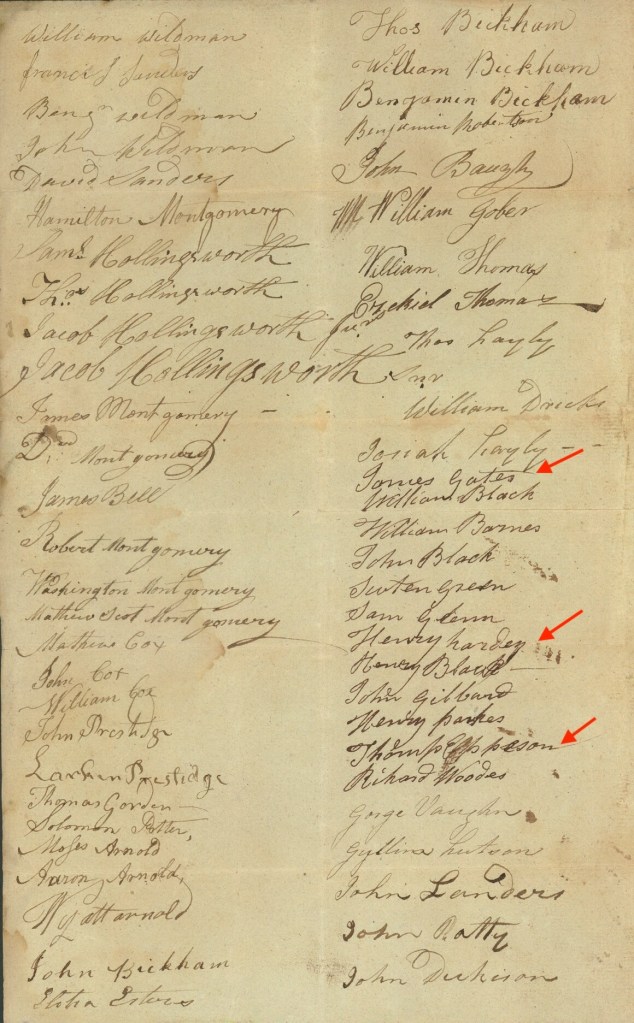
A 30 January 1796 deed in Franklin County confirms that Moses was living in that county by that date. On that date Moses witnessed James Gates’ administration bond for the estate of Samuel Epperson, with Thompson Epperson and Henry Hardy giving security along with James Gates.[13] Thompson Epperson (1757-1836) was apparently Samuel’s father. A Revolutionary pension application that Thompson Epperson filed in Franklin County on 3 September 1832 states that he was born in Albemarle County, Virginia, and gave Revolutionary service in both Virginia and North Carolina before moving to Franklin County, Georgia, in 1790. On 22 September 1782 in Albemarle County, he married Mary Israel.[14] An 8 May 1797 petition of inhabitants of Franklin and Jackson Counties, Georgia, to Governor Jared Irwin shows James Gates, Thompson Epperson, and Henry Hardy all signing in the same column, suggesting that they were neighbors.[15] Also signing this petition on the same page on which Gates, Epperson, and Hardy signed it was Jacob Hollingsworth (1742-1822), who came to Franklin County, Georgia, from North Carolina in 1790 to build Fort Hollingsworth in the Wofford settlement, and who permanently settled there in 1792. These Franklin County citizens were petitioning Governor Irwin to give them more protection against the neighboring Cherokees whose former land the new settlers were now occupying.
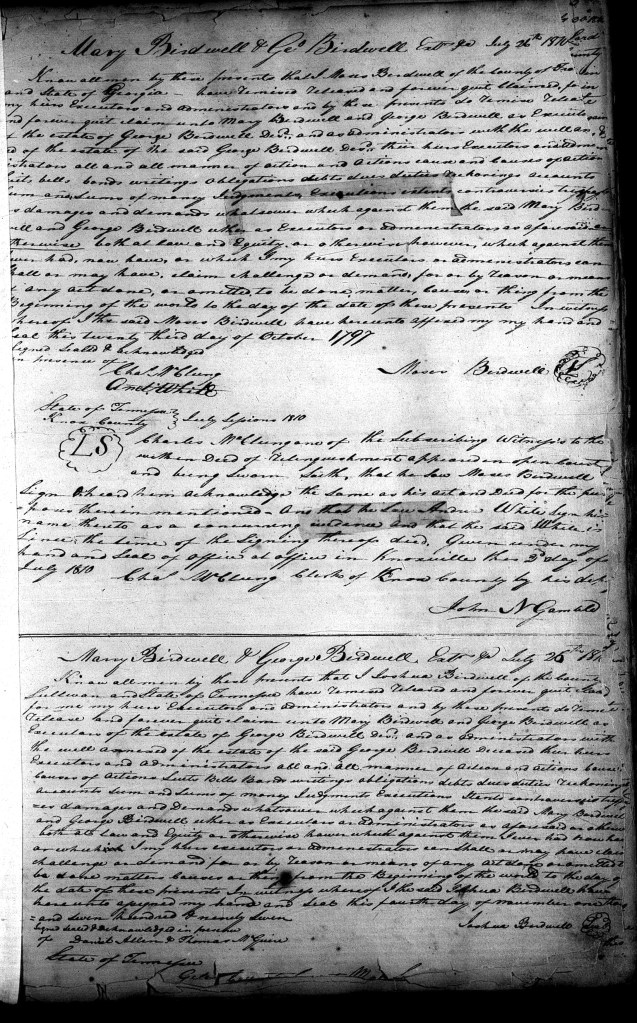
On 4 November 1797, Moses filed a quitclaim to his interest in the estate of his father George Birdwell, stating as he quitclaimed his interest to his mother Mary and older brother George as executors of his father’s estate that he was residing in Franklin County. Georgia. Moses may have made this quitclaim in Knox County, Tennessee, since, as he signed it, it was witnessed by Charles McClung and Andrew White, with McClung proving the document in Knox County on 2 July 1810. It was then filed in Davidson County, Tennessee, on 26 July 1810.[16] Charles McClung (1761-1835) laid out the town of Knoxville.[17] Andrew White was his brother-in-law. This quitclaim was filed in Davidson County, Tennessee, because Moses’ mother Mary and brother George were living there in 1810.
The 1790, 1800, and 1810 federal censuses for Georgia have been lost. In 1800, only the census for Oglethorpe County has survived. Moses Birdwell appears on tax lists in Franklin County, Georgia, in 1800, 1802, 1803, 1805, 1806, 1808, and 1810. The 1800 tax list enumerates him between John and William Birt.[18] In 1802, Moses paid a poll tax, and was listed between Jacob Holdbrooks and John Burt.[19] In 1803, he was taxed for 50 acres granted to Thomas Arinton, which bordered on the land of Thomas Bryant and the north fork of the Broad River.[20] This tax list shows Moses taxed between William Holdbrook and Christopher Lowry.
In 1805, Moses was taxed again for this land, which the 1805 tax lists shows bordering on John Goham and Bear Creek in Captain Bryant’s district.[21] In 1806, Moses paid a poll tax in Captain Bryan’s [sic] district, next to Abel Coleman and Elisha Lowry on Bear Creek and Broad River.[22] The 1806 tax list entry for Edmund Henley, in which Henley was taxed for nine enslaved people and 575 acres, states that his land bordered on Bryant and Birdwell on North River.[23] In 1808, Moses was taxed in Captain Bryan’s district for 70 acres granted to Peter Williamson, which bordered on Sewell on Bear Creek.[24] In 1810, Moses appeared on the tax list taxed for the same land.[25] Moses also appeared on the 1805 land lottery in Franklin County registered for two draws, both of which were blanks.[26]
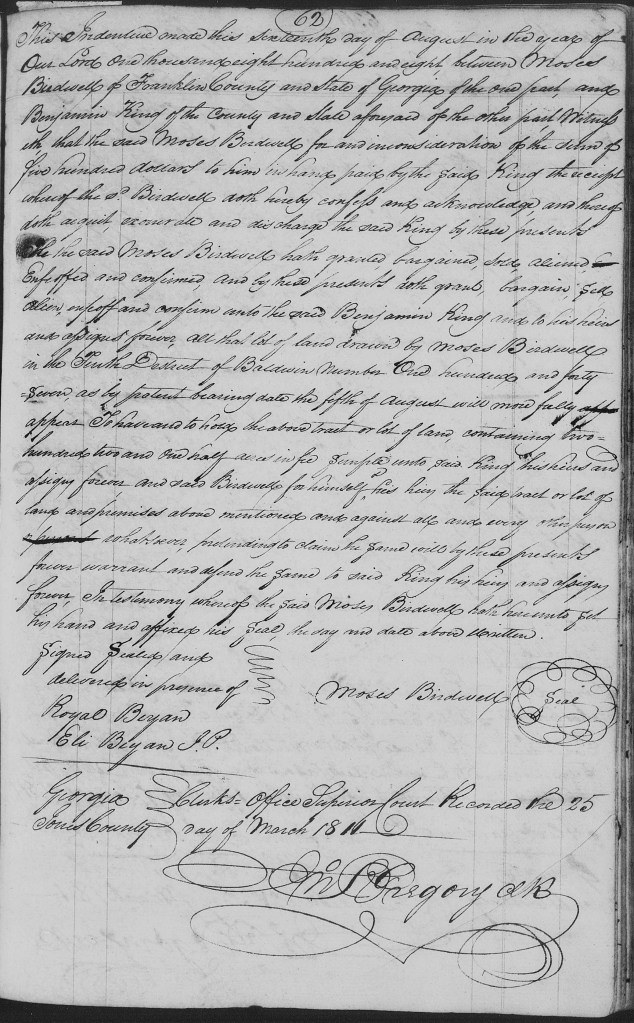
On 16 August 1808 in Jones County, Georgia, Moses Birdwell sold to Benjamin King, both of Franklin County, for $500 202½ acres, lot 147 in Baldwin County’s 10th district.[27] Moses signed and the deed was witnessed by Royal Bryan and Eli Bryan, and recorded 25 March 1811. The reference to Baldwin County in the deed’s land description evidently was intended to note that the land was in Baldwin County prior to the creation of Jones in 1807.
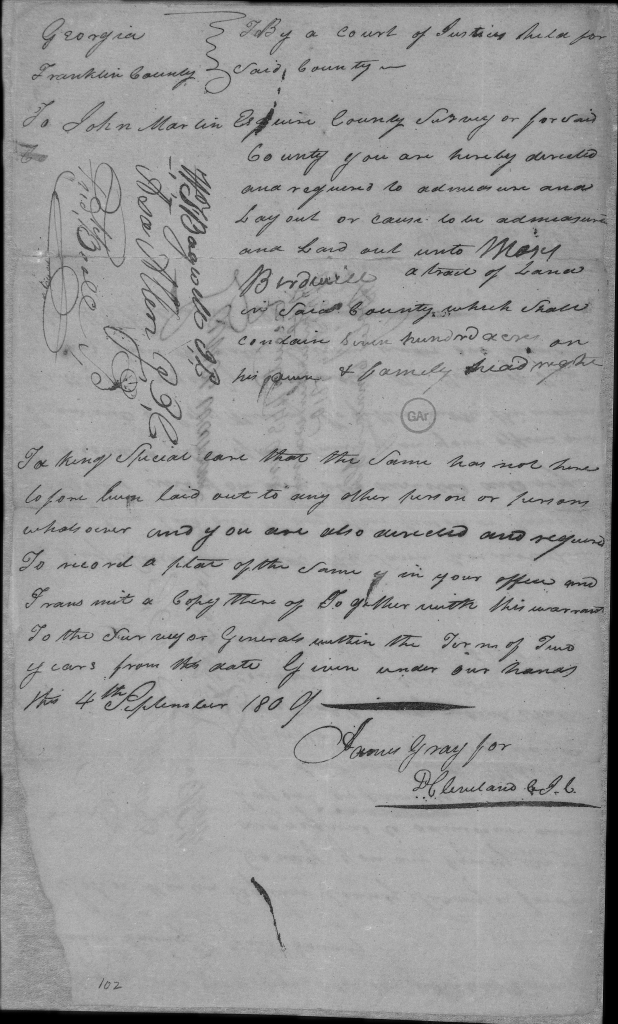
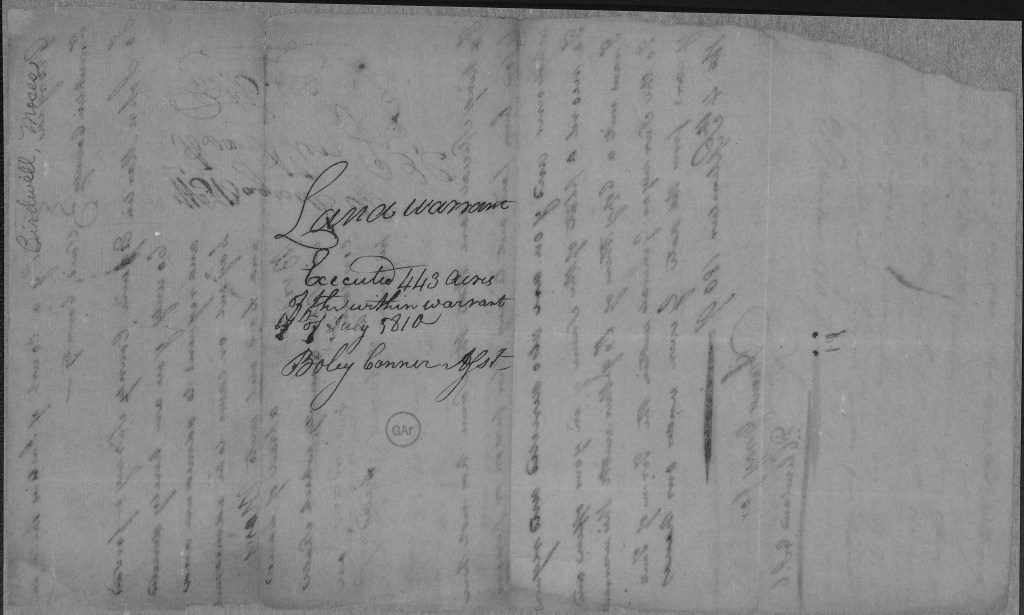

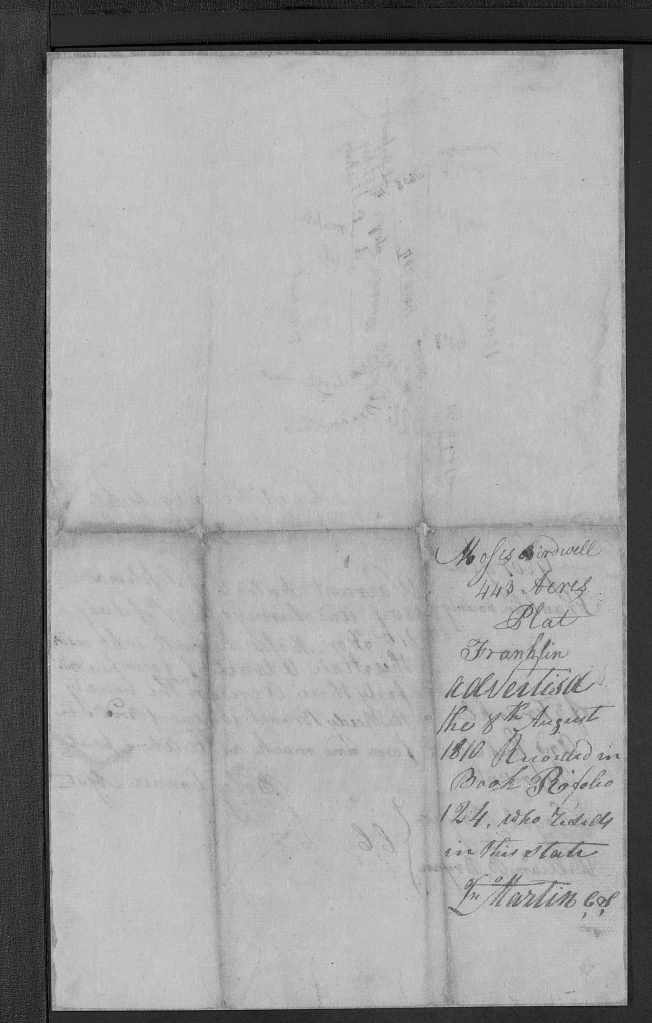
On 4 September 1809, Moses Birdwell received from the state of Georgia a headright warrant for 700 acres of land in Franklin County. When the land was surveyed, the tract was 443 acres. The plat for this tract shows that when Boley Conner surveyed it, the chain carriers were Royal and William B. Bryan. The land was bordered by William Lane and Eli Brian (i.e., Bryan). The plat has no indication of coordinates (NSEW), so it’s not clear in which direction Lane and Bryan bordered Moses. A note on the back of the warrant states that on 7 July 1810, the warrant was executed for 443 acres out of the 700.[28]
From 1783 forward, Georgia distributed land east of the Oconee River through headright grants and bounty grants given for Revolutionary service. Headright grants were available to Georgia residents, with each head of household being eligible for 200 acres for every head of household, and with 50 acres awarded for each dependent including enslaved persons, up to 1,000 acres.[29] By 1809, George apparently had – I’ll discuss the question of identifying all of his children later – five children: sons George, James, Moses, and Zachariah, and a daughter Harriet. That would have qualified him for 250 acres, and his wife would have qualified him for another 50 acres, for a total of 500 acres. I’m not sure how the figure of 443 acres for the final grant was determined.
Note the name of George’s neighbor Eli Bryan and of the chain carriers for the survey of the plat of this land, Royal and William B. Bryan. Eli Bryan or Bryant is the Captain Bryan/Bryant in whose district Moses Birdwell was repeatedly taxed from 1800 forward. Royal and William were his sons. He is thought to have been born about 1761 in North Carolina, perhaps in Johnston County. The Arringtons and Burts mentioned in Franklin County tax records from 1800-1810 and also living near Moses Birdwell likely had roots in Warren and Halifax Counties, North Carolina, close to Johnston County. There were thick marriage and kinship connections between the Arringtons and Burts in those North Carolina counties.[30]
As a previous posting has noted, in the latter part of 1811 or early in 1812, Moses Birdwell relocated his family from Franklin County, Georgia, to Madison County, Mississippi Territory (later Alabama). In the next posting, I’ll discuss Alabama records for Moses Birdwell and his family.
[1] Daughters of the American Revolution (Texas), Genealogical Records Committee, Family Genealogical Records, Birdwell, 1721-1900 (1955), available digitally at FamilySearch, “George Birdwell.”
[2] See Find a Grave memorial page of George Birdwell, burial details unknown, created by Ray Isbell.
[3] The notes are included in an FGS chart for Moses Birdwell compiled by Jerry H. Birdwell on 10 November 1992.
[4] Jane LeFevre Teal, “Birdwell Questions – The Big Ones” (1991) contains a discussion of the bible. This article was unpublished; a copy of it was sent to me in August 1997 by Aggie Birdwell of Lubbock, Texas. Agnes Marie (Aggie) Ellis was the wife of Joseph Murrell Birdwell, a descendant of George Birdwell’s son Robert.
[5] Bedford County, Virginia, Will Bk. 1, pp. 408-9.
[6] An image of the original receipt is in Lyman Draper, Draper Manuscript Collection: The Preston and Virginia Papers, series QQ, vol. 2., p. 5. See also Robert Douthat Stoner, A Seed-Bed of the Republic: A Study of the Pioneers in the Upper [Southern] Valley of Virginia (Berryville: Virginia Book Co., 1962), p. 89.
[7] A photocopy of the original will of George Birdwell on file in the loose-papers probate files of Bedford County, Virginia, is in Odessa Morrow Isbell, Isbell Country: Genealogy of an Isbell Family (Gainesville, Texas: Gainesville Printing, 2000), p. 223.
[8] A photocopy of the original will on file in the loose-papers probate files of Rusk County, Texas, is in ibid., p. 227.
[9] Carolyn Murray Greer, “Will you be my hero?,” Remembering the Shoals, citing Gwenneth A.M. Mitchell, The Mitchells of Linn Flat, pp. 184, 201; Col. Allen B. Birdwell’s Journal; and Jennifer Eckel, “Birdwell, Allen,” Handbook of Texas Online.
[10] Augusta County, Virginia, Survey Bk. 1, p. 30.
[11] Botetourt County, Virginia, Deed Bk. 2, p. 501.
[12] George W. Birdwell’s place and year of birth – Franklin County, Georgia, 1791 – are stated by his son Joseph Birdwell in a deposition Joseph Birdwell made in Young County, Texas, court on 17 December 1904 continuing his father’s and mother’s (Matilda Garner Birdwell) claim for a pension for George’s War of 1812 service: see NARA, War of 1812 Pension Files, 1812-1815, RG 15, file of George Birdwell (S.O. 25426) and widow Matilda Garner Birdwell (S.C. 15498), available digitally at Fold3. George’s tombstone in Gooseneck cemetery at Graham in Young County, Texas, also states that he was born in Franklin County, Georgia, and gives a birthdate of 23 November 1791: see Find a Grave memorial page of George Washington Birdwell, created by Dana Ribble, maintained by Searchers of Our Past, with a tombstone photo by Searchers of Our Past.
[13] Franklin County, Georgia, Deed Bk. L, pp. 70-1.
[14] NARA, Case Files of Pension and Bounty-Land Warrant Applications Based on Revolutionary War Service, compiled ca. 1800 – ca. 1912, documenting the period ca. 1775 – ca. 1900, RG 15, file of Thompson Epperson, North Carolina and Virginia, available digitally at Fold3; and Edna Epperson Brinkman, The Story of David Epperson & His Family, of Albemarle County, Virginia; with Supplementary Notes on the Epperson Family in America (Hinsdale, Illinois, 1933), p. 26.
[15] Petition of the frontier inhabitants of Franklin and Jackson Counties, [Georgia], 1797 May 8, [to the] Governor [of Georgia, Jared] Irwin, Hargrett Rare Book and Manuscript Library, University of Georgia Libraries, Telamon Cuyler collection, box 43, folder 8, document 1, available digitally at the website of Digital Library of Georgia. The signatures in this section of the petition all seem to have been made by a single hand and not to have been the actual signatures of the signatories.
[16] Davidson County, Tennessee, Deed Bk I, p. 1.
[17] Betsey B. Creekmore, “Charles McClung, 1761-1835,” at Volopedia, maintained by University of Tennessee Libraries.
[18] See Martha Walters Acker, Franklin County, Georgia, Tax Digests, vol. 1: 1798-1807 (Birmingham, Alabama, 1980), p. 45.
[19] Ibid., p. 100 (no. 712 on the original tax digest). The surname is spelled Burdwell on the original document.
[20] Ibid., p. 147. The original tax list, which is unpaginated and does not number entries, spells the surname Bardwell.
[21] Ibid., p. 180. The original is unpaginated and does not number entries, and gives the surname as Burdwell.
[22] Ibid., p. 201. The original is unpaginated and does not number entries, and uses the Birdwell spelling.
[23] Ibid., p. 213.
[24] Acker, Franklin County, Georgia, Tax Digests, vol. 2: 1808-1818 (Birmingham, Alabama, 1981], p. 10. Unpaginated and without numbering for entries in the original.
[25] Ibid., p. 48. Unpaginated and without numbered entries in the original.
[26] Virginia S. Wood and Ralph V. Wood, transc., 1805 Georgia Land Lottery (Cambridge: Greenewood, 1964), p. 28.
[27] Jones County, Georgia, Deed Bk. C, p. 62.
[28] Georgia, Franklin County, Headright and Loose Lottery Plats, available digitally at FamilySearch; and Georgia, Headright and Bounty Land Records, 1783-1909, available digitally at FamilySearch (here and here).
[29] “Headright and Bounty Grants” and “Headright Grants,” at the website of Georgia Archives.
[30] See Lyndon H. Hart III, “Arrington of Warren and Halifax Counties,” in Eastern North Carolina Families, vol. 1, ed. David B. Gammon (Chapel Hill: Chapel Hill Press, 1997), pp. 1-10; and John Bennett Boddie, Southside Virginia Families, vol. 2 (Redwood City, California: Pacific Coast Publishers, 1956), pp. 1-23.
 BEGATS AND BEQUEATHALS
5 thoughts on “Moses Birdwell (1769-1849): Virginia, North Carolina/Tennessee, and Georgia Years to 1811/2”