Elvira Birdwell (abt. 1822 – 1855) and Husbands James Madison Grammer and Samuel Kerr Green
1. Elvira Birdwell was born about 1822 in Limestone County, Alabama, and died about 13 December 1855 in Pointe Coupee Parish, Louisiana. Elvira’s year of birth is indicated by the 1850 federal census, which is discussed in a previous posting showing that she was enumerated in 1850 in the household of husband Samuel Kerr Green, with her age given as 28 and Alabama as her place of birth.[1] As we’ve seen, the 1830 federal census, in which she was enumerated in the household of her father James Birdwell in Limestone County, Alabama, places her in the 5-10 age category, and in 1840, she’s listed again in her father’s household in Natchitoches Parish, Louisiana, as a young widow aged 15-19.[2]
Marriage to James Madison Grammer, 1838
As previous postings have noted (here, here, and here), on 17 January 1838 in Marshall County, Alabama, Elvira married James Madison Grammer, son of John Grammer and Elizabeth Abernathy.[3] A number of Grammer researchers state that James Madison Grammer was born in Tennessee on 20 December 1812; I have not seen a documented source for this information.[4]
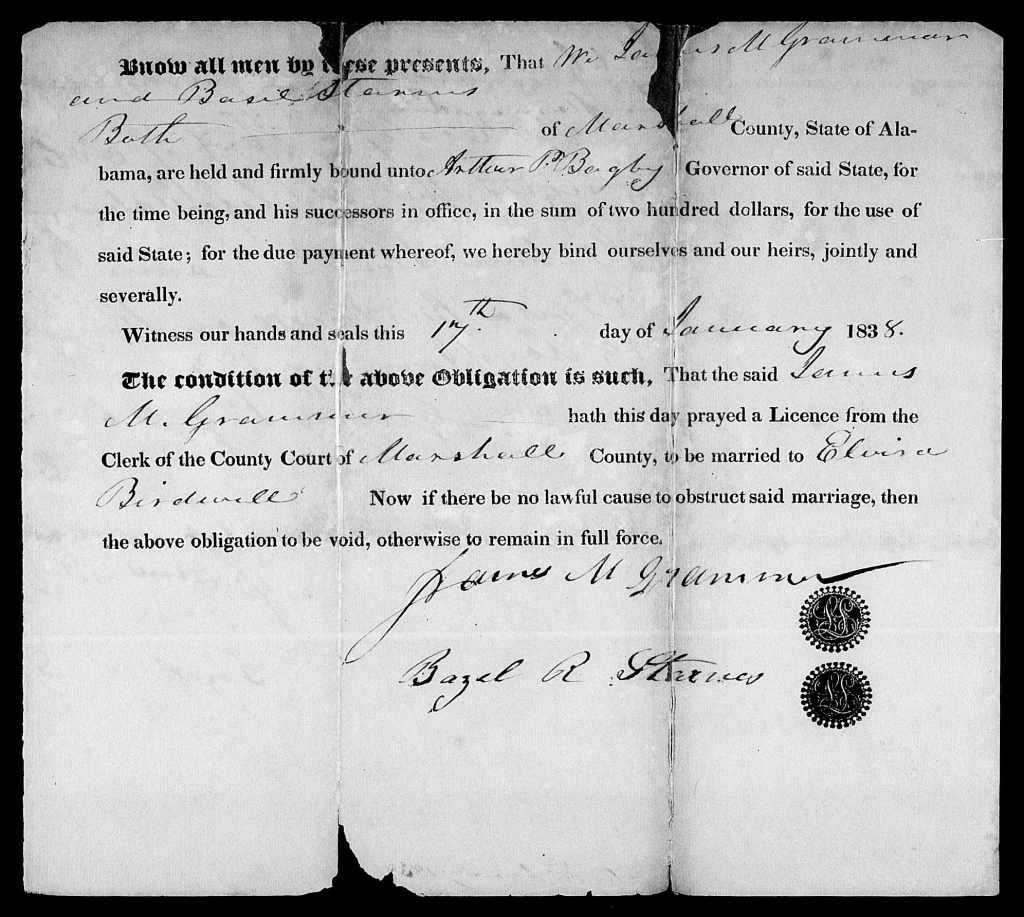


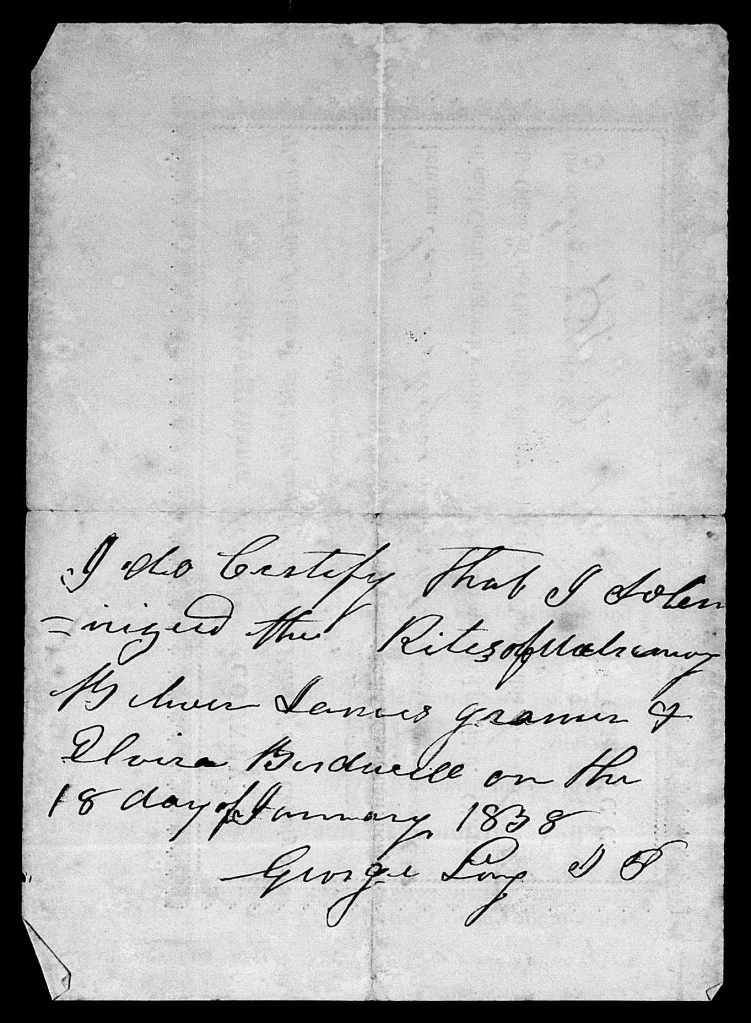
Researchers of this family also state that James Madison Grammer died in 1852. But when Elvira married Samuel Kerr Green in Natchitoches Parish, Louisiana, on 13 June 1844, their marriage contract states that Elvira was a widow of “the late James M. Grammer.” Also, note that when the estate of his mother Elizabeth Abernathy Grammer was probated in Lawrence County, Missouri, in May 1852, the list of her heirs does not include her son James. I suspect James died between his January 1838 marriage to Elvira Birdwell and her parents’ move from Alabama to Louisiana in 1840. I do not find James on the federal census in 1840 and it’s clear to me that Elvira was living in her parents’ household in Natchitoches Parish, Louisiana, in 1840.
James Madison Grammer’s father John Grammer is said to have died in Morgan County, Alabama, in 1840.[5] Morgan borders Marshall County on the west side of Marshall.
Marriage to Samuel Kerr Green, 1844
As another previous posting states (and here), on 13 June 1844 in Natchitoches Parish, Louisiana, Elvira married Samuel Kerr Green. The marriage record gives Samuel’s full name, Samuel Kerr Green, and gives Elvira’s name as “Mrs. Elvira Burdwell, widow of the late James M. Grammer.” Judge Charles E. Greneaux solemnized the marriage, with both Samuel and Elvira signing the marriage certificate.[6]

As several previous postings indicate (here, here, and here), Samuel married Elvira just as he was experiencing severe financial setbacks in Natchitoches Parish. In January 1844, several months prior to his marriage, Samuel had mortgaged his 640-acre plantation in Natchitoches Parish, and on 7 February 1846, as a result of a court judgment, he was forced to sell his land.[7] After losing their land in Natchitoches Parish, in 1848, Samuel and Elvira moved to Pointe Coupee Parish and acquired 650 acres on the Atchafalaya River. As a previous posting indicates, I have found no records for Samuel or Elvira listed in the vendee index for conveyances in Pointe Coupee Parish, so it’s not clear to me how the couple acquired this new piece of land.
The forced sale of Samuel’s land in Natchitoches Parish would probably have generated some income for him, but, in addition, it should be noted that Samuel’s first wife (apparently a common-law one) Eliza Jane Smith died at his house in Natchitoches Parish about 13 March 1843, leaving her property to their only child, Ezekiel Samuel Green, and legal documents discussed in the postings I’ve linked above show that Samuel then appropriated this property, which included a number of enslaved people, and denied that Ezekiel was his son, precipitating a lawsuit filed by Ezekiel that eventually went to the Louisiana Supreme Court. During the time in which Samuel had possession of the enslaved people belonging to Ezekiel, he sought to bring them to New Orleans and sell them – so some of Samuel’s resources in Pointe Coupee Parish may have derived from his previous common-law wife Eliza Jane, who had separated from him, married Captain Samuel Ives in New Orleans and then separated from him, and finally returned to Samuel K. Green after having lived single for some years in Iberville Parish.
As a preceding posting indicates, on 12 July 1854, a young son of Samuel and Elvira Birdwell Green, Albert B. Green, drowned in an accident in St. Landry Parish. Albert was born about 1845. The linked posting cites reports of the drowning published in the New Orleans paper the Times-Picayune and the Daily Gazette and Comet of Baton Rouge, both citing the Echo of Pointe Coupee Parish as their source.[8] The detailed account of Albert’s death in the Times-Picayune states that Albert B. Green, the son of Major S.K. Green of Pointe Coupee Parish, “a fine promising youth of nine years old,” had drowned on the 22nd ult. in a bayou in St. Landry Parish as he was attempting to cross the bayou on a ferry flat boat. The current in the bayou was strong and the rope pulling the ferry had caused Albert to fall into the water. One of his schoolmates, Parris Dickery, had valiantly jumped into the bayou and tried to save Albert, but failed to do so.
Death in Pointe Coupee Parish, Louisiana, 1855
Elvira Birdwell Green died in Pointe Coupee Parish prior to 13 December 1855, the date on which Samuel K. Green appealed for administration of her succession.[9] As the posting I’ve just linked and another previous posting show, at the time of Elvira’s death, the property she and Samuel owned jointly was in her name, with the reasons for this never being explained in the succession documents. The succession file has an inventory of Elvira’s property dated 19 December 1855 and a 10 March 1856 account of the estate sale, which shows Joseph Moore purchasing the couple’s 650-acre plantation on the Atchafalaya River, and which also shows Samuel buying two enslaved people Lace, aged 18, and Amie, aged 50, who were, in fact, previously the property of Eliza Jane Smith that Samuel had refused to hand over to his son Ezekiel Samuel Green following Eliza Jane’s death.
Digital images of the succession documents are in a previous posting. As the linked posting states, pointing to another earlier posting, there’s clear documentation that Eliza Jane Smith purchased Amie in New Orleans on 10 May 1829, and it seems clear that Lace is an enslaved girl named as Lady in a will that Eliza Jane made at Samuel’s house in Natchitoches Parish on 5 March 1843.[10] These enslaved persons did not belong to Elvira, and Samuel seems to have been engaging in some sleight of hand in placing them in Elvira’s succession, one designed to allow him to claim ownership by purchasing them.
Samuel’s petition for administration of Elvira’s succession also states that he and Elvira had one minor child living at the time of Elvira’s death, a daughter Cornelia Jane, for whom Samuel was appointed tutor and T.A. Miller was appointed under-tutor. I have found no record of Cornelia Jane following 19 December 1855. As a previous posting notes, though I have not found a record of Samuel K. Green marrying after wife Elvira’s death in December 1855, there are a number of indicators that he may, in fact, have remarried and that his daughter Cornelia Jane may have been still living in February 1856. These include a list of those staying in hotels in New Orleans published by the Times-Picayune on 20 February 1856, which states that on that date Mrs. S.K. Green and child were at the City Hotel in New Orleans.[11]
Hannah Birdwell (1825-1910) and Husbands Hardin Harville and Ezekiel Samuel Green
2. Hannah Birdwell was born 25 April 1825 in Limestone County, Alabama, and died 19 October 1910 at Summers Mill in Bell County, Texas. This birthdate is inscribed on Hannah’s tombstone in North Belton cemetery at Belton, Bell County, Texas.[12] It’s also indicated by her death certificate, which gives her name as Hanna Green and states that she died on 19 October 1910 in Bell County, aged 85 years, 5 months, and 24 days.[13] The death certificate, signed by Dr. Taylor Hudson, gives Alabama as Hannah Green’s place of birth. Obituaries for Hannah Green published in the Houston Post and the Austin American-Statesman both state that she was born in 1825 in Alabama.[14] A biography of Hannah’s son Joseph Clark Harville in Memorial and Biographical History of McLennan, Falls, Bell, and Coryell Counties, Texas also states that his mother Hannah Birdwell was born in Alabama in 1825.[15]


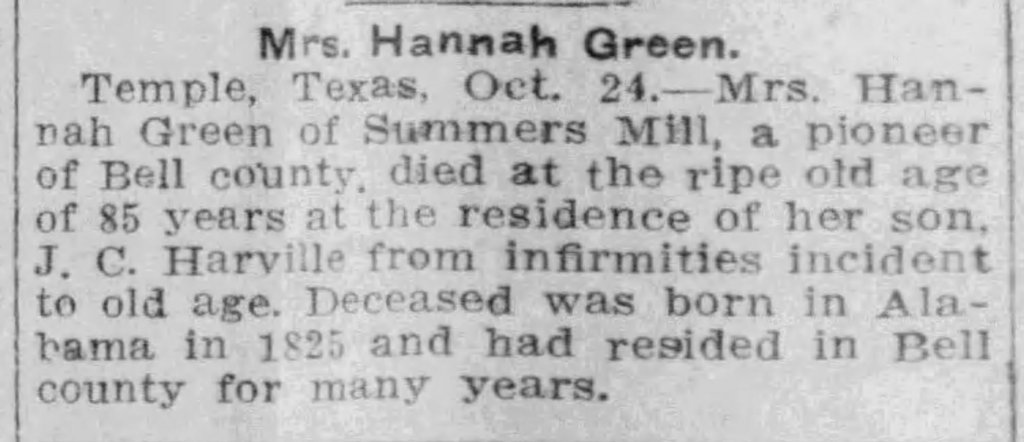
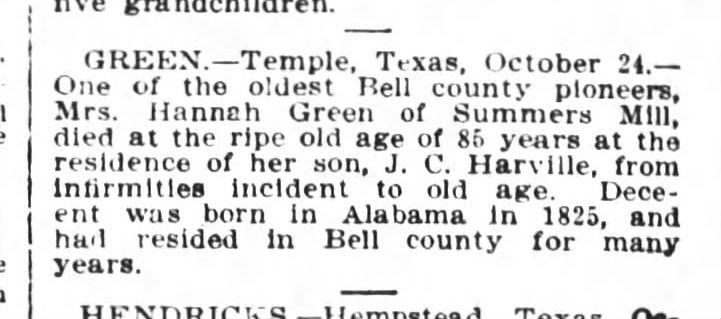
Marriage to Hardin Harville, 1845
On 25 November 1845 in Natchitoches Parish, Louisiana, Hannah married Hardin Harville.[16] The contract for this marriage filed in Natchitoches Parish states that Hannah was the minor (i.e., unmarried and living at home) daughter of James Birdwell and that the marriage occurred at the home of her father James Birdwell in Natchitoches Parish. It also states that Hardin Harville was a resident of DeSoto Parish.
Hardin Harville (1809-1860)
The biography of Hardin and Hannah Birdwell Harville’s son Joseph cited above states that his father, whose given name is spelled Harden here, was aged 51 when he died in 1860, and that he was born in Tennessee.[17] The 1860 federal mortality schedule for Natchitoches Parish says that Hardin Harville died in May 1860 of pneumonia, aged 52, and that he was born in South Carolina.[18] The 1850 federal census, which enumerates Hardin Harville’s family in the western district of DeSoto Parish, shows Hardin as aged 40, a planter, born in North Carolina, with property valued at $4,000.[19] In addition to Hannah and Hardin’s son James Cass Harville, who is listed here as John C. Harville, aged 2, the household contains Hannah’s sisters Frances, aged 13, and Sophronia, aged 9, Frances being born in Alabama and Sophronia in Louisiana. Hired hands James K. Johnson and John W. Christopher were living in the household in 1850. The 1850 federal slave schedule for DeSoto Parish shows Hardin Harville owning six enslaved persons in that parish.[20]
The biography of Joseph Clark Harville states the following about his father:[21]
Harden Harville owned a large cotton plantation and a number of slaves. He was a man of some prominence in the vicinity where he resided. He took an active interest in politics, and was strongly opposed to the war. For a number of years he served as a Notary Public and Justice of the Peace in his parish. He died in 1860, aged fifty-one years. He was a prominent member of the Masonic fraternity, having taken the R. A. M. degree.
Since Hardin Harville died before the Civil War began, I take the statement that he was strongly opposed to the war to mean that he was opposed to secession, which resulted in a civil war not longer after he died. The statewide proceedings of the Freemasons of Louisiana in 1861 state that Hardin Harville had died the preceding year, and was a member Silent Brotherhood Lodge 146 at Coushatta Chute in Natchitoches Parish.[22] Coushatta would become the parish seat of Red River Parish when that parish was formed in 1870.
Hardin Harville was in Natchitoches Parish by 19 September 1837, when he signed with other parish residents to verify that a treaty made on that date between Jehiel Brooks, Federal Indian agent, and the Caddo tribe had been read and explained to the leaders of the tribe in their language.[23] Hardin then appeared on the federal census in Natchitoches Parish in 1840 with a household comprised of a male 30-39 with a male 20-29 and a male and a female 5-9.[24] Also in the household are eleven enslaved persons. It’s not clear to me that the younger household members are children of Hardin Harville. I find no evidence that he had been married before he married Hannah Birdwell, or that he had children other than his children by Hannah. Note that his household in 1840 does not appear to contain a wife.
Hardin’s origins and pre-Louisiana life are murky to me. Family trees published online frequently state that his parents were James Harville and Mary Cass, but I have seen no documentation of this claim. The 1840 census shows Hardin living next to James W. Brown and three households removed from John P. Sprowl. As Ricky L. and Annette Pierce Sherrod have shown, the Brown and Sprowl families were thickly intermarried for generations, and they came to Natchitoches Parish in the early 1820s from Madison County, Alabama, where James G. Birdwell’s father Moses Birdwell settled in 1811 or 1812.[25] John Paul Sprowl and wife Mahala Brown were leaders of a migration of a group of interrelated families living on the Flint River in Madison County, Alabama, to Natchitoches Parish and the Red River valley in the early 1820s. Hardin Harville’s proximity to the Brown and Sprowl families on the 1840 census in Natchitoches Parish makes me wonder about his possible ties to these families who were in Madison County, Alabama, at the same time the Birdwell family was there.
As a previous posting has noted, on 25 January 1848 in DeSoto Parish, Hardin Harville witnessed the sale of enslaved boy Ben to his father-in-law James Birdwell in that parish, giving oath to prove the conveyance on 4 April 1848.[26] The linked posting also notes that Hardin Harville was administrator of James Birdwell’s succession in DeSoto Parish in 1850-2, and was appointed tutor of James’ minor daughters Frances C. and Sophronia, who were, as noted previously, in his and wife Hannah’s household on the 1850 federal census.[27]
On 16 August 1856, for $12,000 Hardin Harville and wife Hannah of DeSoto Parish sold Sarah A. Warren, wife of John J. Greening, tracts of 166.56 acres and 376.26 acres in that parish in township 13 south, sections 19, 24, and 30.[28] The conveyance record shows Hannah Harville relinquishing her dower rights in the land in presence of Thomas A. Guy and Claiborne M. Oliver, as both Hardin and Hannah signed. Claiborne Martin Oliver was Hardin and Hannah’s brother-in-law, having married Hannah’s sister Frances on 2 January 1854 in DeSoto Parish.


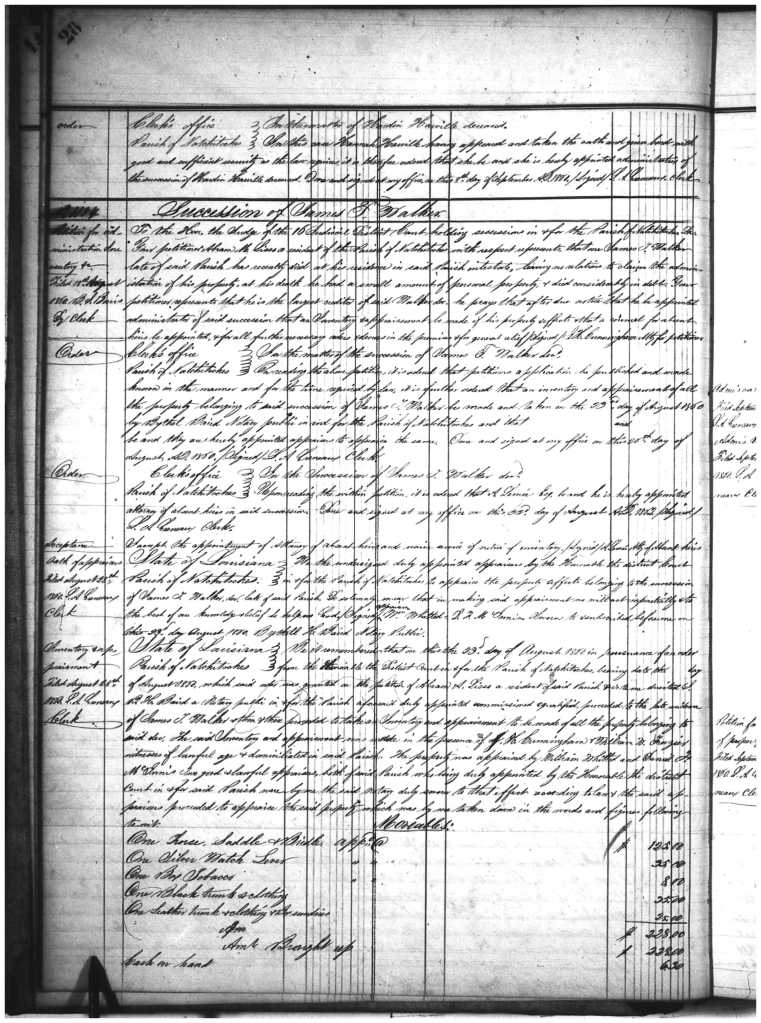
Hardin Harville’s Natchitoches Parish succession documents show his widow Hannah petitioning on 16 August 1860 for administration of the succession.[29] On 10 August 1860, Hannah had appealed for an inventory of the succession, and the order was given for the inventory on 22 August. Hannah was appointed administratrix on 8 September 1860. Hannah’s appeal to be made administratrix states that Hardin Harville died intestate in Natchitoches Parish in May 1860. His heirs are listed as children James Cass, Joseph Clark, John Birdwell, Hardin Archibald, Thomas DeWitt, and Hampton Turner Harville. The petition notes that Hardin Harville died with considerable property, but also considerable debt.
The inventory of the succession, dated 23 August and filed 28 August, lists numerous tracts of land, almost all in township 12, range 9 of Natchitoches Parish. The inventory was done by Abraham M. Lisso and Daniel F. McGinnis in presence of J.H. Cunningham and Waddy Thompson Wilkerson. The property listed in the inventory included enslaved persons Mat, George, Isaac, Tom, Marie, Isabella, Allen, Frisby, Ben, Vean, Bob, Willis, Minerva, Phillis, Harriet, Perry, Meal, Milly, Mina, Jennett, and Bose. The succession was appraised at $18,772, with the land accounting for $2,832.76 and the enslaved persons for $14,925.
On 5 September 1860, Hannah gave oath as administratrix. There are two copies of this oath in the loose-papers file, both signed by Hannah. On the same day, she gave bond for her administration in the amount of $23,500 with A.M. Lisso and F. Vienne as securities.
The succession documents contain a petition dated 23 February 1869 by Hannah, now wife of E.S. Green, both of Natchitoches Parish, to sell a horse, ten head of cattle, and 1,416 acres of land. A description of the land in the case file, evidently for advertisement and undated, states that the land was situated near Springville. There is a receipt dated 27 February 1869 for advertisement of the sale in the Red River News. The file also has a plat showing that most of this land was in townships 12 and 13, range 9 west. The succession file contains an account of the sale of the land dated 27 March 1869, showing the total sale amount to be $815. A 27 March 1869 appraisal is also filed for this property, with appraisers Mannen (?) S. Williams and W.H. Gollison.
On Springville, a now defunct village just east of Coushatta, the parish seat of what became Red River Parish in 1870, see this previous posting (and also here). As the Red River Parish Heritage Society writes in its 1989 volume entitled Red River Parish: Our Heritage, in the 1850s, Springville was the most important trading point in what would later become Red River Parish, while Coushatta Chute was only a shipping point with a warehouse.[30] Abraham M. Lisso, a German Jewish merchant who, as we’ve seen, inventoried Hardin Harville’s succession, opened a store at Springville in 1848, moving to Coushatta in 1865 and finally to New Orleans. This source states that Springville was a thriving village with several stores, a bakery, churches, an academy, and substantial houses. When Coushatta became the parish seat, however, the settlement withered away, since Coushatta was directly on the Red River, which provided direct access to markets for both selling and buying goods.
Federal land records show Hardin Harville buying ten tracts of land in September and December 1858 and April and May 1859 in township 12, range 9 west, in Natchitoches Parish. The total acreage of these tracts was 667.46 acres. All of this land was near Springville and fell into Red River Parish at its formation in 1870. Most of these tracts were certified to Hardin Harville following his death in May 1860. Hardin Harville had previously acquired a quarter section of land in township 13, range 11 west, on the Red River near Grand Bayou in what became Red River Parish.
The 1860 federal census shows Hannah Harville heading her household in Natchitoches Parish.[31] (p. 568). Hannah is listed as a planter aged 35, born in Alabama, with a real worth of $2,803 and personal worth of $17,670. In the household are her Harville children James, 12, Joseph C., 9, John B., 7, Harden A., 5, Thomas D., 3, and Hampton, 1.
The 1860 federal slave schedule shows Hannah Harville holding eighteen enslaved persons in Natchitoches Parish.[32] The enslaved persons are a male aged 55, females aged 48, 40, and 38, a male aged 26, females aged 30, 24, 22, and 18, a male aged 15, a female and a male aged 14, males aged 12, 4, 3, and 2, a female aged 8, and a male aged 4 months. The plantation had four houses for enslaved persons. In 1862, Hannah Harville was listed in a Natchitoches Parish tax list for slaveholders paying taxes on more than ten enslaved persons; Hannah was taxed as owner of eighteen enslaved persons.[33] Hannah Harville also appears on the 1860 federal agriculture schedule for Natchitoches Parish with a farm valued at $2,800.[34]
Marriage to Ezekiel Samuel Green, 1865
As a number of previous postings state (here, here, and here), following the death of his first wife Camilla Birdwell, Hannah’s sister, at some point after 4 December 1865, Ezekiel Samuel Green married Hannah Birdwell Harville. This marriage took place in Natchitoches Parish, Louisiana, on 11 December 1867.[35] As noted previously, Ezekiel was a son of Samuel Kerr Green who married Camilla and Hannah’s sister Elvira Birdwell. The marriage of Hannah Harville and Ezekiel Samuel Green was solemnized by Estes/Eastes Whitted, justice of the peace, whose wife Selina Harriet Snead was the daughter of Julius Snead, a merchant who co-owned a store with the Abraham M. Lisso, mentioned previously, and with Abraham’s brother. Signing as witnesses to the marriage document along with Ezekiel S. Green and Hannah Harville were J.W. Guthrie, Edwin Friend, and Henry Friend. This Friend family was thickly connected to the Harville and Birdwell families. Henry Row Friend’s brother George Adolphus Friend married Hannah’s sister Mary Ann Birdwell, and Henry and George’s sister Sarah Matilda Friend married Hardin and Hannah Birdwell Harville’s son Joseph Clark Harville. Henry, George, and Sarah were children of the Edwin Friend witnessing Ezekiel and Hannah’s marriage in 1867.
The 1870 federal census shows Ezekiel and Hannah and their family living at Coushatta Chute in what was still Natchitoches Parish but would shortly become Red River Parish.[36] Ezekiel’s given name is erroneously stated as Edward, and he’s listed as a farmer, aged 52, born in Louisiana, with $500 real worth. The census also erroneously states that Ezekiel cannot read and write. Hannah is 45, and erroneously listed as being born in Louisiana. In the household are Ezekiel’s daughters by Camilla (Hannah’s nieces) Rosa and Mary Ann Green, 16 and 10, and Ezekiel and Hannah’s son Raleigh, 2. Also in the household are Hannah’s sons by Hardin Harville Joseph, 22, and John, 14. The census states that Joseph is illiterate, though he had been enrolled at Louisiana State University and studied there for a year, according to his biography.[37] John Birdwell Harville, who was actually three years older than stated on this census, is erroneously given the surname Green.
Hannah’s Final Years in Bell County, Texas, and Death There in 1910
As the postings linked in the paragraph preceding the one immediately above note, at some point after 16 June 1870, when the 1870 census was taken, Ezekiel and Hannah went their separate ways, and on 13 January 1876 in Red River Parish, Ezekiel married again to Mary Ann Wester, daughter of Daniel Campbell Wester and Mary Ann Nobles. In 1872, Hannah’s sons Joseph, Hardin, Thomas, and Hampton left Louisiana for Bell County, Texas, and Hannah either accompanied them there or joined them soon after they had made this move. The biography of her son Joseph, which states that he moved from Louisiana to Texas when he was twenty-one years of age (i.e., in 1872), states that Hannah’s son Raleigh by Ezekiel S. Green died young.[38] I think it’s likely that Raleigh had died by the time Hannah moved to Texas.
The 1880 federal census enumerates Hannah Green along with her son Joseph and his family in the household of Samantha Brown in Bell County, Texas.[39] Hannah’s age is given here as 55, and the census incorrectly gives her birthplace as Texas, with parents born in Alabama.
When Joseph Clark Harville’s biography was published in 1893, Hannah was living with her son Joseph, according to this source.[40] The previously cited obituaries of Hannah published in the Houston Post and Austin American-Statesman say that Hannah died at the home of her son Joseph at Summers Mill in Bell County.[41] Summers Mill (or, in some sources, Sommer’s Mill) is about five miles southeast of Belton, the county seat of Bell County, where Hannah is buried in North Belton cemetery in the Harville family plot, with her tombstone stating her given name but giving no surname for her.[42] Hannah’s death certificate states that she died of la grippe (i.e., influenza) complicated by old age.[43] “Gone but not forgotten / Come ye blessed,” reads the tombstone inscription. The biography of Joseph Clark Harville states that his parents were Methodists.
Joseph Clark Harville’s biography states that by 1893, the following sons of Hannah by Hardin Harville had died: James, John, and Hardin. Sons Joseph, Thomas, and Hampton were living in Bell County, Texas, in 1893.[44]
John B. Birdwell (1828-1918) and Wives Mary Emily Brewster and Mary Fredonia Russell
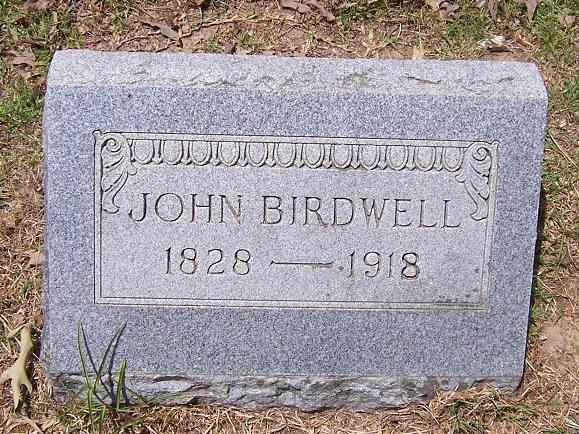
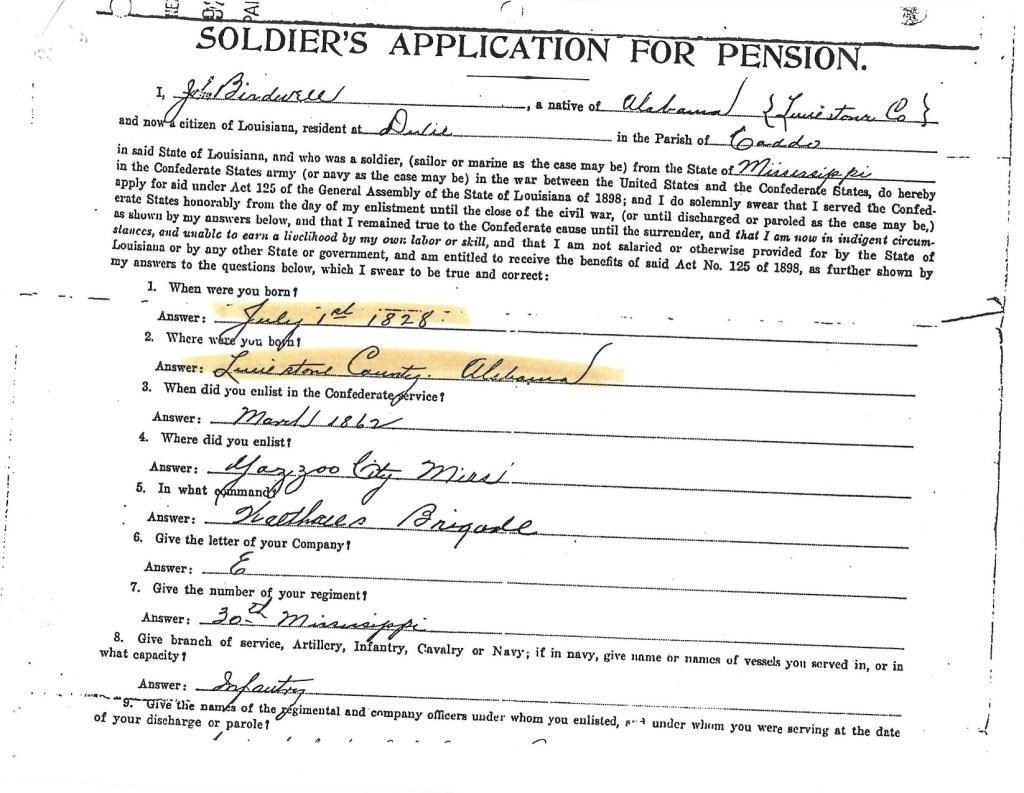
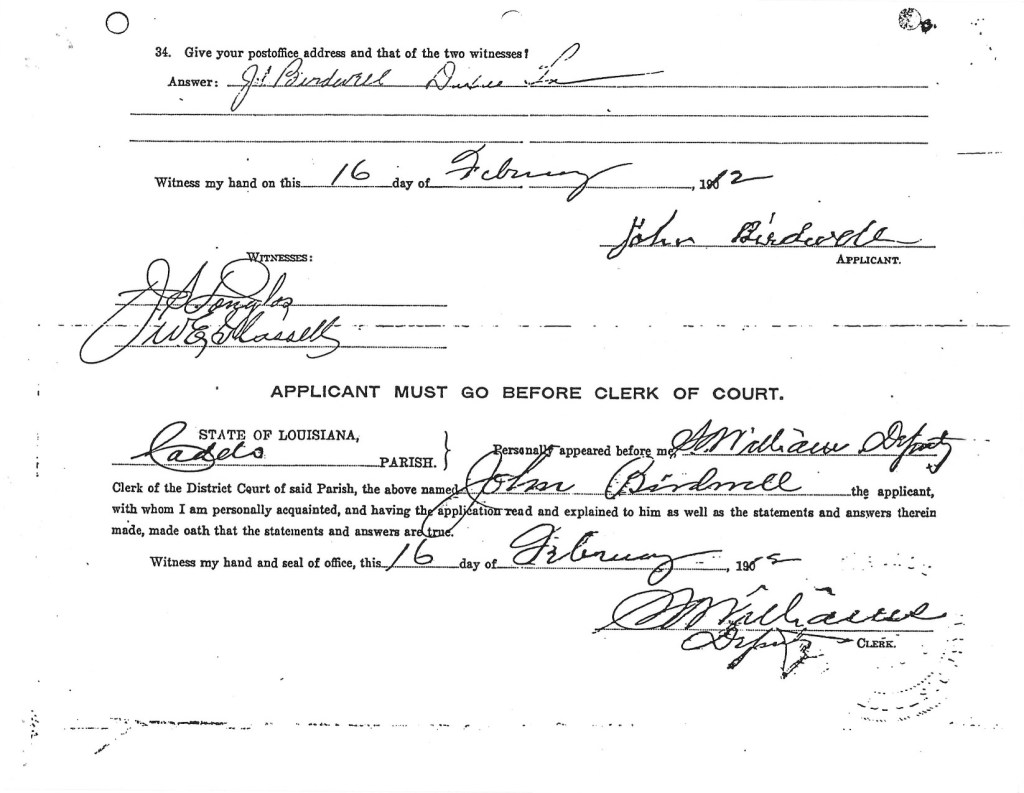
3. John B. Birdwell was born 1 July 1828 in Limestone County, Alabama, and died 31 January 1918 at Belcher in Caddo Parish, Louisiana. John stated this date and place of birth in an application he filed in Caddo Parish on 16 February 1912 for a pension for his service in Co. E (Walthall’s Brigade) of the 30th Mississippi Infantry (CSA) during the Civil War.[45] John’s tombstone in Cottage Grove cemetery at Benton, Bossier Parish, Louisiana, gives his year of birth as 1828, as does his death certificate, which shows him dying at Belcher in Caddo Parish on 31 January 1918, aged 90.[46]

Louisiana Years and Marriage to Mary Emily Brewster, 1855
As previous postings note (here and here), when John’s sister Camilla married Ezekiel Samuel Green in Pointe Coupee Parish on 2 January 1853, John wrote a permission note for the marriage on the preceding day. The second of the links I’ve just provided has a digital image of John’s note, which he wrote as the oldest male of his family, his father having died in December 1849.
On 5 April 1855 in Avoyelles Parish, John Birdwell married Mary Emily Brewster, daughter of James Brewster.[47] As preceding postings have noted (here and here), following their marriage in Pointe Coupee Parish in January 1853, John’s sister Camilla and husband Ezekiel S. Green settled in Avoyelles Parish, which is contiguous to Pointe Coupee on the northwest, and that couple lived in Avoyelles Parish until the early 1860s, when they moved their family to Angelina County, Texas. While in Avoyelles Parish, Ezekiel and Camilla purchased land from Isaac Martin that included rights to a ferry Martin had been given permission by the state legislature to operate near the junction of Old River and the Atchafalaya River.[48]
Following his marriage to Mary Emily Brewster in Avoyelles Parish in April 1855, on 19 December 1855 John Birdwell bought from Joseph J.B. Kirk, both of Avoyelles Parish, 160 acres on the right bank of the Atchafalaya River near Simmesport, which Kirk had purchased from John’s father-in-law James Brewster on 2 April 1851.[49] The land sold for $2,000, with Rachel Selser, wife of Joseph J.B. Kirk, renouncing her dower interest in the land. Both Kirks signed the conveyance along with John Birdwell, with James Brewster and Thomas C. Kirk as witnesses.
Joseph J.B. Kirk was discussed in a previous posting, which noted that he was a buyer at the estate sale of John Birdwell’s sister Elvira, wife of Samuel Kerr Green, in Pointe Coupee Parish on 10 March 1856. The 1850 federal census shows Kirk living in Avoyelles Parish, a merchant aged 36, born in Maryland, with John Birdwell’s brother Thomas living with him and working as a clerk in Kirk’s store.[50] On 7 March 1850, the Louisiana legislature granted Joseph J.B. Kirk the right to operate a ferry across the Atchafalaya to Griffin B. Miller’s landing on the Pointe Coupee side of the River.[51] The 1865 Civil War direct tax list for Avoyelles Parish shows Kirk living near Mary Emily Brewster’s brother Hazard Young Brewster.[52]
Mary Emily and Hazard’s father James Brewster lived on the Atchafalaya River at Simmesport in Avoyelles Parish, where he was postmaster from 1844 up to his death in 1859.[53] The ferry to which Ezekiel S. Green and wife Camilla Birdwell Green bought rights in Avoyelles Parish appears to have been in or near Simmesport.
On 27 September 1856, for $4,814.70, John Birdwell sold back to Joseph J.B. Kirk the 160.49-acre tract he had bought from Kirk in December 1855.[54] The conveyance record notes that the land lay in township 1 south, range 6 east, section 13, i.e., at Simmesport. The conveyance was signed by both parties with L.V. Gremillion and C. Dimargues witnessing. On 3 October 1856, John’s wife Mary Emily renounced her dower rights to this land, with all three parties signing and W.E. Cooke and A.S. Gray witnessing.[55] On the same day (3 October), at James Brewster’s residence, John Birdwell co-signed his wife Emily’s renunciation of rights to a tract of land and sixteen enslaved persons formerly owned by her father James Brewster.[56] The land and enslaved persons had been sold by sheriff’s sale to Henderson Taylor on 6 March 1843. I think it’s likely that as John Birdwell sold his Avoyelles land back to Joseph J.B. Kirk and his wife Emily made this renunciation of her interest in some of her father’s property, the couple were preparing to move their family to Holmes County, Mississippi, where the family appears on the 1860 federal census.
Move to Holmes County, Mississippi, 1856/7
As previous postings note (here, here, here, here, and here), on 5 March 1856 in Pointe Coupee Parish, Ezekiel S. Green filed suit against his father Samuel K. Green regarding property including enslaved persons that Samuel had withheld from Ezekiel after Ezekiel’s mother Eliza Jane Smith left her estate to him when she died in Natchitoches Parish in March 1843.[57] The case file for this lawsuit shows John Birdwell and his brother Thomas giving affidavits on behalf of Ezekiel S. Green in Holmes County, Mississippi, at some point prior to 5 November 1857, when these affidavits were filed in Pointe Coupee Parish. As has been noted previously, Ezekiel S. Green married two sisters of John and Thomas Birdwell, first Camilla, and then following her death, Hannah, the widow of Hardin Harville. And Ezekiel’s father Samuel K. Green married another Birdwell sister, Elvira, the widow of James M. Grammer.
As the affidavit by John B. Birdwell filed in the Green v. Green lawsuit in Pointe Coupee Parish in November 1857 indicates, after selling his land in Avoyelles Parish in September 1856, John Birdwell did indeed move his family to Holmes County, Mississippi. This family is enumerated in Holmes County on the 1860 federal census, which shows John Birdwell and wife Emily at Tchula beat in Holmes County.[58] The census states that John is an overseer aged 31, born in Alabama, with a personal worth of $7,650. John’s wife Emily is aged 26 and born in Alabama, and also in the household is William R. Miles, for whom no age or occupation is given, and who was born in Alabama. William R. Miles is the person for whom John Birdwell was working as an overseer. The 1860 federal slave schedule shows him holding 109 enslaved persons at Tchula.[59] William R. Miles was William Raphael Miles (1817-1900), a wealthy lawyer of Yazoo City.
Tchula is about halfway between Greenwood and Yazoo City, Mississippi. John’s wife Mary Emily is said to have died at Yazoo City, apparently between 1860 and 1864 (see below on this point).
On 14 January 1861 in Holmes County, Mississippi, John Birdwell transferred all his rights in the Avoyelles Parish, Louisiana, lawsuit of Martha J. Brewster, et al., heirs of James Brewster, to Hazard Brewster Young and J. James Brewster, heirs of James Brewster. Joseph J.B. Kirk acted as John Birdwell’s attorney.[60] The deed was witnessed by W.L. Jenkins and P.W. Callihan. Martha Jane Brewster, wife of David Frisby Thomas, was Mary Emily Brewster Birdwell’s sister. Young Hazard and J. James were, I think, half-brothers of Martha Jane and Mary Emily.[61]
Civil War Service, Co. E, 30th Mississippi Infantry
John Birdwell’s Confederate pension file lists comrades of John at the time the Civil War began: William Gill, Warren Day, Jim Mills, and Richard Wallace, all of Pickens Station.[62] Pickens Station was on the Illinois Central railroad line south of Tchula and east of Yazoo City. John Birdwell may have been living in that vicinity when the war broke out.
John’s Civil War service papers show that he enlisted in Co. E of the 30th Mississippi Infantry as a private, aged 33, at Yazoo City on 15 March 1863.[63] The company was at that time under command of Captain Q.D. Gibbs. The papers show that he was slightly wounded at Murfreesboro, Tennessee, on 31 December 1862. The statement about his injury identifies him as John B. Birdwell, and says that he was in Walthall’s Brigade. He was appointed corporal in January-February 1863. He appears on a list of soldiers paroled at Greensboro, North Carolina, on 1 May 1865.
In contrast to the enlistment date recorded in his Civil War service file, the pension application filed by John Birdwell in Caddo Parish, Louisiana, on 16 February 1912 states that he enlisted at Yazoo City on 1 March 1862.[64] The application says that John served in Co. E of the 30th Mississippi Infantry until his surrender at Greensboro, North Carolina.
Marriage to Mary Fredonia Russell, abt. 1854
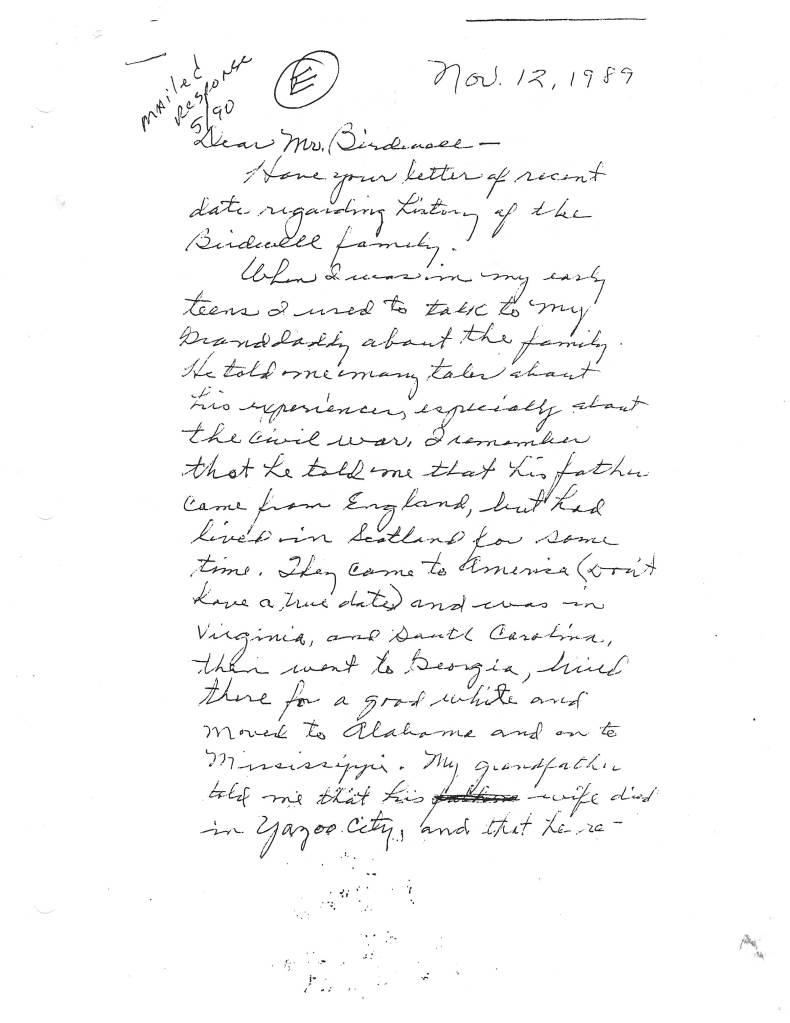
John’s wife Emily Brewster Birdwell appears to have died between 17 October 1860, when she appears on the federal census, and 1864. By March 1865, John had married his next wife, Mary Fredonia Russell, daughter of Elijah Russell and Martha A. Erwin. John and Mary Fredonia had a son Park Russell Birdwell, who was born in March 1865, according to a number of sources (though some sources place his birth in March 1867). I have a photocopy of a letter written on 12 November 1989 by Thomas M. Birdwell of Clinton, Mississippi, to an unnamed Birdwell relative (he’s identified only as Mr. Birdwell).[65] Thomas Birdwell states that he was a grandson of John and Mary Fredonia; his father was their son John Nixon Birdwell. He says that his grandfather John Birdwell told him that his first wife died in Yazoo City, at which time he remarried to a Russell, by whom he had sons John Nixon and Park Birdwell, as well as three daughters.


I have been unable to locate John Birdwell’s family on the 1870 federal census. In 1880, the family was enumerated in Yazoo County, Mississippi.[66] The census shows John as 57, born in Alabama, a farm manager. It erroneously states that he could not read or write. Wife Mary F. is 34, born in Mississippi. In the household are children Park R., 13, Lula E., 11, John N., 8, Mary A., 6, Nina M., 4, and Blanche M., 1, all born in Mississippi. Also in the household are a teacher, Nelly Buver (or Bower?), a farm manager, Philip O’Riley, an Irish-born man named John Welche for whom no occupation is given, and a cook Rachall Morris with her children Elizabeth and Henry Morris, these three household members listed as Black.
Return to Louisiana, 1884, and Death in Caddo Parish, 1918
John Birdwell’s Confederate pension application states that he had resided in Louisiana since 1884.[67] A list of delegates to the Shreveport district of the Methodist Conference published on 5 July 1888 in the Bossier Banner newspaper discussing delegates to an upcoming meeting of the local Methodist conference includes John Birdwell of the South Bossier and Valley circuits of the Methodist church.[68] John and his family were likely living in Bossier Parish at this point, since, when John’s young son James died on 25 April 1891, an obituary of Jimmie printed in the Bossier Banner states that his parents were living at Cash Point in Bossier Parish.[69] The obituary states that Jimmie, the youngest child of John and M.F. Birdwell, had died at Cash Point on 25 April 1891 nine days after having suffered an accident when he fell from a cart as he tried to stop a runaway mule, and the cart’s wheels then ran over him. He was aged 9 years, 5 months, and 19 days when he died (born, therefore, 6 November 1881).

Cash Point plantation was one of the main docking points for steamers navigating down the Red River in northwest Louisiana and was about nine miles north of Shreveport.[70] The plantation, which mainly grew cotton, was in both Bossier and Caddo Parishes and had been owned by George Oglethorpe Gilmer in 1839. In 1849, the planation contained 1,350 acres, and Gilmer deeded it to his three children. The portion in Bossier Parrish was owned by Sarah Mildred Gilmer Spyker, and by 1857, by Thomas Degraffenried, who sold the plantation to his sister, Paulina Degraffenried Gilmer Pickett. She later sold half interest to her son, James Pickett Jr. in 1866. In 1876, the Picketts sold the plantation to Nathan Wesley Sentell.

John Birdwell’s wife Mary Fredonia Russell died 11 July 1905 and is buried along with John in Cottage Grove cemetery at Benton in Bossier Parish, with a tombstone recording her name, Mary Fredonia Russell, and dates of birth (1 December 1845) and death, as well as identifying her as wife of John Birdwell.[71] The pension application John filed in February 1912 noted that his wife had died and that he was being supported by his children[72]. The 1910 federal census shows him living with his daughter Nina and her husband Joseph Ellison Adger at Belcher in Caddo Parish. The pension application gives John’s post office box as Dixie, some four miles south of Belcher, and was witnessed by James Stuart Douglas, husband of John’s daughter Blanche Madeline Birdwell, and W.E. Glassell.
The pension file contains a receipt for $28 paid in April 1918, with a note saying that John Birdwell died in February 1918, and showing that the payment went to John B. Birdwell c/o his son-in-law Joseph Ellison Adger, a planter at Belcher. A letter dated 8 April 1918 from James Stuart Douglas says that Douglas returned the payment on 8 April and also confirms that John Birdwell had died in February 1918. The letter states that Douglas was president of Douglas, North, and Stroud, Merchandise and Cotton, of Douglas and North, Planters and Public Ginners, Douglas and Burt, Contractors, Red River Gas Company of Dixie, and First State Bank of Belcher.
A ledger kept by James Albin Davy, who married John Birdwell’s daughter Lula Elizabeth, shows that John made visits to his daughter Lula and husband James in Ojai, California, the last visit being from July to September 1915.
I have quite a bit of information about John Birdwell’s children and their spouses, several of whom were prominent people in northwest Louisiana and California, but in this posting, I’m focusing primarily on sharing information about the children of James G. Birdwell and Aletha Leonard, and am not extending my discussion to the children of those children. Perhaps in future postings I’ll carry these lines further down.
This posting discusses James and Aletha Leonard Birdwell’s first three children. In subsequent postings, I’ll discuss the remaining six children of James and Aletha.
[1] 1850 federal census, Pointe Coupee Parish, Louisiana, p. 37 (dwelling/family 644, 5 September).
[2] 1830 federal census, Limestone County, Alabama, p. 42A; and 1840 federal census, Natchitoches Parish, Louisiana, p. 173.
[3] Marshall County, Alabama, Marriage Bk. 1838-1848, p. 32. The loose-papers marriage file in Marshall County shows James M. Grammer giving bond with Bazel R. Starnes on the 17th, and James and Elvira receiving license on the same day. George Lay, j.p., returned the marriage to court on the 18th. See also Pauline Jones Gandrud, Alabama Records, vol. 65: Marshall County, p. 63. Bazel Roden Starnes (1813-1864) was commissioned a j.p. in Marshall County on 28 March 1838: see Alabama Civil Register of County Officials, vol. 2 (1832-1844), p. 397.
[4] On 9 January 2004 at the now defunct Grammer discussion group at Rootsweb, Alice E McCollum stated that family lore says that James Madison Grammer, son of John Grammer and Elizabeth Abernaty, was born 20 Dec 1812. The “Price Family Tree/John T. White” maintained by JTrimble3594 at Ancestry features on its page for James Madison Grammer a digital image of a page from a work entitled John Grammer and Elizabeth Abernathy, which states that the list of children of John and Elizabeth with their birthdates was “just passed down thru [sic] the family.”
[5] See Find a Grave memorial page of John Grammer, burial place unknown, maintained by Margaret Geyer Grammer.
[6] Natchitoches Parish, Louisiana, Marriage Bk. 35, p. 227.
[7] Natchitoches Parish, Louisiana, Mortgage Bk. A, pp. 126-7; Natchitoches Parish, Louisiana, Sheriff’s Sales Bk. 5, pp. 26-7; recorded 7 February 1846 and filed 10 March. See also Natchitoches Parish, Louisiana, District Court, file no. 3734; Natchitoches Parish, Louisiana, Judicial Mortgage Record Bk. C, pp. 154-5; and Natchitoches Parish, Louisiana, Conveyance Bk. 39, p. 417, no. 4749.
[8] Times-Picayune (13 July 1854), p. 2, col. 3; Daily Gazette and Comet (Baton Rouge) (12 July 1854), p. 2, col. 1.
[9] Pointe Coupee Parish, Louisiana, Succession file no. 1476.
[10] Natchitoches Parish, Louisiana, Record Bk. 34, p. 130 (no. 3422).
[11] “Arrivals at the Principal Hotels Yesterday,” Times-Picayune (20 March 1856), p. 6, col. 3.
[12] See Find a Grave memorial page of Hannah Birdwell Harville, North Belton cemetery, Belton, Bell County, Texas, created by Jane (Meroney) Taylor, with a tombstone photo by SFC Frank Irons Sr.
[13] Texas Department of Health, Death Certificates, Bell County, October-December 1910, no. 8750. See also Bell County, Texas, Register of Deaths, vol. 2, p. 40, no. 24.
[14] “Green,” Houston Post (26 October 1910), p. 14, col. 7; “Mrs. Hannah Green,” Austin American-Statesman (25 October 1910), p. 3, col. 4.
[15] Memorial and Biographical History of McLennan, Falls, Bell, and Coryell Counties, Texas (Chicago: Lewis, 1893), pp. 387-388.
[16] Natchitoches Parish, Louisiana, Conveyances, Marriage Contracts, etc., Bk. 37, p. 114, no. 1998.
[17] See supra, n. 14. Several of Hardin and Hannah Hardin’s children also reported Tennessee as their father’s place of birth on the 1880 federal census.
[18] 1860 federal mortality schedule, Natchitoches Parish, Louisiana, p. 2, l. 31.
[19] 1850 federal census, DeSoto Parish, Louisiana, western district, p. 176A (dwelling 225/family 214; 3 September 1850). The surname appears as Harvill on this census.
[20] 1850 federal slave schedule, DeSoto Parish, Louisiana, unpaginated, 3 September 1850.
[21] See supra, n. 14.
[22] Proceedings of the M.W. Grand Lodge F. and A. Masons of the State of Louisiana, at Its Forty-Ninth Annual Communication, Held at New Orleans, February 11, 1861 (New Orleans: Bulletin, 1861), p. 146.
[23] U.S. Congress, Reports of Committees, 16th Congress, 1st Session – 49th Congress, 1st Session, vol 5 (Washington, D.C., 1841), p. 105, report no. 1935.
[24] 1840 federal census, Natchitoches Parish, Louisiana, p. 158.
[25] Ricky L. Sherrod and Annette Pierce Sherrod, Plain Folk, Planters, and the Complexities of Southern Society: A Case Study of the Browns, Sherrods, Mannings, and Williamses of Nineteenth Century Northwest Louisiana (Nacogdoches: Stephen F. Austin State University Press, 2014), pp. 47-64; and Rick Sherrod, “The Road/rom Nacogdoches to Natchitoches: John Sprowl & the Failed Fredonian Rebellion,” East Texas Historical Journal 48,2 (October 2010), pp. 9-40.
[26] DeSoto Parish, Louisiana, Conveyance Bk. A, p. 496.
[27] DeSoto Parish, Louisiana, succession file no. 159; DeSoto Parish, Louisiana, Succession Bk. D, pp. 643-650; and Parish, Louisiana, Succession Bk. D, pp. 643-650.
[28] This conveyance is abstracted in notes of Sadie Greening Sparks posted at the DeSoto Parish GenWeb site, with no information about the conveyance book in which the record appears.
[29] Loose-papers succession file of Hardin Harville, Natchitoches Parish, Louisiana, file no. 1153; Natchitoches Parish, Louisiana, Succession Bk. 32, pp. 25-8.
[30] Red River Parish Heritage Society, “Red River Parish,” in Red River Parish: Our Heritage, ed. Red River Parish Heritage Society (Bossier City: Everett, 1989), p. 16.
[31] 1860 federal census, Natchitoches Parish, Louisiana, Natchitoches post office, p. 568B (dwelling/family 1177; 9 October). The surname is spelled Harvill here.
[32] 1860 federal slave schedule, Natchitoches Parish, Louisiana, p. 191 (6-10 October).
[33] Biographical and Historical Memoirs of Natchitoches Parish, Louisiana (Tuscaloosa: Mills, 1985), p. 8.
[34] 1860 federal agricultural schedule, Natchitoches Parish, Louisiana, p. 7.
[35] Natchitoches Parish, Louisiana, Marriage Bk. 5, p. 76.
[36] 1870 federal census, Natchitoches Parish, Louisiana, ward 1, Coushatta Chute post office, p. 307 (dwelling 97/family 93; 16 June).
[37] See supra, n. 15.
[38] Ibid.
[39] 1880 federal census, Bell County, Texas, district 2, p. 301(ED 2; dwelling/family 68, 3-4 June).
[40] See supra, n. 15.
[41] See supra, n. 14.
[42] See Mark Odintz, “Sommer’s Mill, TX,” Handbook of Texas at the Texas State Historical Association site sponsored by University of Texas. On Hannah’s burial information and grave, see supra, n. 12.
[43] See supra,n. 13.
[44] See supra, n. 15.
[45] Louisiana Confederate pension files, Caddo Parish, file no. 10809.
[46] See Find a Grave memorial page of John Birdwell, Cottage Grove cemetery, Benton, Bossier Parish, Louisiana, created by Scout Finch with a tombstone photo by Scout Finch; and Louisiana Department of Health, Death Certificates, 1918: Caddo Parish, certificate no. 11693.
[47] See FamilySearch’s collection, Louisiana Parish Marriages, 1837-1957.
[48] Avoyelles Parish, Louisiana, Conveyances Bk. DD, p. 661; Avoyelles Parish, Louisiana, Conveyances Bk. FF, p. 676.
[49] Avoyelles Parish, Louisiana, Conveyance Bk. AA, p. 43.
[50] 1850 federal census, Avoyelles Parish, Louisiana, p. 147B (dwelling/family 676; 16 October).
[51] Acts Passed by the Third Legislature of the State of Louisiana (New Orleans: Weisse, 1850), pp. 54-5, act no. 91.
[52] John Milton Price, ed., The Civil War Tax in Louisiana: 1865 (New Orleans: Polyanthos, 1975), p. 16.
[53] Corinne L. Saucier, A History of Avoyelles Parish, Louisiana (New Orleans: Pelican, 1943), p. 119.
[54] Avoyelles Parish, Louisiana, Conveyance Bk. AA, p. 526.
[55] Ibid., p. 539.
[56] Avoyelles Parish, Louisiana, Conveyance Bk. AA, p. 534.
[57] Ezekiel S. Green vs. Samuel K. Green, Pointe Coupee Parish, Louisiana, 9th District Court, file no. 1525. See also Ezekiel S. Green, Appellee, vs. Samuel K. Green, Louisiana Supreme Court Docket no. 5483; E.S. Green v. S.K. Green, Louisiana Supreme Court no. 1521, ruling 15 February 1859; and A.N. Ogden, Louisiana Reports, Cases Argued and Determined in the Supreme Court of Louisiana, vol. 65: For the Year 1859 (New Orleans: West, 1860), p. 39.
[58] 1860 federal census, Holmes County, Mississippi, Tchula beat, p. p. 137 (dwelling/family 973; 17 October).
[59] 1860 federal slave schedule, Holmes County, Mississippi, pp. 402-3.
[60] Avoyelles Parish, Louisiana, Conveyance Bk. FF, p. 294.
[61] Mary Emily and Martha Jane’s father James Brewster married Susannah Esther Mills in Avoyelles Parish, Louisiana, on 8 May 1838. Mary Emily was born about 1834 and Martha Jane about 1837, so they were not daughters of Esther Mills. Mary Emily was also born in Alabama, not Louisiana, where her father married Esther Mills. James Brewster’s three sons by Esther were born from 1839-1846. The list of heirs of James Brewster in James Brewster’s succession records in Avoyelles Parish includes only his children by Esther Mills, further suggesting that the oldest two daughters are by a previous wife.
[62] See supra, n. 45.
[63] NARA, Carded Records Showing Military Service of Soldiers Who Fought in Confederate Organizations, compiled 1903 – 1927, Documenting the Period 1861-1865, file of John Birdwell, Mississippi, available digitally at Fold3.
[64] See supra, n. 45.
[65] This photocopy was sent to me by Aggie Birdwell of Lubbock, Texas, wife of Joseph Murrell Birdwell, in November 1991.
[66] 1880 federal census, Yazoo County, Mississippi, beat 2, p. 499B (dwelling/family 14; 11 June).
[67] See supra, n. 45.
[68] Bossier Banner (5 July 1888), p. 3, col. 1.
[69] “Died,” Bossier Banner (7 May 1891), p. 3, col. 2.
[70] Edith Smith and Vivian Lehman, No Land … Only Slaves!, vol. 3: Slave Conveyances Abstracted from the Deed Books of Caddo Parish, Louisiana (Balch Springs, Texas, 2003); and Dale Jennings, “Cash Point Plantation,” The Genie 34,1 (1st quarter 2000), pp. 1-4.
[71] See Find a Grave memorial page of Mary Fredonia Russell Birdwell, Cottage Grove cemetery, Benton, Bossier Parish, Louisiana, created by Scout Finch, with a tombstone photo by Scout Finch.
[72] See supra, n. 45.
 BEGATS AND BEQUEATHALS
2 thoughts on “Children of James G. Birdwell and Aletha Leonard of Alabama and Louisiana – Elvira, Hannah, John B. Birdwell”