Then I moved up the family line of John Green’s wife Jane Kerr, daughter of Samuel Kerr and Mary Calhoun, and tracked Jane’s Calhoun family line from her mother Mary through Mary’s parents Ezekiel Calhoun and Jane/Jean Ewing (starting here) to the immigrant ancestors of this Calhoun family, Patrick Colhoun and wife Catherine Montgomery. There’s more I could fill in as I work back in time on these family lines: for instance, I have not shared all the information I have on the family line of Samuel Kerr, father of Jane Kerr Green, who was the son of an older Samuel Kerr and Margaret Pickens. Perhaps down the road I’ll take some time to fill in the Kerr and Pickens lines.
For now, however, I want to “climb back down” these family lines, which are ancestral lines of my father Benjamin Dennis Lindsey running back from his grandmother Mary Ann Green, wife of Alexander Cobb Lindsey: I want to climb down this set of family lines and work for a time on the Birdwell family line of Mary Ann’s mother Camilla Birdwell, who married Ezekiel Samuel Green. In my series of postings about Mary Ann’s father Ezekiel Samuel Green linked in the first paragraph above, I’ve shared most of the information I have about his first wife Camilla, daughter of James G. Birdwell and Aletha Leonard, whom Ezekiel married in Pointe Coupee Parish, Louisiana, on 2 January 1853.
As the linked postings indicate, Camilla was born about 1834 in Jackson County, Alabama, and died between 4 December 1865 and 11 December 1867. I don’t know for certain where Camilla died. As the postings I’m pointing to you show, in 1862, Ezekiel S. and Camilla Green sold their land (and rights to a ferry) in Avoyelles Parish, Louisiana, where they lived after marrying, and moved to Angelina County, Texas, where I last find any record of Camilla in a 4 September 1865 deed. By 11 December 1867, Ezekiel was back in Louisiana marrying Camilla’s sister Hannah, the widow of Harvin Harville, in Natchitoches Parish on that date, so Camilla died between the September 1865 and December 1867 dates – I suspect, but don’t know for certain, in Texas.
Franklin County, Georgia Beginnings, 1795-1811/2
Now I want to turn my attention to Camilla’s father James G. Birdwell. James’ date and place of birth are indicated by the 1850 federal mortality schedule for DeSoto Parish, Louisiana, which shows him dying of cholera in December 1849 aged 54 years and born in Georgia.[1] This would place James’ birth in 1795. At the time of James’ birth, his father Moses Birdwell was living in Franklin County, Georgia, where he appears in various records up to 1812, when he begins to show up in records of Madison County, Mississippi Territory (later Alabama). It’s pretty clear that James Birdwell was born in Franklin County, Georgia, then. Moses Birdwell was in Franklin County as early as 23 November 1791 when his oldest son George Washington Birdwell was born on that date in Franklin County.[2]

Brief biographical information about James Birdwell is found in an 1883 manuscript written by Thomas Dunlap Leonard (1810-1888), a first cousin of James’ wife Aletha Leonard. Thomas Dunlap Leonard was a son of Robert Leonard (1777-1844) and Rachel Dunlap. Robert was a brother of Aletha Leonard’s father Thomas Lewis Leonard (1781-1870). The manuscript is entitled “Biography of the Leonards,” and appears to have had brief additions made to it by Joseph J. Gill, husband of Angelina Moore, whose parents were William Depriest Moore and Hannah Leonard (1795-1886) of Petersburg, Marshall County, Tennessee. Hannah was a sister of Robert and Thomas Lewis Leonard.
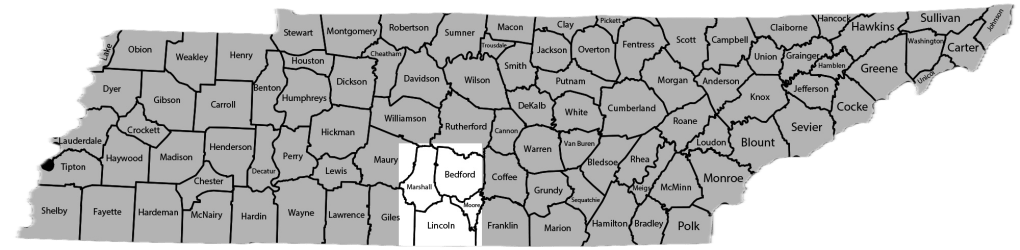
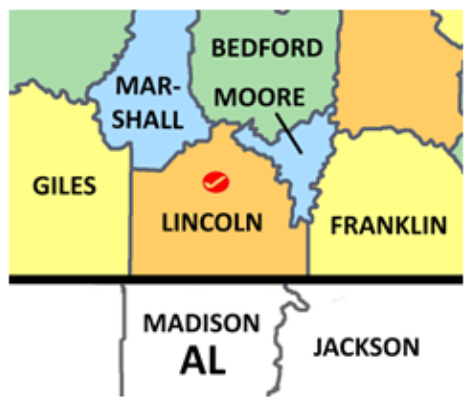
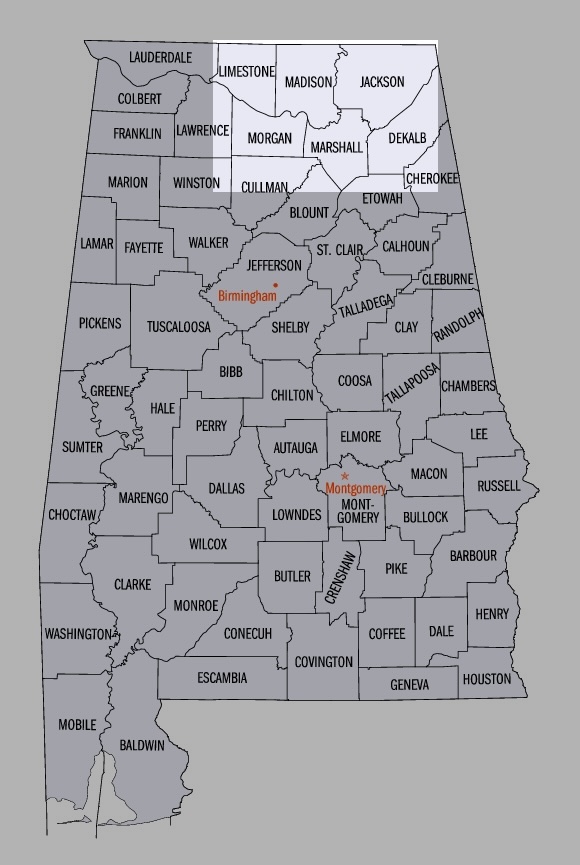
Thomas Dunlap Leonard grew up in Tennessee among his Leonard relatives there and then in Madison County, Alabama, to which his father Robert Leonard moved about 1818 and where, as noted above, Moses Birdwell brought his family from Georgia by 1812 when the county was still in Mississippi Territory. Madison County, Alabama, is very close to Marshall County, Tennessee, where Thomas Leonard (1752-1832) and wife Hannah James (1752-1842), parents of Robert, Thomas Lewis, and Hannah Leonard, settled in 1806 near what became Petersburg. The Leonard family moved to this region from Pendleton District, South Carolina.
This area was in Lincoln County, Tennessee, at the time and in 1836 fell into Marshall County. Madison County, Alabama, borders Lincoln County, Tennessee, on the south, with Marshall County bordering Lincoln on the north. Thomas Dunlap Leonard was born 8 January 1810 in Lincoln County, and as his manuscript states, he grew up knowing his grandparents Thomas and Hannah James Leonard and hearing their family stories. His manuscript records both family traditions they and other family members passed on to him and documents kept by the Leonard family at their home near Petersburg.
“Biography of the Leonards” indicates that Thomas Dunlap Leonard finished his manuscript in 1883 while living in Waller County, Texas, with the family of his widowed first cousin Elizabeth Frances Leonard Norris, a daughter of John Leonard and Hannah Fowler. Joseph J. Gill then added material to the manuscript, finishing his work on it on 17 May 1884. I have never seen the original manuscript copy of “Biography of the Leonards” or been able to track its whereabouts. My typescript copy came to me from Leonard researcher Jackie Leonard of the Limestone County, Alabama, Historical Society in February 1997.
Noting that James Birdwell, whom Thomas Dunlap Leonard knew personally, was a son of Moses Birdwell, “a good citizen,” “Biography of the Leonards” describes James as “a farmer and a sober, steady man of good habits and of good family.”
Madison County, Mississippi Territory/Alabama, Years, 1812-1818
Moses Birdwell moved his family from Franklin County, Georgia, to Madison County, Mississippi Territory, in the latter part of 1811 or early in 1812, when James Birdwell was sixteen or seventeen years old. The family was definitely in Madison County by 1 April 1812 when minutes of Enon Baptist church, now First Baptist church at Huntsville, show Moses joining the church on that date.[3] Enon church minutes for 1 July 1811 show Moses’ brother John Birdwell (1770-1854) along with several other men who were members of Enon church commissioned to view a place for a meeting house for Enon.[4]
In moving to Madison County, Mississippi Territory, at this time, the Birdwell family was taking part in a migration of other families from northwest Georgia to the newly opened lands of the Tennessee River valley in what would soon become north Alabama. Madison County lands were first offered for sale in 1809 not in Huntsville but in Nashville.[5] In that year, LeRoy Pope, a wealthy planter from the Broad River settlement at Petersburg in Elbert County, Georgia, spearheaded a migration of families from that part of Georgia just south of Franklin County, where the Birdwells lived, to Madison County. As Claire M. Wilson notes,[6]
Native Americans were forced from their lands in what is now northern Alabama, white settlers from Georgia, Tennessee, and the Carolinas began moving into the area. In 1809, Pope, John W. Walker, and Thomas Bibb headed the Broad River investors who bought large tracts of land in Madison County, which was in the Mississippi Territory at the time.
As that migration of wealthy planter families from the Broad River region of northwest Georgia to Madison County was taking place, a similar migration was occurring from nearby Franklin County, which is on Georgia’s northeastern border as is Elbert County. In contrast to the folks migrating from Elbert, who tended to be affluent planters, those coming to Alabama from Franklin County were for the most part yeoman farmers like the Birdwells. As a previous posting has noted, also moving to Madison County in 1809 from Franklin County, Georgia, was the family of Rowland Cornelius, which had moved to Franklin County, Georgia, by 1797 from Spartanburg County, South Carolina. The Corneliuses were accompanied to Madison County from Franklin County, Georgia, by a Connolly/Connelly family that intermarried with them for generations.
Some researchers have concluded that the James Birdwell who was a son of Moses Birdwell is a man of this name who bought 160 acres of land in Washington County, Alabama, on 20 January 1813, and who is on tax lists in that county through 1816. In my view, it’s not likely that this James Birdwell is the James who was son of Moses Birdwell. Washington County is in extreme southwest Alabama on the Mississippi border, and no records that I’ve ever seen place Moses’ son James in that part of Alabama. Note that James Birdwell would have been only eighteen years of age in 1813, too, and it seems unlikely that he’d have left his family, who were living on the northern border of the state in Madison County, to move to south Alabama at that young age.
Marriage to Aletha, Daughter of Thomas Lewis Leonard and Sarah M. (likely Mauldin) Lauderdale, Abt. 1819, Limestone County, Alabama
I have not found a record of when James Birdwell married Aletha Leonard, who was the daughter of Thomas Lewis Leonard and Sarah M. (likely Mauldin) Lauderdale of Limestone County, Alabama. Thomas Dunlap Leonard’s “Biography of the Leonards” states that Aletha (or, as this source spells the name, Alitha) was Thomas Leonard’s oldest daughter and was born in South Carolina (Pendleton District) about 1803. This source states that James Birdwell and Aletha Leonard married in Limestone County. James and Aletha’s oldest child was evidently their daughter Elvira, who was born about 1822; her date of birth suggests that the couple married about or before 1820. Many of Limestone County’s early records burned in 1862, and its marriage records do not go back prior to 1832.
Aletha Leonard’s parents had moved from Pendleton District, South Carolina, to Lincoln (later Marshall) County, Tennessee, in 1806 along with Thomas Lewis Leonard’s parents Thomas and Hannah James Leonard, and moved from there in 1818 to Limestone County, Alabama.[7] While living in Lincoln County, Thomas L. Leonard had patented land in Madison County, Mississippi Territory, in 1811. Limestone, which was created in 1818 from the Cherokee and Chickasaw Cessions of 1816 and 1817, borders Madison County on the west, with both counties bordering Tennessee on their northern borders. As Claire Wilson notes (see above), migration into north Alabama in this period had everything to do with removal of the native peoples from fertile lands in that part of the state, to make way for white settlers.
Limestone County, Alabama, Years, 1818-1830
James Birdwell’s father Moses had begun acquiring land in Limestone County by 24 February 1818, when James Isbell, husband of Moses’ niece Elizabeth Birdwell (a daughter of John Birdwell and Mary Allen), assigned to Moses a certificate (no. 1156) for 158.60 acres in Limestone County. On 4 September 1821, Moses received a payment schedule for installments he had to pay to receive the final patent for this land (certificate no. 664), which he bought with aid from Congress under a law that gave relief to purchasers of public lands prior to 1 July 1820. Moses made his final payment on 27 September 1822 and received the patent for the land on 1 May 1824.[8] Moses Birdwell was living in Limestone County by 1820 when the membership list of the first Baptist church established in that county, Round Island Baptist church on Round Island Creek, shows him joining that church by letter in 1820.[9] The Round Island church was organized in 1817.
James Birdwell and Aletha Leonard had probably married before 8 January 1820 when Limestone County’s Circuit Court and Superior Court Minute Book for 1818-1820 shows James on that date returning to court a summons for him to testify in Thomas Leonard’s case of debt against James W. Dupuy.[10] The court minutes do not specify that James was Thomas’ son-in-law, but I think it’s likely that’s why he was called to testify on Thomas’ behalf.
On 18 August 1826, when Moses Birdwell gave bond in Limestone County for administration of the estate of Thomas Lawrence, James Birdwell was his bondsman along with Joseph Johnston whose son Samuel married Aletha Leonard’s sister Minerva.[11] Thomas Lawrence’s estate was appraised by Thomas Leonard, Stephen Flinn (to whom Moses Birdwell sold the land he acquired in Limestone County from James Isbell), and Jonathan Cottingham. At the sale of Lawrence’s estate on 18 September 1826, James Birdwell was a buyer.
The 1830 federal census enumerates James Birdwell and his family in Limestone County, Alabama.[12] The household contains a male aged 30-40 (James, obviously), a male under five, two females 5-10, and a female 20-30 (Aletha). There are also two enslaved persons in the household, a male aged 30-55 and a female aged 24-36. The male under five is James and Aletha’s son John B. Birdwell, who was born 1 July 1828. The females aged 5-10 are Elvira (born about 1822) and Hannah (born 25 April 1825).
Jackson County, Alabama, Years, 1831-6
By 1830, James Birdwell’s father Moses had moved from Limestone to Jackson County, which joins Madison County on the east, bordering Tennessee on the north. Jackson County was created in 1819 from the Cherokee Cession. Moses had sold the Limestone County land he acquired from James Isbell on 25 October 1826, with Stephen Flinn as the buyer.[13]
On 28 September 1830, at the federal land office in Huntsville, Moses Birdwell purchased two tracts of land, each 80+ acres, in township 6, section 26 in Jackson County, and another tract of 80+ acres in township 6, section 27.[14] These tracts were near Grant and Grassy Mountains in what would become Marshall County in 1836. The patents issued to Moses Birdwell for this land state that he was living in Jackson County, Alabama, when the land was patented to him.
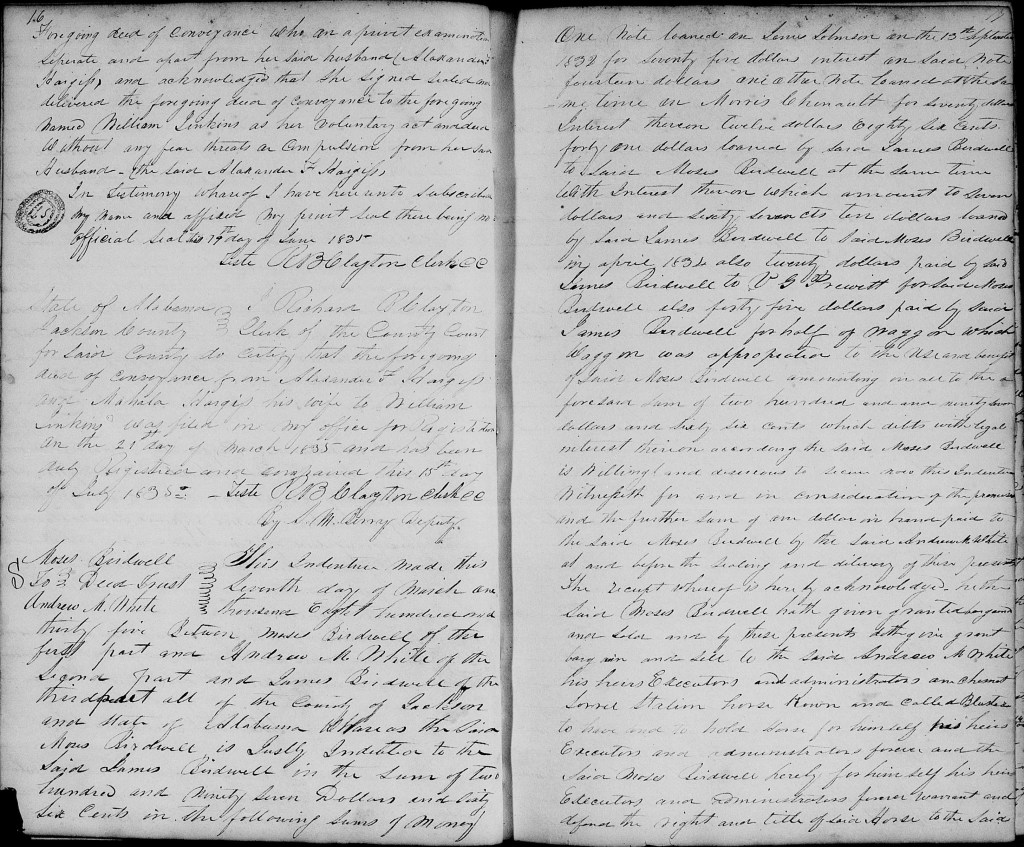

It appears that soon after his father moved from Limestone to Jackson (later Marshall) County, James joined Moses in Jackson County. Because Jackson County had destructive courthouse fires in 1864 and 1920, it’s difficult to track families living in that county in its formative years. James appears with his father Moses Birdwell in one surviving record from the early period of the county, a deed of trust showing Moses indebted to James Johnson ($75, with $14 interest), Morris Chenault ($75, with $12.86 interest), and his son James Birdwell ($41, with $7.77 interest), with James as Moses’ trustee as he mortgaged property to secure the debt.[15] The deed of trust states that James Birdwell was living in Jackson County along with Moses when it was made on 13 September 1832. It was recorded 7 March 1835.
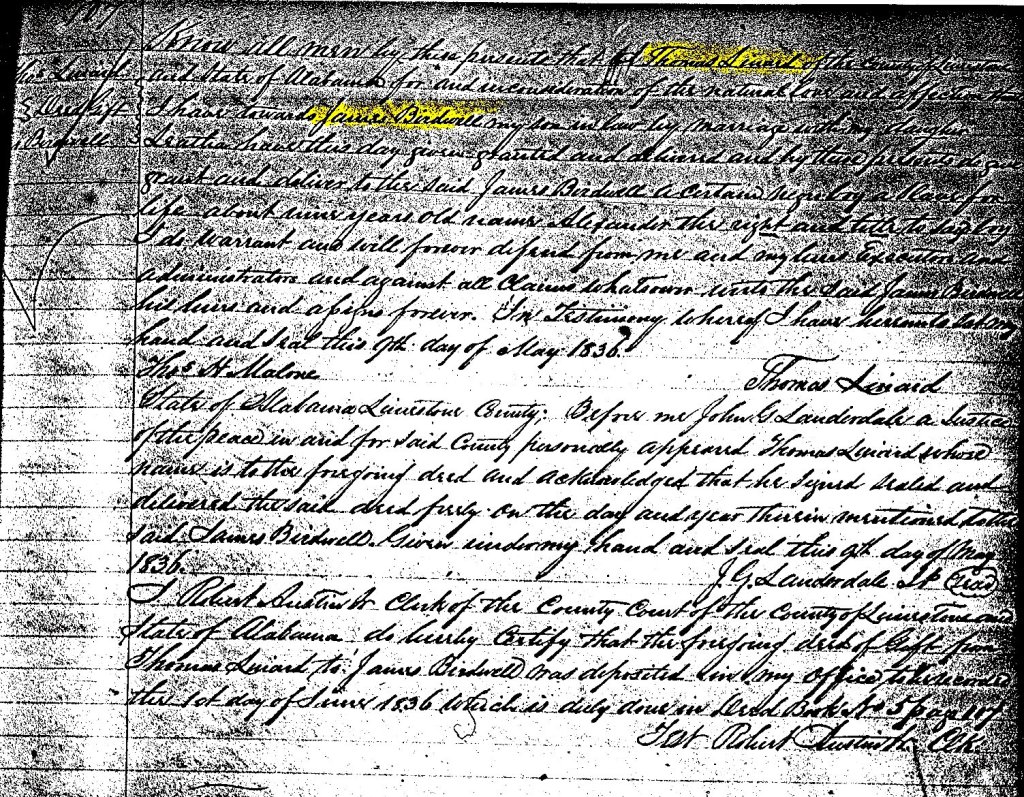
On 9 May 1836 in Limestone County, James Birdwell’s father-in-law Thomas Leonard deeded to James for love and affection an enslaved boy named Alexander, nine years old.[16] The deed states that James was Thomas’ son-in-law through marriage to Thomas’ daughter, whose name appears as Leatha here. Thomas proved the deed on the day it was made before John Gamble Lauderdale, a justice of the peace who was his brother-in-law, brother of Thomas’ wife Sarah M. Lauderdale.
Marshall County, Alabama, Years, 1836-1839
By 1837, James Birdwell begins to show up in the records of Marshall County, Alabama, which was formed in 1836 from Blount and Jackson Counties and the Creek Cession. As I have noted above, the land that Moses Birdwell bought in Jackson County in 1830 fell into Marshall at that county’s formation in 1836. It appears that Moses was living by 1830 in the portion of Jackson County that would become Marshall in 1836, and that his son James followed him to this area soon after 1830.
The first record I have for James Birdwell in Marshall County shows him giving bond on 22 July 1837 in the amount of $300 along with William S. Johnson for David Ricketts’ administration of the estate of Adam Nichor.[17] Adam Nicar was in Limestone County by August 1820 when he bought land in that county from the Huntsville land office. David Ricketts was actively involved in the removal of the Cherokee people from Marshall and surrounding counties, having been appointed in 1836 along with General Andrew Moore as an appraising agent for Cherokee property in the northern part of Alabama, with Cherokee chief Andrew Ross acting as their interpreter.[18] Ricketts Gap, named for this Ricketts family, is some ten miles north of the Marshall County seat, Guntersville, and about five miles south of Grassy Mountain, near which Moses and James Birdwell appear to have lived.
On 13 January 1838, The Democrat of Huntsville carried a notice that an unclaimed letter was waiting for James Birdwell in the Claysville, Alabama, post office as of 31 December 1837.[19] The same notice ran again in this paper again on 14 July 1838 and 25 April and 17 October 1840. Claysville is just north of the Marshall County seat, Guntersville, and like Guntersville, was on the Tennessee River, now on Lake Guntersville.
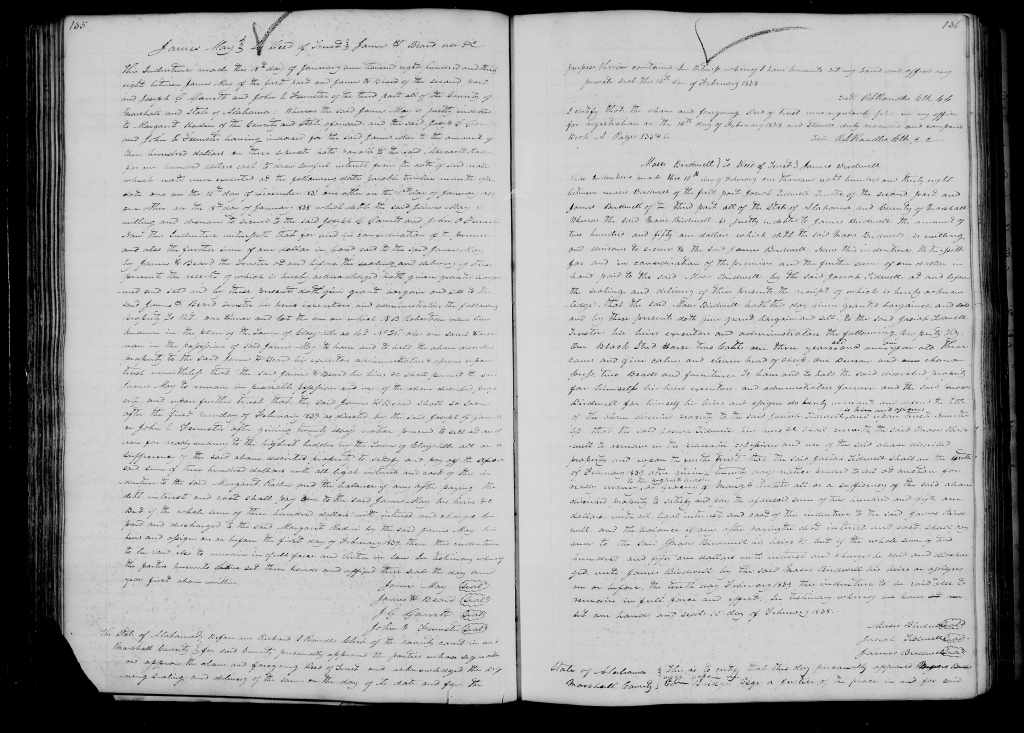
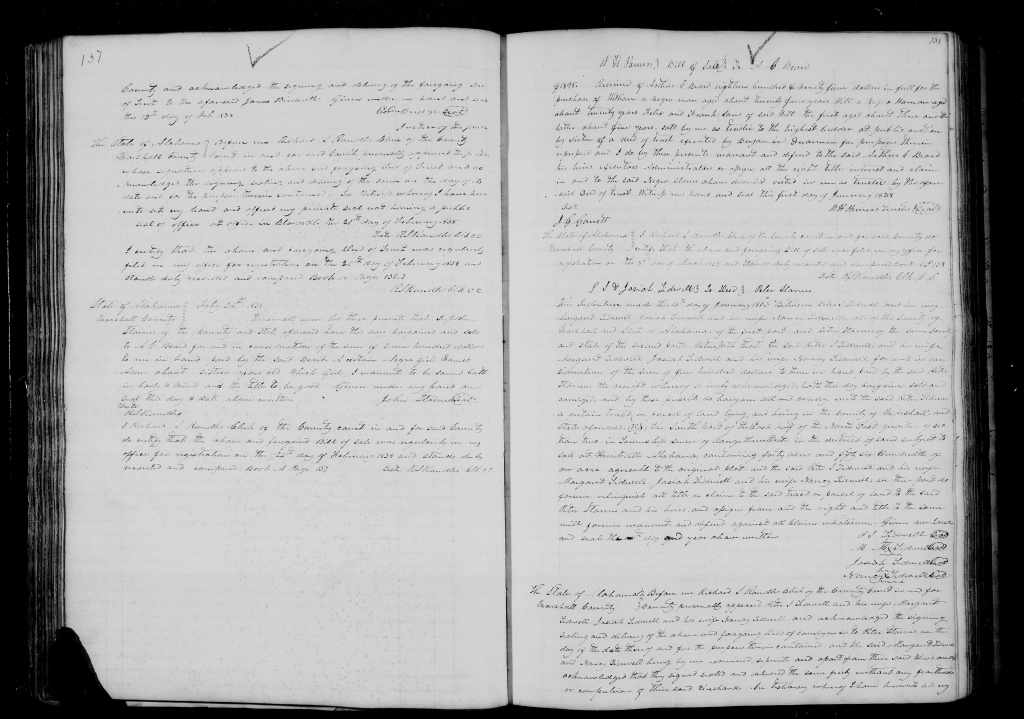
Moses Birdwell’s problems with debt continued into the latter part of the 1830s, and as we’ll see when I post more about Moses, eventually caused him to go bankrupt and leave Alabama for Texas at the very end of his life. On 10 February 1838, James Birdwell appeared in another deed of trust in Marshall County as his father Moses mortgaged property to secure a debt. The deed notes that Moses owed James $251.00.[20] Josiah Tidwell acted as trustee for this mortgage, in which Moses placed in trust livestock and household furniture, with the understanding that the property would remain in his hands until 8 February 1839, when Tidwell would sell it if Moses had not paid his debt to James. The deed was signed by Moses, James, and Josiah Tidwell, who verified it on 20 February 1838, when it was recorded.
Josiah Tidwell is enumerated on the 1830 federal census in Blount County, Alabama, which adjoins Marshall on the southwest. Other Tidwells in Blount County in 1830 included Henry and Job, who are on the same page with Josiah. Job Tidwell was aged 60-70, while Josiah was 50-60.
On 30 April 1838, a deed of trust by Edmund Bridges to William S. Logan and James Birdwell, all of Marshall County, noted that James had endorsed Bridges (that is, had gone security for him) to the Bank of Alabama at Huntsville on a note for $525, and that the note would fall due on 28 March 1839.[21] To secure his debt to James Birdwell, Edmund Bridges placed in trust in William S. Logan’s hands two parcels of land, 120 acres and 100 acres, in township 7, section 6 of Marshall County. The condition of the mortgage was that Bridges could remain in peaceable possession of the land unless he defaulted on his debt, at which point Logan could sell it to satisfy the debt. All three parties signed the deed and it was acknowledged by Bridges and Logan on 5 May 1838. Note that Moses Birdwell’s 5 February deed of trust to his son James was witnessed by Edmund Bridges.
According to Marshall County historian O.D. Street, the portion of Marshall County that had previously been Jackson County on the north side of Tennessee River was settled by settlers primarily from Virginia, North Carolina, and Tennessee, and these included David Ricketts, mentioned previously, and Edmund Bridges.[22] On 17 January 1834, Bridges was made postmaster of Cottonville, Alabama, which is some ten miles north of Guntersville and close to Claysville, discussed above.[23]
As a previous posting has noted, the economic collapse that occurred in 1837 hit planters in north Alabama especially hard, because, as the cotton economy boomed in that region and many cotton growers made money quickly, they had also overextended themselves economically by going security on each others’ debts, so that when the economy crashed and the debts were called in, they frequently went broke. At this point, large numbers of north Alabama cotton planters cut their losses and moved west, with Louisiana and Texas as particularly enticing destinations.
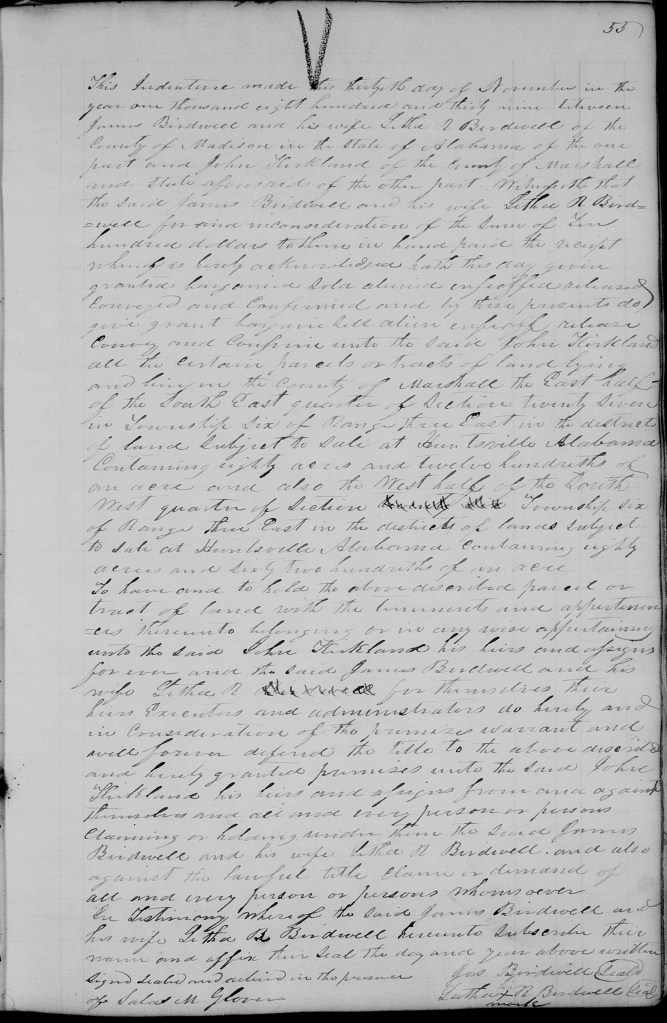
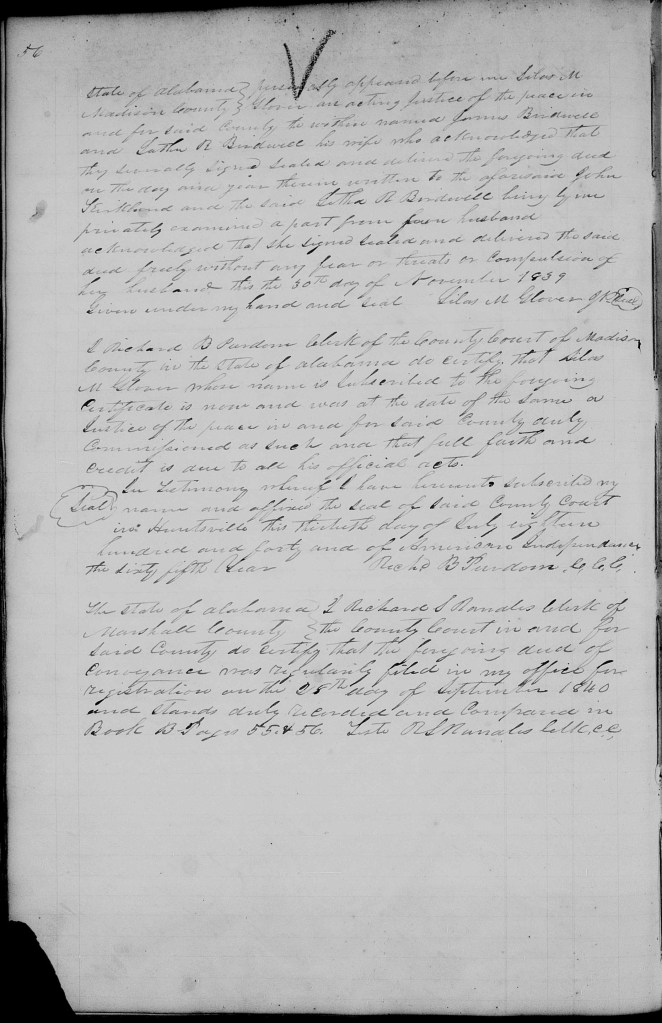
My reading of the two 1838 deeds of trust involving James Birdwell discussed above is that he was setting his affairs in order at that time with plans to leave Alabama for Louisiana. On 30 November 1839, he and wife Aletha sold to John Kirkland the tracts of land that Moses Birdwell had patented in Jackson County in 1830, which had fallen into Marshall County at that county’s formation.[24] I think this land had likely come into James’ hands due to his father’s debt to James, and that James and Aletha had probably been living on and farming this land since the first part of the 1830s. The deed is signed by both James and Aletha, James signing and Aletha (who is called Letha R. Birdwell in the deed) making her mark, with Silas M. Glover as witness. The deed states that James and Aletha were in Madison County at the time it was made.
It’s clear to me that, with this land sale and their temporary relocation to Madison County, James and Aletha were moving their family to Louisiana. According to Thomas Dunlap Leonard in his “Biography of the Leonards,” the Birdwell family moved to Louisiana from Alabama in 1840. In May 1839, Aletha’s father Thomas Lewis Leonard sold his land in Limestone County, Alabama, and moved to Texas, with court records stating that Thomas Leonard had “absconded” from the county in May 1839 – that is, he left debts behind.
Prior to selling his land in Marshall County in November 1839 and moving to Louisiana, James Birdwell made a deed of trust in Limestone County on 21 March 1839 in which he and Thomas Dunlap Leonard recorded a trustee’s deed to Napoleon Grayson for debt to John C. Grayson for land in Madison County.[25] Again, James was tying up financial loose ends in Alabama as he moved his family to Louisiana. With the next posting, I’ll pick up James’ story after his family went to Natchitoches Parish, Louisiana.
On James Birdwell’s name as James G. Birdwell and why I conclude he had that middle initial, see this previous posting.
[1] 1850 federal mortality schedule, DeSoto Parish, Louisiana, p. 168, l. 11.
[2] George W. Birdwell’s place and year of birth – Franklin County, Georgia, 1791 – are stated by his son Joseph Birdwell in a deposition Joseph Birdwell made in Young County, Texas, court on 17 December 1904 continuing his father’s and mother’s (Matilda Garner Birdwell) claim for a pension for George’s War of 1812 service: see NARA, War of 1812 Pension Files, 1812-1815, RG 15, file of George Birdwell (S.O. 25426) and widow Matilda Garner Birdwell (S.C. 15498), available digitally at Fold3. George’s tombstone in Gooseneck cemetery at Graham in Young County, Texas, also states that he was born in Franklin County, Georgia, and gives a birthdate of 23 November 1791: see Find a Grave memorial page of George Washington Birdwell, created by Dana Ribble, maintained by Searchers of Our Past, with a tombstone photo by Searchers of Our Past.
[3] The original records of Enon Baptist church for the period 1808-1866 are extant and are available digitally at FamilySearch. I’m citing the original church record book for 1812, p. 12.
[4] Ibid., p. 11. On the early history of Enon, see Huntsville-Madison County Historical Society, “Enon Baptist Church History,” Huntsville Historical Review 25,2 (2022), pp. 31-4. See also Duane and Tracy Marsteller, “Original Site of Enon Baptist Church,” at the Historical Marker Database website.
[5] Ricky L. Sherrod and Annette Pierce Sherrod, Plain Folk, Planters, and the Complexities of Southern Society: A Case Study of the Browns, Sherrods, Mannings, and Williamses of Nineteenth Century Northwest Louisiana (Nacogdoches: Stephen F. Austin State University Press, 2014), p. 24. See also pp. 47-8.
[6] “LeRoy Pope,” Encyclopedia of Alabama of Auburn University and Alabama Humanities Alliance.
[7] Thomas Dunlap Leonard, “Biography of the Leonards.”
[8] See Find a Grave memorial page for James R. Isbell, Blue Spring cemetery, Larkinsville, Jackson County, Alabama, created by Ray Isbell.
[9] “The Membership of the Round Island Baptist Church, As Recorded in the Minutes, 1817-60,” Limestone Legacy 1,1 (January1979), p. 36.
[10] Limestone County, Alabama, Circuit Court and Superior Court Minute Bk. 1818-1820, pp. 494-7, case 329. Thomas Leonard’s surname is spelled Lenard here.
[11] Limestone County, Alabama, Will Bk. 3, pp. 19-20; and Limestone County, Alabama, Orphans Court Minutes 1824-30, pp. 62-3. See also Pauline Jones Gandrud, Alabama Records: Limestone County, vol. 88, p. 2, vol. 237, p. 41; Huntsville Land Office, vol. 7, pp. 186-7.
[12] 1830 federal census, Limestone County, Alabama, p. 42A.
[13] Limestone County, Alabama, Deed Bk. B 2, pp. 278-9.
[14] Margaret Matthews Cowart, Old Land Records of Marshall County, Alabama (Huntsville, 1988), pp. 116-7, certificates 3153-4, citing Marshall County Tract Books.
[15] Jackson County, Alabama, Deed Bk. A, p. 16-9; see also Gandrud, Alabama Records: Jackson County, vol. 226, p. 19.
[16] Limestone County, Alabama, Deed Bk. 5, p. 107. Thomas Leonard’s surname is given as Linard here.
[17] Marshall County, Alabama, Final Records Bk. 1, pp. 93-6.
[18] Lamar Marshall, Larry Smith, and Michael Wren, Alabama Collection Camps, Forts, Emigrating Depots and Travel Routes Used During the Cherokee Removal of 1838-1839 (Washington, D.C.: National Park Service, 2009); and U.S. Department of War, Report from the Secretary of War in Compliance with a Resolution of the Senate of the 13th October, 1837, in Relation to the Cherokee Treaty of 1835 (Washington, D.C.: Blair & Rives, 1838), pp. 680-1.
[19] The Democrat [Huntsville, Alabama] (13 January 1838), p. 3, col. 1.
[20] Marshall County, Alabama Deed Bk. A, pp. 136-7.
[21] Ibid., p. 153.
[22] O.D. Street, “Marshall County One Hundred Years Ago,” Guntersville Democrat (26 February 1903), p. 2, col. 4-5.
[23] U.S. Appointment of Postmasters, Alabama, vol. 11, p. 92.
[24] Marshall County, Alabama, Deed Bk. B, pp. 55-6.
[25] Limestone County, Alabama, Deed Bk. R, p. 10.
 BEGATS AND BEQUEATHALS
.png)

7 thoughts on “James G. Birdwell (1795-1849): Georgia and Alabama Years”