Emigration of the Family of Valentine Ryan and Bridget Tobin to America in Two Stages, 1852 and 1854
This posting focuses on a great-grandmother of mine whom I’ve mentioned in a number of previous postings, none of which discusses her life in any detail. This was my mother’s Irish-born grandmother Catherine Ryan, daughter of Valentine Ryan and Bridget Tobin of Killahy (civil) parish, Inchacarran townland, County Kilkenny, Ireland, and Jefferson and Grant Counties, Arkansas. Several years ago, I did a series of postings about this family and its emigration to America in two stages: Valentine Ryan arrived in New Orleans on Christmas day 1852, to be followed by wife Bridget and their children Margaret, Patrick, and Catherine in March 1854. When the Ryans came to America, Margaret was approaching sixteen, Patrick was just about to turn eight, and Catherine was four.
Immediately after Bridget and the children arrived in New Orleans, the Ryans then settled in Clarke County in southeast Mississippi near an Irish colony in Paulding. Valentine may already have been living in Mississippi and, as I suspect, working with other Irish men to lay tracks for the railroad that was just reaching that corner of Mississippi when the Ryan family came to America – working to make money to bring his wife and children over from Ireland and to save money to buy farmland, something the Ryans did in Arkansas in 1859. On the railroad aspect of this story, see the posting I linked in the previous paragraph.
Marriage of Margaret Ryan to Robert Allen Sumrall, Clarke County, Mississippi, 1856, and Move to Jefferson County, Arkansas
In two previous postings (here and here), I note that, after the Ryans settled in Clarke County, Margaret married Robert Allen Sumrall (1831-1900) on 22 October 1856.[1] Robert was the son of Jesse and Christiana Sumrall of Clarke County; Christiana was née Sumrall and was a first cousin of Jesse. As a previous posting states, Robert had an aunt Mary Sumrall who married an Irish immigrant in the Paulding Irish colony, Patrick Brogan, and I suspect that it was that connection that led to Robert A. Sumrall meeting Margaret Ryan and marrying her.

As a previous posting states, by 1859, Valentine and Bridget Ryan had moved to Arkansas with their unmarried children Patrick and Catherine, and had bought land in what was then Jefferson County and became Grant County in 1869. The family settled about twenty miles directly south of Little Rock. And as another posting indicates, Margaret and her husband Robert A. Sumrall soon followed the Ryan family in this move to Arkansas, and on 2 July 1860 at the federal land office in Little Rock, Robert bought land in Jefferson County near Valentine Ryan.[2] The posting I’ve just linked also tells you that Margaret died in Jefferson (now Grant) County on 9 August 1862 and is buried with her parents and siblings in a cemetery at Orion in Grant County. Margaret’s tombstone states that she was aged 27 years and seven days when she died; her baptismal record in Kilmacow (later Mullinavat) Catholic parish in County Kilkenny shows her baptized on 3 August 1838, which would make her three years younger than her tombstone indicates.[3]
Margaret Ryan Sumrall’s Death, 1862, Leaving Daughter Mary Margaret Motherless
When Margaret Ryan Sumrall died, she left a daughter Mary Margaret Elizabeth Sumrall, who was born about 1860 in either Clarke County, Mississippi, or Jefferson (later Grant) County, Arkansas. As two previous postings note (here and here), following Margaret’s death, her father Robert A. Sumrall took his daughter Mary Margaret back to Mississippi and placed her with the family of William T. Harper to raise, then went to Texas and remarried, living the rest of his life there. Mary Margaret remained in Mississippi and married William T. Harper’s nephew John Thomas Harper.
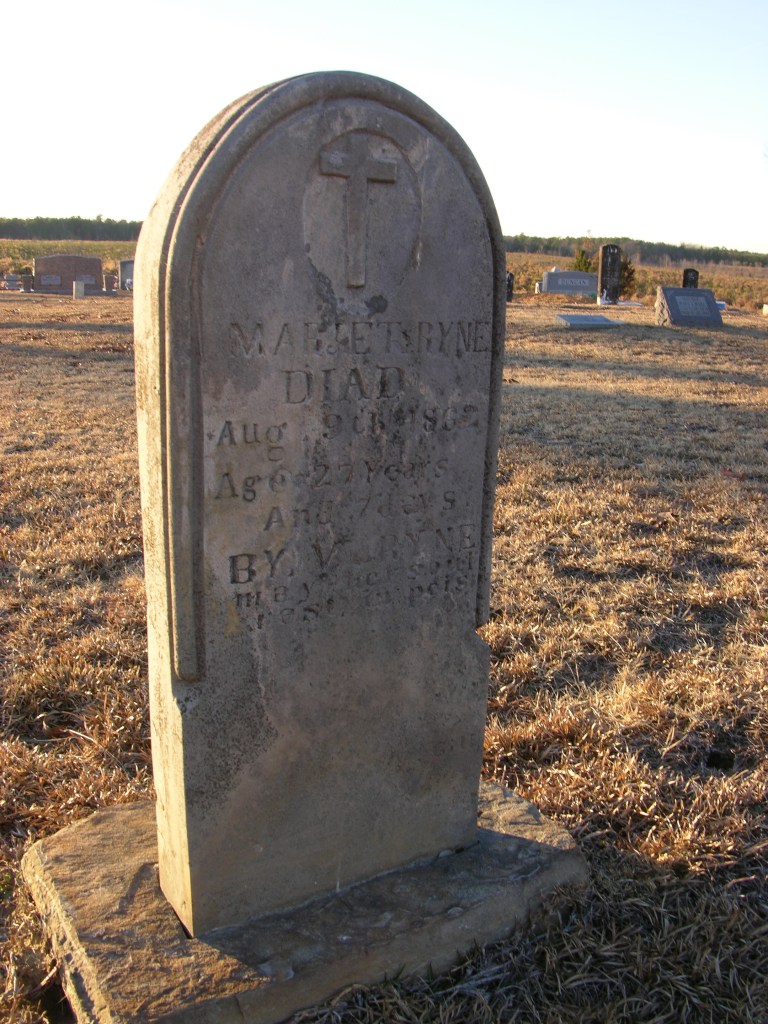
But that’s not the whole story. I have not told more of this story in previous postings because what I knew of it depends heavily on family stories told to me as I was growing up, and until the past week, I had been unable to verify a central claim of those stories: this is that, following her sister Margaret’s death, my great-grandmother Catherine Ryan married Margaret’s widow Robert A. Sumrall, so that Catherine’s niece Mary Margaret would have a mother. I had never found proof of that fact until this past week, when, using FamilySearch’s new experimental full-search feature, I decided to see if I might turn up new information about Robert A. Sumrall by entering his name into that search engine.
Surprising Confirmation of Family Story That Margaret’s Sister Catherine Married Margaret’s Widower Robert Sumrall after Margaret’s Death to Give Mary Margaret a Mother
When I did so, up popped a deed I had never seen before, showing Robert A. Sumrall and wife Catherine on 31 July 1867 selling two tracts of land, one 51 acres and the other 160 acres, in Jefferson County, Arkansas, to Silas N. Marshall and James S. Wolfe.[4] Silas Newton Marshall and James Smith Wolfe were both New York-born, Marshall being a Little Rock merchant and Wolfe treasurer of Pulaski County, of which Little Rock is the seat. The deed states that Robert and Catherine Sumrall were living in Little Rock when they sold this Jefferson County land, though it shows Catherine relinquishing her dower rights in Jefferson County on 3 August, with Jefferson County justice of the peace H.B. Jernigan stating that Catherine was well-known to him. Henry Bishop Jernigan was a neighbor of the Ryan family in what became Grant County when that county was cut from Jefferson in 1869, and is buried in Orion cemetery in Grant County along with Catherine Ryan Batchelor, her parents, and her siblings.
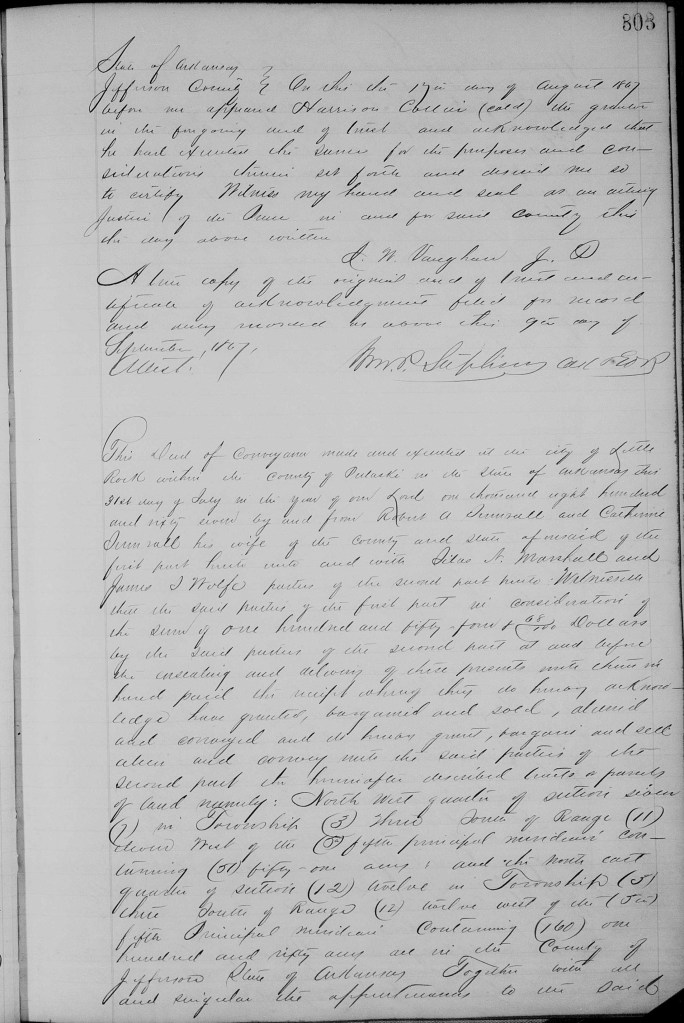
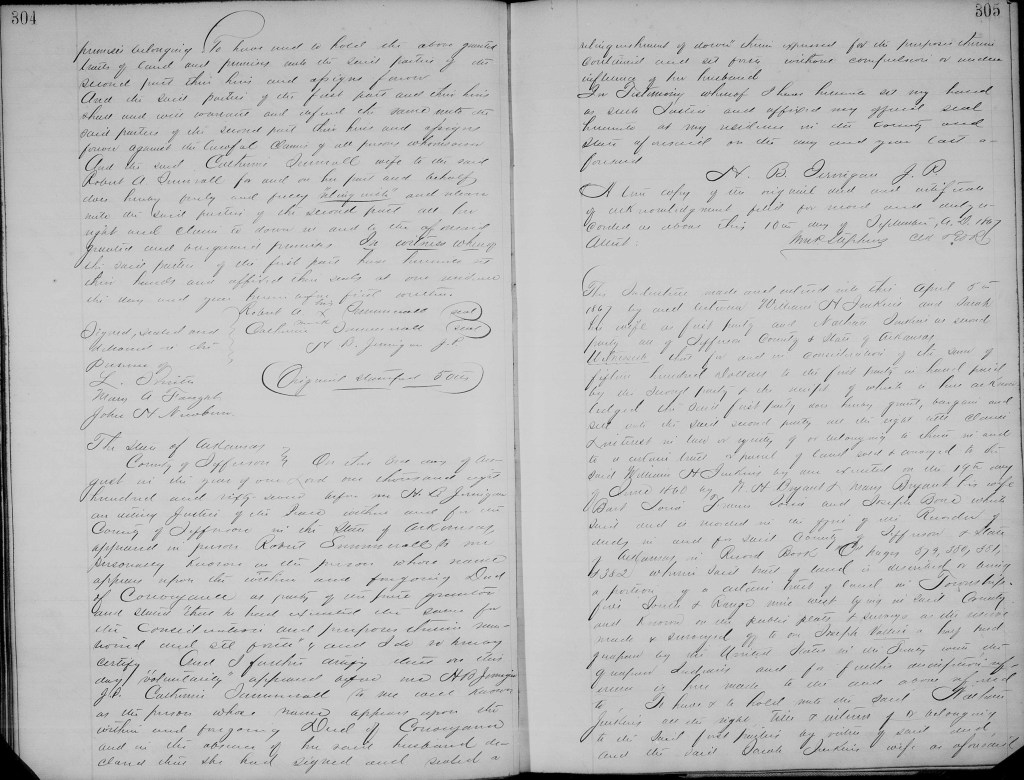
The land that Robert and Catherine Ryan Sumrall sold to Marshall and Wolfe on 31 July 1867 is the land that Robert Sumrall bought at the Little Rock federal land office on 2 July 1860. It appears to be all of the land that Robert Sumrall owned in Jefferson County. Nothing in the deed states why Robert and Catherine were living in Little Rock instead of Jefferson County by July 1867, or whether Robert had previously lived with wife Margaret on his Jefferson County land, near which Margaret is buried, or why the couple were selling all of their land in Jefferson County in 1867. The deed, does, however, provide solid proof that the family story I was told as I was growing up was correct when it stated that Catherine Ryan married her sister Margaret’s widowed husband following Margaret’s death: the marriage had taken place at some point before 31 July 1867. I have not found a record of this marriage.
I keep referring to “the family story I was told as I was growing up”: to be precise, I heard this story from my grandmother Hattie Batchelor Simpson, the youngest daughter of Catherine Ryan by the husband she married after her marriage to Robert A. Sumrall ended, George Richard Batchelor. I also heard it from my mother and her four sisters, all of whom were told the story by their mother.
Dissolution of Marriage of Catherine Ryan and Robert A. Sumrall, 1867-1870
There’s more to the story than the information that following Margaret Ryan’s death, her sister Catherine married Margaret’s widowed husband Robert Allen Sumrall. The story I was told as I grew up also stated that Catherine left Robert A. Sumrall because he was cruel to her, and at some point after that, married George R. Batchelor. I was also told that during the time Robert and Catherine were married, Catherine had a daughter by Robert A. Sumrall. I have not been able to prove that Robert Sumrall and wife Catherine Ryan had a daughter, though I have no particular reason to doubt this detail in the story told to me as a child. If the couple did have a daughter, then I think she did not live beyond infancy.
Robert A. Sumrall Returns to Mississippi, 1867-1870, with Daughter Mary Margaret
My attempt to find specific information about a possible daughter of Robert and Catherine and about precisely when Catherine married George R. Batchelor is complicated by the fact that I cannot find either Catherine Ryan Sumrall or George R. Batchelor on the 1870 federal census. I do find Robert A. Sumrall and his daughter by Margaret Ryan, Mary Margaret Sumrall. In 1870, Robert was living in the household of his brother William Wesley Sumrall at Ellisville in Jones County, Mississippi, and his daughter Mary Margaret was also living at Ellisville in the household of William T. Harper and wife Amanda Adaline Collins.[5] The census shows Robert aged 39 and working as a farm laborer, with his brother William listed as the farmer for whom he’s working. Mary Margaret’s name is given as Elizabeth. She is 10 years old and the census states that she was born in Mississippi. The 1880 federal census, which shows Mary Margaret continuing to live with William and Amanda Harper, lists her as M.S. Harper and states that she was born in Arkansas and was aged 18 in 1880.[6] Mary Margaret’s tombstone in Lebanon cemetery at Laurel, Jones County, Mississippi, gives her name as Margrett E. Harper.[7]
Robert A. Sumrall’s brother William Wesley Sumrall was married to Nancy Emaline Collins, a sister of Amanda Adaline Collins to whom William T. Harper was married. These two Collins women were daughters of Vinson A. Collins and Nancy Bynum of Jones County.
Though I have not found a record of the dissolution of the marriage of Robert A. Sumrall and Catherine Ryan, I can verify, then, that at some point between 31 July 1867 and August 1870, the marriage ended and Robert returned to Mississippi with his daughter by Margaret Ryan and gave her to a Harper family to raise – and, again, these pieces of information were, as the links provided at the start of this posting state, part of the story my grandmother and her daughters told me as I was growing up.
In 1938, Mary Margaret’s son Robert Harper by her husband John Thomas Harper came to Arkansas and visited my grandmother and her sister Frances. My grandmother, who was left a widow with six children and a stepson to raise when my grandfather William Z. Simpson died in 1930, was startled and a bit frightened when this strange man with a long beard knocked on her door. She had never heard of him. He told her that when Mary Margaret was seven years old – that is, in or around 1867 – Robert A. Sumrall brought her to Mississippi and gave her to William T. and Amanda Harper to raise.
As a previous posting notes, in March 1997, I visited Mary Margaret’s grave in Lebanon cemetery at Laurel, Mississippi, and was directed by someone who was passing by the cemetery to the house of a Mrs. Mollie English, who lives just across the road from Lebanon cemetery. When I told Mrs. English why I was visiting Mary Margaret’s grave and recounted to her the family stories I’m recounting here, Mrs. English listened with great interest. After I finished talking, she told me that she knew these stories and had heard them herself, since she happened to be a daughter of John Thomas Harper, Mary Margaret Sumrall’s husband, by his second wife Martha Jane Jones. As the posting I linked at the head of this paragraph also states, Mrs. English pointed me to a photograph of Margaret Ryan that some of her descendants in Laurel, Mississippi, owned – a photograph I shared in the posting I’ve linked above, a sepia version of which is at the head of this posting.
If Robert A. Sumrall brought his daughter to Mississippi in 1867, then it would seem that the marriage of Robert Sumrall and Catherine Ryan ended around the time they sold all of his land in Jefferson County, Arkansas. I wonder if they might have sold this land in July 1867 as a prelude to dissolving their marriage. If so, having Catherine participate in the land sale and relinquish her dower interest in the land before the couple divorced would have streamlined Robert’s sale of his Arkansas property as he prepared to return to Mississippi. Or it’s possible Robert and Catherine were selling their land with plans to move to Mississippi and she then decided she would not join him in that move.
I might note here that in 1867, Robert was around thirty-six years old and Catherine was eighteen. Her baptismal entry in the Catholic parish register of Mullinavat in County Kilkenny, Ireland shows her baptized on 19 August 1849,[8] and this is the date of birth also stated on her tombstone in the Orion cemetery in Grant County, Arkansas.
And Where Was George R. Batchelor in 1870?
Just as I have not found a record of the divorce of Robert A. Sumrall and Catherine Ryan, I have also not found a record of Catherine’s marriage to George R. Batchelor. Since I cannot locate either George or Catherine on the 1870 federal census, I don’t know for certain whether they had married by that point. Their oldest child, a son James Franklin Batchelor, who died at age four, was born 1 July 1870, according to his tombstone in Orion cemetery in Grant County, Arkansas. This birthdate suggests that the couple had probably married by or in 1869. If the marriage took place in Grant County, then the marriage record is likely lost, since the early records of that county, which was formed in 1869, burned in 1877.
Compounding the puzzle of the absence of both George Batchelor and Catherine Ryan from the 1870 federal census, there’s the fact that a number of other members of George’s family are absent from that census. Not only is George R. Batchelor missing from the census, but so are three of his five living brothers: Wiley, Daniel, and Edward. Where were all of these young Batchelor men in 1870?
Their parents Moses Batchelor and Minerva Monk had brought the family from Hardin County, Tennessee, to Hot Spring County, Arkansas, in the latter part of 1848. The family settled close to what would become the Hot Spring-Grant County line when the latter county was formed in 1869, near the town of Poyen in what is now Grant County, where Moses and his second wife Louisa Waters Robinson are buried. The 1870 federal census shows Moses and his oldest son John both living in Hot Spring County, and I find Moses joining Francois Baptist church there in August 1870. Church minutes show his wife Louisa joining the Francois church in September 1869. Moses joined “by experience,” an indicator that he was unchurched when he joined the church; Louisa joined “by letter,” which tells us that she had previously belonged to a Baptist church.[9] Louisa’s father John Waters was a Baptist pastor in Saline and Grant Counties, Arkansas. (Moses didn’t last long in the church. Not far down the road, he was “disfellowshipped” for being drunk in public, and I’ve never known if the offense was being drunk or doing it in public.)
Minerva Monk, the mother of Moses’ six sons, died in the latter part of 1860, apparently from breast cancer, and Moses almost immediately remarried Louisa, the widow of Washington Robertson/Robinson. Louisa had seven children by her first husband. That made for a combined Batchelor-Robinson household of thirteen children, a blended family of two sets of stepchildren.
Reading between the lines and piecing together hints I heard in family stories as I was growing up, Moses’ younger sons, who included my great-grandfather George R. Batchelor, did not want to stick around long after their mother died and stepmother arrived, and the two youngest boys, George and his brother Ed, who were young teens when their mother Minerva died, moved east to the part of Jefferson County that became Grant County in 1869 and both married there. The 1860 federal census shows that as Minerva was dying, she and Moses had sent their sons Wiley and James to Pine Bluff in Jefferson County, James to live with his uncle John B. Monk and Wiley to live with the family of Kinchen M. Thomas, who came to Pine Bluff from North Carolina where Moses and Minerva Monk Batchelor were also born. I suspect that Moses and Minerva sent James (aged sixteen) and Wiley (aged eighteen) to Pine Bluff as she was dying to lighten the burden of maintaining a family as its mother was approaching death. In July 1861 James enlisted in the Confederate Army and was killed in November 1861 at Columbus, Kentucky. Wiley vanishes from all records after 1860. In 1862, the oldest Batchelor son, John Wilson Batchelor, married the oldest daughter of his stepmother Louisa, Talitha Emeline Robinson, and it was clear from that point forward that the Batchelor family farm was going to go to that couple after Moses and Louisa died, so his brother George and Edward, the two youngest sons, had no reason to remain at home and at some point after 1862, they moved to the portion of Jefferson County that became Grant County in 1869. George was seventeen in 1862 and Ed was thirteen.
To sum up, the 1870 federal census captures the whereabouts of the father of these Batchelor sons, Moses, and of his oldest son John, but misses the rest of Moses’ sons. James was killed in 1861, and perhaps Wiley died after he appeared on the 1860 federal census. But where were George, Daniel, and Edward, the three youngest sons, all of whom were definitely alive in 1870? And, again, where was Catherine Ryan Sumrall, who was evidently married to George R. Batchelor by this point? Interestingly, the household next to her parents Valentine and Bridget Ryan on the 1870 federal census in Jefferson County is listed as a blank household.[10] A number is given for the dwelling, then a line drawn through the section for a family number, suggesting that no one was living in that household.
I have to wonder if this was the household of Valentine and Bridget’s daughter Catherine, and if she had perhaps married George R. Batchelor by that date – but this is, of course, supposition. Catherine does not appear on the census near her brother Patrick, who was living in Pulaski County in 1870 after having ended his Union War service, and having married Rosanna Hill, the widow of his Army mate John H. Spann.[11] Rosanna died in 1868 and Pat Ryan remarried on 9 December 1869 to Delilah Rinehart, whose sister Rachel married George R. Batchelor’s stepbrother George Anderson Robinson. George A. Robinson enlisted in the Confederate Army with George R. Batchelor’s brother James, and was then captured in Kentucky and switched sides and joined the Union Army.
There was such upheaval in many places, Arkansas notably, during the Civil War, with men off at war, men dying, men switching sides, gangs of lawless men roaming the countryside and murdering and robbing people while pretending to represent one side or the other – such upheaval that there are just interruptions in records and some mysteries about where people were, perhaps compounded in this story by the dissolution of the marriage of Catherine Ryan and Robert A. Sumrall and his move back to Mississippi.
Civil War Record of Robert A. Sumrall
A case in point, which illustrates the difficulty of tracking people in places like Arkansas during the turbulent Civil War years, is Robert A. Sumrall and his Civil War record. After having taken his daughter Mary Margaret to Mississippi around 1867, at some point after he appeared on the 1870 federal census in Jones County, Mississippi, Robert A. Sumrall then went to Texas, where he married again: Polk County, Texas, marriage records show him marrying Mary Jane Hare in that county on 2 August 1874.[12] On 6 December 1893, Robert filed a pension application in Polk County seeking recompense for service he claimed to have given in the Union Army during the Civil War.[13] Robert’s pension application states that on 19 August 1863 in Iowa, he enlisted in Co. K of the 18th Regiment of Iowa Infantry, and was discharged at Fort Smith, Arkansas, on 1 February 1865.
The only Civil War service papers extant for Robert A. Sumrall show Robert enlisting at Pine Bluff, Arkansas, on 18 June 1862, in Co. K of the 26th Arkansas Infantry of the Confederate Army.[14] Robert’s service papers show him then deserting by 29 July 1862, rejoining on 20 August 1862, and being on his unit’s roll until 30 June 1863.
The file for the pension claim Robert made in Polk County, Texas, in December 1893 shows the federal claims office rejecting Robert’s claim and stating that there was no proof he ever served in Co. K of the 18th Regiment of Iowa Infantry. It also has paperwork from Dr. E.N. Gray stating that, though Robert claimed to suffer from rheumatism and general debility as a result of his Civil War service in the Union Army, he never appeared for a medical examination that was set up to verify his claims.
The pension file also has an affidavit made on 11 January 1895 by John Rushing of Calator, Polk County, Texas, aged 77, who testified that he knew Robert A. Sumrall in Springfield, Missouri, in 1864 and went with him as a refugee on the march to Fort Smith at that time. Due to his failure to appear for his medical exam and the lack of proof that he served in the Union Army unit in Iowa, his pension claim was rejected.
If we put the chronology of Robert’s Confederate service papers together with his file claiming a pension for Union service and together with other pieces of information we can verify about his whereabouts during the Civil War years, we come up with the following:
18 June 1862: Robert enlisted in Co. K of the 26th Arkansas Infantry, CSA.
29 July 1862: Robert had deserted from this unit.
9 August 1862: Robert’s wife Margaret Ryan Sumrall died.
20 August 1862: Robert rejoined his CSA unit.
30 June 1863: last mention of Robert serving in Co. K, 26th Arkansas Infantry, CSA.
19 August 1863: Robert claims to have enlisted in Co. K of the 18th Regiment of Iowa Infantry.
1864: Robert was in Springfield, Missouri, according to John Rushing, and went from there to Fort Smith, Arkansas.
1 February 1865: Robert was discharged at Fort Smith from Co. K, 18th Regiment of Iowa Infantry, according to his pension claim.
Who Was Providing Care for Robert’s Daughter Mary Margaret Sumrall During His Civil War Service?
Since the federal government rejected Robert A. Sumrall’s Union service pension claim, stating that there was no proof he served in the Iowa unit, I don’t know what to make of the claims he made in his pension application about his Union service. What we can say for certain: Robert’s wife Margaret Ryan Sumrall died on 9 August 1862, leaving their daughter Mary Margaret Sumrall motherless, and at some point after that date, Margaret Ryan’s younger sister Catherine married Robert so that Mary Margaret would have a mother.
If Robert was away serving in military units from 18 June 1862 through 1 February 1865, and if he had not yet brought Mary Margaret to Mississippi and given her to the William T. Harper family to raise, someone has to have been providing care for Mary Margaret, and that someone was likely the family of Valentine and Bridget Ryan, her grandparents, and their daughter Catherine, her aunt, in Jefferson (later Grant) County, Arkansas. It seems to me likely that, if Robert A. Sumrall did, in fact, serve in the Union Army and was discharged from it on 1 February 1865, Catherine Ryan married Robert after he returned to his daughter in Jefferson County Arkansas following his discharge.
I am assuming that, even though I have not found a record of this marriage, Robert A. Sumrall and Catherine did legally marry. Otherwise, their July 1867 deed of land would not make legal sense, since it states that they were husband and wife. Nor could both Robert and Catherine have remarried if their marriage had not been legally severed, though I have not been able to find a record of their divorce.
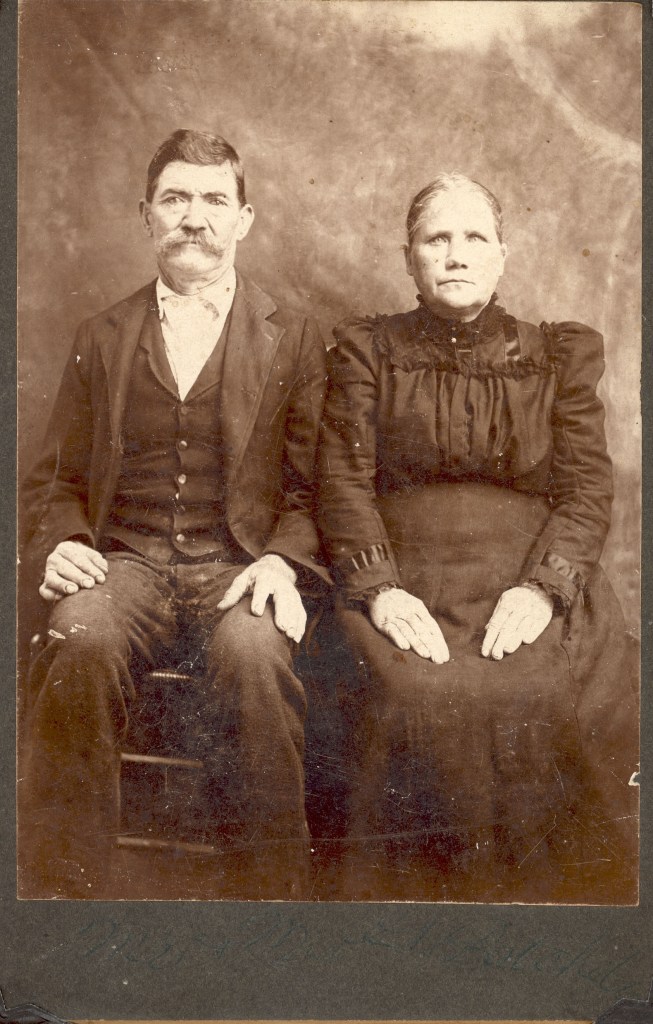
As I note in a previous posting discussing the voluminous file of papers having to do with the pension claim made by Catherine’s brother Patrick for his service in Co. K of the 3rd Arkansas Cavalry (Union Army), a claim continued by his wife Delilah after Pat Ryan died on 18 October 1893, George R. and Catherine Ryan Batchelor gave affidavits on behalf of the pension claim in Jefferson County on 25 May 1895. When they did so, their neighbor at Orion in Grant County, James Harrison Reynolds, the postmaster of the Orion community whose son Lewis married George and Catherine’s daughter Frances, gave an affidavit stating that the couple were “perfectly reliable and stand well in the community.” James H. Reynolds would not have made such a deposition if George and Catherine Ryan Batchelor were not well-known to be a legally married couple.
I make these comments not because it would ever occur to me to question whether George and Catherine Ryan Batchelor legally married. That definitely is not anything I’d be inclined to wonder about. I knew their daughter Hattie, my grandmother, as I was growing up and three of her brothers, and know well that the thought of people living together and having children without being legally married was unthinkable for them. In the small, rural central Arkansas community in which they grew up, families that crossed such lines were quickly stigmatized and excluded – and the Batchelor family was decidedly not one of those families. I have made these comments solely because I’ve noted that I haven’t been able to locate a record of the divorce of Robert A. Sumrall and Catherine Ryan or of Catherine’s marriage to George R. Batchelor, in the case of the latter record, because it likely burned along with other early records of Grant County, Arkansas.
What to Make of Some Sumrall Family Stories?
What to make of the following story told to me by a descendant of the of the Sumrall family of Clarke and Jones County, Mississippi, to which Robert A. Sumrall belongs? In April 2018, this Sumrall descendant, contacted me and shared with me a story she had been told by her father. She shared with me that her father had told her a story of an unnamed Sumrall man who ran off from his wife to Texas after the Civil War. Her father told her that members of the Brogan family, from whom her own Sumrall family line also descended, were involved in this story. As I note above, Robert A. Sumrall’s aunt Mary Sumrall married Patrick Brogan, an Irish immigrant in Paulding, Mississippi.
I have no idea whether this family story refers to Robert A. Sumrall, though I would note that there are some interesting parallels between it and what we know of Robert’s documented story. And I’d also note that a descendant of Mary Margaret Sumrall and John Thomas Harper told me that she had heard family stories maintaining that Robert left Mississippi for Texas with daughter Mary Margaret, but she became sick en route and he then took her back to Mississippi and gave her to the care of the Harper family.
It has to be noted, though, that the 1870 federal census suggests that Robert gave Mary Margaret to the care of the William T. Harper family before he left Mississippi for Texas, and it seems clear from subsequent documents that when Robert went to Texas, he left his daughter Mary Margaret behind in Mississippi. As I’ve noted previously, Mary Margaret continued living with William T. and Amanda Harper up to the point of her marriage to William’s nephew John T. Harper on 27 July 1881. According to this second Sumrall family story, Robert returned to Mississippi at some point after his daughter Mary Margaret had married in 1881, intending to bring her to Texas to live with him, but he then found that she had married. It would seem strange to me that Robert A. Sumrall, who was in Texas prior to his August 1874 marriage there and who left Mississippi at some point after August 1870, would not have known that his daughter had married in Mississippi in July 1881 until he returned to Mississippi at some point after that date.
It’s certainly not my intent to question anyone else’s family stories, or to imply that the stories of one family should trump those of another family. But as my posting began by noting, as we rely on family traditions when we’re doing family history, it’s imperative that we seek solid documentation to verify or perhaps disprove those traditions. The piece of documentation I’ve focused on in this posting which is centered on my own family’s story about the marriage of Robert A. Sumrall to two Ryan sisters, Margaret and Catherine, is the July 1867 deed I’ve now found, to my surprise, which verifies the information in the story handed down to me, that Catherine married Margaret’s husband after Margaret died, so that Margaret’s daughter Mary Mary Margaret would have a mother. It hasn’t been my intent in this posting to give a full account of Robert Allen Sumrall’s life. Though I’ve done quite a bit of research regarding his life, especially insofar as it intersects with the history of my Ryan family, there’s much more to be done, particular in Texas records, many of which are under lock and key in the digital files available at the FamilySearch site.
There’s always more to do, isn’t there, and as we keep researching, we usually find surprising new pieces of information, which sometimes reveal that stories handed down to us are mythic, or which unexpectedly confirm pieces of information in those stories as true. This – this chase – is what keeps us researching, surely.
[1] Clarke County, Mississippi, Marriage Bk. A, p. 188.
[2] Arkansas State Volume Patent Bk. 220, p. 209, certificate 11617.
[3] Mullinavat Catholic Parish Register, County Kilkenny, Ireland, Bk. 1, p. 17. The baptism is recorded in both Kilmacow and Mullinavat parishes. Until 1842, when Mullinavat became a parish separate from Kilmacow, records belonging to what became Mullinavat parish were recorded in Kilmacow parish. When Mullinavat parish was separated from Kilmacow, records belonging to Mullinavat were then transcribed from the Kilmacow register. The transcription in the Mullinavat parish mistakenly gives Margaret her father Valentine’s name. I have not seen the baptismal entry for Margaret recorded in the Kilmacow parish register. The microfilmed copies of this parish register held by National Library of Ireland state that its records begin in 1858. But as John Grenham’s Irish Ancestors website notes, there are actually marriage records for Kilmacow dating from 1791 and baptismal records from 1836, which Rothe House in Kilkenny has indexed and transcribed. In June 1998, I went to the Kilmacow parish and asked the parish priest there if I could see the baptismal record for Margaret Ryan recorded in that parish register. He would show me only the printout of the Rothe House transcription of the baptismal record, which gave the baptismal date found in the Mullinavat register – 3 August 1838 – and gave her name as Margaret and parents as Valentine Ryan and Bridget Tobin. On the separation of the parish of Mullinavat from the parish of Kilmacow in 1842, see William Carrigan, The History and Antiquities of the Diocese of Ossory, vol. 4 (Dublin: Sealy, Bryers & Walker, 1905), p. 171.
[4] Jefferson County, Arkansas, Deed Bk. 2, pp. 304-5.
[5] 1870 federal census, Jones County, Mississippi, township 9, Ellisville post office, p. 209B (dwelling/family 36; 5 August); and p. 207A (dwelling/family 1; 2 August).
[6] 1880 federal census, Jones County, Mississippi, beat 2, p. 316A (ED 126; dwelling 135/family 136; 17 June).
[7] See Find a Grave memorial page of Mary Margrett Elizabeth Sumrall Harper, Lebanon cemetery, Laurel, Jones County, Mississippi, created by Cem W. Akins Jr., maintained by Ralph, with a tombstone photo by Ralph.
[8] Mullinavat Catholic Parish Register, County Kilkenny, Ireland, Bk. 3, p. 71.
[9] A transcription of the minutes of Francois Baptist church from 1848-1879 by John Clarence Parsons is available on microfilm at the Arkansas State Archives: Church Records, 1848-1879, 1902-1938, Hot Spring County, Arkansas [and Other Records], Hot Spring County microfilm 002208. The catalogue description uses the phonetic spelling of Francois Creek in Hot Spring County for which the church and its cemetery are named – i.e., Franceway. Moses Batchelor’s son by Minerva Monk, Edward Eli Batchelor, and his daughter by Louisa Waters (Robinson), Minerva Louisa Batchelor (Walters), are buried in Francois cemetery.
[10] 1870 federal census, Grant County, Arkansas, Simpson township, Sandy Springs post office, p. 235A (dwelling 60/family 54; 15 August). The following household, dwelling 61, has a blank drawn through the entry for a family number. The census spells the Ryan surname as Ryne and erroneously states that Valentine Ryan was born in Georgia. Bridget’s name is given as Elizabeth and her place of birth as Georgia. The next household after dwelling 61 is that of Elizabeth Hill, widow of Asa Hiram Hill whose sister Rosanna (the widow of John H. Spann) married Valentine and Bridget’s son Patrick about 1866. Elizabeth was Levina Elizabeth Hodges, daughter of William Hodges and Levina Spann.
[11] 1870 federal census, Pulaski County, Arkansas, Campbell township, Little Rock post office, p. 93A (dwelling 120/family 121; 3 August).
[12] Polk County, Texas, Marriage Bk. B2, p. 534.
[13] Robert A. Sumrall, NARA, U.S. Civil War pension file (Union service), no. 1154758.
[14] NARA, Carded Records Showing Military Service of Soldiers Who Fought in Confederate Organizations, compiled 1903 – 1927, documenting the period 1861 – 1865, RG 109, file of R.A. Summerell, Co. K, 26th Arkansas Infantry (CSA), available digitally at Fold3.
 BEGATS AND BEQUEATHALS