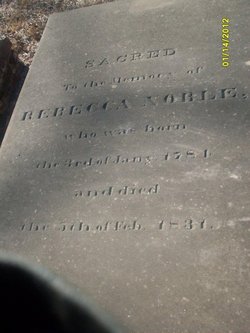
10. Rebecca Pickens, the tenth child of Andrew Pickens and Rebecca Calhoun, was born 3 January 1784 in Ninety-Six District (later Abbeville County), South Carolina. This date is inscribed on her tombstone in Noble cemetery at Willington in McCormick County, South Carolina.[1] The transcript of the family bible discussed in a previous posting gives a birthdate of 8 January 1784, apparently misreading a 3 for an 8 in the bible register.
About 1806 in Abbeville County, Rebecca married William Noble, son of Alexander Noble and Catherine Calhoun. William Noble and Rebecca Pickens were multiple cousins. William’s mother Catherine Calhoun Noble was a sister of Rebecca’s mother Rebecca Calhoun Pickens; William Noble and Rebecca Pickens were thus first cousins. And William’s father Alexander Noble was a son of John Noble and Mary Calhoun, Mary being an aunt of Catherine Calhoun Noble and Rebecca Calhoun Pickens.
As the following brief sketch of the Noble family of Abbeville County found at the webpage for the Noble Family Papers at the website of Huntington Library in San Marino, California, states, William Noble ran family plantations with his brothers Ezekiel and Alexander Noble, and engaged in cotton trade:[2]
The Nobles of Abbeville, South Carolina, closely related through various marriages to the Calhoun, Green, Clemson, Bratton, Pickens, McCaws, Cuningham, and Gadsden families, was one of the most prominent planter families of the “featherbed aristocracy” of South Carolina. The Noble family was of Scots-Irish ancestry; the first Nobles came to America in the early 1700s and settled in Augusta County, Va. Major Alexander Noble (1733-1801), married to his first cousin Catherine Calhoun, moved to South Carolina and made his home in Abbeville District, near Willington. During the Revolutionary War, he was Captain of the state militia and later became an aide-de-camp to General Andrew Pickens. Major Noble’s eldest son John (1774-1819) went to Princeton, studied medicine in France, and the set up medical practice in Charleston. His brothers Ezekiel Noble (d. 1732), William (1777-1823), and Alexander (1794-1821) ran family plantations, including Vienna Plantation on the Savannah River and were engaged in cotton trade. Joseph Noble (1792-1822), a Yale educated lawyer left for Alabama. Patrick Noble (1787-1840), the 57th Governor of South Carolina was the most prominent among Alexander Noble’s sons. He was born in Abbeville and graduated from the College of New Jersey in 1806. In 1809, he was admitted to the bar and set up a law practice in partnership with John C. Calhoun. In 1814, Noble was elected to the state legislature. In 1830, the General Assembly elected him as 34th Lieutenant Governor; in 1836, he became state senator, and in 1838, the General Assembly elected him Governor of South Carolina.
As the preceding sketch of the Abbeville County Noble family notes, William Noble’s brother Patrick, who married Rebecca Pickens’ niece Elizabeth Bonneau Pickens, held prominent political positions in South Carolina. He was elected to the South Carolina House of Representatives in 1814 from Abbeville District, serving for the next four sessions and as speaker from 1818-1823. In 1830, he was chosen lieutenant governor. In 1832, Abbeville County returned him to the House where he again occupied the Speaker’s chair from 1833 to 1835. In 1836 he was elected to the South Carolina Senate and was made president of the Senate. Two years later, Noble resigned his Senate seat upon his election as governor of South Carolina on 8 December 1838.[3]
As I noted previously in discussing the move of Rebecca Pickens Noble’s brother Andrew and other family members to Alabama (and in this previous posting), in a 23 August 1819 letter Andrew Pickens wrote Captain William Noble of Abbeville, which is archived in the Andrew Pickens Papers at the South Caroliniana library of University of South Carolina, Andrew states that he was returning from Alabama where he had left his brother Joseph Pickens intending to go to Tuscaloosa.
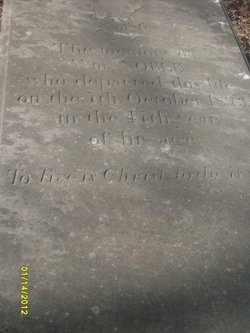
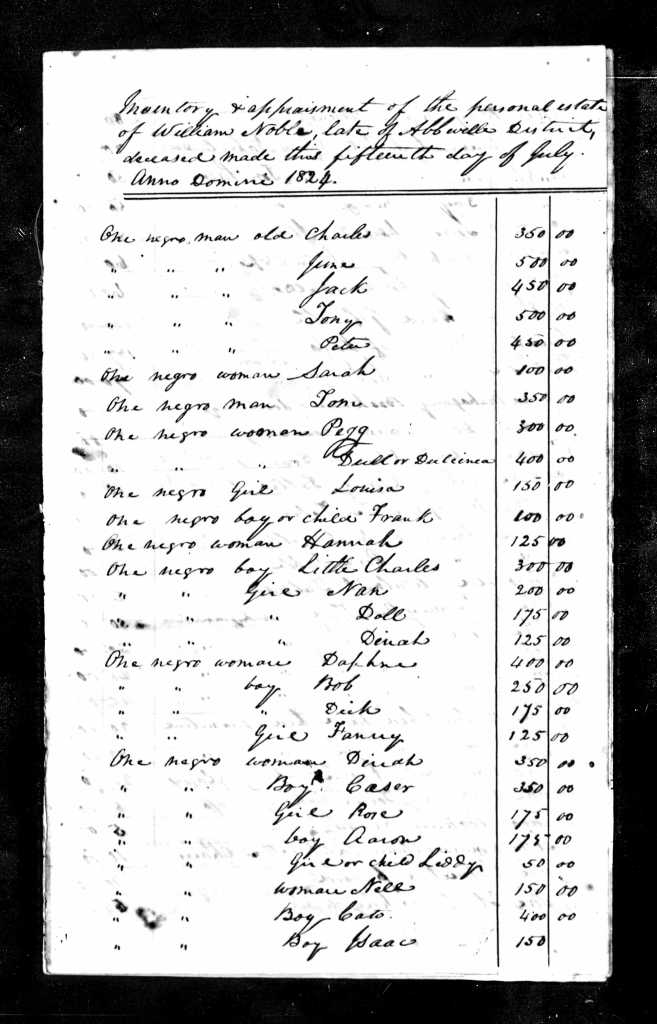
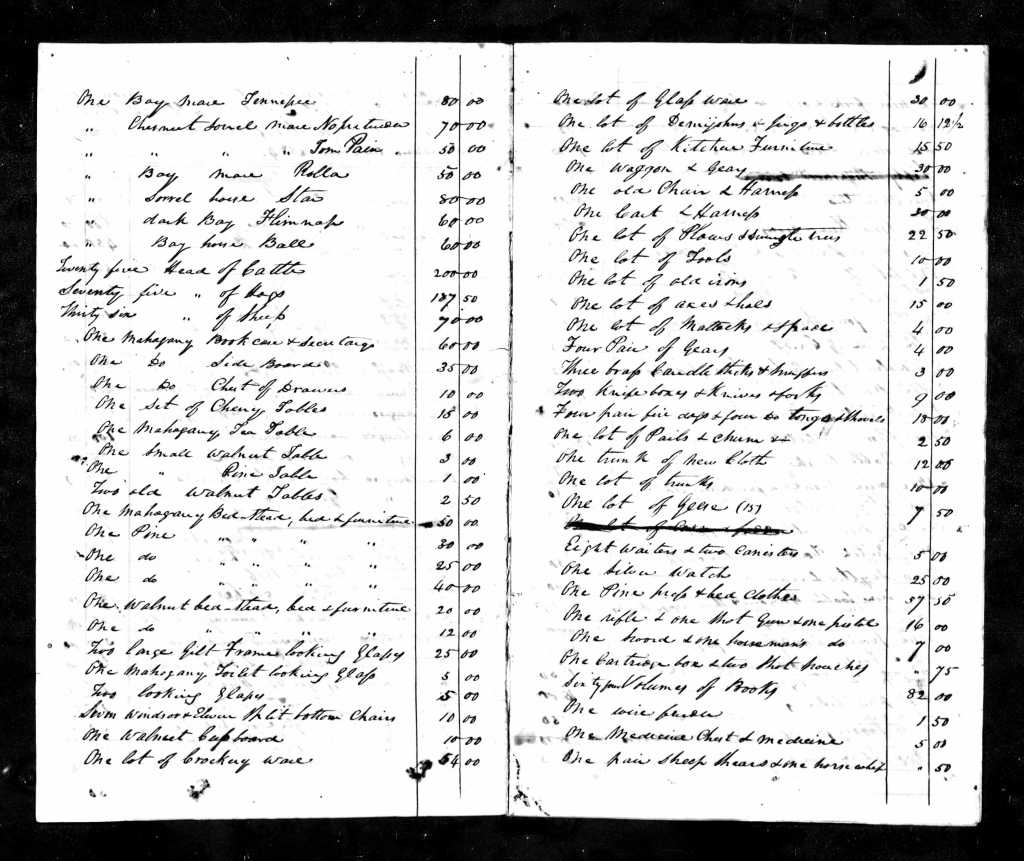
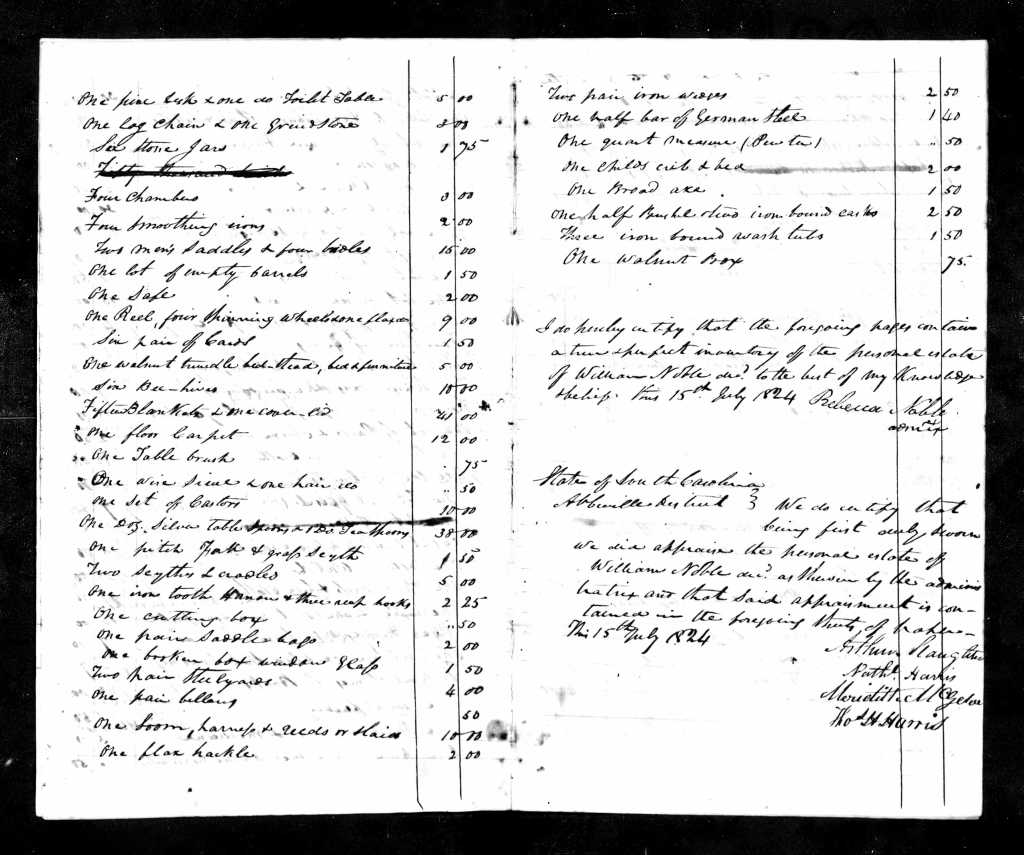
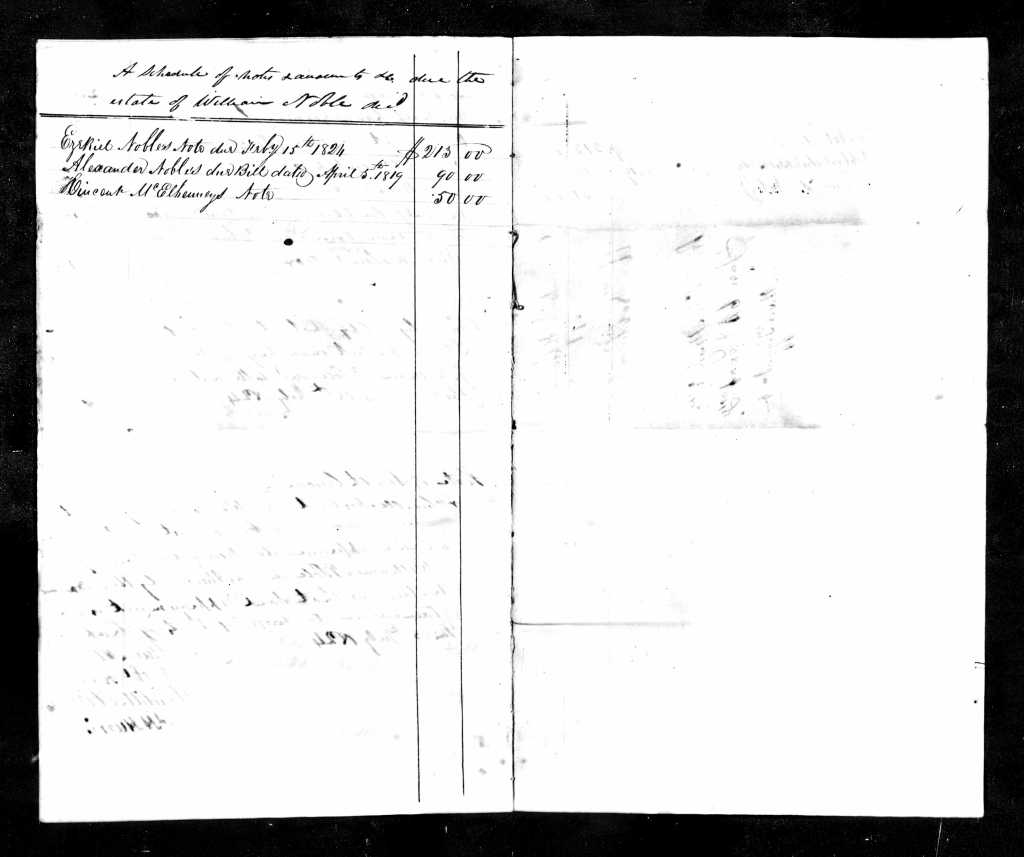
William Noble died on 7 October 1823 in Abbeville County. This date of death is recorded on his tombstone in the Noble family cemetery at Willington in McCormick County.[4] A loose-papers estate file in Abbeville County contains various documents including a bond for estate administration that his widow Rebecca gave on 20 April 1824 with William’s brothers Ezekiel and Patrick, and a 15 July 1824 inventory signed by Rebecca Noble, with Arthur Slaughter, Nathaniel Harris, Meredith McGehee, Thomas H. Harris as appraisers.[5] The estate inventory confirms that William Noble was, as the guide to the Noble Family Papers at Huntington Library says, operating a plantation at the time of his death. The inventory shows that this plantation was being operated with the labor of enslaved persons, since it lists twenty-eight enslaved persons, all of them named.
Various family trees online as well as sites including William Noble’s Find a Grave memorial page (cited above)[6] give him the middle name Alexander. I have seen no documents anywhere giving William Noble’s name as anything other than William Noble.
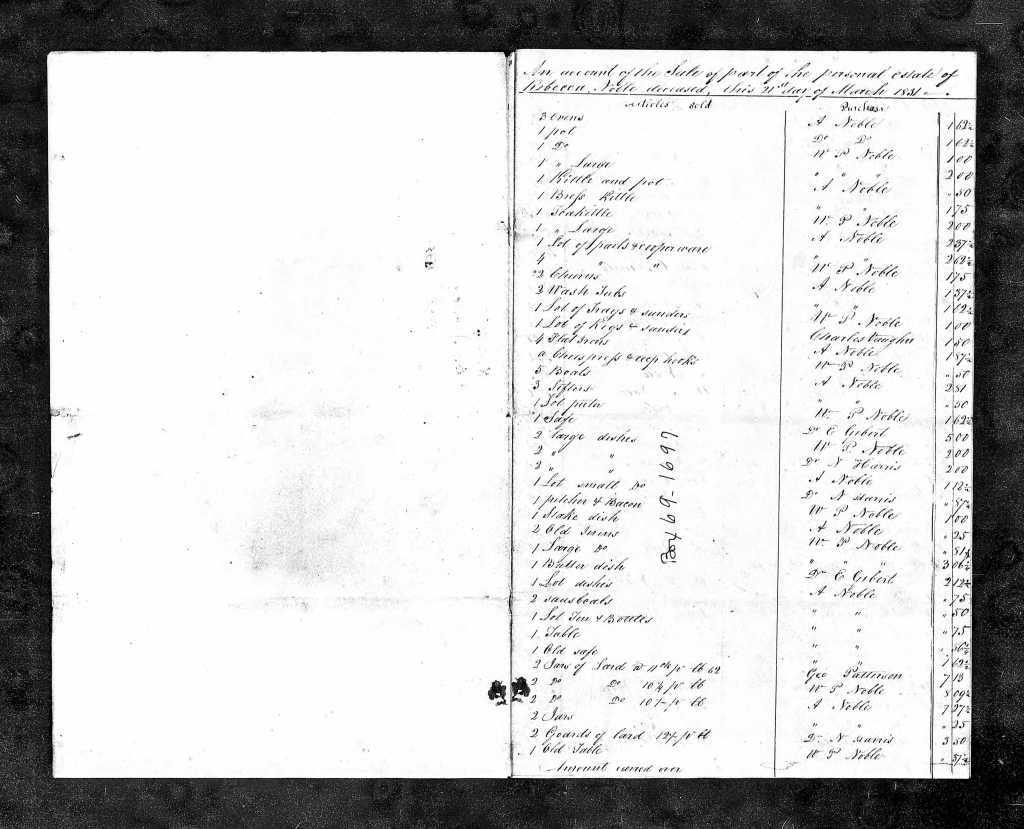
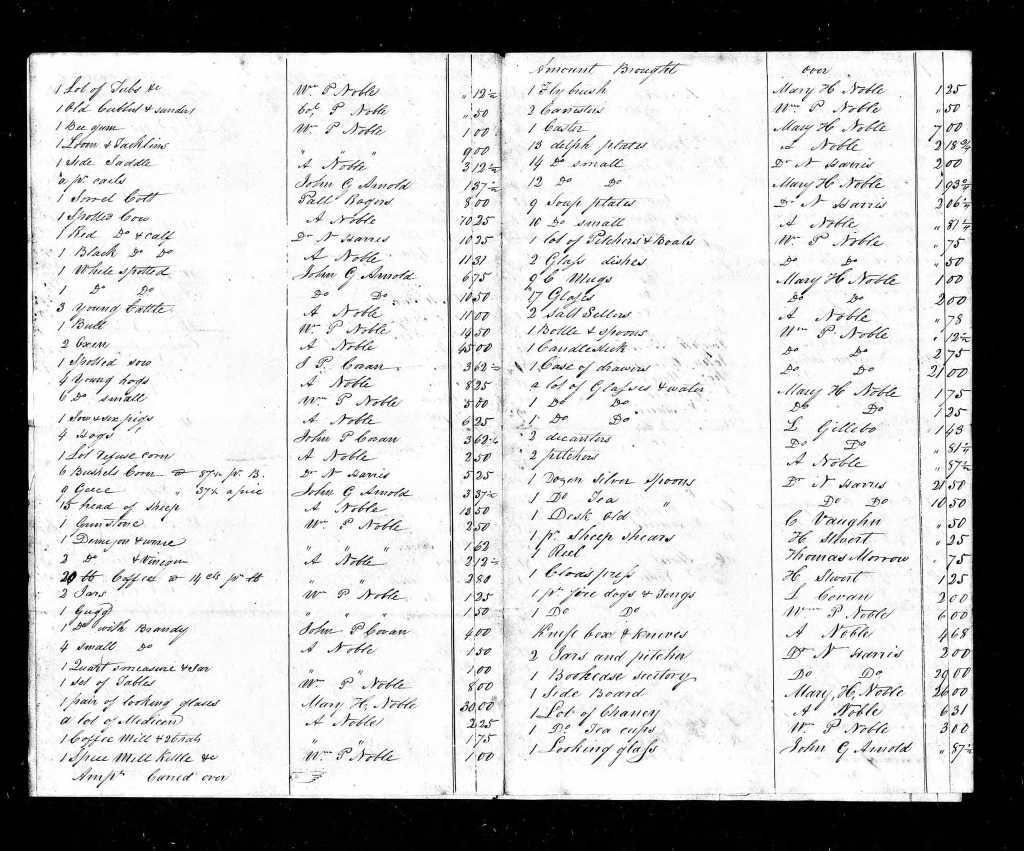
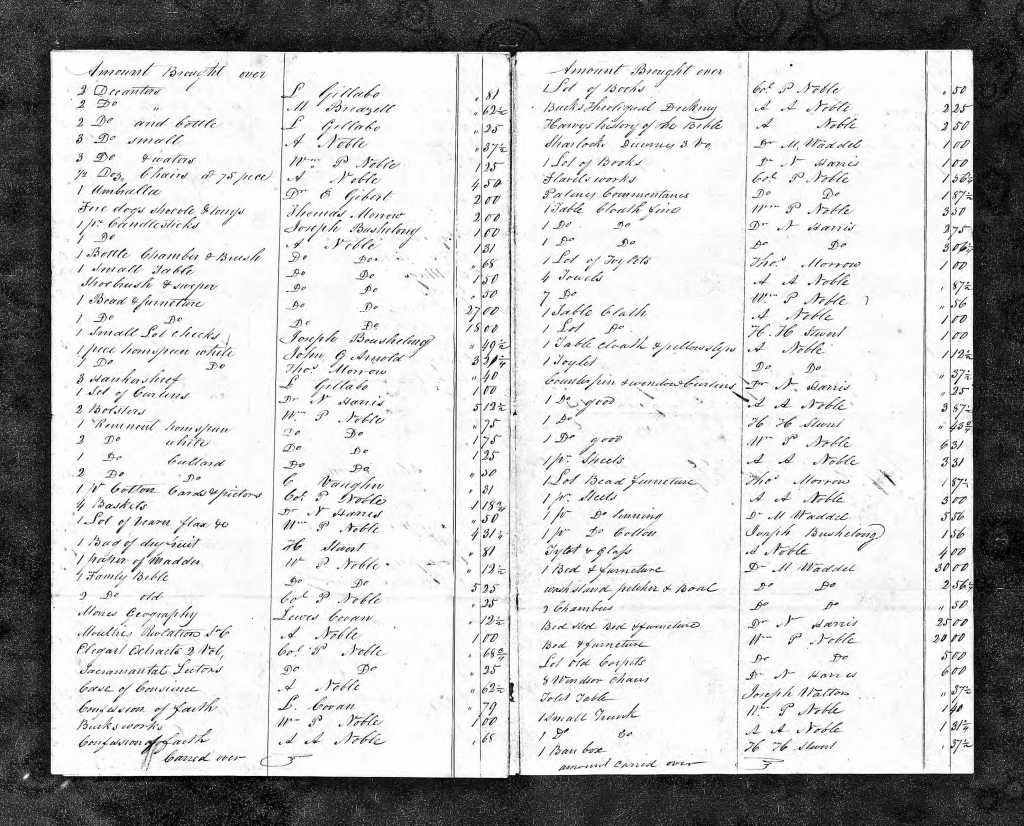
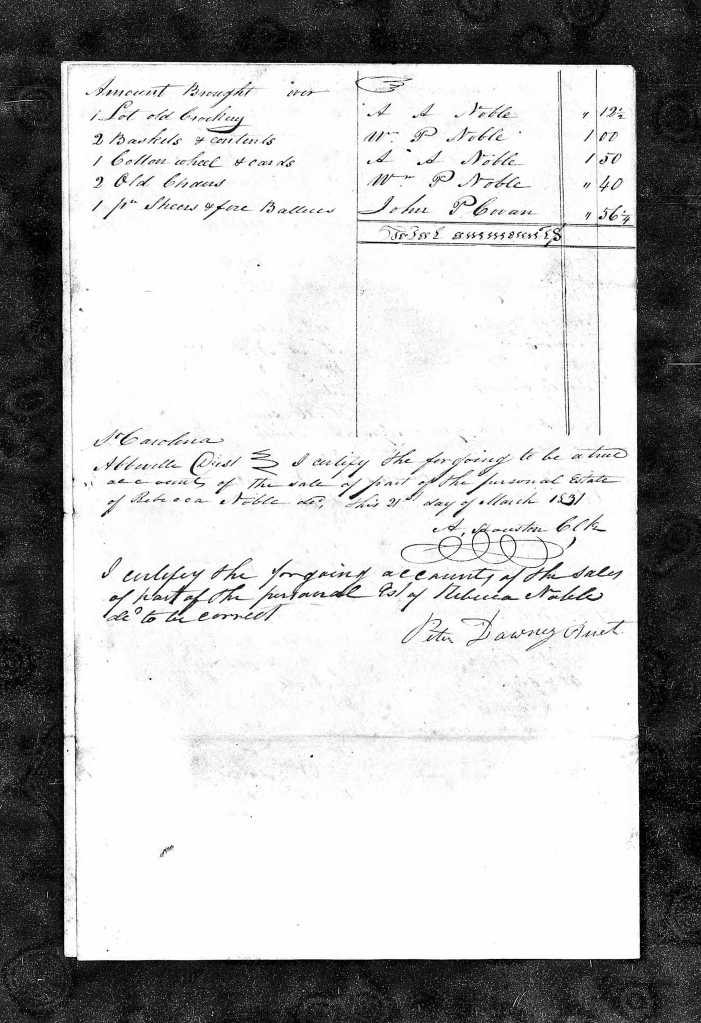
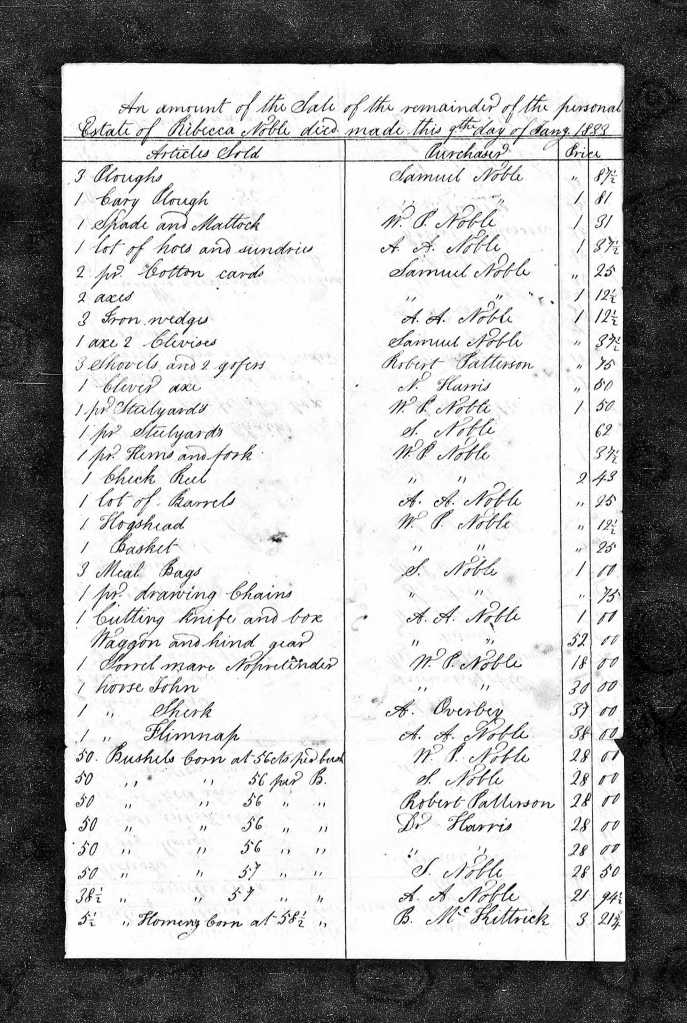
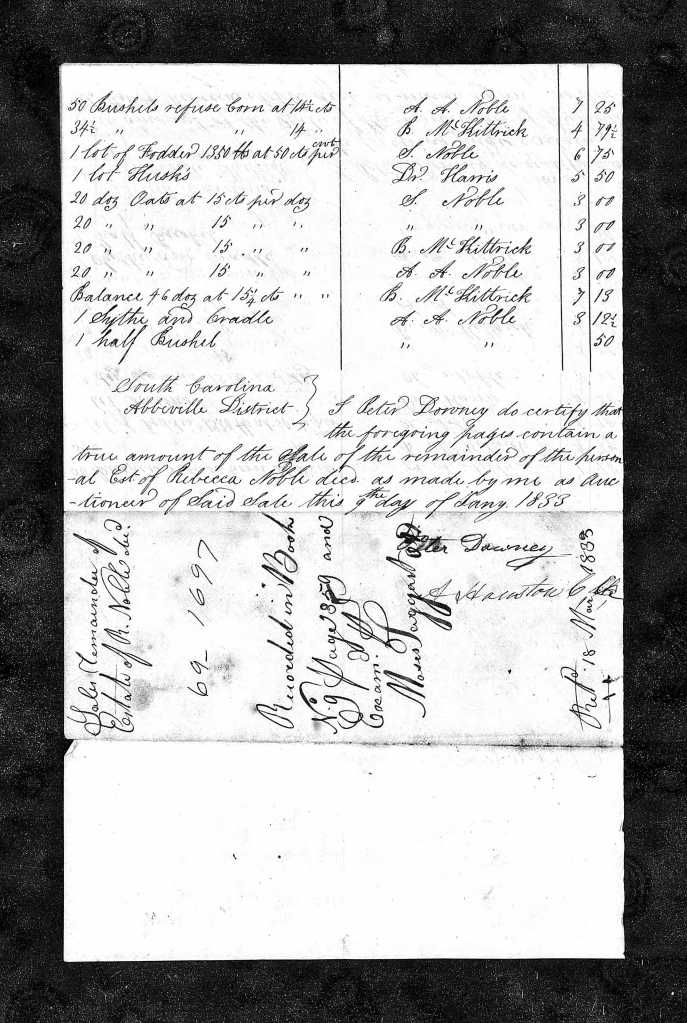
Rebecca Pickens Noble died in Abbeville County on 5 February 1831. This date of death is stated on her tombstone.[7] A loose-papers estate file for Rebecca in Abbeville County shows her son William Pickens Noble petitioning for administration of the estate on 20 February 1831.[8] On 16 March 1831, William P. Noble gave a bond for estate administration in the amount $7,000 with his uncle Patrick Noble as security. On the same day the court gave an order for appraisal of the estate, it appoint Moses Waddell, William Calhoun, Nathaniel Harris, Alexander Houston, and Paul Rogers as appraisers. On 19 March 1831 the named appraisers with the exception of Houston appraised the estate. An estate sale was held 21 March 1831 with primary buyers being Rebecca’s sons William and Andrew, as well as her brother-in-law Patrick Noble and sister-in-law Mary Harris Noble, widow of Alexander Noble. Mary Harris Noble was also Rebecca’s niece, the daughter of Rebecca’s sister Mary and husband John Harris. As stated above, Patrick Noble married another niece of Rebecca, Elizabeth Bonneau Pickens, daughter of Ezekiel Pickens and Elizabeth Bonneau. On 19 January 1833, another sale of Rebecca’s estate was held, and that document is also filed in the estate papers.
The sale bill for the sale held in March 1831 shows a family bible and an old bible both bought by William Pickens Noble. A list of money received by the estate shows that Rebecca and her sons continued operating William Noble’s plantation following William’s death, with cotton-growing as an important part of the plantation operation. The inventory and sale bill do not mention enslaved persons, but the list of monies received by the estate show it hiring some of the enslaved persons named in William Noble’s estate inventory, so it appears that Rebecca bought all or some of those enslaved persons from her husband’s estate.
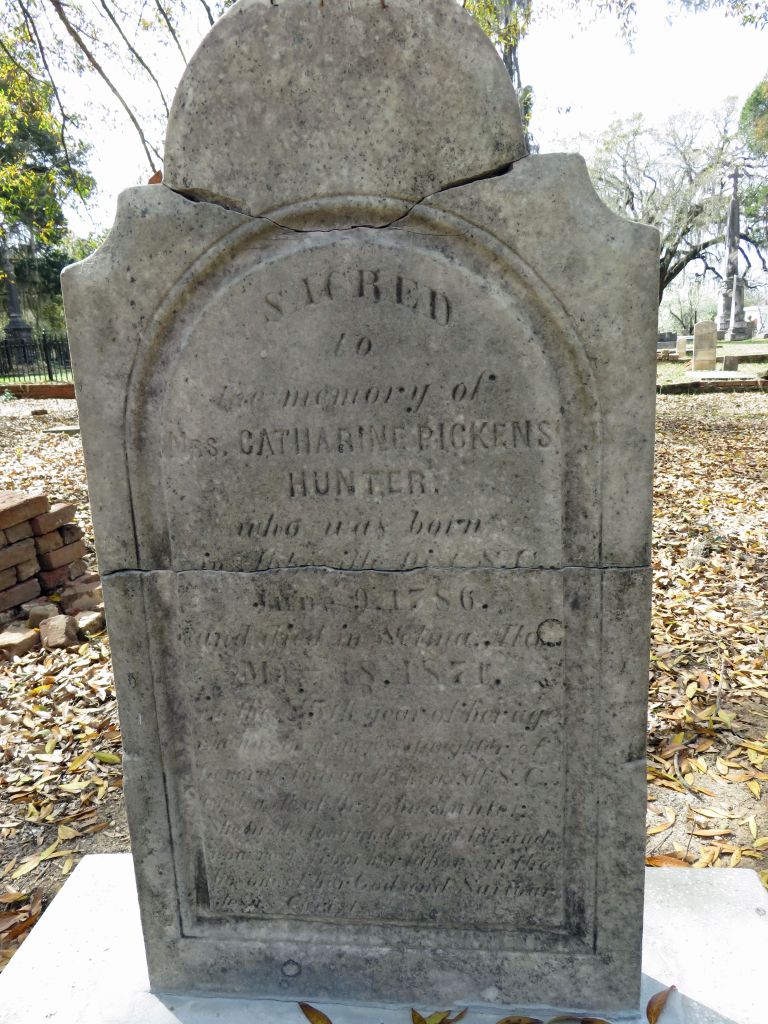
11. Catherine Pickens, the eleventh child of Andrew Pickens and Rebecca Calhoun, was born 9 June 1786 in either Abbeville County or Pendleton District, South Carolina. This date of birth is recorded in the family bible discussed in a previous posting and also on her tombstone in Live Oak cemetery at Selma in Dallas County, Alabama.[9] I say that Catherine was born in either Abbeville County or Pendleton District since, as we’ve seen, her parents moved their family to their new Hopewell House on the Keowee River in Pendleton District in the summer of 1786. If she was born before that move took place, she would likely have been born in Abbeville County. Otherwise, she’d have been born at Hopewell in Pendleton District.
On 5 January 1808 in Pendleton District, Catherine married John Hunter. This date of marriage is stated in the family bible discussed in a posting linked in the previous paragraph. An announcement of the marriage also apparently appeared in the Pendleton Messenger in January 1808.
According to Richard W. Simpson in his history of old Pendleton District, John Hunter was the son of John Hunter and Mary Crawford of Carlisle, Pennsylvania.[10] Simpson thinks that the elder John Hunter was born in Ireland (I suspect this means in Ulster). According to Simpson, the elder John Hunter first married a wife whose name was Margaret, and one of their children, Dr. William Hunter, married Ann Anderson, daughter of General Robert Anderson, a close friend of Andrew Pickens for whom Anderson County, South Carolina is named. On Robert Anderson and his connection to Andrew Pickens and the Calhoun kinship network, see here and here.
A number of sources including a Find a Grave memorial page for John Hunter (whose burial place is not known) state that he was born 31 December 1781 in Carlisle, Cumberland County, Pennsylvania.[11] I have not seen a documented source for this date of birth, and I have not seen sources for the middle name assigned John Hunter on his Find a Grave memorial page, which is Miles.
Following their marriage, Catherine Pickens and husband John Hunter lived initially in Pendleton District, and then took part in the migration of Pickens and Calhoun family members from South Carolina to Alabama in 1819 and shortly thereafter. The Hunter family settled at Greensboro in what was then Greene County and is now Hale County, south of Tuscaloosa. In a journal she kept in the years 1827-1835, Greensboro resident Sarah Haynsworth Gayle, wife of Alabama governor John Gayle (both South Carolina natives), writes frequently and warmly of the Hunter family and the kindness they showed her.[12] On 8 August 1827, for instance, she speaks gratefully of the kindness of Mrs. Catherine Hunter to her.[13] Several days later on 13 August, Sarah writes that before she closed her journal on that night, she felt compelled to give testimony to the kindness shown to her by the family of Dr. John Hunter, which she’d sorely miss if she had to leave Greensboro.[14] She states,
I never pass their door, without a hand being stretched out, and a cordial invitation to come in. Should I leave Greensboro’, no other family will cause more regret to me, or inspire more gratitude for the friendliness with which I have been treated by them.
On 21 August 1827, Sarah notes Catherine Hunter’s mortification at the asperity shown by Mr. Hillhouse, in consequence of his furnishing a ball-supper.[15] The Reverend Mr. James Hillhouse (1788-1835) was pastor of First Presbyterian church in Greensboro, whose wife Ann Calhoun Norris was a cousin of Catherine Pickens Hunter. Ann was a daughter of Patrick Calhoun Norris and Rachel Calhoun of Abbeville County, South Carolina. Patrick’s parents were Robert Norris and Jean or Jane Ewing, who married Robert Norris following the death of Ezekiel Calhoun, Catherine Pickens Hunter’s grandfather. Rachel Calhoun was a daughter of Ezekiel Calhoun’s brother William Calhoun and wife Agnes Long.
In a 1827 journal entry written in September or October 1827 (it’s without a specific date), Sarah Gayle writes that she had been suffering from an inflammation of her eyes, and Catherine Hunter had taken time from her numerous domestic duties to sit by Sarah’s bedside and apply whatever she thought might relieve Sarah’s pain. Catherine’s daughters had also stayed with Sarah several nights to tend to her needs.[16]
In a journal entry written on 16 December 1827, Sarah describes in detail the wedding of John and Catherine Pickens Hunter’s daughter Margaret to James Harrell, noting the pleasing arrangements Catherine had made for her daughter’s wedding party and the cake that Margaret’s sister Maria had baked.[17]
On 20 March 1829, Sarah notes Dr. John Hunter’s failing health: she states that Maria Hunter had returned from Selma bringing with her her cousin Mrs. Simpson and that Dr. Hunter was “daily sinking, his intellect nearly uninjured” (p. 89). The cousin Maria brought from Selma with her is perhaps Eliza Rebecca Miller, daughter of Maria’s aunt Jane Bonneau Pickens and husband John Henry Miller. Eliza married her (and Maria’s) first cousin John Allen Simpson, son of John Simpson and Ann Pickens. This marriage had not yet taken place: it would take place in Selma on 9 June 1827.
The previously discussed family bible that passed down in the family of John Hunter and Catherine Pickens states that John died 17 June 1829 aged 49. In the surname files maintained by Alabama Department of Archives and History, a file for John Hunter states that a notice of his death was published in the Alabama State Intelligencer of Tuscaloosa on 3 July 1829, noting that Dr. John Hunter had died at Greensboro on the 17th of June.[18]
On 21 June 1829, Sarah Haynsworth Gayle recorded the following in her journal (pp. 99-100):
The struggle between Dr. H.’s excellent constitution and intemperate habits is over at last, and he has been laid away in his place of final rest. No change was perceivable in his views of futurity – he seemed to speak & think lightly, when he thought at all of them – ridicule the idea of a preacher’s coming to converse with him, & I presume died as he had lived, a Deist. His family nursed him in his most helpless state, with great care, patience and affection. The children all were respectful and attentive to the last. No man, I think, possessed purer principles of honor, more generosity, or more intelligence. How deplorable than [sic] they should have been rendered useless by the beastly habit of drinking.
In editing Sarah’s journal, Sarah Woolfolk Wiggins has read this passage, with its record of the death of Dr. H., to refer to the death of a Dr. Howell who is nowhere mentioned in the journal. It’s clear to me that Sarah Haynsworth Gayle is speaking here of the death of John Hunter.
Catherine Pickens Hunter died at Selma in Dallas County, Alabama, on 18 May 1871. The date of death is recorded on her tombstone in Live Oak cemetery in Selma.[19] The inscription on Catherine’s tombstone states,
Sacred to the memory of Catherine Pickens Hunter who was born in Abbeville Dist., S. C. June 9, 1786 and died in Selma, Ala., May 18, 1871, in the 85th year of her age. She was the youngest daughter of General Andrew Pickens of S. C. and wife of Dr. John Hunter. She lived a long and useful life and now rests from her labors in the bosom of her God and Savlor Jesus Christ.
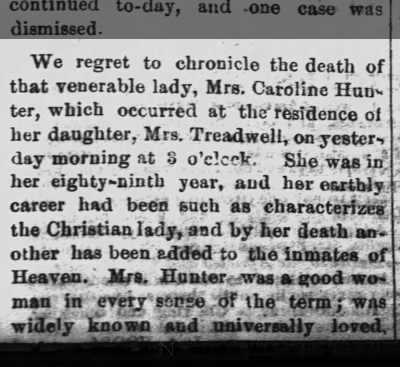
An obituary of Catherine published in the Selma Morning Times on 19 May 1871 notes that the “venerable lady” Caroline [sic] Hunter had died the previous morning at the residence of her daughter Mrs. Treadwell, aged eighty-nine. Mrs. Treadwell was Catherine’s daughter Eliza Barksdale Hunter, who married William Tredwell, and who lived in Selma at this time.
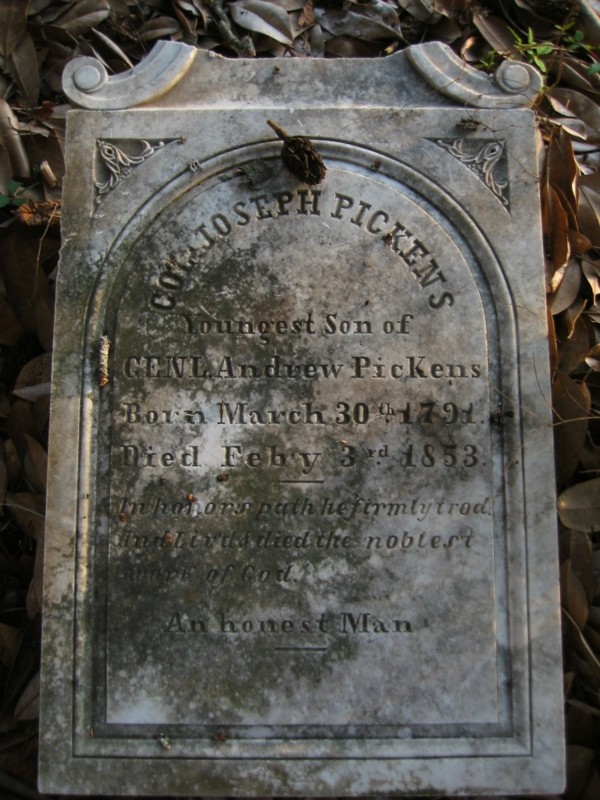
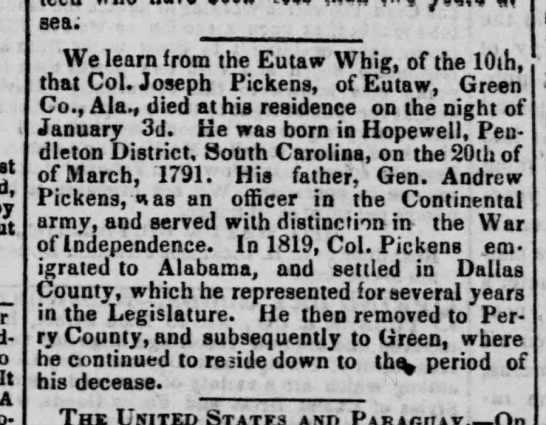
12. Joseph Pickens, the twelfth and last child of Andrew Pickens and Rebecca Calhoun, was born 30 March 1791 at Hopewell in Pendleton District, South Carolina. This date of birth is written in the family bible discussed previously, and is also inscribed on his tombstone in Mesopotamia cemetery at Eutaw in Greene County, Alabama.[20] An obituary of Joseph published in the Richmond (Virginia} Dispatch on 3 March 1853, citing an obituary in the Eutaw Whig on 10 February 1853, gives Joseph’s date of birth as 20 March 1791 and the place of birth as Hopewell in Pendleton District, South Carolina.[21]
The will that Joseph’s father Andrew Pickens made at his Tamassee plantation in Pendleton District (later Oconee County), South Carolina, on 22 June 1809, after it made provision for Andrew’s widow Rebecca Calhoun Pickens, left Joseph, as the youngest son of the family, Andrew’s Tamassee plantation. It states:
And as my children which are gone from under my care, and have got their proportion of the property which I now have I leave and bequeath to my son Joseph Pickens which consists of the tract of land I now live on, with the tracts adjoining, with the Negroes which I now have, with the Stock of horses, cattle, hogs, and sheep, with all the money I may have or which may be due me on Bonds, notes, or otherwise, except as above to his mother, with the household furniture, and the plantation utensils such as wagons, plows, hoes, axes, etc. and that there shall be paid out of the part comeing to my son thirty-five Dollars, yearly to the support of the Gospel in this congregation, until he arrives at full age to act for himself.
According to biographical information written by Joseph’s daughter Sarah Pickens McQueen in 1903 and filed in the Alabama Surname Files at the Alabama state archives, Joseph Pickens moved from Pendleton District to Selma in Dallas County, Alabama, in 1817.[22] As has been noted above and previously, a migration of members of the Pickens and Calhoun families from Pendleton District to Dallas County, Alabama, took place in or just after 1819, with Joseph’s brother Andrew, his sisters Jane, Margaret, and Catherine, and their nephew Ezekiel Pickens all taking part in this migration. If Joseph was in Selma by 1817, he may have been the initial Pickens family member to settle there, and the others followed. But Joseph’s previously cited obituary places his move to Alabama in 1819 instead of 1817, and notes that he initially settled in Dallas County.
As I’ve noted above, on 23 August 1819, Joseph’s brother Andrew wrote their brother-in-law William Noble to tell William that he had just been to Alabama and was returning to South Carolina, and he had left his brother Joseph in Alabama, with Joseph intending to go to Tuscaloosa. As previously discussed, also settling in Dallas County when Pickens family members moved to Alabama in this period were Joseph’s brother Andrew, his sisters Jane and Margaret, and their nephew Ezekiel. Joseph’s sister Catherine then moved to Dallas County following the death of her husband John Hunter in 1829.
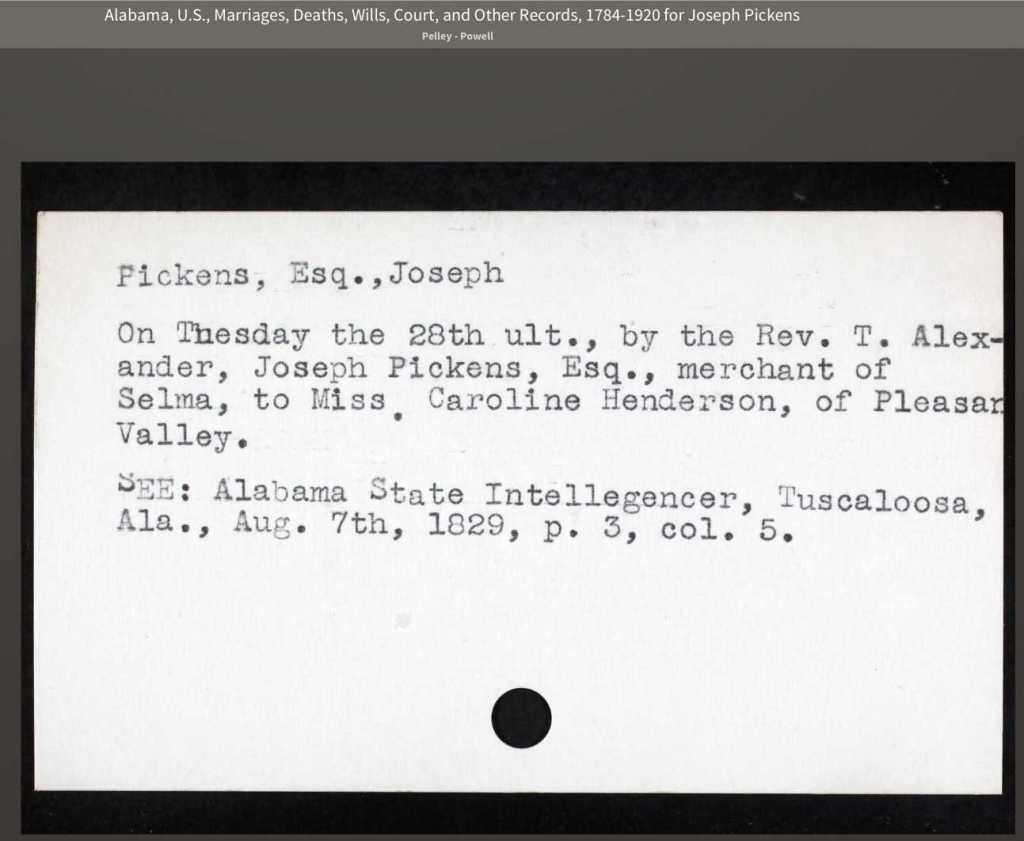
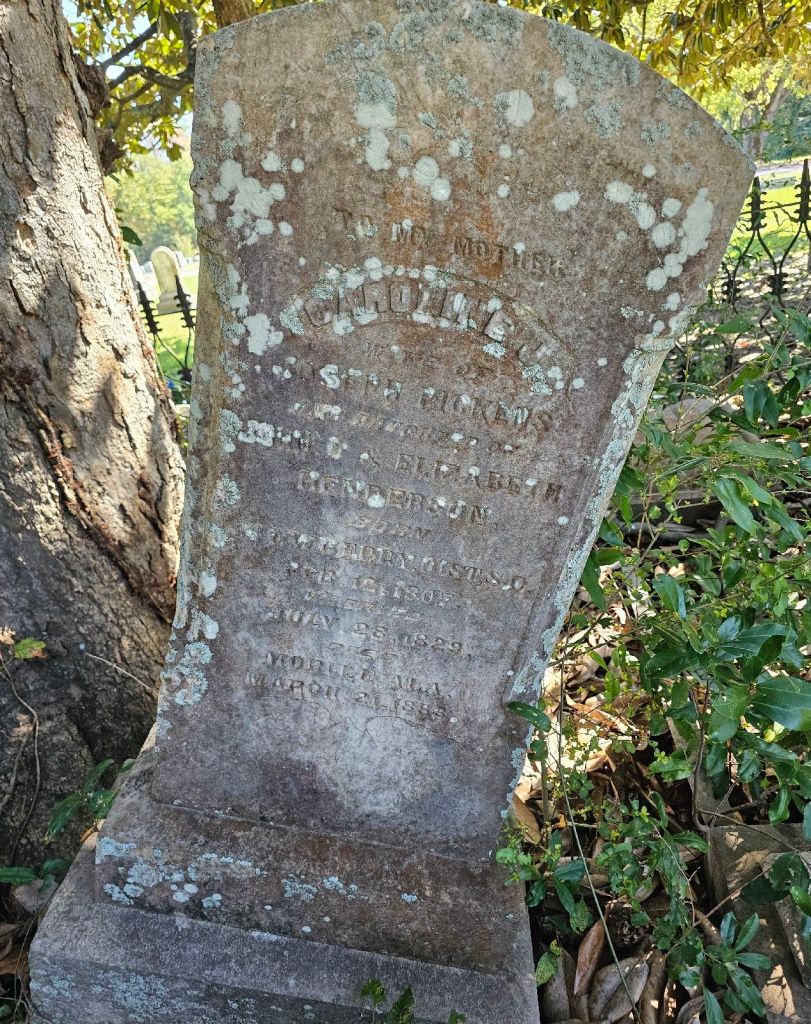
After settling in Dallas County, Joseph represented that county in the Alabama legislature in 1824-5.[23] According to his obituary in the Richmond paper, Joseph then moved to Perry County, Alabama, and after that to Greene County, where, as noted above, his sister Catherine and her husband Dr. John Hunter had settled prior to 1827. On 28 July 1829 in Greene County, Joseph married Caroline Judith Henderson, daughter of John D. and Elizabeth Henderson. This date of marriage was published in the Alabama Intelligencer of Tuscaloosa on 7 August 1829 and is inscribed on Caroline’s tombstone in Mesopotamia cemetery at Eutaw.[24] Caroline, whose father Captain John Henderson was a Revolutionary officer and South Carolina legislator representing Newberry County in the state House, was born 12 February 1807 in Newberry County, South Carolina, and died 21 March 1883 in Mobile, Alabama.
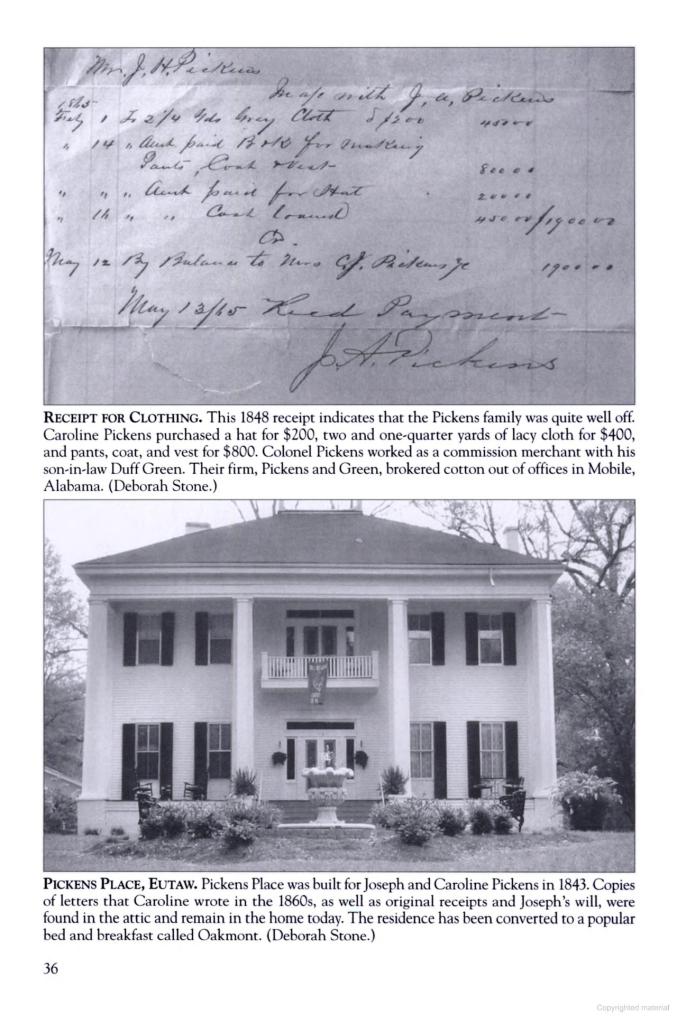
Following their marriage, Joseph and wife Caroline settled in Eutaw in Greene County where they built a house in 1843.[25] In 1908, it appears, the Pickens house was replaced with a house previously called the Webb-Howell house and now called Oakmont, which is operated as a bed and breakfast. Deborah Stone states that copies of letters Caroline wrote in the 1860s were found in the attic of the Pickens house and are now preserved at Oakmont.[26] Oakmont is at 119 Pickens Street in Eutaw.
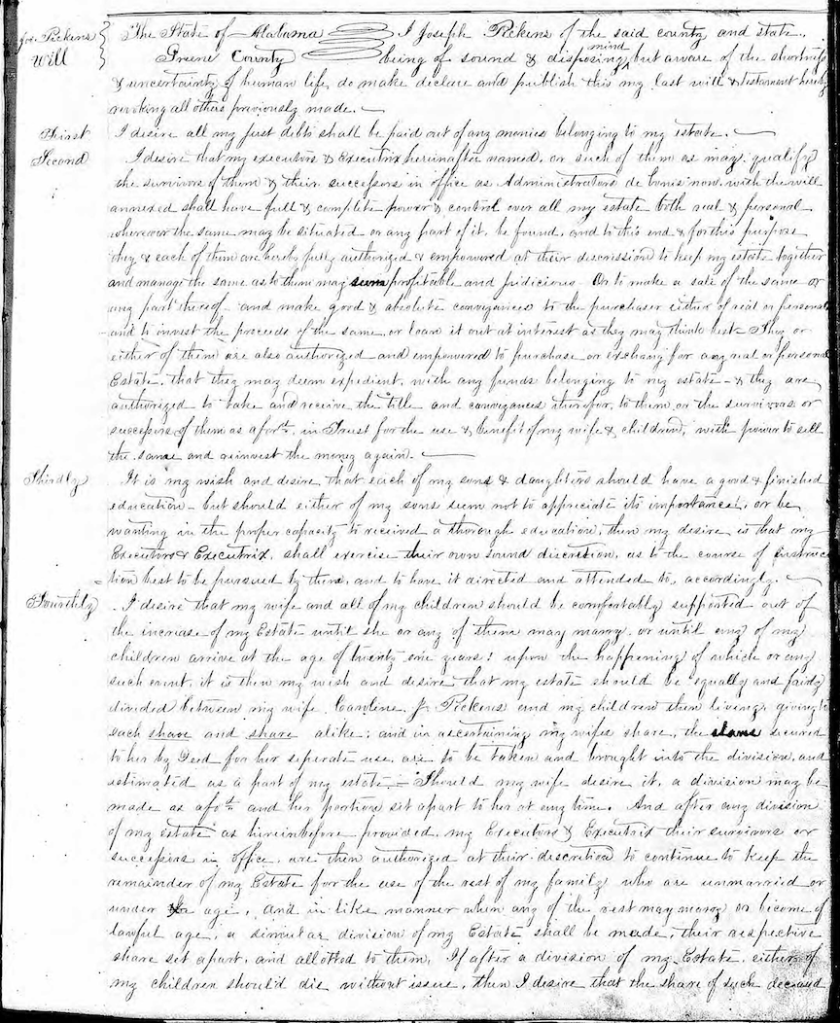
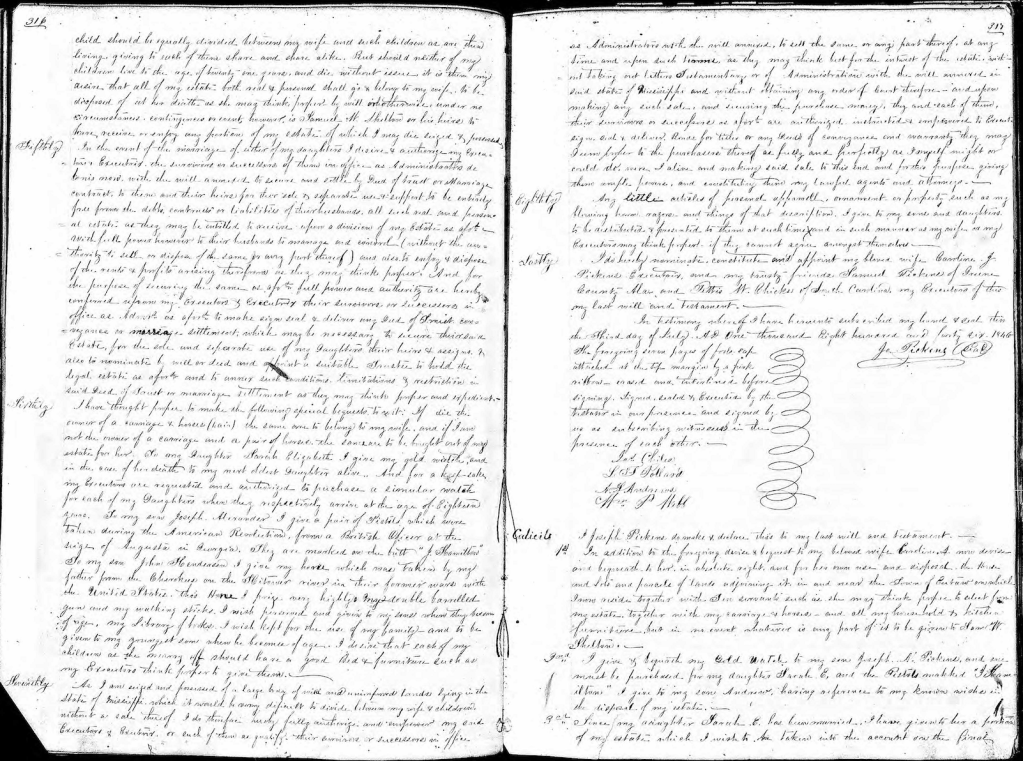
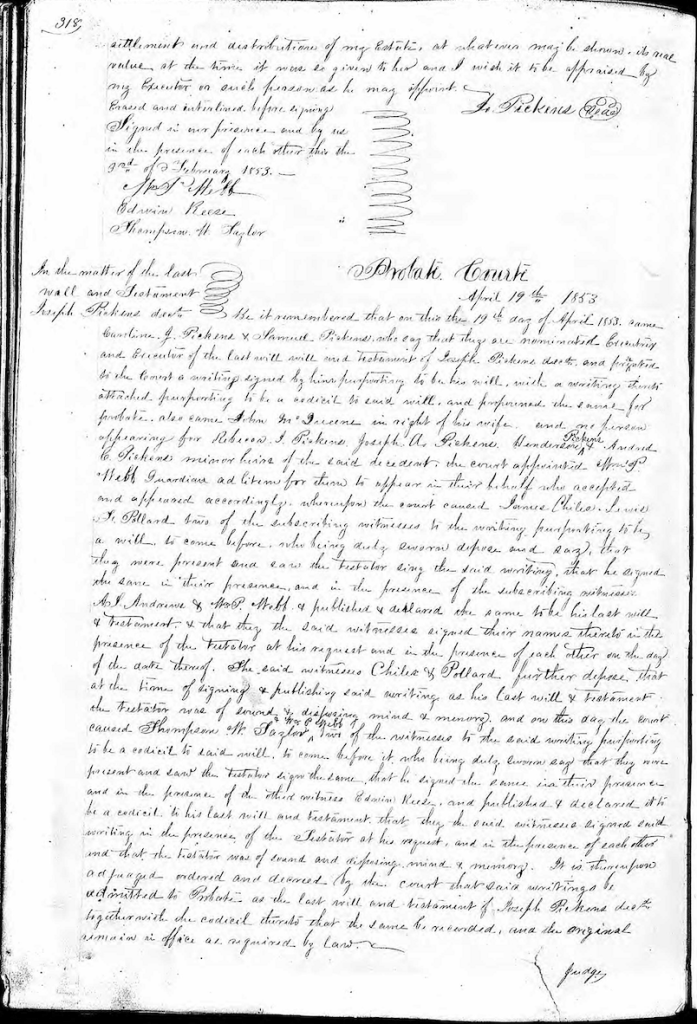
Joseph Pickens died 4 February 1853 at Eutaw.[27] Prior to his death, on 3 July 1846, Joseph made his will in Greene County.[28] The will stipulates that Joseph wanted each of his children to have a “good & finished education — but should either of my sons not appreciate its importance or be wanting in the proper capacity to received [sic] a thorough education, then my desire is that my Executor & Executrix shall exercise their sound discretion as to the course of instruction best to be pursued by them, and to have it directed and attended to accordingly.”
The will then makes detailed arrangements for a division of Joseph’s estate after his surviving children had reached the age of twenty-one and in case of the marriage of his widow Caroline or of the children. It then makes specific bequests to his children, including a gold watch to go to his daughter Sarah Elizabeth or, in case of her death, to his next daughter, with a similar watch to be purchased for each of his daughters as a keepsake; a pair of pistols marked “J Hamiltons” taken from a British officer at the siege of Augusta during the Revolution to go to his son Joseph; and the horse taken by his father from the Cherokees in their wars against the U.S., which Joseph says he particularly prized, to go to his son John Henderson (Pickens). His library of books was to be kept for the use of his family and when his youngest son (Andrew) had come of age, to be given to him.
The will also states that Joseph would die seized of a large body of lands in Mississippi that could not easily be divided equitably among his heirs, and these were to be sold and their proceeds then divided among the heirs. The will makes Joseph’s wife Caroline executrix, and names his “trusty friends” Samuel Pickens of Greene County and Pettis W. Chick of South Carolina executors. The will was witnessed by James Chiles, L.F. Pollard, A.L. Andrews, and William P. Webb. Samuel Pickens (1791-1855) was Joseph’s cousin, a brother of Alabama governor Israel Pickens who had come to Alabama in 1819 with brothers John and James, settling in the fertile Black Belt of the state. Samuel lived on a plantation called Umbria outside Greensboro.[29]
On 3 February 1853, the day prior to his death, Joseph made a codicil to his will stating that his house in Eutaw, with the lots on which it sat and parcels of land adjoining it, were to be left to his beloved wife Caroline, but in no event whatsoever was anything of this inheritance to be given to Samuel W. Shelton. Caroline was also to choose ten servants from Joseph’s estate to go with the house. His gold watch was to go to his son Joseph A. and one like it to be bought for his daughter Sarah E., and the pistols marked “J. Hamiltons” were to go to his son Andrew. Since Sarah E. had now married (on 1 January 1852, she married General John McQueen, a U.S. Congressman of Marlboro, South Carolina), she had received a portion of the estate and this was to be taken into account as it was divided. The codicil was witnessed by William P. Webb, Edwin Reese, and Thompson W. Taylor.
On 19 April 1853, James Chiles and Lewis F. Pollard proved the will, with Caroline J. Pickens and Samuel Pickens presenting the will to court. William P. Webb was appointed guardian ad litem for the minor heirs Rebecca J., Joseph A. (Alexander), (John) Henderson, and Andrew C. (Calhoun) Pickens, and John McQueen acted on behalf of his wife Sarah E. Pickens in the estate settlement.
The inscription on Joseph Pickens’ tombstone in Mesopotamia cemetery at Eutaw reads,
Col. Joseph Pickens
Youngest Son of GENL. Andrew Pickens
Born March 30th 1791 Died Feb’y. 3rd 1853
In honor’s path he firmly trod.
And liv’d & died the noblest work of God.
An honest Man.
The photo at the head of the posting, which is said to be a photo of Joseph Pickens from an unknown source, appears at the “D L S Family Tree” of Ancestry user lamarstyle, who states that the photo is found at John Dickinson’s website entitled Southern Anthology: Families on the Frontiers of the Old South. That site states that the photo is from Ancestry.
In addition to the children whose names appear in Joseph’s will and estate papers, a daughter Catherine Ann was born to Joseph and wife Caroline and is buried with them in Mesopotamia cemetery at Eutaw. Family trees online and other sites with biographical information about Joseph Pickens frequently give him the middle name William. I’ve seen no documents anywhere showing Joseph with the middle name William or any other middle name.
[1] See Find a Grave memorial page of Rebecca Pickens Noble, Noble cemetery, Willington, McCormick County, South Carolina, created by Gypsy Soul, with a tombstone photo by Gypsy Soul.
[2] See “Noble Family Papers,” an online guide to a collection of family papers found in the manuscript collections of Huntington Library, San Marino, California.
[3] See Tom Downey, “Noble, Patrick,” South Carolina Encyclopedia.
[4] See Find a Grave memorial page of William Alexander Noble, Noble cemetery, Willington, McCormick County, South Carolina, created by Gypsy Soul, with a tombstone photo by Gypsy Soul. I have seen no documents anywhere giving William Noble the middle name Alexander. Every document I’ve seen gives his name as simply William Noble.
[5] Abbeville County, South Carolina, Probate Files, box 71, pack 1738.
[6] See supra, n. 4.
[7] See supra, n. 1.
[8] Abbeville County, South Carolina, Probate Files box 69, pack 1697.
[9] See Find a Grave memorial page of Catherine Pickens Hunter, Live Oak cemetery, Selma, Dallas County, Alabama, created by jdc, maintained by Nancy57, with a tombstone photo by Morris Braum.
[10] Richard Wright Simpson, History of Old Pendleton District, with a Genealogy of the Leading Families of the District (Anderson, South Carolina: Oulla, 1913), pp. 180-1. See also William Bailey Williford, Williford and Allied Families (priv. publ., Atlanta, 1961), p. 174.
[11] See Find a Grave memorial page of Dr. John Miles Hunter, burial details unknown, created by G. Brown.
[12] Sarah Haynsworth Gayle’s journal is held by University of Alabama. It is transcribed in The Journal of Sarah Haynsworth Gayle, 1827–1835, ed. Sarah Woolfolk Wiggins (Tuscaloosa: University of Alabama Press, 2023).
[13] Ibid., p. 2.
[14] Ibid., p. 4. Following the death of John Hunter on 17 June 1829, Sarah wrote in her journal on 20 June 1830 that she had visited Catherine Hunter and her family only briefly that day. She stated, “Some how, I do not have the same pleasure in visiting them, I used to have. There appears to be more constraint, less heartiness in their welcome, and less comfort amongst themselves” (p. 159). However, by 13 January 1833, as her family prepared to move to Tuscaloosa, she wrote fondly of those she’d miss in Greensboro who had been exceptionally kind to her, and once again spoke highly of Catherine Hunter, “who left home to wait on me like a mother,” and of Maria and Margaret Hunter, with whom she had “passed hours of happiness” (p. 232).
[15] Ibid., p. 6.
[16] Ibid., p. 23.
[17] Ibid., pp. 37-8.
[18] Alabama Department of Archives and History, Subject Files—Surname files, 1901-1984. The Pendleton Messenger of Anderson County, South Carolina, also published a death notice for Dr. John Hunter on 22 July 1829 noting his death at Greensboro, Alabama, and 17th June, and that he had formerly been a resident of Pendleton for many years: see G. Anne Sherrif, “Pendleton Messenger,” Old Pendleton District Newsletter 19,8 (October 2005), p. 158.
[19] See supra, n. 9.
[20] See Find a Grave memorial page of Col. Joseph Pickens, Mesopotamia cemetery, Eutaw, Greene County, Alabama, created by Craig McCraw, with tombstone photos by Craig McCraw and Callie Rhodes Outlaw.
[21] Richmond [Virginia] Dispatch (3 March 1853), p. 1, col. 5.
[22] Alabama Department of Archives and History, Subject Files—Surname files, 1901-1984. Joseph’s obituary, ibid., also states that he settled first in Selma when he moved to Alabama.
[23] This is stated in the biographical information supplied by Joseph’s daughter Sarah McQueen in Alabama Surname Files and in his obituary in Richmond Dispatch. See also William Garrett, Reminiscences of Public Men in Alabama for Thirty Years, with an Appendix (Atlanta: Plantation, 1872), p. 748.
[24] The Alabama Intelligencer death notice is abstracted in the Alabama Department of Archives and History’s index-card collection entitled Alabama Marriages, Deaths, Wills, Court, and Other Records, 1784-1920, which states that the marriage was announced in that newspaper on 7 August 1829, p. 3, col. 5. And see Find a Grave memorial page of Caroline J. Henderson Pickens, Mesopotamia cemetery, Eutaw, Greene County, Alabama, created by JFJN, with tombstone photos by Callie Rhodes Outlaw, Rick & Kat, and JFJN. See also Pauline Jones Gandrud, Alabama Records, vol. 14: Greene County (priv. publ., Huntsville, Alabama, n.d.), p. 84.
[25] Kimberly R. Jacobson, Greene County and Mesopotamia Cemetery (Charleston: Arcadia, 2007), p. 36.
[26] Ibid., citing Deborah Stone. And see “Webb-Howell House” at the West Alabama website maintained by University of Alabama’s Center for Economic Development Project.
[27] The date is recorded on his tombstone in Mesopotamia cemetery at Eutaw: see supra, n. 20.
[28] Greene County, Alabama, Will Bk. C, pp. 315-8.
[29] See “Umbria Plantation,” Wikipedia.


3 thoughts on “Children of Andrew Pickens and Rebecca Calhoun: Rebecca (Noble), Catherine (Hunter), and Joseph”