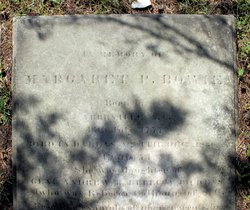
7. Margaret Pickens, the seventh child of Andrew Pickens and Rebecca Calhoun,was born 13 July 1777 in Ninety-Six District (later Abbeville County), South Carolina. This date of birth is recorded on her tombstone in Valley Creek cemetery at Valley Grande, Dallas County, Alabama.[1] The Pickens family bible that passed down in the family of Margaret’s sister Catherine, which was discussed in the previous posting, states that the entry of Margaret’s birth is blurred and reads it as 18 July 1776.
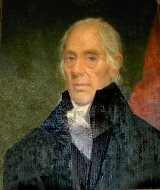
On 18 November 1800 in Abbeville County, Margaret married George Bowie, son of John Bowie and Rosa Reid.[2] John Bowie (1740-1827) was a native of Dumbartonshire, Scotland, who came to Virginia in 1762 and was in the Long Cane settlement by 1777.[3] He gave Revolutionary service, achieving the rank of major, and was for many years clerk of Abbeville County and a justice of the peace in the county. During the Revolution, the South Carolina Provincial Congress appointed him along with Patrick Calhoun and others to execute the Continental Association in Ninety-Six District.[4]
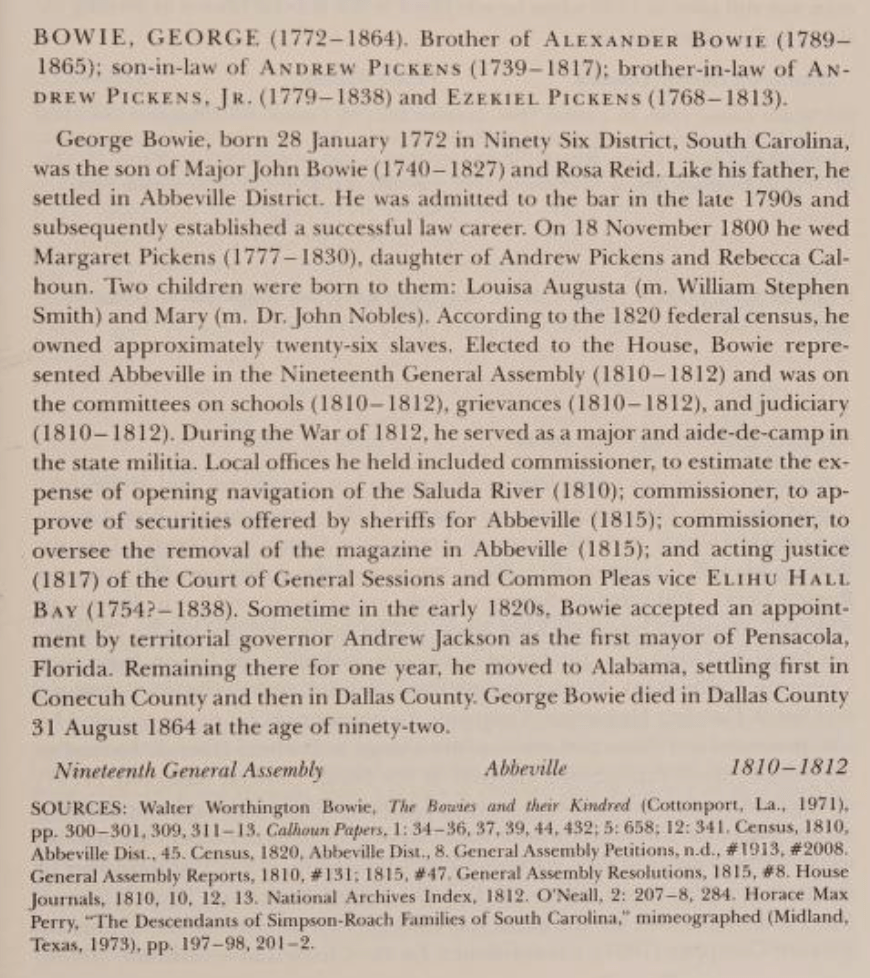
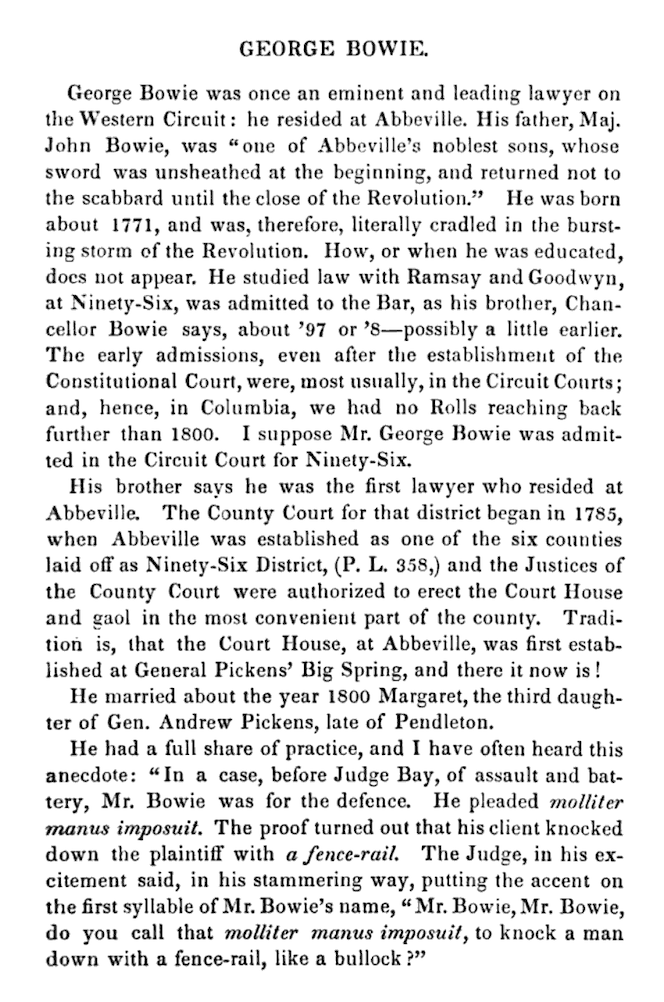
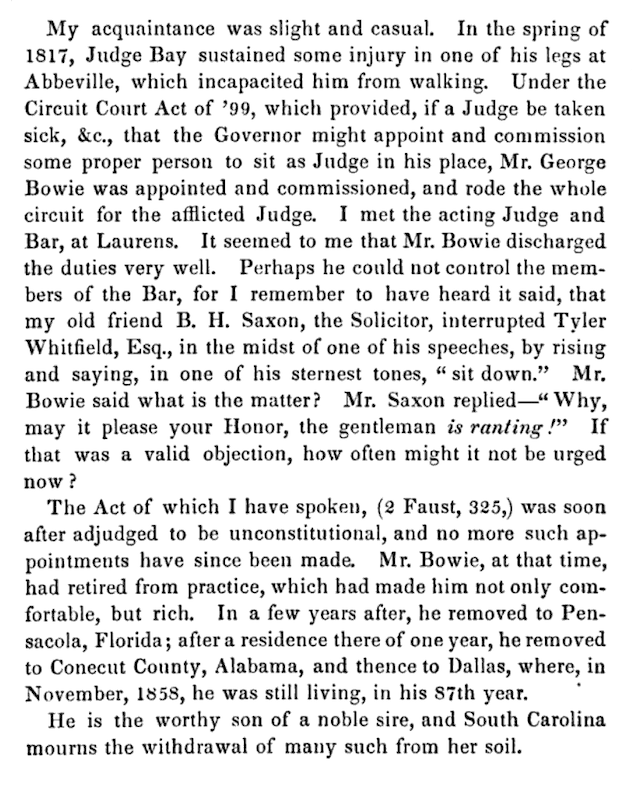
George Bowie was born 28 January 1772 in Ninety-Six District and was educated at Princeton; the biography of his grandson Andrew Pickens Smith in The Encyclopedia of the New West states that at the time of his death on 8 August 1864 at Cahaba in Dallas County, Alabama, George was the oldest living Princeton graduate.[5] He was admitted to the bar at Abbeville in the latter part of the 1790s and is said to have been the first lawyer who resided there.[6]
As a previous posting notes, when Mary Calhoun Kerr, the aunt of George’s wife Margaret Pickens, made her will in Abbeville County on 21 January 1805, she made George Bowie an executor along with Mary’s half-brother Andrew Norris and son-in-law John Green.[7]
In 1805, John C. Calhoun, the future vice-president of the U.S. and first cousin of George Bowie’s mother-in-law Rebecca Calhoun Pickens, studied law with George Bowie in Abbeville, whom William Meigs describes in his biography of John C. Calhoun as “an eminent and leading lawyer on the Western Circuit.”[8]
In 1810, George Bowie was elected to the South Carolina House representing Abbeville County, and served in that position through 1812.[9] His biography in Biographical Directory of the South Carolina House of Representative states that in the early 1820s, territorial governor Andrew Jackson appointed George Bowie as the first mayor of Pensacola, and after a year there, he moved his family to Alabama.[10] On 8 October 1821, the Pensacola Gazette published a notice that George Bowie was resigning the position of mayor due to the demands of his business, and Colonel John Miller would take his place.[11] As a previous posting notes, at this point, Margaret Pickens Bowie’s sister Ann and husband John Simpson were living at Pensacola.
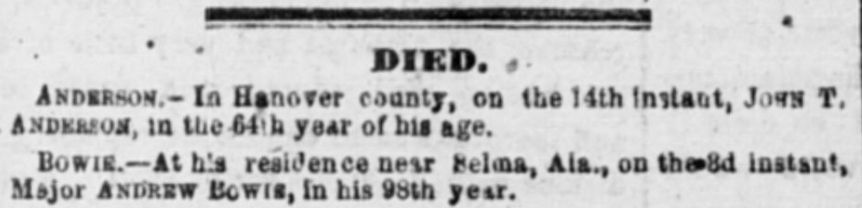
In Alabama, George and Margaret Pickens Bowie first settled in Conecuh County and then moved to Dallas County, where Margaret died 14 December 1830 and George died 8 August 1864, both being buried in the cemetery of Valley Creek Presbyterian church at Valley Grande. Note that whereas George’s biography in Biographical Directory of the South Carolina House of Representative gives his date of death as 31 August 1864, his death notice in the Richmond Whig on 16 August 1864 states that George died on 8 August.[12] The death notice misstates George Bowie’s given name as Andrew, but it’s clear that this death notice refers to George Bowie, who was the only Bowie of this age living in Dallas County, Alabama, at the time George died there. George Bowie was 92 and not 98 years of age when he died in 1864.
The Find a Grave memorial page for Margaret provides the following transcription of her tombstone inscription, one that, as can be seen by a close examination of the photo of the tombstone, appears to add words to what is written on the original (e.g., “13th of July”; “Dallas County“):[13]
In Memory of Margaret P. Bowie, born in Abbeville S. C. the 13th of July 1777 and died in Dallas County the 14th Dec. 1830. She was daughter of Gen. Andrew & Rebecca Pickens, who was Rebecca Calhoun of S.C. From the example of pious parents her mind became early [imbued?] with the principles of Christian religion which she adored, and zealously followed through the remainder of her life. Filled with charity and the most extended benevolence worked her path through Life, she was an affectionate wife a gentle mother and a generous friend. In none were there virtues more conspicuous. Her health had been delicate for more than 20 years and her last sufferings were great and she bore all with true Christian meekness, looking forward to that crown of glory promised to the humble followers of the Lamb, and died in the full triumph of faith, a husband and only daughter deplore their loss, and raised this final monument to her dear memory.
Margaret is a given name that recurred down generations of the Pickens family. It was the name of Andrew Pickens’ grandmother Margaret Pike, who married William Pickens, Andrew’s grandfather.
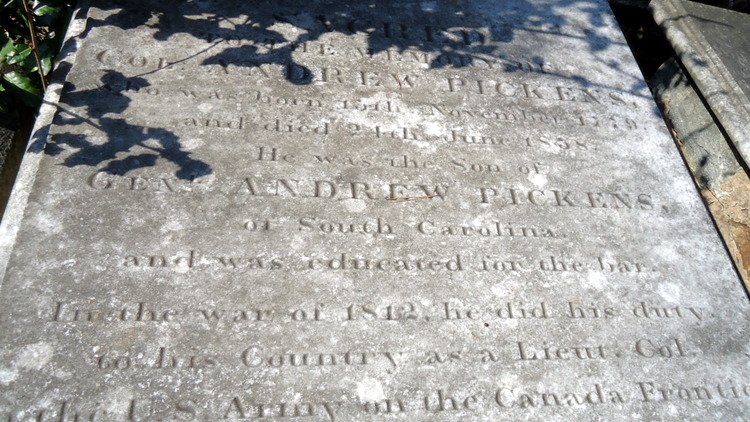
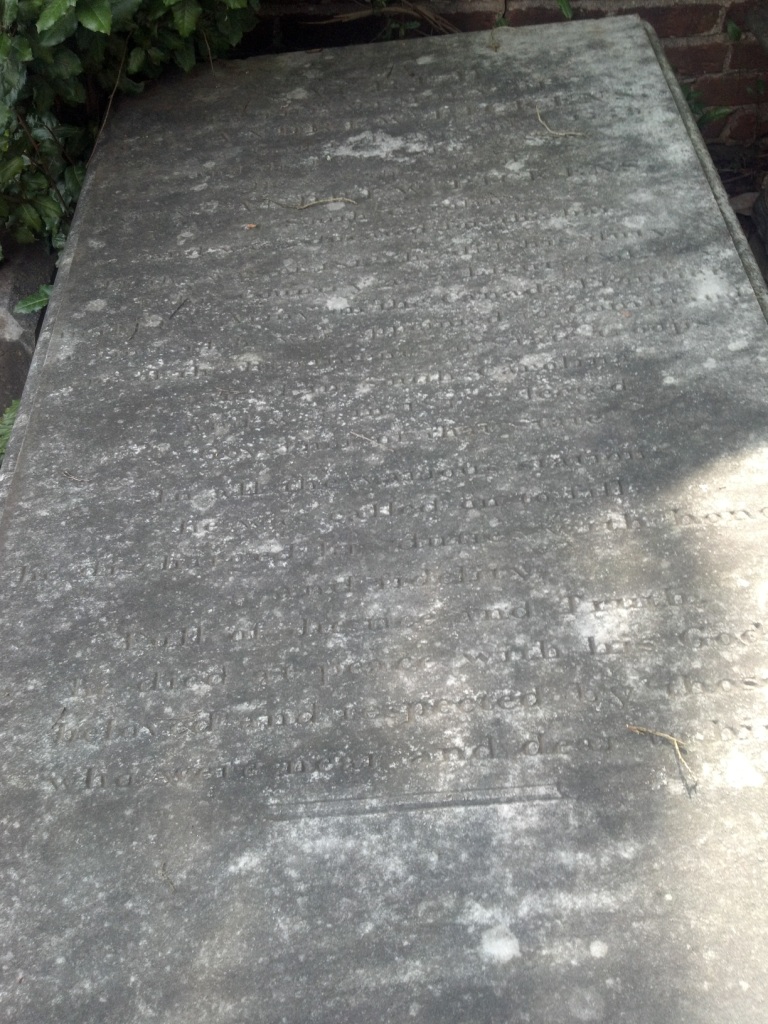
8. Andrew Pickens, the eighth child of Andrew Pickens and Rebecca Calhoun,was born 13 November 1779 in Ninety-Six District (later Abbeville County), South Carolina. This date of birth is inscribed on his tombstone in Old Stone Church cemetery at Clemson in Pickens County, South Carolina.[14] This birthdate appears as well in the previously discussed family bible. The bible transcript found at the linked posting states that Andrew died 7 December. This information is incorrect. As we’ll see, he died 24 June 1838. I suspect that the transcriber has misread the date of death of the unnamed son born after Andrew who died in infancy as Andrew’s date of death.
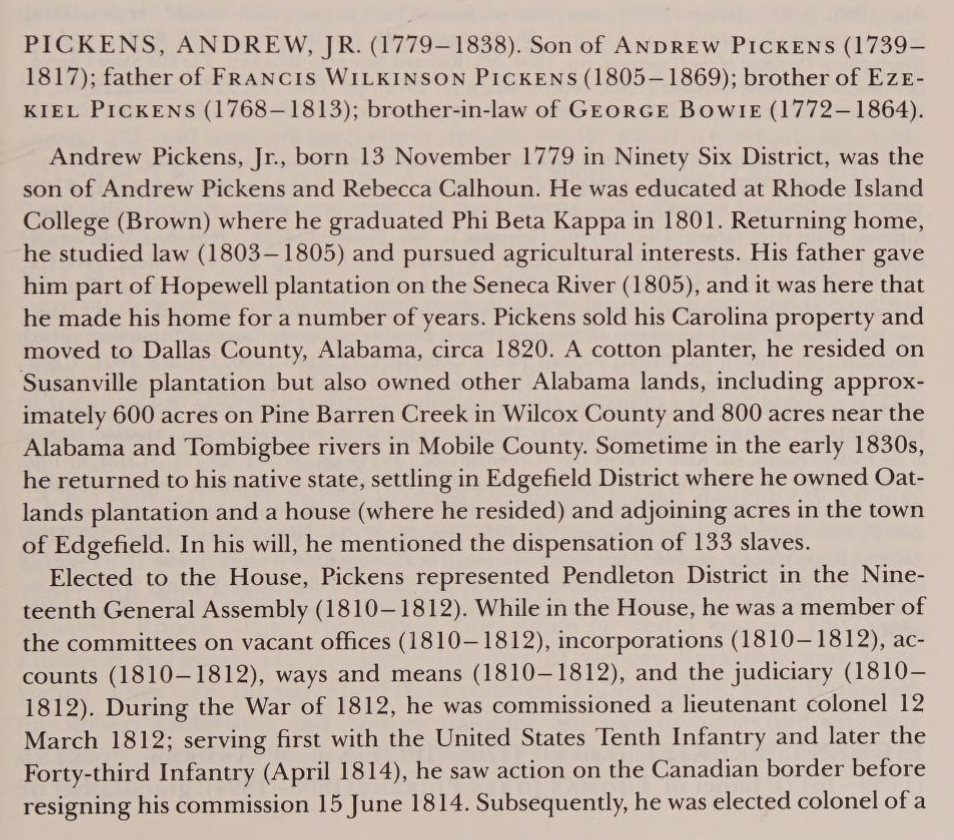
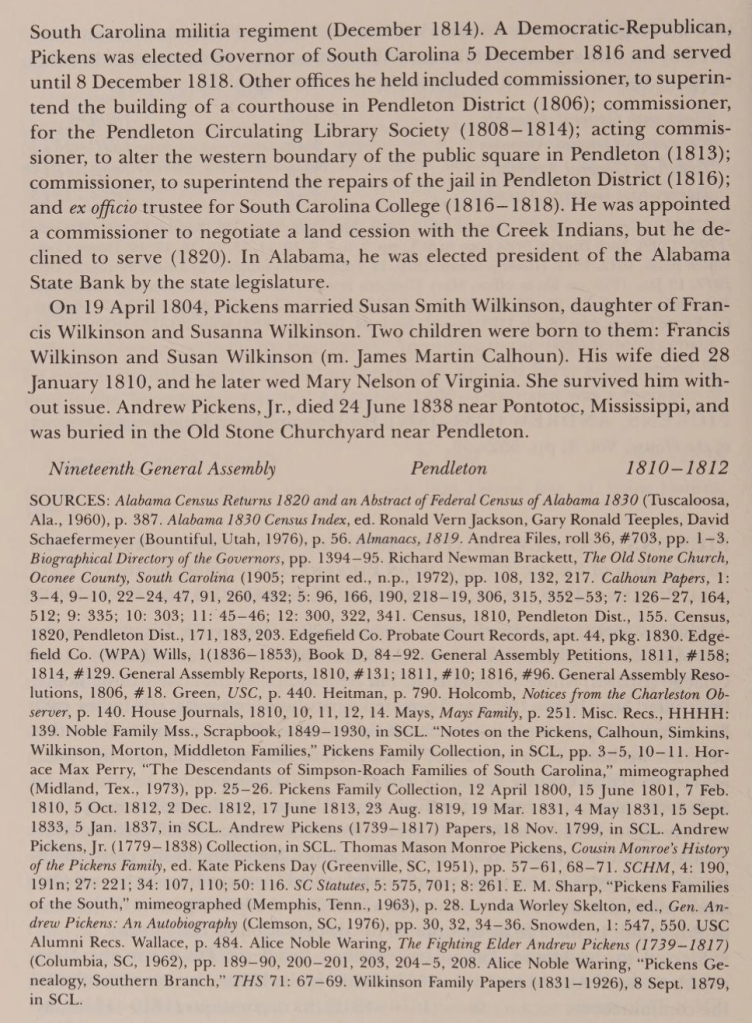
Because of his distinguished career as a public servant, a number of well-documented biographies of Andrew Pickens are readily available.[15] According to his biographies in Biographical Directory of the South Carolina House of Representative and in South Carolina Encyclopedia, Andrew Pickens attended Rhode Island College (later Brown University), where the first source says he graduated Phi Beta Kappa in 1801.[16] Other sources indicate, however, that he was educated at College of New Jersey (later Princeton).[17]
Following his schooling, Andrew studied law in Charleston from 1803-5 before returning to Pendleton District, where his parents were living at their Hopewell house near Pendleton up to the spring of 1805, when, as we’ve seen, they moved to Tamassee Creek in what’s now Oconee County, giving Hopewell to their sons Ezekiel and Andrew. Following his parents’ move from Hopewell, Andrew, who had married Susan Smith Wilkinson, daughter of Francis and Susanna Wilkinson on 14 April 1804, moved into Hopewell with Ezekiel living at a house called the Cottage on the Hopewell plantation, whose land their parents divided between the two sons as the parents went to Tamassee Creek. During this period of his life, Andrew also retained a house in Charleston on the northeast corner of Smith and Beaufain Street, according to Harriette Kershaw Leiding.[18] Andrew’s wife Susan was from a lowcountry family: she was born 9 January 1788 in St. Paul’s parish in the lowcountry of South Carolina.
A 4 April 1805 letter to Andrew Pickens at Hopewell from his aunt Floride Bonneau Colhoun, who was writing from her home in St. Paul’s parish, indicates that Floride had recently visited her nephew in the upcountry and then had returned home. The letter is held by Duke University in its manuscript collection entitled the John Caldwell Calhoun Papers. Floride wrote to her nephew Andrew Pickens:
I was happy to find you were all well and hope in this that Susan has presented you with a fine Son, or Daughter, and that she is perfectly recovered.
On 7 April 1805, Andrew and Susan’s son Francis Wilkinson Pickens was born, so this is the child whose birth was imminent when Floride left Hopewell to return to the lowcountry shortly before 4 April 1805. Floride ends her letter stating,
I hope you are both now made happy parents of a hopeful Child, and may you both be enabled to fullfil all the duties incumbent upon you to your offspring is the sincere prayer of Dear Andrew your Affectionate Aunt Floride Colhoun.
Letters to Andrew Pickens found in both the John Caldwell Calhoun Papers and the Francis Wilkinson Pickens Papers held by Duke University indicate that in the years in which Andrew was living at Hopewell and operating his share of that plantation, his overseer was Joshua Dubose, who had previously been the overseer for Andrew’s uncle John Ewing Colhoun, who died 26 October 1802. The John Caldwell Calhoun Papers have a 31 January 1803 receipt of Joshua Dubose to the estate of John Ewing Calhoun, and an 11 May 1805 receipt in the same collection from the estate of John E. Colhoun to Joshua Dubose identifies him as overseer at the Bonneau Ferry plantation of John’s wife Floride. By October 1809, Joshua Dubose was working as Andrew Pickens’ overseer at Hopewell, according to letters archived in the Francis Wilkinson Pickens Papers.
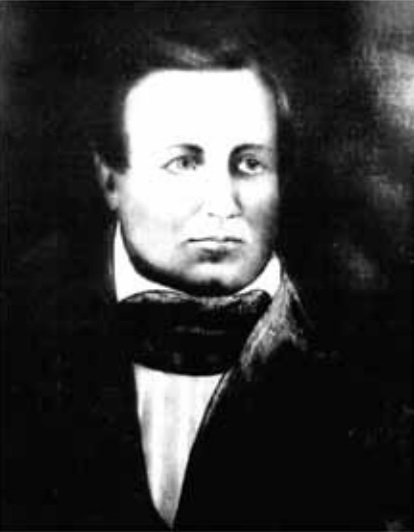
Andrew Pickens’ wife Susan died on 28 January 1810 at Hopewell, and Andrew then remarried to Mary Nelson of Virginia. In his years living at Hopewell and operating his portion of the Hopewell plantation, Andrew combined the life of a planter with political ventures. As James Spady writes,[19]
Pickens’s political career began at the local level, where he served in minor public posts, such as commissioner for building the Pendleton District courthouse (1806) and commissioner of the Pendleton Circulating Library Society (1808–1814). In 1810 the voters of Pendleton District sent Pickens to the state House of Representatives, where he served a single term. Following the outbreak of war between Great Britain and the United States in 1812, Pickens was commissioned as a lieutenant colonel and served with the U.S. Tenth Infantry and the Forty-third Infantry. He resigned his U.S. Army commission on June 15, 1814, and returned to South Carolina, where he was made a colonel in the state militia.
On December 5, 1816, Pickens was elected governor of South Carolina, the first person from above the state’s fall line to serve in that office.
As James Spady notes, “Shortly after the end of his [gubernatorial] term in December 1818, Pickens moved to Alabama, where he acquired large landholdings and took up cotton planting.”[20] In a previous posting, I discussed a 23 August 1819 letter written by Andrew Pickens to his cousin (and brother-in-law) Captain William Noble of Abbeville, which is archived in the Andrew Pickens Papers at the South Caroliniana library of University of South Carolina.[21] In this letter, Andrew states that he was in Monticello in Jasper County, Georgia, as he was returning from Alabama where he had left his brother Joseph Pickens, who was intending to go to Tuscaloosa. In a 21 April 1819 letter she sent to her son James Edward Calhoun (the letter is in the John Ewing Colhoun Papers at the South Caroliniana library), Andrew’s aunt Floride Bonneau Colhoun writes,
I am most mortified that you did not write to Colonel Pickens, do write to him, and enclose it to me, he left Pendleton for the Alabama a week before John E. got up and expects to return in about two months.
The John E. of this letter is John Ewing Colhoun (1791-1847), son of John Ewing Colhoun and Floride Bonneau. As these family letters indicate, a network of Calhoun and Pickens relatives were making plans at this time to move from South Carolina to “the Alabama.” These included Andrew Pickens and his brother Joseph, their sisters Jane Bonneau Pickens and husband John Henry Miller, Margaret and husband George Bowie, Catherine and husband John Hunter, their nephew Ezekiel, son of their brother Ezekiel Pickens, and their cousin Jane Kerr and husband John Green. The posting I’ve just linked notes that in 1817, Pendleton District had suffered crop failures, affecting some families severely, and that in his history of the process of westward migration of planters from the old Southeast, James David Miller cites correspondence of John C. Calhoun to his brother-in-law (and cousin) James Edward Calhoun when James Edward returned to Norfolk, Virginia, in 1820 from naval duty in China.[22] John C. Calhoun wrote to James Edward Calhoun to tell him that in his absence, many relatives including Colonel Andrew Pickens and his brother Joseph and nephew Ezekiel had left Pendleton District for Alabama. Miller notes that after his move to Alabama, Andrew Pickens remained in close touch with his Calhoun kin in South Carolina.
Having moved to Alabama, Andrew Pickens sold the Hopewell tract to Congressman John Carter of Camden, South Carolina, in 1824.[23] In 1829, Carter’s brother-in-law Horace Reese arranged to buy the property, and after his death the transaction was completed by Charles M. and George Reese, nephews of Reverend Thomas Reese. The Reeses advertised the property for sale in the Pendleton Messenger as “Hopewell Plantation, lying on both sides of Seneca River, 11,000 acres. Large dwelling house, Ferry boat.”[24] In 1835, the Hopewell plantation was advertised for sale again by David Cherry, who married Mary Story Reese, daughter of George Reese Sr. Cherry bought the property himself and it then became known as “the Cherry Place.”
In Alabama, Andrew Pickens settled in Dallas County, as did his brother Joseph, his sisters Jane (with husband John Henry Miller), Margaret (with husband George Bowie), Catherine (with husband John Hunter) — Catherine moved there from Greene County after her husband died — and their nephew Ezekiel Pickens. Dallas County is in the fertile Black Belt area of west-central Alabama, a region with prime land for growing cotton. Andrew’s biography in Biographical Directory of the South Carolina House of Representative states,[25]
A cotton planter, he resided on Susanville plantation [in Dallas County] but also owned other Alabama lands, including approximately 600 acres on Pine Barren Creek in Wilcox County and 800 acres near the Alabama and Tombigbee rivers in Mobile County.
In the early 1830s, Andrew Pickens returned to South Carolina and settled near Edgefield, where he acquired a plantation called Oatlands and a house called Halcyon Grove in Edgefield that is mentioned in his will.[26] Andrew’s will states that he bequeathed his son Francis Wilkinson Pickens among other property a portrait of Andrew’s father General Andrew Pickens along with a sword awarded to General Pickens by the U.S. Congress for his conduct at the battle of Cowpens during the Revolution.
Andrew Pickens died 24 June 1848 in Pontotoc County, Mississippi, where his sister Jane and husband John Henry Miller had moved after first settling in Dallas County, Alabama, when they left South Carolina in or around 1819. As I noted previously, Andrew is buried in the cemetery of Old Stone Church at Clemson in Pickens County, South Carolina, where his parents Andrew Pickens and Rebecca Calhoun are also buried.[27] His tombstone states his date of death.
9. Son Pickens, the ninth child of Andrew Pickens and Rebecca Calhoun, was born 13 November 1782 in Ninety-Six District (later Abbeville County), South Carolina, and died in infancy. I suspect that this infant son died 7 December 1782: on this point, see above.
[1] See Find a Grave memorial page of Margaret Pickens Bowie, Valley Creek cemetery, Valley Grande, Dallas County, Alabama, created by Zoe Tom, with a tombstone photo by Hubert Champion. A biography of Margaret’s grandson Reverend Andrew Pickens Smith, a Presbyterian minister, William S. Speer, ed., The Encyclopedia of the New West (Marshall, Texas: United States Biographical Publishing Co., 1881), pp. 205-6, also states her dates of birth and death (though it gives the date of death as 4 December 1830 instead of 14th December, which is on her tombstone), and notes that she was the daughter of General Andrew Pickens of Revolutionary fame.
[2] See N. Louise Bailey, ed., Biographical Directory of the South Carolina House of Representatives, vol. 4: 1791-1815 (Columbia: University of South Carolina Press, 1984), p. 67; John Belton O’Neall, Biographical Sketches of the Bench and Bar of South Carolina, vol. 2 (Charleston: Courtenay, 1859), pp. 207-8. The former source gives the exact date of the marriage, and the latter states that it occurred “about 1800.”
[3] See Find a Grave memorial page of Maj. John Bowie Sr., Upper Long Cane cemetery, Abbeville, Abbeville County, South Carolina, created by Dennis M Ison, with a tombstone photo by Kim Jacobson. Biographical information is found on the memorial page; the tombstone states that John Bowie was born in Dumbartonshire, Scotland.
[4] Mary Catherine Davis, “The Feather Bed Aristocracy: Abbeville District in the 1790s,” South Carolina Historical Magazine 80,2 (April 1979, p. 152.
[5] See supra, n. 1. George Bowie’s date and place of death are stated in a death notice printed in the Richmond [Virginia] Whig (16 August 1864), p. 1, col. 5.
[6] Biographical Directory of the South Carolina House of Representatives, p. 67; and O’Neall, Biographical Sketches of the Bench and Bar of South Carolina, p. 207.
[7] Abbeville County, South Carolina, Will Bk. 1, p. 304; Abbeville County, South Carolina, Probate Files, box 52, pack 1231. See also James Wooley, A Collection of Upper South Carolina Genealogical and Family Records, vol. 2 (Easley, South Carolina: Southern Historical Press, 1981), p. 170; and Willie Pauline Young, Abstracts of Old Ninety-Six and Abbeville District Wills and Bonds (Greenville, South Carolina: Greenville Printing Company, 1950), p. 171.
[8] William M. Meigs, The Life of John Caldwell Calhoun, vol. 1 (New York: Neale, 1917), p. 72.
[9] Biographical Directory of the South Carolina House of Representatives, p. 67.
[10] Ibid.
[11] Pensacola Gazette (8 October 1821), p. 3, col. 4.
[12] Biographical Directory of the South Carolina House of Representatives, p. 67; and see supra, n. 5.
[13] See supra, n. 1.
[14] See Find a Grave memorial page of Andrew Pickens, Old Stone Church cemetery, Clemson, Pickens County, South Carolina, created by Deleted User, maintained by Find a Grave, with tombstone photos by L N M W H and Deleted User
[15] See e.g. N. Louise Bailey, ed., Biographical Directory of the South Carolina House of Representatives, vol. 4: 1791-1815 (Columbia: University of South Carolina Press, 1984), pp. 441-2; James Spady, “Pickens, Andrew, Jr.” South Carolina Encyclopedia; and J.D. Lewis, “Andrew Pickens, Jr.,” Carolana.
[16] Biographical Directory of the South Carolina House of Representatives, vol. 4, p. 441; and Spady, “Pickens, Andrew, Jr.”
[17] See e.g. Lewis, “Andrew Pickens, Jr.,” noting that “other sources” state that Andrew Pickens attended College of Rhode Island. See also John Howard Brown, ed., Lamb’s Biographical Dictionary of the United States, vol. 6 (Boston: Federal Book Company, 1903), p. 251; and Thomas McAdory Owen, History of Alabama and Dictionary of Alabama Biography, vol. 3 (Chicago: Clarke, 1921), p. 286.
[18] Harriette Kershaw Leiding, Historic Houses of South Carolina (Philadelphia: J.B. Lippincott, 1921), p. 302.
[19] Spady, “Pickens, Andrew, Jr. See also Biographical Directory of the South Carolina House of Representatives, vol. 4, p. 441.
[20] Spady, “Pickens, Andrew, Jr.
[21] William Noble was the son of Alexander Noble and Catherine Calhoun. He married Andrew Pickens’ sister Rebecca. William Noble was multiply descended from the Calhoun family, since his father Andrew Noble was the son of John Noble and Mary Calhoun, and his mother Catherine Calhoun was the daughter of Ezekiel Calhoun (Mary’s brother) and Jean or Jane Ewing.
[22] James David Miller, South by Southwest: Planter Emigration and Identity in the South and Southwest (Charlottesville: University of Virginia, 2002), p. 18, citing Meriwether, Papers of John C. Calhoun, vol. 5, p. 96.
[23] Pendleton District Historical and Recreational Commission, Pendleton Historic District: A Survey (Pendleton, South Carolina: Pendleton District Historical and Recreational Commission, 1973), p. 20.
[24] Cited in ibid.
[25] Biographical Directory of the South Carolina House of Representatives, vol. 4, p. 441.
[26] Edgefield County, South Carolina, Will Bk. D, pp. 63-9.
[27] See supra, n.


.jpg)
4 thoughts on “Children of Andrew Pickens and Rebecca Calhoun: Margaret (Bowie) and Andrew”