a. Susan M. Green was born in 1828 (1860 federal census) or 1829 (1850 federal census) in Bibb County, Alabama. On 1 October 1846 in Bibb County, Susan married Thornton Stringfellow, son of Henry and Jane Stringfellow of Perry County, Alabama. Thornton Stringfellow gave bond for the marriage in Bibb County with Edward Henry Bernhard on 29 September 1846 and on 1 October 1846, Reverend Bagwell Lunsford Defreese (1814-1877) married the couple.[1]
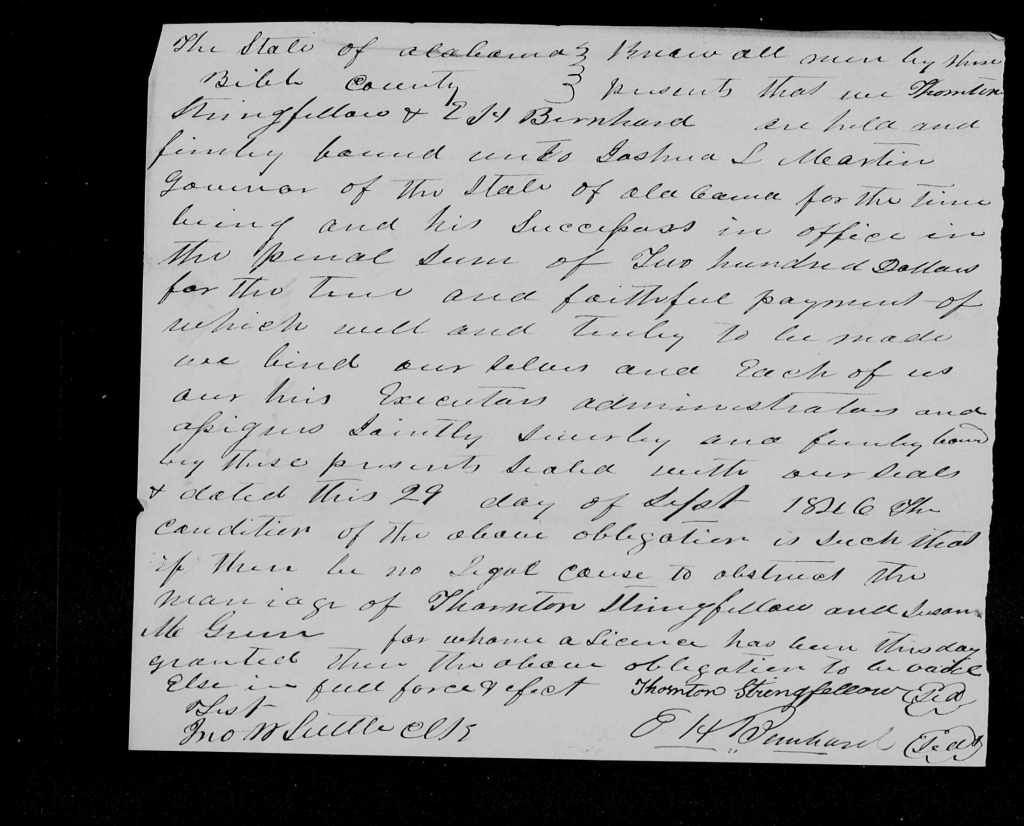
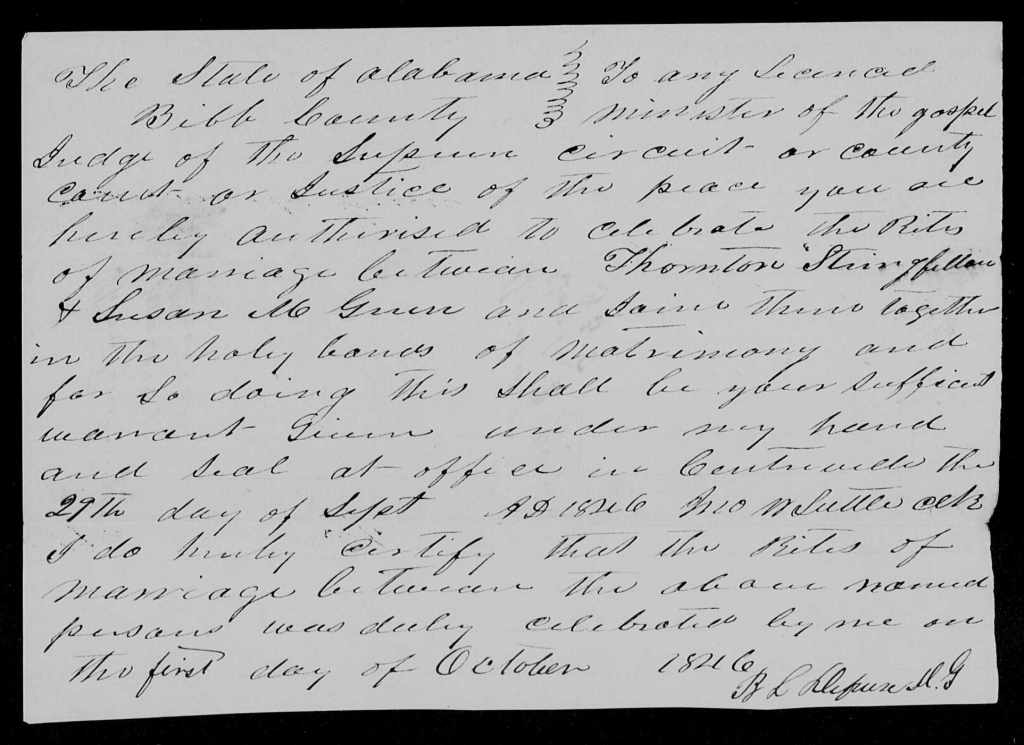

Susan and Thornton appear on the 1850 federal census in Bibb County, Alabama, which lists Thornton as a farmer, 41, born in South Carolina and says that Susan, 21, was born in Alabama.[2] Living with them is Thornton’s mother (or stepmother?) Jane Stringfellow, 82, born in Virginia.[3]

Thornton Stringfellow’s tombstone in Centreville Memorial cemetery at Centreville in Bibb County states that he was born 28 February 1802 and died 5 November 1853.[4] Also buried in the Centreville cemetery are Thornton’s mother or stepmother Jane and his first wife Caroline Barnet, whom he married in Bibb County on 5 January 1837.
I have very little information about Thornton Stringfellow. The Tuscaloosa newspaper State of the Union reported on 17 March 1841 that Thornton Stringfellow was a delegate from Bibb County to a meeting of the 3rd Congressional District of the Democratic party held in Tuscaloosa on the 15th.[5] And on 9 January 1843, Bibb County court appointed Thornton Stringfellow, Joscelin B. Green, and Frederick James to appraise the estate of Ruth Tucker.[6]

Following Thornton Stringfellow’s death in Bibb County on 5 November 1843, Susan Green Stringfellow remarried on 17 December 1854 to Joseph D. Neely, son of John Neely and Rebecca Edwards.[7]
After their marriage, Joseph and Susan settled at Montevallo in Shelby County, Alabama, some 20 miles southeast of the Green family’s homeplace in Bibb County. On 1 April 1857, the Weekly Advertiser of Shelby County reported that Joseph D. Neely had attended the Democratic Party meeting at Columbiana on 18 March 1857 and was appointed to attend the state Democratic convention to nominate a gubernatorial candidate.[8] On 6 February 1858, the Alabama legislature appointed Joseph D. Neely one of the trustees of the Montevallo Presbyterian Institute newly established at Montevallo by the Union Synod of the Cumberland Presbyterian church.[9]
Joseph and Susan appear on the 1860 federal census at Montevallo in Shelby County.[10] The census lists Joseph as 41, a farmer with $10,000 real worth and $27,200 personal worth, born in Alabama. Wife Susan is 32, also born in Alabama. In the household are children Laura, 16, Robert, 14, Lapaly, 12, and William, 11 months, all born in Alabama. Laura, Robert, and John (Lapaly) Neely were Joseph’s children by his first wife Frances Bowden, whom he married 13 June 1843 in Shelby County. Following Frances’ death, on 2 November 1851, Joseph married Catherine Bowden in Shelby County. Also in Joseph and Susan’s household in 1850 are Robert Bowden, W.G. Collins, a teacher, and wife Louisa and their son George, and J.W.B. Roach, a Cumberland Presbyterian minister, with wife Louisa and daughter Iona (or Lona).
On 21 March 1862 at Columbiana, the county seat of Shelby County, Joseph D. Neely enlisted in (and was mustered into) Co. B, 3rd Alabama Reserves (also 1st Alabama Artillery regiment).[11] Joseph entered as a private and was then elected to the post of 2nd lieutenant.
Susan Green Neely died between 1860 and 1870, probably in Shelby County, Alabama. I have not found a death or burial record. By 1870, Joseph had moved to Claiborne Parish, Louisiana, where he appears on the census with a wife Mary E. and the children listed in his household in 1860, as well as a Ruffin Neely, 17, and Charles Neely, 9, both born in Alabama.[12]
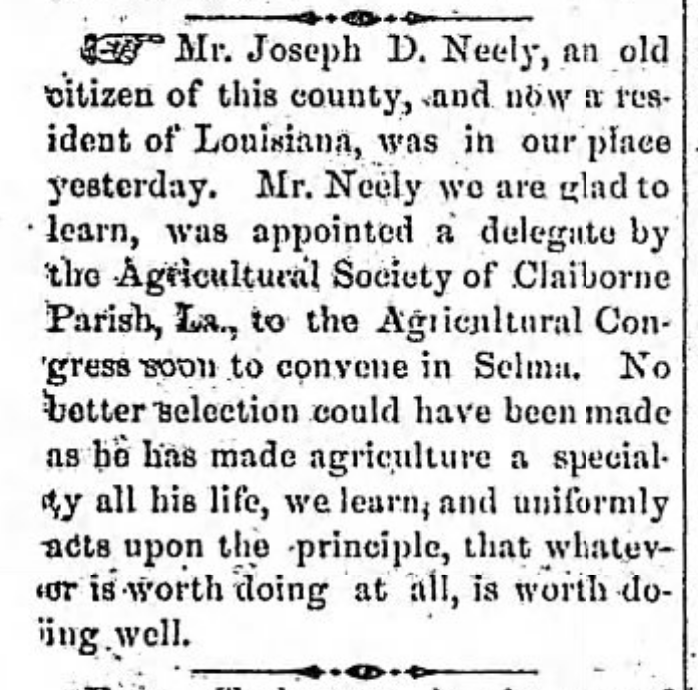
On 23 November 1871, the Shelby Guide (Columbiana, Alabama) reported that Joseph D. Neely, an old citizen of Shelby County and now a resident of Louisiana, was in Shelby County as a delegate of the Agricultural Society of Claiborne Parish, Louisiana, to the Agricultural Congress soon to convene at Selma.[13] On 26 November 1871, the Selma Morning Times reported that Mr. Joseph D. Neely of Louisiana was visiting his old home in Alabama and was to be at the Agricultural Congress soon to meet at Selma.[14]
Joseph D. Neely died in Claiborne Parish in February 1880, according to the 1880 federal mortality schedule.[15] I have not found a burial record for Joseph. It’s possible he’s buried at Forest Hill cemetery in Arizona, Claiborne Parish, in which his brother Dinsmore Neely is buried. Some published and online family trees give Joseph D. Neely the middle name Dinsmore. If that was his middle name, note that his parents would have given that name to two sons, since Joseph had a brother Dinsmore who is documented in his father’s estate records.
As the previous posting states, Susan M. Green had an aunt Susan M. Nichols, who married Drury Allen. I think Susan M. Green was named for her aunt Susan, or both Susan M. Green and her aunt Susan were named for a female ancestor in the Nichols family line.
b. William Nichols Green appears with a varying range of implied birth years in different documents. Both his father’s and his grandmother Jane’s estate records place him between his sisters Susan and Frances Jane as they list the children of Joscelin and Elizabeth Nichols Green. As we’ve seen, Susan appears to have been born about 1829-9, and Frances Jane’s birth year is consistently suggested as 1830 on federal censuses. That birth range doesn’t leave much room for William to have been born between Susan and Frances Jane. If Frances Jane’s birth year is correct as implied by federal censuses, I’m inclined to think Susan was actually born in 1827, two years following her parents’ marriage, and William N. in 1828 or 1829. The 1850 federal census gives William a birth year of 1829; the 1860 federal census has him born in 1828. When William first enlisted in the Confederate army in Bibb County in June 1861, he gave his age as 27, which would yield a birth year of 1834, a clearly incorrect birth year. When William re-enlisted in a new unit in Virginia on 11 June 1862, he said that he was 32, making his birth year 1830.
As the previous posting notes, in 1860, William N. Green was enumerated at Six Mile in Bibb County living alone, with his widowed mother Elizabeth and sister Candace also living at Six Mile in other households.[16] The census states that William N. Green was a merchant, aged 32, with $300 real worth and $13,000 personal worth, born in Alabama.
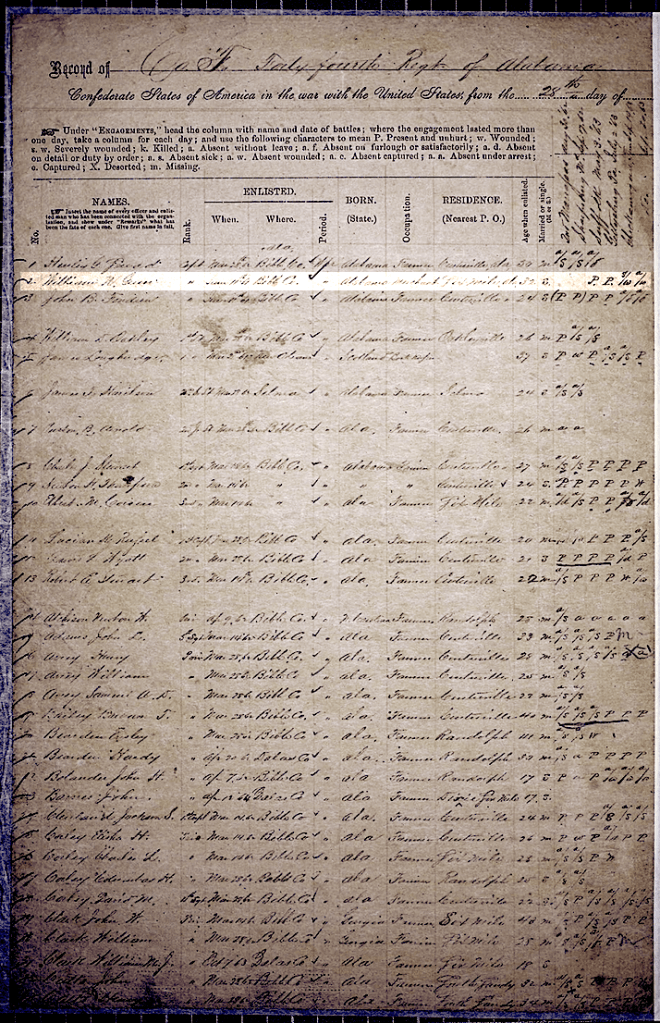
As I’ve just noted, William was a Confederate soldier who enlisted on 11 June 1861 in Co. F, the “Bibb Grays,” of Alabama’s 11th Alabama Infantry.[17] On 4 January 1863, he was elected to the rank of 2nd lieutenant’s rank in Co. B (“the Scottsville Guards”) of Alabama’s 44th Infantry. He was then transferred to Co. F of this regiment and made captain of that company after Captain Henley Graham Sneed resigned from that position later in 1863. William was multiply wounded, first at the battle of Seven Pines in Virginia in late May or early June 1862 and then at Chickamauga on 19 September 1863. He served at Gettysburg, Antietam, 2nd Bull Run, Spotsylvania, and Knoxville, in addition to the battles I previously mentioned.[18]
His service papers show that he was in the hospital with fever in Richmond in April and May 1864, being discharged 6 May. A pay voucher in the service packet shows him signing for payment in July 1864. He was recommended for retirement on 24 November due to his wounds, and he then retired on 29 November. The last trace I find of William N. Green in his service records is his appearance on a roll near Darbytown, Virginia, on 31 December 1864.
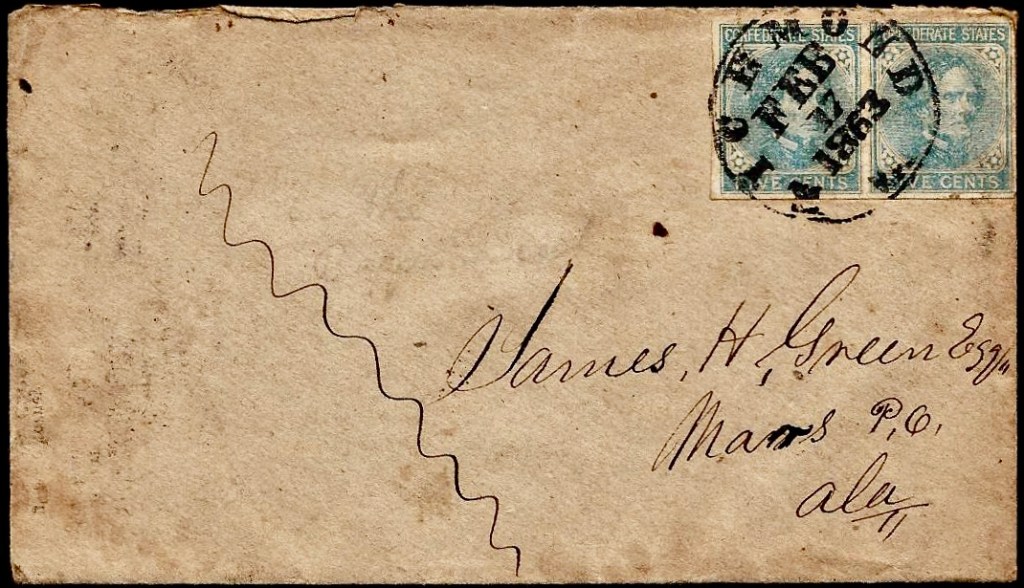
A letter William N. Green sent his uncle James Hamilton Green in Bibb County on 15 September 1863 provides interesting information about his military service (see digital images at the head of this posting). Digital copies of the letter and a transcript appear, with biographical information about William, on the Spared & Shared blog site, which shares Civil War letters.[19] Here’s the transcript of William’s letter published at this site:
Camp 44th Alabama Regt. near Fredericksburg, Va.
February 15th 1863
James H. Green, Esq.
Dear Uncle,
I embrace this opportunity of complying with the promise I made you before I left. This is a cold & wet day — so much so that I don’t think I will be called on to do anything else so I shall devote the day to writing letters to my friends. I don’t know that I have anything that will interest you back there as you all take the papers & are about as well posted as we are on the subject of the war. We are all quiet here at this time & likely to remain so until the weather gets better. By the way, my theme must change. While writing the above an order has come to cook up two (2) days rations to be ready to march at a moment’s warning. So you see, we don’t know one moment what we will do the next. I don’t know what this means. It may be only to go on picket and it may be that the yankeys are making a demonstration at some point & we have to go & meet them. I am in hopes though it is only the former as we have a great deal of picket duty to do now. Our picket lines are about fifteen miles long up and down the Rappahahannock river. Our posts are on one bank & the yankeys on the other about an hundred & fifty yards apart.
We have a “fighting Jo Hooker” to contend with now so there is no telling when we will have to fight as he will have to do something soon or be superseded as that is their rule, though the roads are so bad now I think it out of the question for him to do much at present.
When I commenced this, I intended to write you a long letter but I shall have to cut it short & prepare for marching. I will write you again soon when I have more time.
As you will see from the heading of this, I have changed my position. I am now in Co. F of this regiment — Capt. [Henley G.] Sneed’s company, acting as Second Lieut. I am now in command of the company as Capt. Sneed is at home & Lieut. Oakley is sick. You must write on the reception of this & give me all the news. Tell John to write if his arm will admit of it. I learned that he got wounded in Tennessee though I am in hopes it is getting well by this time. He seems to be unfortunate in getting wounded & fortunate too in its being no worse.
Give my kindest regards to all the family & receive the same to yourself from your nephew, — Wm. N. Green
The John to whom William N. Green’s letter refers is James Hamilton Green’s son John Randolph Green (1844-1924), who was in Co. F (“Tuscaloosa Rifles”) of the 50th Alabama Infantry. During the war he was wounded in both thighs and had his right arm broken. He was wounded in April 1862 at the battle of Shiloh, and was then severely wounded later that year on 31 December 1862 at the battle of Murfreesboro, Tennessee.
William N. Green had died by 28 March 1867 when his brother-in-law Jonathan Newton Smith appealed for administration of William’s estate in Bibb County.[20] I take this record to mean that William returned home after 31 December 1864, when he appears on a military roll in Virginia, and died in Bibb County, though I suppose it’s also possible he died in Virginia between the 1864 and 1867 date and his estate in Bibb County was then probated.
On 16 April 1867, Jonathan N. Smith returned to Bibb County court an appraisal bill for William’s personal estate and an order was given for the sale of the estate.[21] The court order states that the sale would take place at the house of Mrs. Elizabeth Green (William’s mother). On 20 July 1867, court minutes say that Jonathan N. Smith returned the sale bill to court.[22]
On 13 September 1869, Jonathan N. Smith filed an estate account declaring the estate insolvent and asking the court to decree its insolvency, with a hearing set for 14 October about that matter.[23] On 5 October 1869, the Shelby County, Alabama, paper Shelby Guide printed a notice publishing the order about this matter from Bibb County’s probate court.[24] On 13 October 1869, court met and Jonathan N. Smith presented an estate count to court with the court issuing an order for final settlement on 8 November.[25]
When court met on 8 November, the settlement was continued until the 13 December 1869 court session.[26] At the December court session, Jonathan N. Smith presented his account and the court ordered him to continue as administrator and continue settlement of the estate.[27] No date was set at this court session for Smith’s next accounting or final settlement, and since the minutes of this probate book are not indexed, without a date for the next estate action, I have not found further information about when and how the estate was settled or if the court declared it insolvent.
If William N. Green returned home to Alabama and died there not long after the war ended, it would seem that, like so many young men of that war, he came home with his health shattered, bearing physical and psychological scars from the war. And like so many young men both during the war and following it, he died young.
I have not found a burial record for William N. Green. I think he’s likely buried with his parents, whose burial places I have also not been able to find. William Nichols Green was named for his maternal grandfather William Nichols.
c. Frances Jane Green was born in 1830 in Bibb County. Her birth year is consistently suggested as 1830 in federal censuses from 1850 through 1880.
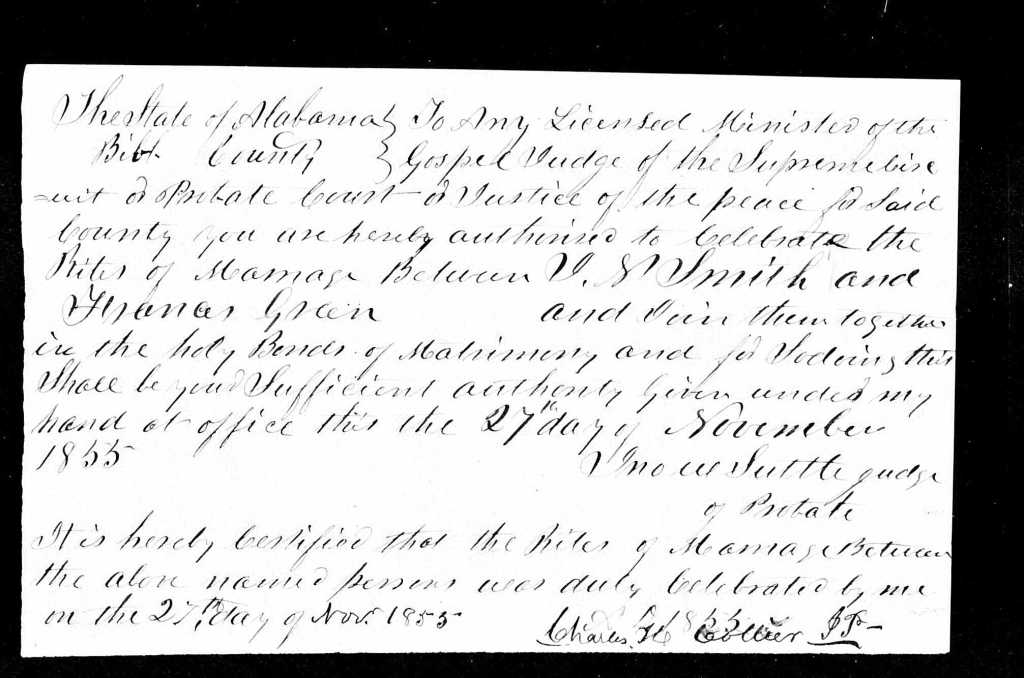
On 27 November 1855 in Bibb County, Jonathan Newton Smith received license to marry Frances Jane Green, and the couple were married the same day by Judge Charles H. Collier.[28] Jonathan, the son of Abington Phelps Smith and wife Mary Davis, was born 27 January 1814 at Sparta in Hancock County, Georgia, and died 23 January 1885 at Brierfield in Bibb County.[29] Prior to marrying Frances, Jonathan had married Mary C. Wood on 22 October 1839 and after her death, Julia Ann Matthews on 4 November 1844, both marriages having taken place in Bibb County.
The family of Jonathan and Fannie J. Green Smith appears on the 1860 federal census in Bibb County, which lists J.N. Smith as 46, a farmer born in Georgia, with $8,000 real worth and $30,000 personal worth.[30] Wife Fannie is 30 and born in Alabama. In the household are their daughter Mary, aged 3, Jonathan’s son by Julia Ann Matthews, John Davis Smith, along with Jonathan’s mother Mary and a Sarah, Newton, and Coleman Smith who appear to be relatives of Jonathan. Also in the household is an A.G. Davis who appears to be a relative of Jonathan’s mother. Coleman Smith appears in Jonathan’s household on the 1870 federal census discussed below, with his name given as Coleman Dennis.
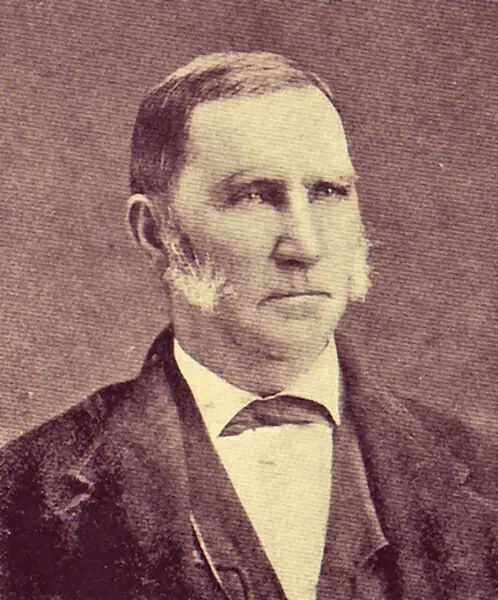

In 1861, Jonathan, who was a principal partner in the Little Cahaba Iron Works on the Little Cahaba River in Bibb County with William Phineas Browne and Alexander K. Shepard, developed a furnace on land he and Caswell Campbell Huckabee, a planter of Greensboro, Alabama, had purchased from Jesse Mahan near the Little Cahaba in Bibb County. This furnace came to be known as the Brierfield furnace.[31] In her book The Story of Coal and Iron in Alabama, Ethel Armes offers a biography of Jonathan written by his son-in-law Frank Fitch.[32] Frank Fitch states that Jonathan “became identified with” five forges, a furnace, and a nailery on the Little Cahaba and its tributaries. He also had a woolen mill, grist mill, and bloomery at Six Mile four miles from his 2,000-acre plantation on the Little Cahaba, on which he raised 2,000 bushels of wheat in a season for the flour mill at Six Mile.
According to Armes, Jonathan established three forges, at Adams Dam, on the Little Cahaba, and at Six Mile. Armes cites Jonathan’s daughter by Frances Jane Green, Mary Angeline Smith, who married Frank Fitch, and who related that when her father was hunting with Pleasant Fancher in the late 1820s and the two camped on Dailey’s Creek, they gathered stones from the creek to put under the logs of their fire. Jonathan woke in the middle of the night to find the stones on fire and realized they had discovered coal. The stream was later called Coal Branch.[33]
On 19 August 1863, an act of the Alabama legislature appointed Caswell Campbell Huckabee of Greene County, Alexander K. Shepard of Perry County, Thomas Gholson and Daniel Prentice of Shelby County, and Jonathan Newton Smith, Ezekiel Smith, and William L. Saunders of Bibb County as commissioners to incorporate the Ashby and Cahaba River Railroad Company.[34] Ezekiel Smith was Jonathan’s brother Ezekiel Carraway Smith.
Jonathan Newton Smith’s family appears on the 1870 federal census once again at Randolph in Bibb County.[35] Newton Smith is listed as a farmer, 56, born in Georgia, with $25,000 real worth and $5,000 personal worth. Wife Fannie is 40, born in Alabama. In the household are children Mollie, 13, Charleton, 3, and Ezekiel, 4 months, as well as Jonathan’s son by Julia Ann Matthews, John Davis Smith. Enumerated following Jonathan’s family are Caroline Smith, a Black woman aged 25 who is a domestic servant, Demos Smith, 60, also Black and born in South Carolina, Sam Smith, 20, and David Smith, 22, all farm hands. Note that Demos was one of the enslaved persons listed in the estate of Jonathan’s father-in-law Joscelin B. Green, who was given to Joscelin’s son William N. Green at the division of enslaved persons. These families are all enumerated in the same household with the family of Ira P. Taylor. On the same census page and the one preceding it men who are working at Jonathan’s Brierfield furnace are enumerated.
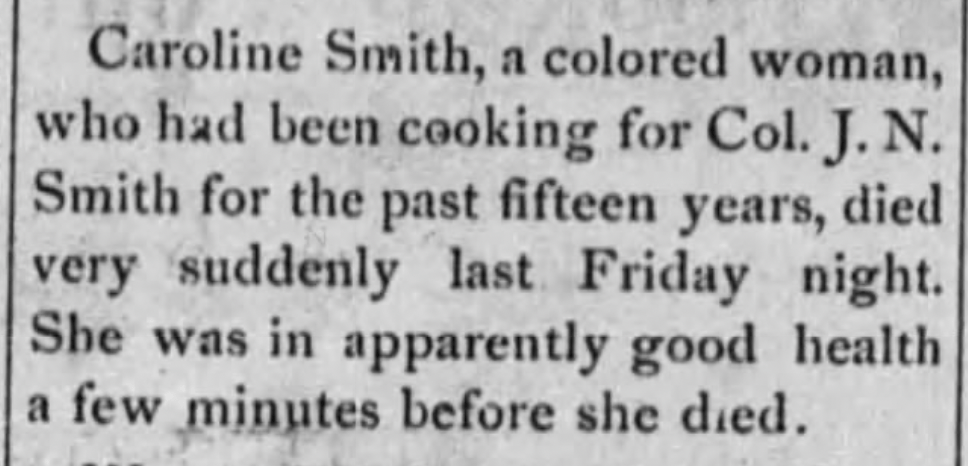
From a notice of her sudden death on 9 September 1881, Caroline had been a cook for Jonathan N. Smith’s family for fifteen years — and if that’s correct and her age on the 1870 federal census is correct, then she began this cooking work when she was only a child and immediately following Emancipation:
In 1874-5, Jonathan Newton Smith represented Bibb County in the Alabama legislature.[36] The previously cited biography of Jonathan by his son-in-law Frank Fitch states, “He represented Bibb County in the state legislature in the trying time of carpet-bag horror….”[37]
In 1880 the family of Jonathan Newton Smith appears on the federal census at Six Mile in Bibb County.[38] J.N. Smith is listed as a farmer aged 66, born in Alabama [sic] with a father born in South Carolina and a mother in Georgia. Wife Fannie is 50, born in Alabama with a father born in South Carolina and a mother in Tennessee. In the household are children Mollie, 20, Sallie, 19, Charleton G., 12, and Zeakle (Ezekiel) M., 9, all born in Alabama. Also living with the family is Fannie Green Smith’s mother Elizabeth Green, 69, born in Tennessee of South Carolina-born parents.

Frances Jane Green Smith died at the family’s home near Brierfield in Bibb County on 8 July 1881. The death date is recorded in Jonathan N. Smith’s family bible.[39] The Bibb Blade carried a death notice on 14 July 1881, stating that Mrs. Fannie Smith, consort of Col. J.N. Smith, had died near Brierfield on the 8th inst. of an attack of paralysis.[40] The death notice states that the paper hoped to print a more extended notice the following week, but I do not find further mention of the death or a more extensive obituary in the Blade.
I have not found a burial record for Fannie. If she is buried with Jonathan, she’s buried in what was previously called the Smith-Mahan cemetery at Brierfield, and is now called Community Baptist church cemetery. Jonathan’s Find a Grave memorial page states that his grave has no marker, and there appears to be none for Frances in that cemetery, either.[41]
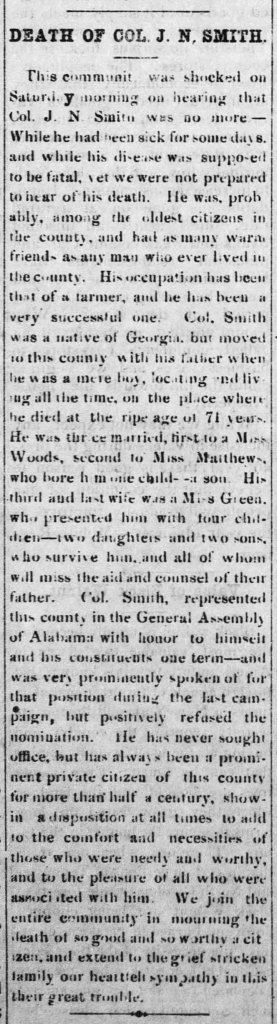
Jonathan Newton Smith followed wife Fannie in death on 23 January 1885. On 28 January (Wednesday), the Bibb Blade published an obituary stating that the preceding Saturday, the community had been shocked to learn of the death of Col. J.N. Smith (the day before), after a sickness of some days.[42] The obituary states that Jonathan was one of Bibb County’s oldest citizens, who had come to the county as a boy from Georgia with his father. It provides information about Jonathan’s three wives, and states that he had represented Bibb County in the Alabama legislature.
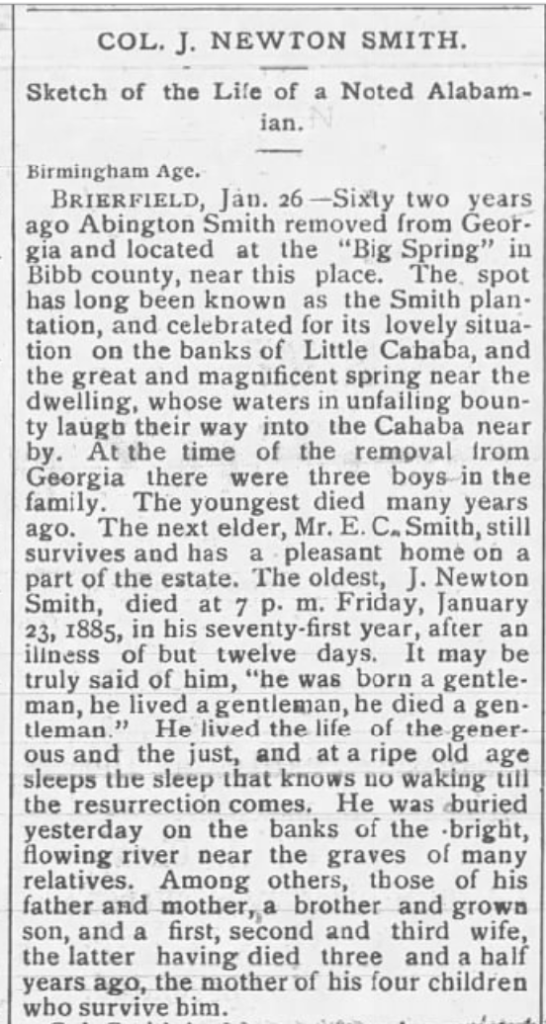


An obituary also appeared in the Selma Times on 1 February 1885.[43] This obituary, which appears to have been written by Jonathan’s son-in-law Frank Fitch (the initials F.F. are at the end), provides biographical details including that Jonathan’s father was Abington Smith, who came from Georgia to Big Spring near Brierfield, on the banks of the Little Cahaba in Bibb County, sixty-two years prior to Jonathan’s death.
Since Frances Jane Green’s mother was named Jane Kerr Green, I wonder if Frances was named for her two grandmothers. In that case, Elizabeth Nichols Green’s mother, wife of William Nichols, could perhaps have been named Frances.
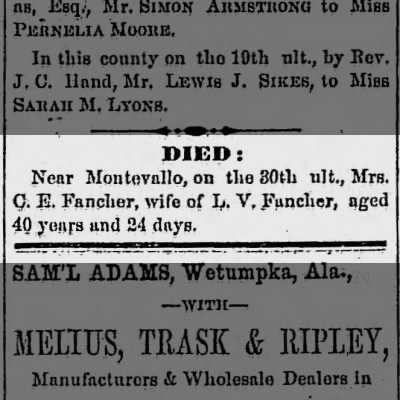
d. Eliza Candace Green was born 6 June 1832 in Bibb County, Alabama, if her death notice in the Shelby Guide newspaper of Columbiana, Alabama, on 9 July 1872 has accurate information about her age at time of death.[44] The death notice states that Mrs. C.E. Fancher had died the 30th ult. (i.e., 30 June 1872) near Montevallo, aged 40 years and 24 days. The 1850 federal census suggests a birthdate of 1833 for Candace. In 1860, she’s given a birth year of 1837 by the federal census. And in 1870, her birth year appears as 1835 on the federal census.
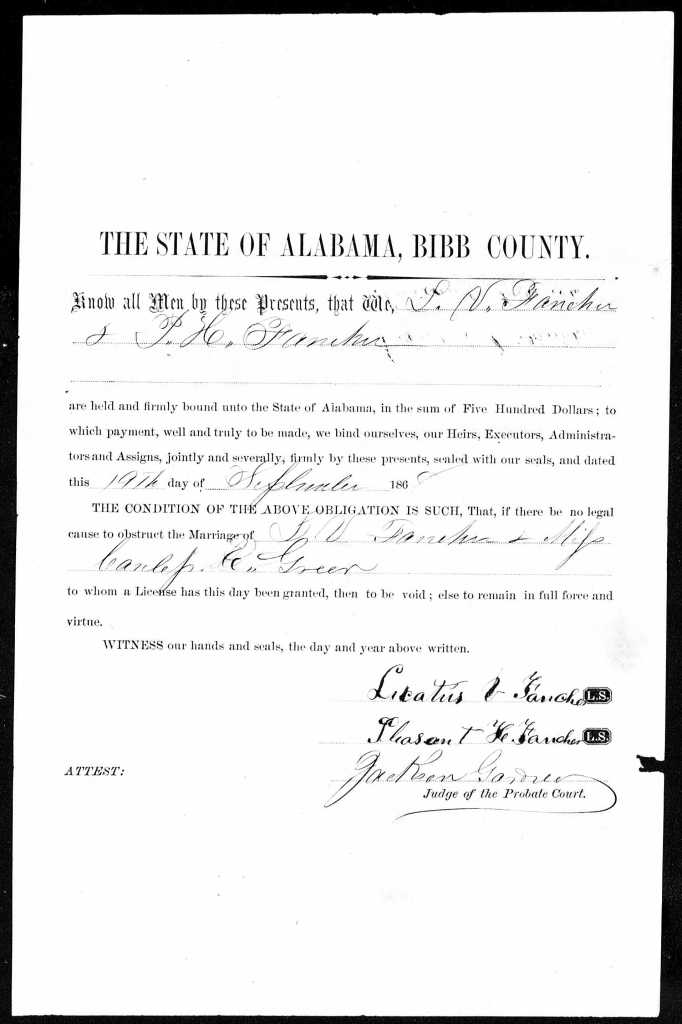
On 19 September 1868 in Bibb County, Licastus V. Fancher gave bond for $500 with Pleasant H. Fancher to marry Miss Candess [sic] E. Green. The couple received license for the marriage the same day and married the following day, with Reverend W.W. Moon.[45]
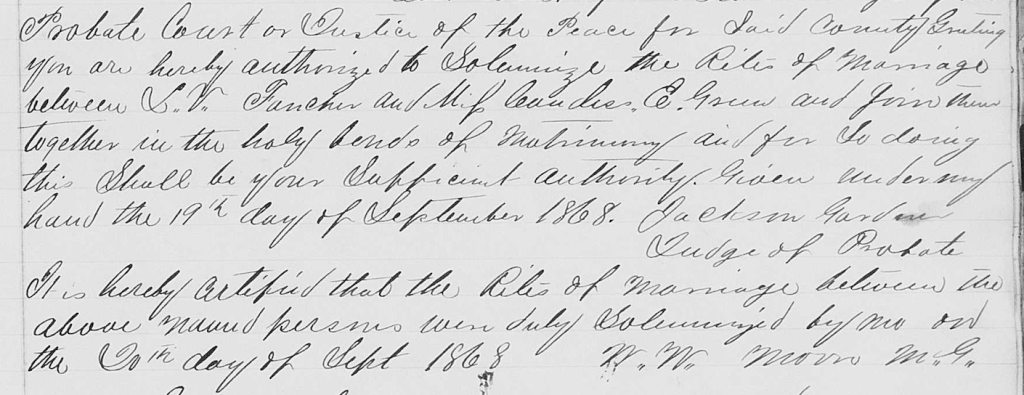
Licastus, who was the son of Noah Haggard Fancher and Triphena Matthews, was born 14 July 1841 in Shelby County, Alabama, and died 14 March 1876 at Oxmoor in Jefferson County.[46] During the Civil War, he was a CSA soldier who enlisted 4 June 1861 at Montevallo in Co. C of the 10th Alabama Infantry.[47]
In 1870, Licastus and wife Candace (spelled Candis here) are enumerated on the federal census at Montevallo in Shelby County.[48] Licastus Fancher is listed as a farmer aged 28, born in Alabama, with $1,500 real worth and $500 personal worth. Candis is 35 and was born in Alabama.
As stated above, according to a death notice in the Shelby Guide of Columbiana, Alabama, on 9 July 1872, Mrs. C.E. Fancher died on the 30th ult. near Montevallo, aged 40 years and 24 days.[49] I have not found a burial record for either Licastus or Candace.
[1] See Bibb County, Alabama, loose-papers marriage files and Marriage Records Bk. D, p. 350. On Edward Henry Bernhard, see the previous posting.
[2] 1850 federal census, Bibb County, Alabama, W.C. (West Cahaba) River, p.8B (dwelling/family 108, 30 September).
[3] [3] I don’t have proof positive that the Jane Stringfellow who was living with Thornton and Susan in 1850 and who is buried with Thornton in Centreville Memorial cemetery at Centreville, Bibb County, Alabama, is Thornton’s mother. If she’s not his mother, then she was his stepmother. Henry Stringfellow married Mary Brannin 30 January 1793 in Fauquier County, Virginia (see Richard Chichister, “Stringfellow of Culpeper, VA,” at Genealogy.com). If Mary lived until after 1802 when Thornton Stringfellow was born, then she was his mother. If she died prior to 1802 and Henry then remarried to Jane, Jane was Thornton Stringfellow’s mother.
[4] See Find a Grave memorial page of Thornton Stringfellow, Centreville Memorial cemetery, Centreville, Bibb County, Alabama, created by sherrien59, with a tombstone photo by Karin Rock.
[5] “Democratic Convention,” State of the Union [Tuscaloosa] (17 March 1841), p. 3, col. 2.
[6] Bibb County, Alabama, Orphans Court Minutes Bk. C, p. 116.
[7] This date is the date on which the couple received license for the marriage: see Bibb County, Alabama, Marriage Record Bk. E, p. 104. I have not found the marriage bond and return. According to Bobby Joe Seales, John Neely was an Irish-born Revolutionary soldier — see “Known Revolutionary Soldiers, Shelby County, Alabama,” at the Shelby County Genweb site.
[8] Weekly Advertiser [Shelby County, Alabama] (1 April 1857), p. 2, col. 6.
[9] Acts of the General Assembly of the State of Alabama (Montgomery: Cloud, 1858), p. 88, act 100.
[10] 1860 federal census, Shelby County, Alabama, Montevallo post office, p. 255 (dwelling/family 95, 7 June). The 1850 federal census shows Joseph living in Shelby County prior to his marriage to Susan M. Green Stringfellow (p. 172).
[11] NARA, Compiled Service Records of Confederate Soldiers Who Served in Organizations from the State of Alabama, 1861-1865, RG 109, available digitally at Fold3.
[12] 1870 federal census, Claiborne Parish, Louisiana, p. 187B (dwelling/family 158, 12 July).
[13] Shelby Guide [Columbiana, Alabama] (23 November 1871), p. 2, col. 1.
[14] Selma Morning Times (26 November 1871), p. 2, col. 4.
[15] 1880 federal mortality schedule, Claiborne Parish, Louisiana, p. 78.
[16] 1860 federal census, Bibb County, Alabama, E.C. (East of Cahaba) River, Six Mile, p. 729 (dwelling 564/family 555; 24 July),
[17] This enlistment date and the information that William gave his age as 32 is given in a muster roll of this unit dated 28 March 1862: see Alabama Archives’ Muster Rolls of Alabama Civil War Units, available digitally in Ancestry’s database Alabama, U.S., Civil War Muster Rolls, 1861-1865. For William’s service record, see NARA, Compiled Service Records of Confederate Soldiers Who Served in Organizations from the State of Alabama, 1861-1865, RG 109, available digitally at Fold3.
[18] On William N. Green as captain of Co. F, an all-Bibb unit, following Henley G. Sneed, see Rhoda Ellison, Bibb County, Alabama, The First Hundred Years 1818-1918 (Tuscaloosa: University of Alabama Press, 1984), p. 119; and William Calvin Oates, The War Between the Union and the Confederacy, and Its Lost Opportunities, with a History of the 15th Alabama Regiment and the Forty-eight Battles in which it was Engaged, etc. (New York: Neal, 1905) p. 784.
[19] Griff, “1863: WILLIAM N. GREEN TO JAMES H. GREEN,” at Spared & Shared blog. There is no indication of who owns the original letter; by googling, I can see that it was offered for sale online by a firm that seems to specialize in selling antique letters, so I assume that someone bought the letter from that firm and made it available on the Spared & Shared site.
[20] Bibb County, Alabama, Probate Minutes Bk. I, p. 403.
[21] Ibid., p. 412.
[22] Ibid., p. 451.
[23] Ibid., Bk. K, p. 18.
[24] Shelby Guide (5 October 1869), p. 3, col. 3.
[25] Bibb County, Alabama, Probate Minutes Bk. K, pp. 25-6.
[26] Ibid., p. 32.
[27] Ibid., p. 59.
[28] Bibb County, Alabama, Marriage Records Bk. E, p. 137.
[29] Jonathan’s dates and places of birth and death and father’s name are stated in his eulogy published in Selma Times:“Col. J. Newton Smith, Sketch of the Life of a Noted Alabamian,” Selma Times (1 February 1885), p. 3, col. 2. See also Find a Grave memorial page of Jonathan Newton Smith, Community Baptist Church cemetery, Brierfield, Bibb County, Alabama, created by Martin Everse. This source erroneously lists Jonathan’s parents as Uriah Smith and Tabitha Norwood. In addition, Jonathan N. Smith’s family bible lists the birth and death dates of Abington Phelps Smith and Mary Davis Smith. Carol Payne and Juanita Martinez found the bible in spring 2002 at an estate sale in Homewood, a suburb of Birmingham. They were not allowed to buy it but were permitted to photocopy its register, which they then transcribed and published in Alabama Genealogical Society Magazine: see Carol Payne and Juanita Martinez, “The J.N. Smith Bible,” Alabama Genealogical Society Magazine 34,2 (fall/winter 2002), pp. 54-6. The bible was published by Kimber and Sharpless of Philadelphia and does not have a publication date. In the bible, the dates of Jonathan N. Smith’s marriage to Miss Fannie J. Green and of her death are recorded. Jonathan was appointed administrator of Abington Smith’s estate by Bibb County court in December 1843: see Bibb County, Alabama, Orphans Court Minutes Bk. C, p. 179.
[30] 1860 federal census, Bibb County, Alabama, E.C. (East of Cahaba) River, Randolph post office, p. 763 (dwelling 790/family 780, 28 July).
[31] See “John Newton Smith,” Encyclopedia of Alabama,sponsored by the Alabama Humanities Alliance with Auburn University; “Brierfield Furnace,” at Wikipedia; Ethel Armes, The Story of Coal and Iron in Alabama (Birmingham: Chamber of Commerce, 1910), p. 169; and Ellison, Bibb County, Alabama, The First Hundred Years 1818-1918, pp. 100-1.
[32] Armes, The Story of Coal and Iron in Alabama, pp. 73-4. Note that Frank Fitch’s biography of his father-in-law Jonathan Newton Smith also states that Jonathan was the son of Abington Smith.
[33] Ibid.
[34] Acts of the General Assembly of the State of Alabama (Montgomery: Saffold & Figures, 1864), pp. 34-44, #37.
[35] 1870 federal census, Bibb County, Alabama, Randolph, Brierfield post office, p. 243B (dwelling/family 92, 24 June).
[36] Owen Thomas McAdory, History of Alabama and Dictionary of Alabama Biography, vol. 1 (Chicago: S.J. Clarke, 1921), p. 134.
[37] Armes, The Story of Coal and Iron in Alabama, p. 73.
[38] 1880 federal census, Bibb County, Alabama, beat 6, Six Mile, p. 304C (dwelling/family 93, 8 June).
[39] See supra, n. 29.
[40] “Here and There” Bibb Blade (14 July 1881), p. 3, col. 2.
[41] See supra, n. 29.
[42] “Death of Col. J.N. Smith,” Bibb Blade, (28 January 1885), p. 2, col. 2.
[43] See supra, n. 29.
[44] Shelby Guide [Columbiana, Alabama] (9 July 1872), p. 2, col. 6.
[45] Bibb County, Alabama, Marriage Records Bk. F, p. 51.
[46] Paul Buford Fancher, Richard Fancher (1700-1764) of Morris County, New Jersey: Richard Fancher’s Descendants 1764-1992 Fancher-Fansher-Fanchier-Fanshier (Atlanta, 1993), p. 129.
[47] NARA, Compiled Service Records of Confederate Soldiers Who Served in Organizations from the State of Alabama, 1861-1865, RG 109, available digitally at Fold3.
[48] 1870 federal census, Shelby County, Alabama, Montevallo post office, p. 405B (dwelling/family 161;29 June).
[49] See supra, n. 44.
 BEGATS AND BEQUEATHALS
3 thoughts on “Children of Joscelin B. Green (1800-1853) and Wife Elizabeth Nichols: Susan M., William Nichols, Frances Jane, and Eliza Candace Green”