Samuel also appears on the 1860 mortality schedule (and here) in Grimes County, Texas, which states that he died in that county in March 1860, aged 70, and was born in South Carolina. We can pinpoint Pendleton District as the place in South Carolina in which Samuel Kerr Green was born because the 1790 federal census shows his father John Green living in Pendleton District with a household comprised of a male aged 16+, a male aged under 16, a female, and 12 enslaved persons.[2]
Pendleton District, South Carolina, Beginnings
Samuel was the first-born of John Green and Jane Kerr’s children, so the configuration of this household in this 1790 South Carolina census entry fits John and Jane’s family and confirms that this is their household. As we’ll see when I post about John Green and Jane Kerr, they married about 1788, probably in the part of Ninety-Six District, South Carolina, that later became Abbeville County, where both were born and grew up, and records place their family in Pendleton District (later Anderson County) from 1790 to 1818, when they sold their land there and moved to Bibb County, Alabama. John Green and wife Jane settled in Pendleton District after they married so that John could manage the upcountry plantation, Keowee Heights, of Jane’s uncle John Ewing Colhoun, and I think it’s very likely that the twelve enslaved persons listed in John and Jane’s household on the 1790 census belonged to Jane’s uncle John Ewing Colhoun. John’s brother Benjamin Green was the tutor of John Ewing Colhoun’s children. The tombstone of John and Jane’s son Ezekiel Calhoun Green in Smithland cemetery, Livingston County, Kentucky, states that Ezekiel was born in Pendleton District, South Carolina, on 22 August 1795.[3]

On 16 September 1805, in Pendleton District, Samuel K. Green witnessed a deed of William Hays to Benjamin Armstrong Jr., with Samuel’s father John Green also witnessing this deed.[4] Both John and Samuel signed, Samuel signing as Saml. K. Green. The deed states that the 320 acres Hays was selling Armstrong was part of a grant of 838 acres to John Green surveyed on 1 January 1793. The tract lay on branches of Six Mile Creek of the Keowee River. John Green gave oath proving the deed on 7 March 1806, and it was recorded 28 March. After the January 1793 survey for the 838 acres on the east side of Keowee River for John Green, the grant was made to him on 6 May 1793.[5] I haven’t yet found a record showing when John sold 320 acres of his grant to William Hays.


On 16 February 1808, Samuel K. Green witnessed a deed by Joseph Eaton to Samuel’s father John Green, both of Pendleton District, of 175 acres on both sides of Six Mile Creek on the waters of the Keowee.[6] The land had been surveyed for James Beaty on 4 December 1787, and bordered land surveyed for Robert Anderson and Robert Beaty. Archibald McCoy witnessed the deed along with Samuel K. Green, who signed again as Saml. K. and who proved the deed on 28 April 1808, signing now as S.K. Green, with the deed recorded the same day.
Samuel Heads to Nashville, Tennessee, by 1816
As I note above, in 1818, Samuel K. Green’s parents sold their home plantation of 1,345 acres on the east side of the Keowee River in Pendleton District and moved to Bibb County, Alabama.[7] I’ll discuss this land sale and the move to Alabama in more detail when I post about John Green and Jane Kerr. For now, I’d like to note that it appears that at some point before this move took place, Samuel K. Green and his brother Ezekiel Calhoun Green left Pendleton District for Tennessee (in Samuel’s case) and Kentucky (in Ezekiel’s case). By 5 November 1816, Samuel had formed a business partnership in Nashville with John Young. On that date, a notice began appearing in the National Banner and Nashville Whig newspaper that the firm of Young & Green had flat boats or keel boats prepared to ship goods to New Orleans (via the Cumberland and Mississippi Rivers).[8] (See the digital image at the head of the posting.)
I’m fairly confident that Samuel K. Green is a “K. Green” who signed a petition of citizens of Nashville on 8 December 1817 for the establishment of a branch bank at Nashville.[9] The petition notes that the resources of the area and its intimate connections with New Orleans, New York, and Philadelphia demanded the establishment of a bank, since planters around Nashville shipping goods to Nashville from New Orleans had to use banks on the east coast — an inconvenience for them. Other signatories of this petition included John Young, Samuel K. Green’s business partner, and R. (Robert) and J. (Joseph) Woods and Stephen Cantrell, all of whom appear in subsequent documents relating to the business of Young and Green. Stephen Cantrell was president of the Nashville bank in 1818.

The Young-Green firm begins to appear with the name Young, Green & Co. in notices in the National Banner and Nashville Whig on 21 March 1818.[10] A recurring notice about the firm that began to be printed on that date was drawn up on 28 February 1818. It states that Young, Green & Co. would not be responsible for damage to goods the company freighted unless it could be ascertained that the damage occurred on their boats and not en route to Nashville. The notice is undersigned by J. & R. Woods and Stephen Cantrell & Co. This notice continued to appear in this newspaper through much of April 1818.

On 14 November 1818, National Banner and Nashville Whig began running an ad by J.K. Kane in which he states that he had an office in a room attached to the warehouse of Messrs. Young, Green & Co. on Water Street about halfway between the middle and lower ferries in Nashville.[11] Kane was offering his services as a scrivener to do “writing of any description” and to draw up deeds, bonds, conveyances, etc.
As John Wooldridge’s History of Nashville (1890) notes, a 24 April 1796 act to amend the original 1784 charter establishing Nashville called for the settlement’s trustees to “lay off a Water Street” along the Cumberland River from the upper boundary line of the town to its lower end.[12] Unless I’m mistaken, what was Water Street in early Nashville is now 1st Avenue North, the street running along and closest to the Cumberland River in downtown Nashville. According to Wooldridge, the lower ferry was near but outside the Nashville settlement, which I take to mean down the Cumberland River from Nashville.[13] In a letter she sent on 18 December 1817 to her friend Matthew Dunbar from Nashville, Anne Royall speaks of the middle ferry, noting that it traversed the Cumberland from its east side directly to the settlement of Nashville.[14] The information in the ad placed by J.K. Kane suggests to me that the warehouse of Young, Green & Co. was likely within the community of Nashville, but perhaps toward the outer limits of the settlement in the direction of the lower ferry.
Anita Shafer Goodstein on “Young Men on the Make” in Early Nashville
As Anita Shafer Goodstein notes in her history of early Nashville, after Nashville’s foundation by land-speculating pioneers, the new settlement began drawing merchants, bankers, and lawyers in the period after 1812.[15] Goodstein calls this group of early settlers “specialized merchant migrants” or “young men on the make” who sought to exploit the new opportunities opened by the new settlement on a new urban frontier to make wealth.[16] As Goodstein notes, the 1820 federal census shows Nashville’s population to be predominantly young, male, and transient.[17] By 1830, something like 70% of the names of heads of households of Nashville in 1820 had moved on.
Goodstein also notes that one of the businesses drawing the young men on the make to Nashville in the early period was transporting crops downriver to New Orleans and bringing goods like cigars, sugar, rum, molasses, coffee, and other items imported from Europe upriver from New Orleans.[18] This trade created connections between Nashville, Pittsburgh, Philadelphia, Baltimore, and New Orleans, and drew lawyers, doctors, land speculators, and planters.[19] In addition to New Orleans, goods were also brought from Europe to Nashville via the three east coast cities I’ve just named.
Merchants involved in this business operated through a complex system of partnerships that pooled capital and provided managers. Capital was needed to buy crops to sell downriver, or to extend credit to farmers who would then turn over their cotton or tobacco for trade, and to pay shipping costs to New Orleans.[20]
According to Goodstein, between 1800-1825, there were over a hundred individuals and firms entering the cotton and tobacco trade in Nashville, many of them frontiersmen, pioneers in the keel boat trade, and former military men — almost all young when they began their careers in Nashville.[21] Goodstein studies 28 of these young merchants who are on both the 1811 Nashville militia rolls and the 1820 federal census.[22]
Various documents over a span of several years reference an April 1818 case in Davidson County chancery court, filed by Nelson Patterson et al. vs. Samuel K. Green et al., about which I have been unable to find much information. The date of the case and the fact that it was heard in April 1818 in Davidson County chancery court appear in a report of a Tennessee Supreme Court case, Waters et al. vs. Carroll, Gov. in March 1836.[23] The Waters case cites an April 1818 ruling of Davidson’s chancery court in the Patterson vs. Green case. As well as I can determine from the reference to the Davidson chancery court case that appears in the report of the Supreme Court’s Waters vs. Carroll case, Nelson Patterson had apparently sued Samuel K. Green for debt, and the county’s chancery court then ruled that, as clerk of court, Eli Talbot was to act as receiver for funds in the hands of Nathan Ewing.
I do not find chancery court minutes or case files for Davidson County at the FamilySearch site going back to the year 1818. In Davidson County circuit court minutes, I find a record from the court session of 25 May 1820 noting that a deed of trust from Samuel K. Green, James Snodgrass, and Isaiah Scott to Nathan Ewing for four lots (#11, 12, 19, 20) in Nashville had been presented in court by oath of Hickman Lewis and Ben F. West, witnesses.[24] I do not find this deed of trust indexed in Davidson County deed records under Samuel K. Green’s name. I’ll say something further about this document later in this posting.
Another reference to the Patterson vs. Green case appears in a notice in the National Banner and Nashville Whig on 24 October 1821, which indicates that the case of Nelson Patterson et al. vs. Samuel K. Green et al., the plaintiffs had appeared in the Supreme Court of Errors and Appeals from the Fourth Judicial Circuit of Nashville in September 1821, but Samuel K. Green’s co-defendants John Maneese and Alfred Woodyard had not appeared in court and were no longer residents of Tennessee.[25] Maneese and Woodyard had been subpoenaed for a hearing in January 1822.
Notes on Samuel’s Business Partner John Young
Some information about Samuel K. Green’s business partner John Young: his tombstone in House cemetery at Puryear in Henry County, Tennessee, states that he was born 22 February 1797 and died 3 October 1876.[26] Young was in Nashville by 14 May 1813 when he sold part of lot #9 between Market and Water Streets to David Moore, with the deed stating that both lived in Nashville.[27] John Young signed the deed with witnesses Stephen Cantrell Jr., Joseph Woods, and George Bell. Cantrell and Woods proved the deed in July 1813 court, and it was recorded 22 August. Note that Cantrell and Woods signed the 8 December 1817 petition discussed above to establish a bank at Nashville, with “K. Green” also signing. As noted above, Stephen Cantrell was president of the Nashville bank in 1818.

On 25 July 1814, John Young sold David Moore 14 more inches on the north side of Market Street adjoining lot #9.[28] Young signed with Foster Sayre and John Sommervell (Sommerville is the spelling elsewhere) as witnesses. Young proved the deed at July court and it was recorded 14 August.
On 16 October 1817 in Nashville, John Young married Caroline Sommerville, daughter of John Sommerville, with Mr. Blackburn presiding. A notice of the marriage is in National Banner and Nashville Whig on Monday, 20 October 1817, stating that the marriage had taken place the preceding Thursday.[29] In her Old Days in Nashville, Jane Henry Thomas appears to think that Caroline Sommerville’s father’s name was Thomas rather than John.[30] Jane H. Thomas notes that Caroline’s father was the president of First United States Bank, founded on Market Street in Nashville in 1814. An 1812 tax list for Nashville shows John Young and John Sommerville taxed on the same page.
Young, Green & Co. Acquire Co-Ownership of the General Jackson
By 2 February 1819, Samuel K. Green and John Young were co-owners of the steamboat General Jackson along with C.H.P. Marr of Clarksville, Tennessee. This information appears in a registration record for the General Jackson at the port of New Orleans on that date, which states that the ship’s master was Joseph Smith.[31]
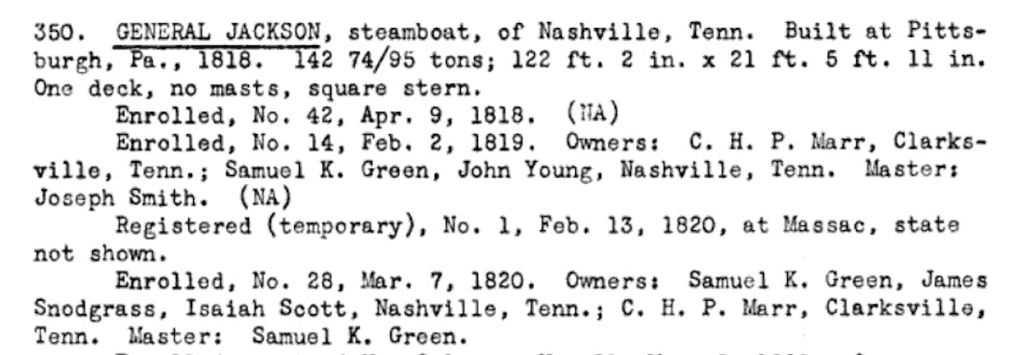
Another registration of the General Jackson at the port of New Orleans on 7 March 1820 again lists Samuel K. Green as a co-owner of the boat, along with James Snodgrass, and Isaiah Scott of Nashville and C.H.P. Marr of Clarksville.[32] Samuel K. Green is now the boat’s master, and he continues to appear as the boat’s master in New Orleans registration entries on 9 March and 28 April 1820.[33]
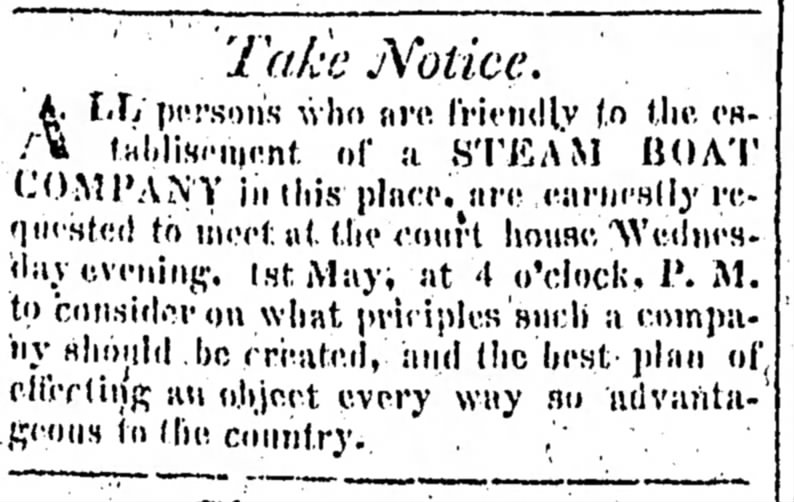
The interest of Nashville merchants in bringing a steamboat to Nashville in the years prior to these New Orleans listings is apparent in a notice published in the National Banner and Nashville Whig on 30 April 1816.[34] The notice calls on “all persons who are friendly to the establishment of a steam boat company” in Nashville to attend a meeting at the courthouse on 1 May at which the creation of such a company would be discussed.
John Wooldridge and Byrd Douglas report that at the meeting held on 1 May, Thomas Claiborne was made chair of the planning committee with Alfred Balch secretary, and a committee was established to plan the bringing of a steamboat to Nashville.[35] Its members were Jenkins Whiteside, Wilkins Tannehill, General William Carroll, Major Christopher Stump, and Captain Alpha Kingsley. Douglas notes that the primary interest of those engaged in this venture was to secure a steamboat to facilitate Nashville’s trade with New Orleans.
Historical Notes on Nashville’s First Steamboat, the General Jackson
Up to this point, as Wooldridge points out, there had been a barge with the name General Jackson carrying goods between Nashville and New Orleans.[36] On 23 May 1815, the National Banner and Nashville Whig carried an ad by Richard Rapier & Co. announcing the arrival of the General Jackson (i.e., the barge with this name) from New Orleans, with a cargo of brown sugar, rum, rice, and fresh acid.[37] On 18 April, the National Banner and Nashville Whig had carried an ad by S. Cantrell & Co. dated 4 April stating that it had just received from New Orleans sugar, rum, sweet oranges, and indigo. Wooldridge points out that in 1816, the company of Young and Green had several large keel boats suitable for trade with New Orleans, which they offered for sale or to freight on accommodating terms.[38]

On 28 March 1818, the National Banner and Nashville Whig carried a notice that the steamboat General Jackson had arrived in Nashville.[39] The notice states that the boat was owned by General Carroll and Mr. Whiting of Nashville, and that the Kentucky Herald of Louisville had announced on the 13th that the General Jackson had arrived there from Pittsburgh bound for New Orleans, with flour and whiskey and passengers.[40] The Herald notes that the General Jackson was to engage in regular trade between Nashville and New Orleans. Captain Hopkins was piloting the boat as it left Louisville for Nashville.

Byrd Douglas gleans the following historical outline of the General Jackson from early references to it.[41] He notes that the General Jackson was built at Pittsburgh, with its keel being laid in the summer or early fall of 1817. She cost $16,000 and was 150 tons burthen. The General Jackson was the 22nd boat to ply the Mississippi. In 1819, she made four trips between New Orleans and the mouth of the Cumberland. Her agents in Nashville were Young, Green & Co. in 1819-20, and Thomas Yeatman in 1820-1. Shortly after her second arrival in Nashville, the Carroll & Whiting firm sold her to Fletcher, Marr, & Young, Green for $33,000.
Douglas states that Zadok Cramer, author of Pittsburgh’s Navigator and Almanac, wrote in 1814 that Nashville’s businesses included William Carroll & Co., with Mr. Cowan of Pittsburgh, as an associate.[42] The joint business had a nail manufactory and an extensive ironmongery store. Douglas notes that Nashville was then operating “a line of barges constantly running from Nashville to New Orleans, loaded down with the rich products of Tennessee, and up with sugar, coffee, rice, hides, liquors, dry goods, etc. …[43] A Mr. Spriggs was coordinator of much of this trade.
William Carroll came to Nashville from Pittsburgh in 1810, establishing a nail factory on Cedar Street where it entered the public square. Prior to that time, nails had to be imported from Pittsburgh. His business partner Cowan also had a general store. As Douglas indicates, Carroll was Andrew Jackson’s second-in-command in New Orleans. Among those collaborating with Carroll to bring the first steamboat to Nashville (see above), Jenkins Whiteside was a financier and banker, Wilkins Tannehill was mayor in 1825-6, and Christopher Stump and Alpha Kingsley were already involved in the barge and keel boat trade. Kingsley had a business with coffee, sugar, and salt by 1818, and Stump was a leather and hardware merchant.[44] A 7 September 1814 Davidson County deed shows Samuel K. Green’s business partner John Young selling Alpha Kingsley part of lot #9 in Nashville, with E.S. Hall and Wilkins Tannehill as witnesses.[45]

Douglas notes that after arriving in Nashville in March 1818, as stated above, the General Jackson arrived in New Orleans on 1 April 1818.[46] The General Jackson then evidently returned to Tennessee, picked up more goods to market in New Orleans, and returned to New Orleans on or just before 23 July 1818, since the Louisiana State Gazette reported (p. 2, col. 4) on that date that the General Jackson had just arrived from New Orleans, having left the mouth of the Cumberland on the 15th. The Gazette‘s report lists eight boats the General Jackson had passed on its way downriver, giving “full chase” to one of them, the Vesuvius.
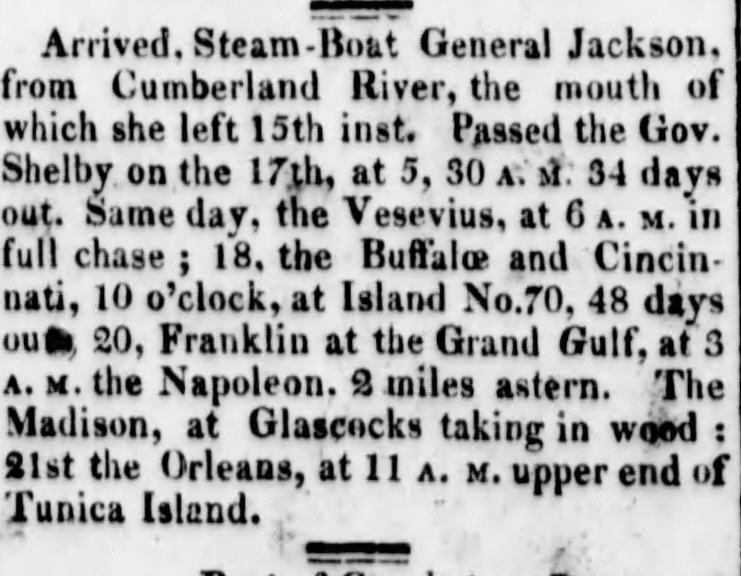
The first certain documentation of a return trip of the General Jackson from New Orleans to Nashville appears in a notice in the National Banner and Nashville Whig on 13 March 1819.[47] The notice states that with Captain Smith as its pilot, the General Jackson had arrived in Nashville from New Orleans on the 11th, having run from New Orleans to Harpeth Island in 21 days and 6 hours. Due to low water, she remained at Harpeth for several days until the water rose, then came to Nashville and was unloaded. The National Intelligencer of Washington, D.C., picked up this news on 8 April 1819.

The General Jackson then turned around and headed back to New Orleans on 14 March 1819, according to a notice in The Tennessee and State Gazette on 16 March, which says that the General Jackson had left Nashville on the 16th “loaded with tobacco, etc.” (p. 3, col. 4). An article in the National Banner and Nashville Whig on 1 May 1819 announces that, with Captain Young piloting, the General Jackson had left New Orleans on 5 April and arrived at the mouth of the Cumberland on the 20th, a 15-day trip that was believed to be “the quickest passage ever made by any boat. This report ends with the following ominous observations — ominous in light of the sinking of the General Jackson at Harpeth Shoals on 30 May 1821.[48]
This fine boat has given us but one visit since she has been in action; and it is not because she is displeased with Nashville; but it is because we have done nothing to remove the small obstructions in the navigation of our rivers. It is hoped the next legislature of Tennessee, will make a law, with provisions and requisitions, permitting Steam Boats to pass to Nashville, at all seasons of the year.
An ad placed by the firm of A. & G. McNeill of Nashville on 23 June 1819 in the Nashville Gazette provides a snapshot of the kinds of goods the General Jackson was bringing to Nashville — the ad states that the McNeill firm had just received a long list of goods from New Orleans via the steam boat General Jackson:

The Captain Young piloting the General Jackson back from New Orleans to Tennessee in April 1819 was, of course, Samuel K. Green’s business partner John Young. Fletcher, Marr, Young, and Green’s acquisition of the General Jackson took place sometime before 2 February 1819 when the registration of the General Jackson at the port of New Orleans lists Samuel K. Green and John Young as co-owners of the boat along with C.H.P. Marr of Clarksville, Tennessee, as noted previously.
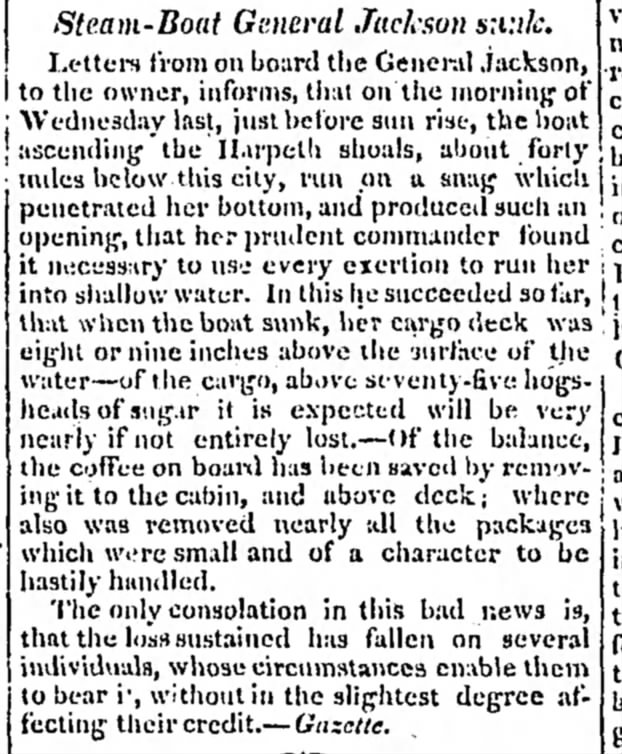
And then the General Jackson sank at Harpeth Shoals. The 6 June 1821 edition of the National Banner and Nashville Whig reports that a week earlier (31 May), just before sunrise, the boat had run onto a snag while ascending Harpeth Shoals about 40 miles from Nashville, and had sunk.[49] Most of the coffee the boat was carrying was saved, while most of the cargo of sugar was lost. The report notes that this loss fell heavily on several individuals whose credit remained sound. Whether those individuals included Samuel K. Green is not clear to me: as stated previously, Byrd Douglas appears to think that by or in 1820, Young and Green had sold the boat to Thomas Yeatman.

On 21 August 1821, the National Banner and Nashville Whig announced that on 12 September next at the courthouse in Nashville, the General Jackson would be sold at auction.[50] I find no information about this sale in later issues of this newspaper or other Nashville newspapers of the period.
Connections Between John Young and William Carroll, General Jackson‘s First Owner
Davidson County, Tennessee, deed records document connections between Samuel K. Green’s business partner John Young and William Carroll, the original owner of the General Jackson in conjunction with R. Whiting. When John Young sold lots on Water Street in Nashville to Robert Weakley on 16 August 1815, William Carroll was one of the witnesses to the transaction.[51] The following day, John Young sold John Brahon of Madison County, Mississippi Territory, part of lot #9 on Market Street, with William Carroll again signing.[52] On the same day, Young sold William Carroll another part of lot #9 and part of lot #10.[53]
On the third Monday in October 1817, John Young appears in Davidson County court minutes about the case of John Young vs. John M. Armstrong.[54] The case had to do with a debt Armstrong owed Young. A keel boat belonging to Armstrong on the Cumberland River at Nichols’ ferry had been attached, with William Carroll as garnishee, and Young had sold the boat to Armstrong and had not gotten payment. The court rewarded judgment to Young.
Carroll and Young are mentioned again in the case of James Armstrong vs. John M. Armstrong in court minutes on the third Monday in January 1819.[55] This had to do with a dispute about reimbursement for a barge full of goods that John M. Armstrong had brought from New Orleans to Nashville in 1816. Carroll was once again garnishee for a debt to John M. Armstrong for the balance due on goods on the barge that were consigned to Carroll.
James Snodgrass and Isaiah Scott of the Young, Green & Co. Firm
As was noted above, when the General Jackson was registered at the port of New Orleans on 7 March 1820, Samuel K. Green was listed as a co-owner of the boat along with James Snodgrass and Isaiah Scott of Nashville and C.H.P. Marr of Clarksville, Tennessee. Davidson County records document the interaction of Samuel K. Green and John Young with Snodgrass and Scott.
On the third Monday in July 1819, Samuel K. Green appears in Davidson County court minutes regarding the case of Young & Green vs. Thomas P. Hinson.[56] The case involved a claim of debt made by John Young, Samuel K. Green, James Snodgrass, and Isaiah Scott against Hinson for $1,400 plus $500 in damages, with Hinson having signed a promissory note on 15 December 1818 and not having paid his debt. Court minutes indicate that Snodgrass and Scott were members of the firm of Young, Green. Hinson did not appear in court and the court found in favor of the plaintiffs.
As I noted previously, Davidson County circuit court minutes state that on 25 May 1820, a deed of trust from Samuel K. Green, James Snodgrass, and Isaiah Scott to Nathan Ewing for four lots (#11, 12, 19, 20) in Nashville had been presented in court. On 17 January 1821, Ewing placed a notice in the National Banner and Nashville Whig stating that on 29 January 1820, Samuel K. Green, James Snodgrass, and Isaiah Scott, who were indebted to Joseph and Robert Woods in the sum of $5,325, had given a note for this amount to the Woods men, payable in the various Banks of Nashville in the name of Young, Green & Co., and had made a deed of trust for the four lots listed above.[57] On 20 February, Nathan Ewing was going to auction the lots in question to satisfy Young, Green’s debt to Joseph and Robert Woods.

By the time the preceding events were taking place in 1820 and 1821, Isaiah Scott had died. A notice in the National Banner and Nashville Whig on 24 May 1820 states that Captain Isaiah Scott of the firm of Young, Green & Co. had drowned from the steamboat General Jackson.[58] The notice does not specify where Scott drowned.
Other References to Samuel in Nashville Records, 1818-1822
In the period 1818-1822, I find a number of references to Samuel K. Green in Nashville records involving ventures other than the purchase and piloting of the General Jackson. In 1818, for instance, he appears in a list of Davidson County, Tennessee, subscribers to Nicholson’s British Encyclopedia published in the 12th edition of that work (The British Encyclopedia, Or, Dictionary of Arts and Sciences. Comprising an Accurate and Popular View of the Present Improved State of Human Knowledge, vol. 12 [London: Mitchell, Ames, and White 1818)], unpaginated). And he is mentioned as a debtor to the estate of James Hamilton of Davidson County in Hamilton’s 23 August 1819 inventory.[59]
On 28 June 1820, the firm of Young, Green & Co. appears in a record involving a deed of trust made by Gideon Gary Jr.[60] The deed record notes that Gary had executed two notes to Jenkins Whiteside and Alfred Balch with Young, Green & Co. as endorsers. One of these notes had come due 1 January 1820, and had fallen into the hands of William Quarles, who was calling it in.
Samuel K. Green is enumerated (as Saml. K. Green) on the 1820 census in Davidson County.[61] The census shows him living alone in Nashville, aged 26-45. William Carroll is listed on the same census page, and listed near Samuel K. Green are two men noted in Tennessee history — Felix Grundy and John Shelby. Both served in the state legislature, and Grundy was a friend of Samuel K. Green’s cousin John C. Calhoun. It’s worth noting, too, as I comment on this 1820 federal census entry, At some point in the 1820s, Samuel’s brother Ezekiel Calhoun Green, who had moved west with Samuel, as stated previously and had settled by February 1820 in Livingston County, Kentucky, seems to have spent time in Middle Tennessee, since Ezekiel married Jane Lynch on 7 November 1824 in Wilson County, a county contiguous to Davidson.
The 6 June 1822 inventory of the estate of Alexander Ewing of Davidson County includes a note of T.H. Fletcher that had been endorsed by G.G. Washington and Young, Green & Co.[62] And on 13 June 1822, Samuel K. Green appears in an inventory of the estate of Jesse Smith of Davidson County, owing a note to the estate.[63] This is the last record I find of Samuel in Davidson County. It does not, of course, necessarily indicate that he was still living in Tennessee at the time this estate inventory was made. I’m inclined, in fact, to think that Samuel had left Nashville for New Orleans by this point.
It appears that in the same time frame in which Samuel K. Green left Nashville for New Orleans following the sinking of the General Jackson, John Young also moved away. By 1825, had gone to Paris, Tennessee. On an unspecified day in March 1825, he sold to Philip Hoover and James Thomas of Davidson County part of lot #9 in Nashville, the deed stating that John was living in Paris in Henry County.[64] A 25 March 1826 deed from John Young to the Nashville Bank for land on the east side of Nashville’s public square also states that John was living in Paris in Henry County at this point.[65] The deed was to satisfy a debt to the bank, and John Young’s father-in-law John Sommerville acted as his agent in this sale. As stated previously, John Young is buried in Henry County, where he died 3 October 1876.
Notes about Joseph Smith, One of the Pilots of the General Jackson
A few notes about Joseph Smith, who appears as the captain of the General Jackson when it was registered in New Orleans on 2 February 1819, with the registration record stating, as noted above, that Samuel K. Green and John Young were co-owners of the steamboat along with C.H.P. Marr of Clarksville, Tennessee:
Captain Joseph Smith’s tombstone in Nashville City cemetery states that he was born in 1787 and died 28 Feb. 1837.[66] On 31 August 1820 in Nashville, Joseph Smith married Elizabeth Eakins.[67] Jane Henry Thomas states that Elizabeth’s father, “Mr. Aken,” was a hatter who lived between Mrs. Hays’ tavern and the Nashville town square and had a tavern called the Boatman’s Tavern.[68] Elizabeth’s father was John Eakins per various other sources. Thomas notes that Mr. Aken’s daughter Elizabeth married Mr. Smith, a steamboat captain. This Eakins/Aikens family seems to descend from a John Eakins who was born in Ireland in 1761 and died in Tennessee in 1825. His wife was Jane Rodgers, and he and his sons established a wholesale store in Nashville at “Eakins’ Corner” on the southeast corner of the public square. John’s son William married Felicia, a daughter of Felix Grundy.
W.W. Clayton’s history of Davidson County indicates that a man by the name of Joseph Smith was assessed for taxes in district 3 of the county in 1816.[69] The 1820 federal census shows the Joseph Smith family living in Nashville.[70]
Whether Joseph Smith, one of the pilots of the General Jackson when Samuel K. Green co-owned it, had any connection at all to the woman Samuel would marry or begin a marital arrangement with after he moved to Louisiana in 1821-2 — Eliza Jane Smith — I have been unable to ascertain. I’ve researched Joseph on the chance that there is some kind of connection, though the surname Smith is admittedly very common.
Samuel Leaves Nashville for South Louisiana, 1821-2
And then the trail of records for Samuel K. Green ends in Nashville, after he made his way to south Louisiana and started a new life there as an overseer on sugarcane plantations south of New Orleans in Plaquemines Parish in 1822. If he still had a financial interest in the General Jackson when it sank at the end of May 1821, he might well have been ruined financially by that happening, and this would explain his starting anew in a new place.
Otherwise, as we’ve seen, Anita Shafer Goodstein finds that a large majority of the young men on the make who came to Nashville after 1812 to seek their fortunes left there between 1820 and 1830, and Samuel may have been among their number. The completeness and suddenness with which he vanishes from any records I’ve found in Nashville after 1822 suggests to me he may have left there with debts unpaid and have chosen south Louisiana as his new residence because it was many miles from Nashville. New Orleans would also have been a place he had come to know from his trips there in connection to the General Jackson, and it’s likely he would have developed ties with businessmen and planters in south Louisiana through his years of participating in the Nashville-New Orleans trade. I’ll resume Samuel’s life story in south Louisiana (much of which I’ve already told in previous postings) in the next part of this chronicle.
[1] 1850 federal census, Pointe Coupee Parish, Louisiana, p. 37 (dwelling and family 644, 5 September).
[2] 1790 federal census, Pendleton District, South Carolina, p. 6.
[3] See Find a Grave memorial page for Ezekiel Calhoun Green, Smithland cemetery, Smithland, Livingston County, Kentucky, created by Charles Lay, maintained by wdlindsy, with a tombstone photo by wanda.
[4] Pendleton District (now Anderson County), South Carolina, Conveyance Bk. H, pp. 342-3.
[5] South Carolina Plat Bk. 29A, #279; and South Carolina Land Grants Bk. 32, p. 243.
[6] Pendleton District, South Carolina, Conveyance Bk. I, p. 202.
[7] Ibid., Conveyance Bk. O, pp. 136-7.
[8] “For Sale or Freight to New Orleans,” National Banner and Nashville Whig (5 November 1816), p. 3, col. 3. The notice subsequently appeared in the same newspaper on 5, 19, and 26 November 1816. John Wooldridge mentions these ads placed by Young & Green in the Nashville paper in the fall of 1816 in his History of Nashville, Tenn., etc. (Nashville: H.W. Crew, 1890), p. 304.
[9] Public Documents Printed by Order of the Senate of the United States, Second Session of the Twenty-Third Congress, vol. 2 (Washington, D.C.: Duff Green, 1834), p. 229.
[10] “Young, Green & Co.,” National Banner and Nashville Whig (21 March 1818), p. 4, col. 5.
[11] “Scrivener’s Office,” National Banner and Nashville Whig (14 November 1818), p. 4, col. 1.
[12] Wooldridge, History of Nashville, p. 302; see also John Lellyett, comp., Ordinances of the City of Nashville of a Public Nature in Force August 1st, 1872, etc. (Nashville: Roberts and Purvis, 1872), p. 3.
[13] Wooldridge, History of Nashville, p. 302.
[14] Anne Royall, Letters from Alabama on Various Subjects, etc (Washington, D.C., 1830), pp. 19-21.
[15] Anita Shafer Goodstein, Nashville, 1780-1860: From Frontier to City (Gainesville: Univ. of Florida Press, 1989), p. 19.
[16] Ibid.
[17] Ibid., p. 22.
[18] Ibid., pp. 26-30.
[19] Ibid., p. 26.
[20] Ibid., p. 27.
[21] Ibid., p. 30.
[22] Ibid., pp. 32f.
[23] See George Shall Yerger and Tennessee Supreme Court, Reports of Cases Argued and Determined in the Supreme Court of Tennessee, 1818-1837, vol. 9 (Hall and Heiskell, 1836; repr. St. Louis: G.I. Jones, 1878], p. 77, citation #103.
[24] Davidson County, Tennessee, Circuit Court Minute Bk. C, p. 39.
[25] National Banner and Nashville Whig (24 October 1821), p. 3, col. 6. The notice spells Samuel’s surname as Greene.
[26] See Find a Grave memorial page of John Young, House cemetery, Puryear, Henry County, Tennessee, created by Melissa Clayton Key, with a tombstone photo by Craig Thweatt.
[27] Davidson County, Tennessee, Deed Bk. K, pp. 109-110.
[28] Ibid., p. 332.
[29] “Married,” National Banner and Nashville Whig (20 October 1817), p. 3, col. 5.
[30] Jane H. Thomas, Old Days in Nashville, Tenn.: Reminiscences (Nashville: Publishing House of Methodist Episcopal Church, South, 1897), pp. 40-1. Caroline Sommerville Young is buried in the Nashville City Cemetery with a tombstone giving her date of birth as 26 January 1797 and her date of death as 10 October 1822. The Find a Grave memorial page for this tombstone states that Caroline was the wife of Captain John Young and daughter of John Sommerville and Elizabeth Chisholm: see Find a Grave memorial page for Caroline H. Sommerville Young, Nashville City cemetery, Nashville, Davidson County, Tennessee, created by connie jansen, with a tombstone photo by OBXr. In a 3 November 2009 email to me, Connie Jansen told me that John Sommerville came to Nashville from Harrison County, Virginia. He moved first to Palmyra, Tennessee, where he married Elizabeth Chisholm in 1794. He was born in 1770, perhaps in County Londonderry, Ireland, where his grandfather John Sommerville was a farmer at Gransha.
[31] WPA, Ship Registers and Enrollments of New Orleans, Louisiana, vol. I: 1804-1820 [Baton Rouge: Louisiana State University Press, 1941), p. 54.
[32] Ibid.
[33] Ibid.
[34] “Take Notice,” National Banner and Nashville Whig (30 April 1816), p. 3, col. 3.
[35] Wooldridge, History of Nashville, pp. 303-4; Byrd Douglas, Steamboatin’ on the Cumberland (Nashville: Tennessee Book Co., 1961), p. 4.
[36] Wooldridge, History of Nashville, p. 302.
[37] National Banner and Nashville Whig (23 May 1815), p. 3, col. 4; (18 April 1815), p. 1, col. 1.
[38] Wooldridge, History of Nashville, p. 302.
[39] “Steam-Boat Gen. Jackson,” National Banner and Nashville Whig (28 March 1818), p. 3, col. 3. See Woodridge, History of Nashville, pp. 101-2, 305.
[40] Note that, according to Henry McMurtrie in his Sketches of Louisville and Its Environs (Louisville: S. Penn, 1819), p. 203, R. Whiting was a resident of Pittsburgh and William Carroll of Nashville.
[41] Douglas, Steamboatin’ on the Cumberland, p. 8. See also See also Bob Millard, “Remembering the General Jackson,” Nashville Magazine 8,3 (June 1980), pp. 82-3.
[42] Ibid., p. 1.
[43] ibid., p. 2.
[44] Ibid., p. 5.
[45] Davidson County, Tennessee, Deed Bk. K, pp. 467-9.
[46]Douglas, Steamboatin’ on the Cumberland, p. 6, citing E.W. Gould, Fifty Years on the Mississippi.
[47] “The Steam-Boat Gen. Jackson,” National Banner and Nashville Whig (13 March 1819), p. 3, col. 1.
[48] National Banner and Nashville Whig (1 May 1819), p. 3, col. 1.
[49] “Steam-Boat General Jackson Sank,” National Banner and Nashville Whig (6 June 1821), p. 3, col. 1. See Douglas, Steamboatin’ on the Cumberland, p. 6.
[50] “The Steam-Boat General Jackson,” National Banner and Nashville Whig (29 August 1821), p. 3, col. 4.
[51] Davidson County, Tennessee, Deed Bk. L, p. 83.
[52] Ibid., p. 82.
[53] Ibid., p. 132.
[54] Davidson County, Tennessee, Court Order Bk. L, p. 214.
[55] Ibid., p. 474.
[56] Davidson County, Tennessee, Court Order Bk. M., 3rd Monday in July.
[57] “Auction of Valuable Lots in the Town of Nashville,” National Banner and Nashville Whig (17 January 1821), p. 3, col. 5.
[58] “Drowned,” National Banner and Nashville Whig (24 May 1820), p. 3, col. 5. This notice spells Green as Greene.
[59] Davidson County, Tennessee, Will Bk. 7, p. 334.
[60] Davidson County, Tennessee, Deed Bk. H, pp. 404-406.
[61] 1820 federal census, Davidson County, Tennessee, Nashville, p. 79.
[62] Davidson County, Tennessee, Will Bk. 8, p. 100.
[63] Ibid., p. 112.
[64] Davidson County, Tennessee, Deed Bk. R, p. 342.
[65] Ibid., pp. 121f.
[66] See Find a Grave memorial page of Capt. Joseph Smith, Nashville City cemetery, Nashville, Davidson County, Tennessee, created by kimshockey (reb), maintained by Ed Catterson.
[67] Davidson County, Tennessee, Marriage Bk. 1, p. 225.
[68] Thomas, Old Days in Nashville, Tenn., p. 12.
[69] W.W. Clayton, History of Davidson County, Tennessee, with Illustrations and Biographical Sketches of Its Prominent Men and Pioneers (Philadelphia: J.W. Lewis, 1880), p. 368.
[70] 1820 federal census, Davidson County, Tennessee, Nashville, p. 98.
 BEGATS AND BEQUEATHALS
5 thoughts on “Samuel Kerr Green (1790-1860) — The South Carolina and Tennessee Years”