This takes us back full circle to that 1 March 1776 Montgomery County deed that is the first record I’ve found for Thomas in Montgomery County.[1] As I’ve stated previously, this deed shows Jonathan Jennings of Fincastle County selling to Charles Lynch of Bedford County 150 acres at the mouth of Reed Island Creek on Woods (i.e., New) River in Montgomery County. The deed states that the land had come to John Buchanan by a grant, and Buchanan’s executor William Preston sold it to Jennings. In addition to Thomas Whitlock, this deed was witnessed by James Callaway, Sarah Pearce, James Newell Jr., and William Sayers. As the land was sold, Jonathan’s wife Diana (Dyaniah is the spelling the deed uses) relinquished her dower rights in the land.
The Case of Jonathan Jennings
In previous postings, I’ve looked closely at everyone named in this deed except Jonathan Jennings. I’ve pointed out that Charles Lynch moved from Albemarle County, where I believe Thomas Whitlock was living by 1760, to Bedford County, where Thomas and his wife Hannah are found by July 1769 and where they were living in June 1774 when their daughter Sarah was born. I’ve also noted that Lynch’s father Charles Lynch Sr. married in Louisa County, where Thomas Whitlock was born, and that Charles Lynch Jr. lived there until he appears in Albemarle. I’ve also noted Lynch’s connection to the lead mines of John Chiswell, near which Thomas Whitlock lived.
In the postings I’ve linked above, I also discussed James Callaway, James Newell Jr., and William Sayers, nothing that both Callaway and Newell were also in Bedford before they show up in Montgomery, and that Callaway also had ties to Chiswell’s lead mines. But in all my previous discussions of this deed, I told you nothing about Jonathan Jennings, since I had not yet researched him and had little to say about him.
I’ve now done further research on Jonathan Jennings, and what I discover is interesting, indeed. Jonathan — who was also in Bedford before he moved to New River — appears to have had a close tie to a Phillips family that I think may well be the family to which Hannah Phillips Whitlock belonged, though I do not yet have any real proof of the connection. Jonathan Jennings’s link to a Phillips family: his daughter Peggy (Margaret) Jennings is thought to have married Tobias Phillips (1750 – 1809), though proof of that marriage has not been found. This Phillips family is found in Bedford County records, connected to Jonathan Jennings, before Tobias moved to Montgomery (later Wythe and then Grayson) County.
Well-documented information about Jonathan Jennings and the Phillips family to which Tobias Phillips belonged is found in John Perry Alderman’s Carroll 1765-1815: A History of the First Fifty Years of Carroll County, Virginia.[2] According to Alderman, Jonathan’s wife Diana was the daughter of James Bobbitt, who lived in Antrim parish on the Pigg River in what was then Halifax but later Pittsylvania County, where he died testate (in Halifax) in 1761. Alderman thinks both Jonathan and Diana were born around 1730.[3]
Jonathan Jennings Appears in Halifax County, Virginia, Records, 1750
By 3 November 1750, Jonathan shows up in Halifax County records having land surveyed.[4] The tract was 250 acres on both sides of Reedy Creek in what would later be Pittsylvania.
On 4 April 1751, Benjamin Turman and Jonathan Jennings entered 400 acres in Halifax County on the south side of Staunton River beginning at Lynch’s lower line below the mouth of Reed Creek.[5] This land, too, would fall into Pittsylvania in 1767.
Jonathan Jennings Appears in Bedford County, Virginia, Records, 1756
By 22 March 1756, Jonathan appears in Bedford County records. On that date, Bedford court appointed Arden Evans surveyor of the road from Irvine’s ford on Otter River to Clement’s ford on Staunton River, and Evans, along with Jonathan Jennings, Reuben Bateman, and Charles Lynch’s tithables on Staunton River, were ordered to keep this road in repair.[6]
Well, I’ll be. There’s old Charles Lynch again. The very same Charles Lynch to whom Jonathan Jennings sold New River land in Montgomery County in March 1776. We’ve gone full circle here and discovered that Jennings and Lynch had been linked for at least twenty years prior to that March 1776 land sale. Linked in Bedford, where Thomas Whitlock and wife Hannah can be placed from at least July 1769 to June 1774….
A 2 February 1763 Halifax County survey for Isaac Clement and Jonathan Dillard says that the land surveyed for them, which would fall into Pittsylvania, bordered (Jonathan) Jennings.[7] Pittsylvania was created in 1767 from Halifax, the county in which James Bobbitt, father of Jonathan’s wife Diana, lived. Pittsylvania is contiguous to Bedford on the south and is on the North Carolina border.
On 27 March 1764, a Mary Jennings who seems to figure into Jonathan Jennings’s story shows up in Bedford records. On that date, Francis Luck and wife Sarah deeded to Mary Jennings, all parties of Halifax, 100 acres on the north side Goose Creek in Bedford.[8] Mary’s name appears as Ginnings in the deed.
Bedford deed records mention Jonathan Jennings again on 25 June 1765, when sheriff William Mead deeded to Gross Scruggs 145 acres in Bedford.[9] The deed states that at Bedford court on 25 May 1763, John Welch, who had been charged in execution at a suit filed by Jonathan Jennings, took an oath as an insolvent debtor, and at this point the 145 acres were delivered up to Sheriff Mead.
Jonathan Jennings Makes Settlement on New River in What Is Eventually Wythe County, 1765
Alderman thinks that by 1765 Jonathan Jennings had made a settlement at the mouth of Big Reed Island Creek in what was then Botetourt, and would become Fincastle, and later Montgomery, and finally Wythe.[10] Alderman is citing Mary B. Kegley’s Early Adventurers on the Western Waters, who is summarizing an entry in Record of Certificates of Commissioners of Washington and Montgomery Counties, 1767-1788.[11]This record shows Henry Davies/Davis, as assignee of Charles Lynch, as assignee of Jonathan Jennings, receiving a certificate in 1782 for 400 acres at the mouth of Great Reed Island Creek up the river to Ray’s line to join Clemens and include Topp Bottom. The certificate record adds that the land certified to Henry Davies had been settled in 1765.
Alderman takes this record to indicate that Jonathan Jennings had made a settlement by 1765 on this piece of land, but had not yet moved his family to the New River. An 18 March 1765 deed record suggests that Jennings’s family may at this point have been in Halifax (later Pittsylvania) County. On that date, Benjamin Lankford sold Jonathan Jennings, both living in Halifax, 160 acres on the north side of Pigg River at Lewis Potter’s corner.[12] Then on 16 March 1767, when William Bennett and Hannah his wife sold to Thomas Bennett (the name is spelled Bennat here) 76 acres on the north side of Pigg River in Halifax, Jonathan Jennings witnessed the deed along with John Bobbitt and James Waldrop.[13] Two days after this on 18 March, John Bobbitt sold Benjamin Lankford, both of Halifax, 136 acres on Potter’s Creek.[14] At the same time, as Jonathan Jennings was appearing in deed records in Halifax County in 1767, with statements that he was living in that county, he was also taxed in Bedford County.[15]
Before I move on from Henry Davies’s 1782 certificate for 400 acres at the mouth of Great Reed Island Creek, let me draw your attention to several noteworthy points in this record. First, the land certified to Henry Davies was land assigned by Jonathan Jennings to Charles Lynch. As we’ve seen in numerous previous postings (e.g., here), Henry Davies was father of Mary Davies who married Thomas Whitlock’s son Charles. The certificate mentions that the land that had gone from Jennings to Lynch to Davies bordered on Clemens: this is Benjamin Clements, Thomas Whitlock’s neighbor, who also entered 400 acres on Little Reed Island Creek in Montgomery County in November 1781 at the same time Thomas Whitlock entered 400 acres, both of them having been assigned the land by Charles Lynch.[16]
George Phillips Marries Mary Jennings, Bedford County, 1768
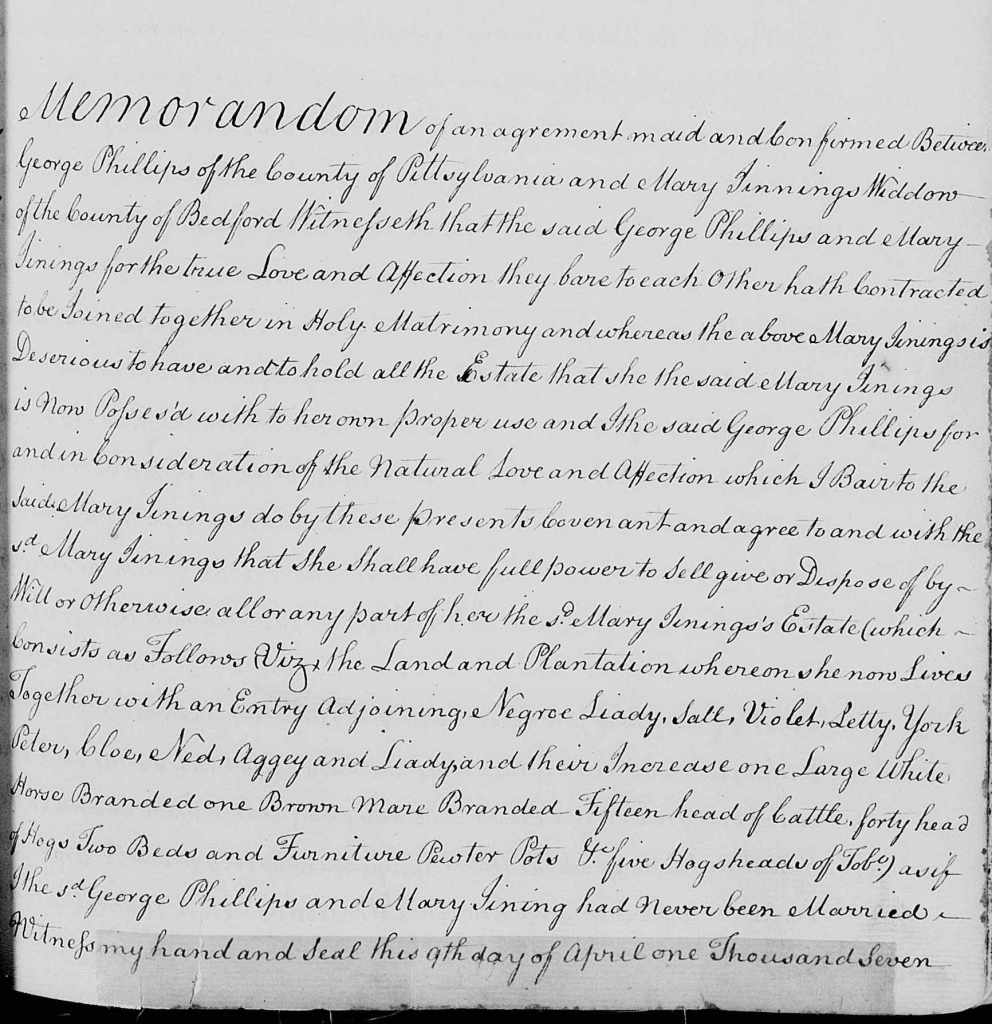

Previously, I noted a Mary Jennings of Halifax County who shows up in Bedford County records in March 1764 when Francis and Sarah luck deed land to her. On 27 June 1768, a marriage agreement was filed in Bedford County for Mary Jennings and George Phillips of Pittsylvania County.[17] George was the father of Tobias Phillips whose wife Peggy, as numerous historians of the Jennings family have concluded, was the daughter of Jonathan Jennings. The marriage agreement between George and Mary states that the couple had already married and Mary was insisting on securing her legal right to manage and dispose of her own property independently of George. I do not know Jonathan Jennings’s connection to Mary Jennings, but I’m strongly persuaded that the two were closely connected.
Alderman thinks that at some point in this time frame — not long before 1770 — George Phillips’s son Tobias married his wife Margaret, who is long thought by Jennings researchers to have been a daughter of Jonathan Jennings. He writes,[18]
His wife was called Peggy and probably named Margaret; the family researchers contend that she was Peggy Jennings and daughter to Jonathan and Dianah Bobbitt Jennings, but no record has been unearthed that proves it so. There was a Jennings/Phillips connection; in 1768 a George Phillips (perhaps Tobias’ father) married a widow Mary Jennings in Bedford County.
George Phillips had moved to what Halifax County by 18 January 1765, when he entered 400 acres on Clay branch adjoining Goad’s survey in what would soon be Pittsylvania.[19] The land entry states that the tract was surveyed for David Ross per the verbal order of said Phillips, and may also indicate that George had also entered 400 acres at the head of the said branch. George moved to this area from North Farnham parish in Richmond County, where he was born and grew up, the son of Tobias Phillips (1687 – 1739) and Hannah Goad. His birth is not listed among the children of Tobias and Hannah whose births are recorded in the North Farnham parish register, but he is named as a son in Tobias’s 19 September 1739 will in Richmond County, which was proven 7 April 1740.[20] George appears to have been born around 1725.
Jonathan Jennings Sells His Bedford Land to Christopher Lynch, 1769
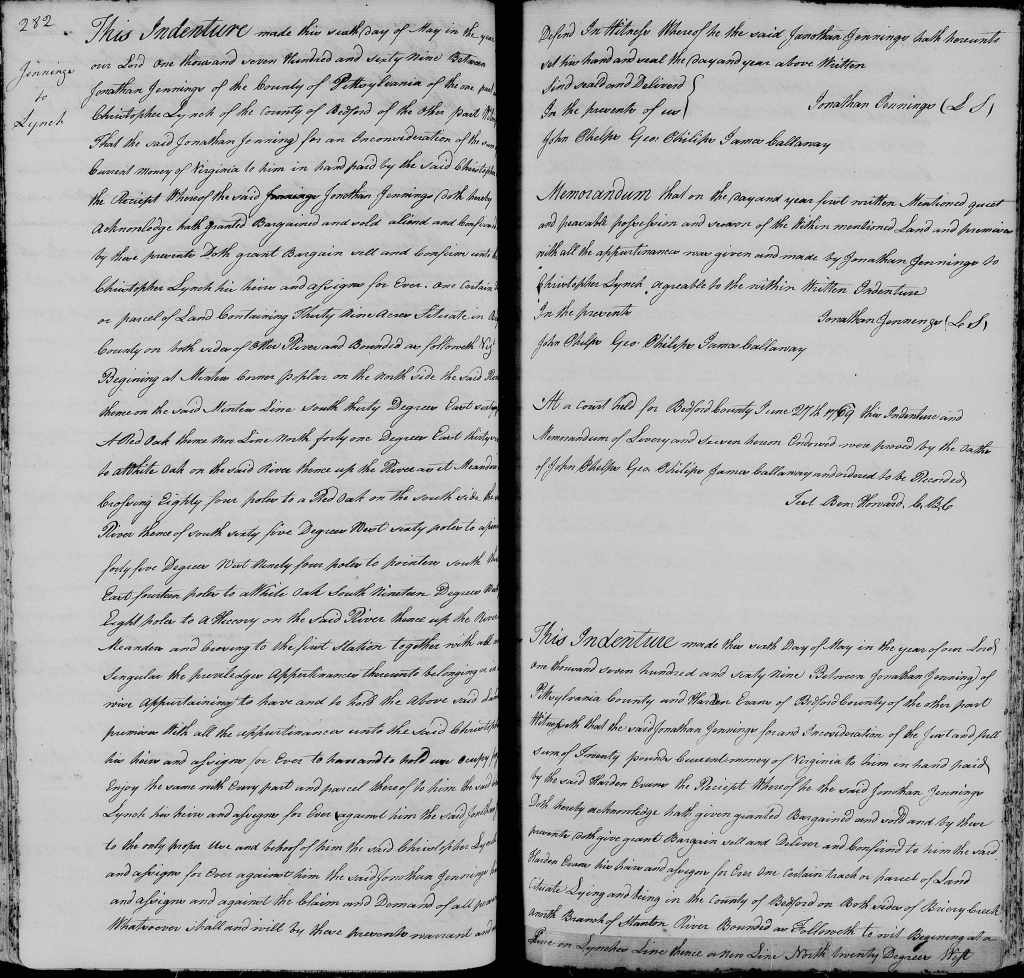
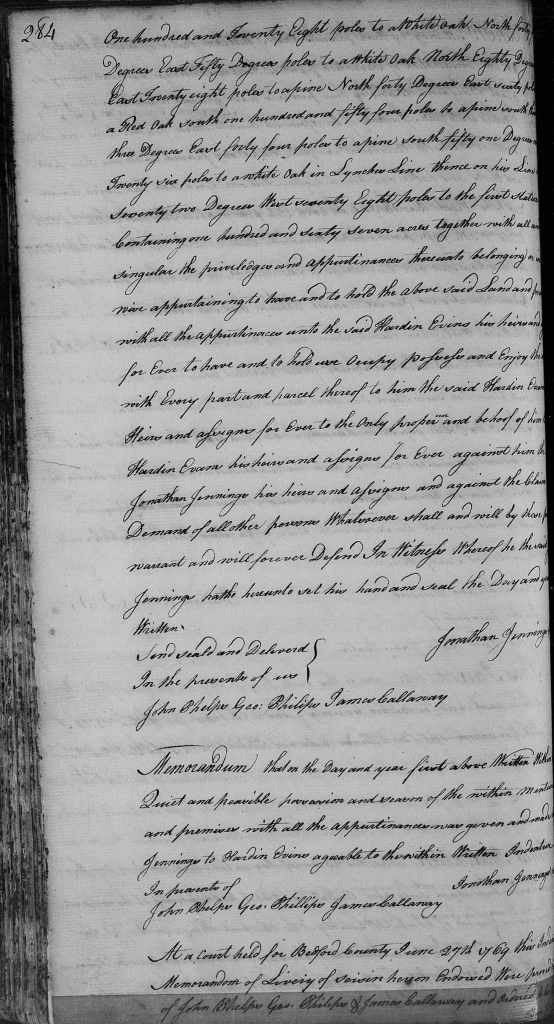
On 27 June 1769, Jonathan Jennings of Pittsylvania County sold to Christopher Lynch of Bedford County 39 acres in Bedford on both sides of Otter River, with witnesses John Phelps, George Phillips, and James Callaway.[21] On the same day, Jonathan sold Hardie Evans 167 acres in Bedford on Briery Creek, a north branch of Stanton River.[22] This deed has the same witnesses as the previous one — Phelps, Phillips, and Callaway. Alderman takes the name Phelps to be Phillips, and thinks that in addition to George Phillips, a John Phillips witnessed this deed.[23]
Note what these two deeds tell us. First, Jonathan is selling land in Bedford to Christopher Lynch. Christopher Lynch is Charles Lynch’s son. We’re back full circle yet again to Charles Lynch. Second, George Phillips, who had married Mary Jennings in Bedford a year earlier, and whose son Tobias married a Peggy thought by many Jennings researchers to be Jonathan Jennings’s daughter, witnesses these deeds. Third, another witness to these deeds is James Callaway, whom we meet again in the March 1776 deed in which Jonathan Jennings sold Charles Lynch land on the New River in Montgomery County — with Thomas Whitlock, whose wife Hannah was a Phillips, also witnessing that deed. An undated account (evidently from 1771) of the estate of Nicholas Eastin in Pittsylvania County lists among debtors and creditors George Phillips, William Bobbitt, John Goad Sr. and Jr., and Captain James Callaway among others.[24]
On 1 September 1769, Jonathan Jennings appears as a witness to a deed in which William Bobbitt and Nancy his wife, both of Pittsylvania County, sold David Ross of Goochland 12 acres on both sides of Frying Pan Creek in Pittsylvania.[25] The property was known as Bobbitt’s mill seat, according to the deed. According to Alderman, William Bobbitt was Jonathan’s brother-in-law, who filed suit against Jennings in Pittsylvania, with the suit being dismissed in July 1769.[26]
Jonathan Jennings Moves His Family to New River (Later, Wythe County), 1769
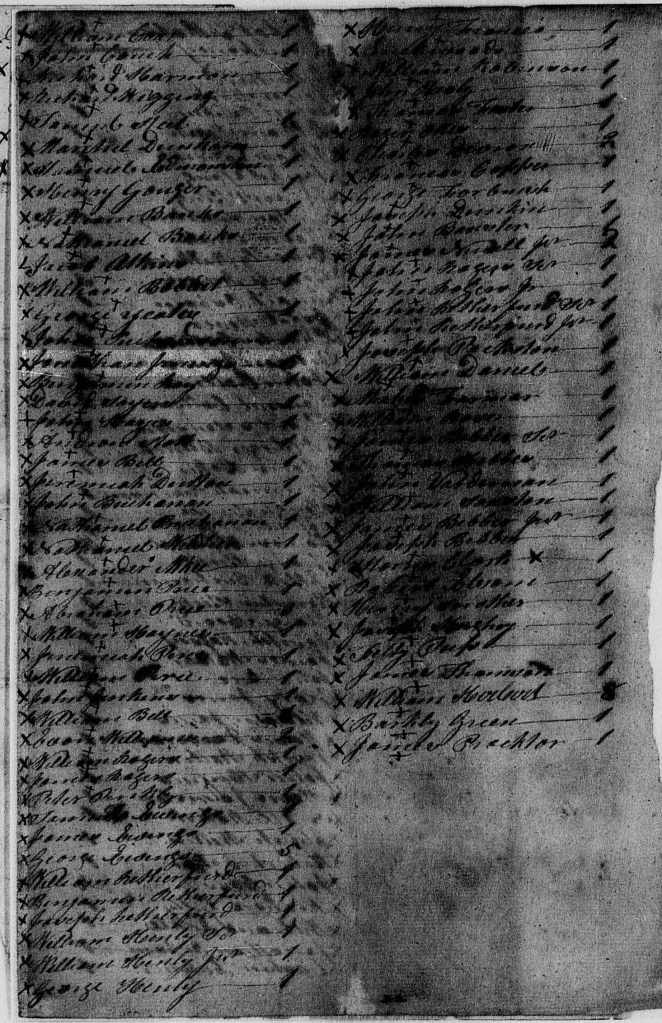
In my view, with his sale of land in Bedford in June 1769, Jonathan Lynch was moving from Pittsylvania, where he seems to have been living since that county’s formation in 1767 while owning land in Bedford. I think at this point, Jonathan moved his family to his New River land in what was then Botetourt County, where he appears on a list of tithables in 1771.[27] In the same list are William Bobbitt and David and John Sayers. William Bobbitt is listed next to Jennings. They have evidently moved together to the New River. As previous postings have indicated, we know that David and John Sayers were neighbors of Thomas Whitlock, so this tithables list is obviously taken on New River in the vicinity in which Thomas Whitlock would be living by 1776.
On 29 March 1771, Jonathan Jennings disposed of more of his land in Pittsylvania County, another indicator that he had transferred his family’s residence to New River. On that date, Jonathan Jennings of Botetourt County (the deed spells his name Jinnings) sold David Ross of Goochland 161 acres in Pittsylvania on the north side of Pigg River starting at the mouth of Frying Pan Creek.[28] The deed states that the land had been conveyed to Jennings by John Bobbitt when Pittsylvania was Halifax.
Alderman notes that Jonathan Jennings was definitely on the New River at the mouth of Big Reed Island Creek by 7 October 1771 when he bought 150 acres on New River from William Preston as executor of John Buchanan (see the digital images at the head of this posting).[29] The deed states that Preston was of Augusta County and Jennings of Botetourt County, and that the land, which was at the mouth of Reed Island Creek on Woods (i.e., New) River, had been patented to Buchanan 22 August 1753. Later Jennings would acquire 355 more acres in the same location from the Loyal Company.[30]
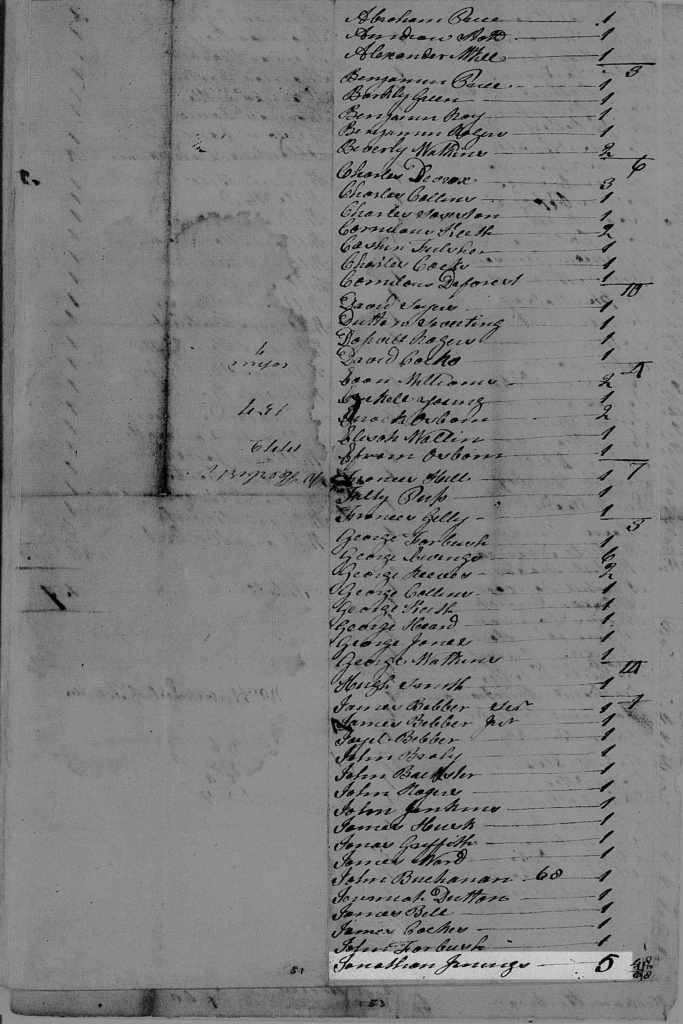
Jonathan Jennings is taxed again in Botetourt in 1772 in William Herbert’s tithables list, with five tithables.[31] Listed near Jennings on this tithables list are David Sayers, James Newell, and William Bobbitt. Both the 1771 and 1772 list show John Buchanan and Jeremiah Pierce, people we’ve met in previous postings about Thomas Whitlock, also living near Jonathan Jennings. Who were the four white male adults in addition to Jonathan himself living with Jonathan Jennings on the New River in 1772, one wonders?
On 3 May 1774, Jonathan Jennings appears on a grand jury in Fincastle with Robert Montgomery as foreman, and with others including William, Thomas, and James Montgomery, Joseph and Andrew Crockett, and James and Robert Davis — note these names.[32] Jonathan has not moved: Fincastle was created from Botetourt in 1772. He’s still on the New River in what would later become Montgomery and finally Wythe. Fincastle court order book minutes for 6 December 1774 show Jonathan Jennings being allowed a claim for 1,800 pounds of gross winter rotted hemp.[33]
On 25 January 1775, John Bobbitt and Benjamin Lankford of Pittsylvania, along with Jonathan Jennings of Fincastle, sold David Ross of Dinwiddie 160 acres both sides of the Pigg River at the mouth of Frying Pan Creek in Pittsylvania.[34] David Ross, whose name has appeared in other documents discussed above, was a Scottish-born tobacco merchant in Virginia.[35]
In 1776, Jonathan Jennings served nine months under Colonel William Christian in an expedition from Fincastle against the Cherokees.[36] Then — full circle again — on 1 March 1776, Jonathan Jennings of Fincastle deeded to Charles Lynch of Bedford 150 acres on the south side of Woods River at the mouth of Reed Island Creek in Montgomery.[37]
Regarding this land sale, Alderman states, “He sold his land in 1776 to Charles Lynch of Bedford and moved away.”[38] Jonathan evidently moved to Kentucky, where his widow Diana was taxed in Mercer County in 1795. Alderman thinks that Jonathan died testate, but his will has not survived. He bases this conclusion on the fact that on 23 February 1836, Jonathan’s son William Jennings gave power of attorney to his son Robert in Grayson County, Virginia, to recover property willed to William in his father’s will.[39] This filing for power of attorney states that Jonathan Jennings died in Kentucky.
In Conclusion
In conclusion — here are some points that stand out for me as I work my way through the trail of records left by Jonathan Jennings:
1. Jonathan Jennings had a connection to Charles Lynch in Bedford County, seemingly as early as 22 March 1756, when Bedford court minutes had him working a road along with Charles Lync’s tithables. Then on 27 June 1769, Jonathan Jennings sold Charles Lynch’s son Christopher Lynch land in Bedford County, with one of the witnesses being George Phillips, who had recently married Mary Jennings and whose son Tobias married Margaret, thought by many Jennings researchers to be Jonathan Jennings’s daughter.
2. When Jonathan Jennings sold Charles Lynch his New River land in Montgomery County in March 1776, he was selling that land to a man whom he knew in Bedford County, and with whom he seems to have had some connections.
3. Jonathan Jennings shows up in Bedford County records by 1756 and owned land there up to 1769, the point at which we first find Thomas Whitlock and wife Hannah in Bedford records. When Jonathan sold some of his Bedford land in June 1769 to Charles Lynch’s son Christopher, a witness to that land sale in addition to George Phillips was James Callaway, who also witnessed Jonathan’s March 1776 sale of New River land in Montgomery to Charles Lynch.
4. Jonathan Jennings seems to have made a settlement on New River in what would ultimately become Wythe County by 1765, and moved his family to that settlement — near where Thomas Whitlock settled on Little Reed Island Creek — in 1769 when he sold his Bedford County land.
5. Also moving to Montgomery County in the latter half of the 1770s were Tobias Phillips and wife Margaret, who is, I think, very likely Jonathan Jennings’s daughter. I’ll say more about Tobias in a future posting. For now, I want to note that he is in Pittsylania records along with his father George Phillips and grandmother Hannah Goad, now married to second husband William Dodson, up to 1776 and married Margaret in Pittsylvania not long before Jonathan Jennings, living in Pittsylvania, sold his Bedford land and moved his family to his New River land in what would later become Wythe County. Tobias shows up in Montgomery, then Wythe, and finally Grayson County records; he settled on Greasy Creek on the New River watershed in what became Grayson when that county was formed from Wythe in 1793.
6. The parallels to Thomas Whitlock’s story are interesting: Thomas married with Hannah Phillips around the same time that Tobias Phillips married Margaret (Jennings, I have concluded). Thomas was born about 1745 and Tobias in 1750. By July 1769 and likely for some time before that date, Thomas and his wife Hannah were in Bedford County, where Jonathan Jennings had land and ties to Charles Lynch, to whom Jonathan sold land on the New River in March 1776 with Thomas Whitlock as a witness.
7. Both Jonathan Jennings and Thomas Whitlock then moved to what would become Wythe County, settling on New River near Reed Island and Little Reed Island Creeks. It’s clear to me that Thomas Whitlock was already living there by March 1776 when he witnessed Jennings’s deed to Lynch; since the bible of his daughter Sarah and husband Thomas Brooks places Thomas’s family in Bedford in June 1774, Thomas would have moved his family to New River between that date and March 1776.
8. Shortly after Thomas Whitlock first shows up in Montgomery records, Tobias Phillips and wife Margaret (Jennings, I’ve concluded) moved to the New River region in Montgomery County.
9. Central to this narrative and deserving to be highlighted: Thomas Whitlock married Hannah Phillips. As I think about these parallel narratives (and also frequently intersecting ones — the stories of Thomas and Hannah Philips Whitlock, of Jonathan and Diana Bobbitt Jennings, of George Phillips and his son Tobias and wife Margaret), I’m tempted to conclude that Hannah Phillips Whitlock is closely related to George and Tobias Phillips.
I wonder, in fact, if Hannah is a sister of Tobias Phillips and a daughter of George Phillips. The big obstacle to concluding this is that the births of Tobias and other of George’s children by a wife Hannah, surname not known, are listed in the North Farnham parish register in Richmond County, Virginia, and there is no Hannah among those children. Between January 1750, when Tobias was born, and October 1760, Thomas and Hannah Phillips had children Tobias, Sarah, Frances, George, and William.
It should be noted, however, that the same parish register does not list the birth of George Phillips to parents Tobias and Hannah Goad Phillips, though the will of Tobias shows George as his son. The will also names a daughter Hannah whose birth is not recorded in the North Farnham parish register.
Unfortunately, George Phillips did not leave a will — at least, not a will that has survived — and I find no estate records or any record other than the North Farnham parish register listing George’s children. George died in Pittsylvania County, it seems, some time after a survey was made for him there on. 19 January 1786.[40] The survey was for 100 acres on branches of Pigg River in Pittsylvania, beginning at Tobias Phillips’s corner and including a little tract formerly claimed by William Goad. The survey was pursuant to a warrant (#1450) issued to David Ross 22 November 1782.
I want to stress that I have absolutely no proof that Hannah Phillips Whitlock was a daughter of George and Hannah Phillips of Richmond County, Virginia, and in George’s case, of Pittsylvania County. As I say, I’m tempted to think Hannah may have been George’s daughter, for reasons I’ve outlined above, but for now, this temptation should be viewed only as a proposal for further research. Lord knows, I’ve already hared down one path and another following William and Richard Phillips in Louisa and Albemarle records, finding no indicator at all that they’re in any way connected to Hannah Phillips Whitlock.
Perhaps I’m eager to see clues for my research on Hannah Phillips Whitlock in the Jonathan Jennings-George Phillips-Tobias Phillips story because this is the first story that in any way seems to open promising doors to figuring out Hannah Phillips Whitlock’s roots.
[1] Montgomery County, Virginia, Deed Bk. A, pp. 160-2.
[2] John Perry Alderman, Carroll 1765-1815: A History of the First Fifty Years of Carroll County, Virginia (Roanoke: Central Virginia Newspapers, 1985), pp. 108-9, 134-5.
[3] Ibid., pp. 108-9. James Bobbitt’s will is in Halifax County, Virginia, Will Bk. 0, p. 131.
[4] Pittsylvania County, Virginia, Old Survey Bk. 1, p. 40.
[5] Pittsylvania County, Virginia, Entry Bk. 1737-1770, p. 132.
[6] Bedford County, Virginia, Court Order Bk. OB 1-B, p. 58.
[7] Pittsylvania County, Virginia, Old Survey Bk. 1, p. 113.
[8] Bedford County, Virginia, Deed Bk. 2, pp. 332-4.
[9] Ibid., p. 647.
[10] Alderman, Carroll 1765-1815, p. 108.
[11] Mary B. Kegley, Early Adventurers on the Western Waters, vol. 2 (Orange, Virginia: Green, 1982), p. 105, citing and transcribing Record of Certificates of Commissioners of Washington and Montgomery Counties, 1767-1788, p. 52. See also Montgomery County, Virginia, Land Entry Bk. 1781, p. 14 and 1782, p. 43, the latter for an entry of 800 acres by Henry Davies/Davis as assignee of Charles Lynch, assignee of Jonathan Jennings.
[12] Halifax County, Virginia, Deed Bk. 6, p. 285.
[13] Ibid., p. 323.
[14] Ibid., p. 275.
[15] Alderman, Carroll 1765-1815, p. 198, citing Maude Carter Clement, The History of Pittsylvania County, Virginia (Lynchburg, Virginia: Bell, 1929), p. 280.
[16] Kegley, Early Adventurers on the Western Waters, vol. 2, p. 104, citing Records of Certificates of Commissioners of Washington and Montgomery Counties, Virginia, 1767-1788, p. 40.
[17] Bedford County, Virginia, Deed Bk. 3, pp. 193-4.
[18] Alderman, Carroll 1765-1815, p. 134, citing ibid. See also p. 109,
[19] Pittsylvania County, Virginia, Entry Bk. 1737-1770, pp. 342-3.
[20] Richmond County, Virginia, Will Bk. 5, p. 354.
[21] Bedford County, Virginia, Deed Bk. 3, p. 282-4.
[22] Ibid., p. 283.
[23] Alderman, Carroll 1765-1815, p. 108.
[24] Pittsylvania County, Virginia, Will Bk. 1, pp. 134-7.
[25] Pittsylvania County, Virginia, Deed Bk. 1, p. 421.
[26] Alderman, Carroll 1765-1815, p. 108, citing Pittsylvania County, Virginia, Court Order Bk. 1, p. 130.
[27] Botetourt County, Virginia, List of Tithables, 1771, list 9, pp. 21-2, available digitally at FamilySearch.
[28] Pittsylvania County, Deed Bk. 2, p. 68.
[29] Botetourt County, Virginia, Deed Bk. 1, pp. 310-2. See Alderman, Carroll 1765-1815, p. 108, citing Lewis Preston Summers, Annals of Southwest Virginia, 1769-1800 (Abingdon, Virginia, 1929), p. 544.
[30] Mary B. Kegley, Early Adventurers on the Western Waters, vol. 1 (Orange, Virginia: Green, 1980), p. 34. Kegley is transcribing Loyal Company records as found in the Augusta County chancery court suit file n.s. 183 (1834). She indicates that a similar list is in the Loyal Company papers at the Virginia State Library, and notes that the original survey appears in an assignment filed by Col. Charles Lynch.
[31] Botetourt County, Virginia, List of Tithables, 1772, list 21, pp. 51-2, available digitally at FamilySearch. See also Kegley, Early Adventurers 3, 276-8
[32] Summers, Annals of Southwest Virginia, p. 623.
[33] Alderman, Carroll 1765-1815, p 108, citing ibid., p. 633. Summers is citing Fincastle County, Virginia, Court Order Bk. for 6 December 1774.
[34] Pittsylvania County, Virginia, Deed Bk. 4, p. 96.
[35] See Charles B. Dew, “David Ross and the Oxford Iron Works: A Study of Industrial Slavery in the Early Nineteenth-Century South,” William and Mary Quarterly 31,2 (April 1974), pp. 189-224.
[36] Alderman, Carroll 1765-1815, p. 108, citing Summers, Annals of Southwest Virginia, p. 1420.
[37] See supra, n. 1.
[38] Alderman, Carroll 1765-1815, p. 108.
[39] Ibid., p. 109, citing Grayson County, Virginia, Deed Bk. 7, p. 275.
[40] Pittsylvania County, Virginia, Entry Bk. 1770-1796, p. 47.
 BEGATS AND BEQUEATHALS
Thank you for this work. I think this will tie Jennings to the Isle of Wight family.
LikeLike
Thank you for your comment, Pat. I’m glad to hear that this may be helpful to you. I haven’t done enough work on Jonathan Jennings to be able to tell you more about him or his Isle of Wight County connections. I’ll be happy to hear more about those connections.
LikeLike