Elizabeth Burleson Brooks
As noted in the posting I’ve just linked, the biography of Charles and Elizabeth’s son John Lee Brooks in History of Texas and Texans contains much biographical information about his mother Elizabeth, including that she was born 11 April 1835 near old Fort Bastrop, Texas, and, when Sam Houston retreated before Santa Anna, was carried as a baby in her mother’s arms 300 miles by foot from Fort Bastrop to the Sabine River.[1] The previous posting also notes that the biography of her son John states that her forebears included in addition to the Burlesons the noted Buchanan and Christian families of Virginia.[2] (Note that, as my posting below indicates, Elizabeth Burleson was not a Christian descendant: her mother Mary Randolph Buchanan married first Thomas Christian, and following his death, James Burleson, and by him she gave birth to Elizabeth Burleson. Thomas — not John, as the History of Texas and Texans biography states — Christian was killed in the Wilbarger massacre of 1833.)

Elizabeth’s son John, who supplied the information printed in his biography, described his mother in a way typical of many accounts of pioneer women of the Texas Republic as their progeny remembered them: a woman of great strength and beauty, with heroic characteristics — in her youth, a popular belle of fine physique and appearance, vivacious, high-spirited, ambitious and daring, who once felled a native American warrior with a stick of stovewood, then escaped as his companions shot arrows at her.[3] Her son stated, too, that his mother Bettie Burleson was an accomplished horsewoman, good shot, and fine dancer.[4]
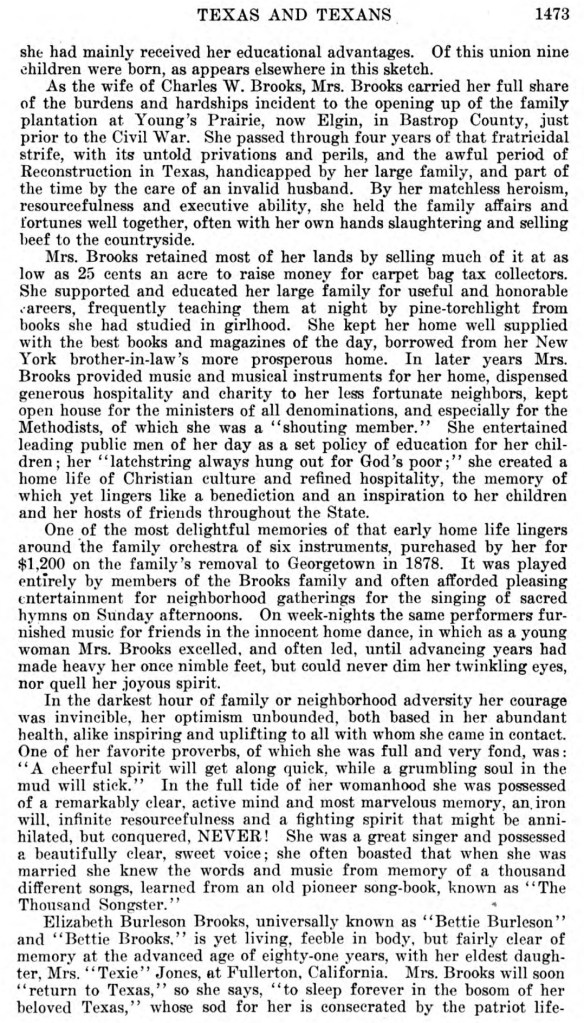
During the period following the Civil War, when Charles W. Brooks was infirm and unable to work for some seven years (this was discussed in the previous posting), it was his mother who kept the family’s ranch going with the assistance of a man formerly enslaved, according to John Lee Brooks.[5] Note that it’s not clear from the biography that this man had been enslaved by the Brooks family; no records I’ve found indicates that the family held enslaved persons in Texas.
John’s biography indicates that his mother slaughtered cattle with her own hands during this period of the family’s life and sold the meat around the countryside to bring in much-needed income.[6] When taxes became onerous in the post-war period, Elizabeth managed to hold onto the family’s homeplace by selling off pieces of land at prices as low as 25 cents per acre. John’s biography recalls that, after laboring on the family ranch during the day, Elizabeth would teach her children at night from books she had studied as a girl supplemented by books and magazines she borrowed from her half-sister Martha (Christian) and Martha’s husband Sherman Reynolds.[7]
As Charles W. Brooks moved his family to Georgetown, Texas, in 1878 so that his children could take advantage of the newly opened Southwestern University there, his mother bought an orchestra of six musical instruments for $1,200, John Lee Brooks reported in his biography. Family members played the instruments at neighborhood gatherings on Sunday afternoons at which hymns were sung, and for dances held in their neighborhood at other times.[8] Her son stated that his mother was a great singer with a beautifully clear voice, who boasted that at the time she married she knew the words and music for over a thousand songs from an old pioneer songbook entitled The Thousand Songster.
John, who obviously esteemed his mother highly, spoke of her and the hospitable house she kept in the following glowing terms:
In later years Mrs. Brooks provided music and musical instruments for her home, dispensed generous hospitality and charity to her less fortunate neighbors, kept open house for the ministers of all denominations, and especially for the Methodists, of which she was a “shouting member.” She entertained leading public men of her day as the set policy of education for her children; her “latchstring always hung out for God’s poor”; she created a home life of Christian culture and refined hospitality, the memory of which yet lingers like a benediction and an inspiration to her children and her hosts of friends throughout the state.[9]
At the time John Lee Brooks provided these statements about his mother for his biography in 1914, Elizabeth Burleson Brooks was still living, and, writing for the Mary Christian Burleson Foundation, Cristin Embree suggests that Elizabeth herself may have provided information to Alexander W. Terrell, who completed Frank Johnson’s work History of Texas and Texans after Johnson died.[10] The biography notes that she was with her daughter Texana Jones at Fullerton, California, as John Lee Brooks’s biography was published in 1916, and on her death, would “’return to Texas,’ so she says, ‘to sleep forever in the bosom of her beloved Texas.’”[11]


Elizabeth Burleson Brooks died 24 February 1920. Her obituary in the Houston Post on Friday the 27th of February 1920 states that she died at the home of her son James Robert Brooks at Mertzon in Irion County, Texas, but her death certificate says that her death occurred at San Angelo in Tom Green County, Texas.[12] Her son J.R. Brooks of Mertzon provided the information for her death certificate, which names her parents as James Burleson and Mary Buchanan. Elizabeth is buried in the Odd Fellows cemetery at Georgetown, Williamson County, Texas, in which her husband Charles is buried, with her tombstone giving her dates of birth and death as 4 April 1835 and 15 February 1920.[13] The latter date conflicts with the date of death given in both her Houston Post obituary and on her death certificate.
Mary Randolph Buchanan (Christian) (Burleson) and Her Role in Elizabeth and Charles’s Lives
Significant information about Elizabeth and her connection to her mother Mary Buchanan (Christian) (Burleson) is found in a number of valuable sources, As we saw in the previous posting, Mary lived with her daughter Elizabeth and husband Charles W. Brooks at Elgin in Bastrop County, following Charles and Elizabeth’s marriage. As the posting I’ve just linked notes, the biography of their son John states that after Charles and Elizabeth married, they settled at Elgin, where Elizabeth’s mother was living, and Charles “opened up a big plantation and stock-farm of his own, on a large body of lands partly inherited by his wife from her pioneer father.”[14] As that posting also indicates, this statement in John Lee Brooks’s biography and other documents suggest that much of the land on which Charles and Elizabeth operated their ranch at Elgin came to the Brooks family through the Burleson connection.

That supposition is corroborated by a very useful document compiled in 2015 by the Mary Christian Burleson Foundation, an organization seeking to restore the house Elizabeth’s mother Mary Buchanan (Christian) (Burleson) built at Elgin in 1855. As the foundation began this project, it compiled for the Texas Historical Commission a document entitled “Mary Christian Burleson Homestead, Elgin, Texas: Historic Structure Report and Preservation Plan,” a draft of which is online at the Commission’s website.[15] This document contains quite a bit of good information about how Mary acquired the land on which she ranched in Bastrop County, and how some of that land passed to her daughter Elizabeth and husband Charles Brooks.
As the previous posting notes, Mary Randolph Buchanan was born in Wythe County, Virginia, on 1 March 1795, daughter of John Buchanan and Nancy Wright.[16] In 1820 in Kentucky, Mary met Thomas Christian, a War of 1812 veteran, stock raiser, and surveyor, and in 1822 the couple married in Virginia. After spending time in Illinois and Missouri, the couple arrived with several small children at the Austin colony in Texas in April 1832. The Christian family settled at Fort Bastrop and on 16 October 1832, Thomas and Mary Buchanan Christian were granted one of the fifteen original titles in Stephen F. Austin’s Little Colony, a 477-acre headright grant located six miles north of Mina (Bastrop County), where they built one of the first houses in the colony.[17]
In August 1833, Thomas Christian was murdered in the Wilbarger massacre near present-day Austin, and in 1834 at Hornsby’s Fort in the Mina district near what is now Austin, Mary married the widower James Burleson. The following year, the couple had a daughter, their only child, Elizabeth, who would marry Charles W. Brooks in 1855. In late November 1835, James Burleson became seriously ill after taking part in the “Grass Fight” at the siege of San Antonio, and failing to recover, died at the home of his daughter Rachel Rodgers on 3 January 1836.[18] It was shortly after this that Mary fled with her infant daughter Elizabeth and others from Fort Bastrop to the Sabine River in what Texas folklore calls the “Runaway Scrape” as Sam Houston retreated before Santa Anna.
In 1840, Mary then settled with her seven children (six by Thomas Christian and Elizabeth by James Burleson) in a newly built log house on the league of land in Bastrop County that had been granted to Thomas Christian. This house was the first to be built at the site of what became Elgin.[19] Troubles with the native peoples of the region then caused Mary to take her children back to Fort Bastrop, however. Mary Burleson returned to the area in 1847 and remained there until her death, building a two-room log cabin after her return, and in 1855, the house for whose preservation a foundation has been established.[20]
As Cristin Embree notes, Mary had an extensive ranch operation at present-day Elgin, watering her large herds of cattle on a branch of Burleson Creek. The land on which she had her ranch had not come to her from her marriage to James Burleson, but was the land granted to her and husband Thomas Christian when they first settled in Texas. James Burleson’s will did, however, bequeath property to his daughter Elizabeth, including the house in which he and Mary lived following their marriage.[21] Embree cites an oral interview Elizabeth Burleson Brooks provided to her niece Mrs. H.B. Smith on an unspecified date, in which Elizabeth told her niece that her father James Burleson left Elizabeth and her mother Mary a home on a tract of land on the Colorado River near Bastrop, where they lived until 1840, when Mary moved the family to the headright league that had been granted to her and Thomas Christian.[22]
Embree notes that in May 1840, Mary Burleson filed a petition under the Republic of Texas to be appointed administrator of the succession of Thomas Christian’s headright league.[23] In 1841, Mary petitioned the court to divide the Christian land, with half of it to be held in guardianship by Jonathan Burleson for her minor children.[24] Embree states, “In July of that same year, two thousand acres on the south and west of the Headright League was granted to Mary and two thousand, four hundred and forty-four acres on the north and east granted to her minor children.”[25]
According to Embree, the land granted to Thomas and Mary Buchanan Christian at what is now Elgin consisted of two distinct types of soil — friable sandy land and prairie clay. Most of the Christian headright was prairie land, but when Mary established her second homestead in 1847, she chose to settle on the edge of the sandy area, probably intending to benefit from both types of soil. The prairie land permitted cotton growing, while the sandy land did not, but the latter was ideally suited to grazing cattle, which appears to have been Mary’s primary interest as she farmed .[26]
Embree notes that the land in the vicinity of Mary’s land was described in an 1861 account as “vast open prairie, at the time before barbed wire with large herds of cattle roaming, where grains and other cereals were farmed.”[27] Embree cites A.H. Carter, who states, “What is now Elgin was surrounded by a vast wooded section on the east, while on the west was a vast open prairie with large herds of cattle. At that time barb wire was not known here, hence there was little farming for it was impossible to fence against the large herds of cattle.”[28]
This, then, is the land on which Charles W. Brooks and wife Elizabeth settled following their marriage in 1855, when they made their home with Elizabeth’s mother Mary and ranched with her. As Cristin Embree states, “20th century oral histories indicate that Elizabeth (Burleson) Brooks, who lived on part of the Thomas Christian League neighboring Mary’s, was also a capable rancher.”[29] Embree notes that Elizabeth with husband Charles continued her mother’s practice of rounding up the unbranded cattle that had been ranging on their ranchland and moving them north on cattle drives, a practice that was continued following the Civil War until barbed wire came along and transporting livestock by rail became the norm.[30]
As Embree reports, “Mary was an independent businesswoman and land manager” who also made significant contributions to her community in the fields of religion and education, a tradition carried on by her daughter Elizabeth. In the spring of 1835, Mary was one of eleven charter members of what is believed to have been the second Methodist congregation to be chartered in Texas. It is likely that she was also a charter member of the first Methodist society in Elgin, which would later become First Methodist church in Elgin, the community’s first church, to which her daughters, grandchildren, and great-grandchildren belonged. Embree notes that memorial windows in the church commemorate the leadership Mary and her descendants provided in the church.[31] Two of Mary’s grandsons became Methodist bishops.
Embree thinks it is possible that Mary supported the abolition of slavery, as he says other Methodists in Bastrop did in the antebellum period. He notes that Bastrop area Methodists passed a resolution making it unacceptable for a bishop to be connected in any way with slavery.[32] I don’t, in fact, find either Mary Burleson or Charles Brooks holding enslaved people in Bastrop County, though the 1850 federal slave schedule shows Mary’s step-son Jonathan Burleson holding fifteen enslaved persons, and the 1860 slave schedule shows him with twenty-one enslaved persons. And though Charles Brooks had been an overseer on a plantation in Lawrence County, Alabama, operated by the labor of enslaved people and then brought some fifty enslaved people belonging to Eggleston Dick Townes to Texas in 1854 to open a plantation for Townes….
Embree also notes that Mary and her children made significant educational contributions in their community, especially in the area of women’s education, and “multiple Christian and Burleson women were college educated and some became educators in the early community.”[33] The first school in the area, the Burleson Branch school, was located on Mary’s Christian family tract, and she supported the charter for the Burleson Male and Female Academy.
The Burleson Branch school, a one-room log structure with seats made of split logs, was established in the late 1860s.[34] With Mary’s encouragement, her sons-in-law John S. Smith, Charles W. Brooks, Thomas H. Gatlin, and Ed Tisdale obtained a charter for the school as the Burleson Male and Female Academy in 1873. In this sparsely settled area, the school was never well attended; it closed when a school was organized in Elgin. Embree indicates that Elizabeth Burleson Brooks taught in the newly chartered school before the Brooks family moved to Georgetown in 1878.
Embree also notes in addition the deep roots of the family of Mary’s second husband, the Burlesons, in the field of education in Texas. As he indicates and has been previously noted, Rufus C. Burleson, son of Jonathan Burleson Sr., brother of Mary’s second husband James Burleson, was the second president of Baylor University and first president of Waco University. When Southwestern University opened at Georgetown in 1873, its founding members included members of the Burleson family, according to Embree.[35]
In my next posting, I’ll provide information about the children of Charles Wesley Brooks and Elizabeth Burleson.
P.S. For a brief addendum to this posting providing links to valuable resources regarding Mary Buchanan Christian Burleson and her daughter Elizabeth Burleson Brooks, see this subsequent posting.
[1] Frank W. Johnson, A History of Texas and Texans, vol. 3 (Chicago and New York: American Historical Society, 1916), pp. 1471-2.
[2] Ibid., p. 1471.
[3] Ibid., p. 1472.
[4] Ibid.
[5] Ibid.
[6] Ibid., p. 1473.
[7] Ibid.
[8] Ibid.
[9] Ibid.
[10] See Cristin Embree, “Historical Background,” in “Mary Christian Burleson Homestead, Elgin, Texas: Historic Structure Report and Preservation Plan,” a draft of a document compiled in 2015 by the Mary Christian Burleson Foundation, online at the website of Texas Historical Commission. See also Don Hendrix, “Johnson, Francis White (1799–1884),” Handbook of Texas, at the website of Texas State Historical Commission; and Irby C. Nichols, Jr., “Terrell, Alexander Watkins (1827–1912),” also in Texas State Historical Commission’s Handbook of Texas.
[11] Johnson, A History of Texas and Texans, vol. 3, 1473.
[12] “Mrs. C.W. Brooks,” Houston Post (27 February 1920), p. 8, col. 3; and Texas Department of Health, Death Certificates, 1920, Tom Green County, #8301, available digitally at Ancestry.
[13] See Find a Grave memorial page of Elizabeth “Betty” Burleson Brooks (1835-1920), Odd Fellows cemetery, Georgetown, Williamson County, Texas, created by John Christeson with tombstone photos by John Christeson.
[14] Johnson, A History of Texas and Texans, vol. 3, p. 1469.
[15] See supra, n. 10.
[16] See Byron Howard, “Burleson, Mary R. B. Christian (1795–1870),” Handbook of Texas, at website of Texas State Historical Commission; and Mary Christian Burleson Foundation, “Mary Christian Burleson Homestead, Elgin, Texas: Historic Structure Report and Preservation Plan.”
[17] Howard, “Burleson, Mary R. B. Christian (1795–1870)”; and Mary Christian Burleson Foundation, “Mary Christian Burleson Homestead, Elgin, Texas: Historic Structure Report and Preservation Plan.”
[18] Howard, “Burleson, Mary R. B. Christian (1795–1870)”; Mary Christian Burleson Foundation, “Mary Christian Burleson Homestead, Elgin, Texas: Historic Structure Report and Preservation Plan”; and Mary Christian Burleson Foundation, “The Mary Christian Burleson Homestead,” at website of Mary Christian Burleson Foundation.
[19] Howard, “Burleson, Mary R. B. Christian (1795–1870)”; Mary Christian Burleson Foundation, “Mary Christian Burleson Homestead, Elgin, Texas: Historic Structure Report and Preservation Plan”; and Mary Christian Burleson Foundation, “The Mary Christian Burleson Homestead,” at website of Mary Christian Burleson Foundation.
[20] Mary Christian Burleson Foundation, “Mary Christian Burleson Homestead, Elgin, Texas: Historic Structure Report and Preservation Plan”
[21] Cristin Embree in Mary Christian Burleson Foundation, “Mary Christian Burleson Homestead, Elgin, Texas: Historic Structure Report and Preservation Plan,” citing will of James Burleson, Probate Records, Bastrop County (1935), p. 59 and Texas Comptrollers Audited Claims, Military Service Records.
[22] Cristin Embree in Mary Christian Burleson Foundation, “Mary Christian Burleson Homestead, Elgin, Texas: Historic Structure Report and Preservation Plan,” citing H.B. Smith, “Thomas Christian Family History, Pedigree Given to Mrs. H.B. Smith from Word of Mouth by Aunt Bettie Brooks,” recorded oral history of Elizabeth (Burleson) Brooks, a typescript held by Elgin Depot Archives in its Mary Christian Burleson Collection. For information about the location of James Burleson’s house on the Colorado, Cristin Embree is citing Bill Moore, Bastrop County, 1691–1900 (Wichita Falls: Nortex, 1977).
[23] Cristin Embree in Mary Christian Burleson Foundation, “Mary Christian Burleson Homestead, Elgin, Texas: Historic Structure Report and Preservation Plan,” citing Bastrop County, Texas, Probate Bk. B, p. 51, held as typescript by Elgin Depot Museum, Mary Christian Burleson Collection.
[24] Cristin Embree in Mary Christian Burleson Foundation, “Mary Christian Burleson Homestead, Elgin, Texas: Historic Structure Report and Preservation Plan,” citing Bastrop County, Texas, Probate Bk. B, pp. 111-2, held as typescript by Elgin Depot Museum, Mary Christian Burleson Collection.
[25] Ibid.
[26] Cristin Embree in Mary Christian Burleson Foundation, “Mary Christian Burleson Homestead, Elgin, Texas: Historic Structure Report and Preservation Plan.”
[27] Cristin Embree in Mary Christian Burleson Foundation, “Mary Christian Burleson Homestead, Elgin, Texas: Historic Structure Report and Preservation Plan,” citing Texas Almanac and State Industrial Guide (Galveston: Galveston: A.H. Belo & Co., 1961), p. 380, which is quoting an 1861 source.
[28] Cristin Embree in Mary Christian Burleson Foundation, “Mary Christian Burleson Homestead, Elgin, Texas: Historic Structure Report and Preservation Plan,” citing A.H. Carter, “Notes on the Early History of Elgin,” possibly published in Elgin Courier in 1930s, held in typescript by Elgin Depot Archives, Mary Christian Burleson Collection.
[29] Cristin Embree in Mary Christian Burleson Foundation, “Mary Christian Burleson Homestead, Elgin, Texas: Historic Structure Report and Preservation Plan.”
[30] Cristin Embree in Mary Christian Burleson Foundation, “Mary Christian Burleson Homestead, Elgin, Texas: Historic Structure Report and Preservation Plan,” citing Paul C. Boethel, Colonel Amasa Turner: The Gentleman from Lavaca and other Captains at San Jacinto: The Surveyor of Bastrop (Austin: Von Boeckmann-Jones, 1963), pp. 137-9; and Johnson, A History of Texas and Texans, vol. 3, pp. 1472-3.
[31] Cristin Embree in Mary Christian Burleson Foundation, “Mary Christian Burleson Homestead, Elgin, Texas: Historic Structure Report and Preservation Plan,”citing “Commemoration Document, Elgin Methodist Dedication,” held by Elgin Depot Museum Archives, Mary Christian Burleson Collection; and “Christian Scrapbook (1955,” also held by Elgin Depot Archives, Mary Christian Burleson Collection. Elgin Depot Museum Archives, Mary Christian Burleson Collection).
[32] Cristin Embree in Mary Christian Burleson Foundation, “Mary Christian Burleson Homestead, Elgin, Texas: Historic Structure Report and Preservation Plan,” citing Allan Pape, Cyde Reynolds, and David Steward, 150 Years of Methodism in Bastrop (Bastrop: Bastrop Stationers, 1985).
[33] Cristin Embree in Mary Christian Burleson Foundation, “Mary Christian Burleson Homestead, Elgin, Texas: Historic Structure Report and Preservation Plan.”
[34] Cristin Embree in Mary Christian Burleson Foundation, “Mary Christian Burleson Homestead, Elgin, Texas: Historic Structure Report and Preservation Plan,” citing A.H. Carter, “Notes on the Early History of Elgin,” possibly published in Elgin Courier in the 1930s, a typescript held by Elgin Depot Archives, Mary Christian Burleson Collection.
[35] Cristin Embree in Mary Christian Burleson Foundation, “Mary Christian Burleson Homestead, Elgin, Texas: Historic Structure Report and Preservation Plan,” citing Norman Woods Spellmann, Growing a Soul: The Story of A. Frank Smith (Dallas: SMU Press, 1979).
 BEGATS AND BEQUEATHALS
The maternal grandfather of Elizabeth Burleson was Thomas J. Christian (not John). Thomas and William Strother were murdered and scalped by Indians in 1833 near Pecan Springs. Josiah Wilbarger was also scalped, but lived to document the horrific event for future generations. The site is marked by a large granite historical monument and a small bronze plaque at the corner of Berkman Drive and 51st Street in Austin’s Bartholomew District Park. I am a descendant of the Christian family.
LikeLike
Thank you for your comment and this information. I’ll correct the misinformation in the post. I’m grateful to you.
LikeLike
Rev. Bagby-Grose, I’m looking at the posting above and trying to figure out what needs to be corrected. Can you please help me to know what isn’t correct? I do want to correct it, but am unclear about what’s wrong. I don’t think I refer to Elizabeth Burleson’s grandfather as anything other than Thomas, but had understood you to be saying I refer to him as John at some point? And are there other items above that need to be corrected? I’ll be grateful for your assistance.
LikeLike
I’m not sure my initial reply to you went through. My apologies if this is a duplicate. Thank you for your comment and for this information. I’ll make corrections in the posting. I’m grateful to you.
LikeLike
Thanks of your gracious and prompt response. It’s interesting to note that Allen Christian, the brother of Thomas, was an early surveyor and settler in Tarrant and Parker counties. Allen was a Parker County commissioner in 1867.
LikeLike
Interesting. The Christians clearly played a significant role in Texas history. I appreciate the additional information.
LikeLike
Well my friend, this article has a few family history errors. Elizabeth (Betty” Burleson Brooks was the only child of James B. Burleson, Sr. and Mary Randolph Buchanan Christian Burleson. She was not related by blood to the Christian family. Her mother’s first husband, Thomas J. Christian, is the “John” Christian referred to in this article who was murdered and scalped by Comanches in 1833 at Pecan Springs (large granite memorial monument is at the corner of West 51st Street and Berkman Drive in Austin’s Bartholomew District Park. The Mary Christian Burleson House, the oldest structure in Elgin, is being restored by the Mary Christian Burleson Foundation with support from federal and state historic preservation grants.
LikeLike
Can you please point me to any statement this article makes about a “John” Christian? You’ve mentioned that twice, but I spot no reference at all to that name anywhere in the article. As the posting says, Elizabeth Christian Burleson was the daughter and only child of Mary Randolph Buchanan and James Burleson. As it also says, Mary’s first husband was Thomas Christian, and Mary married James Burleson following Thomas Christian’s murder. Can you please alert me to anything that is incorrect in those statements? Thanks. See also https://begatsandbequeathalsasouthernusfamilydocumented.com/2022/02/11/short-addendum-to-posting-about-elizabeth-burleson-wife-of-charles-wesley-brooks-valuable-resources/
LikeLike
The second paragraph of this 1916 article from the American Historical Society states that Elizabeth’s (Betty) mother was Nancy Christian. Obviously, you know that’s not true as you refer to her mother correctly as Mary Randolph Buchanan Christian Burleson.
The fourth paragraph refers to the massacre of William Strother and Thomas J. Christian, but incorrectly names Thomas as “John” and connects him biologically to Betty, even though he was her mother’s first husband, not her father. I was correcting the article, not any of your comments on it.
LikeLike
Thank you for clarifying that you’re referring to the Frank Johnson article. But anyone reading the posting will know that Mary Randolph Buchanan married Thomas Christian, who was killed in the Wilbarger massacre in August 1844, and in 1834, she then married James Burleson and they had only one child, Elizabeth Burleson who married Charles Brooks. I had assumed that those reading the posting would recognize that some of the information in the Frank Johnson article is not correct and that I’m providing correct, documented information in my posting, with footnotes to enable anyone reading the article to check my information. I wanted, of course, to include digital images of Frank Johnson’s article because it provides other information readers might want to have about this family, and it points them to a biographical source that, though erroneous in some ways, contains information not found elsewhere.
But I take your point that readers who don’t read the posting itself may be misled by the pieces of misinformation in Frank Johnson’s article that you highlight, so I’ll put a statement within the body of the posting noting these errors in Frank Johnson’s article and pointing to the correct information my posting provides on these points. Thank you for pointing this out to me.
LikeLike