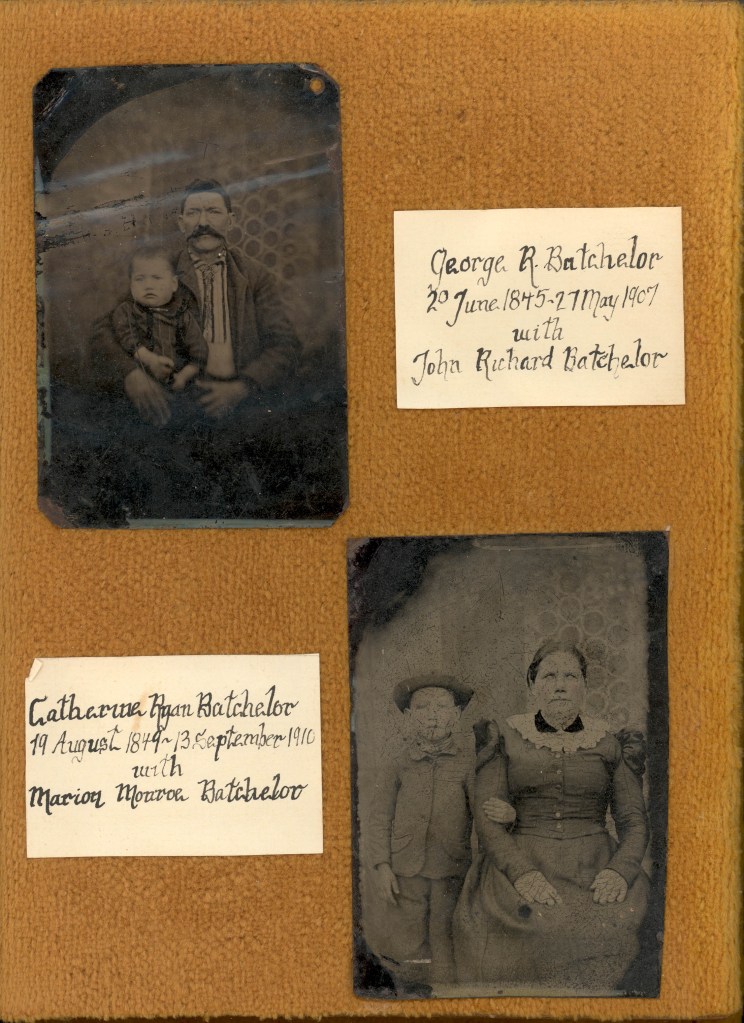
In previous years, I have gone through old family photos that have ended up in my possession, and have identified, scanned, catalogued them, and put them into albums. Before her death in 1968, my maternal grandmother Hattie Batchelor Simpson (1888-1968) gave me an album of tintype photos that her mother had given to her on her 12th birthday in 1900. That album has a number of photos of her parents George Richard Batchelor (1845-1907) and Catherine Ryan (1849-1910), as well as photos of a number of their children including my grandmother. I’ve added to it a small framed tintype photo of my great-grandfather Mannen Clements Simpson (1845-1886) that his granddaughter, my mother’s first cousin, gave me. (George was born 20 June 1845 in Hardin County, Tennessee, and died 17 May 1907 in Grant County, Arkansas. Catherine was born 19 August 1849 in Mullinavat, County Kilkenny, Ireland, and died 13 November 1910 in Grant County, Arkansas. Mannen was born 15 June 1845 in Tuscaloosa County, Alabama, and died 3 November 1886 in Calhoun County, Mississippi.)
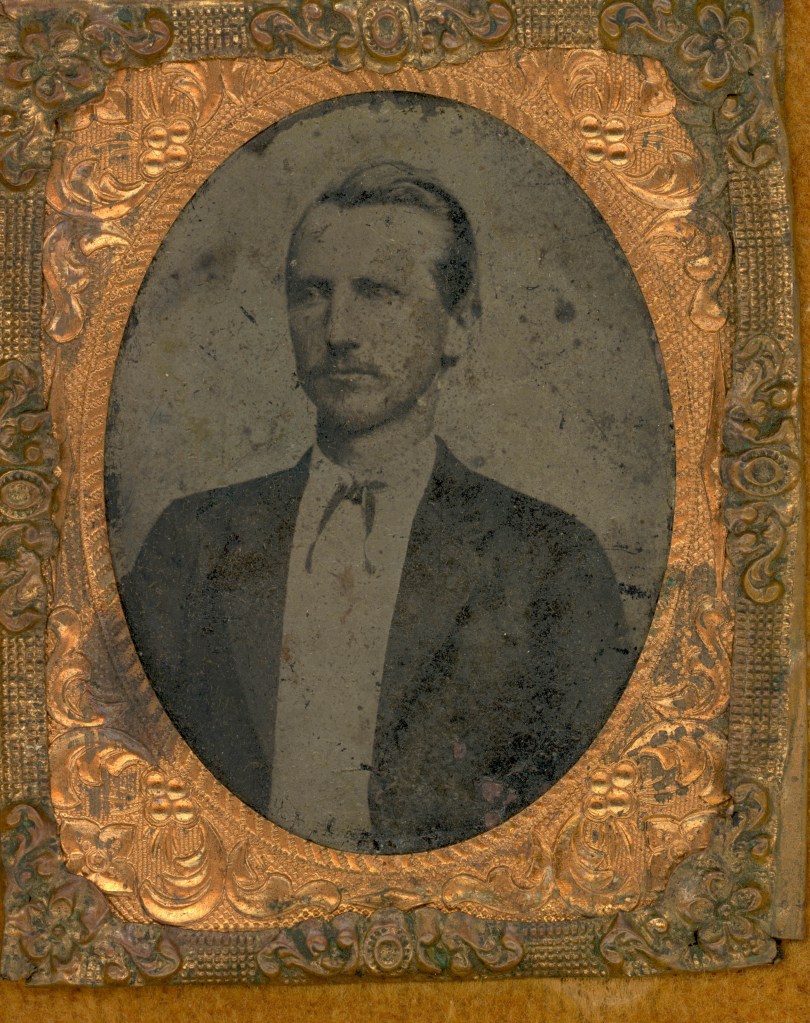
My grandmother Hattie (as I’ll call her now) also had boxes of other old family photos that she identified for me a number of times before her death and wanted me to have, and I’ve placed those in an album and labeled them carefully. I’ve done the same for photos of other branches of my ancestral lines that family members have given to me, and now have albums called “Batchelor,” “Lindsey,” “Simpson,” and “Snead” (the surnames of my four grandparents), all with older family pictures I’ve labelled so that anyone who wants these albums once I’m gone will know who these folks are.
The photos I’m working with now are, for the most part, ones that came my way when the last person living in my grandmother Hattie’s house, my aunt Katherine/Kat Simpson, died in December 2001. Kat’s youngest sister Billie and I inherited half shares of my grandmother’s house and its belongings, and when Billie and I divided the contents of the house, I took all the old family photos I could find. She didn’t want them and wanted me to have them.
A large group of these were stored in the old trunk of Hattie’s brother John Richard Batchelor (1891-1948) that was in the attic of my grandmother’s house. After I looked through these cursorily at the time they came to me in 2001 and realized I knew only some of the faces in them, I put them away and forgot about them, and have only recently pulled them out to tussle with and to see if I can identify the people in them.
I’m finding that a large number of these photos clearly belonged to John’s wife Frances Tucker Batchelor (1893-1924), whom he married in 1921. Following her death from tuberculosis, with which she was diagnosed around the time their son George was born in 1922, and after my grandfather William Z. Simpson (1869-1930) died, John came to live with Hattie, and his trunk and its contents then ended up in her attic when he died in 1948, with the pictures belonging to his wife Frances that I’m now sorting through, and a diary she kept from the time she was finishing her studies at University of Arkansas in 1921 up to shortly before her death on 18 May 1924 in Little Rock.
Before her death, my grandmother Hattie gave Frances’s diary to me, and in 2006, I donated it to the Butler Center for Arkansas Studies in Little Rock. Frances was an accomplished person from a family that prized good education. Her parents Francis William Tucker (1843-1924) and Helen M. Wilkins (1856-1932) were Massachusetts natives who moved to Arkansas following the Civil War. They sent their three daughters Mary, Frances, and Ruth back to Massachusetts to be educated, and Frances graduated from Wellesley College in June 1915 before enrolling at University of Arkansas and obtaining a master’s degree in classics there in June 1921. Before marrying John R. Batchelor on 17 June 1921, she had taught Latin at Altheimer near Pine Bluff, Arkansas, where the couple settled following their marriage.
It frustrates me as a genealogist to have caches of photos collected by family members in the past, capturing faces of people who obviously meant something to them, whom I now cannot identify. In ending up with these photos, I feel a sense of responsibility, as strange as that may seem, to try to know who the people in these photos are and, if possible, to figure out who might want these photos now.
In what I’m calling a “gathering” of photos I now realize my great-aunt Frances had saved, I find two mystery photos of WWI soldiers, with their names written on the back in Aunt Frances’s handwriting (see the images at the head of the posting). I recognize the handwriting because, as I’ve said, my grandmother gave me Frances’s diary some years back and I later donated it to the Butler Center for Arkansas Studies. I also have books in which Aunt Frances had written her name when she was teaching Latin, and cards she sent my grandmother Hattie at various points.
But who are these two men, and if Frances had kept their photos, then why did she do so? One, the photo of Louis Anderson, has Des Moines written under his name. So that’s at least a clue….
Since I felt a hard-to-explain responsibility to identify these two men when I spotted these photos in Frances’s “gathering,” I’ve done some online searching and lo and behold, I think I’ve identified both of them starting with the good leads of their names and the information that one of the two lived in Des Moines, Iowa. I find that Edward Patrick McElroy was born in Afton, Iowa, in 1895, died in 1977, and is buried in Creston, Iowa, in the same county. And he was, indeed, a WWI soldier.
Louis J. Anderson was born in Des Moines in 1896, died in 1974, and is buried in Des Moines. He, too, was a WWI soldier.
But after I had identified the two mystery men, a puzzle remained: Why did Frances Tucker down in far-off Little Rock, Arkansas, who married my grandmother’s brother John R. Batchelor, also a WWI soldier, in 1921 have photos of two Iowa WWI soldiers? Who were about her age (she was born in 1893) and the age of her sisters Mary (born 1891) and Ruth (born 1899), who didn’t marry? Were these beaux of Frances, Mary, Ruth? But Iowa? How would they even know men in Iowa, when they lived in Arkansas and had gone back to Massachusetts, their parents’ birthplace, and New York City for their educations?
Then it struck me: Frances and her sisters and parents were close friends of erstwhile Arkansas writer Octave Thanet (real name: Alice French), who was born in Massachusetts, moved as a girl to Iowa with her parents, and came down to Arkansas in 1883 where she and her lifelong companion after 1883, Jane Allen Crawford, bought a portion of the Clover Bend plantation in Lawrence County — another portion of which Frances Tucker’s father Francis Tucker owned. The Allens were also Massachusetts folks who moved to Iowa.
Alice and Jane lived side by side with the Tuckers at Clover Bend for some time, with Alice and Jane living in a cottage they called Thanford, which was the center of her pseudonymous stories written under the pen name Octave Thanet. After the Tuckers moved to Little Rock in 1903, Alice and Jane moved to Cedar Rapids, Iowa, in 1909, coming back to visit the Tuckers often.
Cedar Rapids is a hop, skip, and jump from Des Moines, and Des Moines is very close to Afton. The Tuckers did go up to Iowa to visit Alice and Jane, so it’s entirely possible the Tucker girls met the two soldier boys in Iowa — or perhaps Alice and Jane were matchmaking and trying to find suitable beaux for the Tucker girls in Iowa, and sent their photos to the Tucker sisters.
In her diary, Frances does intimate that her parents were unhappy with her choice to marry my grandmother’s brother John, who had minimal education in comparison to Frances and her family members, was from a farm family with nowhere the wealth and status of the Tuckers, and had an Irish-born mother who spoke with a broad Irish brogue.
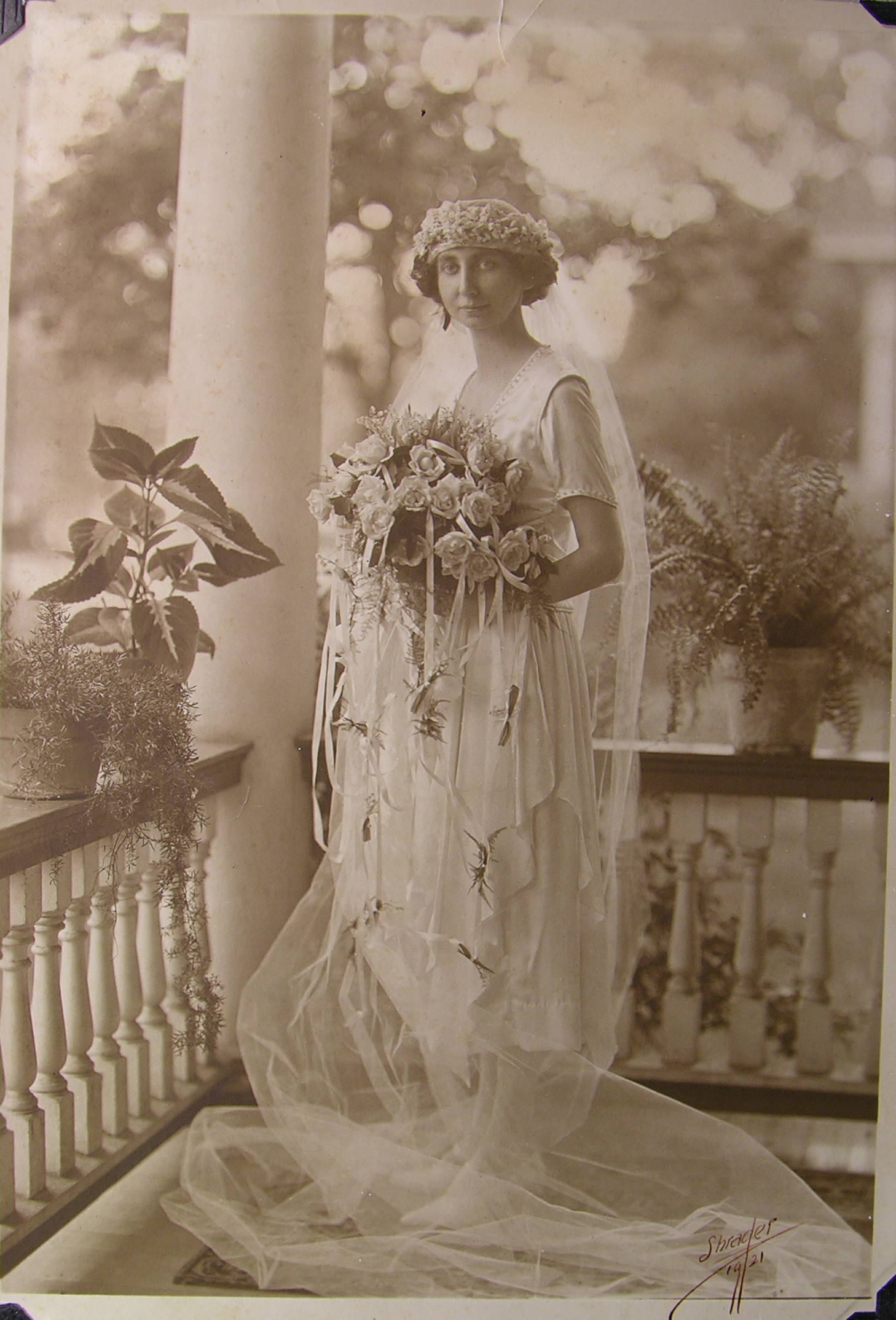
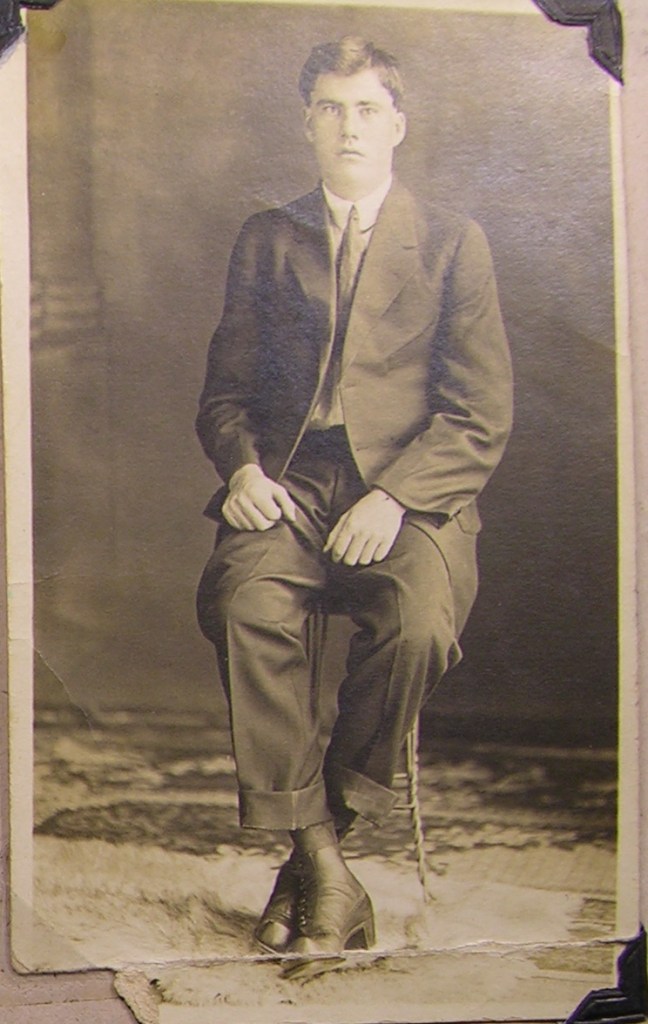
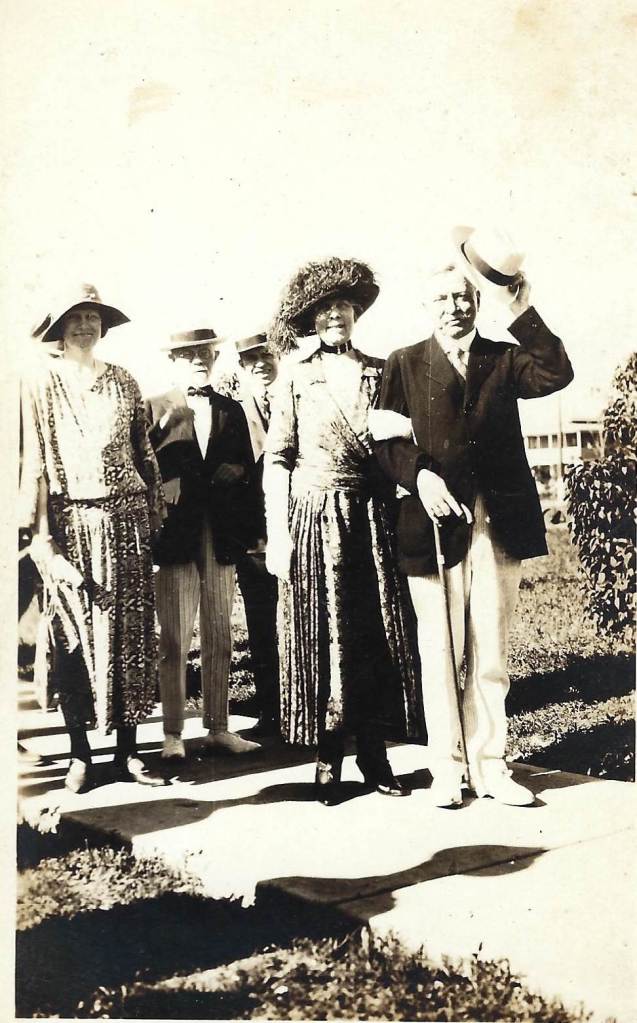
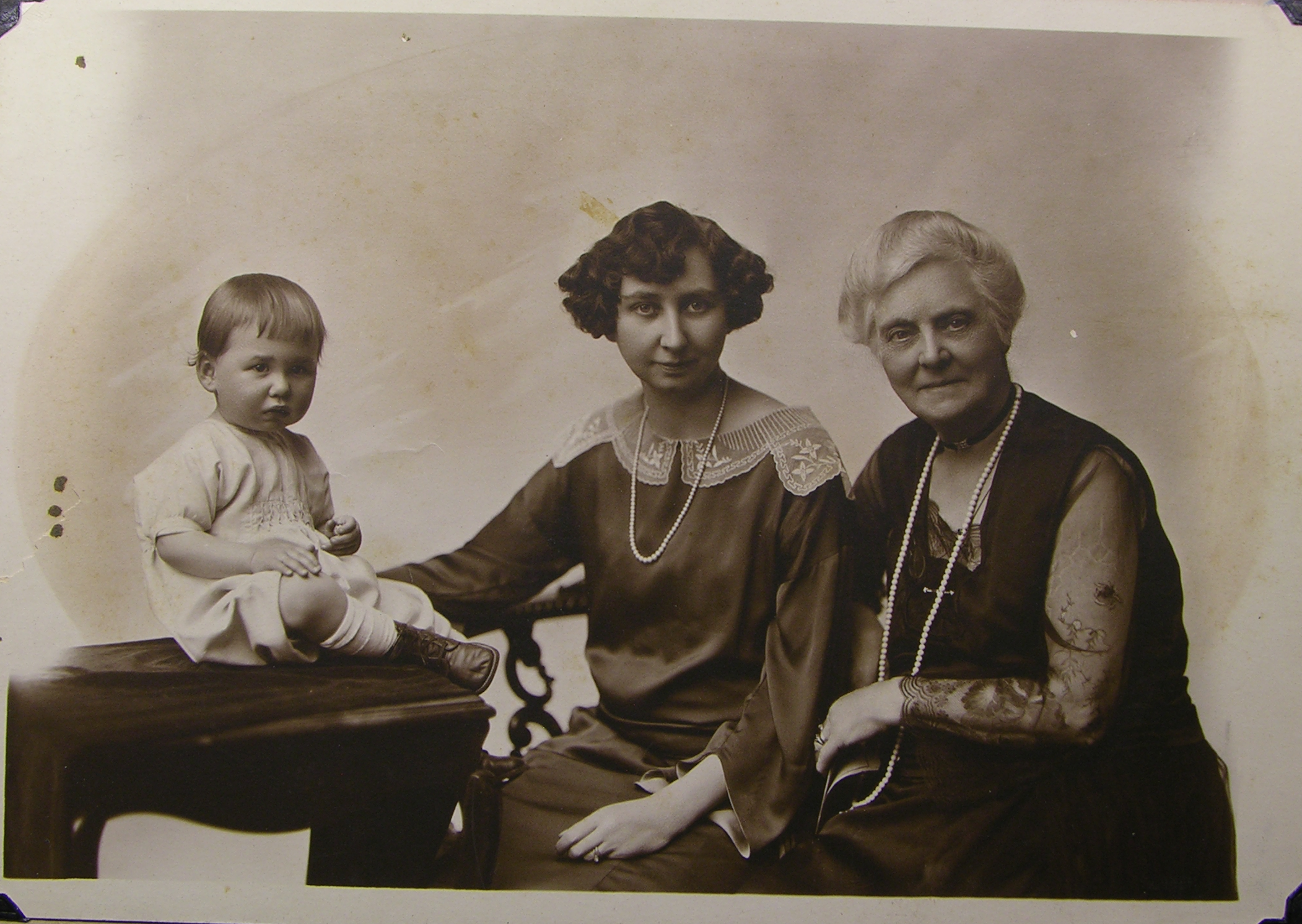
But John swept Frances off her feet and her diary makes plain she was head over heels in love with the handsome devil and loved his siblings, especially his oldest sister Delilah, who mothered Frances and wept bitterly when she learned Frances had been diagnosed with tuberculosis. Knowing Frances loved peanuts, Aunt Lilah would send her shipments of raw peanuts from her and Uncle John Graves’s farm in Grant County when Frances went to Colorado after her diagnosis of tuberculosis, where she spent time in a sanatorium hoping that the higher climate and good air would cure her.
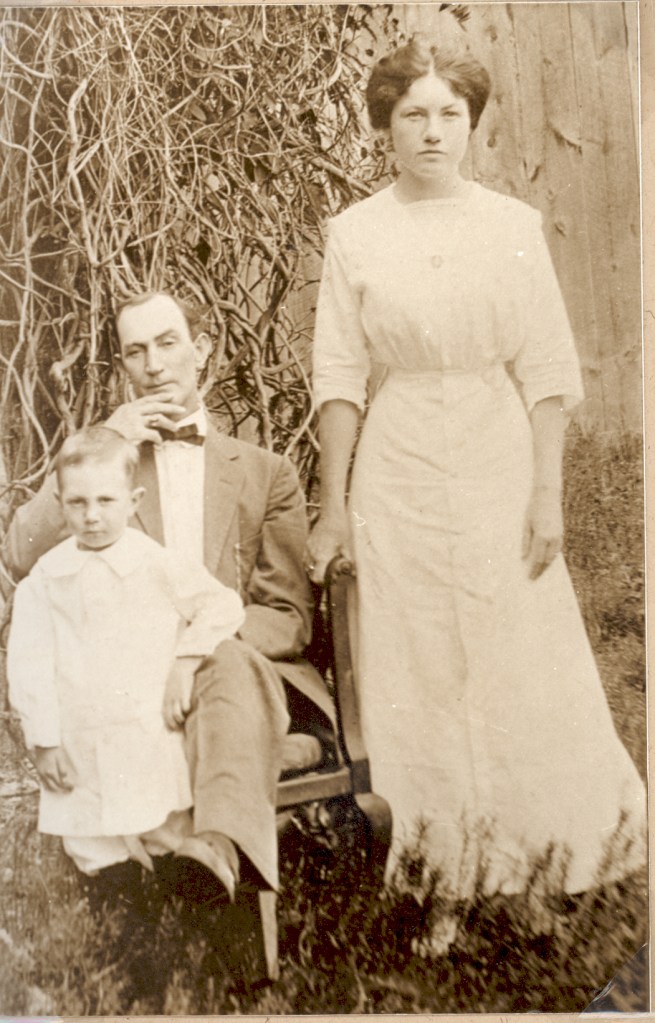
My grandmother Hattie remembered a time Frances was visiting her and my grandmother was in the barn (my mother’s family lived in town but kept milk cows and had a barn and 40 acres behind their house as pasture) milking. She and Frances were talking, and my grandmother told Frances, “Frances, I just feel so inferior to you with your education.”
Frances replied, “Hattie, I feel inferior to you. You can do all kinds of things I can’t do, like milking cows.”
I’m pleased as punch with myself for identifying these two mystery soldiers and figuring out — at least, to my satisfaction — a plausible explanation of why Frances Tucker Batchelor would have had and kept these two photos. It would be wonderful if I could hunt up some relatives of both men who might want to have these photographs that obviously meant much to Frances, since she held onto them.
 BEGATS AND BEQUEATHALS
One thought on “Notes on Identifying Old Family Photos as a Genealogical Project: A “Gathering” of Batchelor Family Photos”