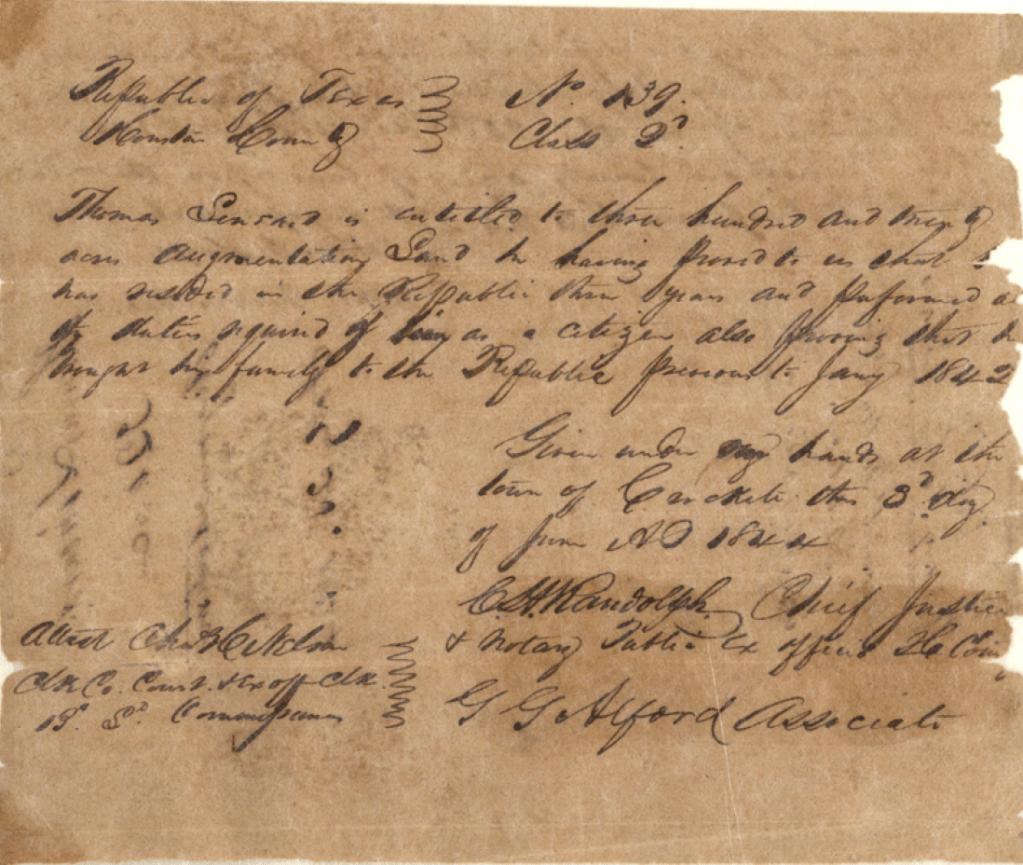
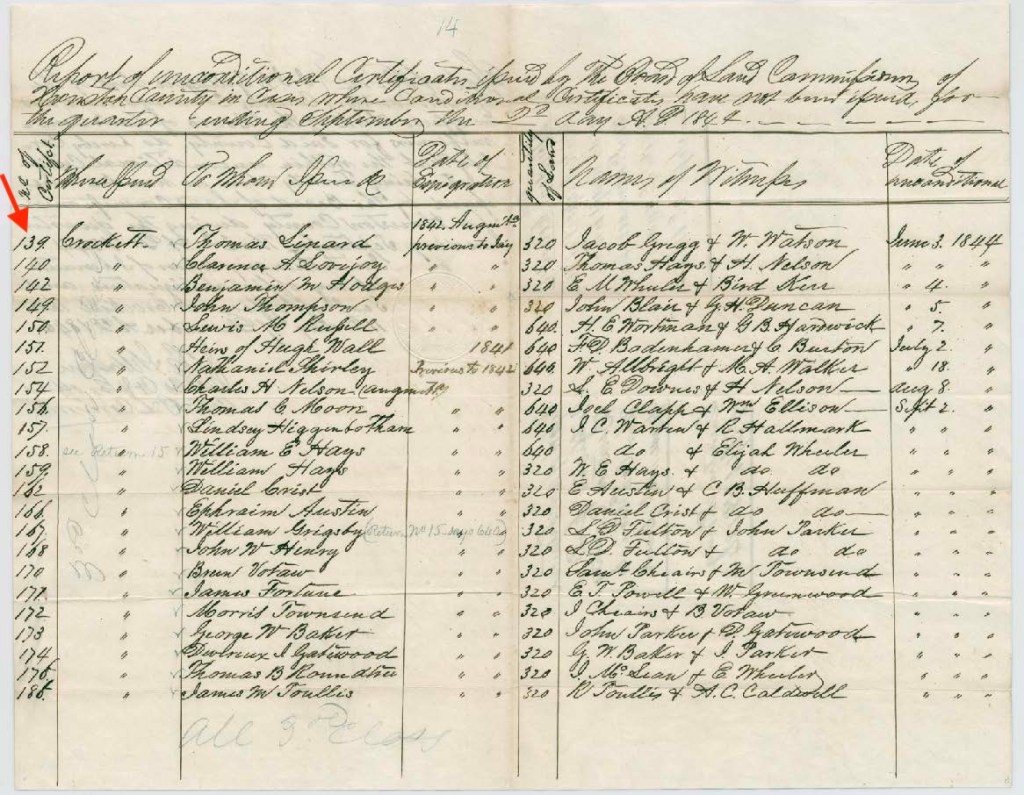
After 2 March 1836, Texas gave headright grants of 640 acres to heads of families who had immigrated to the Republic of Texas prior to 1 January 1842 and who became residents for at least three years. On 1 August 1841 at the office of the land commission of Houston County in Crockett, Thomas received another certificate (no. 139) for 320 acres, bringing the tally of his headright grant to the full 640 acres.[3] This piece of land was also granted to him on 3 June 1844. When Cherokee County was formed from Nacogdoches in July 1845, Thomas’ headright land fell into Cherokee.
Cherokee County is in central east Texas, with its county seat, Rusk, lying 130 miles southeast of Dallas and 160 miles north of Houston. As John R. Ross notes, rapid settlement of what would become Cherokee County began in 1834.[4] The Houston-Forbes treaty of February 1836 assured the neutrality of the Cherokee living in this part of Texas, but increasing settlement of settlers of European descent resulted in violence, precipitating a massacre of members of the Killough family near present-day Jacksonville, Texas, on 5 October 1838. This sparked the Cherokee War of 1839 and the expulsion of all native Americans from the county, causing more settlers of European background to move into the county and claim land.
As my first posting in this series about Thomas Lewis Leonard notes, the 1883 document entitled “Biography of the Leonards” composed by Thomas’ cousin Thomas Dunlap Leonard states that when Thomas and Sarah Lauderdale Leonard moved to Texas, they settled “near Alto where he opened a good farm.” Alto is a small town of some thousand residents about twelve miles southeast of the county seat, Rusk. It was laid out in 1849 on a drainage divide between the Angelina and Neches Rivers — hence its name meaning “high” in Spanish.
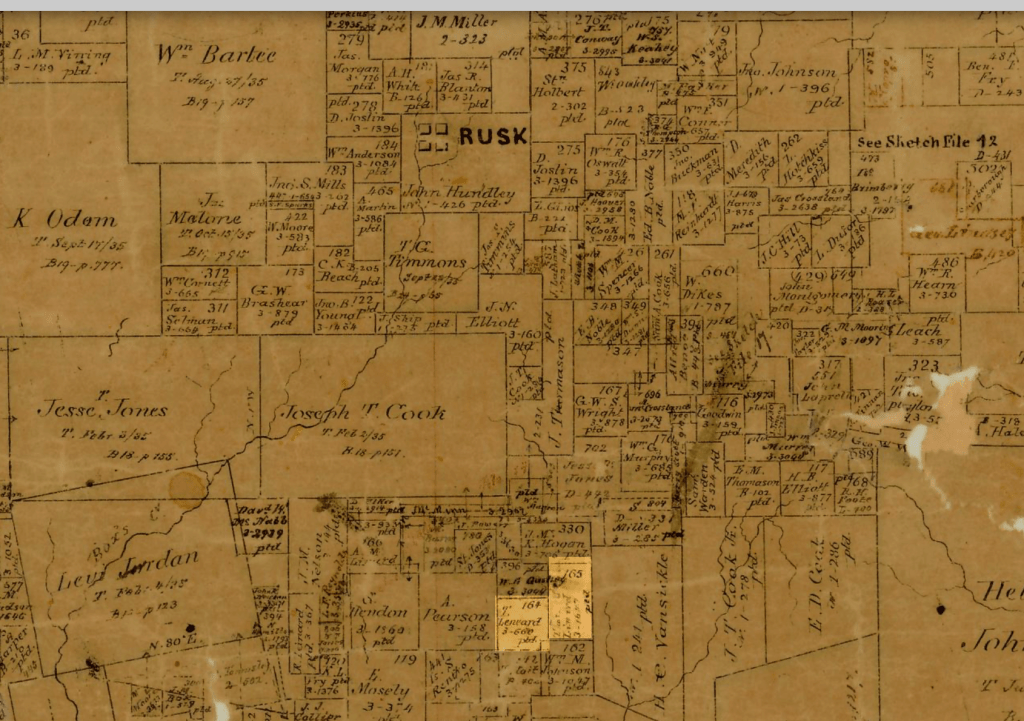
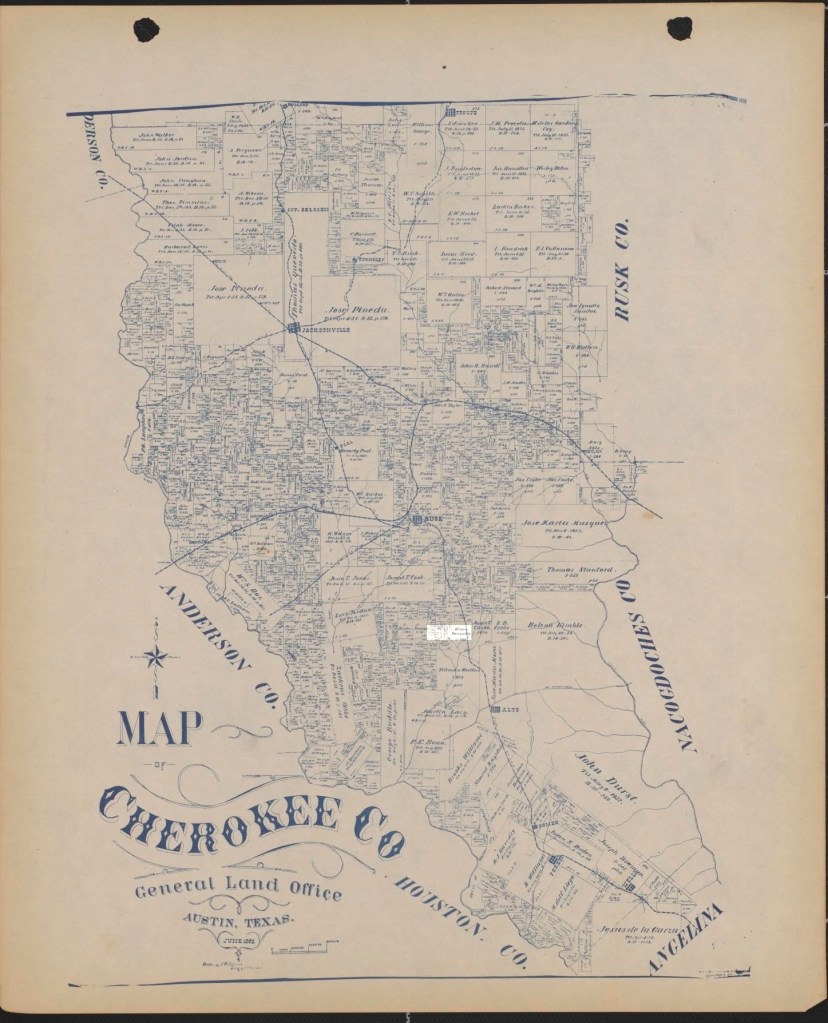
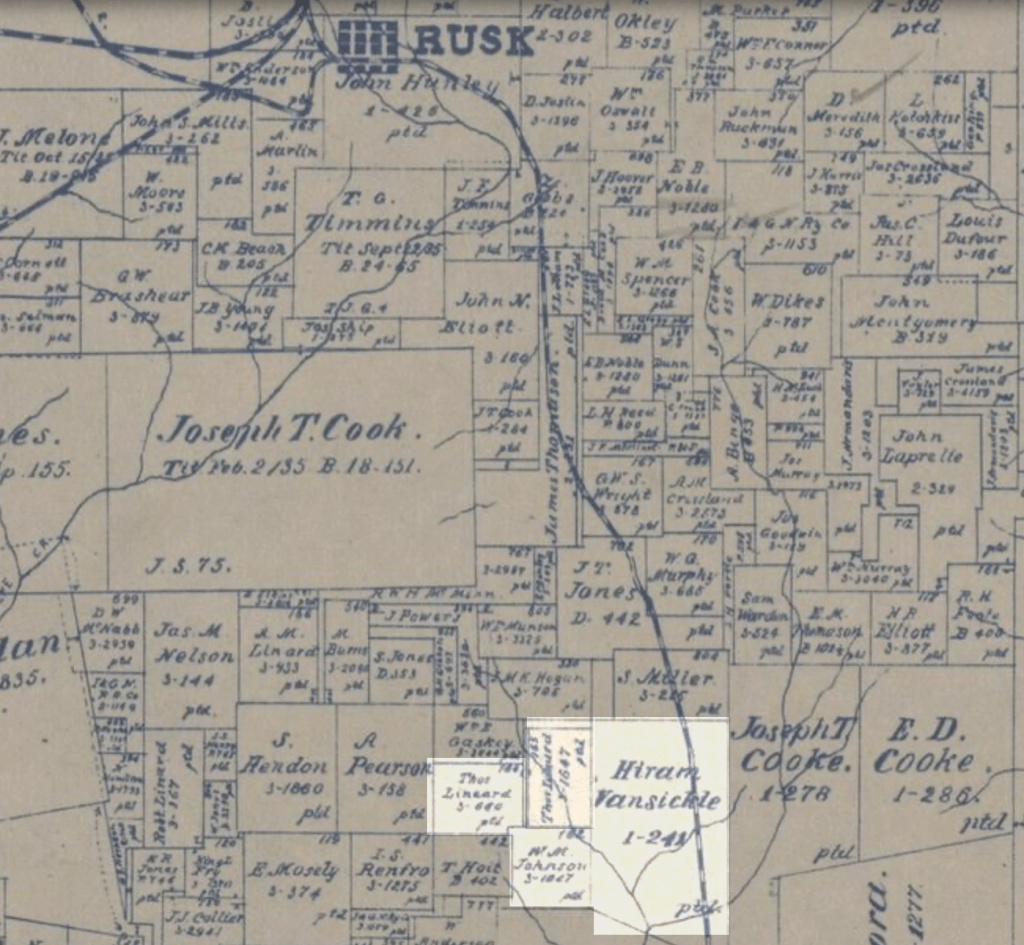
A number of maps of Cherokee County allow us to pinpoint precisely where Thomas’ two headright grants of 320 acres were located. Joseph Martin’s 1851 map of Cherokee County and a 1902 plat map of the county, both drawn for the General Land Office of Texas, show Thomas Linard with two tracts of 320 acres contiguous to each other, bordering Hiram Vansickle’s 1,467-acre survey to the west and bordered on the south by a headright grant tract belonging to Thomas’ son-in-law William Marmaduke Johnston.[5] The shape of the two tracts matches the plats for each 320-acre tract drawn on the surveys found in the GLO files for these two headright grants.
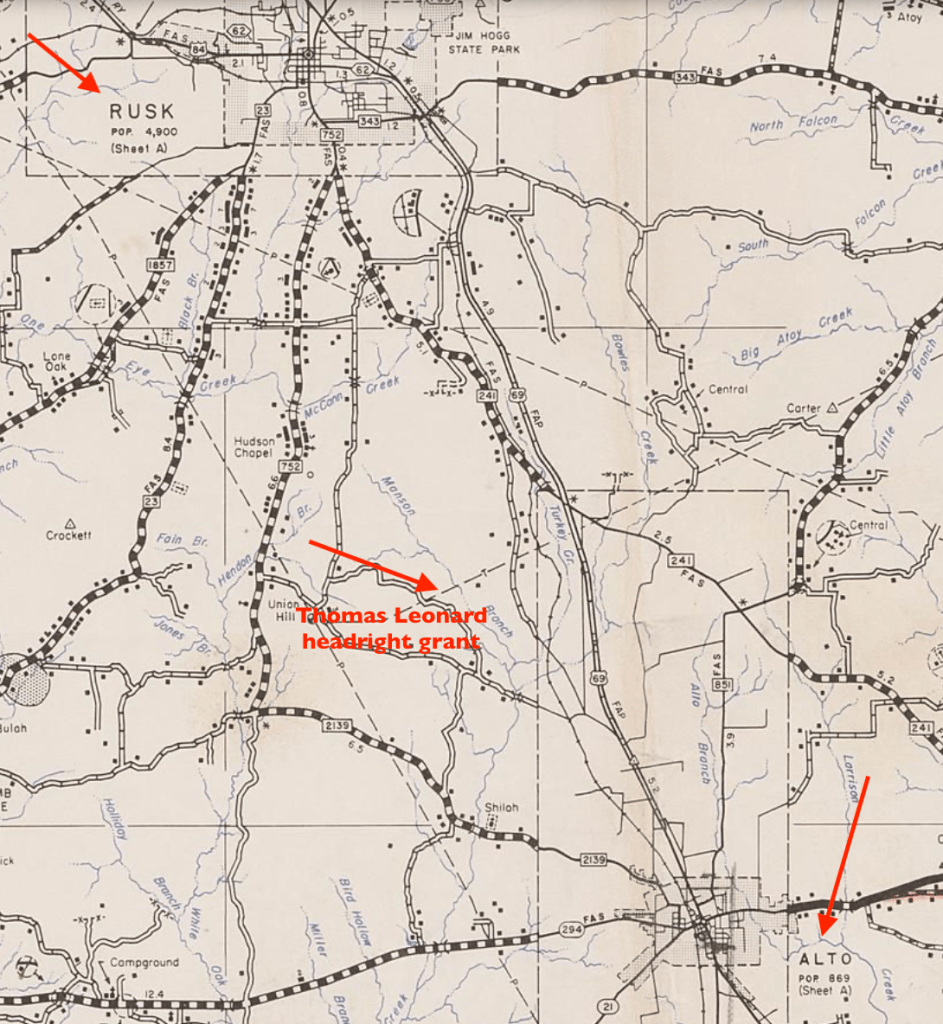
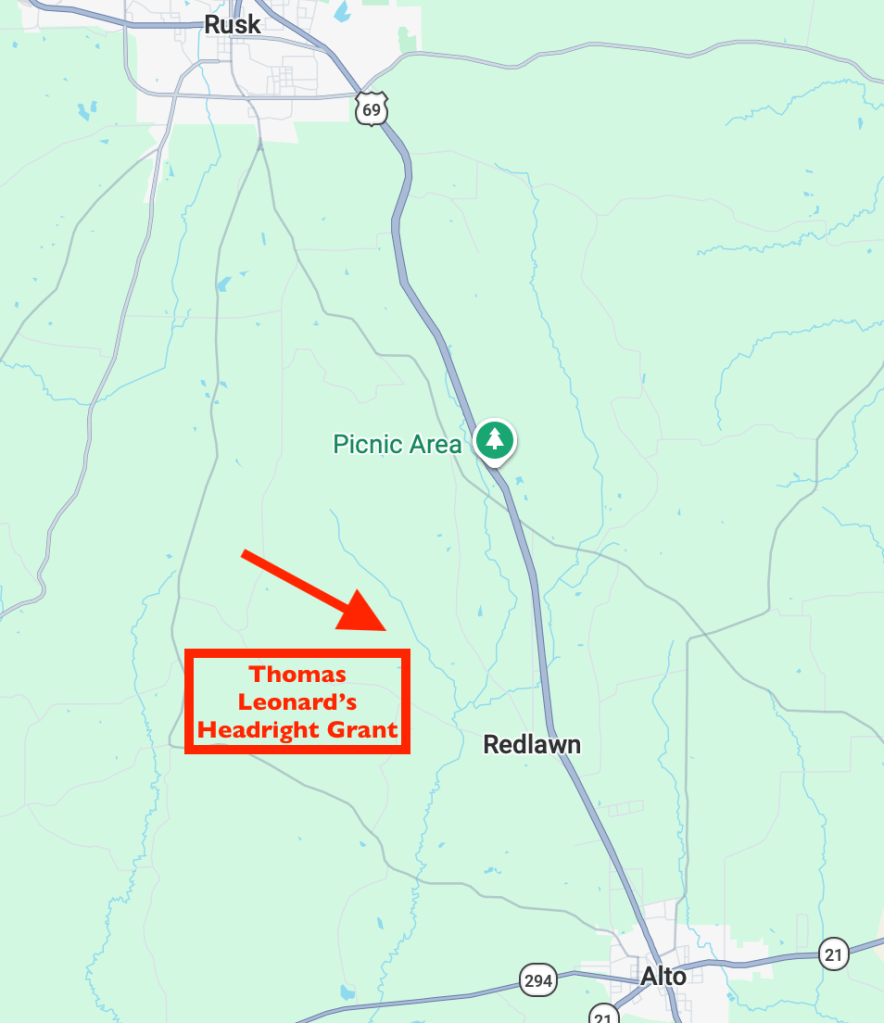
Surveys of both of Thomas Leonard’s 320-acre tracts dated 20 August 1845 state that the land was in Cherokee County on the waters of the River Neches, with the survey for the land granted by certificate 138 stating that it was north of the San Antonio Road and 6½ miles southeast of Rusk and the survey for the land granted by certificate 139 noting that it was about 6 miles south of Rusk. A map prepared in 1960 by the Planning Survey Division of Texas Highway Department and a Google map allow us to place these tracts south of Rusk and north of Alto, west of US highway 69 and just north of the junction of Manson Branch and Turkey Creek, which come together northwest of Alto to form Bowles Creek, a tributary of the Neches River.[6] As we’ll see in a moment, Vansickle’s grant (a portion of which Thomas bought), Bowles Creek, and the Neches River are all referenced in subsequent land records of Thomas Leonard in Cherokee County.
According to Gifford White, who abstracted a number of Texas county tax lists for 1840 and published a book using those tax lists to create a “census” of Texas based on the tax lists, Thomas Linard appears on an 1840 tax list in Houston County taxed for 1,420 acres for which he had a complete title from the General Land Office, and fifteen enslaved people.[7] As I’ve just noted, Thomas obtained a certificate for 320 acres of headright land at the Houston County land office in August 1841, but that land was in Nacogdoches County and fell into Cherokee County in 1845.
I have found no documents suggesting that Thomas Leonard lived or owned land in Houston County, which borders Cherokee on the northeast. As a previous posting states, the 1830 federal census shows Thomas with fourteen enslaved persons and one free man of color in his household, and the 1840 federal census enumerates the household of Thomas’ son-in-law James Birdwell in Natchitoches Parish, Louisiana, with fifteen enslaved persons who, I suspect, were Thomas Leonard’s property. So that information matches what Gifford White is reporting about this 1840 Houston County tax list — the original of which I have been unable to track down and read.
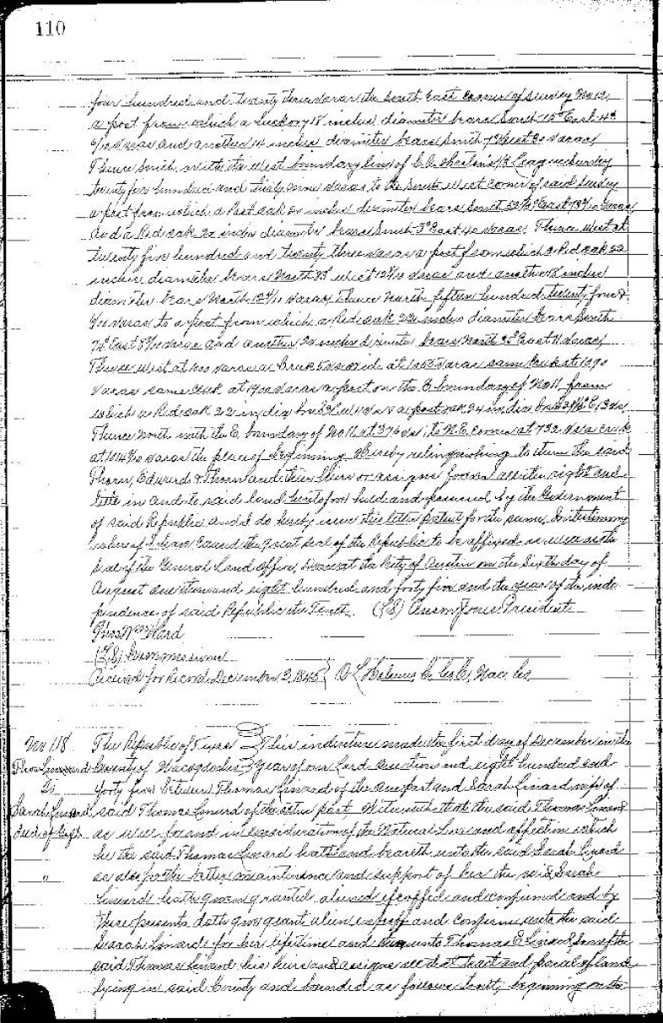
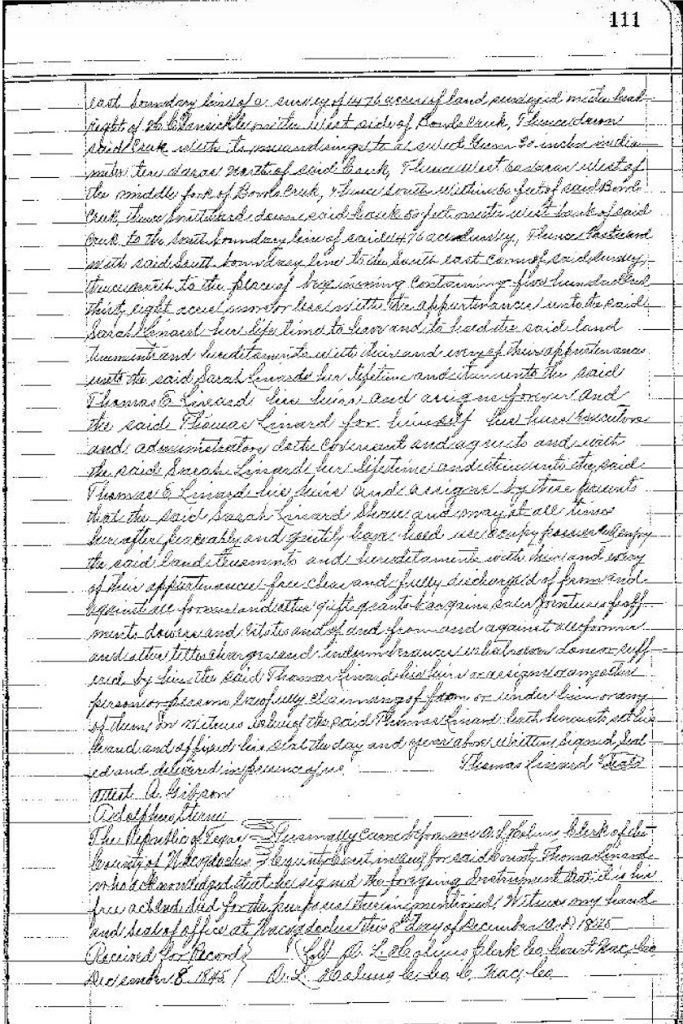
Thomas Leonard appears on an 1845 tax list in Nacogdoches County.[8] On 1 December 1845, Thomas filed three interesting documents. On that date, he sold land to his son-in-law Marmaduke Johnston, and then deeded enslaved persons and land to Marmaduke’s wife Maria, Thomas’ daughter, and land to his (i.e., Thomas’) wife Sarah.[9] The deeds to Maria Johnston and Sarah Leonard were deeds for love and affection — i.e., gifts deeded to these two family members. Since the land Thomas sold to his son-in-law Marmaduke Johnston and the land he deeded for love and affection to Sarah was not the land granted to Thomas as headright land — we know this because Thomas sold the two 320-acre headright tracts on 25 July 1848 and 24 June 1853 while retaining the land on which he was evidently living by 1845 — he had apparently purchased additional land from the Hiram Vansickle survey by this date. I do not have a deed for that land purchase.
The deed for love and affection to wife Sarah states that Thomas was giving Sarah 538 acres bordering Hiram Vansickle’s survey (the land was actually a portion of 1,476 acres surveyed for Vansickle) and with Bowles Creek running through the land. Sarah was to have unhindered ownership and use of the property with its appurtenances. Thomas signed as Thomas Linard, and A. Gibson and Adolphus Sterne witnessed the deed. On 8 December, Thomas acknowledged the deed and it was recorded.
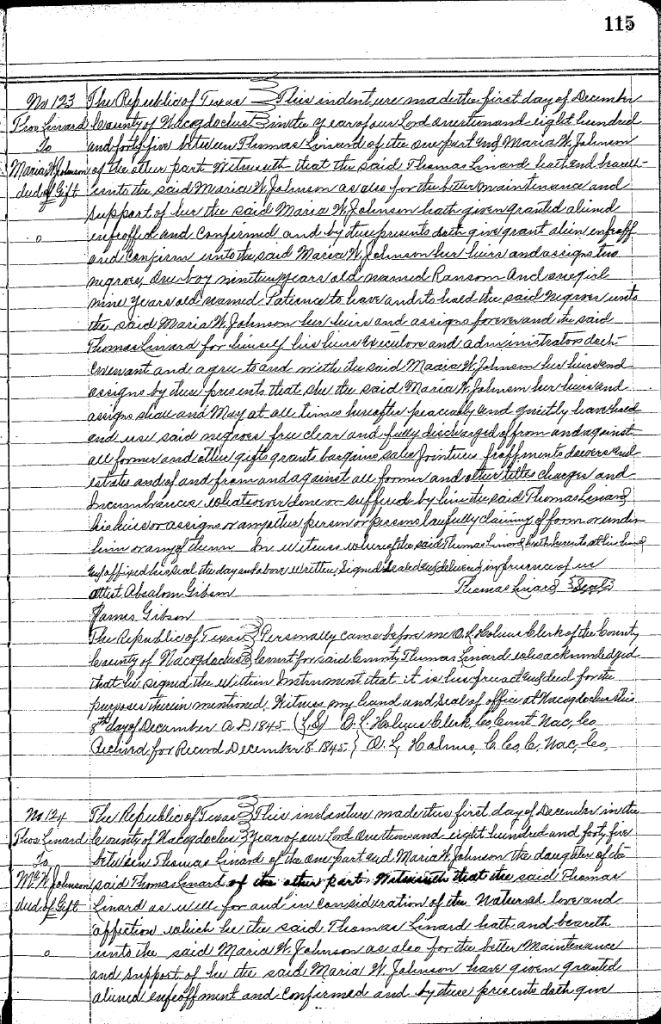
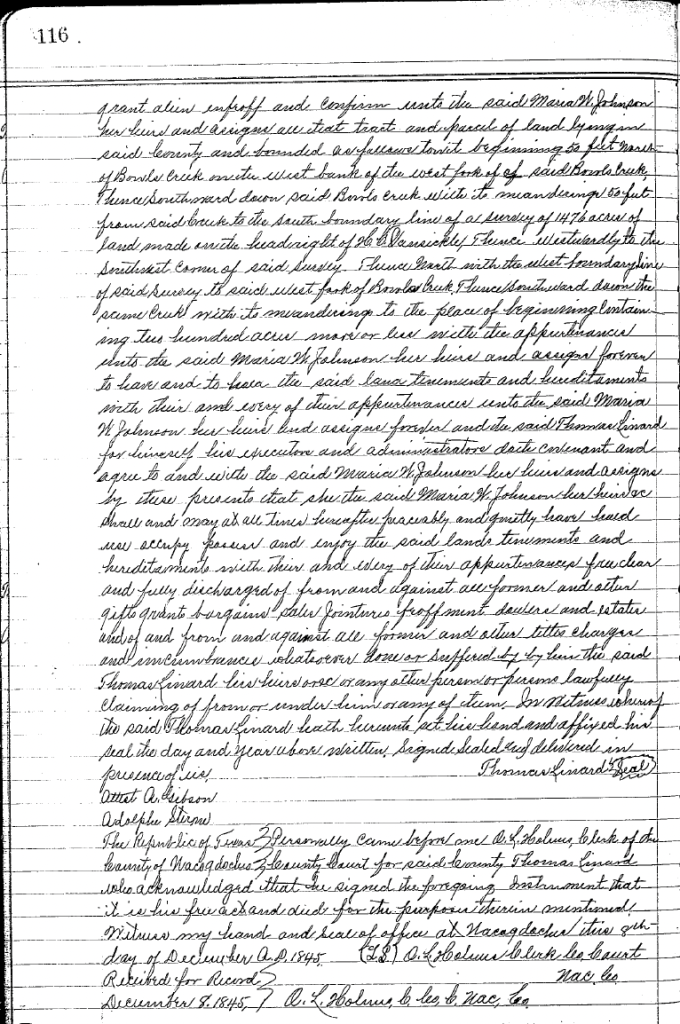
Then on the same day, Thomas made a deed of gift to daughter Maria, naming her as Maria W., wife of Marmaduke Johns[t]on, two enslaved persons, Ransom aged nineteen and Patience aged nine. Thomas signed the deed with Absalom and James Gibson witnessing, with Thomas proving it on 8 December. On the same day, Thomas deeded to Maria for love and affection 200 acres on Bowles Creek with Absalom Gibson and Adolphus Sterne as witnesses.
The curiosity of the deed of gift to Sarah Lauderdale Leonard is that it’s clear from other documents that Thomas and Sarah lived on the 538 acres he deeded over to Sarah in December 1845, and they may, in fact, have been living on this land even as Thomas placed it in his wife’s name. Thomas was taxed for this land consistently from 1849 forward, as we’ll see in a moment, and as we’ll also note, he sold his two headright grants on 25 July 1848 and 24 June 1853, an indicator that by 1848, he was definitely not living on the headright land. So why deed the land to wife Sarah when Thomas clearly maintained control of it — otherwise, he would not have been taxed for the land, but Sarah would have been?
The best answer I can think of for this legal maneuver is that, as we’ve seen previously, Thomas was still being pursued for debt into the late 1840s by creditors he left back in Alabama when he made his move in 1839 to Texas. Perhaps he placed his home piece of land in his wife’s name to escape legal liability should creditors try to garnish or take the land to satisfy debts he had not paid in Alabama.
Another possibility is that Thomas’ family members thought he was not managing his finances well and wanted the land out of his legal possession in order to protect it from being sold away. I suggest that possibility because, as we’ve seen previously (and here), precisely this sort of drama took place in Sarah Lauderdale Leonard’s family when she was a girl in Pendleton District, South Carolina, when her father John Lauderdale deeded his home tract of land in January 1795 to Sarah and her brother James, with the deed stating that he was taking that step because he had wasted and run through an inheritance given to them by their grandfather. As the two postings I’ve just linked indicate, it appears that this inheritance came to the two children from their maternal grandfather John Mauldin, and that members of the Mauldin family were leaning on John Lauderdale to place his land in his children’s name due to his profligate ways.
A note about the three men who appear as witnesses to Thomas Leonard’s deeds in December 1845: Absalom Gibson (1804-1884) was a judge and surveyor in Nacogdoches and Cherokee Counties who came to Nacogdoches with his family from Tennessee in 1833 or 1835 and later lived in Angelina County.[10] James Gibson (1826-1899) was Absalom’s son.[11] The 1850 federal census shows the family of Absalom Gibson living next to that of Thomas Leonard’s son Alfred Murray Leonard in Cherokee County.
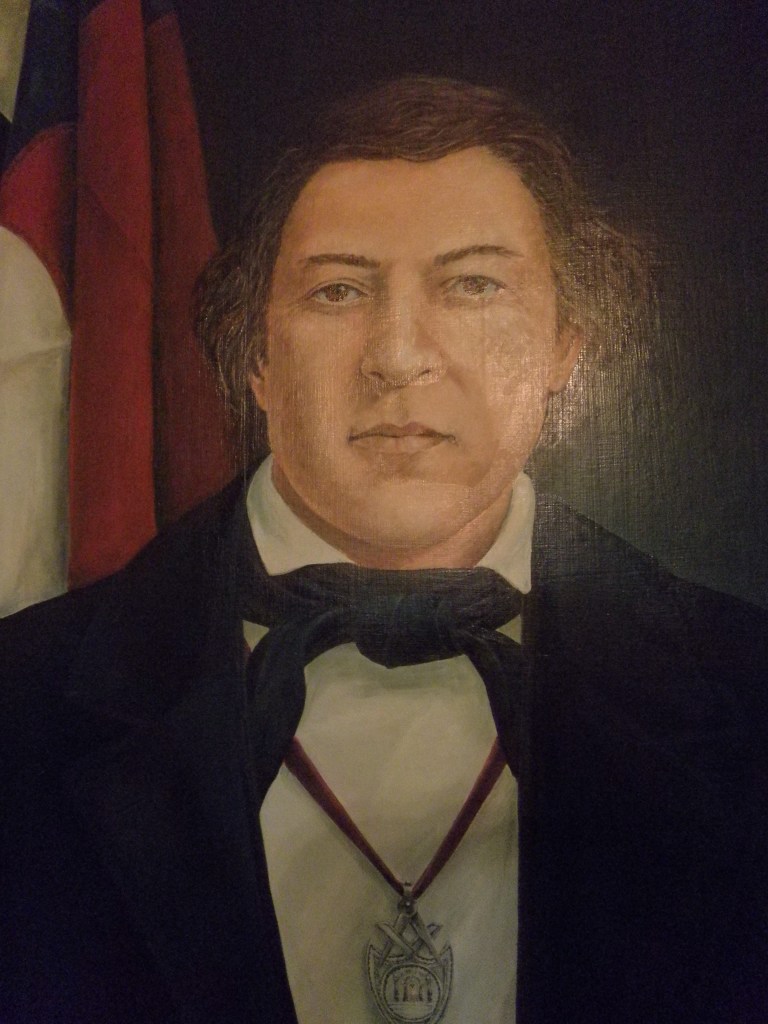
Adolphus Sterne (1801-1852) was a German-born Jewish colonist and financier of the Texas Revolution, who was a merchant and legislator.[12] In 1847 he was elected to represent Nacogdoches in the House of Representatives of the Second Legislature. The Sterne-Hoya House Museum in Nacogdoches commemorates Sterne, his family, and his contributions to the history of Nacogdoches.
According to researcher Nancy Breidenthal, on 31 December 1847, Thomas Leonard purchased property from his son A.M. (Alfred Murray) Leonard. This information appears in notes Nancy sent me a number of years ago, citing the deed index for Cherokee County, Texas, without stating a specific deed book or page number for this deed, and without providing details regarding the property Thomas purchased from his son.
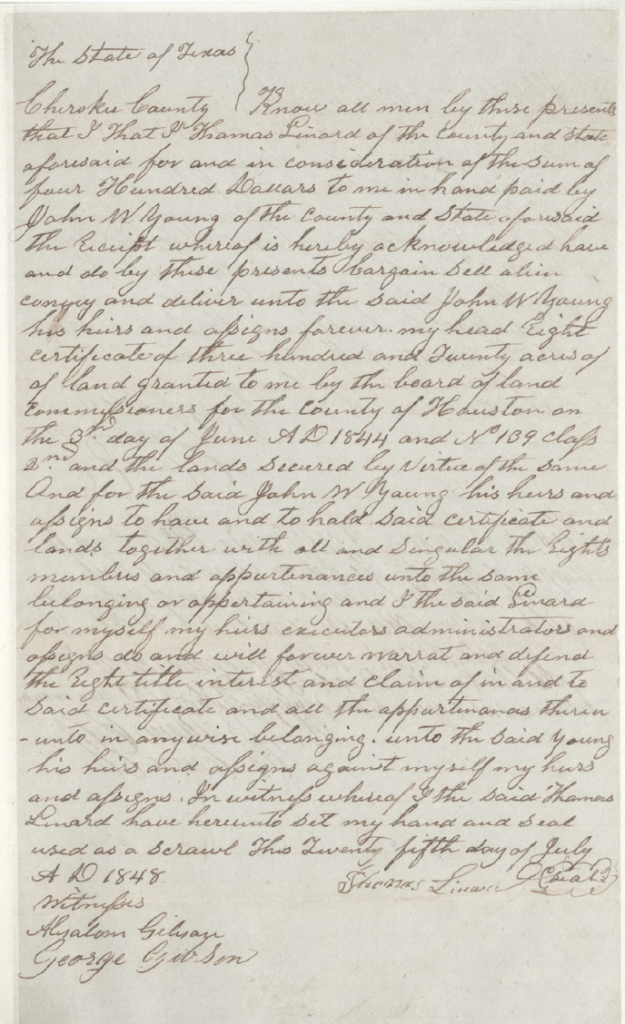
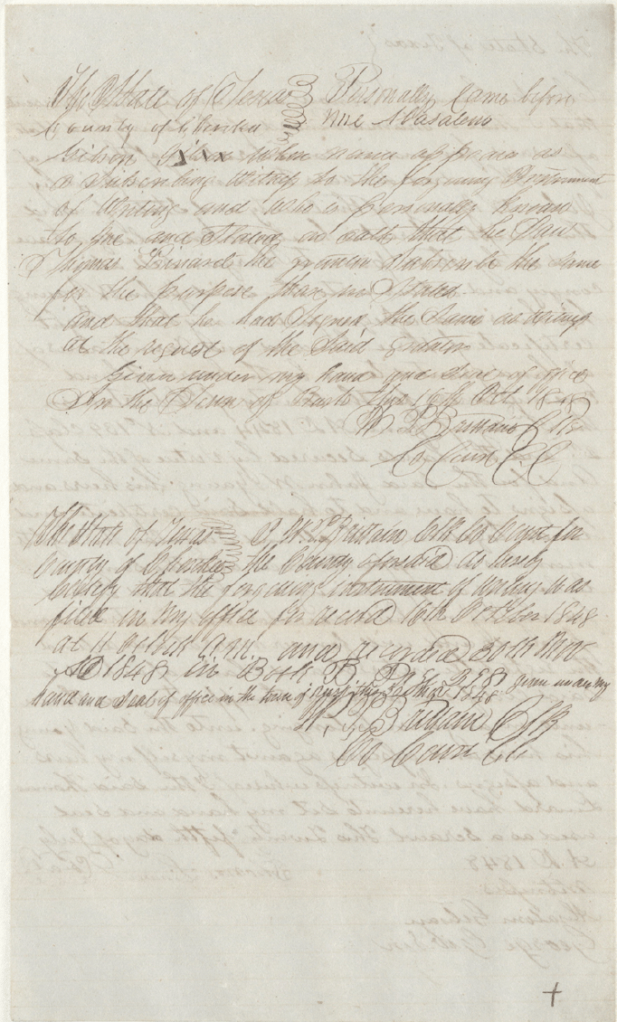
On 25 July 1848, Thomas Leonard sold one of his two headright grants, the tract he had been granted by certificate no. 139.[13] He sold this land for $400 to John W. Young, with Absalom and George Gibson witnessing as he signed the deed. Absalom Gibson proved the deed on 16 October 1848 and it was recorded on 30 November. The original deed is filed with the Texas GLO for this tract of land.[14]
Thomas’ daughter Maria W. Leonard Johnston died in Cherokee County on 20 September 1848.[15] After this, the probate minutes books of Cherokee County show ongoing litigation by Maria’s father Thomas that appears to have begun in December 1849. The litigation had to do with his appeal for guardianship of Maria’s children on the ground that Marmaduke Johnston was wasting their estate. Thomas was granted guardianship with no contestation on the part of Marmaduke Johnston, who remarried to Martha Vinning in Cherokee County on 13 February 1851. Probate minutes indicate that Maria died owning two enslaved persons (evidently Ransom and Patience named in Thomas’ December 1845 deed of gift to Maria) and 150-175 acres of land, and it appears that this property spurred Thomas Leonard’s litigation on behalf of her children Cornelia A., Alfred Thomas, Minerva E., William Edwin, and Mary Martha Elizabeth. Probate court minutes for 29 July 1852 show Thomas selling Ransom, the enslaved man he had deeded in 1845 to Maria, for the benefit of her heirs.
Thomas appears on the on the 1849 tax list in Cherokee County as Thos. Leonard, taxed for 538 acres worth $1,076 granted to H. Vansickle in a grant for 1,476 acres, and thirteen enslaved persons worth $3,900, with six horses worth $130.[16] His son Alfred M. is listed long with his father, perhaps because the two were farming together, and has one enslaved person. The tax list also states that Thomas has 320 acres worth $160 granted to him — his remaining headright tract, that is.
The 1850 tax list in Cherokee County shows Thomas Linard taxed for 593 acres, with a notation that this land was out of Hiram Vansickle’s survey of 1,476 acres.[17] The land is valued at $1,614. Thomas is also taxed for eleven enslaved persons valued at $3,850 and five horses valued at $300. Listed next to Thomas is his son Thomas E. Linard, with no property recorded; it appears the two were farming together. Thomas Edwin Leonard was twenty-one years of age in 1850. On the same page is Thomas’ son Alfred M. Linard taxed for 593 acres out of Hiram Vansickle’s tract and 320 acres — that is, Alfred is taxed for the same land for which his father is also taxed. This tax list offers further evidence that Thomas and his son Alfred may have co-owned the land he (or they?) had purchased from Hiram Vansickle’s survey. Alred M. Linard is also taxed for two enslaved persons.
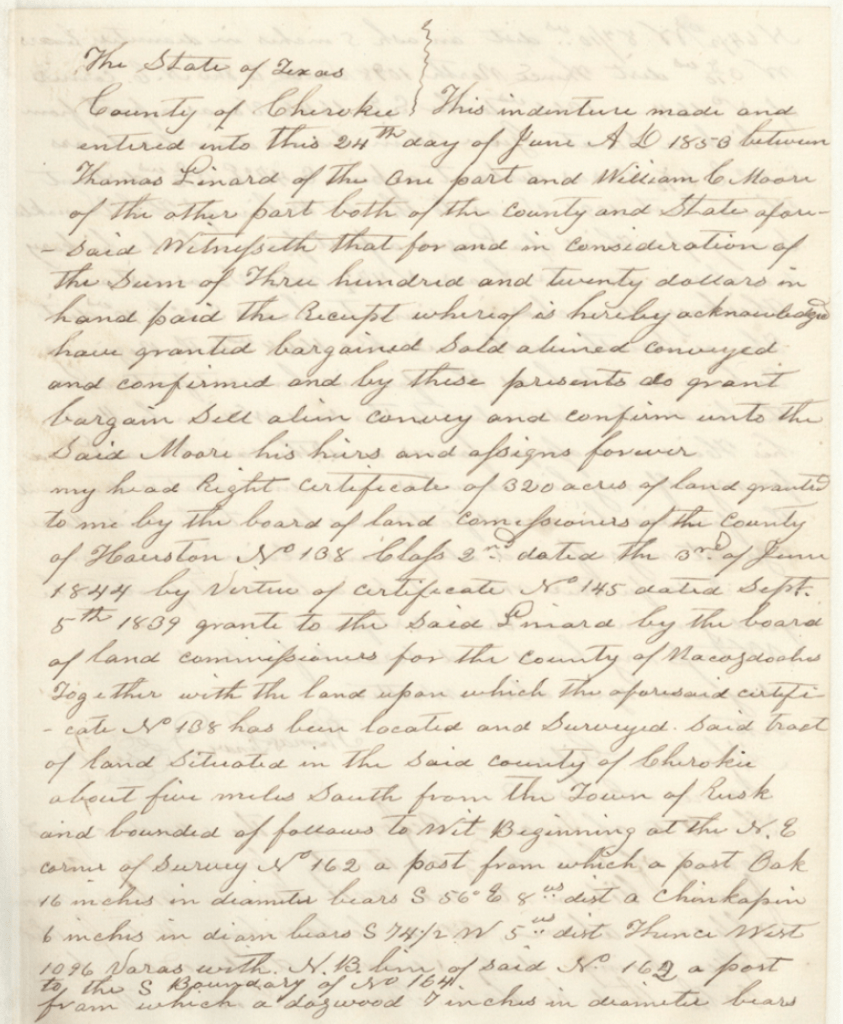
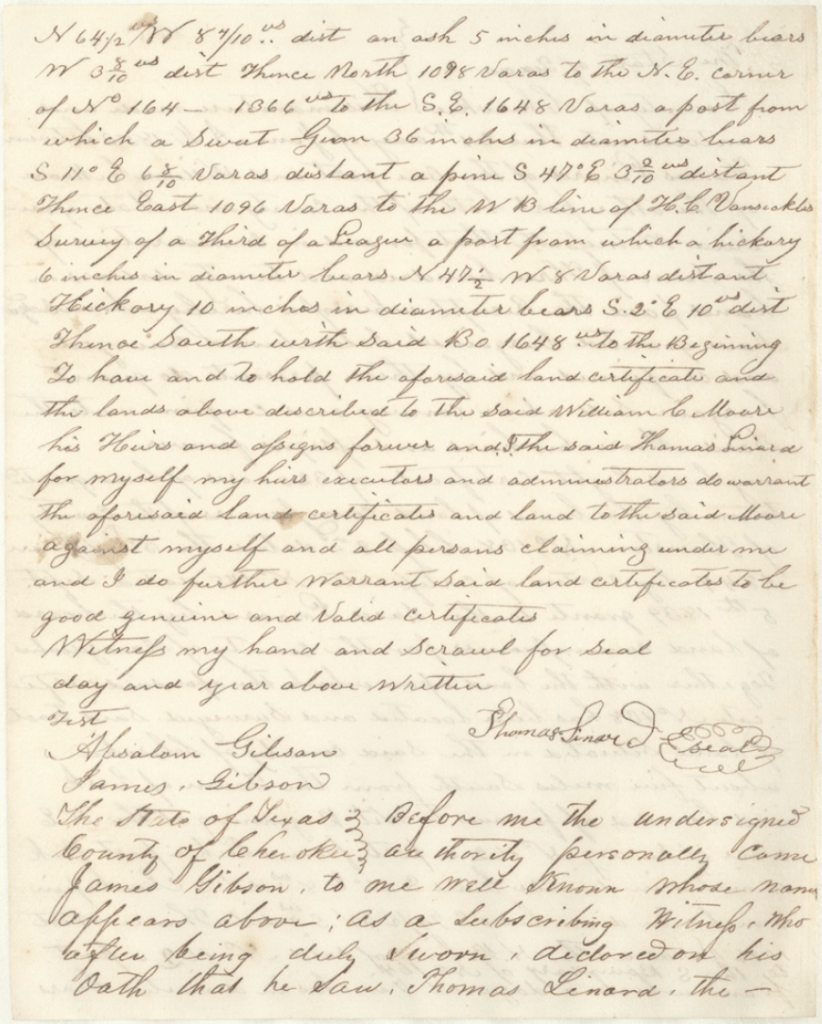
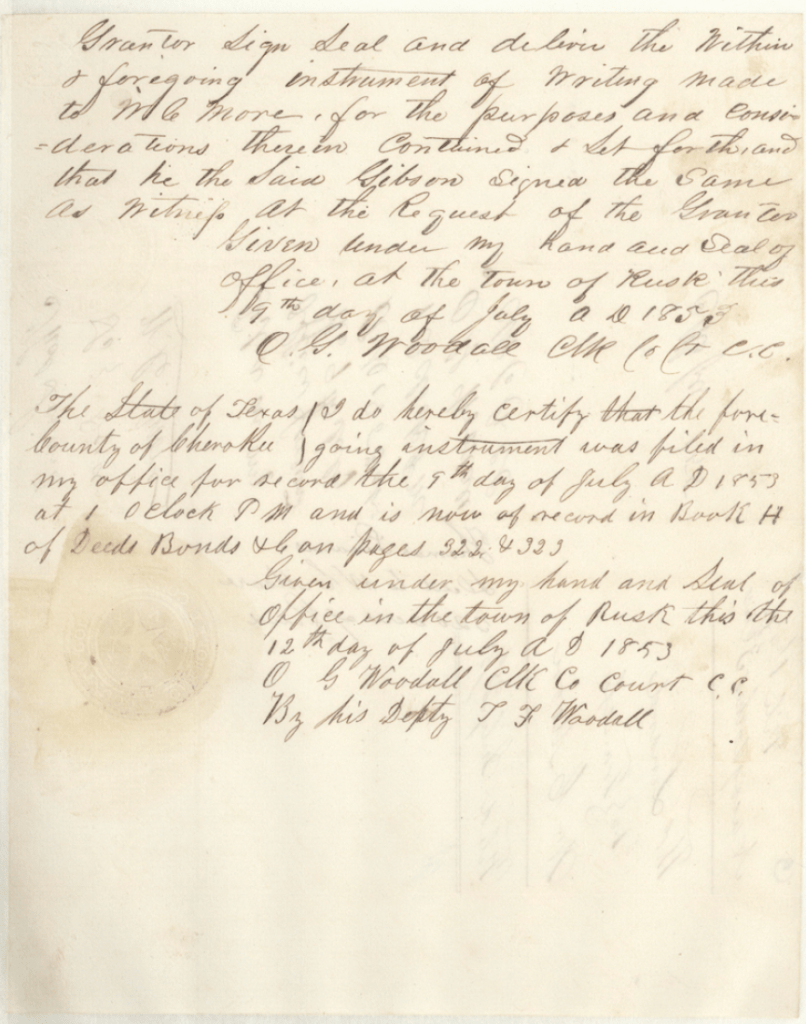
NOTE: The following is out of chronological order, because I misread the year 1853 as 1850 in the deed above when I composed this posting. I cannot move this material to the correct place in the narrative without messing up the footnotes: On 24 June 1853, Thomas Leonard sold his remaining piece of headright land to William C. Moore for $320, with Absalom and James Gibson witnessing as he signed as Thomas Linard.[18] James Gibson proved the deed 9 July 1853 and it was recorded on the 12th. Later in 1850 on 8 November, Thomas sold property to A.B. (Andrew Bogle) Criswell (1814-1864), who had come to Cherokee County from Talladega County, Alabama.[19]
The 1850 federal census enumerates Thomas Leonard in Cherokee County.[20] The census shows only two members of the household, Thomas himself and his son Thomas E., whose name is given as Thomas A. Thomas elder is aged 69, a farmer born in Maryland with real property valued at $3,000. Thomas A. is aged 21, is a farmer, and was born in Alabama. Sarah Lauderdale Leonard is enumerated in the household of the family living next to Thomas Leonard and his son: she’s listed as Elizabeth Leonard, aged 64, born in Georgia, in the household of Peter and Patience King.[21] Note that Elizabeth’s age and place of birth match the documented date and place of birth of Thomas Leonard’s wife Sarah M. Lauderdale.
It’s not clear to me why Thomas’ wife Sarah would be living apart from him in 1850 in the household of a seemingly unrelated family next-door to her husband. By 1860, the federal census shows Thomas and wife Sarah living together again in the household of son Alfred, so if this was some sort of separation, it appears to have been temporary. It does make me wonder all over again about Thomas’ deed of gift of his land in December 1845 to Sarah — when one document after another shows him continuing to own and control and be taxed for this land after 1845.
The 1850 federal slave schedule shows Thomas, whose name appears to be spelled Thos. Leinard, owning eleven enslaved people in Cherokee County, males aged 54, 30, 19, 10, 4, and females aged 35 (two), 20, 17, 6, and 2.[22] All are listed as black. Listed next to Thomas on this slave schedule is William Marmaduke Johnston with two enslaved persons.
The 1850 agricultural schedule enumerates Thomas in Cherokee County with 100 acres of improved land and 400 unimproved acres, and a farm valued at $3,000, with machines and tools valued at $400, six horses, nine milk cows, four oxen, twenty other cattle, and sixty swine.[23] The livestock are valued at $600. The farm has produced in the last year 1,000 bushels of corn, twenty-four bales of ginned cotton @400 pounds per bale, 200 bushels of peas and beans, 100 bushels of sweet potatoes, and 300 pounds of butter. It has also produced homemade manufactures valued at $50, with slaughtered animals valued at $100. Listed next to Thomas is P. King in whose household wife Sarah appears to be living in 1850.
In 1851, Thomas Leonard is taxed in Cherokee County, TX, for 538 acres worth $1,200 granted to H. Vansickle, and 205 acres worth $410 granted to James T. Cook, 14 Negroes worth $6,600 and 6 horses worth $350.
On 5 February 1853, Thomas bought property in Cherokee County from A.B. Criswell.[24] I have no further details about this deed record. On Thomas’ sale of his remaining 320-acre headright grant in June 1853, see above.
In 1853, Thomas appears as Thomas Lenard Sr. on the Cherokee County tax list, taxed for 538 acres worth $1,200 from the Vansickle tract, and for 205 acres worth $400 originally granted to James T. Cook.[25] Thomas is also taxed for twelve enslaved persons worth $5,600 and five horses worth $350. In addition, as guardian of the heirs of M. Johns[t]on, Thomas is taxed for 200 acres of land valued at $400 out of the Vansickle grant, along with an enslaved person valued at $600. I suspect this is Patience, who had been deeded to Maria Leonard Johnston as a deed of gift by Thomas in December 1845. Next to Thomas on the tax list is his son Alfred Murray Leonard, taxed for 600 acres of Vansickle land valued at $1,200 and two enslaved persons also valued at $1,200.
As has been noted previously, the 1855 tax list for Cherokee County gives Thomas a middle name: he appears on this tax list as Thomas Lewis Linard, and is taxed for 400 acres worth $1,800 from the Vansickle tract, along with eleven enslaved persons worth $5,000 and five horses worth $250.[26] Thomas is also taxed again as guardian of his daughter Maria’s children for 400 acres of Vansickle land and one enslaved person. Next to him is his son Thomas, listed as junior, with no taxable property; he is obviously farming with his father. Also taxed beside Thomas Sr. and Jr. is A.M. (Alfred Murray) Leonard, who is taxed for 428 acres of Vansickle land and 265 acres from James T. Cook, as well as three enslaved persons.
The 1860 federal census enumerates Thomas and wife Sarah in the Cherokee County household of their son Alfred and wife Mary M. McGaughey Leonard.[27] Thomas is aged 79, a farmer born in Maryland. Wife S.M. is 75, born in Georgia. Both are literate. As household head, A.M. Leonard has a real worth of $2,560 and personal worth of $9,423. It’s clear to me that in his advanced years, by 1860, Thomas had turned over management of his farm and property to his son Alfred. The 1860 slave schedule for Cherokee County lists Thomas with one enslaved person, a boy aged six, and shows his son A.M. Leonard (next to Thomas) with twelve enslaved persons: the eleven enslaved persons of Thomas in 1850 have now become twelve enslaved persons listed in the name of his son Alfred.[28]
The deduction that Alfred is now managing his father’s farm is reinforced by the 1860 agricultural schedule for Cherokee County, which lists only A.M. Leonard, and has no listing for his father Thomas.[29] A.M. Leonard has 150 acres of improved land and 170 acres unimproved, with the land valued at $2,560. The agricultural schedule shows Thomas and his son Alfred continuing to operate a robust farm — with the labor of enslaved people, obviously. The farm has three horses, four mules, sixteen milk cows, three working oxen, fifty other cattle, fifteen sheep, and fifty swine, all valued at $915. In the past year, it produced sixty bushels of wheat, 1,500 bushels of corn, twenty bushels of oats, fourteen bales of ginned cotton @400 pounds per bale, and fifty pounds of wool. It also raised twenty bushels of peas and beans, eight bushels of Irish potatoes, forty bushels of sweet potatoes, and produced 100 pounds of butter, twelve pounds of beeswax and twelve of honey, with slaughtered animals valued at $50.
Found next to the family of A.M. Leonard on the 1860 census, and also on both the slave and agricultural schedules is his brother Thomas E. Leonard. Thomas E. has a real worth of $2,360 and personal worth of $730. In his household are two small children, a daughter S.E. and son A.M., whose name was probably Alfred Murray Leonard. Also in the household is his niece Mary Martha Elizabeth Johnston, daughter of his sister Maria. The 1860 slave schedule shows him with one enslaved person. The entry for him on the 1850 agricultural schedule next to his brother Alfred is crossed through and only partly filled in.
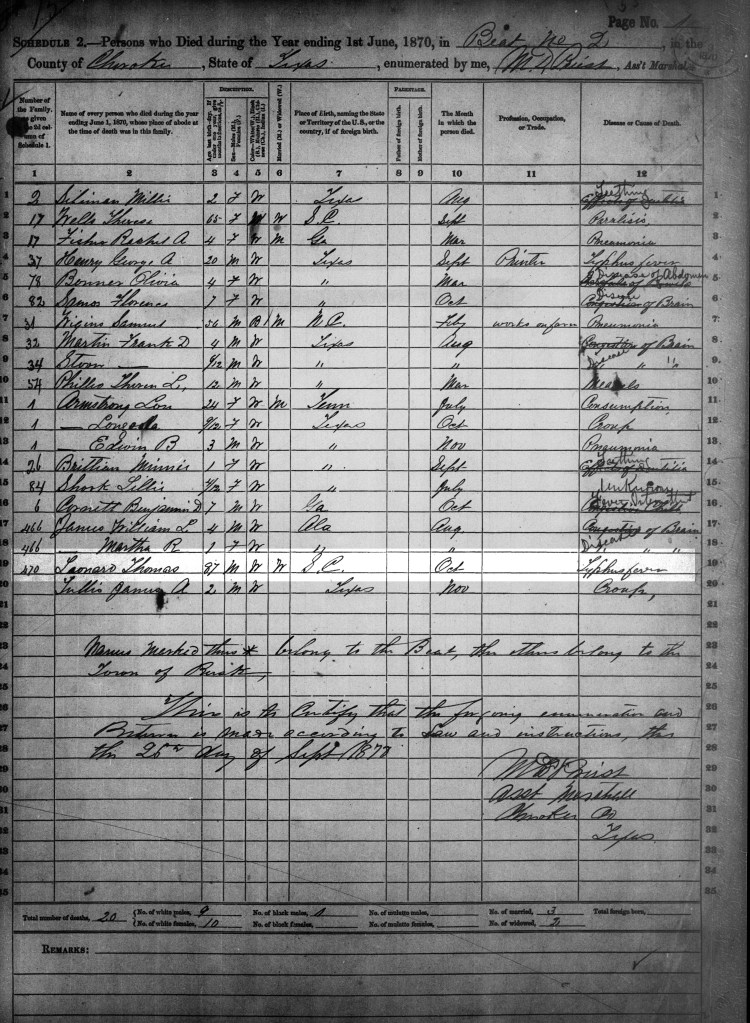
The 1870 mortality schedule for Cherokee County shows Thomas dying in October of that year of typhoid fever.[30] His age is given as 87, and his place of birth (erroneously) as South Carolina. This document indicates that Thomas was living in household 470 in beat 2 at the time of his death; the federal census for that year shows that this was the household of his daughter Cynthia, widow of James Reuben Blanton.
I have not found precise information about when Sarah Lauderdale Leonard died. Thomas Dunalp Leonard’s 1883 manuscript “Biography of the Leonards” says, “Sarah died several years before him.” A communication that researcher Nancy Breidenthal sent me on 20 September 1998 states that she had been in touch with a descendant of Thomas and Sarah who thought that Sarah died about 1866 in Cherokee County. Since Sarah does not appear on the 1870 federal census, it does seem that she died in the decade 1860-1870, and likely predeceased Thomas.
I have not been able to find any information about where Thomas and Sarah might be buried, and can find no estate records for Thomas. A prefatory note to Helen Woodell Crawford’s Early Probates and Wills of Cherokee County, Texas says that her book was compiled from the original old probate and will papers of the county, many of which were never listed in the probate books.[31] Crawford notes that during the early 1970s, several hundred of these papers were apparently stolen before her work was completed. Her book lists no Leonard estates.
Thomas Dunalp Leonard’s “Biography of the Leonards” states that Thomas and Sarah Lauderdale Leonard “lived to see all but two of their children buried, namely Syntha and Alfred,” and that the couple “lived many years as consistent members of the Baptist Church, as did the greater part of their children.” As we’ve seen previously, Thomas and Sarah belonged to Round Island Baptist church in Limestone County, Alabama, before they made to Texas, but church minutes show both being excluded from membership in the early 1820s. I have no further record of their church connections.
Thomas Dunlap Leonard, who continued his close ties to the family of his uncle Thomas Leonard after his father Robert Leonard moved to Nacogdoches (later Cherokee) County, Texas, in 1840,[32] says the following about Thomas, his wife Sarah, and their children:
Thomas’ daughters all married in Limestone Co Al. He brought up an excellent family. He was one of Limestone’s best citizens, no man stood higher as a good man than Thomas Leonard. His wife was his equal in all duties of a companion. She by her example and precepts impressed her good qualities on her daughters so firmly as to prepare them for all the duties of a companion. I had the acquaintance and have been in all their families and know them to be excellent ladies. They in turn taught their children to recognize all those hightoned principles that constitute good citizens and christians.
In a subsequent posting, I’ll provide information about the children of Thomas and Sarah Lauderdale Leonard.
[1] Limestone County, Alabama, Deed Bk. 5, pp. 567-8.
[2] See Texas General Land Office land grant file 1647, patent volume 9, patent number 595, certificate 138, available digitally at the website of Texas GLO. See also Nacogdoches County, Texas, Board of Land Commissioners Records, files 24A-B; and Carolyn R. Ericson, Nacogdoches Headrights 1838-1848 (New Orleans: Polyanthos, 1977), p. 38. The land records show Jacob Gregg and William Watson witnessing Thomas’ application for a land certificate. Both were early settlers of Houston County, Texas, the Greggs arriving there in 1837 from Illinois and settling near the Neches River and San Antonio road.
[3] See Texas General Land Office land grant file 660, patent volume 5, patent number 496, certificate 139, available digitally at the website of Texas GLO. See also Nacogdoches County, Texas, Board of Land Commissioners Records, files 23, 24C.
[4] John R. Ross, “Cherokee County, Texas: History, Geography, and Economy,” Handbook of Texas, a site maintained by the Texas State Historical Association.
[5] Digital copies of Joseph Martin’s 1851 map and the 1902 Texas GLO map are available online the collection, GLO Historic County Maps, at The Portal to Texas History site, a digital repository hosted by the UNT Libraries.
[6] The 1960 Texas Highway Department map of Cherokee County is available digitally in the Abilene Library Collection at the Portal to Texas History. On Bowles Creek, see Anonymous, “Bowles Creek (Cherokee County),” Handbook of Texas Online, maintained by the Texas State Historical Association.
[7] Gifford White, 1840 Census of the Republic of Texas (Austin: Pemberton, 1966), p. 79.
[8] On the 1845 tax list, see Pauline Shirley Murrie, Early Records of Nacogdoches County, Texas (Waco: 1965), p. 20, citing p. 16 of the original.
[9] My notes for the deed to Marmaduke Johnston, which came to me from Nancy Breidenthal, say that this deed is filed in Cherokee County, Texas, Deed Bk. G, p. 58. The deeds of gift to Thomas’ wife Sarah and daughter Maria Johnston are in Nacogdoches County, Texas, Deed Bk. G, pp. 110-1, 115-6. I do not have a copy of the deed to Marmaduke Johnston and know no details about it. Because records for both Nacogdoches and Cherokee Counties are locked at the FamilySearch site, I cannot consult the original records. I do have photocopies of the deeds of gift to Sarah Linard and Maria Johnston. If it’s correct that the deed to Marmaduke Johnston is in Cherokee County Deed Bk. G while the two deeds of gift are in Nacogdoches County Deed Bk. G, I cannot account for the fact that these instruments are filed in two different counties, especially when one notes that Cherokee County was separated from Nacogdoches in July 1845, and this land (and the enslaved people named in the deed of gift to Maria) were in Cherokee County.
[10] See Frank W. Johnson, A History of Texas and Texans, vol. 5 (Chicago: American Historical Society, 1914), p. 2588; and Joyce Beasley Starling, “Absalom Gibson,” in Cherokee County History, ed. Cherokee County History (Jacksonville, Texas, 2001), p. 282. Absalom is buried in Crawford cemetery at Lufkin, Angelina County.
[11] James Gibson is buried in Largent cemetery at Lufkin, Angelina County.
[12] See Archie P. McDonald, “Sterne, Nicholas Adolphus: Financier of the Texas Revolution and Influential Legislator,” at Handbook of Texas, a site maintained by the Texas State Historical Association; “Adolphus Sterne,” at Wikipedia; and “Adolphus Sterne,” at Center for Regional Heritage Research of Stephen F. Austin State University in Nacogdoches.
[13] Cherokee County, Texas, Deed Bk. B, p. 298.
[14] See supra, n. 3.
[15] I have scanned copies of the register of the bible of William Marmaduke Johnston and Maria W. Leonard, sent to me in February 2005 by their descendant Sarah Jane Brown. The bible register gives their dates of birth, marriage, and death, with similar information for some of their children. I do not know who presently owns this bible.
[16] 1849 tax roll, Cherokee County, Texas, unpaginated, arranged alphabetically and available digitally at FamilySearch.
[17] 1850 tax roll, Cherokee County, Texas, p. 16A, available digitally at FamilySearch.
[18] Cherokee County, Texas, Deed Bk. H, pp. 322-3. The original deed is in the Texas GLO file for this tract of land, certificate no. 139: see supra, n. 2. On William C. Moore, see Mrs. James E. Bishop, “William C. Moore and Elizabeth Younge Moore,” in Cherokee County History, p. 419.
[19] Cherokee County, Texas, Deed Bk. E, p. 115; I’m citing research notes of Nancy Breidenthal that do not specify what the property Thomas was selling was. Andrew Bogle Criswell is buried in Cedar Grove cemetery in Kaufman County, Texas.
[20] 1850 federal census, Cherokee County, Texas, p. 876 (family/dwelling 474; 7 November).
[21] Ibid., family/dwelling 473.
[22] 1850 federal slave schedule, Cherokee County, Texas, unpaginated, 16 November.
[23] 1850 federal agricultural schedule, Cherokee County, Texas (p. 153, no. 31, 2 November).
[24] Cherokee County, Texas, Deed Bk. H, p. 283.
[25] 1853 tax roll, Cherokee County, Texas, p. 19A, available digitally at FamilySearch.
[26] 1855 tax roll, Cherokee County, Texas, p. 25A, available digitally at FamilySearch.
[27] 1860 federal census, Cherokee County, Texas, beat 1, Rusk post office, p. 411 (family/dwelling 27, 4 June).
[28] 1860 federal slave schedule, Cherokee County, Texas, p. 1 (4 June).
[29] 1860 federal agricultural schedule, Cherokee County, Texas, p. 1.
[30] 1870 federal mortality schedule, Cherokee County, Texas, beat 2, p. 1. Mary Smith Fay, War of 1812 Veterans in Texas (New Orleans : Polyanthos, 1979), p. 192, notes Thomas Leonard’s death in Texas in 1870, stating that he was born in 1781 in Maryland. She gives his wife’s name (erroneously) as Lara Lauderdale. Fay is apparently citing
Eleanor Henrietta Stevens Galvin, 1812 Ancestor Index, 1892-1970: National Society United States Daughters of 1812 (Norcross, Georgia: Harper, 1970).
[31] Helen Wooddell Crawford, Early Probates and Wills of Cherokee County, Texas (Jacksonville, Texas, 1983).
[32] Abstract of Land Claims Compiled from the Records of the General Land Office of the State of Texas (Galveston: Civilian Book Office, 1852) shows Thomas Lineard with 320 acres in Cherokee County, survey 164 on the Neches River, and Robert Lineard also with 320 acres in Cherokee County on the Neches River, with no survey number given.
 BEGATS AND BEQUEATHALS