• 1830: Thomas and his family are enumerated on the federal census in Limestone County, with the following household members: one male under 5 years, one male 5-10, two males 10-15, two males 15-20, and one male 40-50; one female under 5 years, one female 5-10, two females 10-15, two females 15-20, and one female 40-50.[1] Also enumerated are the following enslaved persons: three males under 10, three males 10-24, two males 24-36, two females under 10, one female 10-24, three females 24-36, along with one free male of color, 10-24. The number of enslaved people Thomas had acquired by 1830 suggests that the legal actions taken against him for debt may not have been due to insolvency, but to the fact that he was wheeling and dealing financially as he sought to acquire land and enslaved people.
• 1830: along with his father Thomas, Thomas is on an 1830 tax list in Lincoln County, Tennessee, Captain William D. Moore’s district. The elder Thomas is taxed for 230 acres on Cane Creek. William D. Moore was William Depriest Moore, who married Thomas Leonard Sr.’s daughter Hannah on 1 July 1817 in Lincoln County, Tennessee.
• 1 January 1830: Thomas is in a list of accounts due to the estate of Peter Dunlap.[2]
• 25 August 1830: Thomas Leonard is administrator of the Jonas Denton estate.[3] His securities for the administration were Joseph Johnston and Stephen Flinn. Thomas turned in his account of the estate on 13 March 1833, listing his own claims against the estate. Jonas Denton was the husband of Thomas’ daughter Cynthia. Joseph Johnston’s son Stephen married Thomas’ daughter Minerva. Note Stephen Flinn’s and that Stephen Flinn’s appearance in records of Moses Birdwell and his son James Birdwell, who married Thomas’ daughter Aletha.
• 6 September 1830: Thomas Lenard is named as administrator in the case of John Birdwell vs. Jonas Denton involving a debt Birdwell claimed the estate owned him.[4] John Birdwell was an uncle of James Birdwell who married Thomas’ daughter Aletha.
• 10 November 1830: Thomas is named, with Calvin Hine and Stephen Flinn, as appraiser of the estate of James Gray.[5] The estate appraisal was returned to court 1 January 1831.
• 7 March 1831: James Birdwell vs. Thomas Linard shows Thomas’ son-in-law James Birdwell filing suit to recover $140 in debt Thomas owed him, along with damages of $14.14.[6]
• 20 May 1831: Thomas Linard adm. of Jonas Denton to sell land of the estate.[7]
• 6 June 1831: John Bridgeman vs. Thomas Linard adm. of Jonas Denton — Thomas is sued by John Bridgeman for a debt of $95.25 owed by Jonas Denton to Bridgeman. The court finds in favor of Bridgeman.[8]
• 2nd Monday in June 1831: Philip Barnes vs. Thomas Lenard adm. of Jonas Denton, a debt of $266.66. Denton iss insolvent and the court accepts Thomas Lenard’s account of the estate.[9]
• 5 September 1831: Bennett Boggess vs. Thomas Lenard, Boggess to recover $450 in debt and $54 in damages.[10]
• 5 September 1831: Thomas Lenard vs. William Foote, damages awarded to Lenard $35.[11]
• 10 February 1832: Thomas is a buyer at the estate sale of Peter Dunlap.[12]
• 8 March 1832: J.J. Coleman adm. vs. Thomas Linard adm., a case of debt involving the estate of George Foote.[13]
• 10 January 1832: Thomas is a buyer at the estate sale of John Fletcher.[14]
• 8 March 1833: Bennett Boggess vs. Thomas Lenard, Lenard to recover from Boggess his costs expended in the suit.[15]
• 2nd Monday in June 1833: the case of Stephen S. Ewing and William Patton vs. Bennett Boggess and others involves a note for $250 that Thomas Lenard held and is evidently trying to call in; judgment is given for the plaintiffs and a note in the minutes says that Thomas Lenard signed satisfaction with the judgment on 5 March 1835.[16]
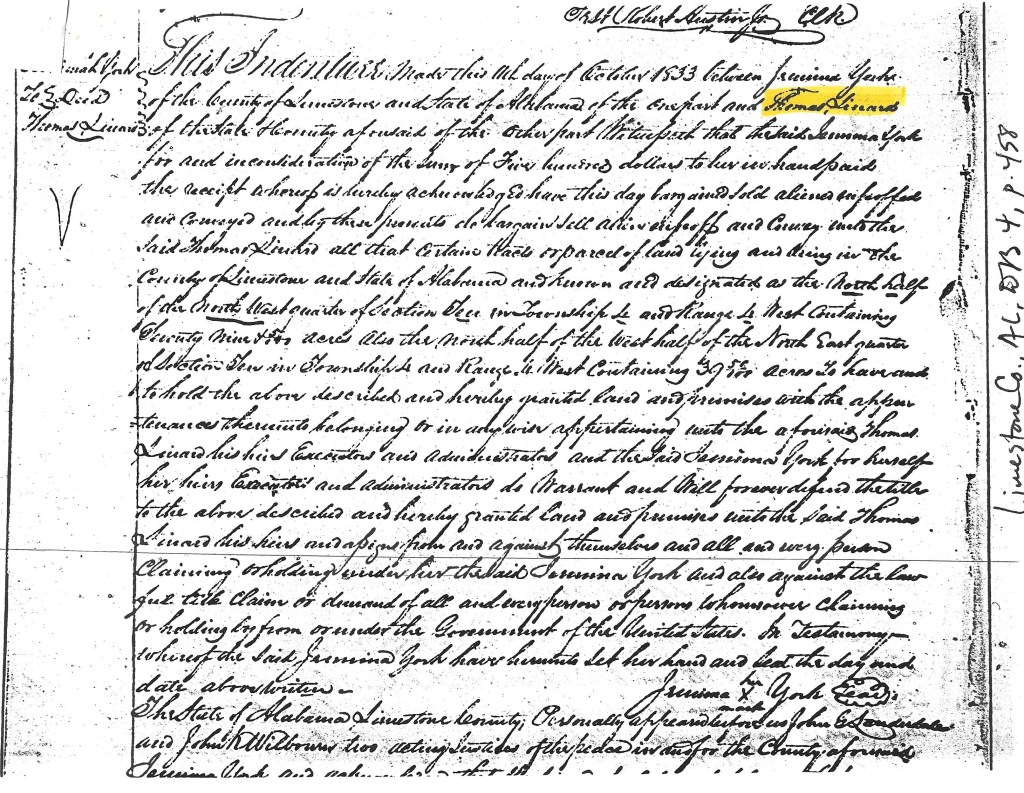
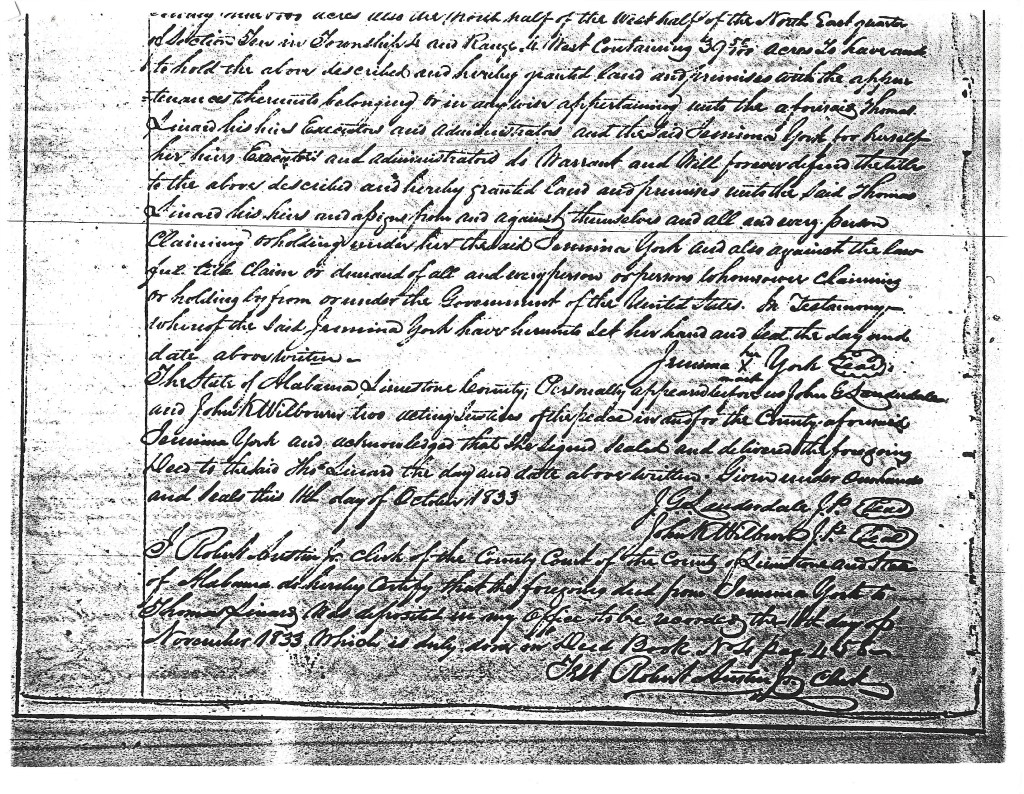
• 11 October 1833: Thomas buys from Jemima York, both of Limestone County, for $500, the north ½ of the northwest ¼ of section 10, township 4, range 4 west, 79.5, and the north ½ of the west ½ of the northeast ¼ of the same section, township and range, 39.5 acres.[17] The deed has no witnesses and is signed by Jemima York by mark. It is recorded 1 November 1833.
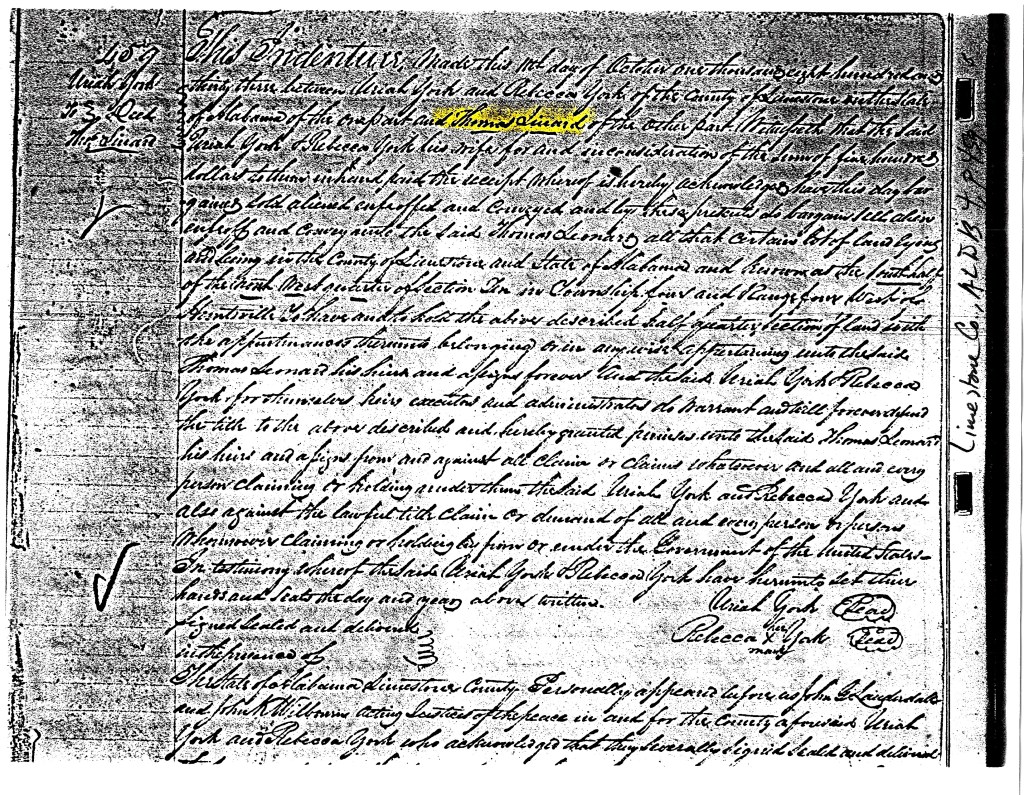
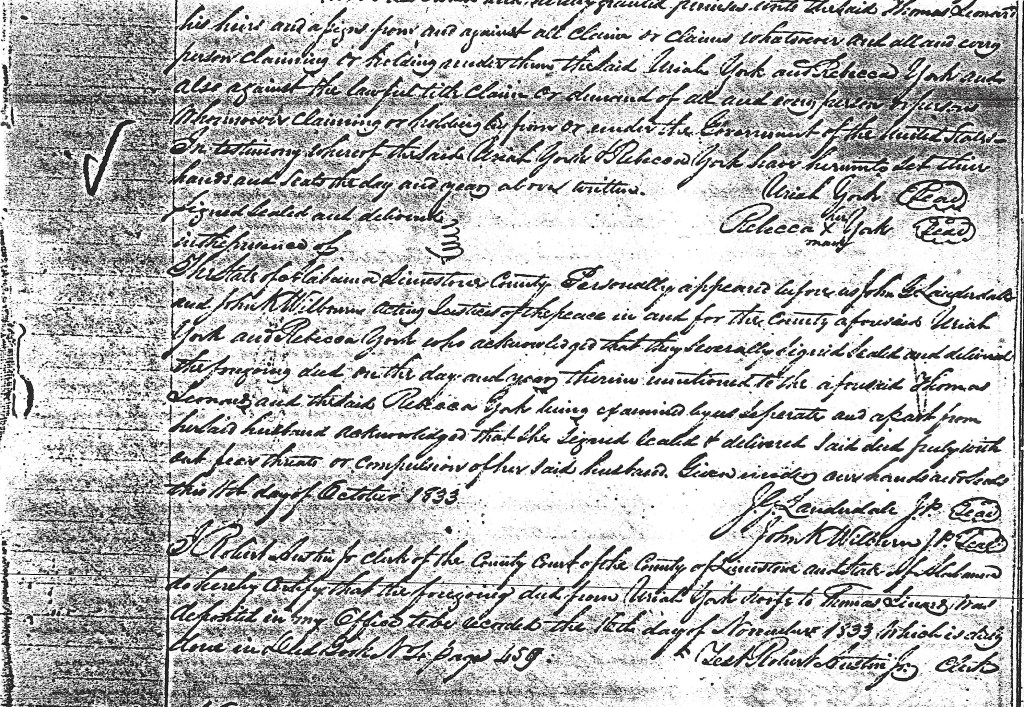
• 11 October 1833: Thomas buys from Uriah and Rebecca York, all of Limestone County, for $500 the south ½ of the northwest ¼ of section 10, township 4, range 4 west, 79.5 acres.[18] The deed is signed by Uriah with Rebecca signing by mark. It is recorded 11 October 1833. Thomas’ uncle Robert Leonard married Katherine York about 1782 in Maryland. Is the York family in these Limestone County records related to Katherine York?
• 7 April 1834: Thomas is in a list of accounts due to the estate of Peter Dunlap turned in by Thomas’ brother-in-law John G. Lauderdale, both notes being dated 10 June 1833.[19]
• 6-7 January 1835: Thomas is a buyer at the estate sale of Benjamin Peete.[20]
• 1st Monday in March: jurors elected, sworn in, and impaneled include Thomas Leonard.[21]
• 3 March 1835: E.G. Brown vs. Thomas Leonard, a case of debt.[22]
• 6 March 1835: Bennett Boggess vs. Thomas Lenard, plaintiff dismisses the suit.[23]
• 24 March 1835: Thomas is in the accounts of Ruffin Coleman, guardian of George Foote, for renting an enslaved man Henry for 1833.[24]
• 26 May 1835: an instrument filed in Limestone County states that John Raney admitted having made statements about the character of Thomas Leonard that he could not substantiate and that he had no right to make these statements.[25] On 4 June, Stephen Flinn, who witnessed Raney’s retraction of slander, verifies the instrument in court; on 6 June, Thomas H. Malone, another witness, also verifies the instrument. This document is recorded 16 December 1835.
• 7 September 1835: Thomas is an appraiser of Edith Witsett’s estate; on 24 Sept. 1835, he turns in his inventory.[26]
• 22 December 1835: Thomas is listed in notes due to the estate of Calvin Hine.[27]
• 9 May 1836: Thomas deeds an enslaved man or boy named Alexander to his son-in-law James Birdwell. The deed, which uses the Linard spelling for the surname, is signed by Thomas Linard and witnessed by Thomas H. Malone.[28] A digital copy of this instrument is at the head of this posting.
• 12 September 1836: Thomas is appointed commissioner to sell land of Thomas Clifton.[29]
• 1 February 1837: Thomas patents federal land in Limestone County, the east ½ of the southeast ¼ of section 10, township 4, range 4 west, 79.5 acres.[30] The certificate for this land is issued 1 August 1839: see below.[31] The purchase price of the land is $98.81.
• 7 March 1837: Thomas Lenard vs. Frederick Batts, the case is continued by the county court.[32]
• September 1837: Thomas Lenard vs. Frederick Batts continues to next term.[33]
• March 1838: Thomas is a juror for the March term of court.[34]
• 2 March 1838: Richardson & Sexton vs. Thomas Lenard — Thomas Linard was summoned to court on the 2nd Monday in September 1837 to answer the complaint of William S. Richardson and Thomas Sexton about a debt of $81.46 on a promissory note Thomas Lenard had made to John G. Lauderdale.[35] John Gammel Lauderdale was Thomas’ brother-in-law, the brother of Thomas’ wife Sarah M. Lauderdale.
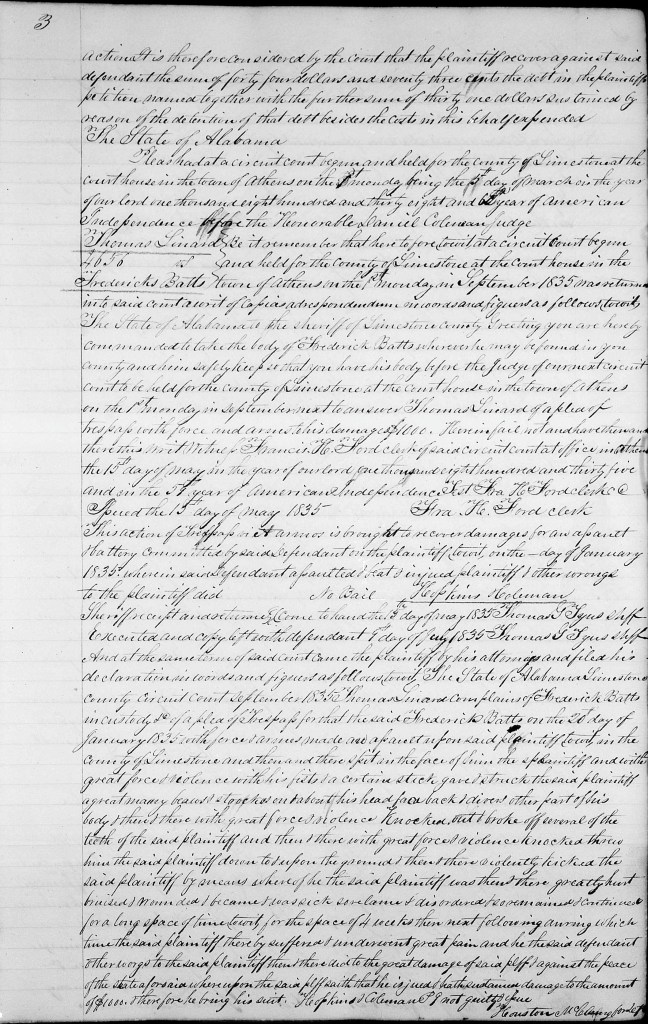
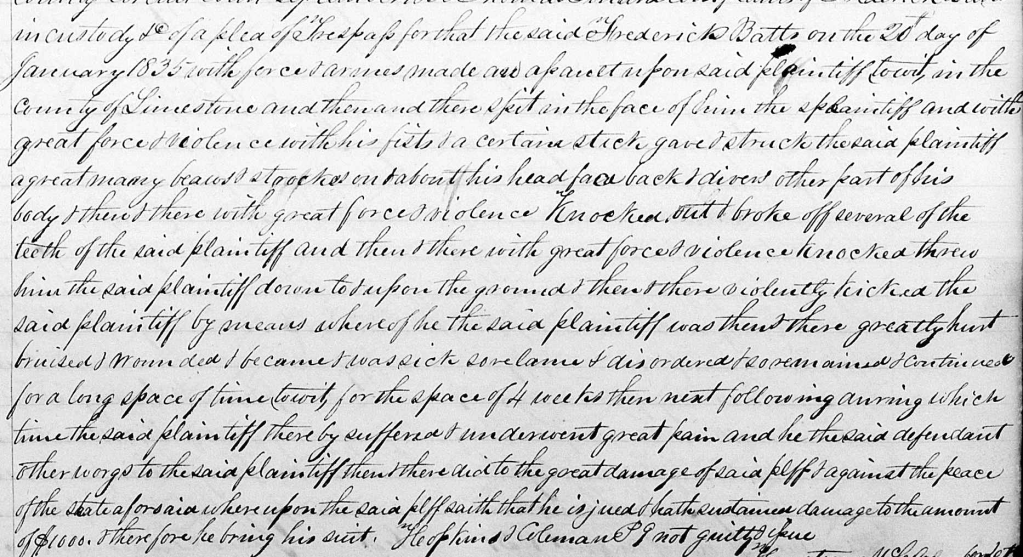
• 5 March 1838: Thomas Linard vs. Frederick Batts — Thomas charges Batts with battery committed on his person on 20 January 1835 and asks for damages of $1,000:
“For that the said Frederick Batts on the 20th day of January 1835 with force & armes made an aſsault upon said plaintiff (to wit, in the county of Limestone and then and there spit in the face of him the sd plaintiff and with great force & violence with his fists & a certain stick gave & struck the said plaintiff a great many blows and strikes on & about his head face back & divers other part of his body & then and there with great force & violence knocked out and broke off several of the teeth of the said plaintiff and then and there with great force & violence knocked threw him the same plaintiff down to & upon the ground and then and there violently kicked the said plaintiff by means whereof the said plaintiff was then & there greatly hurt bruised & wounded and became & was sick sore lame & disordered & so remained and continued for a large space of time (to wit, for the space of 4 weeks then next following during which time the said plaintiff thereby suffered & underwent great pain and the said defendant other [wrongs?] to the said plaintiff and then and there did to the great damage of said plff & against the peace of the state aforesaid whereupon the said plff saith that he is injured & hath sustained damage to the amount of $1000 & therefore he bring his suit.”
• 5 March 1838: Richardson and Sexton vs. Thomas Linard, plaintiffs William S. Richardson and Thomas Sexton dismiss the suit.[36]
• 6 March 1838: Richardson & Sexton vs. Thomas Lenard, suit is dismissed with Lenard to assume costs.[37]
• 6 March 1838: J. Jackson & Sons vs. Thomas Linard, a case of debt of $605 payable by 1 January 1838.[38] The court renders judgment for Jackson for $605.31 and damages of $45.73.
• 7 March 1838: Hiram C. Ragsdale, assne. vs. Thomas Linard and J. Jackson & Sons vs. Thomas Linard: both suits are dismissed.[39]
• 2 June 1838: Thomas Linard is drawn as a juror for circuit court for second court term.[40]
• 10 December 1838: on 5 March 1838, James Tucker had sued Thomas for a debt of $850, on a note Thomas had made to Thomas P. Logan on 14 November 1836, which had come to Tucker’s hands. At December court 1838, Tucker receives judgment for the debt.[41]
• 10 December 1838: J. Jackson & Sons sue Thomas for a debt of $605, receiving judgment in their favor.[42]
• 10 December 1838: Hiram C. Ragsdale sue Thomas for a sum of $130 owed to Ragsdale, with Ragsdale receiving judgment.[43]
• 10 December 1838: Thomas W. Malone sues Thomas for a debt of $290.25, receiving judgment.[44] This case had actually been filed on 29 May 1838, with court minutes showing that that Malone is a merchant in business with John Jackson.[45]
• 10 December 1838: on 26 March 1838, Hiram C. Ragsdale files suit against Thomas regarding a note of Thomas Leonard that Ragsdale held as assignee of Jacob Light, with Lenard promising to pay Light $160 by 1 October 1836.[46]
• 1838: According to his cousin Thomas Dunlap Leonard in Thomas D. Leonard’s manuscript “Biography of the Leonards,” in 1838, Thomas moved from Limestone County, Alabama, to Cherokee County, Texas. But note that Thomas and wife Sarah were still living in Limestone County up to 6 May 1839, when they sold their Alabama land and moved to Texas (see below). So if Thomas had moved to Texas in 1838, it would appear he went there temporarily to begin the process of relocating and then returned to Alabama.
• 4 March 1839: Benjamin B. Peter adm. of Hiram Ragsdale vs. Thomas Linard and Cordy Clifton — the debt has been paid and suit is dismissed.[47] Cordy Claiborne Clifton was the husband of Thomas’ daughter Matilda Caroline Leonard.
• 6 March 1839: Murrah and Gamble dismiss their suit of debt against Thomas Linard.[48]
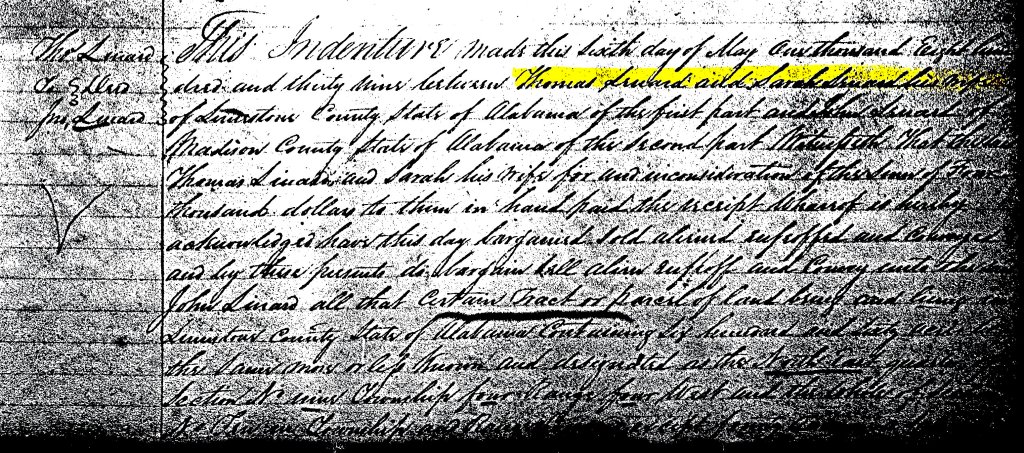
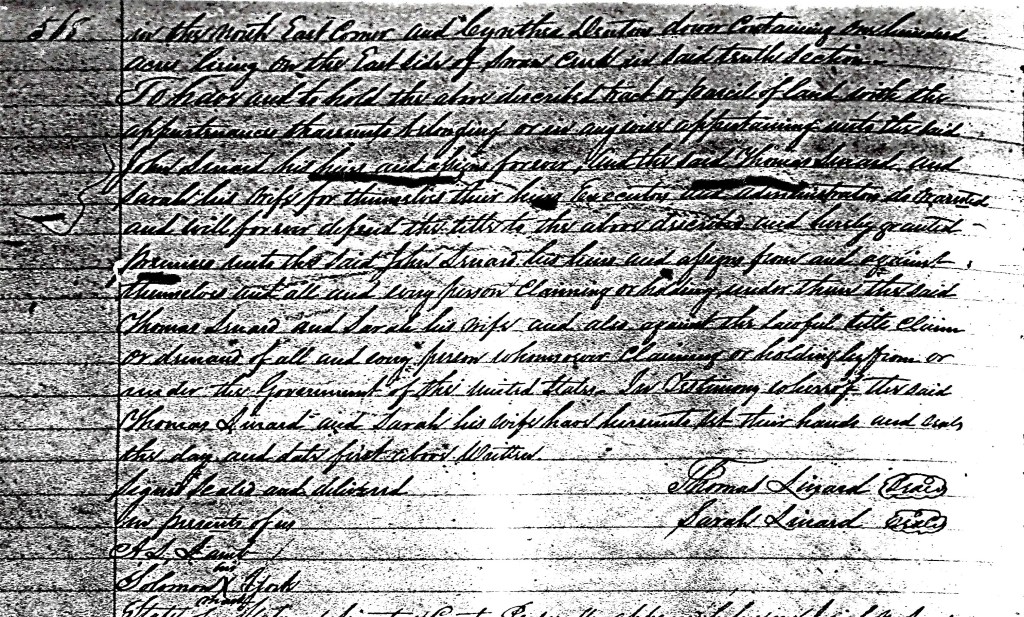
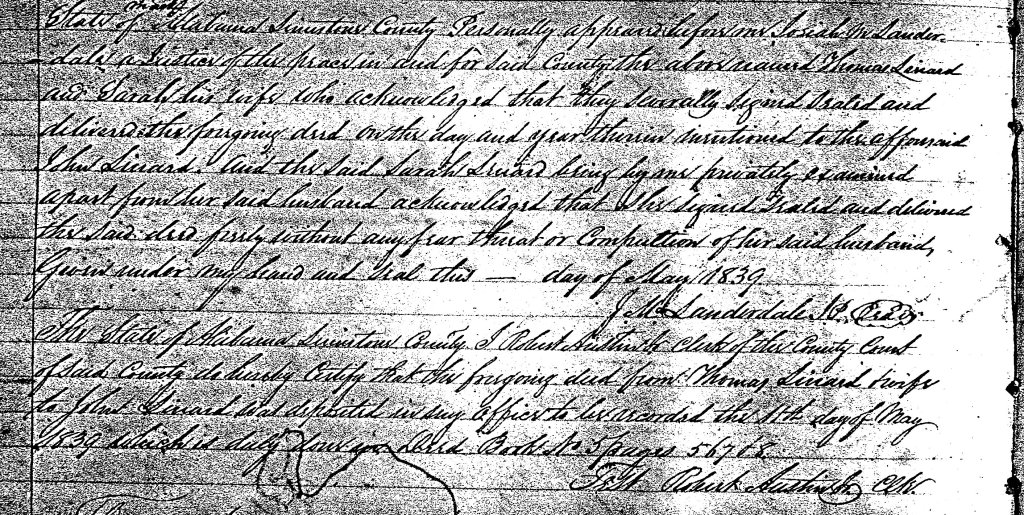
• 6 May 1839: Thomas and wife Sarah (living in Limestone County, per the deed) sell to Thomas’ brother John Leonard of Madison County 660 acres, the northeast ¼ of section 9, township 4, range 4 west, and the whole of section 10 of the same township and range except for 40 acres in the northeast ¼ and Cynthia Denton’s dower tract containing 100 acres on the east side of Swan Creek.[49] The deed is signed by both Thomas and wife Sarah, and is witnessed by A.L. Lamb and Solomon York (making his mark). On 10 May 1839, Thomas and wife Sarah acknowledge the deed and it is recorded on 11 May.
As noted above, Cynthia Denton was a daughter of Thomas and Sarah Leonard, who married Jonas Denton. Jonas died in Limestone County before 26 August 1830, and Thomas administered his estate. A.L. Lamb was Alfred L. Lamb, who is discussed in previous postings (and here), married a daughter of Moses Birdwell, whose son James G. Birdwell married Thomas and Sarah Leonard’s daughter Aletha. As the two postings I’ve just linked also noted, Sarah Lauderdale Leonard’s brother Josiah Mauldin Lauderdale married another daughter of Moses Birdwell, his daughter Harriet.
As stated previously, from the time Thomas Lewis Leonard moved his family from Tennessee to Limestone County, he appears to have lived on a piece of land his brother Griffith James Leonard had acquired there in February 1818, in section 9 of township 4, range 4 west. In October 1833, Thomas bought adjoining tracts from members of the York family in section 10 in the same township and range, and in February 1837, he patented more federal land in this section. By the time he and Sarah sold their land in Limestone County, Thomas had 660 acres in this part of Limestone County.
This land was in the southern portion of Limestone County just west of highway 65 and near Davis Temple Church in the present community of Tanner. This is not far north of Decatur and is south of Athens. A Limestone County tract map in a previous posting shows the exact location of this land, with the section numbers marked.
After Thomas and Sarah Lauderdale sold their Limestone County land and proved the deed on 10 May 1839, they made their move to Texas, where, as we’ll see later, Thomas patented 320 acres of land on 6 September 1839 in what was then Nacogdoches County and in 1846 became Cherokee County. Thomas Leonard continues in Limestone County court minutes, however, into the 1840s as creditors sought to obtain payment of debts he left behind when he “absconded” from the county, as some of these minutes state — that is, when he left Limestone County with debts unresolved.
The frequency with which Thomas was already being sued in 1838 and 1839 before he sold out and moved away suggests to me that it was known that he was making preparations to leave the county, and creditors were trying to obtain payment from him before he relocated. As a previous posting notes, in the late 1830s, it was not uncommon for cotton planters in north Alabama ruined by the economic downturn there to light out for Texas leaving debts behind, with litigation to recover those debts continuing in Alabama after they had settled in Texas.
As a previous posting indicates, several months after Thomas and Sarah Leonard left Alabama for Texas, their daughter Aletha and husband James G. Birdwell sold their land in Marshall County, Alabama, and moved to Natchitoches Parish in northwest Louisiana. The 1840 federal census in Natchitoches Parish shows the couple holding fifteen enslaved persons that I suspect are enslaved persons belonging to Aletha’s father, and who are listed as Thomas’ property on the 1840 census of the Republic of Texas, a document I’ll discuss later.
Here are some of the continued references to Thomas Leonard in Limestone County movements after he made his move to Texas in 1839:
• 10 June 1839: Thomas is sued by Squire Larue for a debt of $172.66, Larue receiving judgment.[50]
• 11 June 1839: Ira Hobbs, garnishee, testifies that last winter, Matthew Pritchett, executed his note to Thomas Linard for $500 due 1 January 1840. Hobbs was Pritchett’s security and Pritchett had left the county. The note had fallen into Cordy Clifton’s hands.[51]
• 11 June 1839: Tanner Redus & Co. vs. Thomas Linard discusses in more detail the bond Matthew Pritchett executed on a note to Thomas Linard.[52]
• 1 August 1839: Thomas is issued a certificate for the 79.5 acres of federal land in the east ½ southeast ¼ section 10 township 4 range 4 west that he had patented in February 1837 and sold in May 1839. See above for information about that patent.
• 3 September 1839: Samuel Tanner vs. Wm. M. Johnson, estate of Thomas Linard, sues Thomas for $500 on a note he had made to Matthew Pritchett, which had come into Reeder’s hands; in the same court, Tanner sues Thomas on another note to Matthew Pritchett for $500, both verdicts going against Thomas.[53] William M. Johnson was William Marmaduke Johnston, husband of Thomas’ daughter Maria.
• 9 December 1839: legal action for debt against Thomas Linard by Samuel Tanner & Co. continues.[54] Thomas is indebted to the firm of Samuel Tanner, Peterson Tanner, and Meredith Tanner, late partners in trade under the name S. Tanner and Tanner Redus Co. for various debts. “The said Thomas absconded so that the ordinary process of law cannot be served upon him,” and an attachment has not been sued out. The court now issues an attachment and garnishes Cordy Clifton, in whose hands a note or notes by Thomas Linard has ended up.
• 11 December 1839: James Redy & Co. vs. Thomas Lenard, the suit is dismissed with Thomas ordered to pay $224.29 in damages.[55]
• 3rd Monday September 1843: a writ of attachment against Thomas Lenard by the Bank of Alabama is issued in Morgan County court on a note Thomas had made on 5 July 1838 $2,500 to Gamble & Murrah endorsed by S. Tanner and Sons and Keyes Richardson.[56] “Oath also having been made by the said Agents that the said Lenard resides out of this state so that the ordinary proceʃs of Law cannot be Served upon him….” The 660 acres Thomas and wife Sarah had sold to his brother John Leonard in May 1839 are attached.
• 2nd Monday in September 1847: Bank of Alabama, Decatur branch vs. Andrew Montgomery — at a court hearing on the 2nd Monday in March, a capias writ is issued for Montgomery on a charge of trespass for Montgomery’s occupancy of the northeast ¼ of section 9 township 4 range 4 west and all of section 10, the same coordinates except for 40 acres in the northeast ¼, Cynthia Denton’s dower land.[57] On the 4th Monday in September 1843, an attachment is issued in Decatur on the estate of Thomas Lenard on a debt of $2,500 to the Decatur branch Bank of Alabama, with a note dated 5 July 1838 drawn on Gamble and Murrah and endorsed by S. Tanner & Sons and Key Richardson & Co. At issue were the 660 acres Thomas Lenard sold to John Lenard, deceased, with Montgomery now trespassing on the land. John Lenard left heirs Robert, Sarah, Hannah, Martha, Mary, and Alpha. Verdict is given to the bank.
• 13 March 1848: James Birdwell, assignee, vs. John Linard: on 6 May 1839, John Lenard bound himself to Thomas Lenard by a note of $500.[58] Thomas assigned the note to James Birdwell who is suing for the use of Terry Bradley. Birdwell says that when Thomas Lenard assigned John Lenard’s note to him, the note was delivered to Rachel Lenard for safekeeping until the land was sold by John Lenard. John never sold the land and Rachel never delivered the note to James Birdwell.
Again: John Leonard was Thomas Lewis Leonard’s brother, to whom Thomas and wife Sarah sold their 660 acres in Limestone County in May 1839. John Leonard died in Limestone County before 14 November 1846. This court case indicates that Thomas then assigned John’s promissory note for $500 to his son-in-law James Birdwell. James alleged that the note was given to Rachel Dunlap Leonard, wife of Robert Leonard, a brother of Thomas and John. Robert and wife Rachel moved to Texas along with his brother Thomas in 1839.
What Limestone County court records of the 1830s and 1840s show us is the extent to which cotton planters in north Alabama, who appeared to be riding high economically when cotton prices were strong, were highly susceptible to economic ruination when the economy took a nosedive and creditors and banks began calling in loans and promissory notes. The wealth of north Alabama cotton planters in this period was illusory, in that it consisted of notes of credit and payment that were circulated as though they were scrip, but which did not represent “real” money in the bank — as planters decimated by the economic downturn of the 1830s discovered to their dismay when creditors and banks demanded cash payment on promissory notes. Thomas Lewis Leonard is far from the only cotton planter in this region who headed to Texas when the crash occurred, leaving debts behind in north Alabama, and a trail of court records that followed these Alabamians who had headed to Texas for years after they left Alabama.
In my next posting, I’ll document Thomas Lewis Leonard’s years in Texas from 1839 up to his death in October 1870.
[1] 1830 federal census, Limestone County, Alabama, p. 11.
[2] Limestone County, Alabama Will Bk. 4, p. 47.
[3] Ibid., pp. 200-201.
[4] Limestone County, Alabama, Court Mintes Bk. 1827-1832, p. 423.
[5] Limestone County, Alabama, Will Bk. 3, p. 348.
[6] Limestone County, Alabama, Court Mintes Bk. 1827-1832, p. 473.
[7] Limestone County, Alabama, Orphans Court Minutes Bk. 1830-4, p. 67.
[8] Limestone County, Alabama, Court Mintes Bk. 1827-1832, pp. 548-550.
[9] Ibid., pp. 525-6.
[10] Ibid., p. 508.
[11] Ibid., p. 509.
[12] Limestone County, Alabama, Will Bk. 4, pp. 50-1; and see Limestone Legacy 8,4 (July 1986), p. 165.
[13] Limestone County, Alabama, Court Mintes Bk. 1827-1832, pp. 557-9. See also 6 April 1832: John J. Coleman adm., use of John R.B. Eldridge, vs. John Lenard plaintiff to recover $91.50 and $4.57 damages, ibid., p. 586.
[14] Limestone County, Alabama, Will Bk. 4, pp. 55-7; and see Limestone Legacy 8,4 (July 1986), p. 166.
[15] Limestone County, Alabama, Court Minutes Bk. 1831-8, p. 20.
[16] Ibid., pp. 37-8.
[17] Limestone County, Alabama, Deed Bk. 4, p. 458.
[18] Ibid., p. 459.
[19] Limestone County, Alabama, Will Bk. 4, p. 319.
[20] Ibid., pp. 451-9, and see in Limestone Legacy 15,3 (Spring 1993), p. 66.
[21] Limestone County, Alabama, Court Minutes Bk. 1831-8, p. 126.
[22] Ibid., p. 136.
[23] Ibid., p. 148.
[24] Limestone County, Alabama, Will Bk. 4, p. 470.
[25] Limestone County, Alabama, Deed Bk. 5, p. 41. John Raney appears various times in court records in Limestone County, not often in a favorable light. In February 1821, for instance, he was convicted in superior court of stealing an enslaved person from William B. Higgins: Limestone County, Alabama, Superior Court Minutes Bk. 1820-22, p. 313, no. 573.
[26] Limestone County, Alabama, Orphans Court Minutes Bk. 1835-1843, p. 39; and Will Bk. 4, p. 552.
[27] Limestone County, Alabama, Will Bk. 4, p. 574.
[28] Limestone County, Alabama, Deed Bk. 5, p. 107.
[29] Pauline Jones Gandrud, Alabama Records: Limestone County, vol. 98, pp. 26. 30, citing the “original” records (will book? Orphans Court?), pp. 109, 122.
[30] Huntsville, Alabama, Federal Land Office Tract Bk. 273, p. 210; see also Marilyn Davis Barefield, Old Huntsville Land Office Records and Military Warrants, 1810-1854 (Easley, South Carolina: Southern Historical Press, 1985), p. 83.
[31] Alabama Patent Bk. 3590, p. 371, no. 11104.
[32] Limestone County, Alabama, Court Minutes Bk. 1831-8, p. 201.
[33] Ibid., p. 240.
[34] Ibid., pp. 257, 259.
[35] Limestone County, Alabama, Court Minutes Bk. 1835-8, pp. 14-5.
[36] Ibid., pp. 13-4.
[37] Limestone County, Alabama, Court Minutes Bk. 1831-8, p. 266.
[38] Ibid., p. 292.
[39] Ibid., p. 269.
[40] Ibid., p. 288.
[41] Ibid., pp. 289-290; and Limestone County, Alabama, Court Minutes Bk. 1830-1849, p. 227.
[42] Limestone County, Alabama, Court Minutes Bk. 1831-8, p. 291.
[43] Ibid., p. 293.
[44] Ibid.
[45] Ibid., pp. 304-5.
[46] Ibid., p. 293.
[47] Limestone County, Alabama, Court Minutes Bk. 1838-1845, p. 3.
[48] Ibid., p. 14.
[49] Limestone County, Alabama, Deed Bk. 5, pp. 567-8.
[50] Limestone County, Alabama, Court Minutes Bk. 1830-1849, p. 241.
[51] Limestone County, Alabama, Court Minutes Bk. 1838-1848, p. 43.
[52] Limestone County, Alabama, Court Minutes Bk. 1830-1849, pp. 248-250.
[53] Limestone County, Alabama, Court Minutes Bk 1835-1838, pp. 248-250.
[54] Limestone County, Alabama, Court Minutes Bk. 1838-1848, pp. 39-43.
[55] Limestone County, Alabama, Court Minutes Bk. 1830-1849, p. 263.
[56] Limestone County, Alabama, Court Minutes Bk. 1847-1852, pp. 91-3.
[57] Ibid., pp. 90-6.
[58] Ibid., pp. 132-7.
 BEGATS AND BEQUEATHALS
One thought on “Thomas Lewis Leonard (1781-1870), Son of Thomas Leonard and Hannah James: Limestone County, Alabama, Years, 1830-1839”