According to Thomas Dunlap Leonard, a first cousin of Thomas Lewis Leonard who compiled a manuscript (and see here) about this Leonard family in 1883, Thomas Lewis Leonard moved his family from Lincoln County, Tennessee, to Limestone County, Alabama, in 1818 and brought up his eleven children in that county. Thomas and Sarah Lauderdale Leonard had six children when they left Tennessee; five more would be born to them in Alabama. As has been previously noted, Thomas Dunlap Leonard (1810-1888) knew Thomas Lewis Leonard (1781-1870) and his family personally. Thomas D. Leonard grew up in Tennessee living among his Leonard relatives with his parents Robert and Rachel Dunlap Leonard, and when Robert joined his brother Thomas Lewis Leonard in moving to Alabama in 1818, Thomas D. Leonard continued his connection to the family of his cousin Thomas Lewis Leonard in Alabama.
Prior to his move to Limestone County in 1818, Thomas Lewis Leonard seems to have been eyeing land in north Alabama along with his brothers John and Griffith James Leonard. In 1811, he patented land in Madison County, Mississippi Territory (later Alabama), with his brother Griffith patenting land in the same county on 11 September 1811.[2] The land patent record states that the Thomas Linard (as the surname is given here) patenting this land was “Thomas Linard of Lincoln County.”

Lincoln County, Tennessee, is contiguous to Madison County, Alabama. There was much to-ing and fro-ing between the two counties in the early 1800s, with people sometimes appearing simultaneously in the records of both counties and even living at various points in both counties. I find Jacob Clements (1775-1846), the second husband of my ancestor Frances Simms, in records of both Lincoln County, Tennessee, and Madison County, Mississippi Territory, in the period 1809-1815, and there are indicators that the family was living in both places during that period, with their land possibly spanning the line dividing the two counties. My ancestor Benjamin Harrison married in Madison County in 1819, but owned land in Lincoln County at that time, and probably was living in Lincoln County at the time of his marriage. His children were born from 1820-1833, with some reporting Lincoln as their birthplace and others Madison.
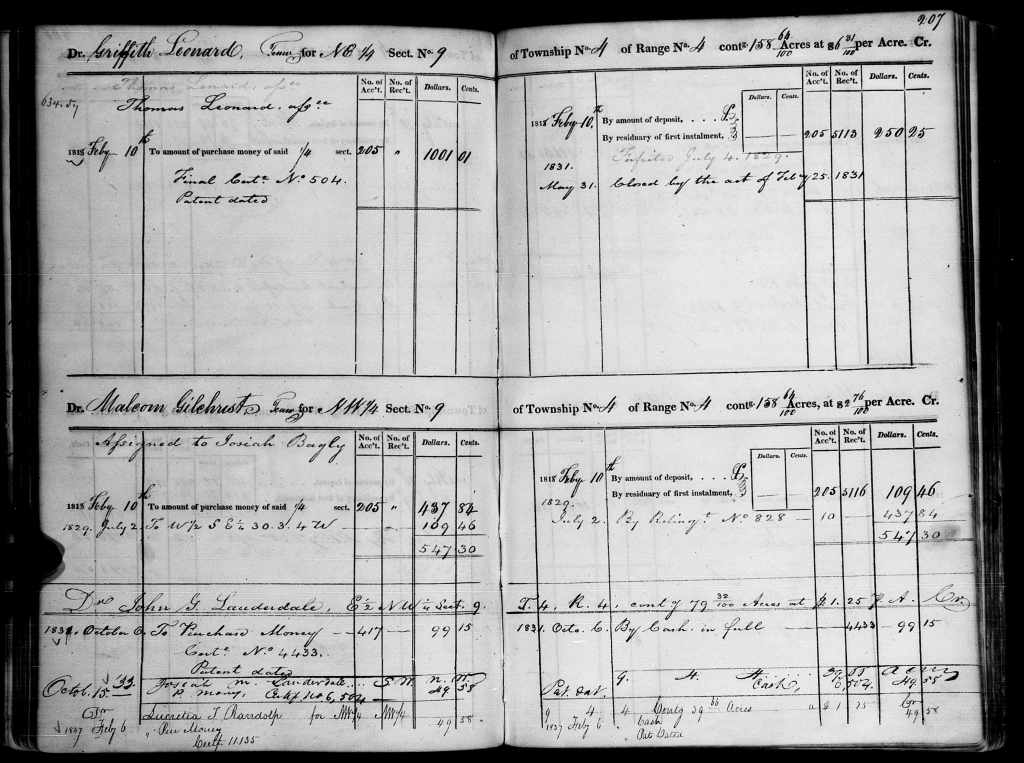
Limestone County, where Thomas Lewis Leonard settled in 1818, is bounded by Madison County on the east and by Lincoln County, Tennessee, on the northeast. Tract books for the Huntsville land office, which was originally in Nashville and then moved to Huntsville in Madison County, Mississippi Territory, in 1811, show Thomas Leonard’s brother Griffith acquiring 158.54 acres of land in Limestone County from the Huntsville land office on 10 February 1818.[3] The land was a quarter section of land, the northeast ¼ of section 9, township 4, range 4 west, and was apparently assigned to Thomas Leonard on the date his brother Griffith bought it. On 9 April 1832, as the assignee of Griffith Leonard, Thomas Leonard had a certificate from the federal land office in Huntsville for this piece of land.[4] A digital image of the land certificate is at the top of this posting.
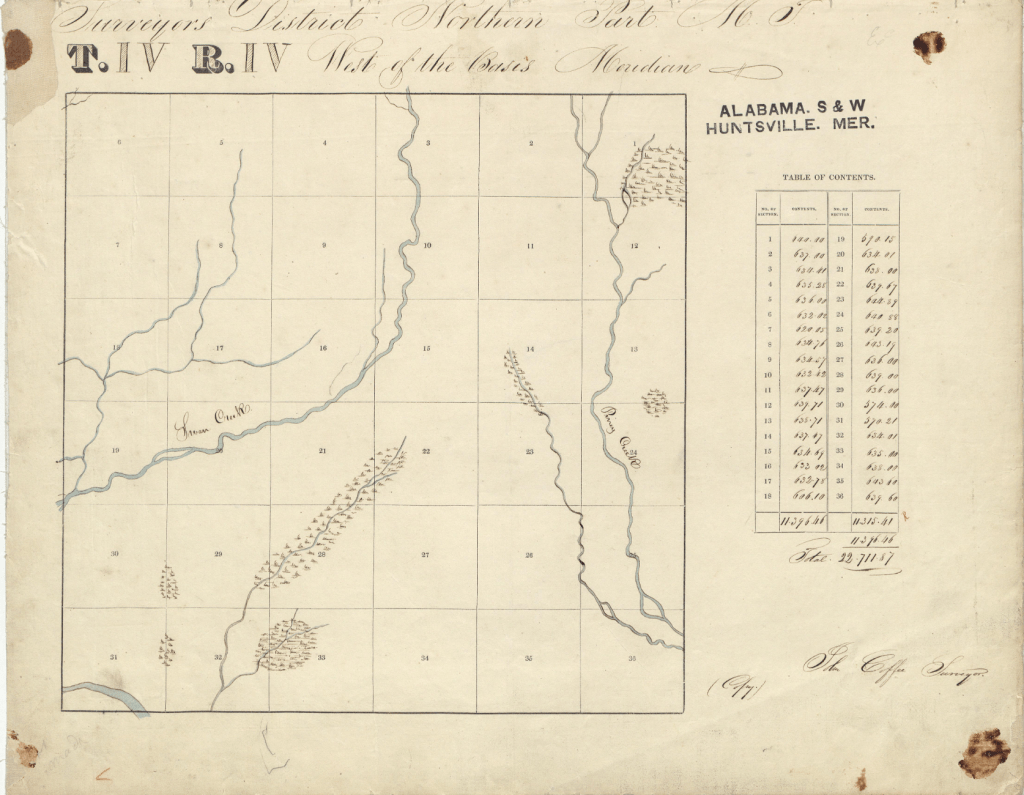
I suspect that this is the land on which Thomas originally settled when he came to Alabama, and that he arrived there by February 1818. As we’ll see down the road, when Thomas and wife Sarah sold their homeplace in Limestone County to his brother John on 6 May 1839, the deed stated that the 660 acres were in the same coordinates given above, and that some of the land bordered Swan Creek, which is shown in the plat of the original federal survey of the land.[5]
Like Madison County, Limestone County, Alabama, is in the Tennessee Valley section of north Alabama. As previous postings note — see here, in particular — a big spur to migration into this area of Mississippi Territory (later Alabama) in the first decade of the 19th century was the lure of good cotton-growing land. People aspiring to enrich themselves by growing cotton when the market was high, frequently with reliance on the labor of enslaved people, moved in large numbers to the counties of north Alabama through or along which the Tennessee River runs. The lure of good land and lucrative crops caused aspiring planters stricken with “Alabama fever” to overextend themselves financially, taking out loan after loan and signing or giving security for promissory notes that were then used as legal tender in transactions.
The years from 1820, when Thomas Lewis Leonard was establishing himself in Limestone County, and 1839, when he and wife Sarah sold their land in Limestone and moved to Texas, were years of both increasing accumulation of land and property for the family, and, with the panic of 1837 and a resulting economic crash for planters on the growing edge of the cotton kingdom in north Alabama, years of sudden devastating bankruptcy. They were also years in which Thomas Leonard appears in Limestone court records in a bewildering array of debt cases, cases in which he was charged with failing to pay debts or was himself the plaintiff suing for payment of an unpaid debt.
Thomas Leonard had definitely established himself in Limestone by the 4th Monday in October 1819, when minutes of the circuit court case Vance Greer vs. Chapman R. Willborn show him as a juror.[6] Minutes of the same court session show Thomas as a juror in the trial of Caleb Shott vs. George Brown.[7]
Limestone County circuit court minutes for the first Monday in March 1820 state that at a hearing held in Athens, the county seat, on 8 January 1820, James W. Dupuy was summoned to answer a charge of debt to Thomas Linard.[8] (The surname is spelled Lenard as well in this set of minutes). The debt was for $17.12½ Dupuy owed Leonard for whiskey. The court found in favor of Thomas Leonard. Dupuy then appealed and a new hearing date was set with the court affirming the judgment.[9] Thomas was a juror again on the 4th Monday in October 1820 at the circuit court trial of William W. Porterfield vs. Robert Gibson.[10]
The Dupuy debt case suggests that Thomas Lewis Leonard may have been distilling and selling whiskey. If so, he was carrying on an occupation of his father: Lincoln County, Tennessee, court minutes in 1814-5 show the elder Thomas Leonard charged with operating a tippling house. Thomas Leonard’s 8 July 1829 will in Lincoln County demonstrates that he had a still as it notes that Thomas was bequeathing his son Griffith James Leonard his still tubs.[11]
Thomas Leonard was enumerated on the 1820 Alabama state census in Limestone County, with a household consisting of a male and a female over 21, eight females under 21, and two enslaved persons.[12] By the time the family of Thomas Lewis Leonard moved from Tennessee to Alabama, Thomas and wife Sarah had seven daughters born from 1803-1816: Aletha, Hannah, Milbury, Cynthia, Matilda, Maria, and Minerva. The birthdates of these seven are fairly well established. Thomas Dunlap Leonard’s manuscript states that Thomas and Sarah also had three daughters who died as young women: Martha, Sarah, and Mahala. I haven’t found clear information about when and where those daughters were born and died. If one was born by 1820, then she’s likely the eighth daughter enumerated on this census. If Aletha, who was the oldest child, had married by 1820, then two of the additional three daughters named by Thomas D. Leonard were in Thomas and Sarah’s household in 1820.
The following is a summary of documents tracking Thomas Leonard’s life in Limestone County from 1820-1830:
• March court 1820: Thomas Linard was a juror in the case of A. Tedford vs. E. Nixon.[13]
• 4 Monday in August 1820: Peter Moyers & Co. vs. Cornelius Malone and Thomas Lenard, a suit of debt for $275.75, based on a bond Malone and Lenard made 20th October 1819 to pay Moyers & Co. $250.50 by 1 April 1820 or if the debt wasn’t paid by that date, it would become $275.75.[14]
• 12 March 1821: case of Peter Moyers & Co. vs. Cornelius Malone and Thomas Leonard, judgment in favor of Moyers, $250 and court costs of $18.34.[15]
• 16 August 1822: as a previous posting shows, Thomas deeded to his uncle Colin Campbell two tracts of land he had held onto in Lincoln County, Tennessee, after he had moved to Alabama.[16]
• 4 June 1824: Thomas reported a stray mare, along with John Favor, in Limestone County.[17]
• 1824: Thomas was excluded from membership in the Round Island Baptist church in Limestone County.[18] Previously in 1822 a Sarah Leonard who was evidently Thomas’ wife Sarah Lauderdale Leonard had also been excluded from membership. For more information on this church, the first Baptist church established in the county, see this previous posting about Moses Birdwell, who was a member of the church along with his son James Birdwell, husband of Thomas and Sarah’s daughter Aletha.
• 19 May 1826: Thomas purchased a razor and its case along with a pair of “Settin Chairs,” at the estate sale of Noah Dutart in Limestone.[19]
• 29 June 1826: Thomas was sued by David C. Humphries for a debt of $228.87 from a promissory note dated 6 March 1826 in Limestone.[20]
• 29 June 1826: George Keys and Benjamin Dunkin, merchants of Limestone, sued Thomas for debt of $209.22 from a note dated 29 April 1826. Verdict was for Keys and Dunkin.[21]
• 7 September 1826: Thomas was a juror in the case of Samuel Brooks vs. Frederick Harris.[22]
• 18 September 1826: along with Stephen Flinn and William Fletcher Jr., Thomas appraised the estate of Thomas Laurence (also spelled Lawrence), of which Moses Birdwell, father of James G. Birdwell who married Thomas’ daughter Aletha, was administrator.[23]
• 9 October 1826: Thomas witnessed the estate inventory of Thomas Lawrence, of which he was an appraiser.[24] Thomas’ son-in-law James Birdwell was a buyer at the sale.
• 15 January 1827: David C. Humphries received judgment against Thomas for the debt of $228.87 mentioned above.[25]
• 20 February 1827: Thomas was appointed a commissioner to allot the estate of William Driver to his heirs. Others appointed were Charles King, Joseph Johnson, William Fletcher, and John Michaels.[26] John Gammel Lauderdale, a brother of Thomas’ wife Sarah M. Lauderdale, married Penelope Nichols, daughter of John Nichols and Martha Driver. Joseph Johns(t)on was the father of Samuel Johnston, who married Thomas’ daughter Minerva D. Leonard.
• 7 May 1827: the estate inventory of David Hobbs shows the estate holding a note of debt on Thomas.[27]
• 6 September 1827: Philip A. Foote, adm. vs. Thomas Leonard, with Foote suing to recover a debt of $91. The court ruled for Foote.[28]
• 3 March 1828: Thomas was a juror for the first week of the March court term.[29] At the same court session, the case of Amos Vincent & Co. vs. Thomas Leonard was heard re: an unpaid debt of Thomas.[30] Judgment was for Vincent to recover $7.21 plus $17.59 in damages.
• On 29 March 1828: Thomas was a purchaser at the estate sale of Samuel Renfro, buying a brindle cow and calf, a swingletree and 2 divies, a “tea cittle,” and a jug.[31]
• March 1829: first week of term, Thomas was a juror.[32]
• Along with William Fletcher and Noah Dutart Jr., Thomas appraised the estate of Matthew Stewart.[33]
• 2nd Monday in June 1829: Theophilus (Theophs) Thomas vs. Thomas Lenard, a suit asking to recover a $200 debt from Thomas Lenard. On 31 December 1827, Lenard committed himself to pay Thomas $8 for hire of enslaved man Dellaware, to give Dellaware a wool hat, a wool four-point blanket, a wool roundabout jacket, a pair of wool pantaloons, two cotton shirts of homemade cloth, a pair of homemade cotton pantaloons, and a pair of double-soled shoes and socks. Leonard was to pay the $8 to Dellaware by 1st of March 1829 and did not do so, and had not provided the goods he covenanted to provide. The court found for the plaintiff.[34]
• 9 July 1829: Thomas Leonard, father of Thomas Lewis Leonard, made his will in Lincoln County, Tennessee.[35] The will names and leaves legacies to Thomas Sr.’s wife Hannah and children Robert, Griffith, and Hannah (wife of William D. Moore). It makes no mention of Thomas’ other children John, Thomas Jr., Hezekiah, Samuel, and Colin, except to say that any other persons not named in the will but being legal heirs are to receive an inheritance of $5 from Griffith Leonard, should they make a claim on the estate.
In my next posting, I’ll document Thomas Lewis Leonard’s life in Limestone County from 1830 to 1839, when he and wife Sarah sold their land there and made their final move to Texas.
[1] Pendleton District was Ninety-Six District at the time Thomas Leonard’s father Thomas settled there in 1786. It became Pendleton District three years later.
[2] Margaret Matthews Cowart, Old Land Records of Madison County, Alabama (Huntsville, Alabama, 1979), p. 253, citing Receiver’s Ledger Bk. B, p. 102, no. 446; and p. 80, citing Receivers Ledger Bk. B, no. 545. John Leonard had patented land in the same township and range on 16 December 1810. Griffith sold the land he had patented to Eli Hammond on 22 June 1816 with the deed noting that Griffith lived in Lincoln County, Tennessee: Madison County, Alabama, Deed Bk. E, pp. 56-7. John Leonard was a witness to this deed.
[3] Alabama Tract Books, Huntsville Land Office, vol. 5, p. 207.
[4] Alabama Patent Bk. vol. 132, p. 324, no. 504.
[5] Limestone County, Alabama, Deed Bk. 5, pp. 567-8.
[6] Limestone County, Alabama, Circuit and Superior Court Abstracts, 1818-1820, pp. 87-9.
[7] Ibid., pp. 141-2.
[8] Limestone County, Alabama, Circuit and Superior Court Minutes, 1818-1820, pp. 491-3. At the same court session in March 1820, Thomas Linard was a juror in the case of A. Tedford vs. E. Nixon: ibid., pp. 480-1.
[9] Ibid., pp. 494-7.
[10] Ibid., pp. 110-111.
[11] Lincoln County, Tennessee, Will Bk. 1, pp. 79-80.
[12] “Alabama Census Returns 1820,” Alabama Historical Quarterly 6,3 (fall 1944), p. 452, abstracting the original document.
[13] Limestone County, Alabama, Court Minutes Bk. 1818-1820, p. 480.
[14] Ibid. Bk. 1820-2, pp. 89-90.
[15] Ibid., Bk. 1821-5, p. 18.
[16] Lincoln County, Tennessee, Deed Bk. B, pp. 226-7. Colin Campbell sold this land to Griffith Leonard on 31 December 1830 with the deed stating that Colin bought the land from Thomas Leonard Jr: Lincoln County, Tennessee, Deed Bk. I, pp. 251-2.
[17] Research notes shared with me by Leonard researcher Nancy Breidenthal, citing Limestone County, Alabama, Animal Take-Up Bk. 1824-1853, p. 645.
[18] “The Membership of the Round Island Baptist Church, As Recorded in the Minutes, 1817-60,” Limestone Legacy 1,1 (January 1979), p. 36; and MariLee Beatty Hageness, Membership, Round Island Baptist Church, Limestone County, Alabama (Hageness, 1995).
[19] Limestone County, Alabama, Will Bk. 3, pp. 1-5. See also Valley Leaves 17, 3 (March 1983), p. 131; and Limestone Legacy 1,1 (October 1978), p. 13.
[20] Limestone County, Alabama, Court Minutes Bk. 1826-8, pp. 79-80, 86-87.
[21] Ibid., pp. 86-7.
[22] Ibid., Bk. 1825-7, p. 163.
[23] Limestone County, Alabama, Will Bk. 3, p. 19; and see also Valley Leaves 17,3 (March 1983), p. 132.
[24] Limestone County, Alabama, Will Bk. 3, pp. 19-20.
[25] Limestone County, Alabama, Court Minutes Bk. 1825-1830, p. 94.
[26] Limestone County, Alabama, Orphans Court Minutes Bk. 1824-30, p. 97.
[27] Limestone County, Alabama, Will Bk. 4, pp. 629, 635.
[28] Limestone County, Alabama, Court Minutes Bk. 1827-1832, p. 33.
[29] Ibid., p. 96.
[30] Ibid., pp. 106-7.
[31] Research notes shared with me by Leonard researcher Nancy Breidenthal, citing (possibly?) Limestone County, Alabama, Orphans Court Minutes Bk. 1824-1830, pp. 146-7.
[32] Limestone County, Alabama, Court Minutes Bk. 1827-1832, pp. 139-140.
[33] Research notes shared with me by Leonard researcher Nancy Breidenthal, citing (possibly?) Limestone County, Alabama, Will Bk. 3, pp. 28, 52.
[34] Limestone County, Alabama, Court Minutes Bk. 1827-1832, pp. 315-7. See also Court Minutes Bk. 1825-1830, p. 347.
[35] Lincoln County, Tennessee, Will Bk. 1, pp. 79-80.
 BEGATS AND BEQUEATHALS
2 thoughts on “Thomas Lewis Leonard (1781-1870), Son of Thomas Leonard and Hannah James: Limestone County, Alabama, Years, 1820-1830”