The posting I’ve just linked also cites a number of documents which indicate that James had moved his family to Augusta County by February or March 1744/5, settling at the junction of the James River and Looney’s Mill Creek.[2] After James Lauderdale occupied a tract of 366 acres that he acquired from John Harrison (who had a patent for this land on 12 February 1742), litigation ensued — a suit of debt by Harrison against Lauderdale — and the outcome of that suit was that in 1749 (the exact date appears to be on or near 2 March), John Harrison issued a deed for the land on which James Lauderdale had been living continuously from February or March 1744/5.[3]
This chain of documentation corrects misinformation stated in Robert Douthat Stoner’s Seed-Bed of the Republic which indicates that James Lauderdale arrived at this location in Virginia in the 1730s, as well as misinformation in F.B. Kegley’s Kegley’s Virginia Frontier which has James first appearing in Augusta County in 1749.[4] I have not found solid information about James Lauderdale’s pre-Virginia days in Maryland or, if family tradition is to be believed, Pennsylvania (and, ultimately, Ulster), so I cannot say from where in Maryland he moved his family to Virginia at some point before February or March 1744/5.
Because James Lauderdale settled where Robert Looney had preceded him, at the junction of James River and a creek named for Looney, and because James’ oldest daughter Margaret married Robert Looney’s son Peter, it’s worth considering that James may have had some pre-Virginia connection to the Looney family. I have not researched the Looney family intensively, though I note that some sources state that Robert Looney had a survey on his mill creek in April 1740 and a grant for 250 acres on James River and his mill creek on 30 July 1742.[5]
I also see a number of sources stating that Looney came to Virginia from Maryland after having arrived in the colonies in the 1720s at Philadelphia, and that he appears in the records of Augusta’s parent county, Orange County, in the latter part of the 1730s.[6] Some of these sources recount family traditions that, after having spent time in Chester County, Pennsylvania, the family then settled briefly near Hagerstown, Maryland, before moving into western Virginia. These traditions also suggest that Robert Looney was a Quaker who migrated to Virginia as part of the Quaker migration to the western part of Virginia from the middle colonies.
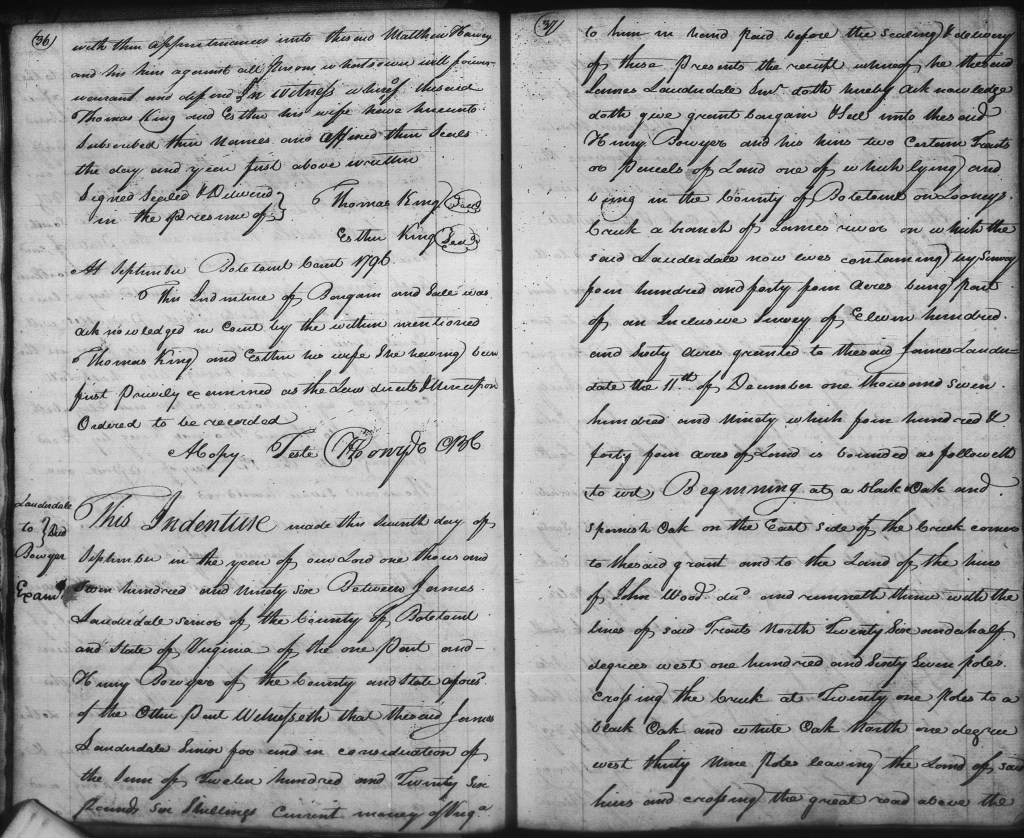
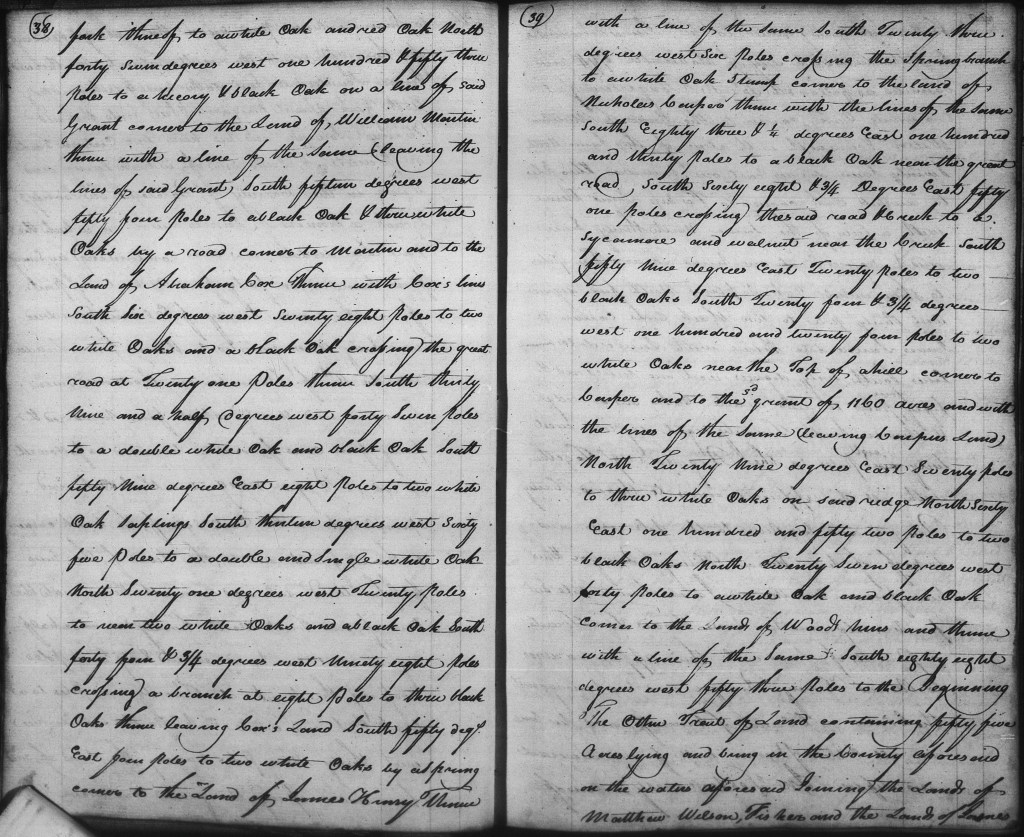
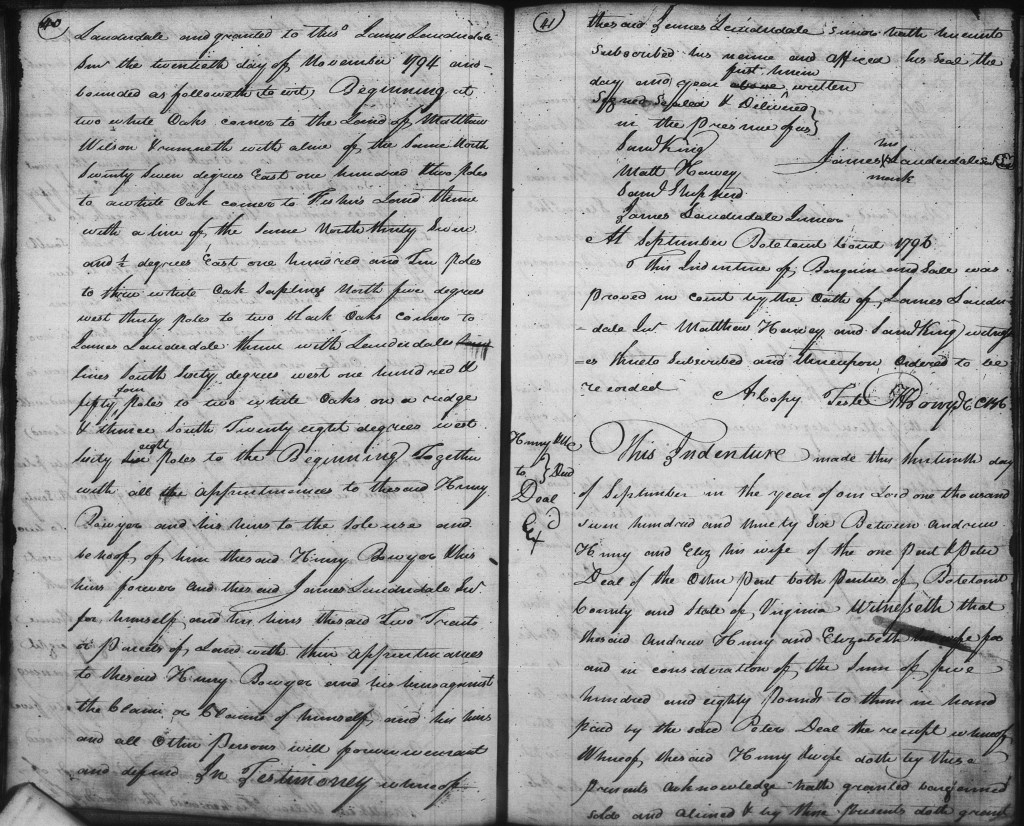
As the preceding posting states, James Lauderdale lived continuously on his 366-acre tract on the James at Looney’s Mill Creek, adding contiguous tracts to it, until he left Botetourt County for Tennessee after making his will in Botetourt County on 22 September 1796.[7] The will states that James was intending to move to Tennessee, when he made the will — most of his children had removed from Virginia to Sumner County, Tennessee — and it’s filed in that Tennessee county, where he died by the first Monday in April when his sons and executors William and James filed an inventory of his estate.[8] Before making his will, on 7 September 1796, James Lauderdale Sr. sold the bulk of his property in Botetourt County, two tracts of land, 444 acres and 55 acres to Colonel Henry Bowyer for £1226 6s, with his youngest son James Jr. witnessing the deed along with several other men, two of them proving it with James Jr. at Botetourt court in September 1796.[9] As with previous documents and his will, James Sr. signed this deed by mark.
So those are the bookends for James Lauderdale’s life in Virginia — his documented arrival there from Maryland by February or March 1744/5, and his sale of his property in Botetourt County in September 1796 followed by making his will and then leaving Virginia for Tennessee between 24 September 1796 (the date of a codicil to his will) and April 1797, the dates between which he died in Tennessee. As my previous posting ends by telling you, I do have quite a few notes to fill in the years between those two bookends, but I have not fleshed out those notes with the kind of narrative I’ve provided for James’ arrival in Virginia and his departure for Tennessee.
My previous posting also says that in my next posting about James Lauderdale, I’d provide these notes about James’ years in Virginia between 1744 and 1796 as “raw” notes that would, I hope, be of use to other researchers of James Lauderdale. In what follows, I’m going to list the citations I’ve gathered over the years from various sources to fill in James Lauderdale’s Virginia years. The documentation I’ll provide will sometimes by sketchy, but I hope it will be sufficient to point other researchers in the right direction as they look for information about James Lauderdale. For a list of the sources cited, see the end of this posting.
Documents Providing Information on James Lauderdale’s Years in Augusta/Botetourt County, Virginia
Note: records prior to 1770 are Augusta County records; after 1770, they’re Botetourt County records unless otherwise noted. I don’t by any means intend to say that the following list is an exhaustive account of Virginia records for James Lauderdale. It’s the one I myself have compiled over the years from a variety of sources, both original and secondary (published) ones.
1753: survey for 143 acres on Back Creek of the James River (Kegley, p. 160, giving the surname as Landerdale).
5 May 1753: patent for 300 acres on a branch of Looney’s Mill Creek (Kegley, p. 79).
15 December 1753: grant for 150 acres on Looney’s Mill Creek (Augusta County, Virginia, Survey Rec. no. 196, 1799-1822; and Kegley, p. 161).
November 1756: judgment in case of John Harrison v. James Lauderdale states that James had settled on the south branch of the James River in March 1744/5 (Chalkley, vol. 1 ,p. 315: see infra, n. 2).
1755: listed as a delinquent taxpayer in the district of Robert Breckinridge, sheriff (Chalkley, vol. 2, p. 418).
1759 and 1761: served under Colonel William Byrd in the 2nd Virginia Regiment in campaign against the Cherokees (Kirk, pp. 12-13). Note: has this service been documented in original sources?
29 August 1759: buyer at the estate sale of Bryan McDonald (Augusta County, Virginia, Will Bk. 2, p. 332; surname given here as Litherdale).
26 February 1760: power of attorney from John Harrison to convey 300 acres on Looney’s Creek adjoining William Harbison to John Vance (Breidenthal, citing deed book? or Chalkley?; surname given as Lawderdale).
18 November 1760: gave bond with daughter to administer the estate of spouse Margaret’s husband Peter Looney (Augusta County, Virginia, Will Bk. 2, p. 421; surname is Litherdale here).
18 August 1761: power of attorney to deed 300 acres of Hugh Corruthers of Orange County, North Carolina, to Andrew McNeilly on Looney’s Creek (Augusta County, Virginia, Deed Bk. 9, p. 520; and Chalkley, vol. 3, p. 375; surname is Ledderdale here).
28 January 1765: processioning of 366 acres on James River south of Catawba Creek, per order of the Augusta parish vestry (Augusta County, Virginia, Augusta Parish Vestry Minutes 1746-1776, p. 404). James was also paid for processioning land (p. 409).
1767: listed in a list of taxpayers who were supernumeraries (Chalkley, vol. 2, p. 421, citing delinquent tax lists).
17 November 1767: served as grand juror (Augusta County, Virginia, Court Order Bk. 11, p. 341; Chalkley vol. 1, p. 140; surname is Leatherdale).
18 November 1767: Margaret Looney as administratrix of Peter Looney gives James counter-security (Augusta County, Virginia, Court Order Bk. 11, p. 349; Chalkley, vol. 1, p. 141).
November 1767: sued by Stephen Trigg (Chalkley, vol. 1, p. 351, citing loose-papers files of Augusta County court judgments). James assumed the case on behalf of his son James, who had come of age by this time. The same month, the judgment book entry says that James paid Trigg on 6 June 1766, assuming the debt for his son (Chalkley, vol. 1, p. 473).
Note: subsequent entries in Augusta and Botetourt records may be for either James Sr. or James Jr., and may sometimes not have the Sr. or Jr. designation to clarify.
17 March 1767: appointed to administer the estate of James Carty along with John Craig and Samuel Pepper (Augusta County, Virginia, Will Bk. 3, p. 495; Chalkley, vol. 3, p. 97; surname is Ledderdale here).
1767-8: warrant certificate for growing hemp (Kirk, p. 13).
24 February 1768: survey for 280 acres on Looneys Creek (Augusta County, Virginia, Survey Bk. O-1, p. 136; Kaylor, p. 49).
16 March 1768: bond as security for Margaret Looney, with James McKain and Jonathan Smith as his own securities (Augusta County, Virginia, Will Bk. 4, p. 93, Chalkley, vol. 3, p. 103; surname is Ledderdale here).
18 May 1768: bought from James McKain two black horses, a bay mare, a bay horse, and a wagon (citing Augusta County, Virginia, Deed Bk. 14, p. 445; Chalkley, vol. 3, p. 470; surname given as Latherdale).
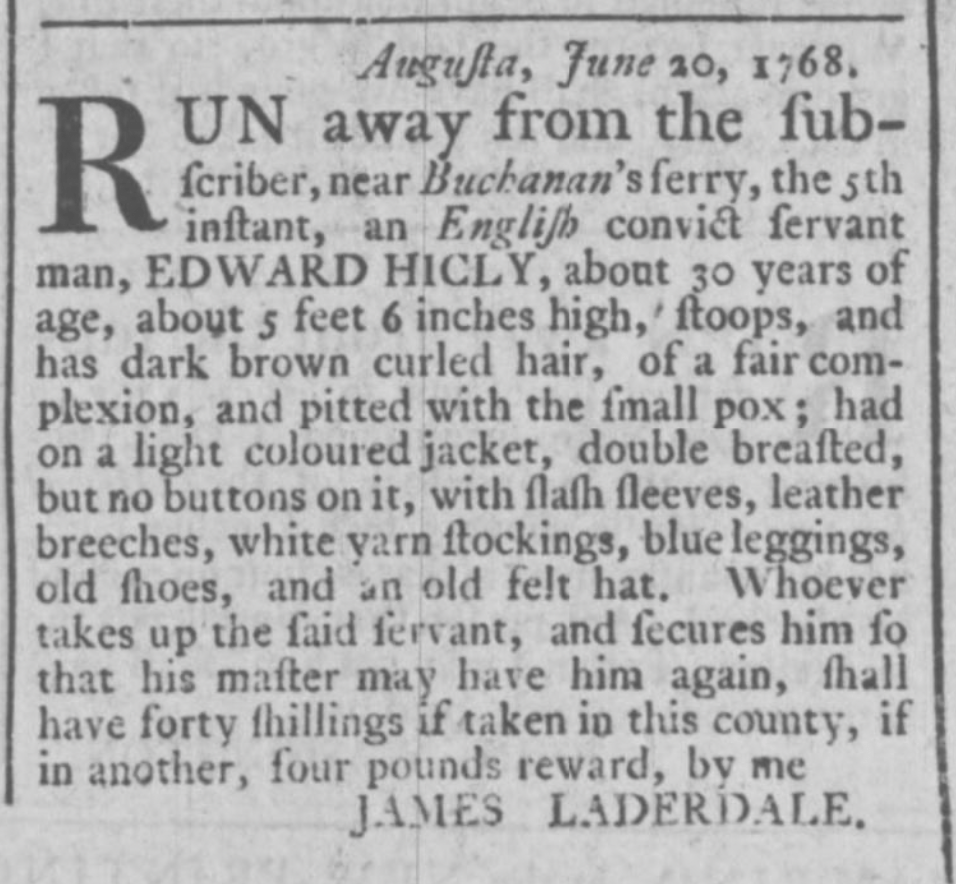
14 July 1768: notice appeared in Virginia Gazette says that Edward Hicly, an English servant aged 30, had run away from James Lauderdale of Augusta (Virginia Gazette, 14 July 1768). James’ surname is given as Laderdale, and the ad was placed 20 June 1768.
Note: records from 1770 forward are Botetourt County records unless otherwise noted.
1770: named county surveyor but relinquished this role to William Preston soon after assuming it (Breidenthal).
12 May 1770: 280 acres surveyed on Looney’s Mill Creek (Surveyors Rec. no. 55, 1799-1822). I do not find this record book; is it in Augusta or Botetourt County? Is this the record of when the 280 acres James had surveyed in February 1768 were granted?
15 November 1775: named guardian for grandson Peter Looney (Summers, p. 248, citing court order book).
1782: taxed for 798 acres (Breidenthal, citing Burton).
August 1782: militia list of Captain John Mills’ militia company contains the names of James, William, and John Lauderdale, 38th District (Worrell, p. 48, citing the original lists on file in Botetourt courthouse). Some researchers have thought this is James Lauderdale Sr. In my view, these are James Sr.’s sons James, William, and John. Breidenthal says that James Sr. is said to have served, along with his son James, as a lieutenant in Capt. Mills’ company of the Botetourt militia for 13 years from 1770-83. If James Sr. was a supernumerary by 1767 (see supra) he would have been a man of advanced years and it’s not likely he was serving in a militia company in this period of his life. Breidenthal says (citing Kegley, p. 418) that James furnished the Botetourt patrol with 6 horses, 16 cattle, and 5 slaves in this period: this may well have been James Sr.
Charles Lauderdale says (p. 69) that James is reported to have been a commissioned officer in the Revolutionary War. He also notes (pp. 31-2) that there are no Revolutionary service records for James. Again, I think it’s highly unlikely that James Lauderdale Sr. served in a military capacity during the Revolution.
1785: James. Sr. and Jr. are taxed next to each other with William Lauderdale beside them (Burton, p. 8). Botetourt Co. tax list, JL Sr. and Jr. appear, with William Lauderdale beside them. They are in John May’s dist. James Sr. has 5 persons in his house, 1 dwelling house, and 3 other buildings. James Jr. has 8 persons in his house, one dwelling, and 3 other buildings
15 November 1786: granted permission for land survey (Summers, p. 417).
1787: taxed with a male over 21, 2 males 16-26, 3 blacks over 16 and 6 under 16, and 18 horses (citing Schreiner-Yantes, p. 227).
Kirk (p. 12) says that the Lauderdale family and other Presbyterian families on the upper branches of Looney’s Mill Creek belonged to Sinking Springs congregation (later the Fincastle congregation), pastored by Rev. John Craig. I have not seen documents showing this.
Sources Cited
Breidenthal, Nancy. “Nancy’s Dead Relatives,” now defunct website
Burton, Charles T. Botetourt County 1785 Enumeration (priv. publ., Troutville, Virginia; n.d.)
Chalkley, Lyman/ Chronicles of the Scotch-Irish Settlement in Virginia (Rosslyn, Virginia: Commonwealth, 1912), 3 vols.
Kaylor, Peter Cline. Abstract of Land Grant Surveys 1761-1791 (Harrisonburg, Virginia: Rockingham Historical Society, 1938; repr. Baltimore: Genealogical Publishing Company, 1976)
Kegley, F.B. Kegley’s Virginia Frontier (Roanoke: Southwest Virginia Historical Society, 1938)
Kirk, Cooper. William Lauderdale, General Andrew Jackson’s Warrior (Fort Lauderdale, Florida: Manatee Books, 1982)
Lauderdale, Charles J. The Lauderdales of Scotland and America 1056-1936 (Joplin, Missouri: Gahagan, 1937)
Lauderdale, Clint. History of the Lauderdales in America: 1714-1850 (Bowie, Maryland: Heritage Books, 1998)
Schreiner-Yantis, Netti. The Personal Property Tax Lists for the Year 1787 for Botetourt County, Virginia (Springfield, Virginia: Genealogical Books in Print, 1987)
Summers, Lewis Preston. Annals of Southwest Virginia, 1769-1800 (Abingdon, Virginia, 1929) Worrell, Anne Lowry. Early Marriages, Wills, and Some Revolutionary War Records, Botetourt County, Virginia (Baltimore: Genealogic
[1] NARA, US, Revolutionary War Pensions, 1800-1900 RG 15, file of William Lauderdale VA S4505, available digitally at Fold3.
[2] Augusta County, Virginia, judgments in case of John Harrison v. James Lauderdale, February 1744/5 or March 1744/5, loose-papers court case files in the Augusta County courthouse abstracted by Lyman Chalkley, Chronicles of the Scotch-Irish Settlement in Virginia, vol. 1 (Rosslyn, Virginia: Commonwealth, 1912), pp. 301, 315.
[3] Augusta County, Virginia, Deed Bk. 2, pp. 287-9.
[4] Robert Douthat Stoner, A Seed-Bed of the Republic: A Study of the Pioneers in the Upper (Southern) Valley of Virginia (Roanoke, Virginia: Roanoke Valley Historical Society, 1962), p. 399; F.B. Kegley, Kegley’s Virginia Frontier (Roanoke: Southwest Virginia Historical Society, 1938), p. 164.
[5] “Early Settlers at Looney’s Mill Creek, Augusta County, VA” in the “Early Settlers of Augusta County, Virginia” files at WeRelate, citing Baylor’s Book of Surveys in Frederick County for the 1740 survey information.
[6] “Robert Looney Sr.,” WikiTree, page managed by Melissa Farris, Greg Looney, Linda Davis, and Randy Church; “Robert Looney Sr.,” Find a Grave memorial page created by Christine Moyer, maintained by Looking for Family; Early Looneys in America, a typescript in the holdings of Houston Public Library (no author stated), available digitally at FamilySearch.
[7] Sumner County, Tennessee, Will Bk. 1, pp. 39-41.
[8] Sumner County, Tennessee, Court Minutes Bk. 3, p. 125. James’ will makes his son-in-law James Henry an executor along with sons William and James Lauderdale, but the court minutes as his estate inventory was filed name only the two sons.
[9] Botetourt County, Virginia, Deed Bk. 6, pp. 36-41.
 BEGATS AND BEQUEATHALS
One thought on “James Lauderdale (abt. 1707 – 1796/7): The Virginia Years, 1744/5 – 1796”