I followed my initial posting with the following postings tracking my Lauderdale line back from John Lauderdale’s daughter Sarah M. Lauderdale (1785/6 – abt. 1866) to John and his wife Milbury Mauldin:
John Lauderdale (1745 – 1830/1840), Father of Sarah Lauderdale Leonard (1)
John Lauderdale (1745 – 1830/1840): Revolutionary War Records, Virginia to Georgia (2)
John Lauderdale (1745 – 1830/1840): Georgia and South Carolina Records to 1790 (3)
John Lauderdale (1745 – 1830/1840): South Carolina Records, 1790-1806 (4)
John Lauderdale (1745 – 1830/1840): Final Years in Tennessee and Alabama (5)
Notes about Milbury Mauldin (1760/1770 – 1836/1840), Wife of John Lauderdale (1745 – 1830/1840)
Sumner County, Tennessee: James Lauderdale’s Will and Death
As this series states, the John Lauderdale on whom the preceding postings focus is thought to be a son of a James Lauderdale who died testate in Sumner County, Tennessee, with a will written 22 September 1796, which names among other children a son John (see the images at the head of this posting).[1] The will helpfully tells us that James was living in Botetourt County, Virginia, when he made the will, but intending to relocate to Tennessee. The will itself, then, links the James Lauderdale who died in Sumner County prior to the first Monday in April 1797, when his sons William and James as executors filed his estate inventory in Sumner County court, back to Botetourt County, Virginia.[2]
So there’s a clear trail permitting us to track the James Lauderdale who died in Sumner County, Tennessee, it seems from Sumner County probate records between 23 September 1796 when he made a codicil to the will he had made on 22 September, and the first Monday of April 1797 when his executors filed an inventory of his estate in Sumner County, to Botetourt County, Virginia. And it’s also fairly clear, it seems to me (see the trail provided by the postings cited above), that this James Lauderdale is the father of the John Lauderdale who died between 1830 and 1840 in Limestone County, Alabama, and who married Milbury Mauldin.
Augusta and Botetourt County, Virginia Records for James Lauderdale and Confusion about His Pre-Virginia Origins
Where things become less than clear — for me, at least — is when I attempt to follow James Lauderdale through Botetourt County records and, before that, in Botetourt’s parent county, Augusta. The unclarity doesn’t have so much to do with the records themselves as with what a number of published accounts of this family have made of them over the years. A number of published histories make James Lauderdale the son of an older man of the same name who is said to have come from Ulster to Pennsylvania, and whose life seems to be curiously undocumented by Lauderdale researchers.
I have to say frankly that I have never seen documentation that this man even existed. I’ve seen only assertions that he was the immigrant ancestor a generation prior to the James Lauderdale on whom this posting focuses. Adding to the mystery surrounding this undocumented Ur-ancestor of the Lauderdale family of Botetourt County and points west are myths that this immigrant ancestor was a son of a Scottish earl of Lauderdale, John Maitland Lauder, the 5th Earl of Lauderdale.[3]
The myth that the Lauderdale family of Botetourt County, Virginia, descends directly from the noble Maitland family of Lauderdale may be echoing stories told in a letter written by James Shelby Lauderdale (1815-1909) in 1880. James S. Lauderdale was a great-grandson of the James Lauderdale who died in Sumner County, Tennessee, in 1796-7; his father Samuel D. Lauderdale (1776-1866) was a son of James Lauderdale’s son James, who is discussed in several of the previous postings listed above (here and here).
A transcription of James S. Lauderdale’s 1880 longhand letter, the original of which is in the Tennessee Archives, appears in Clint Lauderdale’s History of the Lauderdales in America.[4] The letter does not name its recipient, but at one point speaks of “your uncle Sam.” Clint Lauderdale thinks that James S. was writing to one of his first cousins, either James Hart Lauderdale or John Mills Lauderdale, sons of Samuel D. Lauderdale’s brother William.
James Shelby Lauderdale’s letter states that around 1830, a Dr. David Lauderdale of Charleston, South Carolina, visited his father Samuel D. Lauderdale and they discussed the history of the American Lauderdale family. Samuel D. Lauderdale was living in Washington County, Texas, at the time.
According to James S. Lauderdale, Samuel and David Lauderdale agreed on the following:
Our original name was “Maitland,” but centuries back the Laird of Maitland was made Earl or Lord Lauderdale, for services rendered his country, I don’t know whether military or civil and a patrimony or landed estate were [sic] given with the title. In some of the many civil wars of England, our branch of the family (the younger branch) had to flee from Scotland, for safety, to Ireland, and in a subsequent Revolution, from there (Cork) to the United States, for the same reason. You will see, we are Scotch, but came from Ireland, in the first part of the 18th century.
Note the claim that the point of emigration from Ireland was Cork: I find similar legends among a number of American families that clearly have Ulster Scots origins, including the Montgomery and Pickens families, with these stories always elaborated with tales about ancestors having to flee Scotland for Ireland due to some trouble and ending up in Cork before leaving for America. But it’s very clear that all these families came to the American colonies from Ulster and not from the southern part of Ireland, from Cork, specifically.
James S. Lauderdale’s letter goes on to say, “Our great-grandfather (whose given name I don’t know) emigrated from Ireland and settled first (I think) in S. W. Pennsylvania, and about 1740 afterwards moved to Botetourt Co., Virginia.”
Note that in this statement, James S. Lauderdale makes his great-grandfather James Lauderdale (abt. 1707? – 1796/7) the immigrant ancestor. Clint Lauderdale proposes that the immigrant ancestor, whom he calls James Maitland Lauderdale, and who he identifies as father of the James Lauderdale who settled in Augusta/Botetourt County, immigrated to Pennsylvania from Ulster, having gone from Cork to Ulster, and then settled in Pennsylvania about 1714.[5] He thinks that the Lauderdale family may have moved from Pennsylvania to Maryland and from there to Virginia, where he proposes that the immigrant ancestor died.
Though I never want entirely to discount oral tradition and family stories, especially when they can be tracked back quite a way back in time, I find no documentation anywhere to back up these stories about the immigrant ancestor of the Botetourt County, Virginia, Lauderdale family. As we’ll see in a moment, however, there is documentation indicating that the family came to Botetourt County from Maryland — but that documentation tracks the movements of the James Lauderdale who died in 1796 or 1797 in Sumner County, Tennessee, not of his purported immigrant father.
You’ll see why I say that “things become less than clear” when one moves back from Tennessee to Virginia to track the life of James Lauderdale of Botetourt County. Some published sources have conflated this James with a man of the same name who appears in other (undocumented) accounts as the immigrant ancestor. None of this is made any easier to sort out when one throws in clearly erroneous myths of a noble ancestry for the immigrant Lauderdale ancestor, and stories about flights under duress from Scotland to Cork and from Cork to Ulster prior to the emigration of the ancestor of the Virginia family.
The Problem of Establishing a Birthdate for James Lauderdale
So what can we document regarding the pre-Tennessee history of the James Lauderdale who died in Sumner County, Tennessee, in 1796 or 1797? No extant document that I’ve found gives us a clear indication of his date of birth. We do know from an affidavit James’ son William gave in Sumner County on 10 August 1833 that William was born in Maryland in 1741 or 1742.[6] William is one of the children James Lauderdale names in his September 1796 will in Sumner County, and was made James’ executor along with his brother James. William’s August 1833 pension affidavit states that he was ninety-one years of age and had been born in “the State of Marayland in the year 1741 or 1742,” and that “he moved when an infant with his parents to the State of Virginia in Botetourt County.”
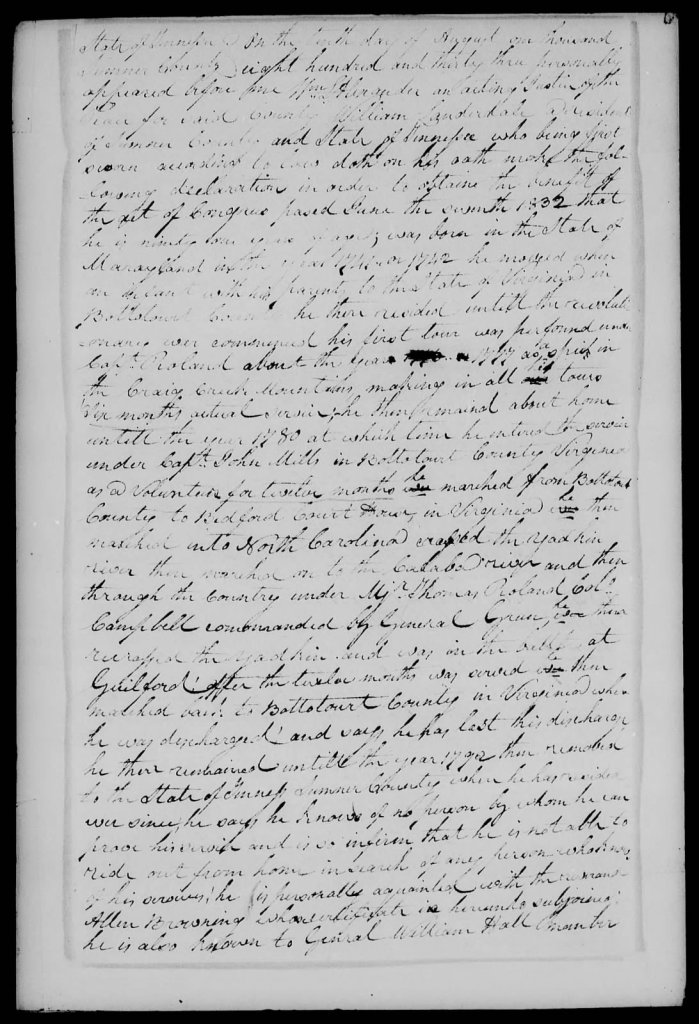
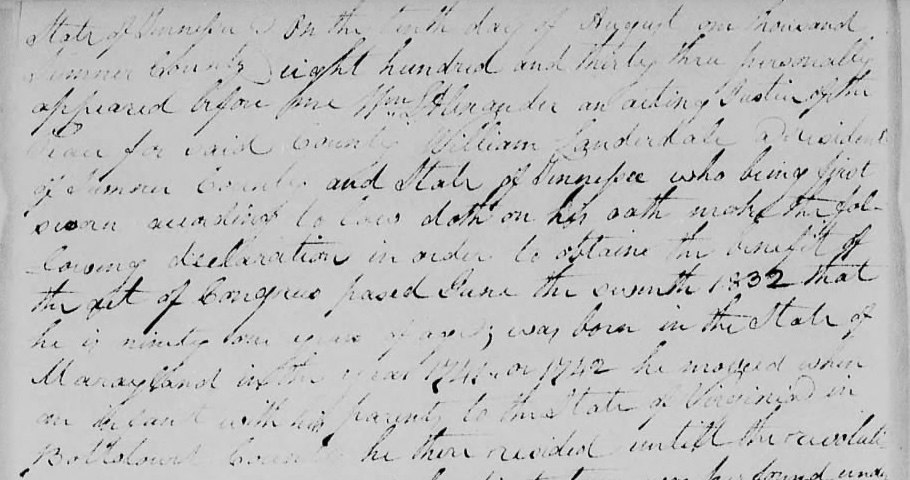
James Lauderdale’s will states that William was his oldest son. It also indicates that William’s sister Margaret was James’ oldest daughter. I have not found a document stating clearly Margaret’s date of birth, but it appears she was slightly older than her brother William. She married Peter Looney in Augusta County, Virginia, before 11 October 1759.[7] If she was around age eighteen in 1759 (Peter was twenty-five in that year), then she may have been born around 1741 or somewhat before that date.[8]
The substantiated 1741-2 birthdate for James Lauderdale’s son William and the inferred birthdate of about 1741 or somewhat earlier for James’ daughter Margaret suggest a birthdate for James Lauderdale prior to or around 1720. Charles J. Lauderdale offers a birthdate of 1730 for James, but that date of birth cannot be possible if James’ oldest son was born in 1741-2.[9] Clint Lauderdale suggests a birth year of 1709 for James, but provides no documentation for that conjecture except to surmise that James was born in Ireland and came as a young man to Pennsylvania with his father.[10] In an April 1997 telephone conversation with me, Clint told me that he had concluded that James was born abt. 1707, and moved to Augusta County, Virginia, in 1738, a point to which I’ll return in a moment.
One additional document allows us to date James Lauderdale’s year of birth prior to 1717. In his Chronicles of the Scotch-Irish Settlement in Virginia, Lyman Chalkley abstracts a delinquent tax list from Augusta County in 1767 that lists men who were exempt from taxation because they were supernumeraries: that is, they were over fifty years of age.[11]
To sum up this discussion of when James Lauderdale (abt. 1707? – 1796/7) was born and what we know of him prior to his settling in Augusta County, Virginia, I want to underscore a point that should be apparent from all I’ve just said: if records documenting James’ life prior to his coming to Virginia in the 1740s exist, I haven’t seen them.
James Lauderdale’s Arrival in Augusta County, Virginia, by 1744/5
Though as I’ve noted above, Clint Lauderdale thought that James Lauderdale moved his family from Maryland to Augusta County, Virginia, in 1738, the Revolutionary pension affidavit his son William gave in Sumner County on 10 August 1833 states that he was born in Maryland in 1741 or 1742 and that he moved to Virginia with his parents when he was an infant. I see no reason to doubt the reliability of this testimony by William Lauderdale.
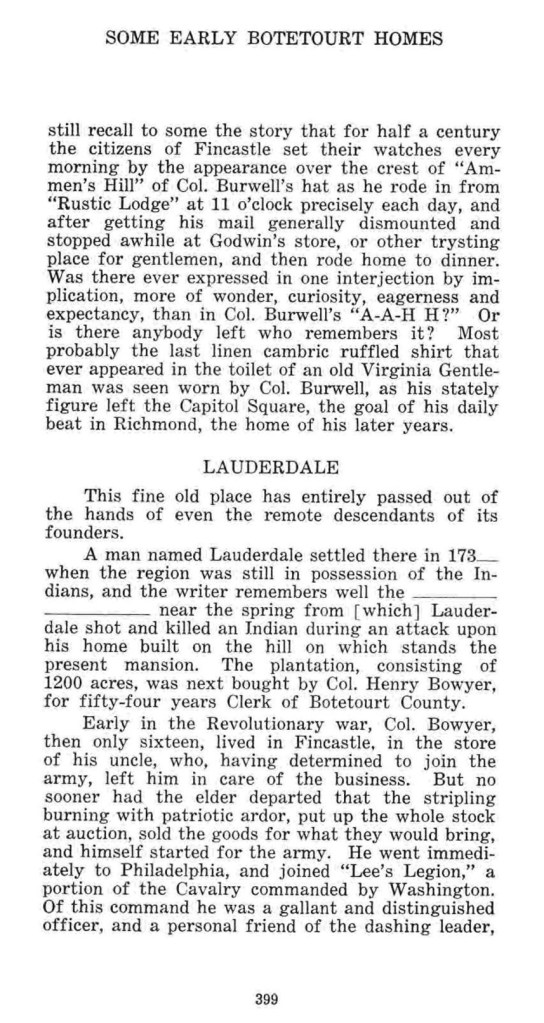
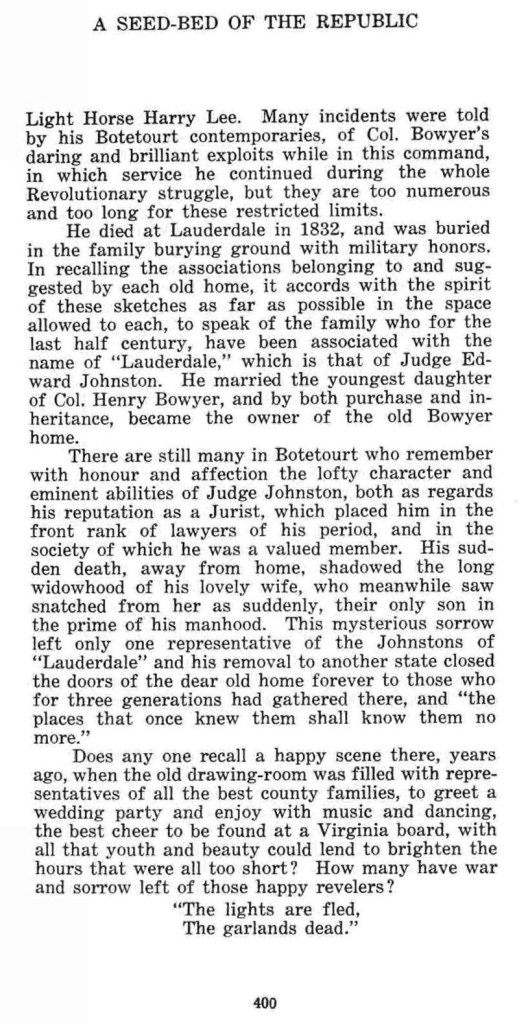
It’s possible that Clint Lauderdale assumed that James Lauderdale settled in Virginia in 1738 because of a statement that Robert Douthat Stoner makes in his history of Botetourt County entitled Seed-Bed of the Republic. In speaking of a house named for the Lauderdale family near Buchanan in Botetourt County, Stoner states,[12]
A man named Lauderdale settled there in 173— when the region was still in possession of the Indians, and the writer remembers well the ——— near the spring from [which] Lauderdale shot and killed an Indian during an attack upon his home built on the hill on which stands the present mansion.
Clint Lauderdale’s History of the Lauderdales suggests that one reason he wants to advance a pre-1740 date for James Lauderdale’s arrival in Virginia is that he is operating from the assumption that two James Lauderdales came to Virginia, father (the undocumented immigrant) and son, with the father, whom Clint Lauderdale calls James Maitland Lauderdale, dying in Virginia in 1736, and with his son, also in Virginia prior to 1736, then claiming land in Augusta County in 1744.[13]
Given that no documentation exists (none that I’ve seen, at least: it may be there, but I haven’t found it) showing the James Lauderdale who came to Augusta County in the 1740s having a father named James Maitland Lauderdale, and that no documentation exists showing this older James dying in Virginia in 1736, I think we’d be wise to take the 1833 affidavit of James Lauderdale’s son William at face value and place James’ family in Maryland up to about 1742, and then begin looking for James in Augusta County, Virginia, records from 1742 onward.[14] (William says that the family moved from Maryland to Botetourt County, but Botetourt was not formed from Augusta until 1770.)
All the more reason to take this approach, it seems to me, when there’s documentary evidence that James Lauderdale had arrived in Augusta County by February 1744/5. Chalkley abstracts two Augusta County court judgments in August 1749 and November 1756 which state that James Lauderdale bought land on the south branch of the James River from John Harrison on 2 February 1744/5 or March 1744/5.[15] These documents indicate that in September 1747, John Harrison sued James Lauderdale for debt based on a bond Lauderdale made to him when Lauderdale settled on land on the James River on which he was living in September 1747.[16] The two court judgments I’ve just cited are judgments in that case of debt.
Cooper Kirk sums this case up in the following way: prior to 1747, James Lauderdale settled on Benjamin Borden’s grant along the headwaters of the James and Roanoke Rivers.[17] Kirk speaks of brothers William and John settling on the Borden tract along with James Lauderdale. I find no corroboration of those brothers, and think that Kirk is mistaking James Lauderdale’s two oldest sons, who were not of age in 1747 but began appearing in Augusta and Botetourt records after they came of age in the 1760s, with brothers of James. It should also be noted that, if I am not mistaken, the Borden tract was north of Looney’s Mill Creek, where James Lauderdale bought his land from John Harrison.
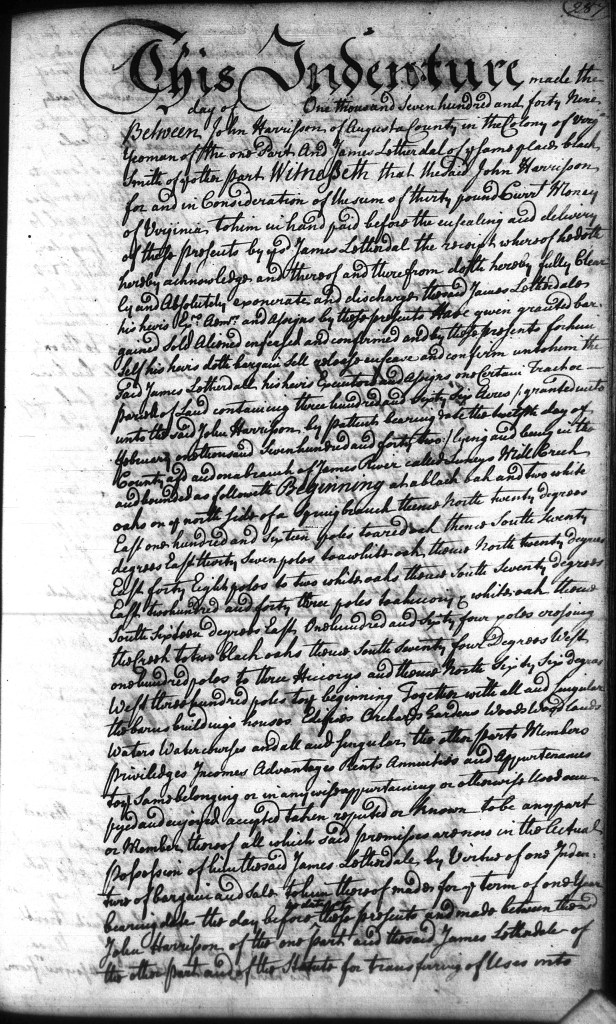
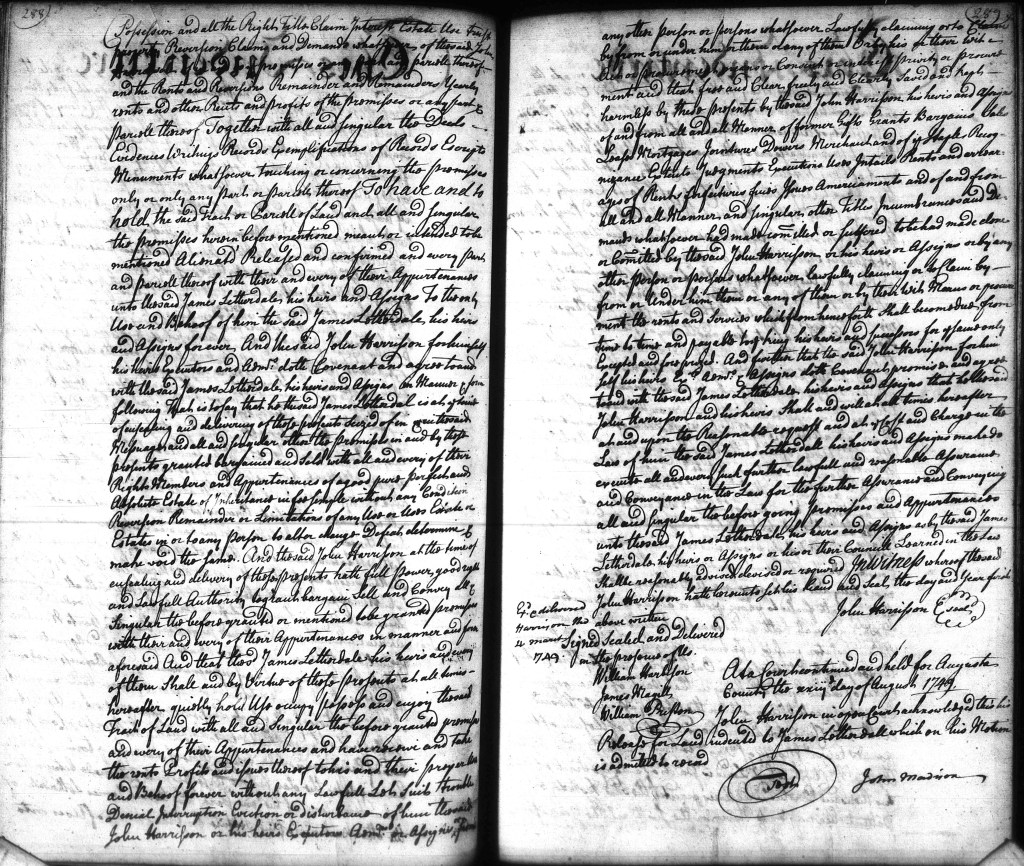
According to Kirk, in 1746, two patents based on previous surveys of Looney’s Mill Creek came into John Harrison’s possession, and three years later, Harrison launched into land speculation by selling 366 acres to James Lauderdale.[18] Kirk indicates that he’s relying here on a deed John Harrison made to James Letherdale in Augusta County in 1749 in which Harrison gave title to 366 acres on Looney’s Mill Creek of the James River to James Letherdale, blacksmith.[19] Kirk gives the deed a 17 May 1749 date, but the deed actually states only the year, though it has a marginal annotation indicating that it was delivered on 4 March 1749 and recorded in August 1749. The deed states that the 366 acres were patented to Harrison on 12 February 1742.
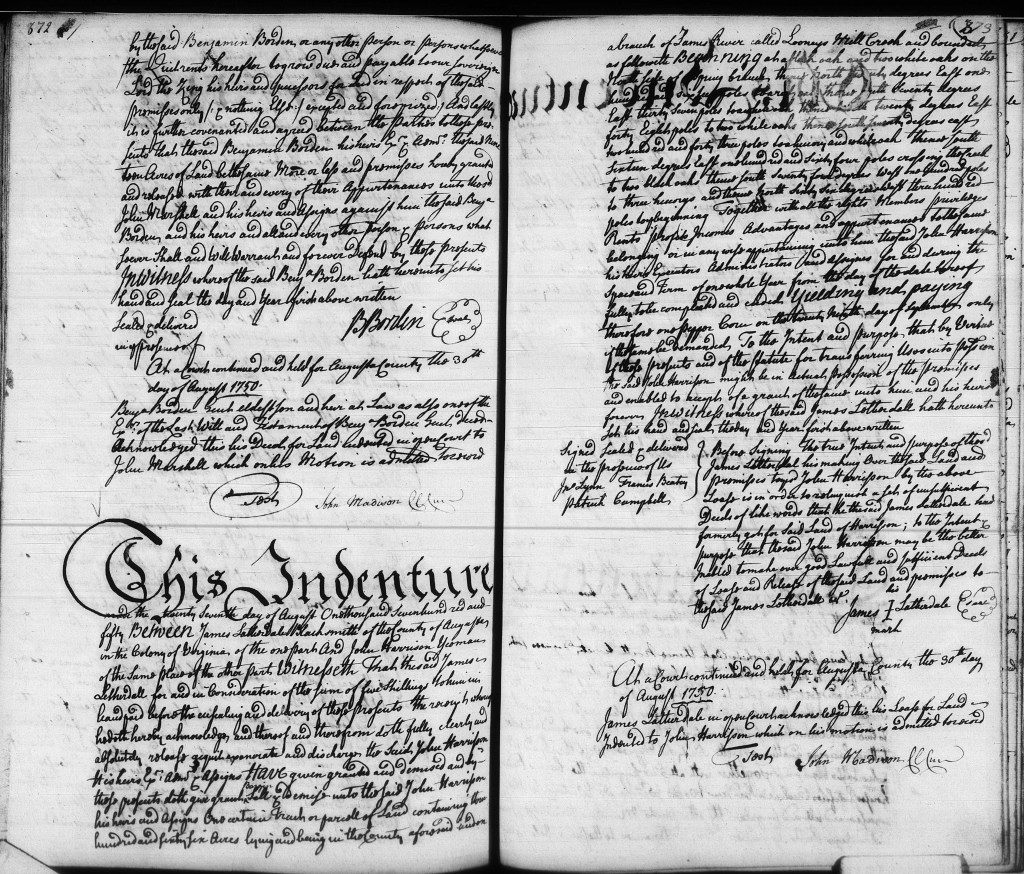
On 27 August 1750 James Letherdale deeded this tract of 366 acres to Harrison, with this document stating that he was deeding the land back so that Harrison could issue Letherdale “good Lawfull and sufficient Deeds” for the land, the previous deeds having been “insufficient” in their wording.[20] The Augusta court order books show Harrison acknowledging his deed of lease and release of the land to James Ledderdale on 30 August 1750.[21] I read this set of deeds as an indicator that Harrison and Lauderdale had settled the dispute that had led to Harrison’s lawsuit against Lauderdale.
This set of deeds appears to be the documentation F.B. Kegley is citing when he says that James Lauderdale was a blacksmith who first appeared in Augusta County in 1749, when he purchased land from John Harrison to which he added as he bought contiguous tracts over subsequent years.[22] Kegley provides valuable background to the John Harrison-James Lauderdale story, and to the probable reason for the dispute between the two men that resulted in a lawsuit in 1747.[23] As he notes, the area around Looney’s Mill Creek on which James Lauderdale was living on land he had acquired from John Harrison did not open for formal surveys and settlement until an order of the Virginia Council in April 1745 gave leave to James Patton and others to survey 100,000 acres. However, prior to this, “several groups of individuals had made selections and established their homes in anticipation of titles to the land.”[24]
Then:
Surveying was begun in March, 1746; but in that same year two patents based on previous surveys [were] issued to John Harrison, Jr., the original owner of the Lauderdale home on Looney’s Mill Creek, one of the first in that region to be occupied.
Since it appears that John Harrison first patented the 366 acres on Looney’s Mill Creek in February 1742 and then sold that tract to James Lauderdale in February or March 1744/5, James Lauderdale was already settled and living on this tract when questions arose due to the Virginia Council’s order for formal surveys in April 1745.
Kegley says that “the Lauderdale place at the junction of Milligan’s Run with Looney’s Mill Creek was then as afterward the most desirable situation on the waters of Mill Creek.”[25] It appears from records up to the point at which James Lauderdale left Botetourt County that he and his family lived continuously on the original 366-acre tract that he acquired from Harrison in 1744/5. The Looney’s Mill Creek Lauderdale tract is discussed on a number of postings listed at the start of this posting — e.g., here and here. As a posting about another ancestor of mine, George Birdwell (bef. 1725 – 1781), shows, the minutes of the vestry of Augusta parish for 28 January 1765 show James Lauderdales 366-acre home tract being processioned by the Augusta parish not long before that date, along with George Birdwell’s home tract of 140 acres on the James. The posting I’ve just linked and another featuring George Birdwell discuss the Looney’s Mill Creek area and the Looney family for which it is named, and offer maps of the area.[26] As these posting note, in my direct ancestral lines, the Birdwell and Lauderdale families intersect through the marriage of James Birdwell (1795-1849), a grandson of George Birdwell, to Aletha Leonard, whose mother Sarah Lauderdale Leonard was a granddaughter of James Lauderdale.
Some Notes on the Lauderdale House of Buchanan, Botetourt County, Virginia
Earlier, I excerpted a passage from Robert Douthat Stoner’s Seed-Bed of the Republic in which Stoner says that after settling in Virginia in the 1730s (as Stoner erroneously thinks: see supra), James Lauderdale built his home on the hill “on which stands the present mansion.”[27] Stoner goes on to say, “The fine old place has entirely passed out of the hands of even the remote descendants of its founders.”
This passage seems to have led some Lauderdale researchers to think that the house named Lauderdale, an historic house at Buchanan in Botetourt County, Virginia, was built by James Lauderdale (abt. 1707? – 1796/7).[28] Wikipedia’s entry entitled “Lauderdale (Buchanan, Virginia)” states, for example, that the Lauderdale mansion was built in 1790 by James Lauderdale Sr. Wikipedia is citing a letter written 12 December 1982 by Gayl Lauderdale Ware of Houston, who purchased the Lauderdale house in 1987 and served as a president of Clan Maitland Society of North America.
According to the Wikipedia article about the house, which has a photograph that appears to date from 2008,
It is a two-story, brick dwelling that has a one-room-deep, center-passage-plan form with a five-bay north-facing front elevation, a two-story ell, and a rear addition built about 1926. It features Greek Revival style decorative details and a Colonial Revival style portico added in 1926. Also on the property are a contributing privy and outbuilding.
According to a number of well-documented accounts, neither James Lauderdale nor his son of that name, who is sometimes given credit for building this Lauderdale house,[29] built the house, but it took its name from their family because it was constructed on land that James Lauderdale Sr. owned. A page for Lauderdale house Virginia Department of Historic Resources states the following:[30]
Lauderdale was named for its 18th-century owner, James Lauderdale, Sr., who bought over 350 acres in what is now Botetourt County in 1749. The current house and its outbuildings, including an antebellum brick privy, were begun in 1819. The house began as a Federal-style building, though it underwent remodeling in the 1840s with Greek Revival details such as the elaborated entrance and some of its interior moldings. The dominant front portico was added in 1926.
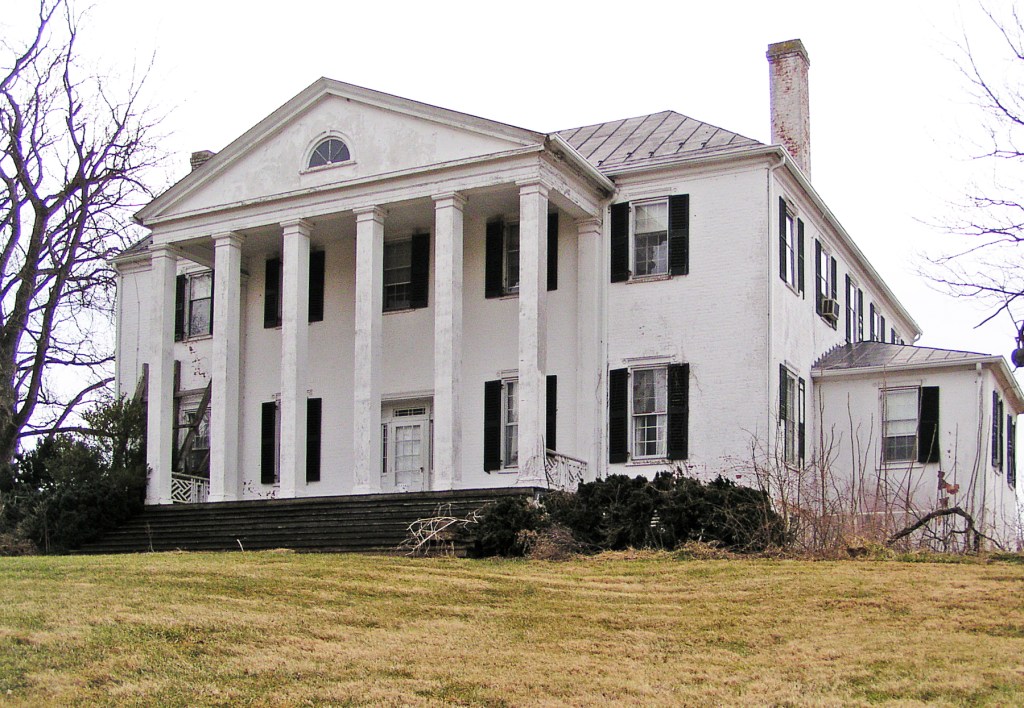
A 14 September 2007 registration form to have the house placed on the National Register of Historic Places linked to the Virginia Department of Historic Resources entry for the house states Lauderdale was built about 1821 for Henry Bowyer, and that the house takes its name from the previous owner of the land, James Lauderdale, though he did not build the house. This document states,
Lauderdale takes its name from the eighteenth century owner of the property, James Lauderdale Sr. Lauderdale purchased 366 acres on Looney Mill Creek in 1749. By the early 1780s, he owned over a thousand acres in Botetourt County, and in 1785 he was listed as the owner of a dwelling and three other buildings. In 1796, Lauderdale sold 444 acres, including his residence to Col. Henry Bowyer (ca. 1760-1832).
For now, this is the sum total of what I want to say about James Lauderdale, whom I’m going to treat as the first proven ancestor in this ancestral line of mine. I do have notes about his years in Augusta and Botetourt Counties following his settling in Virginia at some point prior to February of March 1744/5. I will post those “raw” notes in a subsequent posting. I’m not inclined right now to flesh them out with further research or narrative. I’ve frankly grown weary of working on this line, in part, due to the stultifying effects of dealing with unsubstantiated myths and trying to sort fact from fictional accounts devoid of sound documentation.
When I launched this blog in January 2018, my vision for it was to establish an online place at which I could share with others my 50+ years of documented research on my family lines. At the rate I’m going now, I doubt I’ll complete that project before I shuffle off this mortal coil, unless I start curbing what I say here about this or that ancestor. It’s time, I think, to move on to another of my family lines and leave this Lauderdale one, in its Virginia iteration, in the form of raw notes that someone else someday may find and wish to pursue to fill in the dots regarding the Virginia years of James Lauderdale (abt. 1707? – 1796/7).
[1] Sumner County, Tennessee, Will Bk. 1, pp. 39-41.
[2] Sumner County, Tennessee, Court Minutes Bk. 3, p. 125. James’ will makes his sons William and James executors along with his son-in-law James Henry, but the court minutes show only the two sons acting as executors when the estate inventory was filed. Prior to making his will in Botetourt County in September 1796, James Lauderdale gave power of attorney in that county on 27 November 1794 to his grandson Peter Looney, son of his daughter Margaret, to conduct his business in Sumer County: Sumner County, Tennessee, Will Bk. 1, p. 28. The power of attorney was proven by James Lauderdale Jr. in Sumner County court on the first Monday in January 1795: Sumner County, Tennessee, Court Minutes Bk. 2, p. 80.
[3] See Charles J. Lauderdale, The Lauderdales of Scotland and America 1056-1936 (Joplin, Missouri: Gahagan, 1937), p. 27, which states that James the immigrant, whom Charles Lauderdale calls James Maitland Lauderdale, was born between 1690-5, and was a son of John, the 5th Earl of Lauderdale and his wife Margaret Cunningham. Charles Lauderdale advances no evidence to support that claim, other than his assertion that John Maitland, Earl of Lauderdale, died in 1710, and James Lauderdale, the American immigrant ancestor, emigrated from Scotland about 1714. The children of John Maitland and Margaret Cunningham are well-documented; there was no such James-who-went-to-America among their children. As Cooper Kirk notes, the claim that John Maitland, and Margaret Cunningham had a son James Maitland who became progenitor of the American Lauderdale family is contradicted by Burke’s Peerage which shows James, son of John, becoming Viscount Maitland: see William Lauderdale, General Andrew Jackson’s Warrior (Fort Lauderdale, Florida: Manatee Books, 1982), p. 8.
[4] Clint Lauderdale, History of the Lauderdales in America: 1714-1850 (Bowie, Maryland: Heritage Books, 1998), pp. 192-4. See also Kirk, William Lauderdale, p. 7, for a discussion of this letter, who says that the Dr. David Lauderdale mentioned in this letter was from a branch of the Lauderdales separate from the American branch, descending from John Lauderdale, a merchant from Kirkcudbright, Scotland.
[5] Clint Lauderdale, History of the Lauderdales, p. 7.
[6] NARA, US, Revolutionary War Pensions, 1800-1900 RG 15, file of William Lauderdale VA S4505, available digitally at Fold3.
[7] See Augusta County, Virginia, Deed Bk. 12, p. 198, stating (20 August 1765) that Peter and his brother David signed an agreement on 11 October 1759 in Augusta County regarding their inheritance and proposed care for their aging parents. This document states that Peter died soon after signing the agreement, leaving an infant son Peter — so Peter Looney had married Margaret Lauderdale prior to the October 1759 date.
[8] On Peter Looney’s year of birth as 1734, see the account of his captivity by native Americans in June 1757 published in London Chronicle: or Universal Evening Post on 6-8 September 1757, and republished as “Captivity of Peter Looney” in Mississippi Valley Historical Review 15,1 (June 1928), pp. 95-6. This document is discussed in a previous posting.
[9] Charles J. Lauderdale, The Lauderdales of Scotland and America, p. 31.
[10] Clint Lauderdale, History of the Lauderdales, p. 11.
[11] Lyman Chalkley, Chronicles of the Scotch-Irish Settlement in Virginia, vol. 2 (Rosslyn, Virginia: Commonwealth, 1912), p. 421. Chalkley states that he is abstracting a delinquent tax list. The microfilmed and digitized holdings at FamilySearch do not include tax lists for Augusta County this far back in time. The “Augusta County, Virginia Genealogy” page in the research wiki section of the FamilySearch catalogue indicates that tax lists for Augusta County in the 1760s were published in Augusta Historical Bulletin in the fall of 1972, but lists for 1767 are apparently not included in this transcription.
[12] Robert Douthat Stoner, A Seed-Bed of the Republic: A Study of the Pioneers in the Upper (Southern) Valley of Virginia (Roanoke, Virginia: Roanoke Valley Historical Society, 1962), p. 399. There’s no explanation in Stoner’s book of why sections of this passage have dashes instead of text.
[13] Lauderdale, History of the Lauderdales in America, pp. 9, 11. At the risk of appearing ungrateful to Clint Lauderdale, who shared valuable information about this family with me, I feel compelled to note Marie Martin Murphy’s rather critical review of his book soon after its publication: “Reviews,” National Genealogical Society Quarterly 87,3 (September 1999), pp. 249-250. Murphy notes that the book contains historical errors and also lacks sound documentation. She also identifies the problems created by the undocumented assertion of an immigrant ancestor who was father of James of Botetourt County, and of giving James Jr. brothers William and John.
[14] Note, too, that after Augusta was created from Orange County in 1738, for a period of time, Augusta County records were still kept in Orange County, so the records of that county, too, should be searched for information about James Lauderdale.
[15] Chalkley, Chronicles of the Scotch-Irish Settlement in Virginia, vol. 1, pp. 301, 315. The first court judgment gives James’ surname as Louderdale, the second as Lidderdale. Chalkley states that he is abstracting files of papers in the Augusta County court “Judgments,” which are the original papers in suits and causes that were instituted or adjudicated in that Court. When Chalkley abstracted these files, they were filed in bundles, wrapped, and labeled with the term at which final judgment was entered.
[16] Ibid., p. 297.
[17] Kirk, William Lauderdale, General Andrew Jackson’s Warrior, p. 11.
[18] Ibid.
[19] Augusta County, Virginia, Deed Bk. 2, pp. 287-9.
[20] Ibid., pp. 874-5.
[21] Augusta County, Virginia, Court Order Bk. 2, p. 494.
[22] F.B. Kegley, Kegley’s Virginia Frontier (Roanoke: Southwest Virginia Historical Society, 1938), p. 164.
[23] Ibid., p. 116.
[24] Ibid.
[25] Ibid.
[26] See also “Early Settlers at Looney’s Mill Creek, Augusta County, VA” in the “Early Settlers of Augusta County, Virginia” files at WeRelate; and Elizabeth Shown Mills’ research notes on the Mills family of Augusta County at her Historic Pathways site.
[27] See supra, n. 12.
[28] See e.g. Clint Lauderdale, History of Lauderdales in America, p. 11; and the article entitled “James Lauderdale, the ‘Emigrant’s’ Son” published in spring 1996 by Maitland Matters newsletter, whose author is not identified.
[29] See Kirk, William Lauderdale, General Andrew Jackson’s Warrior, who states that James Lauderdale Jr. built this house(p. 14).
[30] “Lauderdale,” at Virginia Department of Historic Resources website.
 BEGATS AND BEQUEATHALS
2 thoughts on “James Lauderdale (abt. 1707? – 1796/7)”