Lee Hawkins Compere was born 20 May 1920 at Hamburg in Ashley County, Arkansas, the son of Ebenezer Lattimore Compere (1880-1962) and Emma Lucille Hawkins (1888-1981). My family connection to Lee is that on 8 January 1944 in El Dorado, Arkansas, he married my father’s sister Helen Blanche Lindsey, son of Benjamin Dennis Lindsey and Vallie Snead, my grandparents. Through her formative years and afterwards by many family members and friends, Helen was always called by both of her names — Helen Blanche — but in old Southern fashion, her parents and two brothers called her Sister.
When Lee was a young teen of eleven in 1931, his family moved from Hamburg to El Dorado, where his father, who had been practicing law in Hamburg, opened a law practice. Both Hamburg and El Dorado are in counties in southern Arkansas bordering Louisiana. Lee’s father E.L. Compere had a B.A. degree from Ouachita College and a law degree from University of Arkansas. When World War I arrived, he was serving as prosecuting attorney for Ashley County. He then enlisted for service and was colonel, or the commanding officer, of the 3rd Arkansas Infantry, later the 154th Infantry, an Army unit that served in France. His distinguished career included serving as head of the Selective Service system of Arkansas for some years and as head of the state Arkansas Baptist Convention. In 1929, Lee’s father was made Brigadier-General of the Arkansas National Guard.
Lee Joins the National Guard (1938) — The Headquarters, 1st Battalion, 206 Coast Artillery (Anti-Aircraft) (CA) (AA)
I mention these biographical details because his father’s status as a general may have played a certain role in assignments Lee received during WWII. In 1938 at age eighteen, Lee joined the National Guard unit based in El Dorado, 1st Battalion of the 206 Coast Artillery (Anti-Aircraft). He was sent to a military camp at Fort Barrancas, Pensacola, Florida. The following summer, he transferred temporarily to the regiment to which his father belonged, the 142nd Field Artillery, with Lee serving as his father’s orderly and chauffeur while the unit was camped at Fort Sill, Lawton, Oklahoma.
After Lee had attended El Dorado Junior College for a year and a half and had begun serving in the Arkansas National Guard, President Franklin D. Roosevelt nationalized his National Guard unit, the Headquarters, First Battalion, 206 CA (AA), for a year as a training cadre in January 1940. The unit was sent to the anti-aircraft training center at Fort Bliss, El Paso, Texas, for this service.
While Lee was at El Dorado Junior College, a friend, Logan McKinley, invited him on a double date with a friend of Logan’s girlfriend. Logan’s girlfriend was a student nurse in El Dorado. When Lee met his date, he discovered that she was Miss Helen Blanche Lindsey, sister of the student body president of his junior college class, Carlton Lindsey. Lee had previously seen Helen Blanche and told someone that she had mockingbird legs.
Soon after this date took place, General Compere gave the commencement address at Mount Holly High School and Lee drove him to that event, and Lee saw Helen Blanche again. She was salutatorian of her class and gave the salutatory address. Lee was apparently smitten with Helen after having heard her give her salutatory address, and he resolved from that time forward to marry her.
Lee Is Sent to Fort Bliss, El Paso, for Anti-Aircraft Training (1940)
Before Lee left for military training in El Paso early in 1940, he gave Helen Blanche an engagement ring, a “Hot Springs diamond” (i.e., quartz crystal) he had bought on a family trip to that spa city. Lee and Helen agreed that they would not marry until she had completed her education and had become a registered nurse. Helen had followed her friend, Logan McKinley’s girlfriend, in enrolling in the School of Nursing of Warner Brown Hospital in El Dorado, a hospital operated by the Sisters of Mercy, who also established a nursing school in connection with the hospital. After Lee became a full-time soldier, he and Helen then again postponed their marriage plans.

When Lee and his military unit arrived at Fort Bliss, one of the tasks assigned to the soldiers was to drive and test a new vehicle classified as General Purpose, or G.P., with the name then morphing to Jeep. He and his comrades tested the Jeep by driving it across the desert and shooting at jackrabbits from the vehicle. Their good report about the Jeep to its manufacturer, Willis Knight Automobile Co., resulted in having the vehicle manufactured by the major auto manufacturers in the US.
While Lee was in training at Fort Bliss, Roosevelt instituted the National Selective Service and a draft was put into place for young men to go into the military. An induction center was set up at Camp Joseph T. Robinson in Little Rock. Lee’s unit was then reclassified as a training cadre for soldiers who had completed basic training and the unit was informed it would be on active duty for as long as required. Due to this change in status, Lee and several soldiers requested two weeks of furlough and he went to Little Rock to meet his parents. As soon as he arrived, his parents told him, with a telegram also communicating this news, that he was to return to Fort Bliss immediately, since his regiment had received orders to transfer to Fort Lewis, Tacoma, Washington. They were being sent to Dutch Harbor, Alaska, to Fort Mears on the Aleutian Islands. Immediately on his return to El Paso, he was put onto a train for the Northwest.
Lee Is Sent to Fort Mears, Dutch Harbor, Alaska (1941)
In mid-1941, Lee was sent to Fort Mears, Dutch Harbor, Alaska, where he continued to be stationed with the Hq. Btry., 1st Btry, 1st Btn. 206 CA (AA). While Lee was at Fort Mears, the Japanese attack on Pearl Harbor happened on 7 December 1941 and Lee’s unit was placed on red alert to man the 37MM anti-aircraft cannon at their position. As this order came down, they heard via the radio that the US was at war.
At this point, all guns in his unit were manned and Lee was no longer needed for that task, so he applied for a vacant position in the post headquarters. His rank in the 206th CA (AA) was line sergeant, and he could transfer to the DEML (Detached Enlisted Men’s List) unit that staffed the headquarters because someone of that rank was needed there. His job in the DEML unit was in the communications section and consisted of operating the teletype machine with both encoded and “in the clear” messages from the states, both military and personal. Lee’s position at the DEML Post Headquarters was under the command of Brigradier General Edgar B. Colladay and Major John W. Shoemaker, Adjutant.
As he notes this information in his memoirs, Lee also notes, “The war in Europe was going full force, and my two brothers and Dad were all very active in various phases of the conflict.” Lee’s father was serving as Director of Selective Service for the state of Arkansas for the duration of the war and for some years after that.
Lee’s oldest brother Edgar was working on his doctorate degree in physical chemistry at Louisiana State University and was assisting in teaching in the chemistry department. Edgar was also working for Standard Oil Company in its refinery laboratory in Baton Rouge, and when he attempted to enlist in the Army, he was reclassified and eventually sent to work as a nuclear scientist at Oak Ridge, Tennessee.
Lee’s brother Powell was in college at the University of Texas, majoring in economics and political science. He also attempted enlistment, but was deferred until he had graduated and received a degree. Powell was then drafted in the state of Arkansas and inducted at Camp Joseph T. Robinson in North Little Rock. He remained there, working in the classification section of the personnel in the reception center, before he was transferred to Fort Leonard Wood, Missouri, and subsequently assigned to the language school at Washington University in St. Louis. Upon graduation there, Powell was promoted to sergeant and assigned to the 44th Division, later to be sent to France.
On 3 June 1942, while Lee was stationed at Fort Mears in the DEML headquarters, six Japanese dive bombers bombed Fort Mears and the Naval station at Dutch Harbor, with eighteen American soldiers killed and some twenty-five wounded. Buildings and oil and fuel tanks were destroyed. The following day, the Japanese sent another attack squad of planes to bomb Fort Mears.
On that day, the 4th of June, Lee was in his foxhole near the top of a hill directly across the ship channel from the Unalaska docks. As a Japanese bomber came in, Lee fired his M-1 rifle and saw something black come from the plane. The plane crash-landed on Akutan Island, because its oil line had been severed, causing the engine to stop functioning. Since no one actually saw Lee hit the plane, it could not be confirmed that his shots severed the oil line, though Major Shoemaker concluded this is what had happened. The markings on the plane matched those seen as the bomber came into the harbor.
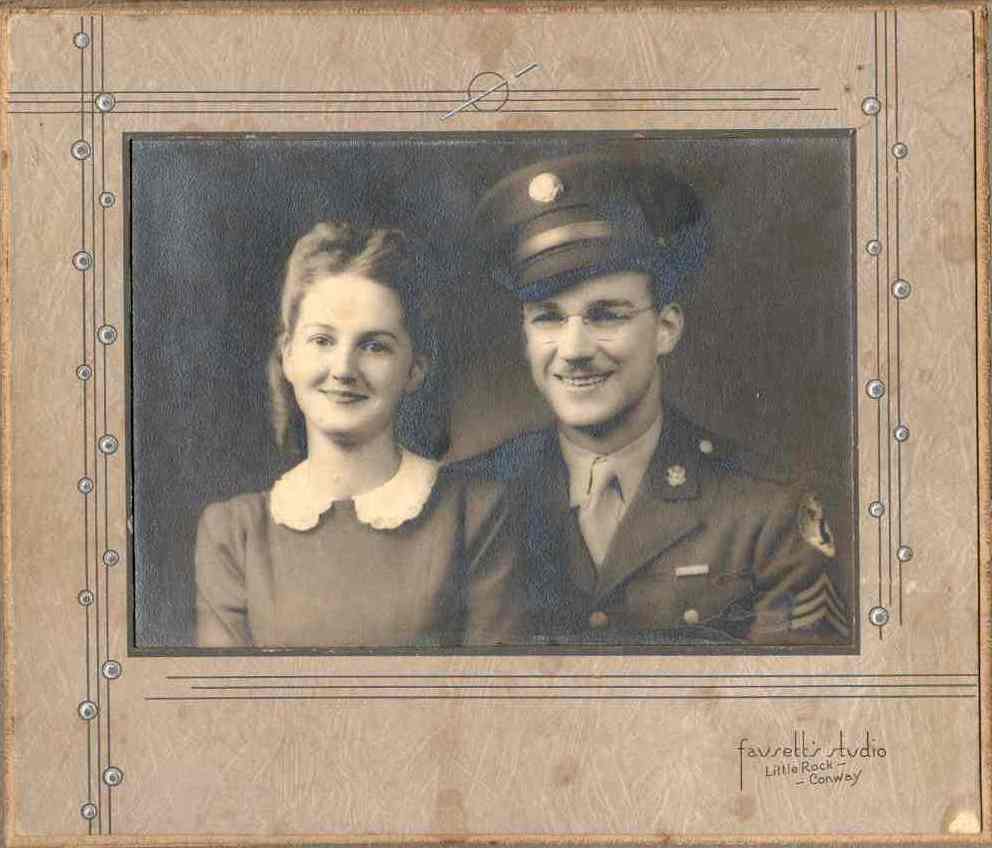
Lee’s memoirs for this period of his service recount an amusing incident that related to his engagement to Helen Blanche Lindsey. Lee says that about twice a week, the Navy showed movies at a movie theater at Dutch Harbor. And:[2]
I recall that on one occasion, a group of soldiers from my unit got to the show about 20-30 minutes before the scheduled start time and were talking about our girlfriends back home. All of us pulled pictures out of our wallets to pass around and to brag that ‘this is the girl I married.’ Or ‘this is the girl I’m going to marry.’
I pulled a picture out of my wallet and started to pass it down the line. I had proposed to Helen before I left El Dorado for my stint in the Army at Ft. Bliss and was proud of my engagement and always proud to exhibit her picture. When the picture started down the line, someone behind me patted me on the shoulder with the announcement that ‘I know that girl!’
I turned around and asked, ‘OK, who is she?’ He replied, ‘That’s Helen Blanche Lindsey!!’
In conversation, I found out that he was Herbert Trull and that he was a classmate of hers at Mt. Holly High School in Southern Arkansas, and that he rode the school bus with her almost daily while in school.
He had joined the Navy and was assigned to the Navy Base Chaplains office, the Catholic Chaplain Thomas J. Conroy.
My memoir of the WWII service of my father Benjamin D. Lindsey notes that on 15 August 1942, he wrote his brother Carlton from Pearl Harbor, where my father was then stationed, noting that he had had a letter from their sister Helen asking that he write her boyfriend in Alaska. The use of the term “boyfriend” makes me wonder if Helen had kept her engagement to Lee something of a secret from her family.
During Lee’s service at Fort Mears, his post got word that the Japanese had landed at a native fishing village, Nikolski, on the southwestern end of Umnak Island, and had burned buildings, docks, boats, equipment. The tribal chief contacted American forces for help, and both Army and Navy men were sent to assist. Lee was assigned the task of living in an empty barracks building available to house the villagers and to assist them.
Lee Transfers to a Signal Regiment and Is Sent to Signal School at Fort Monmouth, New Jersey (1943-4)
After US forces secured Kiska and Attu in August 1943, word reached the soldiers at Dutch Harbor that troops eligible for rotation back to the US after a certain amount of service would be transferred to several reassignment enters stateside. Because Lee had a year of stateside duty plus twenty-one months in the Aleutians, he qualified for reassignment. He chose reassignment at Jefferson Barracks in St. Louis, with a transfer to a signal regiment and school since he had become proficient in teletype operation at Fort Mears.
He got orders to go to Fort Lawton, Seattle, and then went aboard a freighter to Puget Sound, landing at Port Angeles, Washington, and then traveling by truck to Fort Lawton. In his memoirs, he reckons that this trip took place 17-25 December. He then went by train to Little Rock where he arrived at the station and didn’t see his parents, so he asked an MP sergeant on duty if he’d seen a stray Brigadier General looking for someone. The sergeant acted as if Lee were crazy or drunk. Lee’s father then arrived and wouldn’t allow Lee to carry his bags to the car: General Compere wanted to do that for his son, with the MP standing there looking like, “I can’t believe it.”
As noted previously, Lee and his fiancée Helen Blanche Lindsey had agreed to postpone marriage until she completed her nursing degree at the nursing school at Warner Brown Hospital in El Dorado. His parents approved of his choice of Helen and after Lee obtained a license for the marriage in Little Rock, on 8 January 1944 at First Baptist church in El Dorado, the couple married.
They then went to Kansas to visit his Hawkins relatives, who had moved there from Georgia, and from there went to Jefferson Barracks in St. Louis where Lee knew they’d be staying only temporarily as he was en route to the Signal School at Fort Monmouth, New Jersey. As also noted above, Lee’s brother Powell had been sent to special training at the ASTP (Army Specialized Training Program) at Washington University in St. Louis, where his assignment was to study German and French and the customs of Germany and France.
Lee notes that while he and Helen were in St. Louis, they were able to spend time with Powell, and,[3]
Our meeting in St. Louis was the last time that we saw Powell, as he was assigned to Co. K, 324th Infantry, 44th Division, 7th Army and sent overseas to France. He was killed in action during the ‘Battle of the Bulge’ in eastern France, on January 5, 1945, and classified as a ‘hero’ by all of his comrades in his unit for his action to save certain civilians that he had been associated with on the German border.
After they had been in St. Louis for some days, Lee received orders to resume active duty and report to Fort Monmouth, New Jersey, where he’d study teletype installation and maintenance at the Army school there, with Helen returning to Little Rock to resume her position of head floor nurse at Arkansas Baptist Hospital. After a period of time, Lee sent for Helen to join him in New Jersey and they rented a room in Long Branch. Helen, who was now pregnant with their first child, took a position at Monmouth County General Hospital.
Lee Is Sent to the 68th Signal Battalion at Fort Polk, Louisiana (1944)
Lee graduated from the course at Fort Monmouth in September 1944 and was given orders to go to the 68th Signal Battalion at Camp McCain, Mississippi. When he arrived there by train, he found the camp had been transferred to Fort Polk, Louisiana. Because of his experience, Lee was assigned to teach the other soldiers how to do firing, cleaning, and field stripping of armaments. Lee rented a room at Leesville, Louisiana, so Helen could be with him.
As Helen became due, she was sent to Little Rock for hospitalization at Arkansas Baptist Hospital:[4]
When Helen notified me that she would be going into the hospital for the great event, I applied for and received a furlough to be with her at that time.
[On 13 November 1944] she delivered a little lady that we named Linda Lucille Compere. This was a name that we had thought of long before, that Lucille would honor my mother, as it was her middle name, the name that she went by, and Linda, the name we chose as a substitute for the name ‘Lee’ if the baby was a girl.
Linda lived for about one full day before passing on to her ‘Glory.’ She was buried in ‘Babyland’ of the Roselawn Cemetery just south of Wright Avenue (Asher Avenue) at Woodrow Street in Little Rock.
Helen stayed in Little Rock to recover before attempting to rejoin me at Camp Polk, but after a month or so, she did join me.
At Easter 1945, Lee’s parents and brother Edgar came to visit him and Helen at Leesville, and:[5]
I had not told anyone in the 68th that Dad was a general officer, and when he showed up for dinner in full uniform, it threw the entire area into panic. The mess sergeant hurriedly cleared a front table for us, served our plates to bring to us, etc., but by that time, the officer of the day in the orderly room heard that ‘a General was in the mess hall’, and he rushed over and became our personal waiter.
We had a fine dinner, but the lieutenant that waited on us took offense with me for not informing him that my father was a general officer.
This lieutenant and I had had a personality conflict, brought on by the fact that I was a ‘Line Sergeant’ and, according to the ‘Table of Organization’ for our unit, I had taken the rank away from a friend of his that he had promised to promote, and also, he would not accept the fact that a Teletype was another means of communication, and as I was schooled in Teletype, I should give that up and become a telephone man like the rest of the outfit.
As a result, I was given extra duties such as 24-hour shifts running the telephone switchboard that was located in an isolated and unused ‘day-room’ next to our area.
After several complaints by me that were unanswered, I decided to confront the lieutenant and offer to give up my sergeant stripes and take a demotion to private first class to get out from under his command, and he eagerly accepted my proposal. He immediately processed the necessary paperwork to reduce my rank and advance his friend to become the promised promotion to sergeant.
Lee and the 68th Signal Battalion Are Sent to the Philippines (1945)
Lee then received orders to report to Camp Stoneman at Pittsburg, California. This was an assembly camp for units being processed to be sent overseas. After receiving a battery of shots and a physical exam, he and others of the 68th were then sent to San Francisco despite the 68th having been told that it would never be sent overseas or see combat.
He was placed on a ship headed for Lae, New Guinea, at which Japanese submarines fired torpedoes as the ship crossed the Pacific. The troops spent a short time at Finschhafen, New Guinea, and were then ordered to go to Manila Bay, Luzon, the Philippines. When they arrived there, they found that General MacArthur had made entry on Luzon Island and declared the Philippines free of conflict. It was impossible for the ship on which Lee was arriving to enter the bay because it was full of sunken ships, Japanese and American military ones and Filipino and American merchant ones.
In Manila, Lee and a fellow soldier from the 68th, Norman Patch, were ordered to set up teletype communications for General MacArthur. As he worked on that project and walked in downtown Manila one day, he came under fire from a sniper. As he and Patch worked on installing the teletype system, they discovered that the Japanese had created a booby trap with it when Patch turned off the electricity and Lee then inserted a screwdriver into the system and an explosion and fireball resulted, knocking him out, causing temporary paralysis of his right hand and visual damage, and fusing the plastic handle of the screwdriver to his palm. Engineers later found the system had been booby-trapped so that after the electricity was shut down a certain number of times, the breaker system would short-circuit to deliver a fatal blow of electricity.
After he and Norman completed this assignment, Lee was chosen by Sergeant Carlton to assist him with another technical installation outside Manila at University of Manila A & M College. He and five or six other Signal Corps soldiers were assigned to construct a radio-teletype connection direct to the War Department in D.C.
Lee then notes that his brother Powell was killed in action in France during the Battle of the Bulge on 5 January 1945, and he got word of his brother’s death and burial at Épinal, France, soon after he arrived in the Philippines. Following the war, Powell’s body was reburied with military honors at Arlington cemetery in El Dorado, Arkansas.
Lee also notes that by this point, his brother Edgar, who was best man when Lee and Helen married in El Dorado in January 1944, had married Maria de la Luz Perez, a Mexican student at Louisiana State University who was Edgar’s assistant during his graduate studies at LSU. After Edgar was awarded a doctorate at LSU, he and wife Maria went to the National Laboratory at Oak Ridge, Tennessee, where Edgar had been assigned to serve as Nuclear Physics Engineer.
While Lee was still stationed at Manila and before Hiroshima and Nagasaki were bombed on 6th and 9th January 1945, his unit, the 68th Signal Battalion, anticipated that it was going to be sent to Japan to invade that country. But after the bombings of the two cities, Japan sued for peace. Lee was then sent to Camp Stoneman by way of San Francisco. En route, as his ship was at Leyte Gulf, word came that the war had ended. The ship on which he arrived in San Francisco was the first troop ship to return to the States after the war ended and was greeted with great fanfare.
From Camp Stoneman, Lee was sent to Camp Chaffee in Arkansas and received his discharge papers and returned to Little Rock and he re-entered civilian life. On 24 December 1947, Lee and Helen had a son, Benjamin Powell Compere, born at Little Rock. In a letter to me dated 20 November 2001, Lee says that when he and Helen married and lived in Little Rock, he worked for Niloak Pottery and Visking Corporation, which manufactured plastic bonded fabric of cotton, rayon, etc. He then enrolled in Little Rock Junior College for two years and in 1949, he and Helen and Ben moved to Houston, where Lee completed his college education at University of Houston. After Lee graduated from University of Houston, he worked for an oilfield supply manufacturing plant, then with a hospital purchasing department, and finally for over 27 years with National Supply Company, which dealt in oilfield supplies and manufacturing.
Postscript: My uncle Lee Compere never talked about his WWII experiences. As I’ve said in the other memoirs I’ve compiled re: the WWII years of my father, his brother Carlton Lindsey, and my mother’s brother William Z. Simpson and half-brother Wm. Carl Simpson, this was the norm among the men in my family who served during that war. They came home and resumed their civilian lives without fanfare, though in the case of my mother’s half-brother Carl that proved impossible due to his PTSD and his other problems. The men in my family who served in WWII were quiet heroes. Several of them did remarkable deeds during the war, but they never boasted or talked freely about those deeds. They all risked their lives and made sacrifices in the battle against fascism that was at the heart of this world war.
I have fond memories of my uncle Lee, whom I respected highly. At one point over the years, he told me that right before he and Helen married, his father sat him down and said to him, “Son, you’ll hear that marriage is a 50-50 proposition. If you enter your marriage thinking that, it will likely fail. A successful marriage will sometimes require you to give 70% when Helen is capable of giving only 30%, and vice versa: there will be times when Helen will need to give more because you cannot give your all.”
Lee modeled that wise advice throughout his marriage to my aunt. Helen was a sweet, soft-spoken, gentle, and sensitive person who had some emotional and psychological ups and downs during their years of marriage, particularly after their firstborn child, Linda, died within a day of birth. When she became pregnant with their son Ben, she had further complications carrying the pregnancy to term and had to be placed on strict bed rest for many weeks prior to delivery. Lee and Helen discovered after Linda’s death that there was some blood incompatibility between them that was making pregnancy difficult for Helen, and that could be only partly remediated.
Throughout the periods of Helen’s emotional and psychological disturbances, Lee was stalwart and constantly loving to her, something my entire family noted and for which we were deeply grateful. As they both aged, Helen developed progressive dementia. She had been seriously diabetic from midlife forward, and among the tolls that disease took was that she began to lose memory and mental acuity in her 70s. In a letter Lee sent me on Helen’s 80th birthday on 4 April 2002, he states,
Your aunt Helen is now, today, the BIG 80, and after 58 years with her, I think I’ll keep her.
Her Alzheimer problem keeps slowly affecting her memory. She remembers a lot, but questions me quite often about the current times. It just requires patience, and I am willing to expend all that I have. You understand, I know, as I saw that quality in you with your mother.
Lee’s tender and patient treatment of Helen during those years of her need — she lived to the age of 84 — were consistent with how he had treated her during the many years they were married. She depended on him utterly, and he provided utterly.
What struck me about my uncle all through the years I knew him was that he had a very strong moral core rooted in solid character and quiet, never showy religious convictions. Lee’s Compere family for generations made important contributions to the religious life of the American South. His great-grandfather, whose name was also Lee Compere (1790-1871), came to the US from England as a Baptist missionary.[6] He and wife Susanna Voysey, who was a relative of John Wesley’s mother and had received an inheritance prior to their marriage, first went to Jamaica with the intent of living as missionaries there and using Susanna’s inheritance to buy and manumit enslaved people.
The climate of Jamaica proved impossible for Susanna, and the couple then went to the border of Georgia and Alabama and established a Baptist mission there for the Creek people. Lee’s advocacy for abolition of enslaved people and on behalf of the native peoples caused him to encounter the wrath of the Georgia government, and he and Susanna left Georgia, trekking through the South and establishing churches in Alabama and Mississippi including what is now the First Baptist church of Montgomery, Alabama.
While the Comperes were living in Mississippi, Susanna died and Lee married Sarah Jane Beck and then moved with some of his sons including who were also Baptist missionaries to Arkansas, where they did missionary work among the native peoples of Indian Territory and western Arkansas. One of these sons, Ebenezer Lee Compere (1833-1895), was the grandfather of my uncle Lee Compere. He was among Baptist leaders who were instrumental in setting up Ouachita College, a Baptist college in Arkansas.
My uncle Lee Compere was raised with that strong heritage, and with his father heading the Arkansas Baptist Convention for some years. Lee was a committed Southern Baptist until the period in which the Southern Baptist Convention took a very sharp rightward turn religiously and politically and began purging “liberal” professors in its seminaries and imposing doctrinal tests for its churches.
All of that was a bridge too far for my uncle Lee, who had a strong commitment to the freedom of conscience and autonomy of individual churches that had previously been the backbone of Baptist faith. At this point, he left the SBC and joined a Baptist church affiliated with the Cooperative Baptist Fellowship. In that church for some years, he worked in a ministry of hospitality the church provided for families of young men who were dying in large numbers of AIDS in Houston in the 1990s and early 2000s. That ministerial work of arranging lodging, meals, and transportation for family members visiting sons and brothers suffering from AIDS, and the compassion Lee (and Helen) showed those men and their families, were entirely consistent with who he was throughout his life and throughout their marriage.
[1] After sending me the manuscript in 2000, Lee sent me updates dated 4 September 2000, 7 February 2001, 26 November 2001, 15 April 2002, 20 April 2003, and 1 May 2003. I’ve saved these in the ring-binder that holds the manuscript itself.
[2] Lee H. Compere, “My Memoirs — 2000: An Autobiography of Lee H. Compere,” p. 93.
[3] Ibid., p. 111.
[4] Ibid., p. 122.
[5] Ibid., pp. 123-4.
[6] See William D. Lindsey, “Ebenezer Lee (E.L.) Compere (1833-1895),” Encyclopedia of Arkansas; Dallas T. Herndon, Centennial History of Arkansas, vol. 3 (Chicago: S. J. Clarke, 1922), pp. 262-3; Samuel Boykin, History of the Baptist Denomination in Georgia, vol. 1 (Atlanta: James B. Harrison, 1881), pp. 107, 134-5; “E.L. Compere Papers,” Arkansas State Archives; Goodspeed’s History of Benton, Washington, Carroll, Madison, Crawford, Franklin, and Sebastian Counties, Arkansas (Chicago: Goodspeed Publishing Co., 1889), p. 785; Amy Compere Hickerson, The Westward Way (Atlanta: Home Mission Board), 1945; Jane Compere Pipkin, “E. L. Compere, Border Missionary,” unpublished typescript (1944) in Pipkin Family Narratives, Special Collections, University of Arkansas Libraries, Fayetteville; Orville W. Taylor, “Arkansas,” in Religion in the Southern States: An Historical Study, ed. Samuel S. Hill (Macon: Mercer University Press, 1983), pp. 30-52; Ebenezer Lee Compere Papers, Southern Baptist Historical Library and Archives, Nashville, Tennessee; “Letter of Thomas H. Compere of Dardanelle, Arkansas, to Gov. Harris Flanagin, Feb. 8, 1863,” Arkansas Family Historian 33,4 (December 1995), pp. 156-7 (item 787B in Compere Collection, Arkansas State Archives); and Robert G. Gardner, et al., A History of the Georgia Baptist Association, 1784-1984 (Atlanta: Georgia Baptist Historical Society, 1988), p. 107.
 BEGATS AND BEQUEATHALS
5 thoughts on “A Series of WWII Memoirs (5): Lee Hawkins Compere (1920-2013)”