Among my ancestors who were early settlers of Tuscaloosa County is a man named Joseph Pryor (1767-1851). A family bible that appears originally to have belonged to Joseph and his wife Sarah Odle, which passed down among their descendants, records Joseph’s birthdate: 1 December 1767.[1] See the digital image at the head of this posting.
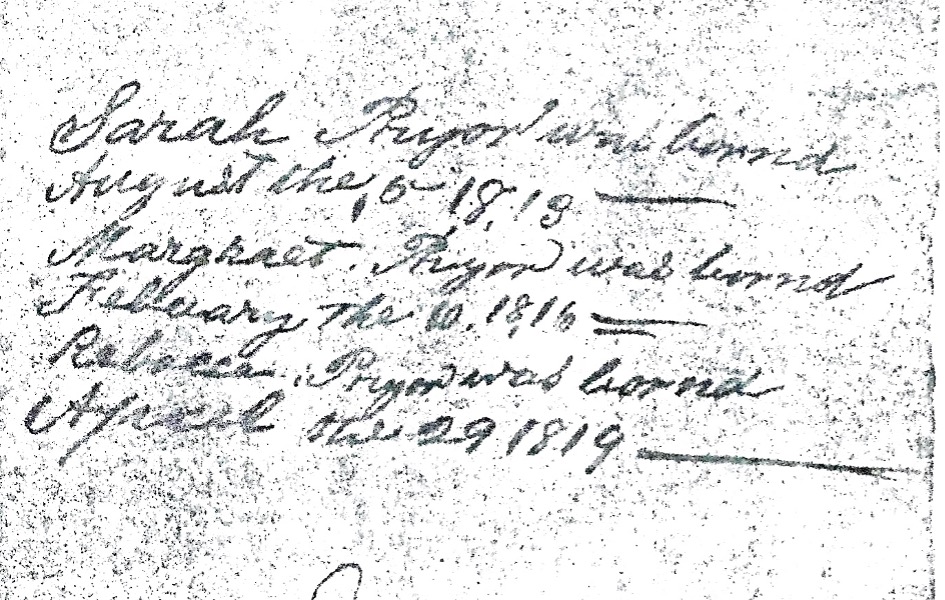
Joseph and Sarah Pryor settled with their family in Tuscaloosa County prior to Alabama statehood: the Pryor family bible shows their last two children, daughters Margaret and Rebecca, born 10 February 1816 and 29 April 1817.[2] All federal censuses from 1850 to 1900 consistently state that Margaret was born in Tennessee, as were the nine siblings born before her.[3] The two federal censuses on which Rebecca appears, in 1850 and 1860, both give her birthplace as Alabama.[4] Census data combined with the family bible record suggest, then, that this Pryor family moved to Alabama from Tennessee between February 1816 and April 1817.
There’s much that I might tell you about Joseph Pryor, including information about where he was born (almost certainly in Louisa or Amherst County, Virginia), and about his family’s life in Virginia and Tennessee before he moved to Alabama, but in this brief essay, I want to focus primarily on confusion that has long been propagated about his whereabouts before he and his wife Sarah begin appearing in Tuscaloosa County records prior to 1820. This Pryor family was definitely living in Tuscaloosa County by November 1819, when minutes of Bethel Baptist church at the Falls of the Black Warrior River in Tuscaloosa County state that on the Saturday before the first Lord’s Day (i.e., Sunday) in November, Si∫ter Sarah Prior was received as a church member by letter.
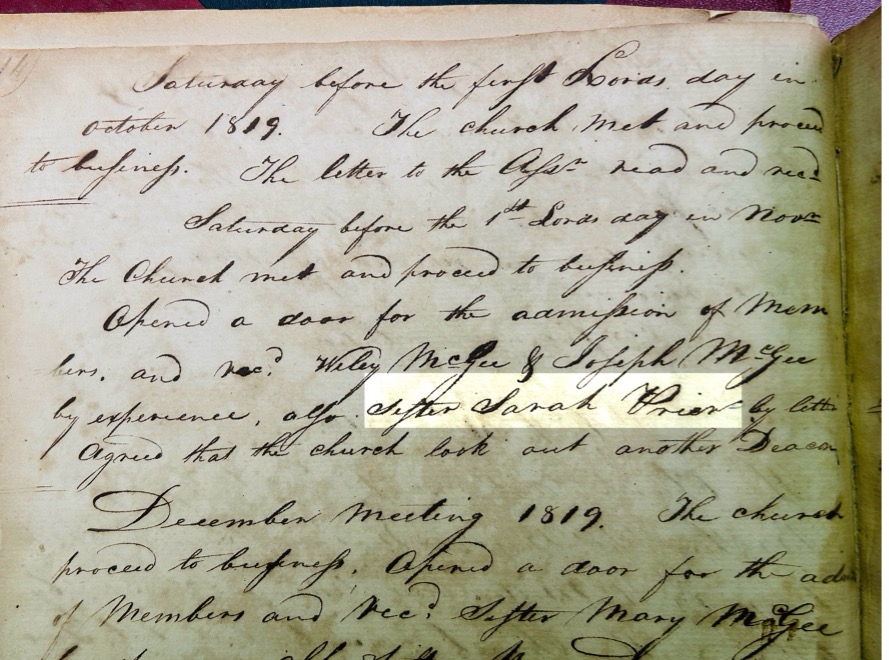
Sister Sarah Prior was Joseph Pryor’s wife Sarah Odle Pryor, daughter of Samuel Odle and Elizabeth Job of Greene County, Tennessee, whom Joseph married about 1790.[5] The notation that she joined Bethel Baptist church by letter means that she had previously belonged to another Baptist church, which gave her a letter of dismission when she moved from that church to a new location, so that she could present this letter to the next Baptist church she joined as she became a member of that church.[6]
Bethel Baptist church was constituted 31 January 1818 and was originally located at the Falls of the Black Warrior River several miles upstream from Tuscaloosa.[7] The original minutes are now held by the West Alabama Heritage Center in Northport, whose staff have kindly allowed me to see these minutes and make copies from them. The church’s constituting document, recorded in its minutes, was signed by ministers of the gospel Nathan Roberts and James and Thomas Baines. Thomas Baines (1787-1836) was the great-grandfather of Lyndon Baines Johnson’s mother Rebecca Baines Johnson.
Plat maps of early tracts in Tuscaloosa County show Joseph Pryor settling by the first part of the 1820s in township 18 south, range 11 west, with land in several sections, but concentrated in sections 27 and 28. These coordinates place Joseph’s residence between the communities of Samantha and New Lexington, to the west of highway 43. Others holding land in this vicinity included William and John Wilson, Samuel Winter, David S. Winter, and members of the Clements family.
Noting that her ancestor Thomas Keesee moved from Tennessee to Tuscaloosa County in 1821 after having become acquainted with Alabama in the Creek campaigns of the War of 1812, historian Carolyn Earle Billingsley discusses what attracted early settlers to Tuscaloosa County:[8]
The Creeks and the Choctaws were forced to cede their lands between 1814 and 1816, the Territory of Alabama had been created in 1817, both Tuscaloosa and Bibb counties were formed in 1818, and Alabama became a state in 1819. Tuscaloosa sat at the head of the Black Warrior River, a major transportation route from upper Alabama to the Alabama-Tombigbee Rivers, which drain into Mobile Bay on the Gulf of Mexico. Tuscaloosa became a principal market for cotton because of the convenient steamboat transportation via the rivers. Cotton prices were extremely high after the War of 1812, reaching their peak about 1819.
Northern Alabama, Historical and Biographical states that the early inhabitants of the area around Tuscaloosa came primarily from Tennessee, with roots before that in the “upper districts of the Carolinas and Georgia.”[9] According to this source, many of these settlers had heard glowing accounts of fertile land around Tuscaloosa by Tennessee soldiers serving under John Coffee during the Creek War of 1813-4, and settlers from Tennessee then began making their way into what would soon be Tuscaloosa County, taking trails and military roads opened by Generals Jackson and Coffee during their campaigns against the native inhabitants of the area. Joseph Pryor’s son-in-law Zachariah Sims Simpson (1793-1869), who married Joseph’s daughter Elizabeth, was among early settlers of Tuscaloosa County who served in the War of 1812 under Jackson and Coffee: in 1813, Zachariah Simpson was a private in Captain William Locke’s company of John Coffee and John Alcorn’s regiment of cavalry and mounted gunmen, Tennessee Volunteers.[10]
Serving in the same company was a John Bryant who is, I think, likely the man of this name who married Joseph Pryor’s oldest daughter Mary. A biography of Newton Bolivar Haney (1854-1930), whose father William Bradford Haney (1832-1903) married Zachariah S. Simpson’s daughter Martha Jane, states that Zachariah S. Simpson was in the War of 1812 under General Jackson, as well as in the Seminole War with Robert T. Haney (1792-1840/1850), father of William Bradford Haney.[11] I have not found Seminole War service records for either Zachariah Simpson or Robert Haney.
I’m focusing on the Tennessee background of many early Tuscaloosa County settlers because, as I’ve noted, there’s considerable confusion among some researchers and descendants of Joseph Pryor about his background before he arrived in Alabama before April 1817. To see the extent of this confusion, one has only to visit the DAR Library’s online ancestor page for a Joseph Prior who gave Revolutionary service from Botetourt County, Virginia, and died in Bourbon County, Kentucky, between 13 December 1812, when he made his will, and February 1813, when the will was probated in Bourbon County court.[12] When you visit this DAR ancestor page and scan the page for a list of the children of Joseph Pryor of Botetourt County, Virginia, and Bourbon County, Kentucky, you’ll find thirteen links to DAR materials for descendants of Joseph and Sarah Pryor of Tuscaloosa County, who have been accepted for DAR membership claiming that Joseph Pryor of Tuscaloosa County was a son of the Joseph Pryor who died in Bourbon County, Kentucky, by February 1813.
The Joseph Pryor with wife Sarah who came from Tennessee to Tuscaloosa County, Alabama, in 1816 or 1817 and who died there before 15 December 1851[13] has been listed by multiple descendants who have entered DAR (and SAR) as a son of an older Joseph who died in Kentucky in 1813. When you click on the link I provided above for the DAR ancestor page of the older Joseph Pryor, you’ll also see an announcement in red all-capital letters stating,
PROBLEMS HAVE BEEN DISCOVERED WITH AT LEAST ONE PREVIOUSLY VERIFIED PAPER.
My understanding is that DAR (and SAR) no longer accept applications of descendants of Joseph Pryor of Tuscaloosa County claiming that this Joseph was a son of Joseph Pryor of Bourbon County, Kentucky. Joseph Pryor of Bourbon County did have a son Joseph, who was named in the 13 December 1812 will made by Joseph Sr. in Bourbon County. It’s not hard to show, however, that this younger Joseph, son of Joseph Sr., died intestate and unmarried in Bourbon County before 2 December 1833, when the county court granted administration of his estate to Asa B. Eades.[14] The 1810 federal census shows Joseph Sr. and Jr. living side by side in Bourbon County, with the latter having a household consisting only of himself: he was unmarried and had no children. By 1810, the Joseph Pryor with wife Sarah who settled in Tuscaloosa County by April 1817 had seven children, according to the entries in his bible register; federal census data and other documents show all of these children born in Tennessee and not Kentucky, between 25 May 1793 and 25 September 1808.
It’s clear that the Joseph Pryor who came from Tennessee to Tuscaloosa County, Alabama, by 27 April 1817 was not the son of Joseph Pryor Sr. of Bourbon County, Kentucky. Joseph of Tuscaloosa County belongs to a different father than Joseph of Bourbon County. To find Joseph’s parents, we have to look elsewhere than the records of Bourbon County, Kentucky. To wit: on 8 August 1797, the court of Logan County, Kentucky, appointed Mourning Pryor, widow of Richard Pryor, administratrix of the estate of Richard Pryor, deceased. There’s abundant documentation pointing to Mourning’s roots and to where she met and married Richard Pryor: Mourning was the daughter of Thomas Thomson (abt. 1718 – bef. 10 October 1774) of Louisa County, Virginia, whose 22 April 1774 will in Louisa County names his daughter Mourning Pryor.[15]
After the Revolution, Richard and Mourning Thomson Pryor moved from Virginia to east Tennessee, settling in Greene County, Tennessee, in whose records they are found from 1783 through 1795, and where Mourning Pryor appears as a constituting member of Big Pigeon Baptist church on 6 December 1787.[16] In 1795, Richard and Mourning left Greene County and moved to Sumner County, Tennessee, on the Kentucky border, and then to Logan County, Kentucky, where Richard died by 8 August 1797. Logan is in southwest Kentucky on the Tennessee border.
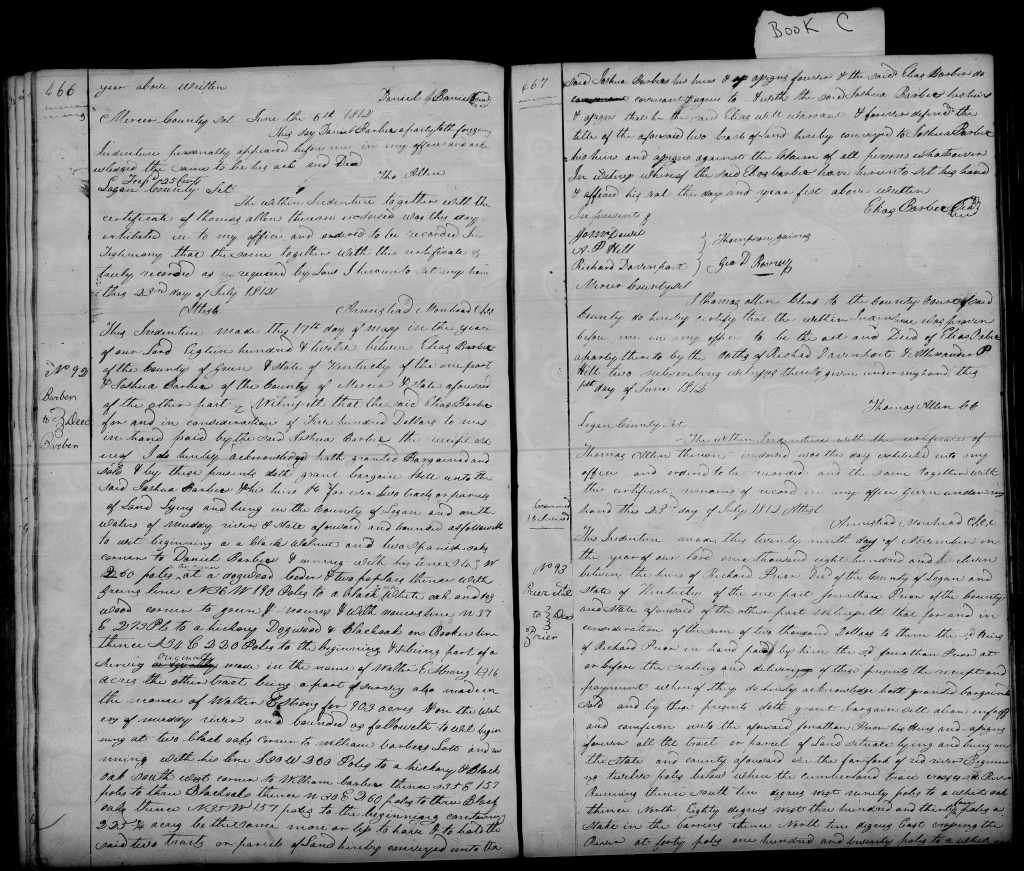


Richard Pryor died intestate, so there’s not a will naming his children. However, a deed made by his heirs following his death captures valuable information about these heirs. On 29 November 1811, the heirs of Richard Pryor deeded to Jonathan Pryor of Logan County for $2,000 a tract of land, 250 acres, on the far fork of Red River in Logan County. This deed was signed by William Pryor, Thomson Pryor, Jeremiah Pryor, Joseph Pryor, James Pryor, Caleb Jobe, Elizabeth Ray, Daniel Jobe, Henry Newby, and William Newby, with James and Jeremiah Pryor witnessing the deed and then proving it on 29 July 1812.[17] The deed explicitly states that those signing it were the heirs of Richard Pryor and were selling land that had come to them as Richard’s heirs. Jonathan Pryor was a son of Richard and Mourning Thomson Pryor; his siblings were selling their brother Johnathan their right to land they had inherited from their Richard Pryor.
This 1811 deed in which Richard Pryor’s heirs sold their share of his Logan County land to Jonathan Pryor does not state where these heirs were living in 1811. But there’s important evidence of their whereabouts in county records in Kentucky and Tennessee. From June 1811 through December 1817, a Joseph Pryor appears in the records of Warren County in Middle Tennessee. This Joseph Pryor drops from Warren County records after December 1817. Joseph may have been in Jackson County, Tennessee, prior to settling in Warren County.[18]
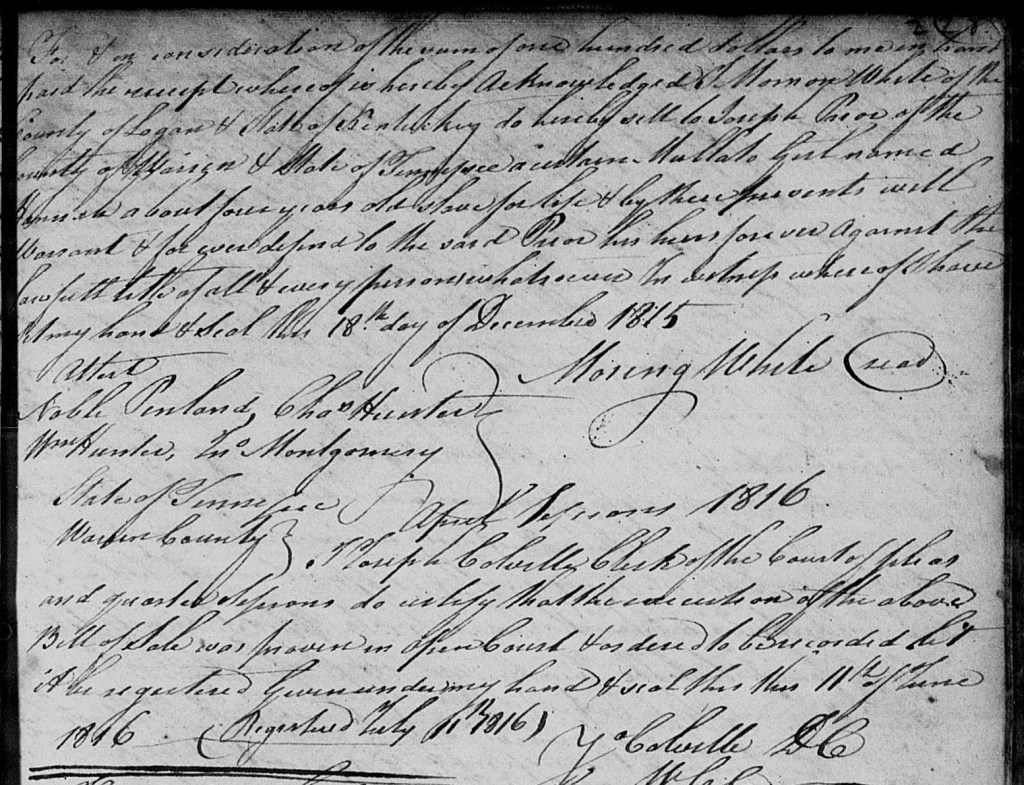
One Warren County deed from this period, 1811-1817, is especially significant. On 18 December 1815, Joseph Pryor of Warren County, Tennessee, bought from Mourning White (the name is spelled Moring in this record) of Logan County, Kentucky, an enslaved mulatto girl named Hannah, aged about four years.[19] The bill of sale was entered in court 11 June 1816 and recorded 11 July 1816.
Mourning White is Mourning Thomson, the widow of Richard Pryor. Following Richard’s death in Logan County before 8 August 1797, his widow Mourning remarried to Thomas White. A series of consecutive deeds in Smith County, Tennessee, on 10 May 1802 show Mourning as Thomas White’s wife acting as administratrix of Richard Pryor’s estate to sell tracts of land Richard had owned in that county.[20] According to Pryor researcher Katherine Reynolds, Thomas and Mourning married on 10 June 1800 in Logan County, Kentucky.[21] Reynolds does not cite a source for this marriage information, and I have not found a source, though the information may well be correct.
So to recap:
• On 18 December 1815, Joseph Pryor of Warren County, Tennessee, bought an enslaved girl from Mourning White of Logan County, Kentucky, with the bill of sale being made 11 June 1816 and recorded 11 July 1816.
• This Joseph Pryor then drops from Warren County records after December 1817.
• The Joseph Pryor who settled in Tuscaloosa County came there from Tennessee, and appears to have moved to Tuscaloosa County between February 1816 and April 1817.
Before Joseph Pryor dropped from Warren County, Tennessee, records, he made two land sales, evidently final ones, in Warren County. On 27 November 1816, he sold Edmund Pace 120 acres on Charles Creek, with Isham Perkins and Clement Sullivan witnessing the deed.[22] The land Joseph Pryor was selling had been granted to Charles Sullivan and Joseph acquired it from Peter Sullivan. When Sardis Baptist church was constituted in Tuscaloosa County on 11 December 1819, two elders were among its constituting members: Nathan Roberts, one of the constituting ministers when Bethel Baptist church was constituted on 31 January 1818, and Edmund Pace.[23] Edmund Pace was born 24 February 1764 (he was, that is, a contemporary of Joseph Pryor) and married Sarah Elizabeth Walker in Surry County, North Carolina, on 25 December 1782.[24]
On 11 December 1817, Joseph Pryor made a second (and, it appears, final) land sale in Warren County, Tennessee. He sold John C. Wilson 100 acres of land in Warren County’s 3rd district, section 34, with Isham Perkins again witnessing the deed along with William Johnson.[25] The two witnesses proved the deed at county court on 24 January 1818 and it was recorded on 30 October 1820.
This deed states that Joseph Pryor was residing in Warren County in December 1817. If this Joseph Pryor is the man of that name who had settled in Tuscaloosa County between February 1816 and April 1817 — and I am confident that he is — then Joseph either moved his family to Alabama prior to April 1817 and returned to Warren County to sell land in December 1817, or the deed represents Joseph as a resident of Warren County when he had already moved to Alabama.
The three Warren County, Tennessee, documents I’ve cited — Mourning White’s 18 December 1815 sale of an enslaved girl to Joseph Pryor of Warren County; Joseph’s 27 November 1816 sale of land to Edmund Pace; and his 11 December 1817 sale of land to John C. Wilson — suggest to me that, from December 1815 into 1817, Joseph Pryor was making plans to leave Warren County, Tennessee, and move away. The December 1815 sale of an enslaved girl by Mourning White to Joseph Pryor also links the man in Warren County, Tennessee, to Richard and Mourning Pryor of Logan County, Kentucky. This document strongly suggests that the Joseph Pryor living in Warren County, Tennessee, up to 1817 was Joseph, son of Richard Pryor and Mourning Thomson. I suspect that the enslaved girl Hannah in Joseph’s possession in 1815, who belonged to his mother Mourning, had been given to him by his mother, and the deed made in December 1815 was effected to assure Joseph’s legal ownership of the little girl Hannah before he moved out of Tennessee to Alabama.
Joseph Pryor is not the only heir of Richard Pryor and Mourning Thomson found in Warren County records in the period in which Joseph resided in that county, by the way. On 8 January 1816, William Newby of Smith County, Tennessee, deeded to James Newby of Warren County 200 acres in Warren County with Thomson Newby and Joseph M. Reynolds witnessing.[26] And on 8 January 1817, Henry Robinson deeded to William Newby, both of Smith County, land in Warren County with Thomson Newby and Joseph M. Reynolds witnessing.[27]
As we’ve seen, the heirs of Richard Pryor who deeded land in Logan County, Kentucky, on 29 November 1811 to Jonathan Pryor included William Newby, who married Richard and Mourning Thomson Pryor’s daughter Nancy. Thomson Newby was, I think, William’s brother; he died in Warren County leaving an undated will that appears to have been made in the 1830s.[28]
I haven’t found a smoking-gun document which definitively proves that the Joseph Pryor who sold his landholdings in Warren County, Tennessee, in 1816-7 and then dropped from records of that county after these land sales — having previously been deeded an enslaved girl in Warren County by Mourning Thomson White of Logan County, Kentucky — is the man of the same name who moved to Tuscaloosa County, Alabama, prior to April 1817. But I think the preponderance of evidence for this conclusion is very strong, indeed, and the evidence strongly points to Joseph of Tuscaloosa County as the son of Richard and Mourning Thomson Pryor. Not the son of Joseph Pryor of Bourbon County, Kentucky….
It’s worth noting that Joseph Pryor and wife Sarah Odle named a daughter Mourning. Though this given name was not unheard of when this daughter was born 14 September 1800, it’s also not an extremely common name — but it is definitely a name replicated frequently among descendants of Richard and Mourning Thomson Pryor. Richard and Mourning named a daughter Mourning. That Mourning married Daniel Job, a cousin of Sarah Odle, who married Mourning’s brother Joseph Pryor.
There’s also the interesting recurrence of the Wilson name in records having to do with Joseph Pryor of Tuscaloosa County, Alabama, and with the Joseph Pryor found in Warren County, Tennessee, records. I’ve noted that Joseph of Warren County sold land to John C. Wilson in December 1817. I’ve also noted that early landholders in Tuscaloosa County included William and John Wilson and members of a Winter family. The Wilsons and Winters were intermarried, and there are some indicators that their kinship network also included the Clements family. As I’ve noted, two of the daughters of Joseph Pryor of Tuscaloosa County married Clements brothers, sons of Jacob Clements and Frances Sims. Zachariah Sims Simpson, who married Joseph Pryor’s daughter Elizabeth, was a half-brother of James Lewis and Mannen Clements, who married Elizabeth’s sisters Nancy and Sarah. Zachariah was a son of Frances Sims by a Simpson husband prior to Jacob Clements whose given name hasn’t been found.
There’s this additional piece of information: when Joseph Pryor made his will in Tuscaloosa County on 22 September 1851 (see n. 13, infra), the will was witnessed by William and John Wilson and Job Hiram Binion. The John Wilson witnessing this will was, I think, William Wilson’s son and was born in 1826, so he cannot have been the John Wilson to whom Joseph Pryor of Warren County, Tennessee, sold land in that county in December 1817. I do find it interesting, however, that the name John Wilson occurs in records of both Joseph of Warren County and Joseph of Tuscaloosa County, and I wonder if the Wilsons who settled early on near Joseph Pryor in Tuscaloosa County may have had connections to the John Wilson of Warren County, Tennessee, to whom Joseph Pryor sold land.
Research that Ginger Winters Stallings of Dallas, Texas, shared with me in 1995 indicates that the William Wilson who witnessed Joseph Pryor’s will was born in Tennessee on 17 October 1802 and died on 4 September 1865. Stallings’ research notes say that William Wilson came to Tuscaloosa County with his father in 1816 and then returned to Tennessee for his family. The Wilson family is said to have cleared part of the land where the state capitol was built. William Wilson was murdered on 4 September 1865 and was apparently a large landholder at the time of his death.
According to Stallings, William Wilson married Sarah Winter, whose family lived in Cocke County, Tennessee, before moving to White County and then to Alabama. Cocke County is contiguous to Greene County where the family of Richard Pryor and Mourning Thomson lived and where their son Joseph married Sarah Odle; Cocke was formed from Greene in 1797. White County is contiguous to Warren County, Tennessee.
An article entitled “The Robber Baron of Newtonville” archived at the website of the city of Fayette, Alabama (no author is indicated) suggests that, like his father William, John Wilson appears to have been murdered.[29] The article cites as sources Buren Sullivan’s History of Newtonville, letters of Judge David Enslen, and Fayette County Historical Society’s publication Sesquicentennial. I note varying information online about the father of William Wilson (1802-1865), with some sources stating that William’s parents were John Wilson and Rachel, the widow of Reuben Windham, who married in Grainger County, Tennessee, on 17 November 1799, and other sources giving Reuben Windham’s wife’s name as Jane Clements and stating that Reuben Windham married Jane Clements on 3 December 1785 in Surry County, Virginia.
I haven’t done sufficient research on the Wilson and Winters families to sort these details out. Wilson is a common surname and John and William are common given names, and I may be on entirely the wrong track in wondering whether the Wilson men who lived near Joseph Pryor in Tuscaloosa County and witnessed his will are connected to the John Wilson to whom he sold land in Warren County, Tennessee. Even so, I think it’s worth pursuing this question, and if the Wilson kinship network included a Clements family, as Joseph Pryor’s kinship network did, then all the more so. And the possibility that the Winters may have pre-Alabama roots in Cocke and White Counties, Tennessee, also attracts my attention.
There’s more to learn, I suspect, about the pre-Alabama roots in Tennessee of these families who settled around each other early on in northern Tuscaloosa County. It’s clear to me that the Joseph Pryor who came to that area by April 1817 had prior roots in Warren County, Tennessee, and was the son of Richard Pryor and Mourning Thomson, Virginians who settled in Greene County, Tennessee, following the Revolution — where Joseph Pryor met and married his wife Sarah, daughter of Samuel Odle and Elizabeth Jobe.
[1] I have not seen the original bible and have been unable to discover who may have it today or if it survives. I have photocopies of the bible register that have circulated among Joseph’s descendants. These show that the bible was published by J. Emory and B. Waugh of the Methodist Episcopal Church, New York, in 1829. In a 4 August 1980 letter to me, Michael J. Hogan of Los Angeles, a descendant of Joseph Pryor, told me that he thinks the bible passed down in either the family of Joseph’s daughter Margaret, who married Joseph Franklin Doughty, or of her sister Rebecca, who married Mordecai Fulton Doughty. Joseph and Mordecai were sons of Jeremiah and Elizabeth Doughty.
[2] Rebecca’s tombstone in Concord Baptist cemetery at Salem in Fayette County gives her birthdate as 27 February 1819: see Find a Grave memorial page of Rebecca Pryor Doughty, created by Frances Bowen Frost, maintained by Phil, with a tombstone photo by Phil.
[3] See 1850 census, Tuscaloosa County, dist. 2, p. 226 (dwelling/family 478; 3 December); 1860 census, Tuscaloosa County, western division, New Lexington post office, p. 667 (dwelling 620/family 588; 13 August); 1870 census, Pickens County, Reform precinct, p. 46 (dwelling/family 83, 23 August); 1880 census, Pickens County, Reform, p. 549B (ED 96; dwelling 108/family 109; 20 June); and 1900 census, Pickens County, Reform twp., p. 73 (ED 73; dwelling 239/family 250; 15 June). In 1900, Margaret was living with the family of her son Jasper.
[4] 1850 census, Tuscaloosa County, dist. 2, p. 258 (dwelling/family 948; 17 January); and 1860 census, Tuscaloosa County, western division, New Lexington post office, p. 669 (dwelling 624/family 529; 14 August).
[5] Sarah has been misidentified in some histories of this family as a Patton or Paxton. Records of the estate of William Paxton, who died in 1806 in Augusta County, Virginia, show him with a daughter Sarah who married James Pryor and had a son Joseph, but these are not records of the family of Joseph Pryor with wife Sarah of Tuscaloosa County, Alabama. Joseph and Sarah Pryor named a son Samuel Odle Pryor and their daughter Elizabeth, who married Zachariah Sims Simpson, named her first daughter Sarah Odle Pryor. The 5 July 1788 will of Samuel Odle of Greene County, Tennessee, names among his children his daughter Sarah, who was not married at the time the will was made and is given her maiden surname; the will is recorded in Jefferson County, Tennessee, Will Bk. 1, p. 45.
[6] If Joseph Pryor with wife Sarah is a man of this name found in records of Jackson County, Tennessee, records from 1802-1810, then the Sarah Prier (as the surname is spelled here) who was a constituting member of Spring Creek Baptist church in that county on 7 July 1802 may be this Sarah: see C.P. Cawthorn and N.L. Warnell, Pioneer Baptist Church Records of South-Central Kentucky and the Upper Cumberland of Tennessee, 1799-1899 (Cawthorn and Warner, 1985), pp. 514-5. The original name of this church was Blackburns Fork Baptist church. Church minutes show “Sister Pryer” being paid 12 cents on the first Saturday in December 1807 for supplying wine for the Lord’s Supper. On the third Saturday in Oct. 1810, Sarah Pryor received a letter of dismission from the church.
[7] See Pioneers of Tuscaloosa County, Alabama, Prior to 1830, ed. Tuscaloosa Genealogical Society (Montgomery: Herff Jones, 1981), p. 10; and Billie Thomson Lockard and Mary Underwood Sinclair, Bridging the Past of Tuscaloosa County, Alabama, vol. 2 (Tuscaloosa, 1987), pp. 10-1.
[8] Carolyn Earle Billingsley, Communities of Kinship: Antebellum Families and the Settlement of the Cotton Frontier (Athens: University of Georgia Press, 2004), p. 40; and see also “Antebellum Planters: Communities of Kinship on the Cotton Frontier,” East Texas Historical Journal 39,2 (fall 1997), pp. 58-74.
[9] Northern Alabama, Historical and Biographical (Birmingham: Smith and Deland, 1888), p. 507.
[10] NARA, Indexes to the Carded Records of Soldiers Who Served in Volunteer Organizations During the War of 1812, compiled 1899 – 1927, documenting the period 1812 – 1815, RG 94, available digitally at Fold3. The service papers, of which I have a copy, state that Zachariah Simpson was on the payroll of the company from 24 September to 10 December 1813, having enlisted on 24 September. A transcription is in Penelope Johnson Allen, Tennessee Solders in the War of 1812, Regiments of Col. Allcorn and Col. Allison (Chattanooga: Tennessee Society of US Daughters of 1812, 1947), pp. 18-19.
[11] See History of Texas, Together with a Biographical History of Tarrant and Parker Counties (Chicago: Lewis, 1895), pp. 454-5.
[12] See DAR Library’s online ancestor page, “Prior, Joseph,” ancestor no. A093343; and Bourbon County, Kentucky, Will Bk. B, p. 330.
[13] Joseph Pryor made his will in Tuscaloosa County on 22 September 1851 (Tuscaloosa County, Alabama, Will Bk. 1, p. 286). Joseph’s loose-papers probate file has a document showing the two executors appointed by Joseph’s will, his son John Pryor and son-in-law Zachariah S. Simpson, presenting the will to court on 15 December 1851, when it was recorded. On 2 January 1852, John Pryor and Zachariah S. Simpson gave bond for $32,000 with J.L. Clements, Mannen Clements, Tobias Watson, Thomas Alexander, J.F. Doughty, M.F. Doughty, and John Bryant: see Tuscaloosa County Orphans Court Minutes, 1850-4, p. 380; and Tuscaloosa County Probate Court Bond Book 1850-1853, p. 75. James Lewis Clements (m. Sarah Pryor), Mannen Clements (m. Nancy Pryor), Tobias Watson (m. Hannah Rose Pryor), Thomas Alexander (m. Rachel Pryor), J.F. and M.F. Doughty (m. Margaret and Rebecca Pryor), and John Bryant (m. Mary Pryor) were sons-in-law of Joseph Pryor.
[14] Bourbon County, Kentucky, Court Order Bk. K, p. 292.
[15] Louisa County, Virginia, Will Bk. 2, p. 202.
[16] Big Pigeon was in Greene County when it was constituted in 1787. Today, it’s in Cocke County. See Cawthorn and Warnell, Pioneer Baptist Church Records of South-Central Kentucky and the Upper Cumberland of Tennessee, p. 421; Ruth Webb O’Dell, Over the Misty Blue Hills: The Story of Cocke County, Tennessee (Newport, Tennessee, 1951), p. 150; and Elizabeth Pryor Harper, Twenty One Southern Families Notes And Genealogies (Albuquerque, 1985), p. 149. O’Dell transcribes the original church minutes showing when the church was constituted and by whom. Other charter members of the Big Pigeon church included Dorcas and Lezaana Jobe, David Jobe, Mary White, Abraham McKay, Rachel McKay, Nicholas Woodfin, Wm. and Elizabeth Whitson. The Jobs, McKays, and Whitsons are all part of the kinship network of Sarah Odle, wife of Sarah Pryor. Dorcas Job was Dorcas McKay Jobe, wife of Samuel Jobe, two of whose sons married daughters of Richard and Mourning Thomson Pryor. Their son Joseph married Sarah Odle, daughter of Elizabeth Jobe Odle, whose father Enoch was first cousin to Samuel Job, husband of Dorcas.
[17] Logan County, Kentucky, Deed Bk. C, pp. 467-470.
[18] See supra, n. 6.
[19] Warren County, Tennessee, Deed Bk. B, p. 228.
[20] Smith County, Tennessee, Deed Bk. B, pp. 94-7.
[21] An unpublished manuscript of Katherine Reynolds entitled The Pryor Family (Houston, 1971)is in the holdings of Clayton Memorial Library in Houston. I have a copy of this manuscript. The marriage information for Thomas White and Mourning Thomson Pryor is on the first page of this manuscript.
[22] Warren County, Tennessee, Deed Bk. C, p. 8.
[23] Pioneers of Tuscaloosa County, Alabama, Prior to 1830, p. 10.
[24] See Mary Ellen White, “The Pace Family,” unpublished typescript in the Lauderdale County, Mississippi, Department of Archives and History, online at the website of this group, noting that Edmund Pace’s family was in Warren County, Tennessee, prior to moving to Greene County, Alabama (contiguous to Tuscaloosa County) by the 1820s. See also Noble Hamilton Pace, The Pace Family History (Columbus, Mississippi, 1959), p. 43.
[25] Warren County, Tennessee, Deed Bk. D, pp. 28-9.
[26] Ibid., Deed Bk. C, pp. 53-4.
[27] Ibid., p. 58.
[28] Warren County, Tennessee, Will Bk. 1, pp. 169-170.
[29] “The Robber Baron of Newtonville,” at website of city of Fayette, Alabama,
 BEGATS AND BEQUEATHALS
One thought on “Joseph Pryor of Tuscaloosa County, Alabama (1767-1851): Notes to Clarify His Pre-Alabama Roots”