These notes also pointed out that Haywood County was formed from Buncombe County, North Carolina, in 1808 and that it’s very likely that John Montgomery was in Buncombe County before 1808. I stated,
The John Montgomery who moved to Lawrence County, Tennessee, by 1820 is found in Haywood County, North Carolina, records as soon as they begin after the formation of that county in 1808. This suggests that he was likely in Buncombe County prior to 1808, and that will be the county to which I turn my attention after I survey records for him in Haywood County….
In the following notes, I’ll be reporting on information I find about John Montgomery in Buncombe County records. These records show that, as I predicted in my previous notes, John Montgomery appears in Buncombe County records prior to the formation of Haywood County in 1808. I first find him in Buncombe records in January 1799. I think it’s likely he was in Buncombe even earlier than that date, possibly from Buncombe’s formation in 1791 from Burke and Rutherford Counties.
Buncombe County, North Carolina, Records for John Montgomery
• On the 3rd Monday of January 1799, John Montgomery proved a deed of David Thomas Montgomery to Stephen Hamlin for 200 acres of land.[1] John signed his name, showing he was literate.
As my previous set of notes shows, the John Montgomery who died in Lawrence County, Tennessee, in 1825 also consistently signed his name. Though it’s possible that the John proving a deed of David Thomas Montgomery in Buncombe in January 1799 was a different man than the John who died in 1825, I have found no solid evidence in Buncombe records in the 1790s and early 1800s of any other John Montgomery in Buncombe County at this period.
On 23 August 1798, David Thomas Montgomery of Franklin County, Georgia, sold Stephen Hamlin of Buncombe County 200 acres in the latter county on both sides of Turkey Creek.[2] The deed states that the tract was granted to David Thomas Montgomery by the state of North Carolina on 11 May 1789. David signed the deed (in Franklin County, Georgia) as David Thos. Montgomery with witnesses Robert Montgomery, William Hall, and J. Mt.Gomery. J. Mt.Gomery (that’s how the name seems to be written in the deed) is obviously John Montgomery, since John Montgomery proved the deed in Buncombe court on the 3rd Monday in January, with court minutes clearly giving his name as John Montgomery.
A deed made by Thomas Foster in Buncombe County to James Alexander, also of Buncombe, on 11 February 1823 for land on the south fork of Turkey Creek says that the 200 acres Foster was selling were originally granted to David Thomas Montgomery by the state of North Carolina on 18 May 1789.[3]
The grant of these 200 acres was made to David Thomas Montgomery in Burke County, North Carolina, on 18 May 1789.[4] The North Carolina Land Grants Images and Data website maintained by North Carolina Historical Records Online shows a number of other Montgomerys in addition to David Thomas Montgomery receiving grants in Burke County in the 1780s and 1790s, including a John Montgomery Sr. and Jr.
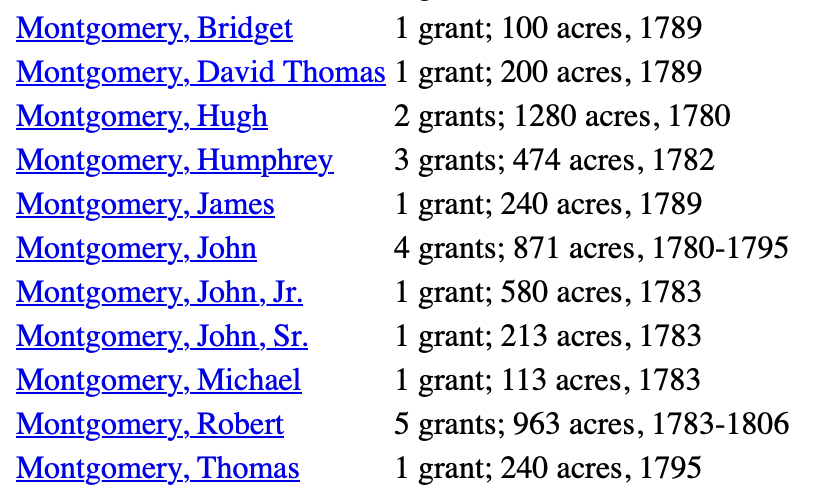
Once again: Burke was one of the parent counties when Buncombe was formed in 1791, and as my previous set of notes indicates, I think it will be important to search for John Montgomery of Buncombe and Haywood Counties in Burke County records prior to 1791. This will be my next research objective.
Given John Montgomery’s January 1799 witness to a deed of David Thomas Montgomery in Buncombe, I think it’s worth asking if John and David Thomas were related. We know from other cases that it’s possible for Montgomerys from different genetic backgrounds to interact in U.S. county records: for example, many of us long thought that James Montgomery (abt. 1690 – bef. November 1756) and his sister Catherine Montgomery Calhoun were related to Hugh Montgomery of Salisbury, North Carolina, but DNA findings disprove that connection. Even so, I think it would be important to try to figure out how or whether John and David Thomas Montgomery are connected to each other.
MontyHistNotes has information about a David Thomas Montgomery found in Burke County, North Carolina, records, who is, I suspect, the same man who had a land grant in Burke in May 1789 and then sold his grant, now in Buncombe, in August 1798.[5] This source has David Thomas Montgomery dying in April 1845 in Burke County. Note that the 1798 deed places him in Franklin County, Georgia, at that time. When I do further research in online sources and family trees, I find a great deal of conflicting information about this David Thomas Montgomery, and confusion about whether he is the same man as a David Montgomery who also appeared in Buncombe records and then moved to Georgia.
• On 15 April 1799, John Montgomery deposed in Buncombe before John Davidson, j.p., in the case of John Tate vs. William Murphy.[6] The case was in Burke County. John Montgomery deposed that four years ago last March, he had gone to Morganton to settle a small debt he owed, which was recorded in Tate’s book account. By way of settling his debt, John offered Tate a note for £8 on Alexander Plumley. Tate refused unless Murphy would take the note in part payment of a debt to Tate. Murphy agreed to this, but John Montgomery did not know if the transaction between Tate and Murphy took place. Note the Plumley surname, which, as we’ll see when I share my Burke County notes, connects to a different Montgomery family in Burke County, one headed by a John Montgomery who came to Burke County from Amherst-Albemarle County, Virginia, and is said to have died in Burke County about 1789, though I suspect this man may be the John Montgomery enumerated on the 1790 federal census in Burke County.
• On 26 February 1800, John Montgomery witnessed a deed of John Nelson of Buncombe County to John Carson of Burke County for 300 acres in Buncombe on both sides of the south fork of Hominy Creek of the French Broad, with Carson paying £130.[7] John Nelson signed the deed by mark. The other witness was Howel Loyd, also signing by mark. John Montgomery proved the deed in Buncombe court in January 1807 and it was recorded 15 April 1807.
This is clearly the John Montgomery later found in Haywood records, who moved to Tennessee from that county with his son-in-law John Nelson, who married John Montgomery’s daughter Talitha Jane. This February 1800 deed definitively proves that these two men were in Buncombe County before Haywood was formed from Buncombe in 1808.
As note 7 (see infra) shows, General Griffith Rutherford and Captain William Moore are said to have pushed the Cherokees out of Hominy Valley during the American Revolution. As records cited below show, John Montgomery appears in Buncombe documents a number of times in connection to a James Rutherford who is possibly the James Rutherford who was a son of General Griffith Rutherford. As Kenneth D. Israel indicates, James Rutherford entered service in June 1795 in Buncombe County to spy on the county’s frontier along with John Nelson, John Davidson, Jonathan McPeeters (whom we’ll meet below), and Nathan Dever, a surname found in connection to John Montgomery in Haywood County in my previous set of notes.[8]
As my previous set of notes indicates, John Montgomery of Haywood County, North Carolina, and Lawrence County, Tennessee, interacted often in Haywood County with members of the Davidson family and a Bryson family closely connected to the Davidsons. As these notes state, prior to appearing in Haywood records from 1808 forward, the Brysons are in Buncombe records. Before this, the Brysons and Davidsons had been in old Rowan and Anson Counties, North Carolina (later Iredell and Mecklenburg Counties), where these families settled when they moved together from Lancaster County, Pennsylvania, to western North Carolina prior to the Revolution.
• On the 3rd Monday in July 1800, John Montgomery was a petit juror in Buncombe.[9]
• On the 3rd Wednesday in July 1800, James Rutherford and John Montgomery gave bail for James Dixon in the case of Isaac Moody vs. James Dixon.[10] At the Same court session, John Montgomery was a juror in the case of State vs. John Fields.[11]
• On 30 December 1800, with George Cathey and Jonathan McPeters, John Montgomery witnessed a deed of Robert Gillaspy to William Gillaspy (i.e., Gillespie), both of Buncombe, for 300 acres on Hommany [sic] Creek entered by Robert Gillaspy on 4 April 1795.[12]
Note the reference again to Hominy Creek, where John Nelson held land that he sold in February 1800 to John Carson of Burke County.
As my previous set of notes shows, in Haywood records, John Montgomery is frequently found in association with George Cathey and other members of the Cathey family. The 3 November 1813 Haywood deed of John Montgomery and John Nelson to Thomas Lenoir cited in the notes I’ve just linked, showing these two men selling 140 acres on the west side of the east fork of Pigeon River in Buncombe, states that the land being sold bordered George and William Cathey.
Betty J. McRee indicates that the Catheys were, like the Montgomerys, an Ulster Scots family who moved from Augusta County, Virginia, to western North Carolina in the 1740s.[13] In 1798, George Cathey (abt. 1756 – 1840), a Revolutionary captain, settled in the Pigeon River Valley of Buncombe (now Haywood) County.[14] Marty Grant notes that George Cathey was living in Burke County in 1776-7 when he enlisted for Revolutionary service.[15] Marty Grant shows that this George or another man of the same name was connected to the John Carson to whom John Nelson sold land in February 1800, as well as to James Rutherford and to the Davidson family. According to Grant, the William Cathey mentioned in Buncombe records along with George was George’s brother.
• On 21 March 1804, John Montgomery witnessed a sale by William Ervin to Robert Gillam, both of Buncombe, for $200 of livestock and household goods. Ervin signed by mark. The other witness was William May, who proved the deed in April 1804. It was recorded 1 May 1805.[16]
• On 25 September 1804, John Montgomery and William Nelson were chain carriers for John Patton’s survey of land in Buncombe for James Miller and Alexander Ervin, in conformity to a survey warrant issued 12 December 1803.[17]
Note the name William Nelson and the recurrence of the Ervin (also Erwin elsewhere) names here. Was William Nelson related to the John Nelson who married John Montgomery’s daughter Talitha Jane? This seems to me worth asking, and it seems worth asking if John Montgomery had some connection to a Nelson family before he began to appear in Buncombe records.
• On 16 April 1805: Henry Webb and Edward Pyburn entered 300 acres in Buncombe on the west side of the east fork of Pigeon River beginning on or near John Montgomery’s line.[18] This entry was caveated by W. Avery 14 June 1805.
This tells us that by April 1805, John Montgomery had land on the west side of the east fork of Pigeon River in Buncombe. Note that the land he and John Nelson sold in Buncombe (both then living in Haywood) on 3 November 1813 (the deed is discussed in my last set of notes) was in this location.
The W. Avery who caveated Webb and Pyburn’s entry was Waightstill Avery, who will be discussed in more detail below.
• On 3 January 1806, John Montgomery had warrants for two tracts in Buncombe, both 100 acres each, one on Stiles’ branch of Hamoney (i.e., Hominy) Creek, the other on James Rutherford’s branch joining John’s 400-acre entry on Hamoney Creek.[19] See the image at the head of this posting for a digital copy of these land entry records.
Again, note the references to Hominy Creek and James Rutherford. I have not been able to locate a record of John Montgomery’s 400-acre entry on Hominy Creek.
Catheys Creek was named for George Cathey (mentioned above), and originates north of Rutherfordton (named for General Griffith Rutherford), running southeast through central Rutherford County to join the Second Broad River.[20]
• On the 3rd Tuesday in July 1806, John Montgomery (with John McFarland, Joseph Sorrels, and Samuel Hughes) was discharged of his bail in the Buncombe County case of John Jarrett (or Janett?) vs. James Reid.[21]
We’ll meet the McFarland surname again in another Buncombe record for John Montgomery cited below.
• On 25 October 1806, John Montgomery was summoned for jury duty in Buncombe’s Superior Court in January 1807.[22]
• On the 3rd Monday in January 1807, John Montgomery was a grand juror in Buncombe (Buncombe County, North Carolina, Court Proceedings, 1798-1812, p. 315).
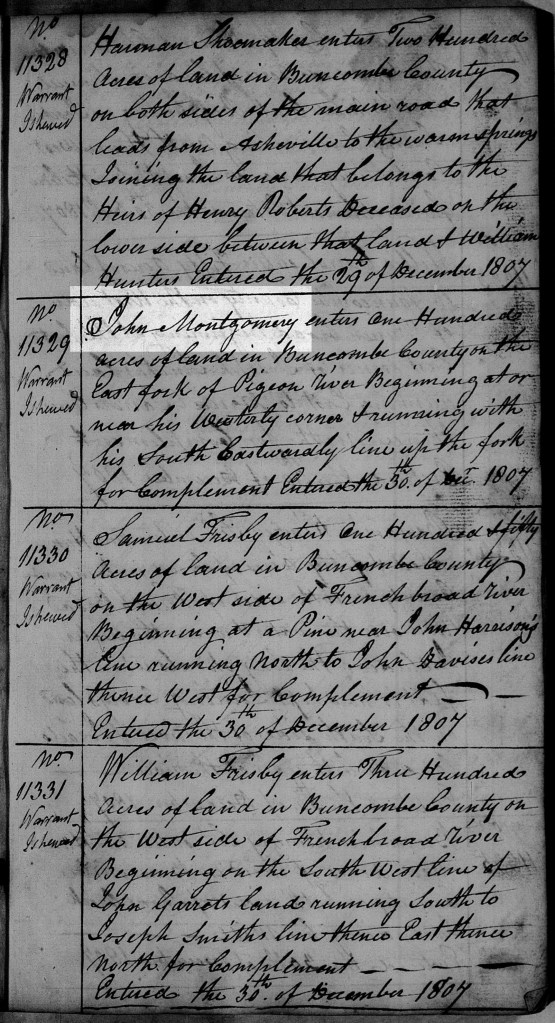
• On 30 December 1807, John Montgomery had a warrant for 100 acres in Buncombe on the east fork of Pigeon River starting at his own line.[23] This is also recorded in Buncombe County Entry Taker’s Return Book for 1807, unpaginated.
Note again the information that John held land on the east fork of Pigeon River.
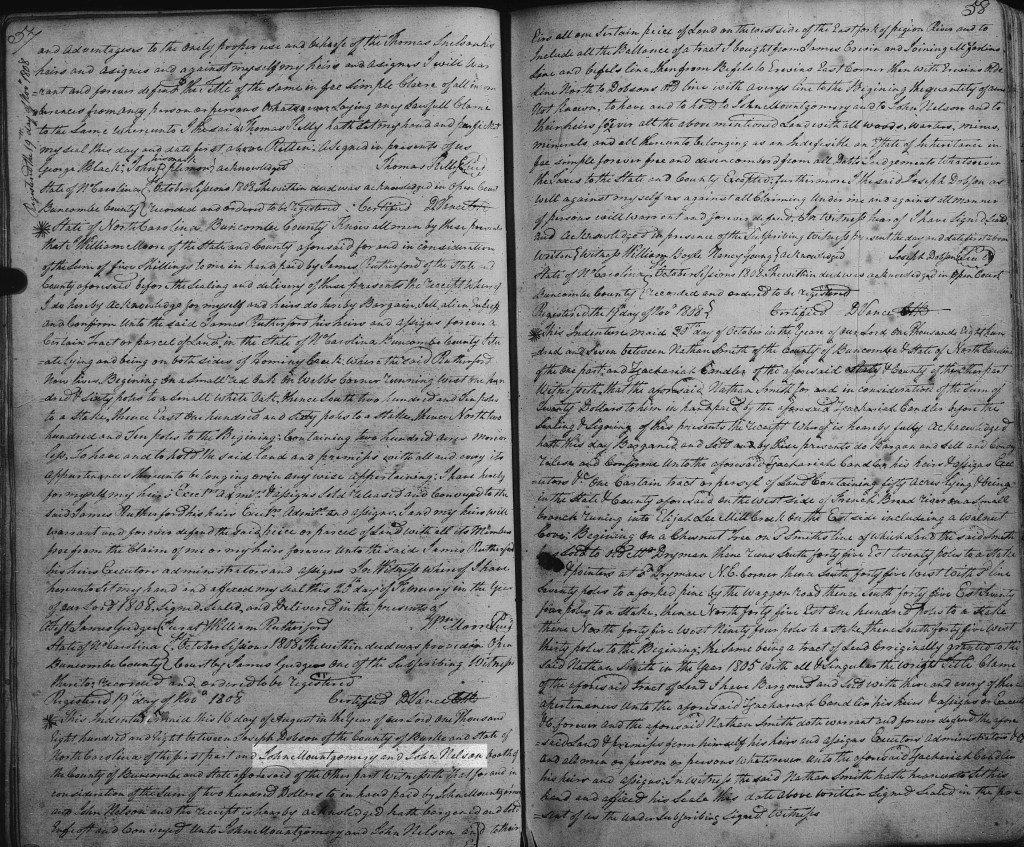
• On 16 August 1808, Joseph Dobson sold John Montgomery and John Nelson, all parties being of Buncombe County, for $200 a tract of land on the west side of east fork of Pigeon River.[24] The acreage is not stated. The land includes a tract Dobson had bought from James Erwin (this is the James Ervin who appears in documents cited above), and borders McFarlin, Bessel, Avery, and Dobson’s old line. Dobson signed with William Boyle witnessing and Nancy Young acknowledging. The deed was proved in October 1808 and recorded 19 November 1808.
The McFarlin mentioned here is John McFarland, whose name was noted above. Bessel is Jacob Bessel, who will be mentioned below. Avery is Waightstill Avery. As my previous set of notes shows, in Haywood County, John Montgomery had connections to a John Dobson who is very likely a relative of Joseph Dobson.
This tract John Montgomery and John Nelson bought from Joseph Dobson in August 1808 is, it’s clear to me, the 140 acres that Montgomery and Nelson sold to Thomas Lenoir on 3 November 1813 while living in Haywood — see my previous set of notes.
• On 26 July 1813, a statement written by Waightstill Avery in the case of Robert Henry (devisee?) vs. John Montgomery and Jonathan McPeters in Wilkes County Superior Court says that Avery was admitted as a defendant in the case (evidently in place of Montgomery and McPeters).[25] The case was to be tried in September 1813 in Superior Court in Wilkes.
As I’ve noted above, Waightstill Avery’s name weaves through Buncombe County records for John Montgomery. Much has been written about Avery (1741-1821), who was North Carolina’s first attorney general, served in the state legislature, was a member of the provincial congress that wrote the state’s constitution, and was a captain in the Burke County regiment of the North Carolina militia during the Revolution.[26]
Jonathan McPeters (1756-1846) is mentioned in several of the Buncombe documents discussed above. Jonathan was in Buncombe’s parent county of Burke before the formation of Buncombe, and gave Revolutionary service in Burke. A deposition he gave for a Revolutionary pension in Buncombe on 18 October 1832 states that he was born in Mecklenburg County, North Carolina on 14 January 1756.[27] Mecklenburg was formed from Anson County in 1762, so it’s likely that McPeters was actually born in Anson County (later Mecklenburg).
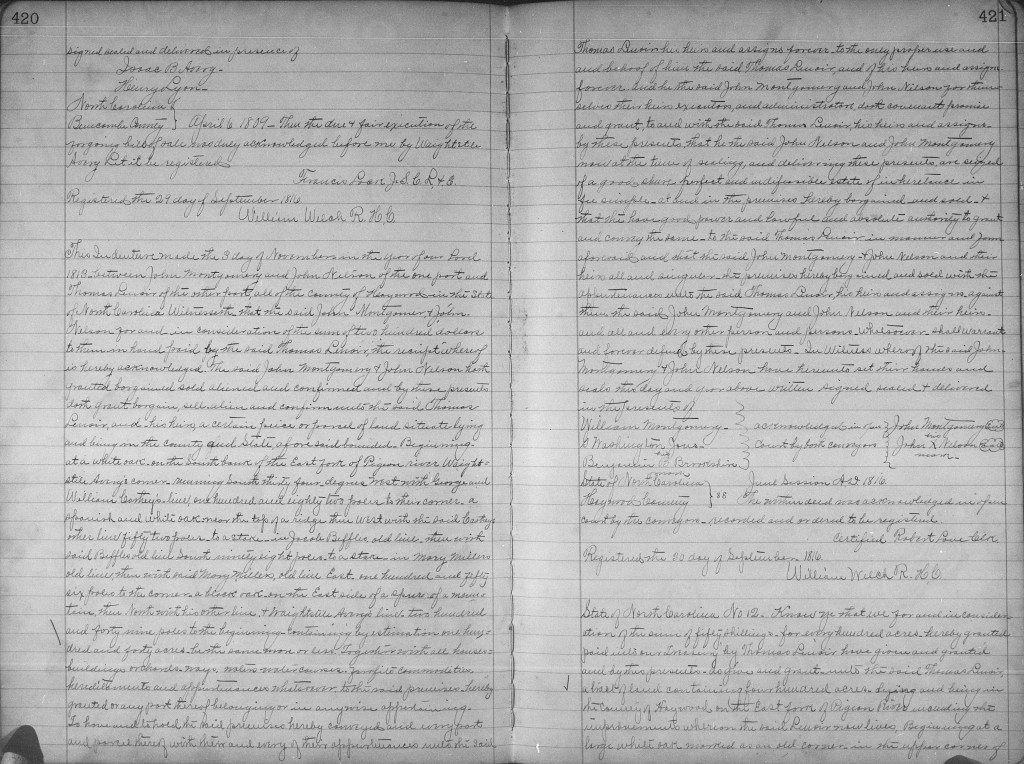
• Once again: as my previous set of notes states, on 3 November 1813 John Montgomery and John Nelson sold John Lenoir, all of Haywood County, for $200 a tract on the west side of the east fork of Pigeon River bordering Waightstill Avery, George and William Cathey, the old lines of Jacob Bessle and Mary Miller, 140 acres.[28] John Montgomery signed with John Nelson making his mark with witnesses William Montgomery, G. Washington (Jones?—mark), and Benjamin B. Brookshire. John Montgomery and John Nelson acknowledged the deed in Haywood County in June 1816 and it was recorded 30 September 1816.
Note that this deed definitively links the John Montgomery with land in Buncombe prior to 1813 with the John Montgomery of Haywood: the land was jointly owned with John Nelson, who married John Montgomery’s daughter Talitha Jane. The witness William Montgomery is likely John’s son William.
In Conclusion
As the documents cited above demonstrate:
• John Montgomery, who died in Lawrence County, Tennessee, and who came there from Haywood County, North Carolina, where he’s found in county records from November 1809 to June 1815 (after the county’s formation from Buncombe in 1808), is in Buncombe County records prior to Haywood’s formation.
• Deeds in Buncombe and Haywood showing John co-owning land in Buncombe with his son-in John Nelson prove this.
• Since I find no strong evidence that a John Montgomery named in Buncombe records from January 1799 forward is anyone other than the John Montgomery owning Buncombe land with his son-in-law John Nelson, it seems John Montgomery was in Buncombe as early as January 1799 and possibly prior to that.
• The first record I find for John in Buncombe in January 1799 connects him to a David Thomas Montgomery who appears in the records of one of Buncombe’s parent counties, Burke, prior to January 1799. I think it’s important to search Burke County records prior to the formation of Buncombe in 1791 for information about John Montgomery, and, as my previous set of notes says, I think it’s very likely that the John Montgomery who died in Tennessee in 1825 and who was in Haywood and Buncombe County, North Carolina, records before he went to Tennessee is a man of that name enumerated on the 1790 federal census in Burke County.
In my next set of notes about the John Montgomery who died in 1825 in Lawrence County, Tennessee, I’ll report on Burke County, North Carolina, records that appear to contain information about this John Montgomery. Many Haywood County residents who appear in Buncombe records before Haywood was formed from Buncombe in 1808 are in Burke County records before Buncombe was formed from Burke and Rutherford in 1791. Unfortunately, many of Burke’s early records burned in 1865, making it a challenge to piece together information about its early residents.
[1] Buncombe County, North Carolina, Court Minutes Bk. 2, p. 70.
[2] Buncombe County, North Carolina, Deed Bk. 4, pp. 267-8.
[3] Ibid., Bk. 16, p. 162.
[4] North Carolina Land Patent Bk. 71, pp. 56-7.
[5] “David Thomas Montgomery, 1754 – 1845,” at MontyHistNotes.
[6] Burke County, North Carolina, Civil Action Papers, 1799, loose papers files.
[7] Buncombe County, North Carolina, Deed Bk. A, pp. 229-231. On Hominy Creek, see “A Brief History of Hominy Creek” at the Friends of Hominy Creek Greenway website, which features a map showing the creek running south and west of Asheville. See also “Hominy Valley” at Wikipedia, which states that General Griffith Rutherford and Captain William Moore pushed the Cherokees out of the valley around 1776 during the American Revolution, and following the war, Moore received the first land grant in the area and became one of the first white settlers in the valley.
[8] Kenneth D. Israel, “Spying on the Buncombe County Frontier in the Summer of 1795” at the Old Buncombe County Genealogical Society website.
[9] Buncombe County, North Carolina, Superior Court Special Proceedings Minutes Bk. A, p. 67.
[10] Ibid., p. 70.
[11] Ibid.
[12] Buncombe County, North Carolina, Deed Bk. 3, pp. 315-6.
[13] See Betty J. McRee, “The Catheys from Scotland to California, 1685-1999,” at the Orange County, California, Genealogical Society website.
[14] See “Family Cathey,” at the Ancestry of Bart Welch website.
[15] See Marty Grant, “Cpt. George Cathey (1755-1840) and Margaret Chambers of North Carolina [Burke, Buncombe, Haywood] and MO [Cooper, Pettis],” at the Marty and Karla Grant website.
[16] Buncombe County, North Carolina, Deed Bk. 8, pp. 236-7.
[17] Warrants, Surveys, and Related Documents, North Carolina Archives, loose-papers files.
[18] Buncombe County, North Carolina, Land Grant Bk. H, warrant 10262, unpaginated, arranged by entry numbers.
[19] Ibid, warrants 10474-5.
[20] See “Catheys Creek [North Carolina],” at Wikipedia.
[21] Buncombe County, North Carolina, Court Proceedings Bk. 1798-1812, p. 295.
[22] Buncombe County, North Carolina, Superior Court Special Proceedings Minute Bk. A, p. 312.
[23] Buncombe County, North Carolina, Grant Bk. I, warrant 11329, unpaginated, arranged by entry number.
[24] Buncombe County, North Carolina, Deed Bk. B, pp. 57-8.
[25] Wilkes County, North Carolina, Land Suits, loose-papers files.
[26] See “Waightstill Avery” at Wikipedia.
[27] See “Pension application of Jonathan McPeters S7195,” transcribed by Will Graves at Will Graves and C. Leon Harris’ site Southern Campaigns Revolutionary War Pension Statements & Rosters
[28] Haywood County, North Carolina, Deed Bk. A, pp. 420-1.
 BEGATS AND BEQUEATHALS